Showing posts with label christine de pizan. Show all posts

Saturday, February 27, 2021

Review: Murder in the Cloister by Tania Bayard

Synopsis: Paris, 1399. Scribe Christine de Pizan is sent to the Priory of Poissy by the palace to copy a manuscript for the prioress. But the prioress already has many copyists at the priory, and Christine senses that something is amiss.Her suspicions are confirmed when the prioress reveals that one of the sisters has been found murdered in the cloister. Fearing for the welfare of the king's young daughter who resides at the abbey, she is eager for Christine to find out who killed the young nun - and why. As Christine investigates, she uncovers dark mischief and closely guarded secrets, but can she unmask a killer?


This is the fourth in the Christine de Pizan mystery series, and as with other review, it is suggested to start this series at the beginning and read in order to ensure continuity. In this outing Christine is travelling to the Prior of Poissy, ostensibly to see her daughter and to copy manuscripts, but also to investigate the murder of one of the nuns.

In the beginning of the 14th century most of the new (12th century) castle was razed to the ground to make way for the Dominican Priory at Poissy, erected in honour of Saint Louis, who had been canonized in 1297. The Priory of Poissy was generously endowed and soon became one of the more wealthy abbeys in France. Here a number of royal descendants of Saint-Louis lived as Dominican sisters involved in the liturgical celebration of this royal cult.

To date, there are some seventy manuscripts which can be identified as belonging to the Dominican monastery of Saint-Louis de Poissy between its foundation in 1304 and its dissolution in 1792. The majority were owned by the nuns and most are illuminated; a small number come from the library of the friars resident at the house. In "Manuscripts from the Dominican monastery of Saint-Louis de Poissy" by JM Naughton, the fate of the volumes is traced form the time of their production through successive alterations and refurbishments (or damage) in order to assess how the nuns acquired their handwritten books, kept them relevant both textually and artistically, or disposed of them when no longer wanted.

One of the convents most notable residents was Marie of Valois, daughter of "mad" king Charles VI and Isabeau of Bavaria. At the time Marie entered the convent the prioress was her great-aunt, Marie of Bourbon. Entering the convent with young Marie as a companion was another Marie, the daughter of Christine de Pizan. Christine described a visit to Poissy in 1400 in her work "Le Livre du Dit de Poissy," where she was greeted "joyously and tenderly" by the seven-year-old Marie of Valois and the Prioress. Christine also described Marie's lodgings as befitting a royal princess. Marie herself would become prioress, ending her days there, dying of plague in 1348.

These mysteries are full of historical detail, including Christine's life as a single mother, raising her family whilst trying to earn a living, which she manages to do thanks to royal patronage.

I really enjoy the series of mysteries as they make a nice change from the usual English-centric historical fiction that has dominated the market for some time. For those who love a bit of French history mixed with a tinge of crime, sorcery, a notable female protagonist.

further reading
> City of Ladies by Christine de Pizan
> Behind the Scenes with Tania Bayard


Tuesday, March 31, 2020

Review: In the Company of Fools by Tania Bayard

52070479. sx318 sy475 Synopsis: Paris 1396: Scribe Christine de Pizan is shocked when the Duke of Orleans' fools find a baby, wrapped in rags and covered in sores, abandoned in the palace gardens. Was there really a wicked plan to substitute the child for the queen's own baby daughter and blame the Duchess of Orleans, Valentina Visconti? Who would commit such an evil act, and why? 

Accused of being a sorceress, Valentina is the victim of much slander and has powerful enemies at the palace, where rumours of witchcraft and superstition run riot. Convinced of the duchess's innocence, Christine is determined to uncover the truth, and soon makes a number of disturbing discoveries. Could the palace fools be the key to unlocking the mystery?


This is the third in the series featuring Christine de Pisan, and I would suggest starting from the beginning with In the Presence of Evil and In the Shadow of the Enemy and many of the characters and themes in this instalment have their origins in the first two books, as does the historical background.

Valentina Visconti (1366 - 1408) - Genealogy
Valentina Visconti
It is three years since the events in the previous books; the French court is still a hot bed of political intrigue, the King is still battling bouts of insanity, and witchcraft and sorcery are being touted as the causes for all that has befallen France. Due to her proximity to the King, someone is out to blacken the name of Valentina Visconti, Duchess of Orleans, and it is the Fools of the Duke, her husband, that provide both the impetus and clues that Christine will need to solve this mystery.


Some Historical Background:
Valentina was born in Milan as the second of the four children of Gian Galeazzo Visconti, first Duke of Milan, and his first wife Isabelle, a daughter of King John II the Good of France. She was therefore she was the cousin of the current King of France, Charles VI and niece of Philip, Duke of Burgundy. Isabeau of Bavaria was the granddaughter of Bernabò Visconti, whom Gian Galeazzo treacherously displaced in Milan, and thus a bitter rival of both Valentina and her father.

Louis I, Duke of Orléans - Wikipedia
Louis I of Orleans
With Charles VI incapable of ruling, Isabeau presided over a regency counsel, on which sat the nobles of the kingdom. Philip the Bold, Duke of Burgundy (the king's uncle), who acted as regent during the king's minority (from 1380 to 1388), was a great influence on the queen (he had organized the royal marriage during his regency). However, influence progressively shifted to Louis I, Duke of Orléans, the king's brother and another contender for power, and it was suspected, the queen's lover. Proximity to the king at crucial moments rather than simple access to him was regarded as vital for advancing oneself and one's interests. There ensued a generation in which court politics was subsumed in wider political factions which sought to control the court from outside.

As a result of the ongoing power struggles for control of the King coupled with the intrigues of the courtiers and nobles - each with their own agendas - and the enmity of the queen, salacious gossip abounded. Pre-eminant among those rumours were that Valentina, who was very close to the King, had bewitched him (causing his madness); and that Isabeau was having an affair with Louis, Valentina's husband and brother of the King. 

From the late 1390s, Orléans - ever in need of greater funds in view of the smallness of his appanage - was exercising much more pressure on the financial officialdom in order to sustain his policies and incurring the unpopularity for which he was to pay dearly. It was here that the clash with Burgundy really became truly venomous. The costs of political stability in the period were enormous. Payments, pensions and one-off presents to courtiers, great officers of the crown and great nobles were a substantial drain on yearly revenues. Hence the competition for control of the revenues.  This rivalry between Louis of Orleans and Philip of Burgundy was such that the end result was outright civil war.

Into this meltingpot of rumour and innuendo, throw in some talk of witchcraft and sorcery. The medieval court was the centre of political life during the Middle Ages, where officials of all ranks attended to governmental affairs. As a place of wealth, influence and power, intrigues were an ordinary suspicion and the court was the ideal environment for popular magical practices to cultivate as the employment of magical practitioners provided great political advantages.

Astrologers delivered a calendar of ideal times for rulers to make political decisions and alchemists, the possibility of riches and prolonged life. A knowledge of chemicals and herbs would have proved useful in intrigues where poisons and love spells were in demand. As fear and usage of magic was ever present, courtiers engaged in the practice of possessing precious stones whose properties protected them from such inflictions. Within the court there were also those who, whilst brandishing significant amounts of influence, held no formal office. As such, those driven by these ambitions employed magic to assist in their plots to beat rivals and gain their desired position. However, in this turbulent political climate fear and suspicion of magical practitioners and accusations of harmful magic increased. Even the Duke of Orelans was not immune when he too was accused of using sorcery (specifically a waxen image said baptized by a monk) against Charles VI (1392).

Finally both ‘factions’ sought to appeal to public opinion by distributing political programs in the form of letters, pamphlets, songs and pasquils  (lampoons) for street distribution which stressed the good of the kingdom, the control of abuses and “reform”, and were a much used weapon in turning public opinion against a potential rival through scandal and innuendo.

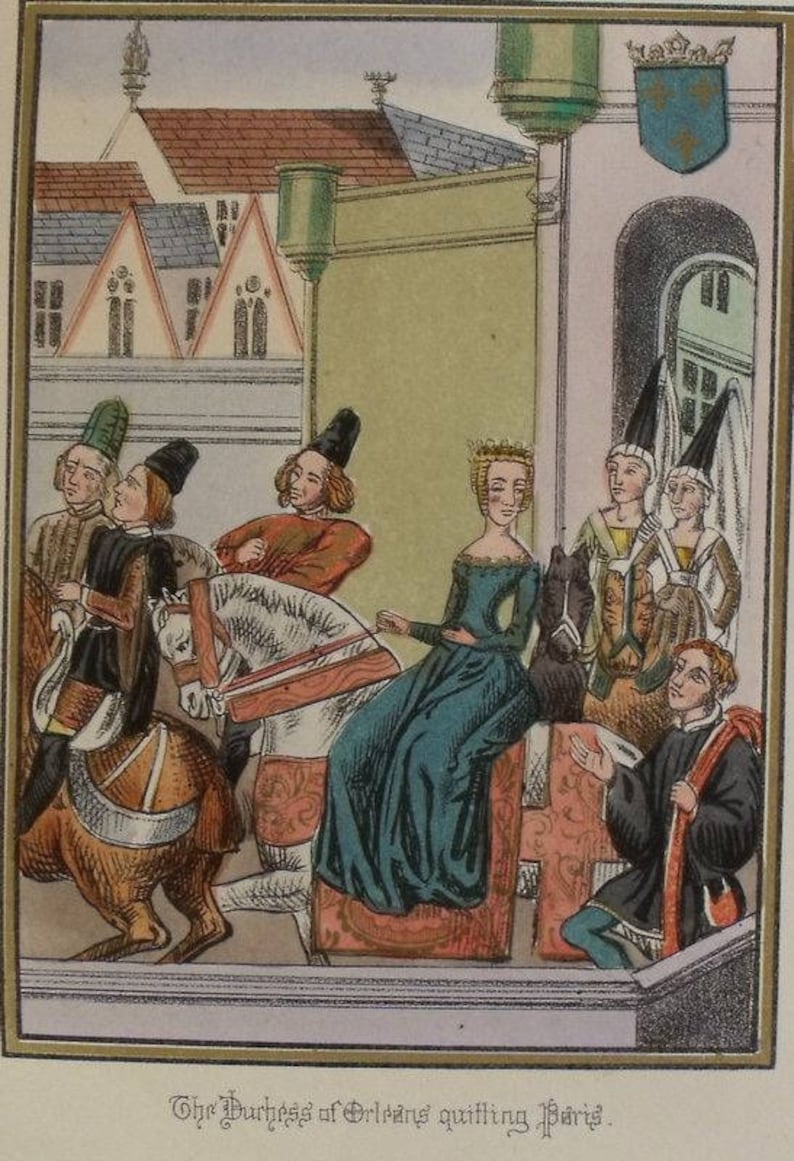
1868 The Duchess of Orleans Valentina Visconti Quitting Paris | Etsy
With public and court opinion against her, rumours of sorcery and witchcraft, Valentina was ultimately exiled from the court and forced to leave Paris. She remained at Blois till her death in 1408.

Gian Galeazzo reacted to gossip about Valentina at the French Court by threatening to declare war on France and to send knights to defend his daughter's honor. There is no record of him doing so. However, after the disaster of Nicopolis (1396), he was strongly suspected of having betrayed the Crusaders as vengeance for his daughter being accused of being behind the illness of King Charles VI of France, as well as for France's increasing control over the city of Genoa that he had attempted to hamper, and for which he had been rebuked by Enguerrand VII de Coucy before the battle.

Now to those other characters - the Fools. Court dwarfs - not to be confused with jesters who were employed for entertainment and amusement - were owned and traded amongst the people of the court, and delivered as gifts to fellow kings and queens. Dwarfs usually had a permanent function and were registered in the personnel rolls as "court dwarf", "personal dwarf" or "chamber dwarf". This enabled them to play an important role in ceremonial culture and gave them close access to the ruler. This close relationship led to multiple roles beyond the foolish task as a natural clown. Court dwarfs served as a substitute for children, companion for royal children, or even diplomats. At the end of their career, these privileged dwarfs would usually receive a pension and other benefits.

Bayard touches upon many of the above background topics - the fools, magic, alchemy, sorcery - to provide us with an insider's view of the French Court. We are reunited with Christine's old foe, Henri le Picout, and allies Marion, the prostitute and Brother Michel of the Abbey of Saint Denis. Whilst not particularly action driven, the reader will find themselves so swept up in the storytelling that they will not realise just how far they have been drawn along. I am looking forward to the next in the series. 


Sunday, January 6, 2019

Review: In the Shadow of the Enemy by Tanya Bayard

In the Shadow of the Enemy (Christine De Pizan Mystery #2)
Book 2 in the Christine de Pizan mysteries - following directly on from "In the Presence of Evil".

"... Brother Michel will record what everyone believes .."

This series, set in France in the 1390s during the reign of mad King Charles VI, features recently widowed Christine de Pizan who is employed as a scribe for the French Queen, Isabeau of Bavaria. The French Court in this period was a hot-bed of political and sexual intrigue, with the various factions fighting for control of both the government and the King (think Wars of the Roses).   For those unfamiliar with the period, Christine de Pizan was actually a court writer during the reign of Charles VI, and was indeed patronised by both the Queen, Isabeau of Bavaria, and the king's brother, Louis, Duke of Orleans. 

Christine's father Thomas worked as a physician, court astrologer and councillor of the Republic of Venice. Thomas de Pizan accepted an appointment to the court of Charles V of France as the king's astrologer and moved to Paris (1368). Christine de Pizan married the notary and royal secretary Etienne du Castel (c.1379). Pizan's husband died of the plague (1389), her father had died the year before. Pizan was left to support her mother and her children. When she tried to collect money from her husband's estate, she faced complicated lawsuits regarding the recovery of salary due her husband. In order to support herself and her family Christine turned to writing - hence her duties for the French court. 

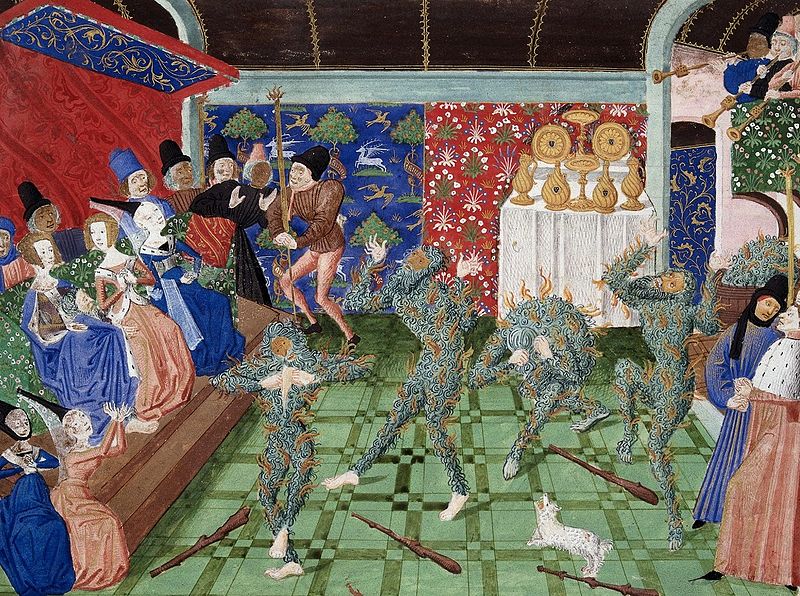
The Shadow of the Enemy directly follows on from In The Presence of Evil - in fact, for the characters, the events are imprinted on their memories so much so this forms one of the main plots. Christine is asked by Queen Isabeau to investigate the incident that would become known as the Bal des Ardents ("Ball of the Burning Men") as she feels that the threat to Charles is to be found closer than she would like. 

This famous incident in French history occurred on 29th January 1393.  A masked ball had been organized by the Queen, Isabeau of Bavaria, to celebrate the wedding of one of her ladies-in-waiting at the Hôtel Saint-Pol. At the suggestion of Huguet de Guisay, the king and four other lords dressed up as wild men and danced about. They were dressed "in costumes of linen cloth sewn onto their bodies and soaked in resinous wax or pitch to hold a covering of frazzled hemp, so that they appeared shaggy & hairy from head to foot". At the suggestion of one Yvain de Foix, the king commanded that the torch-bearers were to stand at the side of the room. Nonetheless, the king's brother Louis I, Duke of Orléans, who had arrived late, approached with a lighted torch in order to discover the identity of the masqueraders, and he set one of them on fire. There was panic as the fire spread. The Duchess of Berry threw the train of her gown over the king. Several knights who tried to put out the flames were severely burned. Four of the wild men perished: Charles de Poitiers, son of the Count of Valentinois; Huguet de Guisay; Yvain de Foix; and the Count of Joigny. Another – Jean, son of the Lord of Nantouillet – saved himself by jumping into a dishwater tub. 

Add to this another subplot based upon previous events in both French history and in Charles' life - the battle of the Golden Spurs - and its horrific aftermath. The Battle of the Golden Spurs (also known as the Battle of Courtrai), was fought between the Kingdom of France and the County of Flanders at Courtrai (Kortrijk ) on 11th July 1302. The Flemish were in rebellion against the French and massacred the French of the city of Bruges. The King of France at the time, Philip IV, organised an enormous army to march against the Flemish and seek retribution. The result was a rout of the French nobles, who suffered heavy losses at the hands of the Flemish. The battle soon became known as the Battle of the Golden Spurs after the 500 pairs of spurs that were captured in the battle and offered at the nearby Church of Our Lady. After the Battle of Roosebeke (27th November 1382), the spurs were taken back by the French and Courtai (Kortrijk) was viciously sacked by Charles VI in retaliation. As this event is featured at the start of the novel, we are left wondering how it will be linked to Christine.

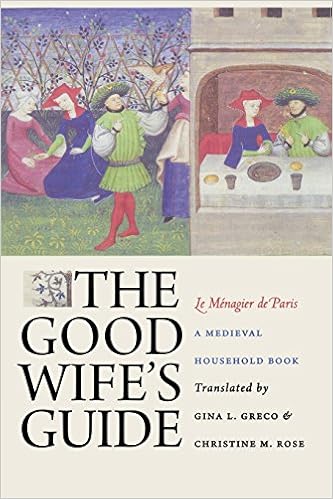
Image result for the book of moral and practical advice for a young wifeThroughout In The Shadow of the Enemy we get more of a feel for Christine's work as a writer at the royal court which is really just starting for the purposes of the novel. Christine wrote a number of books of advice to princesses, princes and knights remained in print until the 16th century. And our story is littered with references to this. In fact, this may be a homage to The Good Wife's Guide (Le Ménagier de Paris): A Medieval Household Book. Written in the late 14th C by an anonymous French writer, the book is addressed to a fifteen-year-old bride, narrated in the voice of her husband, a wealthy, aging Parisian. The book was designed to teach this young wife the moral attributes, duties, and conduct befitting a woman of her station in society, in the almost certain event of her widowhood and subsequent remarriage. The work also provides a rich assembly of practical materials for the wife's use and for her household, including treatises on gardening and shopping, tips on choosing servants, directions on the medical care of horses and the training of hawks, plus menus for elaborate feasts, and more than 380 recipes. I like how author Tanya Bayard as attributed this to Christine and leaves us wondering how this book is linked to Christine's search for Martin de Bois, the missing husband of Klara, a young bride taken in by Christine's mother. 

Christine, who grew up at the Court but is now not of the court, uses her skills and connections as well as relying on others outside of the court, to solve the mysteries at hand. I like the characters of both Marion (the prostitute) and Alips (the Queen's dwarf) and the roles assigned to both, and how the characters, including Henri Le Picart, are a little more developed. This is a much more rounded story - we get a definite feel for the political machinations of the time when not only the king's uncles, but his wife and his  brother are all vying for power and control, and those in positions of power struggle to retain what they consider theirs by right. It is not until we near the end that we get just the merest hint of the shadow in question that is being cast across the king and court, and yet we are never quite sure who is involved.

An enjoyable read - and I love the fact that this series is set at the French Court rather than the English. Another historical mystery solved with a new twist added ... can't wait for the next in the series.

Monday, January 29, 2018

The Book of Joan by Lidia Yuknavitch review – the future is medieval


Joan of Arc and Christine de Pizan are reimagined in a post-apocalyptic dystopia, in this compellingly ambitious examination of gender, semiotics and warfare.

One premise of The Book of Joan is that the 21st century, for all its technological advances, has returned us to pre-modern levels of brutality and strife. There are children fighting once again; there are religious crusades; land is seized at will. Yuknavitch takes three real people from medieval France and reimagines them in a post-apocalyptic future.


The narrative mode is to show through dramatic, often moving scenes, and then to tell, reflecting on them analytically. This disjunction can be jarring, but it’s knowingly done, because the book’s style is itself a theme.