Showing posts with label switzerland. Show all posts

Monday, January 2, 2023

Review: The Enigma of Room 622 by Joel Dicker

Synopsis: "One night in December, a corpse is found in Room 622 of the Hotel Verbier, a luxury hotel in the Swiss Alps. A police investigation begins without definite end, and public interest wanes with the passage of time.Years later, the writer Joel Dicker, Switzerland's most famous literary ingenue, arrives at that same hotel to recover from a bad breakup, mourn the death of his longtime publisher, and begin his next novel. Little does Joel know that his expertise in the art of the thriller will come in handy when he finds himself investigating the crime. He'll need a Watson, of course: in this case, that would be Scarlett, the beautiful guest and aspiring novelist from the next room, who joins in the search while he tries to solve another puzzle: the plot of his next book.

Meanwhile, in the wake of his father's passing, Macaire Ebezner is set to take over as president of the largest private bank in Switzerland. The succession captivates the news media, and the future looks bright, until it doesn't. The bank's board, including a certain Lev Levovitch-Geneva's very own Jay Gatsby-have other plans, and Macaire's race to the top soon becomes a race against time... A matryoshka doll of a mystery built with the precision of a Swiss watch. Joel Dicker presents a diabolically addictive thriller where a love triangle, a power struggle, shocking betrayals and dangerous envy play out against the backdrop of a not so quiet Switzerland, where the truth twists and turns into something no reader will see coming. A European phenomenon, Dicker's latest page-turner is his most personal novel yet"

~~~

Seriously lost in translation.

Half the time I did not know if I was coming or going - were we in the past, present or future - at times we went back a few years, other times over a decade. There was not real point in time by which to securely anchor the story.

The character of Scarlet just grated on me to the point where I could quite easily have murdered her myself. Sure our author - himself the main character - needed some foil by which to begin his investigation, but this women's constant badgering of Dicker to investigate seemed redundant, especially when the mystery of Room 622 was already on Dicker's radar.  His Watson in this instance was superfluous.

The storyline, whilst promising, was highly convoluted, disjointed and at times I struggled to follow it at all. The narrative alternated between first and third person, Dicker's "story" and the mystery including a rather tiresome and confusing back story.  I felt the whole thing was some hodge-podge charade that at nearly 600 pages, was about 400 pages too long. The whole story within a story was done without any finesse or consideration for the reader.

Sorry to say not a fan of this one.

Saturday, July 3, 2021

Review: The Basel Killings by Hansjorg Schneider

Synopsis: It is the end of October, the city of Basel is grey and wet. It could be December. It is just after midnight when Police Inspector Peter Hunkeler, on his way home and slightly worse for wear, spots old man Hardy sitting on a bench under a street light. He wants to smoke a cigarette with him, but the usually very loquacious Hardy is silent―his throat a gaping wound. Turns out he was first strangled, then his left earlobe slit, his diamond stud stolen. The media and the police come quickly to the same conclusion: Hardy’s murder was the work of a gang of Albanian drug smugglers. 

But for Hunkeler that seems too obvious. Hardy’s murder has much in common with the case of Barbara Amsler, a prostitute also found killed, with an ear slit and pearl stud missing. He follows his own intuition and the trail leads him deep into an edgy world of bars, bordellos and strip clubs, but also into the corrupt core of some of Basel’s political and industrial elite. More ominously, he will soon discover the consequences of certain events in recent Swiss history that those in power would prefer to keep far from the public eye.


The Basel Killings is the first (to be translated and published though fifth) in the Inspector Hunkeler series, set in Basel, Switzerland. This was my first real foray into the darker side of Swiss crime fiction - though definitely not my last. However, as I was unfamiliar with the city of Basel and other various locales, a town map would have been a great addition - but that's just me.

Mass murder or serial killings (ie: three or more excluding the perpetrator) are rare in Switzerland, and according to modern day studies, the violence is usually premeditated and ends with the suicide of the aggressor.  One of the conclusions from a study by the Psychiatric Service of Canton Basel Country found that these types of murders were “often they were motivated in their crime by a personal affront.”

Hunkeler is a member of the Kriminalpolizei or criminal investigation agency, of the German-speaking cantons of Switzerland. The 26 cantonal police agencies and numerous municipal police agencies are not subordinate to federal authorities. Their commanding officers report to the head of the respective cantonal or municipal department of police, who is a member of the cantonal or municipal governing council.

Hunkeler is - we are told - old, divorced, alcoholic, out of shape and out of touch. With his girlfriend is away in Paris, he wanders the dark streets late at night. He is due for retirement and is barely tolerated by his more political savvy colleagues who know how to play the game. And this is why Hunkeler is at odds with the higher echelons of the police force, for he has the gall to mix with the lower class, rural, and foreign elements of the city.  

And this book tackles the problems of how the wider community views and treats these undesirables, especially when it comes to a willingness in solving (or turning a blind eye to) crime in these areas. Not only that, like all good detectives that a forged from a different mould, Hunkeler has his own methods - somewhat antiquated - that get results, much to the chargrin of his colleagues.

The Basel Killings is a great read, especially for those that like their protagonists flawed and plausible, slightly eccentric, and their surrounds as gloomy and depressive as the crimes being investigated.


read more:
Mass murder and consecutive suicide in Switzerland: A comparative analysis. Journal of Threat Assessment and Management, A. Ilic, & A. Frei, (2019).

Wikipedia: Crime in Switzerland

Saturday, March 30, 2019

Review: The Execution of Justice by Friedrich Durrenmatt

The Execution of Justice
Synopsis: A respected professor is dead - shot in a crowded Zurich restaurant, in front of dozens of witnesses. The murderer calmly turned himself in to the police. So why has he now hired a lawyer to clear his name? And why has he chosen the drink-soaked, disreputable Spat to defend him? As he investigates, Spat finds himself obsessed, drawn ever deeper into a case of baffling complexity until he reaches a deadly conclusion: justice can be restored only by a crime.


Interesting concept - a very public murder; a known killer; an unknown motive; an disorientating plot; the verdict - "justice can be restored only be a crime".

The plot is very disorientating - one never knows whether we are looking back, looking forward, or are in the moment (as my copious notes will attest). This may be as a result of the length of time it took to complete the novel (approx 30 years); instead the story weaves and totters like its alcoholic narrator. The twist at the end ... clever.

Sunday, March 17, 2019

Review: AllmenSeries by Martin Suter

Allmen, an elegant bon vivant and fine spirit, has come into financial difficulties over the years. Five magical Art Nouveau bowls put him and his factotum Carlos on a business idea: a company for the recovery of beautiful things. The birth of an unusual investigator duo and the launch of a wonderful crime series.

Allmen and the Dragonflies
International heist mystery that is slow to start and a little confusing with regards to timeline.  The present and the past are blurred into one for the first two parts of the story before the story kicked off when we arrive back in the present.  The addition of noticeable paragraphs to signify the end of a story sequence would have worked well.


Johann Friedrich van Allmen is the antihero, who finances his lifestyle through thefts and insurance frauds, using theft as a means also to pay off his creditors.  After a night on the town with a mysterious and ethereal woman results in an opportunity too good to pass up - the theft of a Galle bowl featuring a dragonfly.  Allmen becomes perplexed when the hue and cry is not raised, and so decides to relieve the owner of even more of the collection.   With the introduction of an school chum, Terry Werensbusch, Allmen decides that there is more than meets the eye and has his manservant, Carlos, dig a little deeper.   Its is only when Allmen seems to come out on top do things actually come crashing down and all that he has helped himself to is taken away.  

Image result for galle glass dragonfly bowls
The mysterious manservant Carlos is a refreshing character; and  the setting of Switzerland makes a nice change of scenery.  A decent enough storyline sets the tone for the series, and Allmen and Carlos decide that there is money to be made (and lots of it), in the recovery of lost items.

Like all good crime fiction, this story is based upon real events. In October 27, 2004 in Gingins, Switzerland, glass artworks by Emile Galle were stolen from the Neumann Foundation. A reward 400,000 Swiss Franc was offered.


Allmen and the Pink Diamond
Allmen and the Pink Diamond 
Set two years after "dragonflies", Allmen and Carlos are now running "Allmen International Inquiries" - a business that recovers various things for reward.

Allmen is hired to find a missing "pink diamond" and thus begins an unusual game of cat and mouse with various interested parties on the trail of a missing Russian IT expert. One wonders what a mysterious Russian has to do with a missing pink diamond, and just who else is on the trail and familiar faces keep re-appearing. 
Always, just when things seem to be over they actually pick up again; and just when Allmen seems to be on the up and up, things come crashing down around him.

This second outing is a much more stream-lined story (editing & layout issues from book one attended to), and the development of the main characters - Allmen and Carlos - is nicely fleshed out.  Carlos is by far the most interesting character with still an air of mystery surrounding him.

Another enjoyable read - looking forward to the next three in this series:
  • Allmen and the Dahlias
  • Allmen and the Disappearance of Maria (using google translate here)
  • Allmen and the Erotic (again using google translate here)


Sunday, April 1, 2018

Review: The Stronghold by Albrecht Behmel

THE STORY OF WILLIAM TELL
The people of Switzerland were not always free and happy as they are to-day. Many years ago a proud tyrant, whose name was Gessler, ruled over them, and made their lot a bitter one indeed.

One day this tyrant set up a tall pole in the public square, and put his own cap on the top of it; and then he gave orders that every man who came into the town should bow down before it. But there was one man, named William Tell, who would not do this. He stood up straight with folded arms, and laughed at the swinging cap. He would not bow down to Gessler himself.

When Gessler heard of this, he was very angry. He was afraid that other men would disobey, and that soon the whole country would rebel against him. So he made up his mind to punish the bold man.

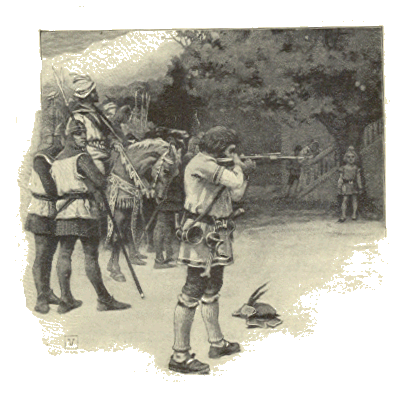
William Tell's home was among the mountains, and he was a famous hunter. No one in all the land could shoot with bow and arrow so well as he. Gessler knew this, and so he thought of a cruel plan to make the hunter's own skill bring him to grief. He ordered that Tell's little boy should be made to stand up in the public square with an apple on his head; and then he bade Tell shoot the apple with one of his arrows.  Tell begged the tyrant not to have him make this test of his skill. What if the boy should move? What if the bowman's hand should tremble? What if the arrow should not carry true?

"Will you make me kill my boy?" he said.  "Say no more," said Gessler. "You must hit the apple with your one arrow. If you fail, my soldiers shall kill the boy before your eyes."

Then, without another word, Tell fitted the arrow to his bow. He took aim, and let it fly. The boy stood firm and still. He was not afraid, for he had all faith in his father's skill.  The arrow whistled through the air. It struck the apple fairly in the center, and carried it away. The people who saw it shouted with joy.

As Tell was turning away from the place, an arrow which he had hidden under his coat dropped to the ground.  "Fellow!" cried Gessler, "what mean you with this second arrow?"   "Tyrant!" was Tell's proud answer, "this arrow was for your heart if I had hurt my child."   And there is an old story, that, not long after this, Tell did shoot the tyrant with one of his arrows; and thus he set his country free.

Image result for the stronghold albrecht behmel
This then is the story as we know it, and from this framework Behmal takes this old tale and constructs his own.  In this instance, the people are in revolt against taxation and unfair legislation.  When Thell's son fires a crossbow arrow after a spot of skylarking, the Imperial Counsellor, Guessler, accuses him of high treason - Thell undergoes a trial by ordeal - forced to shoot an apple from atop his son's head.  He is banished for a year, his daughter taken by Guessler, his son left to fend for himself.  Thell is at the centre of an uprising, exiled for ten years, returns and with the aid of mercenaries the castle of Altdorf is taken.  In the final scenes, the rebels face off against the imperial army of Duke Leopold of Austria - showdown is at the Morgarten Pass.

Set in the very early years of the 14th century, this is a fast paced, action packed story about the beginnings of the Swiss Confederacy - you know how it ends, but then again, with Behmel's spin, you do and you don't.  For those seeking something different in the historical fiction genre, this may be for you.


Side Note: Did Tell actually exist or was he actually based upon a Danish legend set in the times of King Harald Bluetooth.  Tell's legend appears in the White Book of Sarnen, over 100 years after the supposed event related in the tale have taken place (c.1470).