Saturday, April 29, 2017

Victorian Doctors Thought Reading Novels Made Women "Incurably Insane"

Now there's a traffic-stopper of a headline!  Reading makes you - young women - insane.  But not just insane, but "incurably" insane.  Well, lead me to Bedlam!

Read some excerpts from this devilishly insane article from History Buff:
In 1886, homeschooling pioneer Charlotte Mason wrote that “the girl who sits for hours poring over a novel to the damage of her eyes, her brain, and her general nervous system, is guilty of a lesser fault of the nature of suicide.” Strange as it may sound, Mason's belief that reading fiction was physically dangerous for girls and women was actually held by many medical doctors of her day. 

A few years earlier, Dr. John Harvey Kellogg—the same guy who invented corn flakes in an attempt to "cure" people of masturbation—called novel reading “one of the most pernicious habits to which a young lady can be devoted. When the habit is once thoroughly fixed, it becomes as inveterate as the use of liquor or opium.”
Read entire article here @ History Buff and learn more about Bethlem Royal Hospital (Bedlam) here @ All Day.


New Book Examines Military Legal Expansion In World War I

A new book by University of New Mexico School of Law Professor Joshua E. Kastenberg is the first published history to explore the military legal expansions of Major General Enoch Crowder, Judge Advocate General of the U.S. Army. Kastenberg also examines the development of the laws of war and the changing nature of civil-military relations.


“To Raise and Discipline an Army: Major General Enoch Crowder, the Judge Advocate General’s Office, and the Realignment of Civil and Military Relations in World War I,” has been released by the Northern Illinois University Press and is available from various book stores, including Amazon.

The book was reviewed by Fred L. Borch, regimental historian and archivist, US Army Judge Advocate General’s Corps, who comments, “No book has ever told the story behind this remarkable expansion of military legal talent. Kastenberg shows that the influential work of army lawyers significantly altered civil-military relations in the US. He should be commended for his exhaustive use of primary sources.”


An Interview with Catholic Sci-Fi Author John C. Wright

Angelo Stagnaro interviews Catholic Sci-Fi author John C Wright for the National Catholic Register. Excerpts below:


I initially came to know John C. Wright in the same way most people come to know him―through his science fiction and fantasy novels. I knew I wanted to read more of him and possibly meet him when I found he had converted to Catholicism after having been an atheist for many years.


In 2015, Wright received five Hugo Award nominations―another important award for s-fi writers―including three in the Best Novella category ("One Bright Star to Guide Them," "The Plural of Helen of Troy," and "Pale Realms of Shade"), a fourth for Best Short Story ("The Parliament of Beasts and Birds"), and a fifth for Best Related Work ("Transhuman and Subhuman: Essays on Science Fiction and Awful Truth.")


Sci-fi isn't about ray guns, alien brain-eating invaders and exploding rocketships―even though that's the fun part. Rather, good sci-fi is about social commentary and as Wright is a devout Catholic, his writing gets to the core of what our society has become and the moral disasters which might ahead of us all the while holding forward a Christian moral and spiritual ideal to which we, and society, might aspire.


Read full interview at the National Catholic Register

Cairo Inside Out

“Cairo Inside Out” is unlike any other book. It is not a travel book, nor a guide, nor a memoir, and neither is it a history book nor a coffee-table book. It attempts to grasp what the Spanish call “el no se que” and the French, “je ne sais quoi” — expressions which have no exact equivalent in English.

From one page to another, we move on to medieval Cairo, which is mostly intact. The contrast between past and present pervades the atmosphere; you see men wearing the same clothes and eating the same food as their ancestors and yet they are talking on a smart phone.

This book takes you to the heart of Cairo. [Trevor] Naylor conveys in words and pictures the moods and light of a city steeped in history, a city that is both eternal and ever changing.

Read full review by Lisa Kaaki at Arab News

African Kaiser by Robert Gaudi

Anyone interested in 20th-century culture is bound to spend some time thinking about World War I. Yet while most of us are aware of the horrors of trench combat and the thousands lying dead in Flanders fields where poppies blow, what about the war outside Europe? What about German East Africa? 

Still, the war in Africa was more than a sideshow. A brilliant guerrilla strategist, Paul von Lettow-Vorbeck forged his fanatically loyal Schutztruppe — a small colonial infantry consisting of largely black soldiers — into “a highly efficient fighting force, aggressive and completely self-supporting,” and one that was “the first racially integrated army in modern history.” As von Lettow bluntly said, “Here in Africa we are all equal. The better man will always outwit the inferior and the color of his skin does not matter.” These words were not mere lip service, either: His actions show that he genuinely believed them.

Read Michael Dirda's full review at the Washington Post and see more reviews on Amazon


Killing Kings: Patterns of Regicide in Europe, AD 600–1800

“Killing Kings: Patterns of Regicide in Europe, AD 600–1800” by Manuel Eisner, is a statistical study of the demise of 1,513 monarchs in 45 European monarchies over the period 600 to 1800. It reveals that almost a quarter (22 per cent) of all royal deaths were bloody – accidents, battle deaths and killings – and that 15 per cent of all deaths were outright murder.

As a criminologist, Eisner divides his gruesome statistics for kingly killings into four broad scenarios. Top of the list is murder as a means of succession; next up is murder by a neighbouring ruler and competitor, attempting to gain territory or seal a military victory; personal grievance and revenge, fueled by rape, murder or insult committed by the ruler, rank third as scenarios; and finally, the outsider killing.

Read full article here at Medievalist and an abstract of the published paper at British Journal of Criminology. 

Thursday, April 27, 2017

The Bentley Rare Book Museum Opens

The Bentley Rare Book Museum, housed within the department of museums, archives, and rare books at Kennesaw State University in Georgia, made its debut this past weekend. Formerly known as the Bentley Rare Book Gallery, established on campus in 1986, this re-branded space provides a free and open-to-the-public place to celebrate the written and printed word--the first ‘rare book museum’ in metro Atlanta. 

The Bentley Rare Book Museum holds a collection of about 10,000 items, with particular strengths in culinary history, Georgia authors, fine press books, Cherokee language materials, medieval manuscript leaves, and early printed books. 

The museum, located on the ground and second floors of Kennesaw’s Sturgis Library, is open Tuesday-Friday, 10 a.m. to 4 p.m.

Read more here at the Fine Books & Collections Blog

Tuesday, April 25, 2017

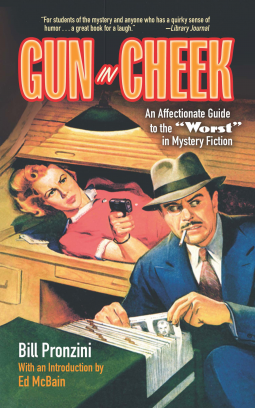
Review: Gun In Cheek by Bill Pronzini


Damn you Bill Pronzini! I was jotting down authors names before I reached the back and discovered and neatly listed bibliography. I had every intention of taking your advice to seek out these B-grade gems of the mystery fiction genre, after-all, many a B-grade film has, with time, become a cult classic.

I liked the way Bill uses his chapters to tackle the different aspects of the fictional mystery - the amateur detective, the police investigator, the private eye, the gentleman rogue, the evil oriental - as well as the spy story. We gain an insight into the publishing - and specifically Phoenix Press, who apparently published the majority of these gems (see page 91). There are comparisons between more popular characters with, often, their not so well known contemporaries and imitators.

Pronzini peppers each chapter with some of the best (??) of the writing of these featured authors:
"He keeps on waiting awhile longer. Then, at five o'clock, he gets up, locks the office door, and goes out (in that order)." "Tomorrow was another day." (Robert Twohy's "Slime"). Even some of our more well-known authors make the list (ie: Spillane, West, Basinsky, Brown, Leroux).

The titles of some of these works border on the fantastical and highly imaginable (No Coffin For The Corpse, The Clue of the Leaning Chimney, The Face on the Cutting Room Floor, When Last I Died, No Luck With The Hanged Man) ; the men are invariably rugged, macho and mysoginistic; the women sport bazooka bras and ooze sex appeal; the dialogue is cliched; the villains suitably nefarious. They were quick reads - they were escapism. But don't be fooled - many of these B-graders were at the height of popular fiction during their day and were prolific in their writing - these were the authors that contributed to what we now refer to as "pulp fiction".

"The good mystery gets all the credit, all the attention .... But what about the bad mystery?" Well, Pronzini has certainly brought together the Good, the Bad, and the Ugly in such a way that you may look twice at some of the lesser gems. I know I have.


Review also posted @ Goodreads

Sunday, April 16, 2017

The Tea Girl of Hummingbird Lane by Lisa See

Blurb by Simon & Schuster:
A powerful story about a family, separated by circumstances, culture, and distance, Tea Girl of Hummingbird Lane paints an unforgettable portrait of a little known region and its people and celebrates the bond that connects mothers and daughters.

Review by Virginia Denucci @ Steamboat Today

Growing up in the Ak-ha tribe in the 1980s was not easy for a woman. Li-Yan’s life was immersed in cultural taboos, superstitions, restrictions and curses. When she became pregnant out of wedlock, Li-Yan was forced to abandon her child, leaving her newborn daughter at the door of an orphanage, with no more than a tea cake from her secret, ancient tea trees. 

Several themes were intricately woven into this amazing story. See immerses the reader into the Chinese tea culture, from small village harvesting to a world-wide business. Enter the world of tea connoisseurs, who discuss vintage, harvests, seasons, geographic source, weather and, of course, age, as it relates to taste.

Review by Deborah Donovan @ Book Page:
See’s ambitious novel touches on Chinese cultural history, the centuries-old intricacies of the tea business and both the difficulties and joys of Chinese-American adoptions. But ultimately it’s a novel about the strength of mother-daughter ties—peopled, as is each of See’s novels, with strong characters with whom the reader empathizes from the first page to the last.

Review by Emily Kim @ the Washington Times:
The best-selling author of “Snow Flower and The Secret Fan” and “China Dolls,” Ms. See is known for writing historical fiction about the Chinese female experience. However in her new novel, Ms. See diverges from writing about the Han, China’s ethnic majority. Here, she focuses on a Chinese ethnic minority, the Akha.

Ms. See gradually gives information about the Akha’s culture, not overwhelming the reader with information. However, the beginning is most heavy with rituals, beliefs and taboos that the narrator, Li-yan reveals.

Review by Terry Hong @ Book List Online:
See, herself partly of Chinese ancestry, creates a complex narrative that ambitiously includes China’s political and economic transformation, little-known cultural history, the intricate challenges of transracial adoption, and an insightful overview of the global implications of specialized teas. The only possible flaw is that some may consider her magic-wand ending unbelievable.