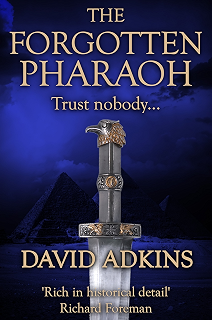
 The Forgotten Pharaoh
 - David Adkins
The ancient civilisation is enjoying unprecedented prosperity during the 18th Dynasty under some of Egypt’s most famous Pharaohs – Ahmose I, Hatshepsut, Thutmose III, Amenhotep III, Akhenaten and Tutankhamun. But every empire has its rivals – here the Hittites, the Mittani, Nubians and Assyrians – and every royal family its enemies. Smenkhkare is the youngest son of Amenhotep III and brother to Akhenamun – later to become the ruler Akhenaten – and Thutmose, plus three older sisters. The Forgotten Pharaoh, explores the extraordinary and dangerous life and times of a real but little known figure from history – from his child-marriage to exile and then reinstatement in Thebes as pharaoh of one of the most influential dynasties of the ancient civilised world.
The Lost Pharaoh Chronicles - Lauren Lee Merewether
Salvation in the Sun
Amidst a power struggle between Pharaoh and the priesthood of Amun, Queen Nefertiti helps the ill-prepared new Pharaoh, Amenhotep, enact his father's plan to regain power for the throne. But what seemed a difficult task only becomes more grueling when Amenhotep loses himself in his radical obsessions. Standing alone to bear the burden of a failing country and stem the tide of a growing rebellion, Nefertiti must choose between her love for Pharaoh and her duty to Egypt in this dramatic retelling of a story forgotten by time.
Secrets in the Sand
The power struggle for the throne should have ended long ago, yet it rages onward, shrouded in conspiracy and murder. Pharaoh Akhenaten's plan to regain power from the priesthood of Amun is done, but his religious zeal has stripped the economy and the people’s morale. Whisperings of rebellion fill the streets as enemies close in on Egypt’s borders, leaving Nefertiti to fend off political wolves as she attempts to stabilize the nation and keep her crown.
Valley of the Kings - Terrance Coffey
In the year 1355 BCE, the land of Egypt was the superpower of the known world. King Tut's father, Akenaten, the so-called 'heretic pharaoh,' and his wife, Queen Nefertiti, are on the verge of catapulting Egypt into a revolution that will forever divide its people and rip the most powerful empire on the earth from its foundation. Inspired by the actual Hittite and Amarna letters of 14th century BCE, 'Valley of the Kings: The 18th Dynasty' is an epic novel of intrigue, passion, and betrayal, resurrecting the thrilling story of a singular leader whose beliefs were both visionary and disastrous.
The Beadnet Dress - Mark Garjewski
Set during the building of King Khufu’s great pyramid, between the years 2571 and 2566 BC, The Beadnet Dress is the story of the seamstress Maetkra, the 167th person to bear a sacred talisman given her family by the falcon god nearly three thousand years earlier, detailing her rise from worker in King Khufu’s pyramid village to become a member of his court, and her subsequent fall. And it’s the story of Ahmes, the man Maetkra loves, low-born on an estate in the Nile delta, his life caught up in and shaped by royal machinations beyond his control.
Beauty of Re - Mark Garjewski
The story of Neferure, the Beauty of Re, caught in the struggle for control of New Kingdom Egypt between her mother, Hatshepsut, and her half-brother, Thutmose III, and the subsequent creation of the world’s first empire.
Pharaoh's Daughter - Julius Lester
Born into slavery, adopted as an infant by a princess, and raised in the palace of mighty Pharaoh, Moses struggles to define himself. And so do the three women who love him: his own embittered mother, forced to give him up by Pharaoh's decree; the Egyptian princess who defies her father and raises Moses as her own child; and his headstrong sister Almah, who discovers a greater kinship with the Egyptian deities than with her own God of the Hebrews. Told by Moses and his sister Almah from alternating points of view, this stunning novel by Newbery Honor-author Julius Lester probes questions of identity, faith, and destiny.
The First Dynasty Series - Lester Picker
 The First Pharaoh
 retells the story of Narmer and his epic journey, seen through his eyes and those of his Chief Scribe, the shaman Anhotek. Book I of The First Dynasty Series, The First Pharaoh gives us an understanding of the culture Narmer lived in and shaped, the battles he fought to unite his people, the woman he loved and nearly lost, the enemies even in his own court who plotted against him, and his many successes and painful failures. Above all, we see how Narmer’s loving relationship with Anhotek defined his personal vision for his country and its people.
The Dagger of Isis traces the life of Meryt-Neith, the first female ruler of a united Egypt. From her marriage to King Wadjet to her eventual coronation after his death, this tale of intrigue and betrayal follows her ascension, the wars she fought and the loves that gave meaning to her life. This saga takes us on a journey throughout ancient Egypt and into nearby lands, as Meryt-Neith struggles to bring honor to her family's dynasty.
With the sudden death of his father, 16-year old Qa'a is thrust onto the throne, unprepared for rule. He is at the mercy of the cunning Chief Priest, Khenemet and his evil disciple. A chance meeting with a successful trader, Nomti, creates a friendship that brings glory to the Two Lands. But Qa'a's missteps bring the newly unified country to war. Unrest follows as the underground leaders of Lower Kem foment a rebellion that challenges King Qa'a's rule.
The Price of Nofret's Nose - SR Anand
When Idut, the Lord and Master of the Amaat Household, falls to his death at the Net-uri quarry, his younger brother Lumeri witnesses something that leads him to believe that Idut's death wasn't an accident. Back in Memphis, Idut's lovely young wife struggles to overcome her own dark fears, while his blind mother who is mostly confined to her chambers, hears and knows everything that goes on in the house. His quest to find justice for his brother takes Lumeri to the ancient city of Qift, where he learns an incredible truth that devastates him, but the dark reign of evil is just beginning.
Khu - Jocelyn Murray
In a land steeped in myth and superstition, a raid on a small village leaves a young boy, Khu, its only survivor. Fate paves a strange and mystical path through dark and uncertain times, when the split powers of Upper and Lower Egypt compete for sovereignty over a realm plagued by instability, rebellion and fear. In this tale of virtue, vice and valor, the destiny of a divided nation is inextricably linked to that of the boy Khu, in the struggle to restore Egypt to a unified and glorious kingdom.
Queen of Egypt - Kylie Quinlan
Ankhesenamun needs to produce an heir to the throne -- quickly. Pharaoh Tutankhamun is young and weak. His chief advisors are planning his quiet removal and Ankhesenamun hopes to hold them off by producing an heir who can become a stronger Pharaoh. When Pharaoh's advisors move the court from the desert city of Akhetaten back to ancient Memphis, Ankhesenamun is thrown into a new world of danger, secrets, and old gods.
The Mask of Ra - PC Doherty
A compelling and dramatic novel set against the background of Egypt's eighteenth dynasty--a time of great change, as warlike Pharaohs fought to control not only the tribes on their western and southern borders, but to bring their subjects firmly under their rule.
The Mummifiers Daughter - Nathaniel Burns
The Mummifier's Daughter carries us back to a land steeped in gods, god-kings, ritual and magic. It paints for the reader a detailed picture of Pharaonic Egypt in all its shadowed glory. Faithfully recreating one of the most remarkable eras in Egypt’s history, bestselling author Nathaniel Burns weaves a shudderingly ominous tale of ancient Egypt’s mysteries with a cast of characters the modern reader will recognize even though millenia have passed.
There are ten titles in the series:The Mummifier's Daughter, Princess of Egypt, the Curse of Anubis, Secret of the 7th Scarab, the Forgotten Papyrus, the Prince of Nubia, the Tenth Plague, Mystery of the Temple, Pharaoh's Gold, the Trader's pact
 In Maat's Service
 - Kathrin Bruckmann
Hori and his fellow students celebrate their graduation from medical school. In a bar brawl, he accidentally kills the vizier's eldest son. For punishment, the king renders an unusual verdict: life in the service of the dead at the weryt, the walled-off embalming compound.


![VALLEY OF THE KINGS: The 18th Dynasty by [Coffey, Terrance]](https://images-na.ssl-images-amazon.com/images/I/51sezi--e5L.jpg)

![The forgotten Prince by [Mangal, Monika]](https://images-na.ssl-images-amazon.com/images/I/515WqLIytCL.jpg)
![Ptolemies of Egypt by [Elgood, P. G.]](https://images-na.ssl-images-amazon.com/images/I/51tOWyww5AL.jpg)