Showing posts with label medieval manuscripts. Show all posts

Sunday, November 17, 2019

Denmark, Iceland at odds over priceless medieval manuscripts

They recount tales of Viking raids, Norse history, kings and gods: a priceless collection of medieval manuscripts, bequeathed by an Icelandic scholar to the University of Copenhagen in the 18th century, that Iceland now wants back.

UNESCO, the U.N. cultural organization, has called them “the single most important collection of early Scandinavian manuscripts in existence,” with the earliest one dating from the 12th century.

Some of the texts — known as the Arnamagnaean Collection — have already been returned to Reykjavik, but 1,400 documents are still locked away in Copenhagen.


The jewel of the collection is an almost complete early 15th century copy of “Heimskringla” — the best known of the Old Norse kings’ sagas, originally written in the 13th century by Icelandic poet and historian Snorri Sturluson.

Unlike many Icelandic medieval manuscripts, which have few decorative flourishes, this version of the Heimskringla is richly illustrated with intricate red lettering on each page.

read more here @ The Japan Times

Saturday, May 11, 2019

Review: The Adventures of Gillion de Trazegnies

25757767The Romance of Gillion de Trazegnies tells of the adventures of a medieval nobleman. Part travelogue, part romance, and part epic, the text traces the exciting exploits of Gillion as he journeys to Jerusalem on pilgrimage, is imprisoned in Egypt and rises to the command of the Sultan’s armies, mistakenly becomes a bigamist first with a Christian and then a Muslim wife, and dies in battle as a glorious hero. The tale encompasses the most thrilling elements of the Western romance genre—love, villainy, loyalty, and war—set against the backdrop of the East.

This fascinating medieval manuscript was acquired by the Getty Museum (2012). UCLA professor Zrinka Stahuljak joined Getty senior curator of manuscripts Elizabeth Morrison to produce a lavish large-scale commercial publication “The Adventures of Gillion de Trazegnies: Chivalry and Romance in the Medieval East,” exploring the cultural, historical and artistic contexts through images, translations and companion essays.

This is first and foremost a medieval romance - the genre comprised of fictional works of chivalry and adventure, often composed in prose as well as in verse, with some of the earliest being poetic works closely resembling the verse epics of Ancient Greece and Rome in both form and content. These narrative fictions represent the adventures and values of the aristocracy - yet the Romance of Gillion reads like a modern day soap opera, as our hero embarks on one adventure after the next, from one mishap to the next.

The Romance of Gillion is a beautifully illustrated manuscript whose authorship is speculative, though academic consensus is that it was penned in mid 1450s Burgundy. Under the Valois Dukes of Burgundy, the duchy flourished and grew as the County of Burgundy was once more reunited with the duchy, as well as with the County of Artois.  In addition, the wealthy Counties of Flanders, Nevers and Rethel also came under Burgundian control.  With a highly mobile court and immense wealth, the ducal family extended their patronage to art, literature and other cultural activities.

Stahuljak in her commentary poses questions and theories as to the text’s unknown author, the manuscript’s patron who might have initially commissioned its creation, and traces the manuscript’s ownership through nobles of the court of Burgundy.

The most accepted pedigree of the Getty manuscript was that is was commissioned by Louis de Gruuthuse (1422-1492), trusted advisor of Philip the Good, Duke of Burgundy and one of the great book collectors of the Middle Ages. He amassed a library of almost two hundred volumes at a time when the English royal collection was composed of less than half that number.   And quite possibly authored by the ducal court scribe, David Aubert under de Gruuthuse's direction.  Philip's bastard son, Antoine de Bourgogne (1421 - 1504), also a prominent noble and court official, was said to have commissioned a copy of the Romance, though his version differs from that of Gruunthuse's copy. The copy held by Getty is the Gruuthuse copy with the illustrations by Lieven van Lathem.

Did Gillion really exist ... not in reality but he is a composite of great men bourne out of the era - and there were plenty of real historical characters to choose from .... even Louis and Antoine themselves .....

The Adventures of Gillion Trazegnies is highly entertaining and a must for those who have an interest not only in medieval manuscripts but also in the literature of the times.


Tuesday, February 12, 2019

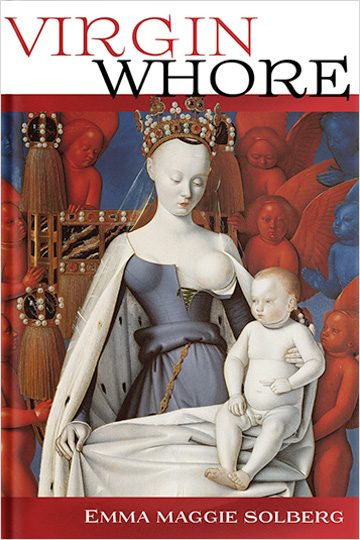
Virgin Whore - Emma Maggie Solberg


Virgin Whore
In Virgin Whore, Emma Maggie Solberg uncovers a surprisingly prevalent theme in late English medieval literature and culture: the celebration of the Virgin Mary’s sexuality. Although history is narrated as a progressive loss of innocence, the Madonna has grown purer with each passing century. Looking to a period before the idea of her purity and virginity had ossified, Solberg uncovers depictions and interpretations of Mary, discernible in jokes and insults, icons and rituals, prayers and revelations, allegories and typologies—and in late medieval vernacular biblical drama.

More unmistakable than any cultural artifact from late medieval England, these biblical plays do not exclusively interpret Mary and her virginity as fragile. In a collection of plays known as the N-Town manuscript, Mary is represented not only as virgin and mother but as virgin and promiscuous adulteress, dallying with the Trinity, the archangel Gabriel, and mortals in kaleidoscopic erotic combinations. Mary’s “virginity” signifies invulnerability rather than fragility, redemption rather than renunciation, and merciful license rather than ascetic discipline. Taking the ancient slander that Mary conceived Jesus in sin as cause for joyful laughter, the N-Town plays make a virtue of those accusations: through bawdy yet divine comedy, she redeems and exalts the crime.

By revealing the presence of this promiscuous Virgin in early English drama and late medieval literature and culture—in dirty jokes told by Boccaccio and Chaucer, Malory’s Arthurian romances, and the double entendres of the allegorical Mystic Hunt of the Unicorn—Solberg provides a new understanding of Marian traditions.

Sunday, August 19, 2018

UCLA Library to host digital archive of ancient Arabic and Syriac manuscripts


The UCLA Library and Early Manuscripts Electronic Library have partnered with St. Catherine’s Monastery to digitize and publish online on an open access basis some 1,100 rare and unique Syriac and Arabic manuscripts dating from the fourth to the 17th centuries.

A UNESCO World Heritage site located in a region of the Sinai Peninsula sacred to Christianity, Islam and Judaism, St. Catherine’s Monastery houses a collection of ancient and medieval manuscripts second only to that of the Vatican Library. Some 400,000 images will be created, including of works from Syriac literate culture, which flourished between the third and eighth centuries, and Christian Arabic literature, which appeared in the eighth century as Christian communities adapted to the spread of Islam.


read more here @ UCLA Newsroom

Friday, June 29, 2018

How we discovered three poisonous books in our university library


Some may remember the deadly book of Aristotle that plays a vital part in the plot of Umberto Eco’s 1980 novel The Name of the Rose. Poisoned by a mad Benedictine monk, the book wreaks havoc in a 14th-century Italian monastery, killing all readers who happen to lick their fingers when turning the toxic pages. Could something like this happen in reality? Poisoning by books?

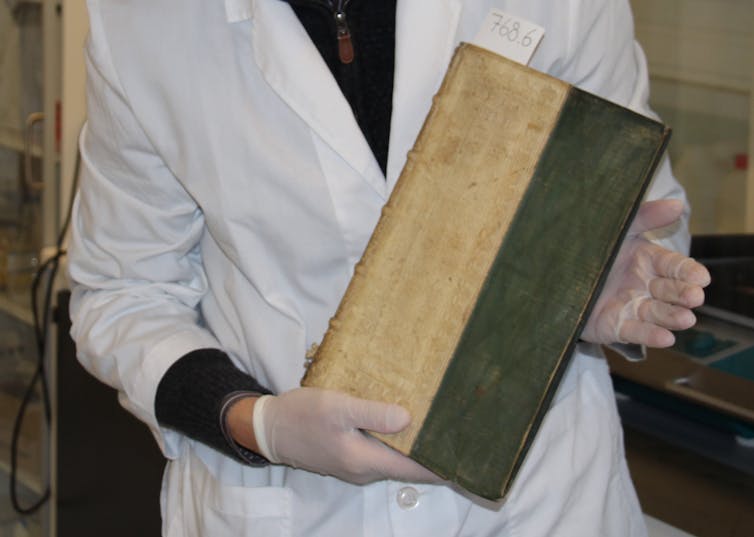
Our recent research indicates so. We found that three rare books on various historical topics in the University of Southern Denmark’s library collection contain large concentrations of arsenic on their covers. The books come from the 16th and 17th centuries.

The poisonous qualities of these books were detected by conducting a series of X-ray fluorescence analyses (micro-XRF). This technology displays the chemical spectrum of a material by analysing the characteristic “secondary” radiation that is emitted from the material during a high-energy X-ray bombardment. Micro-XRF technology is widely used within the fields of archaeology and art, when investigating the chemical elements of pottery and paintings, for example.


read more here @ The Conversation

Saturday, December 2, 2017

Manuscript - The Crusader Bible

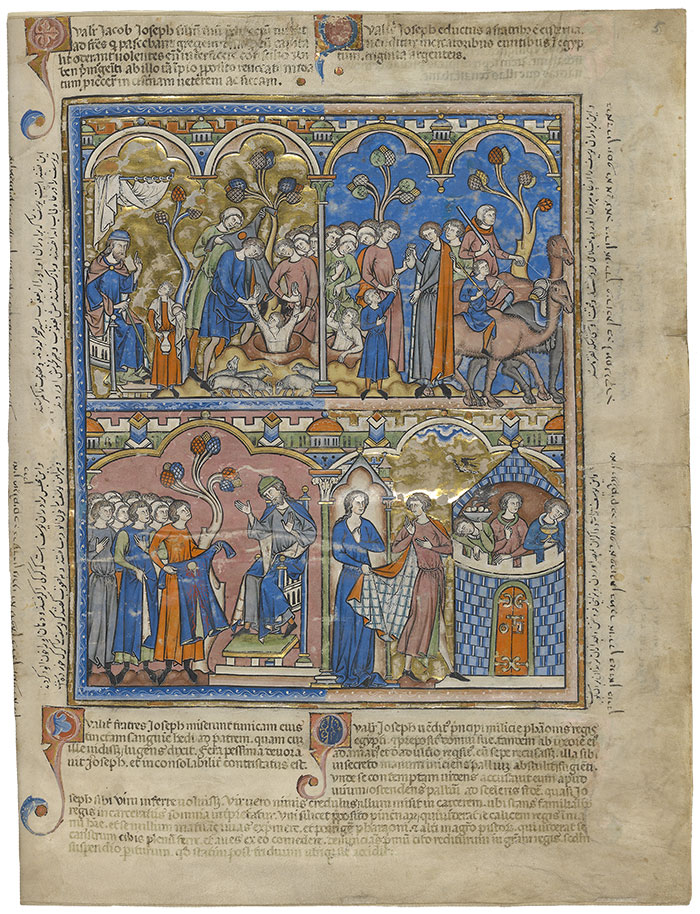
The Crusader Bible does not illustrate the entire Bible, but only portions of Genesis, Exodus, Joshua, Judges, Ruth, and Samuel. The picture book’s forty-six folios depict some 346 episodes, and about forty percent of the pages are devoted to David’s life. 

The stories focus on important heroes in the history of Israel—Abraham, Joseph, Moses, Joshua, Samson, Samuel, Saul, Jonathan, and David, offering models of kingship to be avoided or followed. The stories are not set in the Holy Land, but in the milieu of thirteenth-century France. The miniatures are unprecedented in their naturalism, monumentality, breadth of execution, and narrative detail. 

The story-telling skills of the artists surpass those in contemporary manuscripts, and the dynamic depictions of battles and meticulously portrayed armor betray first-hand experience. Originally there were no captions, so narrative clarity was achieved by cleverly designed architectural settings, costumes, and gestures. Originally there were forty-eight leaves: forty-three are in the Morgan (MS M.638), two (fols. 43, 44) are in the Bibliothèque nationale de France, Paris (MS. Nouv. Acq. Lat. 2294), one (fol. 45) is in the J. Paul Getty Museum, Los Angeles (83.MA.55), and two are missing.


read and view here @ The Morgan Library & Museum


Saturday, September 23, 2017

Fechtbuch - Medieval Fightbook

I first came across a reference to "Fechtbuch" via a documentary on SBS here in Australia - which was no doubt the National Geographic program that had aired much earlier.

The tome in reference - Fechtbuch - was a fencing manual written in 1443 by Hans Talhoffer:
Talhoffer was following a tradition established by Johannes Liechtenauer, an itinerant master swordsman of the fourteenth century who recorded the secrets of his fighting techniques in the form of cryptic verses. The Talhoffer manuscript includes verses from Liechtenauer, sections devoted to the procedures for fighting judicial combats both with and without armor, and the use of the weapons employed in such combats, including the highly specialized Stechschilde (thrusting shields), maces, long swords, spears, and daggers. There are also sections on knife fighting and wrestling, the latter based on the methods of Ott the Jew, a renowned wrestling master to the archdukes of Austria.
There is a 1467 copy of Talhoffer's Fechtbuch in the Bavarian State Library:
This 1467 manuscript Fechtbuch (Combat manual) provides instructions for various methods of fighting, without armor and wearing different kinds of armor, and on foot and on horseback. A series of annotated illustrations is devoted to combat with swords, daggers, pikes, and other weapons. Even the rules for a trial by combat between a man and a woman are included. The author, Hans Talhoffer (circa 1420–circa 1490), was regarded in his time as an unbeatable swordsman and one of the finest teachers of the so-called German school of fencing. Because of his reputation, many noblemen sought his services as an advisor and teacher. Among them was the first duke of Württemberg, Eberhard the Bearded (1445–96), who commissioned this manuscript. The manuscript itself has a curious history: originally forming part of the library of the dukes of Bavaria, it was stolen during the Thirty Years' War and ended up in Gotha. Only in 1951 was it again sold to the Bavarian State Library, where it is now preserved.
See also:

Read Online:
Further Reading:
  • Codex Wallerstein: A Medieval Fighting Book from the Fifteenth Century on the Longsword, Falchion, Dagger, and Wrestling by Grzegorz Zabinski
  • The Art of Combat: A German Martial Arts Treatise of 1570 by Joachim Meyer 
  • The Art of Sword Combat: A 1568 German Treatise on Swordmanship by Joachim Meyer
  • Venetian Rapier: Nicoletto Giganti's 1606 Rapier Fencing Curriculum by Tom Leoni
  • The Art of Swordsmanship by Hans Lecküchner trans Jeffrey L. Forgeng
  • The Complete Renaissance Swordsman: A Guide to the Use of All Manner of Weapons: Antonio Manciolino's Opera Nova (1531) by Tom Leoni

Monday, June 5, 2017

More on Medieval Manuscripts


The British Library holds the world’s largest collections of books made or owned in England between the end of Roman Britain and the Norman Conquest of 1066. These books trace the development of writing, society, economy, government and religion from the 7th to the 11th centuries. We are delighted to announce that 175 of these manuscripts can now be viewed in full online on our Digitised Manuscripts website. We’ve produced a complete list of the Anglo-Saxon manuscripts available as of March 2017. 


Arabic Manuscripts Collection @ British Library:
The subject matter covers the Quranic sciences and commentaries, hadith, kalam, Islamic jurisprudence, mysticism and philosophy, Arabic grammar and philology, dictionaries, poetry and other literary genres, history, topography and biography, music and other arts, sciences and medicine, texts relating to the Druze and Bahais, Christian and Jewish literature, and other subjects such as magic, archery, falconry and dream interpretation.


From the Daily O:
On the margins of manuscripts, Camillo told us, we could expect to find, courtesy a scribe or a commentator - padaccheda (word division), anvayokti (explanation of syntax), padārthabodha – a gloss or a quotation, laukika and alaukikavigraha (ordinary language and technical grammatical explanations) and tātparya – an authorial explanation, a gist. In addition we might find decoration, corrections and an invocation.


Medieval Marginalia @ Atlas Obscura:
From intriguingly detailed illustrations to random doodles, the drawings and other marks made along the edges of pages in medieval manuscripts—called marginalia—are not just peripheral matters. “Both tell us huge amounts about a book’s history and the people who have contributed to it, from creation to the present day.”


Rhode Island Public Radio on the Voynich Manuscript:
Yale University Press’ fascimile edition of the Voynich Manuscript will be released November 1st. The book includes an essay by novelist and historian Deborah Harkness. A second limited-run edition will be released by Siloe, a Spanish publishing house. The limited edition will faithfully reproduce the book’s texture and design.