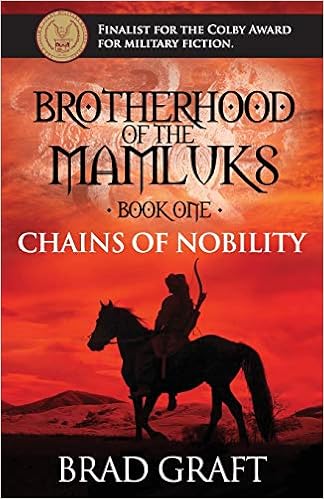
 Book 1 - Chains of Nobility
Duyal, a teenage nomad living on the vast Russian steppe, is captured during a Mongol invasion and forced on a long, deadly journey into the war-torn Middle East. Purchased by a Kurdish prince in eastern Turkey, his destination is an Islamic citadel, filled with similarly enslaved strangers and one merciless instructor—a man determined to purge the weaklings from his ranks and forge the survivors into Mamluks, Islamic Knights unmatched in wielding sword, arrows, and lance from atop Arabian steeds.
When Duyal becomes entangled in his instructor’s schemes and his mates witness another comrade’s unjust execution, the recruits can take it no longer. Their wrath is unleashed.
Chains of Nobility is the first book in the Brotherhood of the Mamluks trilogy. Set during the 13th century, the book is an immersive dive into the world of military slavery—a Muslim institution largely unheard of in the West, whose ranks ousted the Crusaders and Mongols from the Levant, preserving Islam.
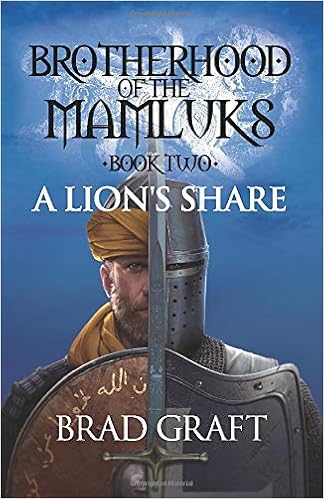 Book 2 - A Lion's Share
A Lion’s Share is the second book in the Brotherhood of the Mamluks trilogy. The story is set in the 13th Century Middle East, during the Seventh Crusade. Told from the Egyptian perspective, it is a rare view of life among the Mamluks—elite Muslim warriors largely unheralded in the West—whose ranks ousted the Crusaders and Mongols from the Levant, preserving Islam.
On the eve of a historic battle, Leander, a disenchanted Crusader, surrenders to Muslim amirs with the intent of joining the revered Bahri Mamluks. His move seems fated. The young Frenchman avoids the mass slaughter suffered by the Christian alliance and earns himself a place with the elite cavalry regiment, serving the Sultan of Egypt. Yet once King Louis IX of France seeks vengeance and sets Cairo as the objective of his campaign, Leander is faced with warfare against his native people as he defends his new home, comrades, and religion.
When the Bahri’s adored sultan dies and Leander becomes tangled in forbidden love with an Egyptian woman, his world unravels further. As the Mamluks seize rule for themselves, a rivalry between opposing regiments turns bloody and the newly-formed Mamluk Sultanate tumbles into chaos, with Leander and his mates scrambling not only for position within the realigned empire, but also for their lives.


