Showing posts with label 19th century. Show all posts

Thursday, January 1, 2026

Review: Louis Mie and the Trial of Hautefaye by LM Twist

Synopsis: In the birth of a new French Republic, a man must risk his honor, his marriage and even his life in a battle between his ideals and his ambition.

France, 1870. A frenzied mob brutally murders a man they believe to be a Prussian spy and a threat to the cult of Emperor Napoleon III. Louis Mie, a republican lawyer, finds himself entangled in a web of political intrigue and moral dilemmas when he is tasked with defending one of the murderers: a political show trial that could send his career to new heights.

But as Louis delves deeper into the high-profile case, he quickly realizes that defending the enigmatic Leonard Piarrouty is far more complex than he ever imagined. And now his entire life is about to fall apart as his obsession with his work takes his strained marriage to the brink of collapse.

In a gripping race against time, Louis must confront the blurred lines between justice, loyalty, and the pursuit of power, risking everything to unearth the truth: secrets that ruthless men will kill to protect.

~ ~ ~

The narrative alternates between the events that led to the trial (both the crime and the appointment of Louis Mie for the defence) and the actual "present day" of the trial and the outcome. The past narrative also includes details of Louis' life leading up to the trial.

The author notes that this is a "fictional account" of events, being a novel of speculation and interpretation, especially with regards to the main character - Louis Mie. This for me was a little disappointing, although I do understand that it is hard to surmise what an historical figure may be thinking or feeling - and without it, the main character may appear a little one dimensional.

The novel deals with the themes of mob violence, suspicion and paranoia, fear and panic in an enclosed community during the height of war; it details the violence and torture quite openly.

Myself, I would have preferred a more non-fictional account that than a fictional one; but kudos to the author for tackling such an obscure historical event, which is what drew me to this tome originally.

If you are after something different in the historical fiction genre - and are not particularly squeamish - then this might be a tome worth tackling.

Monday, December 1, 2025

Review: The Adventures of the Murdered Midwife by Liese Sherwood-Fabre

Synopsis: Arthur Conan Doyle provided few details on Holmes' boyhood. His ancestors were country squires, his grandmother was the sister of the French artist Vernet, and he had a brother named Mycroft - seven years his senior.

Recently, a cache of documents has been discovered detailing, in Sherlock's own hand, his early forays into criminal investigation.Only weeks into his first year at Eton, Sherlock's father calls him and his brother back to Underbyrne, the ancestral estate.

The village midwife has been found with a pitchfork in her back in the estate's garden, and Mrs. Holmes has been accused of the murder.

Can Sherlock find the true killer in time to save her from the gallows?

~ ~ ~

After a few false starts with other authors taking on Holmes, I actually found myself enjoying this take on the young Sherlock. What begins as simply a case of proving his mother innocent of a crime,young Sherlock, and indeed the Holmes clan, embark on solving the actual crime as the body count rises.

The author provides an insight into the young Holmes, fresh from being dragged away from his first year at Eton, to join older brother Mycroft (dragged away from Oxford Uni much to his chagrin) and uncle Ernest in collectively solving these local crimes.

For me, however, it is Mrs Holmes who is the stand out - she is obviously the one whom young Sherlock will emulate - and you can feel the author's guiding hand in his development as a detective. As Sherlock himself says "... mother always taught me a detached mind produced better results ...". We also are treated to the first glimpses of the skills Holmes will develop and use in his latter years - disguises, consorting with all class of people, powers of observation and evidence collection, a little criminal activity, and his one-up-manship against the local constabulary.

All in all, this is a fine start to a new series and one I am looking forward to investing in.

Monday, October 6, 2025

Review: Murder in Constantinople by AE Goldin

Synopsis: A gripping, immersive historical murder mystery in which a wayward boy from London's East End is pulled into the hunt for a serial killer on the eve of the Crimean War.

London, 1854. Twenty-one-year-old Ben Canaan attracts trouble wherever he goes. His father wants him to be a good Jewish son, working for the family business on Whitechapel Road, but Ben and his friends, the 'Good-for-Nothings', just want adventure.

Then the discovery of an enigmatic letter and a photograph of a beautiful woman offer an escapade more dangerous than anything he'd imagined. Suddenly Ben is thrown into a mystery that takes him all the way to Constantinople, the jewel of an empire and the centre of a world on the brink of war.

His only clue is three 'The White Death'. Now he must find what links a string of grisly murders, following a trail through kingmaking and conspiracy, poison and high politics, bloodshed and betrayal. In a city of deadly secrets, no one is safe - and one wrong step could cost Ben his life.

~ ~ ~

"Murder in Constantinople" reads like a boys-own-adventure. There are political machinations, espionage, murder, secret societies, travel, war, criminal detection, and a naive hero blundering into situations beyond his abilities.

And if you suspend belief and accept it as such, you will find an enjoyable romp through 19th century Constantinople at the time of the Crimean War - where politics and high society meld, where "everyone from high to low has secrets, all tied together in an invisible web", where conspiracies abound, and a serial killer is on the loose. Can our young runaway find his feet whilst avoid being the target of a secret group of assassins .... only time will tell.!


The first in a new series, the scene setting begins here and once it gets going, the action follows.

Monday, May 12, 2025

Review: The Return of Moriarty by Jack Anderson

Synopsis: After Professor Moriarty survives Reichenbach Falls and Sherlock Holmes dies, Moriarty finds himself caught up in a locked-room mystery Holmes couldn’t solve.  This time, it’s up to Moriarty to crack the mystery, perfect for fans of Sherlock Holmes ingenious retellings like the ones by Anthony Horowitz and Laurie R. King.

Upon escaping from Reichenbach Falls, his empire in ruins, criminal mastermind James Moriarty takes the identity of wealthy inventor Hugo Strahm and embarks on a dark pilgrimage to the cliffside manor of Schloss Alber in Bavaria.

When medical student Clara Mendel returns to Schloss Alber, she finds her childhood home on the verge of ruin. A deadly feud over a priceless heirloom has thrown the Alber family into chaos while its walls play host to an unusual cast of characters – the obstinate Lord Alber, his strange and beleaguered children, their cantankerous butler, and of course, their mysterious new guest, "Hugo Strahm." When one of them is poisoned at dinner, it’s the first act in a spiraling criminal conspiracy, in which any and all of them are suspects.

Working with the sharp and inquisitive Clara, the former crime lord attempts to solve the mystery whilst trying to keep his true identity concealed. Yet despite taking on the role of detective, Moriarty does not share Sherlock Holmes’s methods, nor his interest in justice. Only one thing is certain, for James Moriarty, dying at the hands of Sherlock Holmes would have been an elegant end… The question of what comes next is far more complicated.

This cleverly plotted mystery is a faithful and inventive take on the Sherlock Holmes legacy, paying homage to Arthur Conan Doyle’s signature style while adding its own devious tricks to the story that is destined to become a must-read classic for Sherlock Holmes fans.

~ ~ ~

As a huge fan of Conan Doyle's Holmes and Moriarty, I was eager to read this new mystery featuring Moriarty himself. And for the first part, I was intrigued and engaged as a series of journal entries and letters reveal that Moriarty did indeed survive after Reichenbach Falls in 1891 - these narratives explain this quite well, with each new narrator picking up where the previous one left off.

It is not until we meet our final main narrator in Clara Mendel and we reach our destination of Schloss Alber, that for me, events stagnate - characters become passe and even Moriarty himself is a bit wishy-washy. The actual mystery, was rather formulaic - just set in a different geographical location and timeline.

Whilst the use of a number of difference narratives does - at first - maintain a certain continuity, they actually begin to distract and detract from the mystery itself, bogging down the narrative to the point that I found myself wondering if the author was ever going to get to the point.

I was not a fan of this rendition of Moriarty, which was most likely one of the main reasons that this story just did not resonate - I would hardly describe it as a homage to Conan Doyle's own style nor being faithful to the Holmes legacy. One for the Holmes corpus ... I think not.

Friday, February 7, 2025

Review: Chinawoman's Chance by James Musgrave

Synopsis: Clara Shortridge Foltz faces a patriarchal nemesis in 1884 San Francisco. When a white prostitute is murdered and flayed down to a skeleton, Clara is hired by the Six Companies of Chinatown to defend the sixteen males who are swept-up by the Chinatown Squad. This ragtag and corrupt group of sheriffs works for the mayor, Washington Bartlett. The mayor uses the nation’s anti-Chinese sentiment in his quest to win the race for Governor of California.

Foltz, the first woman admitted to the California Bar, must learn fast to become a detective in order to prove that her client, journalist George Kwong, is not the killer but was set-up by the mayor to take the fall. Along with Ah Toy, her trusted translator and best friend, she is instructed by the head of detectives, Captain Isaiah Lees. Lees becomes enamored with Clara, who is having personal problems with sexual commitment, due to her first marriage with Jeremiah Foltz. He was a Union vet who deserted Clara and their five children for a younger woman.

Captain Lees has personal problems of his own, as he has devoted all his time fighting the corrupt politicians and the Chinatown Squad for twenty years, and has not even made time for female relations. Theirs is a very special kind of romance.

Clara brings a national spotlight to bear on her case, as thousands of women flock to the City by the Bay to support her effort to win against these patriarchal forces. The Chinese are also oppressed, and Clara and Ah Toy become embroiled in a deadly came of cat-and-mouse to trap the real killer and save George Kwong.

~ ~ ~

I received a copy of this as an ARC from the publisher (six years ago and just got around to reading it now). The cover and synopsis, however, are for the first book in the series - the DRC content is for the second, "The Spiritualist Murders".

Unfortunately, this is just not really my style of narrative, plotting or characters. I did not finish this - but did give it a fair go but just found my interest waning in the extreme; possibly had I read the actual first book this may have been a different read for me. In this instance, 19th Century San Francisco and the spiritualist movement are just not my thing.

This may be of interest to other readers, however, please do read the books in order as I believe there is some background setting that is relevant and will assist in the enjoyment of the series.  The third in the series is titled "The Stockton Insane Asylum Murder" for those interested in pursuing this further.

Wednesday, January 1, 2025

Review: Britain's Greatest Detective by Nell Darby

Synopsis: From his offices at Basinghall Street in the City of London, Henry Slater presided over Britain's best-known private detective agency, king of all he surveyed. In the late Victorian era, and into the twentieth century, his name was synonymous with the Golden Age of private detection; he was a truly modern operator, utilising the press and technology, and creating innovative publicity campaigns to keep his agency in the public eye.

One of the key skills of the private detective was the ability to make friends - to infiltrate the lives of individuals, and to get them to trust them with their secrets. Slater, however, would make one mistake: to befriend the wrong person and to entrust them with his secrets. When that friendship ended, competition in the private detective world would lead to a trial so infamous that Winston Churchill himself came to watch proceedings play out at the Old Bailey. The trial would destroy Henry Slater's career, and expose his real identity.

This is the first in-depth study of private detective work in nineteenth and early twentieth century Britain, looking at the 'Golden Age' of private detectives and the work they did. It provides a fascinating look at the type of person who became a private detective, the people who wanted to be their clients - and the crimes that could be committed along the way. This book sheds new light on this profession, building on the author's previous work on female private detectives in order to enable the reader to gain a better understanding of a job that people of all classes desired to do. But it is also about the career of one man. Sherlock Holmes may have been the most famous fictional private detective, but Henry Slater was, for twenty years, the real star of the private detective world.

~ ~ ~

This book does what is sets out to do - gives the reader an entree into the world of the early private detectives, the people drawn to this type of work, the methods used, and the cases they were typically involved in. Anchoring this tome is the character of Henry Slater - the self proclaimed "greatest detective" of his time.

Darby notes that it was with the passing of the Matrimonial Causes Act 1857 that gave rise to the private detective as courts required evidence of matrimonial misdeeds in order to grant a divorce. This was primarily the type of work available for the private detective, especially one with no connection to the police department.

It is against this that Darby focuses on the case that brought down Slater and his agency - the Pollard divorce case - and highlighted the underhanded dealings that went on to secure the evidence (ie: honey trap, payment of witnesses). None of this would have come to light had Slater not spurned the friendship of one of his employees - Francis Stevens - ".. a man who would do anything to get revenge ..." - including setting up a rival agency and using others to bring about Slater's downfall.

The proceeding court case against Slater and his employees is followed in detail, always referring back to the original Pollard divorce case and methodology used in gaining the required evidence.

Darby follows through to not only the conclusion of the case against Slater et al, but also what followed afterwards for the main players in this drama. Did they get off or were all incarcerated? What happened to the Pollards?

At times the construction of the narrative was a little annoying as it tended to go back and forward in the timeline, but overall it was quite easy to follow. The research that went into this tome is very evident, a times a little dry but never uninteresting.

Definitely one for those interested in the detective agencies that were the UK equivalent of Pinkertons in the 19th and 20th centuries.

Review: The Signare of Goree by Laura Rahme

Synopsis: 1846. In the heat of West Africa, the French navy uncovers the corpses of two French soldiers. Inspector Maurice Leroux arrives at the island of Gorée. It seems death has come to this small colonial outpost off the Senegal coast, home to the prosperous mixed-blood women known as the signares.

The navy suspects that the Bambara people, emboldened by approaching emancipation, may be out for blood. While confronted by the locals’ strange magical beliefs, Maurice remains skeptical. Does malevolence play a part, or are these deaths accidental, brought upon by the brutality of nature in an island known as the white man's grave?

But when murder strikes, it becomes clear that a killer is stalking Gorée.

Swept by a mystery unlike any he has known, Maurice meets Signare Angélique Aussenac. The proud métis, deserted by her wealthy Bordeaux lover, casts her spell upon Maurice.

But beyond the throbbing sounds of the tam-tams and the glittering signare soirées, danger lurks. Someone is watching. And the deaths go on.

Could the killer be one of the rich Bordeaux merchants? Or are they hiding among the powerful signares?

~ ~ ~

I finally started this a couple of days ago and finished it today (20 Sept 2024). I would have completed it in one sitting but was rudely interrupted by life.

In the 18th and 19th century, Gorée was home to a Franco-African Creole, or Métis, community of merchants. Métis women, called signares, were descendants of African women and European traders, were especially important to the city's business life. The signares owned ships and property and commanded male clerks. They were also famous for cultivating fashion and entertainment. As the trade in slaves declined in the late eighteenth century, Gorée converted to legitimate commerce. In 1872, Goree became a French commune with an elected mayor and a municipal council.  However, our story is set in the 1840s.

The Signare of Goree is a compelling mystery, dripping in ancient culture and superstitions, the land of Goree and its people sweep evocatively across the pages, as Laura Rahme demonstrates her mastery of story-telling. Without giving too much away, the reader, like Leroux, is beguiled and bewitched by Goree, succumbing to the rhythmic tam-tams and its ancient magic, a distraction from the task at hand - finding a killer that may not be human.

Highly recommended.

Tuesday, December 31, 2024

Review: The Meji Guillotine Murders by Futaro Yamada

Synopsis: Japan, 1869. A time of reform and rebellion.A classic Japanese mystery – a pair of sleuths investigate a series of bloody murders in 19th century Tokyo.

Detectives Kazuki and Kawaji are assigned to investigate a series of seemingly impossible murders. Together with the help of a mysterious shrine maiden, can they solve each gruesome death and piece together the dark connection between them?

~ ~ ~

This tale is told over a series of small stories, each with it's own mystery and solution, but all converge and are joined in the final chapter, where the over-arching narrative is revealed and mystery solved.

There are two main investigating characters from the Imperial Prosecuting Office: Kazuki (based on a real historical figure) and his partner, the fictional, Kawagi. As an additional character, we are introduced to the fay-life Esmeralda, who accompanies the object in the title - the guillotine - to Japan, and remains as a sort of spiritualist who divines clues from speaking with the victims. Can't say I was a fan of Esmeralda and at times wonder why she was included at all.

There are many themes in this narrative - corruption, reform, colonialisation, tradition, politics, religion, rivalry, jealousy - for mid to late 19th century Japan was undergoing much change with the introduction of Western ideas and the end of Japan's isolationist policies.

A slow moving pace may detract some readers, but it is worth persevering to the end when the mysteries of the shorter stories and finally understood.

Sunday, December 22, 2024

Review: Mrs Hudson & The Capricorn Incident by Martin Davies

Synopsis: It is spring in Baker Street, and London is preparing itself for the wedding of the season - an international spectacular in which the young and popular Duke of Krasnow, a political exile from his native land, is due to take the hand of the beautiful and accomplished Princess of Rovenia - a union that will heal the divisions between her family and the duke's. But the stakes are high.

When the princess disappears in dramatic circumstances, other members of the British establishment are quick to call on Mr Sherlock Holmes and he, in turn, looks to his redoubtable housekeeper Mrs Hudson, and housemaid Flotsam, to assist in this puzzling case.

~ ~ ~

What if Baker Street’s most gifted resident wasn’t called Sherlock Holmes?

This is the premise for a mystery series based around Sherlock Holmes' housekeeper / landlady, Mrs Hudson, as the primary investigator. This particular tome is number seven in the series, which I wasn't fully cognisant of at the time of reading, so my comments are based solely on this tome.

Not a fan - Mrs Hudson was not to my mind, central to the storyline at all, it more based around the housemaid, Flotsam, who is also our narrator. Maybe I should I read the first books, as I was certainly not invested in this one.

For those who are interested, the  books in the series are:
  • Mrs Hudson & the Spirits’ Curse
  • Mrs Hudson and the Malabar Rose
  • Mrs Hudson and the Lazarus Testament
  • Mrs Hudson and the Samarkand Conspiracy
  • Mrs Hudson and the Blue Daisy Affair
  • Mrs Hudson and The Christmas Canary

Wednesday, February 7, 2024

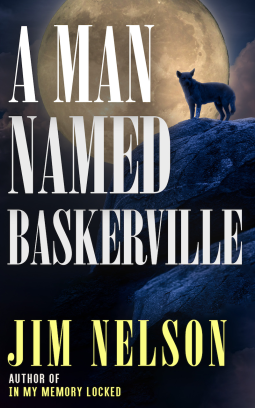
Review: A Man Named Baskerville by Jim Nelson

Sysnopsis:
He took on Sherlock Holmes and Dr. Watson, and he lost. Now he wants revenge.In 1888, Sherlock Holmes slayed the spectral hound haunting the Devonshire moor, thereby laying to rest the curse of the Baskervilles once and for all. The perpetrator escaped into the night and was presumed drowned, consumed by the murky bog...

In truth, the criminal mastermind survived the night to nurse his wounds and plot his revenge against Sherlock Holmes.

"A Man Named Baskerville" recounts the life and times of Rodger Baskerville, exiled heir to the esteemed family's fortune. His journal records his adventures from the Amazon rainforests to the beaches of Costa Rica to Victorian England, where he attempts to take his rightful place at Baskerville Hall. Along the way, he peels back the layers of family secrets and scandals untold in Dr. Watson's account of the demonic hound haunting the Baskervilles.

Most of all, he describes a Sherlock Holmes unlike the legendary detective you think you know.

"A Man Named Baskerville" retells the infamous Arthur Conan Doyle mystery in a way you've never read before. It's a sizzling new take on a classic hailed as a masterpiece of the English language, named one of the most influential books ever by the BBC and Le Monde, and beloved by Sherlock Holmes fans worldwide for over a century.

It's a rousing adventure, from start to finish. What's more—it's a Sherlock Holmes story unlike any you've read before.

~ ~ ~

This is the much needed backstory of the character of Stapleton from Conan Doyle's "Hound of the Baskervilles". It is exceedingly  well done and in keeping with Conan Doyle's original story. Over the course of a few days, and whilst he is being hunted by not only Holmes and Watson but also the local posse, Stapleton / Baskerville's earlier life is recounted.  

This reflection, in diary form and narrated in the first person by Stapleton / Baskerville, is taking place in "real time" following his escape into Grimpen Mire.  This alternate version of current events are related through the eyes of Stapleton / Baskerville, and are written in such a way as to elicit empathy for the narrator.

Heartily recommended for lovers of Holmes and those looking to add to their own Sherlock Holmes collections. Definitely one for my own!

Read More:


Monday, December 25, 2023

Review: The Flames by Sophie Haydock

Synopsis: Set in the extravagant, Bohemian art world of early 20th century Vienna, the electrifying untold story of the four women who posed for and inspired the groundbreaking erotic art of controversial painter Egon Schiele.

Amid an opulent society living under the shadow of war are four muses, women whose bodies were shown in intimate detail, depicted by the charming yet controversial artist Egon Schiele. Adele, his passionate and fierce admirer; Gertrude, his sister who survived their blighted childhood but is possessive, single-minded, and jealous; his mistress Vally, a poor young woman from a bad background but with steel at her core; and the two, very different, Harms sisters, Edith and Adele, both of whom vie to become Schiele’s wife.

Over the course of little more than a decade, the four women risk everything—their reputations, their most precious relationships, and their sanity and souls—as they try to hold on to the man they adore. As World War I throws their lives off course forever, and the Spanish influenza pandemic ravages Europe, threatening everyone in its path, one question remains: Will any of them emerge unscathed from their relationship with this man? Sophie Haydock’s The Flames reimagines the intertwining lives of these women: four wild, blazing hearts longing to be known. In an elegant Bohemian city like 1900s Vienna, everything seems possible. But just as a flame has the power to mesmerize, it can also destroy.

~ ~ ~

If it was the author's intent to bring this women to the fore to show how they influenced a debauched, narcissistic and misogynistic philanderer, then this really does not do it. All the women come off as similar - love becomes obsession before being callously discarded and abandoned for another woman. I felt no connection with any of them as they appear very one dimensional, and Egon Schielle himself I found repulsive in his depraved pursuit of very young women (girls even).

I did finish the book however, hoping to find some redeeming features, but left not really feeling it.

Saturday, February 19, 2022

Who Killed Jane Stanford? by Richard White

A premier historian penetrates the fog of corruption and cover-up still surrounding the murder of a Stanford University founder to establish who did it, how, and why.

In 1885 Jane and Leland Stanford cofounded a university to honor their recently deceased young son. After her husband’s death in 1893, Jane Stanford, a devoted spiritualist who expected the university to inculcate her values, steered Stanford into eccentricity and public controversy for more than a decade. In 1905 she was murdered in Hawaii, a victim, according to the Honolulu coroner’s jury, of strychnine poisoning. With her vast fortune the university’s lifeline, the Stanford president and his allies quickly sought to foreclose challenges to her bequests by constructing a story of death by natural causes. The cover-up gained traction in the murky labyrinths of power, wealth, and corruption of Gilded Age San Francisco. The murderer walked.

Deftly sifting the scattered evidence and conflicting stories of suspects and witnesses, Richard White gives us the first full account of Jane Stanford’s murder and its cover-up. Against a backdrop of the city’s machine politics, rogue policing, tong wars, and heated newspaper rivalries, White’s search for the murderer draws us into Jane Stanford’s imperious household and the academic enmities of the university. Although Stanford officials claimed that no one could have wanted to murder Jane, we meet several people who had the motives and the opportunity to do so. One of these, we discover, also had the means.

Sunday, December 12, 2021

Review: The Return of Hester Lynton by Tony Evans

Synopsis: Victorian England's most celebrated lady detective returns in ten new brain-teasing mysteries.With scheming fraudsters, corrupt doctors, devious forgers and terrible murderers afoot, Hester Lynton, and her trustworthy assistant Ivy Jessop, have their work cut out for them. But amidst the dirt and deprivation of 1800s London, our investigative duo will stop at nothing to catch their criminals.

The Return of Hester Lynton is a collection of ten absorbing cosy detective stories, perfect for fans of Sherlock Holmes, Mrs Gladden and the Lady Hardcastle mysteries.


This is a lovely homage to Sherlock Holmes with female detective Heston Lynton and her female "Watson", Ivy Jessop. Follow Hester and Ivy as the tackle such cases as:
  • The Case of the Fanshaw Inheritance (competition for an inheritance involving a treasure hunt)
  • The Case of the Stolen Leonardo (a stolen master, a locked room, forgery)
  • The Case of the Missing Professor (missing formula, traitors)
  • The Mystery of the Locked Room (mysterious death, question of family inheritance)
  • The Adventures of the Diamond Necklace (missing necklace, scandal, secret organisation)
  • The Adventure of the Kidnapped Schoolboy (missing child that is not straight-forward)
  • The Puzzle of the Whitby Housemaid (Bram Stoker brings a case involving a mysterious doctor and a scared maid)
  • The Case of the Russian Icon (swindled museum, double-cross)
  • The Case of the Naked Clergyman (eccentric clergyman and an inheritance at issue)
  • The Problem of Oscar Wilde (Oscar seek Hestor's help in recovering stolen letters)
Hester shares many similarities with Holmes: she smokes; makes use of disguises; works with a police inspector; deals with confidential cases; has an erstwhile sidekick and biographer (and narrator); is attended to by a loyal housekeeper; and is a spinster to Holmes' bachelor.

The tales, whilst being conveyed to the reader at a later period, date between 1880s and 1890s in Victorian London. England was still under the reign of Queen Victoria (d.1901), the Boer War was in its infancy (1899–1902), and the scare of the Ripper murders was still fresh in peoples' minds (1888). You can refer to my review of MJ Trow's "Four Thousand Days" for further background on London at this point in time.

Hester actually put me in mid of the lesser know female detective - Maud West.  From Bella Ellis' article on Crimereads
"Maud was real-life private detective who was London’s and, I suspect, the UKs only female private detective at start of the twentieth century. Quite a celebrity in her day, with a career spanning more than thirty years, West claimed her work took her all over the globe, from London to Paris, to the U.S and back again. A renowned mistress of disguise she often impersonated men from all walks of life – from sailors to aristocrats." 
A lovely collection of mysteries to while away an afternoon.


Further reading:
- History Extra: Female Detectives

Tuesday, August 31, 2021

Review: The Spirit Engineer by AJ West

Sysnopsis: Belfast, 1914. Two years after the sinking of the Titanic, high society has become obsessed with spiritualism in the form of seances that attempt to contact the spirits of loved ones lost at sea.

William is a man of science and a sceptic, but one night with everyone sat around the circle something happens that places doubt in his heart and a seed of obsession in his mind. Could the spirits truly be communicating with him or is this one of Kathleen’s parlour tricks gone too far?

This early 20th century gothic set in Northern Ireland contains all the mystery and intrigue one might expect from a Sarah Waters novel. Deftly plotted with echoes of The Woman in Black, readers will be thrilled to discover West’s chilling prose.

Based on the true story of William Jackson Crawford and famed medium Kathleen Goligher, and with a cast of characters that include Arthur Conan Doyle and Harry Houdini, The Spirit Engineer conjures a haunting tale that will keep readers guessing until the very end.


Sad to say that I did not finish this - after fourteen chapters which failed to enthrall me in any way shape or form, I put it aside, and found that West's blog was much more interesting - and which can be found HERE.


Sunday, August 22, 2021

Review: The Back to Front Murder by Tim Major

Synopsis: May 1898: Sherlock Holmes investigates a murder stolen from a writer’s research.

Abigail Moone presents an unusual problem at Baker Street. She is a writer of mystery stories under a male pseudonym, and gets her ideas following real people and imagining how she might kill them and get away with it. It’s made her very successful, until her latest “victim” dies, apparently of the poison method she meticulously planned in her notebook. Abigail insists she is not responsible, and that someone is trying to frame her for his death. With the evidence stacking up against her, she begs Holmes to prove her innocence…


I have read a number of books, by a number of authors, who have taken on the mantle of writing new Holmes & Watson books. Many have failed to meet with my expectations; others have done so admirably. This is one of the latter. It actually felt as if the words came from Conan Doyle's own pen - all the nuances that I remembered from my own collection of Sherlockian literature were there.

Major's book is one of many in the Titan Books stables of authors taking on the Holmes genre - but this is the first from that group that I have read. It is not an overly long read, and there is a little twist at the end. I look forward to reading more from both this and other authors under the Titan Books umbrella.


Edit: you can read about Tim's journey here @ Crimereads

Sunday, June 13, 2021

Lady Molly of Scotland Yard by Baroness Orczy

Lady Molly of Scotland Yard is a collection of short stories about Molly Robertson-Kirk, an early fictional female detective. It was written by Baroness Orczy, who is best known as the creator of The Scarlet Pimpernel, but who also invented two turn-of-the-century detectives in The Old Man in the Corner and Lady Molly of Scotland Yard.

First published in 1910, Orczy's female detective was the precursor of the lay sleuth who relies on brains rather than brawn. The book soon became very popular, with three editions appearing in the first year. As well as being one of the first novels to feature a female detective as the main character, Orczy's outstandingly successful police officer preceded her real life female counterparts by a decade.

Lady Molly, like her fictional contemporaries, most often succeeded because she recognised domestic clues foreign to male experience. Her entry into the police is motivated by a desire to save her fiancé from a false accusation. Once her superior intuition has triumphed, Lady Molly marries and leaves the force. The book contains all twelve Lady Molly adventures and is narrated by Lady Molly's assistant Mary Granard.


read more here

Tuesday, May 25, 2021

Review: The Irish Assassins by Julie Kavanagh

Synopsis: One sunlit evening, May 6, 1882, Lord Frederick Cavendish and Thomas Burke, Chief Secretary and Undersecretary for Ireland, were ambushed and stabbed to death while strolling through Phoenix Park in Dublin. The murders were funded by American supporters of Irish independence and carried out by the Invincibles, a militant faction of republicans armed with specially made surgeon's blades. They put an end to the new spirit of goodwill that had been burgeoning between British Prime Minister William Gladstone and Ireland's leader Charles Stewart Parnell as the men forged a secret pact to achieve peace and independence in Ireland--with the newly appointed Cavendish, Gladstone's protege, to play an instrumental role in helping to do so.

In a story that spans Donegal, Dublin, London, Paris, New York, Cannes, and Cape Town, Julie Kavanagh thrillingly traces the crucial events that came before and after the murders. From the adulterous affair that caused Parnell's downfall; to Queen Victoria's prurient obsession with the assassinations; to the investigation spearheaded by Superintendent John Mallon, also known as the "Irish Sherlock Holmes," culminating in the eventual betrayal and clandestine escape of leading Invincible James Carey and his murder on the high seas, The Irish Assassins brings us intimately into this fascinating story that shaped Irish politics and engulfed an Empire.


"Monto (Take Her Up To Monto)"
When Carey told on Skin-the-goat,
O'Donnell caught him on the boat
He wished he'd never been afloat, the filthy skite.
Twasn't very sensible
To tell on the Invincibles
They stood up for their principles,
day and night by going up to Monto Monto......"
(Irish folk song)


Irish politics is like one of those multi-games of chess you see in a New York park scene - the master playing against multiple opponents. It is neither straight forward or insular - there are too many players, too many agendas, too many external forces and influences, and most of the time, the Irish themselves factor little into the private agendas of the dominant personalities.

I am very au fait with both Irish history and politics - and had in the course of my reading, come across the Phoenix Park assassination of Cavendish by the Invincibles so was looking forward to an new analysis of events.  Unfortunately, I was sadly disappointed - and considered this a labourious and unrewarding reading experience.

This book attempts to cover off a lot of history leading up to the assassination. Kavanagh introduces many characters - some I personally consider not necessarily pertinent; and the side trip to Gweedore to "provide context" was, to be perfectly blunt, a waste of paper.

I believe that in order to construct a story around a single event, the author has cast a wide focus - too wide in my opinion; the narrative needed to be more linear. As such, I feel this failed to provide enough focus on the actual assassination, perpetrators and consequences early enough - it took just too long to get to the point. It was convoluted, lacking in structure and direction -  there was too much attention centred on individuals and events that had no relevance. I mean, the author's note says the tome was styled like " .... the shifting episodic structure of today's television dramas ..." - if this was an attempt to make the subject more palatable for the general reading public, then it missed the mark completely.  Sounds like the author is trivialising her subject matter.

Furthermore, the author's note as to the intent behind writing this book should have been placed at the front of the book rather than stuck at the back - it may have provided a slightly clearer idea of what the author was trying to achieve rather than leaving the reader slightly bewildered. The reader who picks this up is looking for more than a dry history lesson - they already have enough background knowledge - they are looking for a more narrow focus on a particular event. Any reader attempting this tome should come well prepared and have read some cursory editions of Irish history and politics beforehand, for without this,  defeat will come faster than a politicians promise on election day.


Had some editor attacked this with the proverbial red pen (or hatchet) and suggested a much more abridged - or even structured - version, this may have made for a more enjoyable (if that's appropriate) read. As mentioned there were just too many side issues which distracted and detracted from a more linear narrative - they were unnecessary and not overly relevant, and certainly should have been left on the cutting room floor.  Trying to literally stuff all the research into the single tome shows a distinct lack of understanding of the topic at hand and an inability to prioritise information- as the adage goes - sometimes less is more.  The topics just needed to be compartmentalised a little more effectively and efficiently.  Having said that, neither of Kavanagh's predecessors - Tom Corfe and Senan Molony - managed to provide a decent narrative on the subject.

Reading this as a kindle version made it much easier to put aside - with a physical copy, I would have just skipped through to the pertinent narrative and have had done with this in less than a day.  

read more here:


Sunday, May 9, 2021

Out of the Shadows by Emily Midorikawa

Out of the Shadows: Six Visionary Victorian Women in Search of a Public Voice by Emily Midorikawa
Queen Victoria’s reign was an era of breathtaking social change, but it did little to create a platform for women to express themselves. Not so within the social sphere of the séance – a mysterious, lamp-lit world on both sides of the Atlantic, in which women who craved a public voice could hold their own.

Out of the Shadows tells the stories of the enterprising women whose supposedly clairvoyant gifts granted them fame, fortune, and, most important, influence, as they crossed rigid boundaries of gender and class as easily as they passed between the realms of the living and the dead. The Fox sisters inspired some of the era’s best-known political activists and set off a transatlantic séance craze. While in the throes of a trance, Emma Hardinge Britten delivered powerful speeches to crowds of thousands. Victoria Woodhull claimed guidance from the spirit world as she took on the millionaires of Wall Street before becoming America’s first female presidential candidate. And Georgina Weldon narrowly escaped the asylum before becoming a celebrity campaigner against archaic lunacy laws.

Drawing on diaries, letters, rarely seen memoirs and texts, Emily Midorikawa illuminates a radical history of female influence that has been confined to the dark until now.


“Midorikawa breathes life into these long-ago women in ways that make them feel contemporary despite their extraordinary circumstances and distance in time . . . By the book’s end, it no longer matters whether you believe these six remarkable spirit mediums were hoaxes or not; you’ll certainly believe in them. —BookPage (starred review)

Join Emily Midorikawa on 5/16 for the virtual launch reading at Brookline Booksmith

Wednesday, May 5, 2021

The Arrowood Series by Mick Finlay

If you have not already invested in this series, I suggest that you do so in order to catch up with all things Arrowood before the release of the latest ....


More for Mick Finlay on his blog >>> here

Saturday, April 10, 2021

Weird Women: Classic Supernatural Fiction by Groundbreaking Female Writers: 1852-1923

Sysnopsis: From two acclaimed experts in the genre, a brand-new volume of supernatural stories showcasing the forgotten female horror writers from 1852-1923.

While the nineteen-year-old Mary Shelley may be hailed as the first modern writer of horror, the success of her immortal Frankenstein undoubtedly inspired dozens of female authors who wrote their own evocative, chilling tales. Weird Women, edited by award-winning anthologists Lisa Morton and Leslie S. Klinger, collects some of the finest tales of terror by authors as legendary as Louisa May Alcott, Frances Hodgson Burnett, and Charlotte Gilman-Perkins, alongside works of writers who were the bestsellers and critical favorites of their time--Marie Corelli, Ellen Glasgow, Charlotte Riddell--and lesser known authors who are deserving of contemporary recognition.

As railroads, industry, cities, and technology flourished in the mid-nineteenth century, so did stories exploring the horrors they unleashed. This anthology includes ghost stories and tales of haunted houses, as well as mad scientists, werewolves, ancient curses, mummies, psychological terrors, demonic dimensions, and even weird westerns. Curated by Klinger and Morton with an aim to presenting work that has languished in the shadows, all of these exceptional supernatural stories are sure to surprise, delight, and frighten today's readers.


read article here @ CrimeReads