Showing posts with label japan. Show all posts

Saturday, July 19, 2025

A Woman of Pleasure by Kiyoko Murata

In 1903, a fifteen-year-old girl named Aoi Ichi is sold to the most exclusive brothel in Kumamoto, Japan. Despite her modest beginnings in a southern fishing village, she becomes the protégée of an oiran, the highest-ranking courtesan at the brothel.

Through the teachings of her oiran, Shinonome, Ichi begins to understand the intertwined power of sex and money. And in her mandatory school lessons, her writing instructor, Tetsuko, encourages Ichi and the others to think clearly and express themselves. By banding together, the women organize a strike and walk away from the brothel and into the possibility of new lives.


Based on real-life events in Meiji-era Japan, award-winning and critically acclaimed veteran writer Kiyoko Murata re-creates in stunning detail the brutal yet vibrant lives of women in the red-light district at the turn of the twentieth century—the bond they share, the survival skills they pass down, and the power of owning one’s language.

Translated by Juliet Winters Carpenter

Sunday, February 9, 2025

Review: The Little Sparrow Murders by Seishi Yokomizo

Synopsis: An old friend of Kosuke Kindaichi's invites the scruffy detective to visit the remote mountain village of Onikobe in order to look into a twenty-year-old murder case. But no sooner has Kindaichi arrived than a new series of murders strikes the village - several bodies are discovered staged in bizarre poses, and it soon becomes clear that the victims are being killed using methods that match the lyrics of an old local children's song...

The legendary sleuth investigates, but soon realises must unravel the dark and tangled history of the village, as well as that of its rival families, to get to the truth.

~ ~ ~

This is the sixth in the Kosuke Kindaichi series that have been translated and re-issued; and my engagement with each new (old) release never wanes.

It is a child's nursery rhyme that will aid Kindaichi in solving not only a twenty year murder mystery but the current one that links back to the original. As usual, family secrets, jealousies and rivalries drive the narrative and slowly come to the fore as we discover connections between the victims and their families.

Yokomizo is the master at weaving an intricate and devilish plots, whilst ensuring the reader is immersed in both scenery and culture, to the point that they feel like they are literally following in the footsteps of our detective, Kindaichi.

Hasegawa Hiroki as Konsuke Kindaichi


As always, I am looking forward to the next release from Pushkin Press (Murder at the Black Cat Cafe) - and cannot recommend this series enough.

Tuesday, December 31, 2024

Review: The Meji Guillotine Murders by Futaro Yamada

Synopsis: Japan, 1869. A time of reform and rebellion.A classic Japanese mystery – a pair of sleuths investigate a series of bloody murders in 19th century Tokyo.

Detectives Kazuki and Kawaji are assigned to investigate a series of seemingly impossible murders. Together with the help of a mysterious shrine maiden, can they solve each gruesome death and piece together the dark connection between them?

~ ~ ~

This tale is told over a series of small stories, each with it's own mystery and solution, but all converge and are joined in the final chapter, where the over-arching narrative is revealed and mystery solved.

There are two main investigating characters from the Imperial Prosecuting Office: Kazuki (based on a real historical figure) and his partner, the fictional, Kawagi. As an additional character, we are introduced to the fay-life Esmeralda, who accompanies the object in the title - the guillotine - to Japan, and remains as a sort of spiritualist who divines clues from speaking with the victims. Can't say I was a fan of Esmeralda and at times wonder why she was included at all.

There are many themes in this narrative - corruption, reform, colonialisation, tradition, politics, religion, rivalry, jealousy - for mid to late 19th century Japan was undergoing much change with the introduction of Western ideas and the end of Japan's isolationist policies.

A slow moving pace may detract some readers, but it is worth persevering to the end when the mysteries of the shorter stories and finally understood.

Wednesday, February 7, 2024

Review: Butter by Asako Yuzuki

Synopsis: The cult Japanese bestseller about a female gourmet cook and serial killer and the journalist intent on cracking her case, inspired by a true story.

There are two things that I can simply not tolerate: feminists and margarine.

Gourmet cook Manako Kajii sits in Tokyo Detention Center convicted of the serial murders of lonely businessmen, who she is said to have seduced with her delicious home cooking. The case has captured the nation’s imagination but Kajii refuses to speak with the press, entertaining no visitors. That is, until journalist Rika Machida writes a letter asking for her recipe for beef stew and Kajii can’t resist writing back.

Rika, the only woman in her news office, works late each night, rarely cooking more than ramen. As the visits unfold between her and the steely Kajii, they are closer to a masterclass in food than journalistic research. Rika hopes this gastronomic exchange will help her soften Kajii but it seems that she might be the one changing. With each meal she eats, something is awakening in her body, might she and Kaji have more in common than she once thought?

Inspired by the real case of the convicted con woman and serial killer, "The Konkatsu Killer," Asako Yuzuki’s Butter is a vivid, unsettling exploration of misogyny, obsession, romance and the transgressive pleasures of food in Japan.

~ ~ ~

Anyone new to Japanese fiction / mysteries should be aware that these books tend to contain lengthy descriptions ... about everything. Having read a number of Japanese mysteries this was something I was well aware of - and yet, I was thoroughly disengaged with both characters (Rika Machida and Manako Kujii) and the narrative to the point that I would consider myself utterly bored. After 100 or so pages of a story that was three parts too long in the telling and one part mystery, I literally gave up - and this being despite the fact that this story was "inspired" upon real events (a theme I tend to find engaging).

If you are interested in cooking and butter then by all means, read on.  If you are interested in the "real events" that inspired this particular work, then head over to good old wikipedia and read about Kinae Kijima.

Sunday, May 29, 2022

Review: Death on Gokumon Island by Seishi Yokomizo

Synopsis: Kosuke Kindaichi arrives on the remote Gokumon Island bearing tragic news – the son of one of the island’s most important families has died, on a troop transport ship bringing him back home after the Second World War. But Kindaichi has not come merely as a messenger – with his last words, the dying man warned that his three step-sisters’ lives would now be in danger. The scruffy detective is determined to get to the bottom of this mysterious prophesy, and to protect the three women if he can.

As Kosuke Kindaichi attempts to unravel the island’s secrets, a series of gruesome murders begins. He investigates, but soon finds himself in mortal danger from both the unknown killer and the clannish locals, who resent this outsider meddling in their affairs.

Loosely inspired by Agatha Christie’s And Then There Were None, the fiendish Death on Gokumon Island is perhaps the most highly regarded of all the great Seishi Yokomizo’s classic Japanese mysteries.


For those unfamiliar with this series, it is about time that you invest in it. You can find the full list HERE - included those few that have been translated into English.

The style is fairly consistent - and one the author Seishi Yolomizo explores well - deep, dark family secrets, which when brought into open, give birth to jealousy, greed and ultimately ... murder. And here again, we have all those elements: a family saga of love and hate, revenge and redemption; many suspects but always one whom you are least likely to suspect; a suspenseful mystery, tied together by a long narrative that conveys the essence of the story, location and characters to perfection.  This is Yokomizo's trademark.

Kato-sensei as Kindaichi
This time, the grisly deaths appear to form some sort of dramatic countenance - and Kosuke is said to have remarked: "... The inhabitants of this island, do they all think this way - as if everything's like some kind of drama ..."

Throw into this murderous mix some pirates, returned and repatriated servicemen, local politics and scandal, and you have all the ingredients for a truly satisfying murder mystery.

I cannot recommend this series enough, with our detective, Kindaichi, who according to the local policeman, looks more like a criminal than a world famous detective!


Sunday, October 10, 2021

Review: The Village of Eight Graves by Seishi Yokomizo

Synopsis: The third title in Japan’s most popular murder mystery series — after The Honjin Murders and The Inugami Curse — fiendish classics featuring investigator Kosuke Kindaichi.

Nestled deep in the mist-shrouded mountains, The Village of Eight Graves takes its name from a bloody legend: in the Sixteenth Century eight samurais, who had taken refuge there along with a secret treasure, were murdered by the inhabitants, bringing a terrible curse down upon their village.

Centuries later a mysterious young man named Tatsuya arrives in town, bringing a spate of deadly poisonings in his wake. The inimitably scruffy and brilliant Kosuke Kindaichi investigates.


I cannot begin to say how much I am loving this series featuring the stuttering, dishevelled, shaggy-haired Japanese detective, Kosuke Kindaichi.  A long-time hit in Japan, but barely discovered here in the West until now, thanks to Pushkin Vertigo.  This is my third Kindaichi novel, having previously read The Honjin Murders and The Inugami Curse, so I literally jumped at the chance to read this one.

It is a slightly familiar format, and one the author Seishi Yolomizo explores well - deep, dark family secrets, which when brought into open, give birth to jealousy, greed and ultimately ... murder.  And here we have all those elements: a family saga of love and hate, revenge and redemption; many suspects but always one whom you are least likely to suspect; a suspenseful mystery, tied together by a long narrative that conveys the essence of the story, location and characters to perfection.

However, in this particular novel, the story begins much earlier - in the 1560s - with the murder of a group of samurai, a missing treasure and a curse.  Events rear their ugly head in the 1920s with the descendants of the village succumbing to the ancient curse.  By the time our story takes place (ie: 1940s), the village has become incredibly insular, and its villagers both suspicious and superstitious of everyone and everything. When events start to unravel along historic lines with the arrival of Tatsuya, the villagers can not but look to the past for an explanation.

In an interview published in The Guardian, Yokomizo's grandson On Nomoto, said: “Kindaichi tries to find out not just how someone has been killed but why it happened. And behind the story, it’s always connected to Japanese history.”

In the same article, Daniel Seton from Pushkin says of Yokomizo's novels: “It has all the ingredients that thrill fans of golden-age British and American mysteries ...... an old country house, a feuding family, mysterious noises in the night, a macabre murder and a brilliant sleuth with an ingenious solution. It’s also steeped in a distinctively Japanese atmosphere, and is packed full of playful references to the classics and traditions of crime writing.”

I love the character of Kosuke Kindaichi - a Japanese Columbo if you are wanting a comparison.  Kindaichi is portrayed as being slightly eccentric, wearing a robe and trousers that have seen better days, as well as having bad dandruff. He also gets easily stressed and excitable, which brings on his stuttering. And yet beneath all of the yokel-like exterior, is an exceedingly clever detective.  It goes to show that you should never judge a book by its cover (though Yokomizo's are fabulous!).

From what I can find, the next Kindaichi novel to be released is the fiendishly clever "Gokumon Island" said to be loosely inspired by Agatha Christie's And Then There Were None.  Perhaps the most highly regarded of all the great Seishi Yokomizo's classic Japanese mysteries, this novel is due for release in June 2022.  This particular novel was translated by  .


Pushkin Vertigo have release 35 mysteries from various international writers - and I have read 25 of them!  You can find the list HERE. Yokomizo is featured among many incredible writers - I cannot but suggest the reader delve into these mysteries for themselves.


More on Kindaichi here 

Monday, September 7, 2020

Review: The Inugami Curse by Seishi Yokomizo

Synopsis: In 1940s Japan, the wealthy head of the Inugami Clan dies, setting off a chain of bizarre, gruesome murders. Detective Kindaichi must unravel the clan’s terrible secrets of forbidden liaisons, monstrous cruelty, and disguised identities to find the murderer.


After reading the Honjin Murders back in March, I was excited to receive a review copy of another Kosuke Kindaichi mystery. However, this does not directly follow the first in fact it is number six in the series, but the second only to have been translated into English (nothing is lost in the translation!).

Events are set roughly around 1947 - after the second world war - and involve a prominent Nasu family. Following the death of the patriarch, the reading of his will (with its very special conditions) plunges the family into a "series of bloody murders". Kindaichi is on the spot and is involved in the investigation from the very beginning.

To say the family is disfunctional would be an understatement - petty jealousies, long concealed secrets, simmering hatreds, questionable motives, a gruesome deaths - all provide a deliciously deceptive narrative, with more red herrings than a Dr Seuss book.  Don't worry if you lose track, Kindaichi provides a brief summary of his discoveries about two thirds of the way through.

As I mentioned in my review of the Honjin Murders, I do hope that more of Yokomizo's Kindaichi series are translated and released.


Side note: another reviewer mentioned the movie version. I tracked it down (the 1976 version at least) on youtube - loved it!.


Sunday, March 8, 2020

Review: The Honjin Murders by Seishi Yokomizo

49016289. sy475
Synopsis: In the winter of 1937, the village of Okamura is abuzz with excitement over the forthcoming wedding of a son of the grand Ichiyanagi family. But amid the gossip over the approaching festivities, there is also a worrying rumour – it seems a sinister masked man has been asking questions about the Ichiyanagis around the village.


Then, on the night of the wedding, the Ichiyanagi family are woken by a terrible scream, followed by the sound of eerie music – death has come to Okamura, leaving no trace but a bloody samurai sword, thrust into the pristine snow outside the house. The murder seems impossible, but amateur detective Kosuke Kindaichi is determined to get to the bottom of it.


This setting, in 1930s Japan, sees a seemingly impossible double murder committed on the night of a wedding. Whilst the police investigate, one of the wedding guests calls in the services of renown private detective Kosuke Kindaichi who is described as ".. ungainly [in] manner, wild, [with] dishevelled hair and a stammer..." and man who ".. enjoyed putting on a show ..". All of this conceals razor sharp deduction skills that enable Kindaichi to solve the seemingly impossible crimes.

As we are propelled along with the investigation, Kindaichi seemingly takes over and many clues come to light and mysteries are solved. The final denoument occurs about three quarters of the way in and is covered off in the last few chapters.

Another theme running through this book was that of the class system that dominated Japanese society and culture at the time. There are many references to the feudal Edo society with its strict social stratification, customs, and regulations. Japanese people were assigned into a hierarchy of social classes based on the Four Occupations that were hereditary. The Emperor of Japan and the kuge were the official ruling class of Japan but had no power. The Shōgun of the Tokugawa clan, the daimyō, and their retainers of the samurai class administered Japan through their system of domains. Bu the majority of Edo society were commoners divided into peasant, craftsmen, and merchant classes, and various "untouchable" groups. 

At this time, Japan, like the rest of the world, was coming out of a depression and was becoming militarised as Japanese politics was gradually overtaken by the military with the invasion of Manchuria (1931) and the Japan-China War (1937) the most notable events. Many incidents occurred that undermined the government (coups and assassinations) as ultra-nationalist groups within the military sought to unite the nation under the emperor and introduce economic and social reforms. One by one, new measures were introduced to control and mobilize people, enterprises and resources. Most Japanese firms remained privately-owned but were heavily regulated to contribute to the war effort. Toward the end of the war, in order to boost heavy industries, consumption was greatly squeezed and light industries were suppressed. The textile industry (previously the leading industry of Japan) was virtually eliminated. The people were forced to live without a new supply of clothes and footwear. Steel products in structures and households were stripped as the metal source for building more airplanes and ships. External trade had all but ceased. In the end, the Japanese economy collapsed and defeat was inevitable. 

I am making a point to read more books that have been translated from their original language - and not just detective fiction. In this instance, I was drawn to the "locked door" mystery and was interested to see how this was interpreted.  What I also enjoyed was the reflective beginnings to this tale, told ten years after the fact and utilising facts garnered from the original investigation - so a little bit of back and forth in the timeline. 

For Yokomizo's detective, Kindaichi, this is one of many outings, in fact, there are 80 books featuring the popular detective, Kosuke Kindaichi. Hopefully, we will see many more translated and republished.

Sunday, October 27, 2019

It All Depends on 31 Syllables: A study of the power of Japan's medieval waka

Imagine if your social stature and your livelihood were dependent on your ability to write poetry and refer to the work of other poets. If there were poetry competitions among the elite that decided one’s worthiness. Or if the entire direction of a nation could be changed via 31 syllables.


Japanese waka, a 31-syllable precursor to haiku, held just this kind of sway for several centuries. Its role in a power play between two imperial factions is at the heart of Kendra Strand’s current book project, An Unfamiliar Place: Poetry, Landscape, and Power in Medieval Japanese Travel Writing. Strand (Asian & Slavic Languages & Literatures, CLAS) is an Obermann Fellow-in-Residence this fall who is focused on three men who were writing between 1350 and 1375 in the Nanbokuchō era: Sōkyū, Nijō Yoshimoto, and Ashikaga Yoshiakira. A Buddhist priest, a statesman, and a shōgun, respectively, these men knew each other and alluded to one another in their writing.


Sunday, June 9, 2019

Review: The Samurai's Daughter by John Healey

The Samurai's Daughter: A Novel
The follow up to The Samurai of Seville - its is a story of acceptance and finding your place in the world as Soledad Maria - the Samurai's daughter - finds herself torn between two cultures - that of her Japanese father and that of her Spanish mother; and never quite accepted in either.

We follow the alternating storyline - Shiro and Catriona / Japan and Spain, as Soledad Maria and her father return to his native Japan where she will be raised. On the way, many adventures take place - shipwrecks, mutiny, imprisonment, gladitorial style combat, narrow escapes, separation and reunion. New characters appear - the Irish captive, Catriona; the Dutch sea captain, Kurt; new family members in both japan and Spain.

In Japan they are received by the Shogun Tokugawa Hidetada, who hears their amazing tale of survival; Soledad maria (now Masako); is trained in the arts of the samurai, all the while being courted by the vengeful Data Tadamune.

On the run and attempting to return to Spain, many more adventures take place until finally they arrive and all stories merge into one.

It is a quick moving tale - slightly smaller in volume that the first. It is ultimately a young woman's reflections of both her own and her family's lives.

"... each of us is hos own person to be respected and understood ..." a poignant message.


Saturday, December 16, 2017

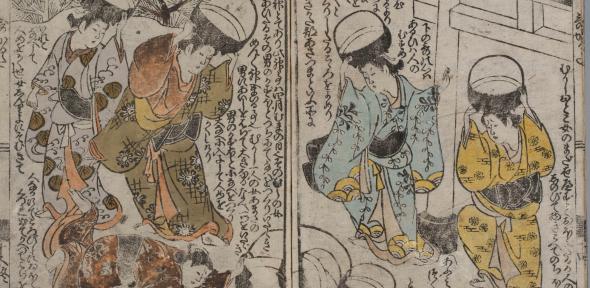
Earliest-known children’s adaptation of Japanese literary classic discovered in British Library | University of Cambridge


A chance discovery in the British Library has led to the discovery and reproduction of the earliest-known children’s adaptation of one of Japan’s greatest works of literature.

Dr Laura Moretti, from the Faculty of Asian and Middle Eastern Studies at Cambridge, came across an unknown children’s picture-book, dating from 1766, under the title of Ise fūryū: Utagaruta no hajimari (The Fashionable Ise: The Origins of Utagaruta) while on a study trip with her students.

The Tales of Ise has since been adapted and reinterpreted continually down the centuries as part of the canon of Japanese literature. 

Dr Moretti’s new book, Recasting the Past (Brill, 2016), presents a full-colour reproduction of the 18th century edition, alongside a transcription in modern Japanese, an English translation, and textual analysis. The publication of the 1766 adaptation of the Tales of Ise fills a gap in scholars’ understanding of the work’s history. Although much scholarship has taken place on the reception of Tales of Ise and its target audiences in different epochs, no one has previously explored the age of its readership.


read more here @ University of Cambridge

Sunday, October 8, 2017

'In the Woods of Memory': Okinawan novelist makes history visceral

From an article in The Japan Times:

It is almost impossible to find a serious novel that does not touch on the subject of death. “In the Woods of Memory,” taking for its theme the death of the soul, is no exception.
The rape of a 17-year-old girl by four U.S. soldiers during the Battle of Okinawa forms the animating horror at the core of this story, based on a number of similar cases related to the author [Shun Medoruma] by his relatives.
In writing this novel, Medoruma creates a sound chamber of voices, time shifts and associations, moving back and forth from 1945 to 2005. He filters experiences through eye witnesses, a wartime Okinawan-American interpreter, an obsequious village ward chief, an American attacker now tormented in his old age by his collusion in an act of barbarity, and his grandson, who is given the harpoon head used by Seiji in the attack on his grandfather.

read more here @ The Japan Times

read reviews here @ Foreword Reviews, @ Asia-Pacific Journal, @ Stone Bridge Press


Saturday, October 7, 2017

'Flowering of the Bamboo': Revisiting the mass poisoning of 1948


The acronym GUBU (grotesque, unusual, bizarre and unprecedented) fits the mass murder at the Teihoku Bank in Tokyo on Jan. 26, 1948. Sixteen people were deliberately poisoned, including an 8-year-old boy. More money was left behind than stolen.
While the incident has long been pored over in Japan, Triplett’s book was one of the first to explore the explosive case in English when it was published in 1985. Triplett, a journalist and playwright, stumbled on the case upon hearing about Sadamichi Hirasawa, a painter who was convicted of the murders and sentenced, but never executed. He lived out his life on death row. Hirasawa’s conviction was widely disputed.
Triplett examines the case from two perspectives: Hirasawa’s and that of Unit 731, the Imperial Army’s secretive Biological Warfare outfit, which had been operational during World War II and had ties to the case.
Besides the forensics of the crime Triplett’s book portrays just how much Japan was in flux in the immediate aftermath of the war: The Americans were trying to pull Japan’s institutions out of a deeply ingrained feudalistic culture, the police wanted to get someone on the hook quickly, and the press didn’t exactly cover themselves in glory while trying to convict Hirasawa in the court of public opinion. A compelling read, even if it unearths more questions than it answers.
read more here 
@ wikipedia - Sadamichi Hirasawa

See also:
  • Unit 731: Testimony by Hal Gold
  • Occupied City by David Peace
  • Justice in Japan: The Notorious Teijin Scandal by Richard H Mitchell
  • The Super Sleuths by Bruce Henderson & Sam Summerlin