Showing posts with label world war 2. Show all posts

Sunday, November 23, 2025

Review: Rogue Agent by James Crossland

Synopsis: The thrilling biography of Robert Bruce Lockhart, Britain's 'Agent' in Moscow

Sir Robert Bruce Lockhart (1887–1970) was an impressive figure: a diplomat, intelligence agent, conspirator, journalist and propagandist who played a key role in both world wars. He was a man who charmed his way into the confidences of everyone from Leon Trotsky to Anthony Eden. A man whom the influential press baron Lord Beaverbook claimed ‘could well have been prime minister’. And yet Lockhart died almost forgotten and near destitute, a Scottish footnote in the pages of history.

Rogue Agent is the first biography of this gifted yet habitually flawed maverick. It chronicles his many exploits, from his time as Britain’s ‘Agent’ in Moscow, and his role in a plot to bring down the communist regime, to leading the Political Warfare Executive, a secret body responsible for disinformation and propaganda in the Second World War.

Exploring Lockhart’s unorthodox thinking and contributions to the development of psychological warfare as well as his hedonistic lifestyle, late nights and many affairs that left him in a state of perpetual debt, Rogue Agent tells the thrilling story of this unconventional war hero.

~ ~ ~

I was familiar with events in Russia both leading up to and following the removal of the Tsar and the installation of the Bolsheviks. However, not as much as I thought I did.

Crossland provides the reader with what seems to be akin to a "boys own adventure" but is - in reality - something far from fiction. Lockhart is an intriguing yet elusive character, a man at odds with himself, a man somewhat ahead of the political game, but one who contributed to his own downfall - a victim of his own story.

Here was a man, aged 31yo, who was given a brief by the British Foreign Office, and had it impressed upon him to undertake and ensure its success "by whatever means" - then he was unleashed into the storm. Left to his own devices, Lockhart cavorted, womanized, drank and plotted to the point that any crucial information forwarded from him was considered suspect. He ignored all the signs that would eventually lead to his own capture and imprisonment, but was lucky in that he left nothing behind to incriminate himself.

Returning to Britain upon his release, and after various jobs for the Foreign Office, he eventually found himself in the political warfare executive (WWII propaganda department).  When the war was over, so too Lockhart's career effectively came to a close. He chose writing as a means to dig his way out of his perpetual cycle of debt, producing a number of works, many of which touched upon his own life experiences.

Crossland has managed to strip back the myth and ambiguity, to reveal a little more of the real man - a man full of human foibles, whose adventures seem larger than life, but one with the sheer audacity to stand face to face with Bolshevik Russia and walk away to tell the tale. Excellent read.

Saturday, July 19, 2025

Spymistress - A Biography of Vera Atkins

She was stunning. She was ruthless. She was brilliant and had a will of iron. Born Vera Maria Rosenberg in Bucharest, she became Vera Atkins. William Stephenson, the spymaster who would later be known as "Intrepid", recruited her when she was twenty-three.

Vera spent most of the 1930s running too many dangerous espionage missions to count. When World War II began in 1939, her many skills made her one of the leaders of the Special Operations Executive (SOE), a covert intelligence agency formed by, and reporting to, Winston Churchill. She trained and recruited hundreds of agents, including dozens of women. Their job was to seamlessly penetrate deep behind the enemy lines.

As General Dwight D. Eisenhower said, the fantastic exploits and extraordinary courage of the SOE agents and the French Resistance fighters "shortened the war by many months." They are celebrated, as they should be.

But Vera Atkins's central role was hidden until after she died; Author William Stevenson promised to wait and publish her story posthumously. Now, Vera Atkins can be celebrated and known for the hero she was: the woman whose beauty, intelligence, and unwavering dedication proved key in turning the tide of World War II.

Friday, February 7, 2025

Review: The Concentration Camp Brothel by Robert Sommer

Synopsis: In his seminal work, The Concentration Camp Brothel, Robert Sommer reveals the hidden horrors of sexual forced labor within the SS camp system, a subject long overshadowed and seldom acknowledged in the discourse on the Holocaust.

Through his rigorous examination of over 70 archives and poignant interviews with more than 30 survivors, including former visitors of camp brothels, Sommer paints a vivid and harrowing picture of the atrocities committed. This book is the first to offer a comprehensive exploration of the establishment, operation, and profound impact of brothels in Nazi concentration camps.

Sommer's research meticulously details the brothels' integration into the concentration camp system, their role in the Nazi exploitation of bodies for control and profit, and the complex reactions of the prisoner society to these establishments. He explores the desperate survival strategies employed by the women forced into sexual labor, and the chilling motivations of their exploiters.

The book also places the tragedy of camp brothels in the broader context of sexual violence under Nazi rule, making a critical connection between these acts of exploitation and the overall history of the Holocaust. This updated English edition incorporates new findings and perspectives since the original German publication in 2009, providing a more comprehensive understanding of the subject. The foreword by Annette F. Timm adds further context and contemporary analysis, enhancing the book's relevance and depth.

~ ~ ~

A confronting lost and ignored piece of Holocaust history. A forgotten voice given a hearing; its victims left physically and emotionally scarred, viewed as collaborators despite their own incarceration; so despised by their own that many refused to openly acknowledge this part of their lives. 

Using memoirs of those who would talk and other historical documents, this is a meticulous account of the brothels that were set up and operated, albeit for a short period of time, in Nazi concentration camps. These brothels were for the use of prisoners, not the guards or officers; mainly Ayran women were "employed" - women who had already been incarcerated for what was termed "anti-social behaviours"; the brothels were used as an "incentive" to increase the productivity of the imprisoned, forced labourers.

The stats at the end of the book are eye-opening - the youngest woman was seventeen, the oldest thirty-five.

It should be remembered that since the recognition of sex slavery in International Law (c. 2002), these victims are still ignored, uncompensated (as this was considered "voluntary"), outcast.

This is a well researched and confronting piece of history that - like its victims - deserves more recognition.


Monday, February 19, 2024

Review: Blood Roses by Douglas Jackson

Synopsis: As the Nazis roll into Warsaw, a serial killer is unleashed…

September 1939. A city ruled by fear. A population brutalized by restrictions and reprisals. Amid the devastation, another hunter begins to prowl. What are a few more deaths amid scores of daily executions?

Former chief investigator Jan Kalisz lives a dangerous double life, forced to work with the occupiers as he gathers information for the fledgling Polish resistance. Even his family cannot be told his true allegiance.

When the niece of a Wehrmacht general is found terribly mutilated, Jan links the murder to other killings that are of less interest to his new overlords. Soon, he finds himself on the trail of a psychopathic killer known as The Artist. But, shunned as a Nazi collaborator, can he solve the case before another innocent girl is taken?

~ ~ ~

My initial thoughts upon immediately finishing this book were that it was:
  • well written
  • evocative
  • engaging
  • great read
  • start of a thrilling new series
  • and I was left wanting more

This thriller is set at the time of the Invasion of Poland by German, Russian and Slovak forces (1 September 1939 - 5 October 1939). Polish forces were stretched thinly along defensive lines, and supply lines were poorly protected. Although the Polish military had prepared for conflict, the civilian population remained largely unprepared. The German invasion saw atrocities committed against Polish men, women and children. The German forces (both SS and the regular Wehrmacht) murdered tens of thousands of Polish civilians.  The Leibstandarte SS were notorious throughout the campaign for burning villages and committing atrocities in numerous Polish towns, including massacres. A campaign of ethnic cleansing was organized by multiple elements of the German government, resulting in tens of thousands of Polish civilians being shot at 760 mass execution sites by the Einsatzgruppen.

On October 30, 1939, Higher SS and Police Leader in General Government Friedrich-Wilhelm Krüger ordered the mobilization of the pre-war Polish police into the service of the German authorities. The policemen were to report for duty or face severe punishment. The main reason for the restoration of the Polish police was the inability to maintain order under wartime conditions, the lack of knowledge of the Polish language by German policemen, as well as the undecided fate of the occupied Polish lands, the formation of the so-called residual state, Reststaat, was still under consideration.  The police was finally formed on December 17, 1939, by order of Governor General Hans Frank.

Into this turmoil falls Jan Kalisz - a patriotic soldier and police officer of the pre-war Polish Police Force. Wounded in action against the Germans, Kalisz is visited in hospital, in secret, and is made an offer - one he cannot really refuse - and one that must remain secret from all, including work colleagues and his family. Thus Kalisz leads a double life - as a collaborating police officer and a supporter of the fledgling Polish resistance.

Investigating a series of (at first) seemingly unconnected murders, Kalisz is brought into the fold of the Germans and is eventually paired with the lawyer, Ziegler. However, Kalisz soon comes to the realisation that solving the mystery of the serial killer known as The Artist may cost him both personally and professionally.

There is a cadre of writers who set their protagonist in these same times - Furst, Kerr, Gardner - and Jackson slots in nicely. Suffice to say, this first in a series does not disappoint. Highly Recommended.

Next in the series:
  • Blood Uprising
  • Blood Vengeance
  • Blood Enemy

Sunday, December 24, 2023

Review: The Counterfeit Countess by Elzabeth White & Joanna Sliwa

Synopsis: The astonishing story of Dr. Josephine Janina Mehlberg—a Jewish mathematician who saved thousands of lives in Nazi-occupied Poland by masquerading as a Polish aristocrat—drawing on Mehlberg’s own unpublished memoir.

World War II and the Holocaust have given rise to many stories of resistance and rescue, but The Counterfeit Countess is unique. It tells the remarkable, unknown story of “Countess Janina Suchodolska,” a Jewish woman who rescued more than 10,000 Poles imprisoned by Poland’s Nazi occupiers.

Mehlberg operated in Lublin, Poland, headquarters of Aktion Reinhard, the SS operation that murdered 1.7 million Jews in occupied Poland. Using the identity papers of a Polish aristocrat, she worked as a welfare official while also serving in the Polish resistance. With guile, cajolery, and steely persistence, the “Countess” persuaded SS officials to release thousands of Poles from the Majdanek concentration camp. She won permission to deliver food and medicine—even decorated Christmas trees—for thousands more of the camp’s prisoners. At the same time, she personally smuggled supplies and messages to resistance fighters imprisoned at Majdanek, where 63,000 Jews were murdered in gas chambers and shooting pits. Incredibly, she eluded detection, and ultimately survived the war and emigrated to the US.

Drawing on the manuscript of Mehlberg’s own unpublished memoir, supplemented with prodigious research, Elizabeth White and Joanna Sliwa, professional historians and Holocaust experts, have uncovered the full story of this remarkable woman. They interweave Mehlberg’s sometimes harrowing personal testimony with broader historical narrative. Like The Light of Days , Schindler’s List , and Irena’s Children , The Counterfeit Countess is an unforgettable account of inspiring courage in the face of unspeakable cruelty.

~ ~ ~

The story of how one Jewish woman took on the Nazis, and came out the other side.

Much of what is written about Dr Josephine Mehlberg - aka Countess Janina Suchodolska - is based upon her own memoirs and what the authors could verify, as her story is without a doubt, fantastic. Here was this fearless Polish, Jewish woman who took on the persona of a Countess, worked for the Resistance in Poland, and then had the audacity and wherewithal to take on the might of the Nazis on behalf of the Jews held at the Majdanek concentration camp. And she survived it all!

"Janina" defied stereotypes - she was so concerned for the welfare of those at the concentration camp, that she took on this alter-ego of the Countess and literally badgered the officials into allowing her to feed the inmates and improve conditions. Along the way we learn of Janina's early life before the war and what became of her after it. A remarkable woman who observed instances of the human capacity to perform logically irreconcilable acts, and whose heroic achievements in the face of all this, became renowned long after they occurred, and set the standard for humanity. I am literally in awe of this woman.

Highly recommended reading - and one of my favourite reads for the year!

Sunday, April 2, 2023

Occupation Series by Chris Lloyd

Taken from the CRA Newsletter:

Layers of Research by Chris Lloyd

There is only one rabbit hole that is deeper and more relentless than researching for a novel. And that is asking a historical novelist about their research. Never, under any circumstances, do it. You may never escape.

I write the Occupation series, featuring Eddie Giral, a French police detective in Paris under the Nazi Occupation. To get the story right calls for a lot of research. This ranges from the general – the major events of the war – to the specific – the occupying authorities and the French police, rationing and criminality. To get the atmosphere and the setting right calls for much more targeted research into the day-to-day minutiae of people’s lives under Nazi rule. Where other writers have a social life, I have layers of research.

The bottom layer is immersive research. This is where I spend hours staring at photos of people of the period, what they’re wearing, where they work, how they move about the city. Films released at the time are a great source of getting a sense of the place and period. Eddie used to moonlight at jazz clubs, so I listen to the jazz he would have listened to.

The next layer up is general research. If my story takes place in autumn 1940, as in the case of Paris Requiem, I need to know what was happening in France and elsewhere and decide how much of it Eddie could have known, given censorship and restrictions.

Next up is specific research. As I set each book at a specific time during the Occupation, the bulk of the research goes into what was happening in Paris during that particular time. What laws were passed, what groups were being persecuted, which senior Nazis visited the city. I look for specific events and curiosities, such as French prisoners going missing from a Paris prison and interpret that through Eddie. His investigation turns up the same truth as the research gave to me but cast through his prism.

Finally comes the targeted research. This comes mainly from diaries and interviews. Recorded memories of people who lived through the Occupation are essential. This is what creates the atmosphere – what it was like to queue for bread, the silence of the streets without cars and buses, the sound of boots on cobbles.

Uniting all of the above, there is one underlying piece of research that is both extremely important and extremely enjoyable – walking Paris. If you want to bring all the strands of your research together, you need to walk the streets your characters walk. Just don’t ask me to talk about it. As I will. At length.

Read more about Chris and his books here.


Tuesday, August 31, 2021

Review: Echoes of War by Tania Blanchard

Synsopsis: Set in Mussolini’s Italy amid great upheaval, this is the story of one woman’s determination to find her place in a world that men are threatening to tear apart. Another heart-rending novel inspired by a true story from Australia's bestselling author of The Girl from Munich.

Calabria, Italy, 1936 - In a remote farming village nestled in the mountains that descend into the sparkling Ionian Sea, young and spirited Giulia Tallariti longs for something more. While she loves her home and her lively family, she would much rather follow in her nonna’s footsteps and pursue her dream of becoming a healer.

But as Mussolini’s focus shifts to the war in Europe, civil unrest looms. Whispers of war are at every corner and her beloved village, once safe from the fascist agenda of the North, is now in very real danger.

Caught between her desire to forge her own path and her duty to her family, Giulia must draw on the passion in her heart and the strength of her conviction.

Can she find a way to fulfill her dreams or will the echoes of war drown out her voice?


Unfortunately not for me.

The main character grated on me - she was way to modern for the period. The narrative dragged on without really much happening then jumped about ten years in the very last part.

In the end I could sum up the whole book in one famous sentence by French writer Jean-Baptiste Alphonse Karr, who wrote “plus ça change, plus c'est la même chose “ – the more things change, the more they stay the same - which was also the theme of The Leopard.

As a side note, I noticed the same theme running through all her other books - is this a good or bad thing, or just complacency?

Wednesday, February 17, 2021

The Forgotten 500 by Gregory Freeman

The astonishing, never before told story of the greatest rescue mission of World War II—when the OSS set out to recover more than 500 airmen trapped behind enemy lines in Yugoslavia...

During a bombing campaign over Romanian oil fields, hundreds of American airmen were shot down in Nazi-occupied Yugoslavia. Local Serbian farmers and peasants risked their own lives to give refuge to the soldiers while they waited for rescue, and in 1944, Operation Halyard was born. The risks were incredible. The starving Americans in Yugoslavia had to construct a landing strip large enough for C-47 cargo planes—without tools, without alerting the Germans, and without endangering the villagers. And the cargo planes had to make it through enemy airspace and back—without getting shot down themselves.

Classified for over half a century for political reasons, the full account of this unforgettable story of loyalty, self-sacrifice, and bravery is now being told for the first time ever. The Forgotten 500:The Forgotten 500: The Untold Story of the Men Who Risked All for the Greatest Rescue Mission of World War II is the gripping, behind-the-scenes look at the greatest escape of World War II.

Sunday, December 20, 2020

Review: The Princess Spy by Larry Loftis

Synopsis: When Aline Griffith was born in a quiet suburban New York hamlet, no one had any idea that she would go on to live “a life of glamour and danger that Ingrid Bergman only played at in Notorious” (Time). 

As the US enters the Second World War, the young college graduate is desperate to aid in the war effort, but no one is interested in a bright-eyed young woman whose only career experience is modeling clothes.

Aline’s life changes when, at a dinner party, she meets a man named Frank Ryan and reveals how desperately she wants to do her part for her country. Within a few weeks, he helps her join the Office of Strategic Services—forerunner of the CIA. With a code name and expert training under her belt, she is sent to Spain to be a coder, but is soon given the additional assignment of infiltrating the upper echelons of society, mingling with high-ranking officials, diplomats, and titled Europeans, any of whom could be an enemy agent. Against this glamorous backdrop of galas and dinner parties, she recruits sub-agents and engages in deep-cover espionage to counter Nazi tactics in Madrid.

Even after marrying the Count of Romanones, one of the wealthiest men in Spain, Aline secretly continues her covert activities, being given special assignments when abroad that would benefit from her impeccable pedigree and social connections.

Filled with twists, romance, and plenty of white-knuckled adventures fit for a James Bond film, The Princess Spy brings to vivid life the dazzling adventures of a remarkable American woman who risked everything to serve her country. 


For me, this was cosy-espionage, a new term I am applying to works on espionage where there is not really a lot of espionage substance.

One cannot take away from Aline that work that she did for the USA whilst she was based in neutral Spain - she was a coder and a field agent of sorts; she underwent the training before being handed a cover story and assigned a task.  Yes, anyone caught spying in Spain was at risk of being arrested, imprisoned and deported - but all, including the Nazi, were on the same playing field. However, the risks associated with her work are a far cry from those who were air-dropped behind enemy lines and were at risk of being captured by the Nazi and executed.

Much of Aline's "work" was social - meeting and mingling with society notables to gain access to any information that might come her way.  The odd bits of derring-do come in the form of being tailed by "associates" of a jealous boyfriend (a bull-fighter of renown) and a short spell of imprisonment.  Her work was carried out in the last year or so of the war in Europe - and with the surrender of the Germans, her work - for all intents and purposes - was over.


By this time, she was more or less ensconced in Spanish society and being courted by a Spanish prince.  Though she claims she wants to do her part, one finds that Aline was more interested in the social aspects that this covert work provided her - so much so she quits to marry her prince.

We are only told that during her marriage that she was working for the CIA - but there are no details that are indeed forthcoming to really give credence to this theory.  Her latter years could be taken from the covers of the gossip columns.

" ... Aline had perfected the art of gathering and keeping friends, weaving them together in a tapestry that spanned from Madrid to Paris to New York to Hollywood ..."

The author himself lets us know quite early on that even he was unsure if her story was even true, and that numerous events in her memoirs are indeed highly imagined. The constant adjustments to her narrative in her own books did not help matters in her favour.  

I would not class her as a war heroine along the lines of say a Nancy Wake, Odette Sansom, Noor Inayat Khan or even Violette Szabo, but one cannot discount that fact that she did serve her country in some capacity (more of a Bletchley Park type role).  I did appreciate the wrap up of the main characters at the end - it is always to see where they ended up after the war.

This is a very readable story of a small town girl, who went from model to spy to novelist to celebrity all in one incredible lifetime.

Wednesday, September 23, 2020

Review: The German Client by Bruno Morchio

The German Client
Synopsis: Private investigator Bacci Pagano can’t resist taking the bait when his new client dangles a check with too many zeros. He should have known that where there’s bait, there’s always a hook.

In a hospital corridor, Bacci Pagano is keeping watch over Jasmìne Kilamba. If she lives, her testimony will shatter a notorious human trafficking ring. Seemingly out of nowhere, he is approached by an elderly German named Kurt Hessen who is searching for his Italian half-brother. Despite his better judgment, Pagano accepts the job. So many things, good and evil, happened when the Nazis occupied Genoa in 1944, what did it matter now? But it matters very much to someone and Pagano finds himself plunged into a world of old secrets and new lies in this wartime thriller where the the bill for the sins of the past has come due . . . with interest. 


The novel is set in Genoa, in the industrial (working class) suburb of Sestri Ponente - in both time frames. What was life really like for those who endured the wartime conditions under both the Italian Fascists and Germans.

When Mussolini was removed from power in 1943, Italy signed the Armistice of Cassabile, ending its war with the Allies. However, German forces shortly succeeded in taking control of northern and central Italy, creating the Italian Social Republic (RSI), with Mussolini installed as leader after he was rescued by German paratroopers. The Germans, often helped by Fascists (Blackshirts), committed several atrocities against Italian civilians and troops. As result, the Italian Co-Belligerent Army was created to fight against the RSI and its German allies, while other Italian troops, loyal to Mussolini, continued to fight alongside the Germans in the National Republican Army. 

For the people living under this regime, brutality (including assault, imprisonment, torture and death), sacrifice, guilt and fear, oppression, betrayal and collaboration, hunger and rationing was commonplace. Many found work in the industries geared towards to the war effort in order to supplement their meagre resources - 1944 would see an incredibly harsh winter and fuel supplies were non-existent. People did what they could to survive. One of Morchio's character laments that "... as long as the war lasts, no one has the luxury of shame .."  

However, it wasn't long before civilians were being rounded up and sent off to work in Germany; others just "disappeared". And as resistance grew and more people joined the partisans, the retaliation by the occupying forces increased in its repressive brutality. The published order by the German Commandant, General Kesselring, was that for every German killed by partisans 10 Italians selected at random would be shot. 


The Italian Communist Party was also seen as a counter to the prevailing fascism - their task was to:
  • attack and annihilate in every way officers, soldiers, material, deposits of Hitler's armed forces;
  • attack and annihilate in every way people, places, properties of fascists and traitors who collaborate with the occupying Germans;
  • attack and annihilate in every way war industries, communication systems and everything that might help to war plans of Nazi occupants.
Of the Italian Resistance Groups, the Gruppi di Azione Patriottica ("Patriotic Action Groups") or simply GAP, established small cells whose main purpose was to unleash urban terror through bomb attacks against fascists, Germans and their supporters. However, another of their tasks was the "elimination of enemies especially heinous", such as torturers, spies and provocateurs. They operated independently in case of arrest or betrayal of individual elements. In Morchio's story, the Patriotic Action Group (PAG) is the equivalent.

On April 26 Genoa fell, with 14,000 Italian partisans forcing the city's surrender and taking 6,000 German soldiers as prisoners.  Many veteran partisans today often deny that a civil war took place in Italy during World War II. However, a clear and simple version of events is not possible as many people made sacrifices to pursue their goals, aspirations and ideals.


When a dying Professor from Germany - Kurt Messen - seeks out Bacci Pagano, the investigator is forced to dig deep into the long concealed wartime memories of family and friends in order to find some semblance of truth and help reunite lost siblings. 

From this point onwards, the narrative alternates back and forth from 1944 to modern day, with Pagano's in the first person, and that of the partisan Tilde, in the third person. But nothing is ever that simple.  With little to go on and brick walls going up left, right and centre, Pagnano, distracted by the brutal assault of girlfriend Jasmine, must find answers before time runs out (for the dying Professor).  

When speaking with one of the old partisans, Bacci muses: "... I'm starting to think that there's something really dirty behind all this and your terrified that it will all come out, even after all these years .."

Long held secrets are slowly being teased out until we reach the final denouement - and for Pagano, things finally make sense.


This is a great read. Originally entitled "Rossoamaro", this is the sixth in a series of elevn (or twelve), and the first one I head read. Whilst not fully conversant with the background of the character Bacci Pagano, there is enough here to weave a wonderful tale. And - of course - make you want to seek out more in the series!


See also:
The Guardian - A House In The Mountain (review)

Tuesday, August 11, 2020

Review: Winston's Spy by Robert Webber

Winston’s Spy: Carlton Chronicles 1
Synopsis: 1939. The storm clouds of war are gathering over Europe and the conundrum faced is whether the Soviet Union will reach a peace concord with Nazi Germany. How can Britain plan for war with Germany without knowing Stalin’s intentions?

The Baltic states hold the key and in particular Russia’s old Grand Duchy, Finland. One man can make a difference and Alex Carlton is recruited by MI2 (the division of Military Intelligence that deals with Russia and Scandinavia) to go undercover in Finland to gain insight into Finnish intentions; but will Alex’s past be a help or hindrance?

As he progresses through training and prepares for his mission, Alex’s life becomes complicated by love and intrigue that nearly derails his assignment… and that would upset Winston Churchill himself! 


This is the story of Aleksander Nikolayevich Karlov whose family fled Russia in the face of the Bolsheviks and who grew up in Finland and Sweden before finally coming to Britain in the 1930s. Alex, on the eve of World War II, finds himself approached to do some secretive work on behalf of the British Government - his ancestry will come in very handy indeed.

This easy to read first chapter (ie: book) deals with all the preliminary work needed to get Alex on his way, whist at the same time navigating a new romance, finishing off his required training, and adjusting to the potential declaration of war whereupon he could be called up at a moments' notice..

If you were expecting things to kick off straight away you will be a little disappointed - there were times when I found myself wondering if Alex was ever going to start his mission. However, I did persevere and am looking forward to the next installment. 

Sunday, June 28, 2020

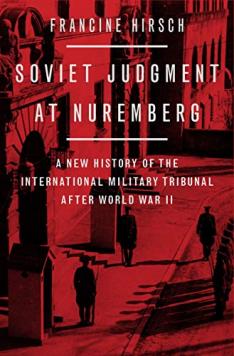
Francine Hirsch - Soviet Contributions in Nuremberg Trials

For years, accounts of the Nuremberg Trials have relied on an America-centric view and have ignored the ways the Soviet Union helped create it. Francine Hirsch produces the first in-depth history of the trials with a sharp eye on the Soviet Union’s forgotten contributions.

Soviet Judgment at Nuremberg: A New History of the International Military Tribunal after World War II (Oxford University Press) includes research from previously unavailable sources to take a new look at Nuremberg. Hirsch offers a fuller picture of the ways politics and international law intertwine, and suggests that Soviet conceptions of postwar justice and war as seen at Nuremberg have found a permanent place in international law.

read more here @ Princeton Alumni Weekly

Saturday, June 27, 2020

Review: Josephine: Singer Soldier Dancer Spy by Eilidh McGinness

Josephine: Singer Soldier Dancer SpySynopsis: Josephine Baker is born into poverty in racially segregated America. Desperate to escape she flees to France where she embraces the hedonistic lifestyle on offer for those who dare, in the Paris of the Roaring Twenties.

Hitler's rise to power in Germany forces her to face her true self. Determined to protect the Liberty Equality and Fraternity she has found in France, she becomes an 'honorable correspondent' for the French Secret Service. So, beginning a journey which will take her from the Red Cross Shelters in Paris to the cruel deserts of North Africa. She will find love and enduring friendship but she must also face dangers which will threaten not only her life but all she holds dear.....Can she find the courage to fight for what she believes in....no matter what the cost? 


This could not have been more timely, having recently watched a documentary (April 2020) on this great woman!

Josephine Baker - IMDbJosephine Baker is the stuff of legends - one of those people whose life experiences one could not imagine belong to a single person. On these pages, McGinness brings to life the story of Josephine from her early childhood to her time in Paris and just after World War II.

The chapters are short and punchy, and I appreciated the dates as chapter headings to give us a sense of where we were in Josephine's story - sometimes we jump ahead by a few years. We get the full sense of segregated America - in fact the opening chapters grab you and hold you firmly in place.

Whilst this may be historical fiction, I urge the read to discover more about Josephine - for her story doesn't end there.


Monday, December 30, 2019

Review: Women of the Third Reich: From Camp Guards to Combatants by Tim Heath

43972608Synopsis: The women of the Third Reich were a vital part in a complex and vilified system. What was their role within its administration, the concentration camps, and the Luftwaffe and militia units and how did it evolve in the way it did?

We hear from women who issued typewritten dictates from above through to those who operated telephones, radar systems, fought fires as the cities burned around them, drove concentration camp inmates to their deaths like cattle, fired Anti-Aircraft guns at Allied aircraft and entered the militias when faced with the impending destruction of what should have been a one thousand-year Reich.

Every testimony is unique, each person a victim of circumstance entwined within the thorns of an ideological obligation. Women of the Third Reich provides an intriguing, humorous, brutal, shocking and unrelenting narrative journey into the half lights of the hell of human consciousness - sometimes at its worst. 


So, whilst this era is not my usual period of study, I was fascinated by the premise. We read so much about life on the home-front in England or American during WWII, that I was curious to say the least, about what stories these women hold and would reveal. 

What author Tim Heath has done is provide a personalised, human face to a hated regime. We view this controversial period in history through the eyes of the young girls and women who lived through it, survived it, and were willing to talk about it. He states in his introduction that the answers to why these women and girls became "embroiled in the madness and horror of the Third Reich" would be found in the stories that followed - they are.

Its a compelling read. I wasn't sure what I was expecting when I picked up this tome - I guess more of a narrative from the author punctuated by examples collated from interviews - but it is the other way around for much of this work is the words and memories of the women themselves. And these words speak volumes. Take away the words "Hitler, SS, Nazi" and these girls' stories could have come from anywhere in war-torn Europe. In fact I made mention that some of the stories of the BDM (League of German Maidens) girls was very similar to what I had read in Yulia Zhukova's memoir "Girl with a Sniper Rifle" (Soviet perspective).

When Germany emerged from WWI, defeated, weakened and nationally humiliated by the terms of the Treaty of Versailles, which they as a nation considered an injustice, the country was ripe for the planting of the seeds of national socialism. This was the era in which many of the girls were born into and grew up in - their parents having lived through the horrors of war and the consequences of the imposed war reparations that followed. And what ultimately united them all - what they had left to cling to - was a sense of national pride - a word that today that is considered by so many in the West as politically incorrect and an unacceptable ideaology.

But for these girls this was all that they knew - and there were many hardline supporters of the regime up until the very end. However, like many who live under such a rigid, totalitarian regime (ie: Stalinist Russia, Communist China, Fascist Spain, or any other number of military dictatorships worldwide), to survive you toe the party line and keep your thoughts and feelings to the contrary to yourself - and there are many documented stories of those who did so out of fear of torture and death - for themselves and their families.

The definition of a military regime is as follows:
A military regime is a form of government wherein the political power resides with the armed forces. The military is the legitimate power-holding group that centralizes political and legal authority. Military regimes are generally held together by their egalitarian belief in equal political, economic, social, and civil rights for all people. Thus, military regimes emerge most often as products of political, economic, and societal crises to replace weak executives and governments. 

Back to the girls and their stories. What an eye-opener! Some of these left me lost for words - just sitting there, staring at the pages I had just read. How many readers just assume that these girls lived idyllic lives, completely oblivious to the world around them - I am sure there were some that did. But these women looked back on their lives and many recounted stories of verbal, physical and sexual abuse (at the hands of those who were supposed to revere them as paragons of Germanic virtue); of personal hardship and of surviving against all odds (scavenging for food, salvaging the dead from bombed out cities); of fighting for their country (especially in the final defense of Berlin); and in the years that followed (for it was the women who took on the initial role of rebuilding). 

The roles of the women was varied - though collated for us in the chapters: we are introduced to office and factory workers; women of the Red Cross; the women who took on a military role; and those that incurred the hatred of so many, the camp guards. Some of the stories are chilling to say the least, others are peppered with humour; all are personal and viewed through the eyes of those who lived through it all - they are, ".. a physical connection to the history ..". Many struggled post-war and found it hard to talk about this period, especially now with all the backlash and attitudes to acknowledging events in the past.

This isn't just a glorifcation of what once was nor a voyeuristic view of cruelty perpetuated at the hands of a few; it is the stories of women - mere girls at the time - and of how they lived and survived in a time many of us today were lucky not to have. And maybe, just maybe, when you come to the end, you shed a little tear for the loss of so much innocence.

The final word goes to Adelen Muller:
" .... an English soldier once asked me if I felt it was all worth it. I told him, 'These things are only worth it if you win the fight. If you are the loser it is never worth it' ..."
and to author Tim Heath:
".... There are few of us who will depart this earth with a completely clear conscious on how we have lived our lives. Our unhappy chapters are often conveniently suppressed, becoming mercifully blurred by time and overtaken by the happier events of our lives .... " 
and the Bible - The Gospel According to John:
'...  He that is without sin among you, let him first cast a stone at her .."


Sunday, November 3, 2019

Review: Russia's Women Snipers


I have lately read two compelling books on two very different, and yet very similar, women who voluntarily entered into military service for their country.

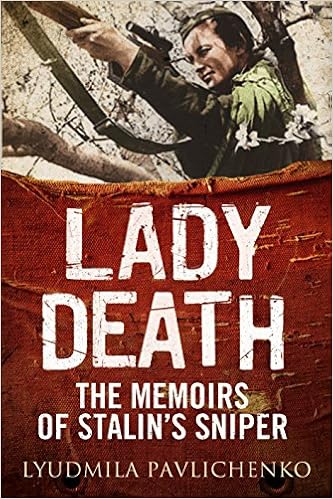
The first "Lady Death" is the story of Lyudmila Pavlichenko, one of over 2000 female snipers, yet one of the more well-known names with 309 recorded kills, including 29 enemy sniper kills, to her name. After being "retired" from active duty, she visited the USA and UK, before returning to train other snipers.

So, a little more about Lyudmila: born in today's Ukraine, Lyudmilia had an affinity with athletics and sports, and was a sharp shooter from an early age. She married at the tender age of 16, had one child, before divorcing her husband. Entering university, studying history and competing in athletics. Following the German invasion of Russia in 1941, Lyudmila signed on to join the infantry in Odessa, eventually being assigned to the 25th Chapayev Rifle Division due to her skill with the rifle. She fought in Odessa, Crimea, racking up the confirmed kills. Wounded after only a year in combat, she became the poster-girl of the Red Army's propaganda machine. Touring the USA, she famously responded to reporters by saying: "... In the Soviet Union I am looked upon as a citizen, as a fighter, as a soldier for my country.” and that "“our women were on a basis of complete equality long before the war ..."  Highly decorated and achieving the rank of major, she trained other snipers until the end of the war, returning to finish her education and work as an historian. Suffering what is now documented as post traumatic stress disorder, Pavlichenko also had to deal with the rumours the rumor that she was nothing more than a propaganda myth actually started within the Soviet armed forces. There is the possibility that Pavlichenko’s own account of her time at the front may have been doctored by Soviet military censors — a very common occurrence at the time — there is no doubting that the woman herself was “the real deal.”  She died aged 58yo.


Because of chronic problems in finding the manpower to fulfill military and industrial tasks, the Soviet government recruited some 7.75 million women, not just to support the soldiers but to join the fight. Around a million women fought in various branches of the Soviet military. Some nursed and supported, as in other countries, but others drove tanks, operated machine guns, and flew fighter planes. Between 1941–1945, it was estimated that a total of 2,484 Soviet female snipers were functioning in this role, between then, credited with more than 12,000 confirmed kills, and of whom about 500 survived the war.

Joining up as a sniper was a strange experience for many women. Though the Soviet army as an institution accepted them, some individuals did not. Families urged their daughters to stay safely at home rather than to fight. Some officers looked down upon the women under their command, not believing that they could be effective combatants. But others were supportive, especially after they saw these women in action.

At recruiting offices, women had theirs braids cut off and were put into men’s uniforms, as there were none tailored to fit women. Then they were sent off to train. Some were specially selected for sniping because they demonstrated a skill. In other cases, this was simply the most convenient place to send them. Training was intense but also hurried. The USSR needed to get troops to the front to counter the German invasion. The women trained as snipers soon found themselves on the front, often hunting their prey amid cities ruined by siege. It was believed that women made the perfect sniper because they could endure stress and cold better than men, and they had “more patience” to wait for the perfect shot.

Snipers usually worked in pairs. Together, they found a place to hide away from the main Soviet forces. There they lay concealed by scenery and camouflage, watching for an opportunity. When an enemy presented himself, they would try to take him down with a single shot to the head. Then they would wait patiently again for their next target, silent and still, or move on if they believed they were in danger. 


As mentioned, Lyudmilia was one of many. Anorther who survived, yet was not as famous as Lyudmilia, was Yulia Zhukova, whose memoirs come to us in "Girl with a Sniper Rifle".

Front CoverYulia's story is slightly different in that she was no sharp-shooter prior to enlisting, which she saw as her patriotic duty. A sickly child who worked in the local factory to support the war effort, she was determined to contribute more. She was dedicated member of the Komsomol (the Soviet communist youth organization) and her parents worked for the NKVD. Completing her training at the central Women's Sniper School, by the time Yulia saw active service in East Prussia and Poland in 1944, female snipers were not unusual. Wounded, she returned to combat until the war ended. Unlike Lyudmilia, she was not a poster-girl for the Russians, but returned to her village and life, struggling to deal with and accept her part in the war; acceptance did not come until much later in life.


Both memoirs are highly readable offering a different yet similar view of their experiences - we often comment that fact is sometimes more enthralling than fiction.  Pavlichenko, the historian, would take a more academic approach, supplementing her diary with historical research; whilst Zhukova relied on memory, letters (that escaped being destroyed as she tried to forget her past) and remembrances of her fellow cadets. Both women were dedicated in their commitment to both Russia and the Russian war effort - "... dying for the motherland was considered a worthwhile sacrifice ...".  It is hoped that readers will discover, through both works, the comradery, strength of spirit, unflinching loyalty that these two women - and the many others like them - displayed in the face of the terror of war.  How many readers are left wondering whether or not they could do the same.


further reading:
Avenging Angels: Soviet Women Snipers on the Eastern Front, 1941-1945 by Lyuba Vinogradova
Soviet Women Snipers: of the Second World War by Youri Obratztsov
The Unwomanly Face of War: An Oral History of Women in World War II by Svetlana AlexievichHeroines of the Soviet Union 1941–45 by Henry Sakaida
Roza Shanina Russian Sniper by Robert Corrigan
Soviet Women in Combat: A History of Violence on the Eastern Front by Anna Krylova

Saturday, October 26, 2019

Review: The Nuclear Spies by Vince Houghton

The Nuclear Spies: America's Atomic Intelligence Operation against Hitler and Stalin
Synopsis:  Why did the US intelligence services fail so spectacularly to know about the Soviet Union's nuclear capabilities following World War II? As Vince Houghton, historian and curator of the International Spy Museum in Washington, DC, shows us, that disastrous failure came just a few years after the Manhattan Project's intelligence team had penetrated the Third Reich and knew every detail of the Nazi 's plan for an atomic bomb. What changed and what went wrong?


If you are looking for a work on the more well known "nuclear" spies like Klaus Fuchs, the Rosenbergs or Harry Gold, then you will be a little disappointed for they are not really here.

This tome deals with "scientific intelligence" or more importantly, America's need to know where their rivals stood in the race for atomic weaponry. The main time frame is the 1930s and 1940s, and the period in which the US entered WWII to find the Germans working with nuclear fission and making all sorts of discoveries that would eventually lead to what we know as the Manhattan Project.

So, whilst the US undertook a merry chase across Europe for the fleeing German scientists in their pursuit for atomic knowledge and to put a stop to Hitler detonating an atomic bomb, they gravely underestimated the Soviets own capabilities in doing exactly the same.

Here we find out just why that came about - and one word could quite nicely cover this - assumptions. 

" ... for the first time in history a nation's scientific resources ... became a key consideration in assessing a potential national security threat ..."

The US dealt in assumption, speculation and prediction (or guesswork) rather than cold hard facts; and this assumption of the Soviets would continue for over a decade before the US abandoned its naive belief in stereotypes and brought the search for scientific intelligence under one cohesive banner.

For in this fledgling period of time, the USA's scientific research was being carried out in the academic sector, privately funded.  During World War II, it finally fell under the purview of Lieutenant General Leslie Groves and Houghton covers off Groves' input in painstaking detail.  However, analysis of scientific information was still being conducted on an ad hoc basis, with no single agency as a centralised depository - and even the analysis of the information was speculative at best and determined by stereotyping, and information to the contrary was considered disinformation.

The US believed that the race to stop Hilter from detonating an atomic bomb was a priority based upon their belief that - at the time - German scientists were pre-eminent in the field of science - no-one else could compare with their facilities, discoveries, personnel.  In the face of advancing armies, these scientists scattered, and the US focused their efforts on capturing both them and their research - the OSS was sent out in 1943 - to France, Germany, Italy - the Alsos Missions.  It was only when the US realised that German efforts to build an atomic bomb had actually stalled that the shift moved towards preventing the Soviets from getting this information - and the scientists! 

Post WWII, there was a decline in collection and collation of scientific intelligence as the researchers and scientists, being poorly treated by the US government, drifted back to academia, and hostility grew between the scientific community and US government.  In the years immediately after the war, ".. effective atomic intelligence was prevented by the inability to create a unified, coherent policy ..." and the US found itself relying on the experiences of others to predict the Soviet's completions of their atomic weaponry and were thus literally caught with their pants down!  Even after the Soviets detonated their first atomic bomb, the US refused to believe it as they considered the Soviets to be a backward nation - an alarming attitude that would prevail over the next decade.

Very well researched with lots of history on the fledgling US intelligence network and the atomic weapons program.


Friday, October 11, 2019

Review: The Anatomy of a Spy by Michael Smith

46779497. sy475
Synopsis: Why do people put their lives at risk to collect intelligence? How do intelligence services ensure that the agents they recruit do their bidding and don't betray them? What makes the perfect spy? Drawing on interviews with active and former British, American, Russian, European, and Asian intelligence officers and agents, Michael Smith creates a layered portrait of why spies spy, what motivates them, and what makes them effective.

Love, sex, money, patriotism, risk, adventure, revenge, compulsion, doing the right thing— focusing on the motivations, The Anatomy of a Spy presents a wealth of spy stories, some previously unknown and some famous, from the very human angle of the agents themselves. The accounts of actual spying extend from ancient history to the present, and from running agents inside the Islamic State and al-Qaeda to the recent Russian active measures campaigns and operations to influence votes in the UK, European Union, and United States, penetrating as far as Trump Tower if not the White House.


This is a history of espionage and betrayal, peppered with real stories, predominantly from the 20th century.  Whilst outlining the difference between a spy and an agent, this book explores the motives for espionage under seven main headings, all of which cross over into each other. So why do spies spy: sex, money, tribal loyalty, revenge, control, ideology, compromise, ego, patriotism, adventure or just the right thing to do.

In summary -
(1) Sexual Relationships: the use of the honey trap, sexual coersion and blackmail.
(2) Money: contraband as currency, no loyalty when selling to the highest bidder, the need for money; unreliable method of recruiting and obtaining information.
(3) Patriotism: doing something for the good of your country, use of civilians (expats or business folk), undermining from within to bring down the rival regime (trojan horse), or the recruitment of citizens of occupied territories.
(4) Adventure: risk takers, egotists, fantasists, psychopaths, self obsession, wounded pride.
(5) Revenge: losers in a civil war, death of a loved one, exiled emigre population, anger at the ruling regime.
(6) Right Thing To Do: ideology, moral duty, belief, feeling of belonging, support for the underdog.
(7) Unwitting Agents: exertion of influence, covert use of someone without their knowledge, tactics of deception and confusion, cybercrime, whistle-blowing.

Some of these larger than life characters I was familiar with from prior reading - though not in such detail as provided here. Fleming is well featured as is that near-fictional Reilley Ace of Spies. None of these fantastical schemes would get past HR today and you are often left wondering how so many of them actually succeeded.

I was particularly interested in wartime espionage and the Cold War, as we moved further closer to our own time, my interest waned a little - but that was just me as I found the "old school" spycraft was more interesting - the human element rather than the current, modern day cybercrime and whistle-blowing (spying from a distance).

If this is your genre, it's well worth the read. 


Wednesday, September 25, 2019

Partisan Diary - Ada Gobetti & Jomarie Alano

Cover for 

Partisan Diary


Ada Gobetti's Partisan Diary is both diary and memoir. From the German entry into Turin on 10 September 1943 to the liberation of the city on 28 April 1945, Gobetti recorded an almost daily account of events, sentiments, and personalities, in a cryptic English only she could understand. Italian senator and philosopher Benedetto Croce encouraged Ada to convert her notes into a book. Published by Giulio Einaudi editore in 1956, it won the Premio Prato, an annual prize for a work inspired by the Italian Resistance (Resistenza).

From a political and military point of view, the Partisan Diary provides firsthand knowledge of how the partisans in Piedmont fought, what obstacles they encountered, and who joined the struggle against the Nazis and the Fascists. The mountainous terrain and long winters of the Alpine regions (the site of many of their battles) and the ever-present threat of reprisals by German occupiers and their fascist partners exacerbated problems of organization among the various partisan groups. So arduous was their fight, that key military events—Italy's declaration of war on Germany, the fall of Rome, and the Allied landings on D-Day —appear in the diary as remote and almost unrelated incidents. 

Ada Gobetti writes of the heartbreak of mothers who lost their sons or watched them leave on dangerous missions of sabotage, relating it to worries about her own son Paolo. She reflects on the relationship between anti-fascist thought of the 1920s, in particular the ideas of her husband, Piero Gobetti, and the Italian resistance movement (Resistenza) in which she and her son were participating. While the Resistenza represented a culmination of more than twenty years of anti-fascist activity for Ada, it also helped illuminate the exceptional talents, needs, and rights of Italian women, more than one hundred thousand of whom participated.

Sunday, June 9, 2019

Review: The True Story of the Great Escape by Jonathan F Vance

The True Story of the Great Escape: Stalag Luft III, March 1944
Like the author, I too was familiar with this story through watching the movie (one, I am unashamed to say, I watch repeatedly - how I do love a good war story, and Steve McQueen - definitely eye-candy). I had always wondered whether this was based on one true event or was a compilation of smaller events rolled into one by Hollywood executives. What utterly escaped my notice was that the script was based on author Paul Brickhill's book, also of the same title (which had I bothered to read the dust jacket of "Reach For The Sky" the penny would have dropped), and that he himself was involved!

Back to this book. Vance has made considerable use of the stories of the survivors to piece together a truly remarkable tale of this one or many historic episodes from World War II. I loved reading about the backgrounds of the men involved which puts a much more human face on the characters - and having watched the film, so can see some semblance. And these personal stories were intersperse with events as they were unfolding within Stalag Luft II. For the most part, the movie does follow the actual story, and whilst I was reading, scenes from the movie would replay in my head.

Image result for the great escape
What I found utterly soul destroying was that the fate of these men was sealed by the whim of one man - for embarrassing Hitler, a lesson had to be learnt, a warning sent out. These men were it.

I appreciated the follow up - of the 76 who escaped, 50 were executed (lets not mince words), 8 were unaccounted for (presumed dead), 3 managed to escape to freedom, the rest were returned to their prison camp. What I didn't know was that those responsible were brought to trial in 1947, with the last trial taking place in 1968.

This is a must read - whether a fan of the movies or of the history, or just someone who wants to know more. It is more than a history - it is a personal, tragic story. I was left with so many thoughts after reading this; I wanted to know more; and when I was done, I was left feeling drained but mostly humbled.

read more here @ The Fifty   |   Paul Brickhill   |   The Forgotten First Great Escape


Sunday, May 19, 2019

One Of The Greatest Cover-Ups Of The 20th Century

Author John Heminway discusses his latest book on History News Network: In Full Flight raises questions that, for me, will linger forever. The first of many is “what would I have done?”

In Full Flight is a story of two lives in one body. They belonged to Dr. Anne Spoerry, a good friend of mine who kept her two selves separated by a vertiginous wall of silence. At one level, In Full Flight pays tribute to Africa for its gift of secrecy—faithfully providing cover for those on the run. At another, it illuminates the burden a person of substance must shoulder even in the far reaches of a wild land.
Heminway discusses that he decided to write a biography on Anne Spoerry based upon his knowledge of her in Africa and her humanitarian work in Kenya. It was his search for what he calls her "European history" that lead to a shocking secret.
Like so many others, I believed she was a verifiable heroine. But something did niggle – the memory of Spoerry’s total embargo on the subject of the second world war, any mention of which made her quick to anger. 

read more here