Showing posts with label military history. Show all posts

Wednesday, July 16, 2025

Review: Nemesis by Catherine Hanley

Synopsis: The extraordinary tale of Philip Augustus, one of medieval Europe's greatest monarchs, and the part he played in the downfall of four Plantagenet kings of England.

Philip II ruled France with an iron fist for over 40 years, expanding its borders and increasing its power. For his entire reign his counterpart on the English throne was a member of the Plantagenet dynasty, and Philip took on them all: Henry II, Richard the Lionheart, John and Henry III. And yet we know so little about medieval England's greatest enemy.

Historian Catherine Hanley, author of the critically acclaimed 1217, redresses this imbalance, bringing Philip out of the shadows in this fascinating new history. Delving into French medieval archives, Nemesis explores Philip's motives for attacking England and in doing so we learn not only about him but discover so much more about England's most colourful and controversial of rulers – the Plantagenets.

When Philip first succeeded to the throne in 1180, Henry II of England, thanks to his Angevin and Norman ancestry as well as his wife's inheritance of Aquitaine, ruled more of France than Philip himself. By the end of Philip's reign in 1223, the pendulum of power had swung the other way. Nemesis reveals how Philip exploited the constant familiar squabbles of the Plantagenets to secure his grip on France, his wily political manoeuvring combined with a mastery of the medieval battlefield turning France into a powerhouse of Europe.

~ ~ ~

For those looking for a straight up biography of this French King, you may find yourselves disappointed - or might I suggest reading the synopsis wherein the author, Hanley, states her intent. 

This is literally a look at the man on a broader political scale, in context with four Plantagenet Kings - Henry II and his sons, Henry the young King, Richard, John and grandson, Henry III - all of who at one time or another were enemies, rivals and allies, often all three ... at once.

It is a study of a young man determined to rule on his own, "... fully aware of the nest of vipers that surrounded him..." - both within and without France. He was a shrewd, methodical ruler, who exploited the factions around him for his own benefit. Philip had a well-developed political acumen; he was a mentally competent and agile strategist, often both single-minded and ruthless - "... he did not necessarily have to draw his sword in order to achieve his political aims ...".

Philip was a monarch driven to protect and empower France, and as a consequence of this self-styled mission, he raised up men based upon their talent and aptitude. But his greatest quality was his patience - he was all about playing the long game, and stored up information for future use. Such was his military and political acumen that he outlived, outwitted and outfought Henry II, his four sons and grandson.

Hanley's book on Philip is well researched, informative, very readable, being neither dry nor pompously academic in tone. There are ample footnotes at the end of each chapter to allow the reader to explore more on their own.  Being slightly pro-Plantagent myself, I found myself moving into Philip's corner on more than one occasion.

For a more indepth biography and history of the period, you would do well to chase up books by Jim Bradbury and Elizabeth Hallam.

Sunday, April 17, 2022

Review: The Normans by Judith Green

Synopsis: A bold new history of the rise and expansion of the Norman Dynasty across Europe from Byzantium to England.

In the eleventh century the climate was improving, population was growing, and people were on the move. The Norman dynasty ranged across Europe, led by men who achieved lasting fame like William the Conqueror and Robert Guiscard. These figures cultivated an image of unstoppable Norman success and their victories make for a great story, but how much of it is true?

In this insightful history, Judith Green challenges old certainties and explores the reality of Norman life across the continent. There were many soldiers of fortune, but their successes were down to timing, good luck, and ruthless leadership. Green shows the Normans’ profound impact, from drastic change in England to laying the foundations for unification in Sicily, to their contribution to the First Crusade. Going beyond the familiar, she looks at personal dynastic relationships and the important part women played in what at first sight seems a resolutely masculine world.


I will preface this review by saying - reader beware.! This is not a casual and cursory look at the Normans that will appeal to the general masses; it is a more focused narrative that assumes that you - the reader - have done your due diligence and a sufficient enough grasp of the topic at hand to absorb the information contained therein.

The focus of Green's book is the Normans and their activities as related to a specific time period - the 11th Century - and is narrowed down to particular theatres of war - England, Normandy, Byzantium, Sicily & Southern Italy, Antioch & the Holy Land. It is also a look at how contemporary writers and chroniclers viewed them as well as their own perceptions of self.

Green begins with a look at the various contemporary writers and chroniclers in England (Malmesbury, Worcester, Huntingdon, Monmouth), Normandy (Dudo William of Jumieges, Vitalis, Wace), Southern Italy & Sicily (Malatera, William of Apulia, Amatus of Montecassin), and of course the Crusades (Ralph of Caen). This list is by no means complete as there are a number of others included as well. In this chapter Green also explores the relationships between subject matter and author, the issues of patronage, potential audience and the accessibility of sources.

We next move to Normandy for a look at the structure of Norman society, its emergence, the outward persona of warrior class, and the internal struggles within for dominance. This leads into the next chapter "swords for hire" and a look at the role of Normans as mercenaries throughout Europe and the Baltic. Here Green notes that 11th Century Europe was swarming with armed men who for for wealth, land and prestige. So what made this particular group that much more successful than others - this is what is explored. Green includes a number of prominent families in her narrative, as well as some much lesser ones (which are the ones I am always on the look out for).

Moving south, we explore the activities and personalities of the Normans in Southern Italy and Sicily from their earliest arrival as armed pilgrims to the arrival of Robert Guiscard and the legitimisation of the new kingdom and its conquests. A brief side visit to Byzantium is also covered off for this will have an impact of future relationships.  This is one of my favourite periods of Norman History (and dominates my personal library).

Doubling back, Green takes us to one of the more well know of the Norman conquests - England in 1066. This was no gentle take-over but one that would see years of resistance and rebellion, and the invasions of neighbouring nations of Scotland, Wales and Ireland. This period would also see the creation of the Domesday Book - a survey every shire in England, and some parts of Wales, to list all holdings and calculate the dues owed to William.

And then to our final field of activity - The Crusades and the establishment of the Norman Principality of Antioch. Green provides an assessment of the various Norman leaders (Bohemond, Tancred, Robert of Normandy), their motives for embarking on this great military and religious endeavour, their successes and their failures.


The remaining chapters encompasses a more rounded view of the Normans, covering such topics as government and power, settlement and conquest, church and state, culture and construction. And it is this lasting legacy that Green concludes with, wherein she notes that they were - in essence - "... ruthless opportunists [who] were able to change the political history of Europe ...". But this is merely one one part of who the Normans were - for they were also exceptional strategists, inventive, progressive, militaristic, pious, opportunistic, ruthless - and utterly compelling and unforgettable.

This is definitely one for my own library shelves, and my own personal collection of Norman literature.

Sunday, August 22, 2021

Review: Powers & Thrones by Dan Jones

Synopsis: Dan Jones's epic new history tells nothing less than the story of how the world we know today came to be built. It is a thousand-year adventure that moves from the ruins of the once-mighty city of Rome, sacked by barbarians in AD 410, to the first contacts between the old and new worlds in the sixteenth century. It shows how, from a state of crisis and collapse, the West was rebuilt and came to dominate the entire globe. The book identifies three key themes that underpinned the success of the West: commerce, conquest and Christianity.

Across 16 chapters, blending Dan Jones' trademark gripping narrative style with authoritative analysis, Powers and Thrones shows how, at each stage in this story, successive western powers thrived by attracting – or stealing – the most valuable resources, ideas and people from the rest of the world. It casts new light on iconic locations – Rome, Paris, Venice, Constantinople – and it features some of history's most famous and notorious men and women.

This is a book written about – and for – an age of profound change, and it asks the biggest questions about the West both then and now. Where did we come from? What made us? Where do we go from here?


It should come as no surprise that Jones has decided to take on 1000 years of history and condense it into one tome.

To be perfectly blunt, I can take or leave Jones as an author - its nothing personal. I've read his books and find them entertaining enough, but to be honest he is not one of my "go to" authors - I don't go all "fan girl" when I see his books.

Having said that, this is quite a good, well-rounded read, that will appeal to the masses. It is broken down into four parts, and four sub topics, that flow in a linear timeline. The focus encompasses both Roman Empires (East & West), Europe and the UK. Its only when discussing the Arabs and Mongols does Jones veer from a predominantly Euro-centric narrative.

To give you an idea of what is in store for the reader, I have provided a little summary - each chapter and part can be read as a "stand alone" .

Part I - 470 - 750.
Its four sub catergories are:
Romans - the Roman Empire (social, military, culture and religion) with a focus on Britain and its invaders
Barbarians - Goths, Vandals, Visigoths, Huns, et el
Byzantines - predominantly Justinian and Theodora
Arabs - invasions and their conflict in the Mediterranean (Greeks and Franks)

Part II - 750 - 1215
Franks - Merovingians and Carolingians, focusing on Charlemange up the fracturing of the kingdom
Monks - looking mainly at the Christianity of the monks, pilgrimage sites
Knights - rather self explanatory, with good detail on El Cid, and the chivalric romances
Crusades - covers from the First to the decline, circa Emperor Frederick III

Part III 1215 - 1347
Mongols - their push westward, biographies on notable leaders including Tamerlane
Merchants - Venice and Genoa feature, with the emphasis on trade routes, banking, the rise of the Republics, and of course, Marco Polo and Dick Whittington
Scholars - rise of the universities, translations of Arabic sources, the insular nature of the church scholars, Isidore of Seville
Builders -Edward I's castle building in Wales, cathedrals, fortified cities

Part IV 1347 - 1527
Survivors - plague, little ice age, economic reform and rebellion, reign of Richard II of England
Renewers - Joan of Arc, Jan van Eyck, Leonardo da Vinci, the Medici, the Renaissance, Chaucer, Dante, Petrarch
Navigators - siege of Constantinople, medieval voyager to India, Africa and the Americas, and the explorers such as Henry the Navigator, Magellan, Columbus, and the Conquistadors
Protestants - papal schism, reformation, Martin Luther, Henry VIII, Charles V

So, you can pick and choose areas of interest, which makes the one thousand year history over seven hundred plus pages seem not that daunting.

The aim here is to entertain and inform, and Jones does this remarkably well; and there is - of course - plenty of notes and references for the avid history buff to go exploring further on their own.

I would recommend this to anyone looking for a slightly different take on the history narrative - and for all fans of Jones!

Saturday, July 3, 2021

Review: Never Greater Slaughter by Michael Livingston

Synopsis: Late in AD 937, four armies met in a place called Brunanburh. On one side stood the shield-wall of the expanding kingdom of the Anglo-Saxons. On the other side stood a remarkable alliance of rival kings - at least two from across the sea - who'd come together to destroy them once and for all. The stakes were no less than the survival of the dream that would become England. The armies were massive. The violence, when it began, was enough to shock a violent age. 

Brunanburh may not today have the fame of Hastings, Crecy or Agincourt, but those later battles, fought for England, would not exist were it not for the blood spilled this day. Generations later it was still called, quite simply, the 'great battle'. But for centuries, its location has been lost.

Today, an extraordinary effort, uniting enthusiasts, historians, archaeologists, linguists, and other researchers - amateurs and professionals, experienced and inexperienced alike - may well have found the site of the long-lost battle of Brunanburh, over a thousand years after its bloodied fields witnessed history. This groundbreaking new book tells the story of this remarkable discovery and delves into why and how the battle happened. Most importantly, though, it is about the men who fought and died at Brunanburh, and how much this forgotten struggle can tell us about who we are and how we relate to our past.


“No slaughter yet was greater made e’er in this island, of people slain, 
before this same, with the edge of the sword”

Brunanburh - like many other battles both before and after, is neither memorialised nor physically remembered with monument or building.

In Never Greater Slaughter: Brunanburh and the Birth of England we are treated to a detailed history leading up to the battle, looking at the military, the political and the personal, using archaeology and contemporary sources, and well as putting some of these sources under the microscope. Livingston then goes on to reconstruct the battle using known sources and basic assumptions - and here his research comes to the fore.


The author, as is his prerogative, has his own theory on the most likely location of Brunanburh, though he does explore other options - and as he mentions "... nothing better stokes enthusiasm than a case of the unknowns ...". Livingston puts forth his case for his location convincingly, whilst acknowledging that this may not agree with others investigating this particular battle. Yet you are drawn to Mike's passion and want to be a part of the search yourself!  There is still much work to be done as nothing is definitive nor conclusive.

I found this to be a well researched, informative and accessible read. Whether you agree of not with Livingston's theories, he has covered off a lot of the leg work for you to do your own research and to draw your own conclusions, because in the end, it is merely a ".... best guess of where it was and how it was ...".

Friday, April 2, 2021

Review: Bohemond of Taranto by George Theotokis

Synopsis: Bohemond of Taranto, Lord of Antioch, unofficial leader of the First Crusade, was a man of boundless ambition and inexhaustible energy - he was, in the words of Romuald of Salerno, 'always seeking the impossible'. While he failed in his quest to secure the Byzantine throne, he succeeded in founding the most enduring of all the crusader states. Yet few substantial accounts of the life of this remarkable warrior have been written and none have been published in English for over a century - and that is why this absorbing new study by Georgios Theotokis is of such value.

He concentrates on Bohemond as a soldier and commander, covering his contribution to the crusades but focusing in particular on his military achievements in Italy, Sicily, the Balkans and Anatolia. Since medieval commanders generally receive little credit for their strategic understanding, he examines Bohemond's war-plans in his many campaigns, describes how he adapted his battle-tactics when facing different opponents and considers whether his approach to waging war was typical of the Norman commanders of his time.


Before complaining that this is NOT a biography (as a small number of reviewers / readers have), the synopsis clearly states that the author " ... concentrates on Bohemond as a soldier and commander, covering his contribution to the crusades but focusing in particular on his military achievements in Italy, Sicily, the Balkans and Anatolia ...".  

And whilst Theotokis does cover off - albeit briefly - a history of the Normans in southern Italy and Bohemond's antecedent's, this is an assessment of his achievements (and failures) as a strategist and commander, focusing on the most prominent parts of Bohemond's military career.  As such, it is quite an admirable undertaking.

If you have sought this book out, then there is an implied assumption that a cursory knowledge of the times and of the crusades is held by the reader. I am not going to re-hash any of this information here either on Bohemond or the Crusades - and will suggest undertaking further reading if your interest is so piqued.

The military focus is centred around Bohemond's involvement in both his own and his father's campaigns in Italy, Anatolia, the Balkans, and the Latin East. The sources used as contemporary - and like today's - occasionally tinged with bias. Yes, it would be great to be able to access more sources from his "enemies" - and hopefully one day these will become more readily available and a truer picture of this restless, enigmatic and oft times, impetuous warrior may be told.

In the meantime, I would suggest reading this along with the more dedicated Crusader and Norman narratives. This is definitely one for my own library (alongside Theotokis' other tome - The Norman Campaigns in the Balkans).

Wednesday, February 17, 2021

The Forgotten 500 by Gregory Freeman

The astonishing, never before told story of the greatest rescue mission of World War II—when the OSS set out to recover more than 500 airmen trapped behind enemy lines in Yugoslavia...

During a bombing campaign over Romanian oil fields, hundreds of American airmen were shot down in Nazi-occupied Yugoslavia. Local Serbian farmers and peasants risked their own lives to give refuge to the soldiers while they waited for rescue, and in 1944, Operation Halyard was born. The risks were incredible. The starving Americans in Yugoslavia had to construct a landing strip large enough for C-47 cargo planes—without tools, without alerting the Germans, and without endangering the villagers. And the cargo planes had to make it through enemy airspace and back—without getting shot down themselves.

Classified for over half a century for political reasons, the full account of this unforgettable story of loyalty, self-sacrifice, and bravery is now being told for the first time ever. The Forgotten 500:The Forgotten 500: The Untold Story of the Men Who Risked All for the Greatest Rescue Mission of World War II is the gripping, behind-the-scenes look at the greatest escape of World War II.

Warriors of the Pale: An Irish Saga by Raymond Reagan Butler

In 1185, King Henry II of England sent a messenger to Rome, requesting that his youngest son, Prince John, should be recognised as King of Ireland. With the request granted, John went to Ireland to fight for his dominion and with him went Theobald Walter, the first of the warriors of the Pale - that part of Ireland completely under English rule in the Medieval period. The Butlers would produce an unbroken succession of male heirs right down to 1515.

For the first two centuries the military struggle between the native Irish and the Normans was a bloody stalemate; then in 1399 Richard II attempted to quell the Irish chieftains once and for all, but was pushed back to the Pale - and in the process lost the English throne to Henry IV. Raymond Butler follows the fascinating and not always well documented military struggle in Ireland, focussing upon the extraordinary Butler dynasty, who supported the English kings and were duly rewarded, the eighth earl being made Chief Governor of Ireland by Henry VIII.

The last of the great warriors of The Pale, the 'Black Earl', was Lieutenant-General of Ireland at his death in 1614, still loyal to the English King James I: though the Butlers had not always been loyal, not when their vast lands and wealth had been threatened. This is a 400-year-long story of pitched battles, shifting loyalties, political confusion, assimilation, treachery and military prowess that sheds new light on the entwined histories of England and Ireland.

Tuesday, December 8, 2020

Review: The Battle of Hastings by Jim Bradbury

The Battle of Hastings: The Fall of the Anglo-Saxons and the Rise of the NormansSynopsis: The effects of the Battle of Hastings were deeply felt at the time, causing a lasting shift in British cultural identity and national pride. Jim Bradbury explores the full military background of the battle and investigates both what actually happened on that fateful day in 1066 and the role that the battle plays in the British national myth.

The Battle of Hastings starts by looking at the Normans-who they were, where they came from-and the career of William the Conqueror before 1066. Next, the narrative turns to the Saxons in England, and to Harold Godwineson, successor to Edward the Confessor, and his attempts to create unity in the divided kingdom. This provides the background to an examination of the military development of the two sides up to 1066, detailing differences in tactics, arms, and armor.

The core of the book is a move-by-move reconstruction of the battle itself, including the advance planning, the site, the composition of the two armies, and the use of archers, feigned retreats, and the death of Harold Godwineson.

In looking at the consequences of the battle, Jim Bradbury deals with the conquest of England and the ongoing resistance to the Normans. The effects of the conquest are also seen in the creation of castles and developments in feudalism, and in links with Normandy that revealed themselves particularly in church appointments.

This is the first time a military historian has attempted to make accessible to the general reader all that is known about the Battle of Hastings and to present as detailed a reconstruction as is possible. 


I have a couple of Jim Bradbury's books already - The Capetians: Kings of France 987-1328 and Stephen and Matilda: The Civil War of 1139-53 - so it was not hard for me to pick up this soon to be released new edition of his book, originally published back in 1998.

The synopsis really does cover off the narrative quite well so I won't go over that again. Suffice to say that much of the social and political scene of both pre-Conquest Normandy and Anglo-Saxon England is covered off; the composition of both armies discussed; and the sources for the battle analysed before we reach a very detailed chapter on the battle itself. Bradbury follows up with a look at the aftermath and consequences of the Norman victory for the people and nation of England.

I personally find his writing style to be clear and clean, the narrative consistent, whilst providing readers with a balanced understanding of events through the use of contemporary evidence. I would suggest that this would be a very good starting point for those just beginning their own journey into the Norman Conquest period - those of us who have read extensively on this subject may feel like they are experiencing deja vu.  However, I believe a keen student will always read widely on their chosen field - you never know what little nuggets may be thrown up.

What the reader will appreciate is the inclusion of maps and diagrams, and the accompanying genealogical trees of the main familial lines under discussion.

A great starting point which covers things off succinctly, whilst leaving the reader with some great resources to follow up on for their own journey.


Wednesday, November 4, 2020

Siege Warfare during the Crusades by Michael Fulton

Sieges played a key role in the crusades, but they tend to be overshadowed by the famous battles fought between the Franks and the Muslims, and no detailed study of the subject has been published in recent times. 

He considers the history of siege warfare in the Holy Land from every angle – the tactics and technology, the fortifications, the composition of the opposing armies, and the ways in which sieges shaped Frankish and Muslim strategy at each stage of the conflict. The differences and similarities between the Eastern and Western traditions are explored, as is the impact of the shifting balance of power in the region.

The conclusions may surprise some readers. Neither the Muslims nor the Franks possessed a marked advantage in siege technology or tactics, their fortifications reflected different purposes and an evolving political environment and, although there were improvements in technologies and fortifications, the essence of siege warfare remained relatively consistent.


read review by Peter Purton @ De Re Militari

Tuesday, November 3, 2020

Review: 1066 - A Guide to the Battles and the Campaigns by Livingston & DeVries

Synopsis: The Battle of Hastings, fought on 14 October 1066, changed the course of English history. This most famous moment of the Norman Conquest was recorded in graphic detail in the threads of the Bayeux Tapestry, providing a priceless glimpse into a brutal conflict.

In this fresh look at the battle and its surrounding campaigns, leading medieval military historians Michael Livingston and Kelly DeVries combine the imagery of the tapestry with the latest modern investigative research to reveal the story of Hastings as it has never been told and guide visitors around the battlefield today.

This absorbing new account of the battle will be fascinating reading for anyone keen to find out what really happened in 1066: the journeys by which Harold Godwinson and William of Normandy came to the battlefield, and the latest reconstructions of the course of the fighting on that momentous day. It is also a practical, easy-to-use guide for visitors to the sites associated with the conquest as well as the Hastings battlefield itself.


This is a well researched and easy to read entry into the period immediately before, during and after the Norman Invasion of England in 1066.

Written so that even someone with no knowledge of events can follow, Livingston and DeVries provide ample information without overwhelming the reader with a vast amount of research. What they do provide is an analysis of the events, battles and key players, whilst using separate text boxes for other key subject matters (ie: weapons, armies, tactics, etc). Each chapter includes or is finished with what the authors term as a "tour" of places and structures pivotal to the events.

The narrative is written simply yet informatively, utilising known chroniclers, the sagas, archaeological evidence, photos and maps to gently guide the reader. An extensive reading list concludes.

Definitely a book to be considered as a primer or introductory text for the Norman Invasion of 1066.


Saturday, October 17, 2020

Review: The Highland Battles by Chris Peers

The Highland Battles: Warfare on Scotland's Northern Frontier in the Early Middle Ages
Synopsis: The wars fought in Scotland's northern and western highlands between the ninth and fourteenth centuries were a key stage in the military history of the region, yet they have rarely been studied in-depth before. Out of this confused and turbulent period came the more settled and familiar history of the region. The Highlands and islands were controlled by the kings of Norway or by Norse or Norse-Celtic warlords, who not only resisted Scottish royal authority but on occasion seemed likely to overthrow it.

Chris Peers explores the international background to many of these conflicts which had consequences for Scotland's relations with England, Ireland and continental Europe. At the same time he considers to what extent the fighting methods of the time survived into the post-medieval period. 


I think this book will send me off to become even further immersed in Scottish history. And whilst I considered myself sufficiently well read on this particular topic, there was still plenty to be learned. 

The battles themselves were detailed and included the events leading up to each particular battle, the engagement itself, and the aftermath. Not all were fought on land, some were on the water - which is not something that I feel many readers would be familiar with nor would the use of what is termed "guerilla warfare" which was one of the key components leading up to the battle known as the Field of Mam Garvia. Not all battles had an obvious outcome - oft times the victor did not live long enough to enjoy the spoils of war. Indeed, with regards to Tankerness, Peers comments that "... few of the participants were destined to die peacefully ...".

The structure of the armies, weapons and equipment is covered off fairly early on - to save repetition - as there is a lot of detail here. Use of archaeological evidence contemporary chronicles and the sagas add colour to the naval and land battles detailed within. It was rather an eye-opener to discover that the battle of Clairdon c.1198 was considered to be the " ... last full scale Viking battle fought on British soil ..." Peers also provides details at the end of each chapter for visiting the each of the battle sites or alludes to a probable site when the location is not as clear cut as we would like it to be.

As the synopsis states: "... The Highlands and islands were controlled by the kings of Norway or by Norse or Norse-Celtic warlords, who not only resisted Scottish royal authority but on occasion seemed likely to overthrow it ...". The participants belonged to the dynasties of Orkney, Man, Scotland and Norway and their offshoots. It was interesting to discover just how close those familial ties were amongst this group of protagonists, and often the feud carried on for a number of generations on both sides, especially between the Earls of Orkney and the Kings of Scotland, and the Kings of Norway and the Earls of Orkney.

The names of many of the protagonists were known to me: Thorfinn, Sigurd, Macbeth, Somerled, Alexander, Malcolm, Haakon. I myself have a number of biographies on the notable characters but Peers book ties them all in to the locations where they were dominant and shows the interaction and interpersonal relationships between them all. 

I was pleasantly surprised at the role of women with regards to the battle of Tankerness (c.1136). "Hell hath no fury like a woman scorned" comes readily to mind. Though in the Sagas we often read about women taking on the role of avenger or ensuring that any slight is revenged, so their role should not be discounted.

The reader will appreciate the map of battle sites, the appendices which list the kings of Scotland, Norway, the Isles and Man, and the Earls of Orkney. Each chapter also included the name of the battle, date and location, and the protagonists involved - and the outcome (though how it leads there is not so clear cut).

The Highland Battles is a well presented, well researched book, featuring seven lesser known military events in Scottish history from the 9th to 13th century which the reader will find rewarding. Definitely one for the Scottish history shelf of my library! 


Sunday, May 10, 2020

Books: The Crusades

Medicine in the Crusades: Warfare, Wounds and the Medieval Surgeon by Piers D. Mitchell
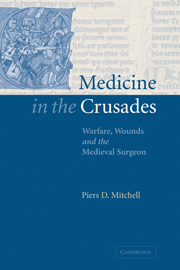
Medicine in the CrusadesThis is the first book to be published on any aspect of medicine in the crusades. It will be of interest not only to scholars of the crusades specifically, but also to scholars of medieval Europe, the Byzantine world and the Islamic world. Focusing on injuries and their surgical treatment, Piers D. Mitchell considers medical practitioners, hospitals on battlefields and in towns, torture and mutilation, emergency and planned surgical procedures, bloodletting, analgesia and anesthesia. He provides an assessment of the exchange of medical knowledge that took place between East and West in the crusades, and of the medical negligence legislation for which the kingdom of Jerusalem was famous. The book presents a radical reassessment of many outdated misconceptions concerning medicine in the crusades and the Frankish states of the Latin East.


The Cambridge Companion to the Literature of the Crusades edited by Anthony Bale
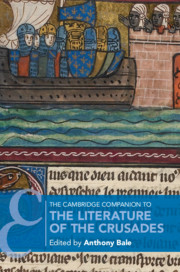
The Cambridge Companion to the Literature of the CrusadesHow were the Crusades, and the crusaders, narrated, described, and romanticised by the various communities that experienced or remembered them? This Companion provides a critical overview of the diverse and multilingual literary output connected with crusading over the last millennium, from the first writings which sought to understand and report on what was happening, to contemporary medievalism, in which crusading is a potent image of holy war and jihad. The chapters show the enduring legacy of the crusaders' imagery, from the chansons de geste to Walter Scott, from Charlemagne to Orlando Bloom. Whilst the crusaders' hold on Jerusalem was relatively short-lived, the desire for Jerusalem has had a long afterlife in many cultural contexts and media.


The Tunis Crusade of 1270: A Mediterranean History by Michael Lower
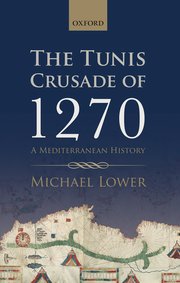
Cover for 

The Tunis Crusade of 1270Why did the last of the major European campaigns to reclaim Jerusalem end in an attack on Tunis, a peaceful North African port city thousands of miles from the Holy Land? In the first book-length study of the campaign in English, Michael Lower tells the story of how the classic era of crusading came to such an unexpected end. Unfolding against a backdrop of conflict and collaboration that extended from England to Inner Asia, the Tunis Crusade entangled people from every corner of the Mediterranean world. Within this expansive geographical playing field, the ambitions of four powerful Mediterranean dynasts would collide. While the slave-boy-turned-sultan Baybars of Egypt and the saint-king Louis IX of France waged a bitter battle for Syria, al-Mustansir of Tunis and Louis's younger brother Charles of Anjou struggled for control of the Sicilian Straits. When the conflicts over Syria and Sicily became intertwined in the late 1260s, the Tunis Crusade was the shocking result.

While the history of the crusades is often told only from the crusaders' perspective, in The Tunis Crusade of 1270, Lower brings Arabic and European-language sources together to offer a panoramic view of these complex multilateral conflicts. Standing at the intersection of two established bodies of scholarship - European History and Near Eastern Studies - this volume contributes to both by opening up a new conversation about the place of crusading in medieval Mediterranean culture.


Crusading in the Fifteenth Century: Message and Impact by Norman Housley
This collection of essays by European and American scholars addresses the changing nature and appeal of crusading during the period which extended from the battle of Nicopolis in 1396 to the battle of Mohács in 1526. Contributors focus on two key aspects of the subject. One is developments in the crusading message and the language in which it was framed. These were brought about partly by the appearance of new enemies, above all the Ottoman Turks, and partly by shifting religious values and innovative currents of thought within Catholic Europe. The other aspect is the wide range of responses which the papacy's repeated calls to holy war encountered in a Christian community which was increasingly heterogeneous in character. This collection represents a substantial contribution to the study of the Later Crusades and of Renaissance Europe.


The Siege of Acre, 1189-1191 Saladin, Richard the Lionheart, and the Battle That Decided the Third Crusade by John D Hosler
"The Siege of Acre, 1189-1191" by John D. HoslerThe first comprehensive history of the most decisive military campaign of the Third Crusade and one of the longest wartime sieges of the Middle Ages.

The two-year-long siege of Acre (1189–1191) was the most significant military engagement of the Third Crusade, attracting armies from across Europe, Syria, Mesopotamia, Egypt, and the Maghreb. Drawing on a balanced selection of Christian and Muslim sources, historian John D. Hosler has written the first book-length account of this hard-won victory for the Crusaders, when England’s Richard the Lionheart and King Philip Augustus of France joined forces to defeat the Egyptian Sultan Saladin. Hosler’s lively and engrossing narrative integrates military, political, and religious themes and developments, offers new perspectives on the generals, and provides a full analysis of the tactical, strategic, organizational, and technological aspects on both sides of the conflict. It is the epic story of a monumental confrontation that was the centerpiece of a Holy War in which many thousands fought and died in the name of Christ or Allah.


The Crusader Armies 1099–1187 by Steve Tibble
"The Crusader Armies" by Steve TibbleA major new history of the Crusades that illuminates the strength and sophistication of the Western and Muslim armies.

During the Crusades, the Western and Muslim armies developed various highly sophisticated strategies of both attack and defense, which evolved during the course of the battles. In this ambitious new work, Steve Tibble draws on a wide range of Muslim texts and archaeological evidence as well as more commonly cited Western sources to analyze the respective armies’ strategy, adaptation, evolution, and cultural diversity and show just how sophisticated the Crusader armies were even by today’s standards.

In the first comprehensive account of the subject in sixty years, Tibble takes a fresh approach to Templars, Hospitallers, and other key Orders and makes the controversial proposition that the Crusades were driven as much by sedentary versus nomadic tribal concerns as by religious conflict. This fluently written, broad-ranging narrative provides a crucial missing piece in the study of the West’s attempts to colonize the Middle East during the Middle Ages.


The Crusader States and their Neighbours: A Military History, 1099-1187 by Nicholas Morton
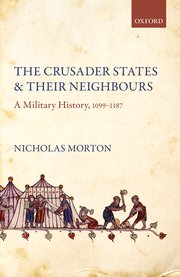
Cover for 

The Crusader States and their NeighboursThe Crusader States and their Neighbours explores the military history of the Medieval Near East, piecing together the fault-lines of conflict which entangled this much-contested region. This was an area where ethnic, religious, dynastic, and commercial interests collided and the causes of war could be numerous. Conflicts persisted for decades and were fought out between many groups including Kurds, Turks, Armenians, Arabs, and the crusaders themselves. Nicholas Morton recreates this world, exploring how each faction sought to advance its own interests by any means possible, adapting its warcraft to better respond to the threats posed by their rivals. Strategies and tactics employed by the pastoral societies of the Central Asian Steppe were pitted against the armies of the agricultural societies of Western Christendom, Byzantium, and the Islamic World, galvanising commanders to adapt their practices in response to their foes. Today, we are generally encouraged to think of this era as a time of religious conflict, and yet this vastly over-simplifies a complex region where violence could take place for many reasons and peoples of different faiths could easily find themselves fighting side-by-side.


Accursed Tower:The Crusaders' Last Battle for the Holy Land by Roger Crowley
"Accursed Tower" by Roger CrowleyThe city of Acre, powerfully fortified and richly provisioned, was the last crusader stronghold. When it fell in 1291, two hundred years of Christian crusading in the Holy Land came to a bloody end. With his customary narrative brilliance and immediacy, Roger Crowley chronicles the tumultuous and violent attack on Acre, the heaviest bombardment before the age of gunpowder, which left this once great Mediterranean city a crumbling ruin.

The ‘Accursed Tower’ was the focal point of this siege. As the last garrison of the Crusader defences, it came to symbolise the disintegration of the old world and the rise of a new era of Islamic jihad. Crowley’s narrative is based on forensic research, drawing heavily on little known first hand sources, both Christian and Arabic. This is a fast-paced and gripping account of a pivotal moment in world history.


Crusading Spirituality in the Holy Land and Iberia, c.1095-c.1187 by William J. Purkis
Crusading Spirituality In The Holy Land And Iberia, C.1095 C.1187For much of the twelfth century the ideals and activities of crusaders were often described in language more normally associated with a monastic rather than a military vocation; like those who took religious vows, crusaders were repeatedly depicted as being driven by a desire to imitate Christ and to live according to the values of the primitive Church.

This book argues that the significance of these descriptions has yet to be fully appreciated, and suggests that the origins and early development of crusading should be studied within the context of the "reformation" of professed religious life in the twelfth century, whose leading figures (such as St Bernard of Clairvaux) advocated the pursuit of devotional undertakings that were modelled on the lives of Christ and his apostles. It also considers topics such as the importance of pilgrimage to early crusading ideology and the relationship between the spirituality of crusading and the activities of the Military Orders, offering a revisionist assessment of how crusading ideas adapted and evolved when introduced to the Iberian peninsula in c.1120. In so doing, the book situates crusading within a broader context of changes in the religious culture of the medieval West.


Crusading and Pilgrimage in the Norman World edited by Kathryn Hurlock & Paul Oldfield
Crusading and Pilgrimage in the Norman WorldThe reputation of the Normans is rooted in warfare, faith and mobility. They were simultaneously famed as warriors, noted for their religious devotion, and celebrated as fearless travellers. In the Middle Ages few activities offered a better conduit to combine warfare, religiosity, and movement than crusading and pilgrimage. However, while scholarship is abundant on many facets of the Norman world, it is a surprise that the Norman relationship with crusading and pilgrimage, so central in many ways to Norman identity, has hitherto not received extensive treatment.

The collection here seeks to fill this gap. It aims to identify what was unique or different about the Normans and their relationship with crusading and pilgrimage, as well as how and why crusade and pilgrimage were important to the Normans. Particular focus is given to Norman participation in the First Crusade, to Norman interaction in later crusading initiatives, to the significance of pilgrimage in diverse parts of the Norman world, and finally to the ways in which crusading and pilgrimage were recorded in Norman narrative. Ultimately, this volume aims to assess, in some cases to confirm, and in others to revise the established paradigm of the Normans as crusaders par excellence and as opportunists who used religion to serve other agendas.


Monday, December 30, 2019

Review: Women of the Third Reich: From Camp Guards to Combatants by Tim Heath

43972608Synopsis: The women of the Third Reich were a vital part in a complex and vilified system. What was their role within its administration, the concentration camps, and the Luftwaffe and militia units and how did it evolve in the way it did?

We hear from women who issued typewritten dictates from above through to those who operated telephones, radar systems, fought fires as the cities burned around them, drove concentration camp inmates to their deaths like cattle, fired Anti-Aircraft guns at Allied aircraft and entered the militias when faced with the impending destruction of what should have been a one thousand-year Reich.

Every testimony is unique, each person a victim of circumstance entwined within the thorns of an ideological obligation. Women of the Third Reich provides an intriguing, humorous, brutal, shocking and unrelenting narrative journey into the half lights of the hell of human consciousness - sometimes at its worst. 


So, whilst this era is not my usual period of study, I was fascinated by the premise. We read so much about life on the home-front in England or American during WWII, that I was curious to say the least, about what stories these women hold and would reveal. 

What author Tim Heath has done is provide a personalised, human face to a hated regime. We view this controversial period in history through the eyes of the young girls and women who lived through it, survived it, and were willing to talk about it. He states in his introduction that the answers to why these women and girls became "embroiled in the madness and horror of the Third Reich" would be found in the stories that followed - they are.

Its a compelling read. I wasn't sure what I was expecting when I picked up this tome - I guess more of a narrative from the author punctuated by examples collated from interviews - but it is the other way around for much of this work is the words and memories of the women themselves. And these words speak volumes. Take away the words "Hitler, SS, Nazi" and these girls' stories could have come from anywhere in war-torn Europe. In fact I made mention that some of the stories of the BDM (League of German Maidens) girls was very similar to what I had read in Yulia Zhukova's memoir "Girl with a Sniper Rifle" (Soviet perspective).

When Germany emerged from WWI, defeated, weakened and nationally humiliated by the terms of the Treaty of Versailles, which they as a nation considered an injustice, the country was ripe for the planting of the seeds of national socialism. This was the era in which many of the girls were born into and grew up in - their parents having lived through the horrors of war and the consequences of the imposed war reparations that followed. And what ultimately united them all - what they had left to cling to - was a sense of national pride - a word that today that is considered by so many in the West as politically incorrect and an unacceptable ideaology.

But for these girls this was all that they knew - and there were many hardline supporters of the regime up until the very end. However, like many who live under such a rigid, totalitarian regime (ie: Stalinist Russia, Communist China, Fascist Spain, or any other number of military dictatorships worldwide), to survive you toe the party line and keep your thoughts and feelings to the contrary to yourself - and there are many documented stories of those who did so out of fear of torture and death - for themselves and their families.

The definition of a military regime is as follows:
A military regime is a form of government wherein the political power resides with the armed forces. The military is the legitimate power-holding group that centralizes political and legal authority. Military regimes are generally held together by their egalitarian belief in equal political, economic, social, and civil rights for all people. Thus, military regimes emerge most often as products of political, economic, and societal crises to replace weak executives and governments. 

Back to the girls and their stories. What an eye-opener! Some of these left me lost for words - just sitting there, staring at the pages I had just read. How many readers just assume that these girls lived idyllic lives, completely oblivious to the world around them - I am sure there were some that did. But these women looked back on their lives and many recounted stories of verbal, physical and sexual abuse (at the hands of those who were supposed to revere them as paragons of Germanic virtue); of personal hardship and of surviving against all odds (scavenging for food, salvaging the dead from bombed out cities); of fighting for their country (especially in the final defense of Berlin); and in the years that followed (for it was the women who took on the initial role of rebuilding). 

The roles of the women was varied - though collated for us in the chapters: we are introduced to office and factory workers; women of the Red Cross; the women who took on a military role; and those that incurred the hatred of so many, the camp guards. Some of the stories are chilling to say the least, others are peppered with humour; all are personal and viewed through the eyes of those who lived through it all - they are, ".. a physical connection to the history ..". Many struggled post-war and found it hard to talk about this period, especially now with all the backlash and attitudes to acknowledging events in the past.

This isn't just a glorifcation of what once was nor a voyeuristic view of cruelty perpetuated at the hands of a few; it is the stories of women - mere girls at the time - and of how they lived and survived in a time many of us today were lucky not to have. And maybe, just maybe, when you come to the end, you shed a little tear for the loss of so much innocence.

The final word goes to Adelen Muller:
" .... an English soldier once asked me if I felt it was all worth it. I told him, 'These things are only worth it if you win the fight. If you are the loser it is never worth it' ..."
and to author Tim Heath:
".... There are few of us who will depart this earth with a completely clear conscious on how we have lived our lives. Our unhappy chapters are often conveniently suppressed, becoming mercifully blurred by time and overtaken by the happier events of our lives .... " 
and the Bible - The Gospel According to John:
'...  He that is without sin among you, let him first cast a stone at her .."


Saturday, October 26, 2019

Review: The Nuclear Spies by Vince Houghton

The Nuclear Spies: America's Atomic Intelligence Operation against Hitler and Stalin
Synopsis:  Why did the US intelligence services fail so spectacularly to know about the Soviet Union's nuclear capabilities following World War II? As Vince Houghton, historian and curator of the International Spy Museum in Washington, DC, shows us, that disastrous failure came just a few years after the Manhattan Project's intelligence team had penetrated the Third Reich and knew every detail of the Nazi 's plan for an atomic bomb. What changed and what went wrong?


If you are looking for a work on the more well known "nuclear" spies like Klaus Fuchs, the Rosenbergs or Harry Gold, then you will be a little disappointed for they are not really here.

This tome deals with "scientific intelligence" or more importantly, America's need to know where their rivals stood in the race for atomic weaponry. The main time frame is the 1930s and 1940s, and the period in which the US entered WWII to find the Germans working with nuclear fission and making all sorts of discoveries that would eventually lead to what we know as the Manhattan Project.

So, whilst the US undertook a merry chase across Europe for the fleeing German scientists in their pursuit for atomic knowledge and to put a stop to Hitler detonating an atomic bomb, they gravely underestimated the Soviets own capabilities in doing exactly the same.

Here we find out just why that came about - and one word could quite nicely cover this - assumptions. 

" ... for the first time in history a nation's scientific resources ... became a key consideration in assessing a potential national security threat ..."

The US dealt in assumption, speculation and prediction (or guesswork) rather than cold hard facts; and this assumption of the Soviets would continue for over a decade before the US abandoned its naive belief in stereotypes and brought the search for scientific intelligence under one cohesive banner.

For in this fledgling period of time, the USA's scientific research was being carried out in the academic sector, privately funded.  During World War II, it finally fell under the purview of Lieutenant General Leslie Groves and Houghton covers off Groves' input in painstaking detail.  However, analysis of scientific information was still being conducted on an ad hoc basis, with no single agency as a centralised depository - and even the analysis of the information was speculative at best and determined by stereotyping, and information to the contrary was considered disinformation.

The US believed that the race to stop Hilter from detonating an atomic bomb was a priority based upon their belief that - at the time - German scientists were pre-eminent in the field of science - no-one else could compare with their facilities, discoveries, personnel.  In the face of advancing armies, these scientists scattered, and the US focused their efforts on capturing both them and their research - the OSS was sent out in 1943 - to France, Germany, Italy - the Alsos Missions.  It was only when the US realised that German efforts to build an atomic bomb had actually stalled that the shift moved towards preventing the Soviets from getting this information - and the scientists! 

Post WWII, there was a decline in collection and collation of scientific intelligence as the researchers and scientists, being poorly treated by the US government, drifted back to academia, and hostility grew between the scientific community and US government.  In the years immediately after the war, ".. effective atomic intelligence was prevented by the inability to create a unified, coherent policy ..." and the US found itself relying on the experiences of others to predict the Soviet's completions of their atomic weaponry and were thus literally caught with their pants down!  Even after the Soviets detonated their first atomic bomb, the US refused to believe it as they considered the Soviets to be a backward nation - an alarming attitude that would prevail over the next decade.

Very well researched with lots of history on the fledgling US intelligence network and the atomic weapons program.


Wednesday, October 2, 2019

Culloden by Murray Pittock

Cover for 

Culloden
The battle of Culloden lasted less than an hour. The forces involved on both sides were small, even by the standards of the day. And it is arguable that the ultimate fate of the 1745 Jacobite uprising had in fact been sealed ever since the Jacobite retreat from Derby several months before.


But for all this, Culloden is a battle with great significance in British history. It was the last pitched battle on the soil of the British Isles to be fought with regular troops on both sides. It came to stand for the final defeat of the Jacobite cause. And it was the last domestic contestation of the Act of Union of 1707, the resolution of which propelled Great Britain to be the dominant world power for the next 150 years.

If the battle itself was short, its aftermath was brutal - with the depredations of the Duke of Cumberland followed by a campaign to suppress the clan system and the Highland way of life. And its afterlife in the centuries since has been a fascinating one, pitting British Whig triumphalism against a growing romantic memorialization of the Jacobite cause.

On both sides there has long been a tendency to regard the battle as a dramatic clash, between Highlander and Lowlander, Celt and Saxon, Catholic and Protestant, the old and the new. Yet, as this account of the battle and its long cultural afterlife suggests, while viewing Culloden in such a way might be rhetorically compelling, it is not necessarily good history.

Sunday, September 29, 2019

Renaissance Mass Murder by Stephen D. Bowd

Renaissance Mass Murder explores the devastating impact of war on the men and women of the Renaissance. In contrast to the picture of balance and harmony usually associated with the Renaissance, it uncovers in forensic detail a world in which sacks of Italian cities and massacres of civilians at the hands of French, German, Spanish, Swiss, and Italian troops were regular occurrences.


Cover for 

Renaissance Mass Murder


The arguments presented are based on a wealth of evidence - histories and chronicles, poetry and paintings, sculpture and other objects - which together provide a new and startling history of sixteenth-century Italy and a social history of the Italian Wars. It outlines how massacres happened, how princes, soldiers, lawyers, and writers justified and explained such events, and how they were represented in contemporary culture.

On this basis, Renaissance Mass Murder reconstructs the terrifying individual experiences of civilians in the face of war and in doing so offers a story of human tragedy which redresses the balance of the history of the Italian Wars, and of Renaissance warfare, in favour of the civilian and away from the din of battle. This volume also places mass murder in a broader historical context and challenges claims that such violence was unusual or in decline in early modern Europe. Finally, it shows that women often suffered disproportionately from this violence and that immunity for them, as for their children, was often partially developed or poorly respected.