Showing posts with label 18th century. Show all posts

Wednesday, July 16, 2025

PD Lennon — The Case of the Mad Doctor

Inspired by the true story of Jamaica’s first serial killer.

Jamaica, 1772. Caribbean jewel, or a killer’s playground?


On the island of Jamaica, people have started disappearing without trace. Have they run away, trying to start new lives in the British colony under assumed names, or is something darker afoot?

Some of the missing had taken out large life insurance policies before leaving England, and so word of the vanishings reaches Bristol when relatives try to collect their payouts.

With suspicion of a grand fraud in the air, ambitious Black barrister’s clerk Isaiah Ollenu is thrown together with pious insurance agent Ruben Ashby, and together they are ordered to the Caribbean to investigate.

But, confronted by prejudice, untoward characters and vengeful spirits, the task may cost this unlikely duo more than either man is willing to pay…

A searing snapshot of the British Empire at the threshold of emancipation, and a chilling historical adventure.

Monday, May 12, 2025

Review: The Art of a Lie by Laura Shepherd-Robinson

Synopsis: Following the murder of her husband in what looks like a violent street robbery, Hannah Cole is struggling to keep her head above water. Her confectionary shop on Piccadilly is barely turning a profit, her suppliers conspiring to put her out of business because they don’t like women in trade. Henry Fielding, the famous author-turned-magistrate, is threatening to confiscate the money in her husband’s bank account because he believes it might have been illicitly acquired. And even those who claim to be Hannah’s friends have darker intent.

Only William Devereux seems different. A friend of her late husband, Devereux helps Hannah unravel some of the mysteries surrounding his death. He also tells her about an Italian delicacy called iced cream, an innovation she is convinced will transform the fortunes of her shop. But their friendship opens Hannah to speculation and gossip and draws Henry Fielding’s attention her way, locking her into a battle of wits more devastating than anything she can imagine.

~ ~ ~

Set in Georgian England, against the ice cream craze, this historical fiction mystery provides for two narrators - the widow Hannah Cole, and the friend of her late husband, William Devereux.

The alternating narrative allows the reader to witness events from these two viewpoints, as Hannah's husband's shady dealings are revealed, bringing her to the attention of local magistrate Henry Fielding. What the reader will have to decide is which of these two are Hannah's enemy, or something darker at work.

Whilst well researched to bring 18th century Georgian England to life, I found my attention wavering and my interest in both the characters, the narrative and the mystery itself dwindling as the pages passed by. 

This period of historical fiction is out of my usual reading comfort zone, but that really was not the reason for my lack of engagement as I am open to new settings, both geographically and time-wise. Can't specifically put my finger on it, but it just wasn't enough for me. I am sure others will feel differently and devour with this eagerness.

Wednesday, January 1, 2025

Review: Sicilian Avengers by Luigi Natoli

Synopsis: A thrilling Sicilian saga about the legendary secret sect purported to be forerunners of the Mafia, translated into English for the first time.

Emerging from the dark streets and subterranean caves of Palermo, the Beati Paoli, masked and hooded, mete out their own form of justice to counter the unfettered power and privilege wielded by the aristocracy. For the voiceless, weak, and oppressed, the Beati Paoli are defenders and heroes.

Reminiscent of a Dumas novel, Sicilian Avengers is a vibrant, atmospheric fresco of early eighteenth-century Palermo. Onto the stage of the ancient city, Blasco da Castiglione, a bold, brash, orphan adventurer, arrives on a quest to discover his origins and seek his destiny. But this fearless, swashbuckling D’Artagnan-esque hero unwittingly gets caught up in a devious and murderous succession plot involving a powerful noble family.

When the Beati Paoli hear about this plot to usurp a rightful inheritance, they spring into action. Their shadowy machinations entangle the charismatic Blasco, who crosses paths with a cast of characters that test his loyalty and resolve in the pursuit of his true identity.

The historical accuracy of the novel is complemented by the most meticulous description of Sicily’s capital city ever written. Action-packed and laced with intrigue and chivalrous duels, Sicilian Avengers is a tale of love and hatred, friendship and betrayal, suffering and retribution.

~ ~ ~

The novel is set in Sicily over a period of about 20 years: 1698 - 1718, when Sicily was under both Spanish and Savoyard rule. Sicily at this time was recovering from an outbreak of plague, a serious earthquake, and frequent attacks from the Barbary pirates.

Sicilian Avengers is the story of the conflict between the evil, greedy and ambitious Don Raimondo Albamonte, a Sicilian aristocrat, and the Beati Paoli, a secret, oft times violent, organization committed to punish Don Raimondo for his various crimes.  A battle of good versus evil.  It is also a family saga with the main protagonist, Blasco de Castiglione, following the standard pathway of the "hero's journey", when events and family truths come full circle.

Reader be warned: this is a lengthy tome, combining two books, both well over 500 pages each. This definitely has to be read as a physical book due to both its size and the cast of characters. The writing style may not be to everyone's tastes - the descriptions are detailed and plentiful. No-one can deny that this novel is not well researched.  I do think it would be more enjoyable to the modern reader with a little bit of diplomatic editing to reduce the size whilst maintaining the overall context. 

Friday, February 9, 2024

Review: A Grave For A Thief by Douglas Skelton

Synopsis: England, 1716. The only certainty in a thief’s life… is death.

Christopher Templeton is a lawyer whose conscience troubles him. He knows many of the secrets of The Fellowship, the shadowy group profiting from the civil unrest in the nation, and has intimated to the Company of Rogues that he is willing to share them.

The problem is, he has vanished. Jonas Flynt – thief, gambler, killer – still recovering from a duel with death upon the frozen Thames, is tasked with finding him.

The trail takes him from the dark slums of London to a quiet village in the north of England, where all is not as it seems. But while he hunts for the missing man, someone else may be stalking him… someone with murder in their heart.

~ ~ ~

Honestly, I am loving this series from Skelton. As I have mentioned previously, the timeline is set outside of my usual historical fiction parameters - but I am glad that I have dipped my toe into the Hanoverian period.

Flynt is back, and being sent on another shadowy mission by Charters. Characters from the previous two books make an appearance (so reading the series from the start is a must), and a new character is introduced, who is not unknown to Flynt. A help or hinderance is debtable.

The cat and mouse game is played out in both London and ending in some rural village, where not all is as it seems. Who is hunter and who is prey will be determined at the final customary stand-off (evil versus, well in this instance, good).

For this book, however, Skelton has decided not to draw on an actual historical event for the plotline - however, this does in no way detract from the story at hand. The elements are all there: crime, mystery, espionage, rebellion, revenge - and the tale is deftly spun, entangling the reader in its web.

Overall, this book, like its predecessors, is an enjoyable romp through the underbelly of Hanoverian England, still under threat from those damnable Jacobites. And I for one, am looking forward to more!


Series Reviews:


Tuesday, January 9, 2024

Review: A Thief's Justice by Douglas Skelton

Synopsis: London, 1716. Revenge is a dish best served ice cold…The city is caught in the vice-like grip of a savage winter. Even the Thames has frozen over. But for Jonas Flynt – thief, gambler, killer – the chilling elements are the least of his worries…

Justice Geoffrey Dumont has been found dead at the base of St Paul’s cathedral, and a young male sex-worker, Sam Yates, has been taken into custody for the murder. Yates denies all charges, claiming he had received a message to meet the judge at the exact time of death.

The young man is a friend of Belle St Clair, and she asks Flynt to look into the murder. Their probing leads them to possible government corruption, Jacobite plots, the horrors of Newgate prison, and a desperate showdown on the ice.

~ ~ ~

I will preface this by saying to the reader - please read the first in the series - An Honorable Thief.

This is the second in the series, set in 18th Century Hanoveran London, Queen Anne, who died in 1714, was succeeded by her second cousin, the Elector of Hanover, George I, as Under the Act of Settlement 1701, excluded Roman Catholics from the line of succession - and this included her half-brother, the Catholic James Edward Stuart.

Once again, Jonas Flynt is set a task (no questions asked) by Colonel Nathaniel Charters, puppet / spy master, head of the Company of Rogues. It is another tale heavy with murder, Jacobite plots, and espionage, as Jonas traverses the underbelly of London in the service of Charters.

I will say this - one of the events in the tale is based on fact, which I loved reading about!

Looking forward to the next in the series - A Grave For A Thief - and to eventually sitting down with the whole series and starting from the beginning again.

Monday, December 25, 2023

Review: The Pirate's Wife by Daphne Palmer Geanacopoulos

Synopsis: The dramatic and deliciously swashbuckling story of Sarah Kidd, the wife of the famous pirate Captain Kidd, charting her transformation from New York socialite to international outlaw during the Golden Age of Piracy. Captain Kidd was one of the most notorious pirates to ever prowl the seas. But few know that Kidd had an accomplice, a behind-the-scenes player who enabled his plundering and helped him outpace his enemies.

That accomplice was his wife, Sarah Kidd, a well-to-do woman whose extraordinary life is a lesson in reinvention and resourcefulness. Twice widowed by twenty-one and operating within the strictures of polite society in seventeenth- and eighteenth-century New York, Sarah secretly aided and abetted her husband, fighting alongside him against his accusers. More remarkable still was that Sarah not only survived the tragedy wrought by her infamous husband’s deeds, but went on to live a successful and productive life as one of New York’s most prominent citizens.

Marshaling in newly discovered primary-source documents from archives in London, New York and Boston, historian and journalist Daphne Palmer Geanacopoulos reconstructs the extraordinary life of Sarah Kidd, uncovering a rare example of the kind of life that pirate wives lived during the Golden Age of Piracy. A compelling tale of love, treasure, motherhood and survival, this landmark work of narrative nonfiction weaves together the personal and the epic in a sweeping historical story of romance and adventure.

~ ~ ~

I will preface my review by saying that I actually thought it was an historical fiction account of Sarah Kidd dressed up as a biography, not an actual biography.

It was an interesting read to get to "know" Sarah Kidd - details of her life before, during and after Kidd will be of interest. And hers is a story of survival and of a woman stepping beyond the social norms of her day to carve out her own destiny.

Having said that, there was much that could have been left out, including the almost mind-numbing account of Kidd's return, arrest and trial, which felt like it took up half the book due to the excessive amount of detail. I get that, based upon her surname, her time with the notorious pirate would be the drawcard - I mean, who would read a biography of some woman named Sarah: Cox, Oort or Rousby (her other married names)?

For me, as I mentioned, I thought it was a work of fiction - that just how it read. And maybe, it might have worked better as such.

Sunday, April 25, 2021

By My Sword Alone by David Black

The Battle of Glenshiel, 1719. Thirteen-year-old James Lindsay watches the action unfold as the Jacobite forces supported by his family are defeated. For the rebels, it is the beginning of the end. But for James, forever marked by the battle, it is truly just the beginning.

Later, forced to flee Scotland, James finds himself on the European mainland and eventually in the Roman palace of his own ‘king’. There, he experiences all kinds of adventure, from the romantic to the brutal. Chastened by time and experience, he gradually loses the naivety of youth and takes a more mercenary approach as the great events of history unfold.

Yet all the while, he is aware of developing philosophies and how they are extending, slowly, into the lives of men and women – and monarchs. On he battles, through the Age of Enlightenment – until he meets a woman who challenges everything …

By My Sword Alone is a striking blend of historical novel and psychological profile that immerses readers in the thought, politics and bloodshed of eighteenth-century Europe. It will please David Black’s many fans and likely win him many more.


Saturday, October 24, 2020

Jewish Women and Their Salons by Emily Bilski & Emily Braun

From their debut in Berlin in the 1780s to their emergence in 1930s California, Jewish women’s salons served as welcoming havens where all classes and creeds could openly debate art, music, literature, and politics. This fascinating book is the first to explore the history of these salons where remarkable women of intellect resolved that neither gender nor religion would impede their ability to bring about social change.

Emily D. Bilski and Emily Braun examine the lives of more than a dozen Jewish salonières, charting the evolution of the salon over time and among cultures, in cities including Berlin, Vienna, Paris, London, New York, and Milan. They show how each woman uniquely adapted the salon to suit her own interests while maintaining the salon’s key characteristics of basic informality and a diversity of guests. 

Other distinguished contributors to the volume discuss in detail the Berlin salons of the 1800s; the salon in terms of Jewish acculturation and its relation to gender and music; and the relations of Marcel Proust, Oscar Wilde, and Gertrude Stein to the literary salon. 

The book is enriched with a lavish array of illustrations, including documentary photographs, paintings, drawings, prints, and decorative arts.

Sunday, September 20, 2020

Review: The Inspector of Strange & Unexplained Deaths by Olivier Barde-Cabucon

The Inspector of  Strange and Unexplained DeathsSynopsis: Everyone has secrets. Even the king.

When a gruesomely mutilated body is found on the doorstep of the Versailles Palace in 1759, the Inspector of Strange and Unexplained Deaths is called to the scene. His ensuing investigation is thwarted at every turn by shady figures such as notorious seducer Casanova, a mysterious Italian gentlewoman who knows more than she lets on and a secret order harbouring revolutionary sentiment.

As the body count rises, the Inspector is brought even further into a web of deceit that he soon suspects may go all the way to the very top of society.


France in the mid-1700s was a melting pot of new enlightened thinking, religious turmoil, and the murmurs of a society fed up with its monarchy. The French King, Louis XV, was on the throne and was well noted for his many mistresses, including the most famous - Madame de Pompadour. It was rumoured that the King kept a private brothel of teenage girls, and was served by some 2000 courtiers, whose main job was to keep him from becoming bored, and he bored easily – and lost his temper readily. Madame de Pompadour, when her relationship with the king was waning was said to have provided the king with suitable female company whilst still ensuring her influence was in the ascendant.

Whilst the nobility lived the high life, attending parties and balls, and reveling in their wealth and status, the majority of the people were poor, illiterate farmers were slowly being broken under the arcane laws and increased taxation. The middle-classes gathered at coffeehouses, where in addition to drinking coffee they read newspapers and discussed ideas. Middle-class and aristocratic professionals formed societies that explored intellectual issues. As time moved on, the disparity between the nobility and commoners grew ever wider.


There was a distinct lack of civil rights. The king could have anyone arrested without reason and imprisoned (and tortured) for as long as he wanted. The kingdom of King Louis XV had no uniform system of law. French society was filled with swindlers, thieves, beggars and vagabonds, and the average Frenchman delighted in witnessing their punishment (there was no guillotine just yet). Security was provided by two different corps of police; the Garde de Paris and the Guet Royal, or royal watchmen. Both organizations were under the command of the Lieutenant General of Police. Parisians considered the police both corrupt and inefficient, and relations between the people and the police were increasingly strained. Paris possessed an extraordinary number and variety of prisons, used for different classes of persons and types of crimes. The fortress of the Châtelet was the oldest royal prison, where the office of the Provost of Paris was also located. It had about fifteen large cells; the better cells were on the upper levels, where prisoners could pay a high pension to be comfortable and well-fed, while the lower cells were extremely damp and barely lit by the sun coming through a grate at street level. The Bastille and the Château de Vincennes were both used for high-ranking political prisoners, and had relatively luxurious conditions.

The Catholic Church played an enormous role in the everyday life of people.  However, petty jealousies existed within its ranks and local parish priests were becoming increasingly displeased by the ambition, indifference and vanity of the upper clergy who behaved more like the nobility than prelates. The Church's influence declined toward the end of the century, partly because of the Enlightenment, and partly from conflicts within the church establishment.

There were many plots and secret societies in France at the time. Pre-eminent among those societies were the Freemasons and a group known as the Encyclopediests. Encyclopedism was a burgeoning movement within France. The 32-volume "Encyclopédie", edited by Diderot and D'Alembert, was the pride of Enlightenment France. There were 74,000 articles written by more than 130 contributors. It presented a secular worldview, drawing the ire of several Church officials. Authorities saw it as a dangerous work-it was banned in France, and the Catholic Church placed it on the Index librorum prohibitorum, or Index of Prohibited Books. The authors themselves came under attack and were threatened with imprisonment. Despite all this, work continued "in secret," partially because the project had highly placed supporters. It sought to empower its readers with knowledge and played a role in fomenting the dissent that led to the French Revolution.


Freemasonry acquired the image of the secret society par excellence. One important reason was the early and long-lasting opposition of the Roman Catholic Church, which first condemned the "liberi Muratori seu Francs Massons" in the bull In eminenti (1738). In fact, the society was used for subversive purposes (on both sides) in the lead up the the French Revolution. Freemasonry membership in France included French nobles and many military men, but the largest portion of membership was the bourgeoisie who liked the idea of being members because they appreciated Freemasonry’s motto of equality. Those excluded from joining included Jews, actors, employees, workers, and servants, as well as women - however, Lodges of Adoption soon sprouted through which women could actively participate. 

The Devot (Devout) Party also makes an appearance. This real group were fiercely opposed to the idea of an absolute monarchy and worked with a number of other secretive groups to achieve their ends, including the (fictional) Brotherhood of the Serpent (possibly modeled on the ancient Brotherhood of the Snake whose purpose was to oppose the enslavement of the spirit and to enlighten through scientific knowledge).

The alternating narrative (Volnay and Casanova) begin with a gruesome murder of a young woman. Volnay investigates whilst Casanova's own motives are never quite revealed until the reader has been well drawn into the tale. During the course of his investigation, Volynay finds himself up against a number of different factions, all with their own endgame, all trying to manipulate and direct the detective for their own purpose.

The characters littered across the pages are suitably human, odious, mysterious, enlightened; a good mix of both fiction and real personages. We have our main character, the Inspector of Strange and Unexplained Deaths - the Chevalier de Volnay, aided in all things by his mysterious and sinister accomplice known as "the Heretic Monk". A worthy foil to Volnay is the ever encroaching presence of Giacomo Casanova, who is content to conduct his own investigation in his own inimitable way. However, Volnay is also up against one Antonie Raymond de Sartine, Lieutenant General of Police, who though admired by his contemporaries, was also criticized for using his highly efficient secret police to spy not only on criminals but also on ordinary citizens. It is in this role we are introduced to Sartine. Then there is also the obscure and mysterious Comte de Saint-Germaine with his connections to the monarchy. A number of fictional characters take centre stage with Volnay including Chiara D'Ancilla (one of Madame de Pompadour's ladies); Wallace, the old soldier

Barde-Cabucon certainly takes the reader on a wild journey through the underbelly of pre-Revolutionary France - with its political and religious intrigue; espionage; secret societies; rumblings of revolution; and a murder or two. There were so many reveals towards the end that I felt like a carnival clown, mouth perpetually open. I literally felt exhausted (in a good way) when I finally finished this.  Whilst there are many themes peppered throughout, rest assured, it does all come together, and Barde-Cabucons extensive research is evident .

This novel (originally titled Casanova and the Faceless Woman) is the first in a series - and I hope that the rest will be translated and re-published in due course as I am looking forward to reading more - and will definitely read this again. 


Recommended reading: 
The Chatelet Apprentice by Jean-Francois Parot

Tuesday, August 4, 2020

Review: Dark Archives by Megan Rosenbloom

Dark Archives: A Librarian's Investigation into the Science and History of Books Bound in Human SkinSynopsis: On bookshelves around the world, surrounded by ordinary books bound in paper and leather, rest other volumes of a distinctly strange and grisly sort: those bound in human skin. Would you know one if you held it in your hand?

In Dark Archives, Megan Rosenbloom seeks out the historic and scientific truths behind anthropodermic bibliopegy—the practice of binding books in this most intimate covering. Dozens of such books live on in the world’s most famous libraries and museums. Dark Archives exhumes their origins and brings to life the doctors, murderers, innocents, and indigents whose lives are sewn together in this disquieting collection. Along the way, Rosenbloom tells the story of how her team of scientists, curators, and librarians test rumored anthropodermic books, untangling the myths around their creation and reckoning with the ethics of their custodianship.

A librarian and journalist, Rosenbloom is a member of The Order of the Good Death and a cofounder of their Death Salon, a community that encourages conversations, scholarship, and art about mortality and mourning. In Dark Archives—captivating and macabre in all the right ways—she has crafted a narrative that is equal parts detective work, academic intrigue, history, and medical curiosity: a book as rare and thrilling as its subject.


For those with a macabre interest in death and dissection, this will provide you with a suitable overview. For those, like myself, who were wanting a bit more, then you will go away slightly less fulfilled.

My interest in anthropodermic bibliopegy dates, back to 2011, I was looking into a series of sensational murder cases dating back to the 1800s and what was the ultimate fate of those arrested. My interest was so sparked that I was compelled to write a blog post on it entitled Cadaver Books which touched on a number of books created from those executed. 

My little blog post was by no means in in-depth study which led me to request a copy of Dark Archives as a means to further enhance my knowledge on those books not created from criminals executed where " ... a dead person's skin had become a byproduct of the dissection process ... ' - dissection being a part of the sentence and a form of public humiliation (a fate intended to deter criminal activity). 

To be honest, I personally, was left a little flat. Whilst I appreciated that the author traveled throughout the USA to the libraries and universities that held these treasures, I was looking for a more broader study. The majority of tomes covered are American based, with some case studies are from the UK (ie: Burke & Hare, Red Barn Mystery) and France. 

" ... each old book is like a mystery quietly awaiting its detective ... "

I also appreciated the author's intent on seeking out those said to be cadaver books and having them tested, which often put paid to their origins when results came back in the negative. 

bookinskinAs I mentioned, those with a passing interest will find this a fascinating book which often looks at the mythology behind the antecedents of each tome; age-old myths surrounding the production of such tomes during both the French Revolution and Nazi Germany are debunked; and the science and methodology behind the production is discussed. Unfortunately I found more than one chapter waffling on before finally getting to the point in the last few paragraphs which resulted in my interest waning.

The author finishes on the matter of skin art and choice wherein today's generation with their beautifully crafted tattoos are looking at a means of preserving these post mortem, and also the current regulation surrounding the possession and display of human remains, and usage of donation to medical science. At the end there is a list of where 17 confirmed books are located.

This is a short book - barely 180 pages, with the rest made up of extensive notes. An entry level read into the subject of anthropodermic bibliopegy.


Sunday, June 21, 2020

Review: Espionage in the Divided Stuart Dynasty 1685 - 1715 by Julian Whitehead

Synopsis: King James II was the Catholic king of a Protestant nation, but he had inherited a secure crown and was able to put down the rebellion by his nephew the Duke of Monmouth. In just over three years James had been deserted by those he loved and trusted and had to flee to France in exile. His throne was seized by his son-in-law and daughter, and when they died, his younger daughter succeeded. For James it was a personal tragedy of King Lear proportions; for most of his subjects it was a ‘Glorious Revolution’ that saved his kingdoms from Popery.

Over the next hundred years James or his descendants would attempt to win back the crown with French support and conspiring with British Jacobites and Tories. In Espionage in the Divided Stuart Dynasty Julian Whitehead charts the inner workings of government intelligence during this unstable period, where it was by no means a forgone conclusion that James or his heirs would never regain the throne. It throws light on the murky world of spies and double agents at a time of intensive intrigue and betrayal, with many politicians and peers trying to keep a foot in both camps. It was especially important in such circumstances for a monarch to receive good intelligence about the many intrigues, but could those providing the intelligence be trusted?


This is another one of those books which has me conflicted. On the one hand, it is an engrossing tale of the reign of James II of England and the subsequent quest for the throne after he fled in the face of growing religious opposition and the invasion by invitation of William of Orange - "... the overriding issue that was to fracture both family and nation was religion ..". And for someone dipping their toes into this period, it is a highly useful and informative resource.

On the other it purports to be a look at the role of espionage during this particular period in English history - which leads to more conflict as I find this component to be - at times - somewhat overshadowed by the first (ie: the history).

As my reading "career" has progressed, I have surpassed the general histories and am looking for more niche subjects. I guess what I was hoping for was more on the espionage side of things rather than a history of the Jacobites for I think to pick up this tome based on title alone one already assumes some understanding of events. I wanted to know more about the methods - the modus operandi, the people involved, the problems they faced - a bit more along the lines of Michael Smith's "Anatomy of a Spy" wherein each chapter highlights a particular theme with examples given to illustrate.


James II of England
England in the 17th and 18th centuries faced a very fluid, very dangerous and incredibly complex situation of threats from France, Scotland, the Netherlands, the Papacy, and Spain. Here was a country that was outnumbered and surrounded by its much more powerful continental European rivals. Into this mix was added the overt religious and domestic political factions, and finally the Jacobites

As Paul Fritz notes in The Anti-Jacobite Intelligence System of the English Ministers, 1715–1715 - "Their earlier experiences of attempted plots, near assassinations, foreign aid, open rebellion, and the inability to gauge the movement's strength, created in the ministers between 1715 and 1745 an almost pathological fear of a Stuart restoration - Jacobites must be hunted out, their secrets penetrated, their plans squashed. The best evidence of this pre-occupation of the government with fear of a Stuart restoration lies in an examination of its methods of securing intelligence through the post office, the employment of spies, and personal interviews [interrogations] with the Jacobites themselves."

So, to deal with this myriad of problems, England like its European counterparts, set up elaborate intelligence gathering systems. It relied heavily on intercepted mail and dispatches. A few agents in the postal system could intercept likely correspondence and have it deciphered, copied and forwarded to the intended receiver. And here a real gem of information stands out - Cromwell's "machines of intelligence".  What were these machines that could "open, copy and seal letters" that were rebuilt by John Wildman when he was in charge of the Post Office but later destroyed when he was suspected of disloyalty. I wanted to know more but alack and alas nothing more was forthcoming. Moving on, once the information was in hand, analysts (set up in the cabinet noir or black chamber) tried to interpret diplomatic policies and intentions of states. 

Information dispersal via propaganda and disinformation was another favoured tool - "... because just as governments developed their arcana imperii, or secrets of state, outside in the world a new landscape of media thronged with reams of printed newspapers, pamphlets and books, while in coffee houses political gossip and whispered knowledge flourished – of politicians, but also of the state’s secret affairs ...". In addition, the threat of Jacobitism triggered a new period of military map making with the state urgently requiring details on fortifications, landscapes, roads and rebels - a theme that was not touched upon.

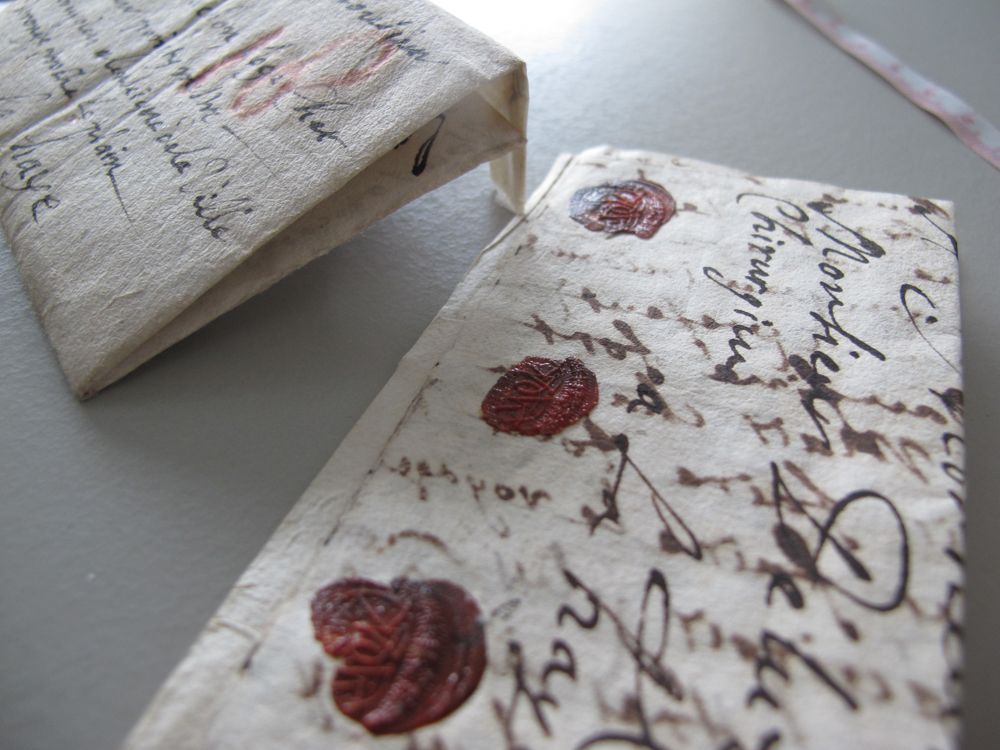
Photos: Treasure Trove of Unopened 17th-Century Letters | Live Science
Sealed Letters
Active agents or spies were also used, especially to estimate military and naval strength and associated activities. These agents, spies and informers were recruited from all aspects of society - diplomats, military, religious, refugees, defectors, fellow exiles, prisoners and captives, local government officials, professional agents provocateur. What I personally gained from this was that espionage was personal - adherence was to religion, nation, monarch but aboveall, to self preservation. Informants transferred their allegiance to whomever paid the most - "... there was money to be had for information ..." - or could offer them the best deal, usually reward or preferment, life and liberty. Lack of opportunity or advancement led some informants to play both sides of the fence. Towards the end of the period under discussion, it is noted that intelligence was "... dominated by adventurers motivated by self-interest and money and thus untrustworthy and often double agents ...". 

Jacobite Rebellion. Several Jacobite uprisings took place in the period 1688-1745
Jacobites
The methods used by the Jacobites, French, Dutch and English were not dissimilar - some were more effective in the collection, collation and usage of intel gathered than others. For as Hugh Douglas, author of Jacobite Spy Wars: Moles, Rogues and Treachery, notes, "... the final betrayal of the Stuart cause had not come about through a mistress's pillow talk: they had finally been shafted by one of their own needy Highland chiefs.."


Further reading:
A history of espionage in early-modern Britain, 1598-1715 by Alan Marshall (publication pending)

The Secret Service under Charles II and James II by James Walker

The Stuart Court in Exile and the Jacobites edited by Eveline Cruickshanks and Edward Corp

The Stuart Secret Army: The Hidden History of the English Jacobites by Evelyn Lord


Thursday, April 2, 2020

Review: The Drowning Guard by Linda Lafferty

The Drowning Guard: A Novel of the Ottoman Empire by [Lafferty, Linda]Synopsis: Each morning in the hour before dawn, a silent boat launches on the Bosphorous, moving swiftly into the deepest part of the waters halfway between Europe and Asia, where a man will die...

The Drowning Guard is the tale of the Ottoman princess, Esma Sultan - one of the most powerful women in Ottoman history and unlike any other woman in the Islamic world. In a gender reversal of Scheherazade in 1001 Arabian Nights, Esma seduces a different Christian lover each night, only to have him drowned in the morning. The Sultaness's true passion burns only for the Christian-born soldier charged with carrying out the brutal nightly death sentence: her drowning guard, Ivan Postivich.

The Drowning Guard explores the riddle of Esma - who is at once a murderer and a champion and liberator of women - and the man who loves her in spite of her horrifying crimes. This textured historical novel, set in the opulence and squalor of Istanbul in 1826, is woven with the complexity and consequences of love.


There are a lot of themes running through this novel, so firstly, some background which will cover off the main characters and also a little bit about the setting - Istanbul and the Ottoman Empire:

Ivan Postivih - aka Ahmed Kadir - a fictional character who was a Serb captured by the Ottomans as a child and conscripted into the elite Janissary cavalry. The Janissaries where themselves always Christian conscripts converted to Islam, trained and educated solely for military service. As an essentially non-Muslim group, they owed no allegiance except to the Sultan. In the novel, Ivan has been demoted (due to inciting envy and jealousy from the Sultan) and sent to the Sultan's sister Esma as a guard. Esma assigns to him the role of her "drowning guard" wherein he is tasked with the clandestine executions of Esma’s discarded Christian lovers.


Esma Sultan
Esma Sultan was the daughter of Sineperver Sultan and the Sultan, Abdulhamid I (d.1789). Her mother was one of nine wives/ consorts of Adbulhamid. Esma was sister to Mustafa IV ruled for one year as Sultan (1080) succeeding his cousin before being executed by Mahmud II (their half-brother). 

When she was 11 years old, her father died. Since Mustafa was only 10 years old at the time of his father’s death. Selim III ascended to the throne as the eldest male member of the Ottoman Empire. She followed her mother to the old palace. When she was 14 her cousin Selim III married her to Küçük Huseyn Pasha, Chief Admiral of the Navy. Her husband died in 1803 when she was 25 years old. She never married again. 

In 1807, the Janissaries revolted again, dethroned, imprisoned, and later murdered Selim III. They placed his cousin Mustafa, brother of Esma Sultan, on the throne. Mustafa IV reigned briefly in an era of Janissary riots. Esma Sultan played a major role in Kabakçı revolt with her mother Sineperver Sultan in bringing her half-brother Mahmud to throne, at the expense of her brother Mustafa, who was duly executed.

Due to her husband's position at court, and the influence over and the esteem in which she was held by both her brothers, Esma became prominent herself and acquired a great deal of property, land, buildings and revenues which enabled her to enjoy her life to the fullest. She had a large retinue, traveled freely and extensively, and was an accomplished poet and musician.

At the time of the events in the novel, Esma is 48 years old and quite possibly residing at one of her waterfront palaces, such as at Kuruçeşme or Ortaköy.


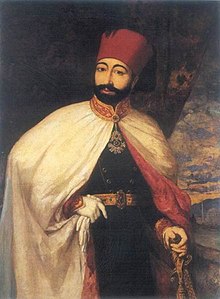
MahmutII.jpgMahmud II was the half-brother of Esma Sultna, his mother NakÅŸidil Sultan, being one of the wives / consorts of Abdulhamid I. As we have seen above, Mahmud came to the throne aged 23 after a revolt by the Janissaries and the deposition and execution of his brother Mustafa IV (1808).

His reign was dominated by external events: the war against the Saudi state, the independence of Greece and other Balkan nations, war with Persia, conquest of Ottoman Algeria by the French, and naval defeat at the hands of a combined force of English, Russian and French navies. In addition, the Ottoman Empire's trade policies and deindustrialisation led to economic downturn - decline had set in.

There is, however, one event that concerns us the reader as it was  more or less contemporary with events in the novel, which themselves may be posited as a mitigating factor, and once again involve the Janissaries. 

Ottoman military reform efforts begin with Selim III (1789–1807) who made the first major attempts to modernize the army along European lines. These efforts, however, were hampered by reactionary movements primarily from the Janissary corps, who had become anarchic and ineffectual. Jealous of their privileges and firmly opposed to change, they created a Janissary revolt (1807). Selim's efforts cost him his throne and his life, but were resolved in spectacular and bloody fashion by his successor, the dynamic Mahmud II. Most of the 135,000 Janissaries revolted against Mahmud II, and after the rebellion was suppressed, its leaders were killed, and many of its members exiled or imprisoned. The Janissary corp was effectively eliminated on 15 June 1826. Opening events in the novel take place less than one month prior (ie: May 1926). This revolt became known as the Auspicious Incident.


I was intrigued by the premise - imperial lovers being drowned in the Bosphorus after a night of pleasure.  Whilst the author states there was no such proofs for "drowning guards" this is in fact possibly incorrect, as events nearly 200 years previous may attest.

Istanbul: The City of Water

When Sultan Ibrahim (1616- 1648) came to the throne, his mental state was rather disturbed - hence he was referred to as "the Mad".  He had been imprisoned in a cage within the Topkapi Palace known as "kafes".  This was the fate of potential male heirs and rivals - previously they had all been executed regardless of age or mental state.  To distract him, his advisors suggested Ibrahim should pleasure himself with girls from the harem. This extravagant pastime pleased him greatly and left others alone to rule his empire as they wished, in particular his mother Kosem Sultan and Grand Vizier KemankeÅŸ Kara Mustafa Pasha. Ibrahim favoured many of his concubines but unfortunately paranoia ruled his life, and his lasting legacy was to drown 280 concubines in the Bosphorus because he suspected they were plotting against him. 

Now to my final thoughts. Having persevered through average narrative, and characters and events that should have held my attention for far longer than they did, I was left slightly dissatisfied with the ending. The subject matter at hand could have made for a much stronger storyline. Possibly those unfamiliar with this period of history may find it more to their liking. Kudos for taking on a rather lesser-known female character and period of history; however, sometimes fiction just does not do actual history any justice.


Wednesday, April 1, 2020

The King's Midwife : A History and Mystery of Madame du Coudray by Nina Rattner Gelbart

Front CoverThis unorthodox biography explores the life of an extraordinary Enlightenment woman who, by sheer force of character, parlayed a skill in midwifery into a national institution. In 1759, in an effort to end infant mortality, Louis XV commissioned Madame Angélique Marguerite Le Boursier du Coudray to travel throughout France teaching the art of childbirth to illiterate peasant women. For the next thirty years, this royal emissary taught in nearly forty cities and reached an estimated ten thousand students. She wrote a textbook and invented a life-sized obstetrical mannequin for her demonstrations. She contributed significantly to France's demographic upswing after 1760.

Who was the woman, both the private self and the pseudonymous public celebrity? Nina Rattner Gelbart reconstructs Madame du Coudray's astonishing mission through extensive research in the hundreds of letters by, to, and about her in provincial archives throughout France. Tracing her subject's footsteps around the country, Gelbart chronicles du Coudray's battles with finance ministers, village matrons, local administrators, and recalcitrant physicians, her rises in power and falls from grace, and her death at the height of the Reign of Terror. 

At a deeper level, Gelbart recaptures du Coudray's interior journey as well, by questioning and dismantling the neat paper trail that the great midwife so carefully left behind. Delightfully written, this tale of a fascinating life at the end of the French Old Regime sheds new light on the histories of medicine, gender, society, politics, and culture.


further reading:
New York Academy of Medicine - biography
New York Times: Baby Boom

Going Public: Women and Publishing in Early Modern France by Elizabeth C. Goldsmith, Dena Goodman
The Art of Midwifery: Early Modern Midwives in Europe edited by Hilary Marland

Sunday, March 29, 2020

Books: Medieval Books

Prince of the Press: How One Collector Built History’s Most Enduring and Remarkable Jewish Library by Joshua Teplitsky
"Prince of the Press" by Joshua TeplitskyThe story of one of the largest collections of Jewish books, and the man who used his collection to cultivate power, prestige, and political influence

David Oppenheim (1664–1736), chief rabbi of Prague in the early eighteenth century, built an unparalleled collection of Jewish books and manuscripts, all of which have survived and are housed in the Bodleian Library at Oxford. His remarkable collection testifies to the myriad connections Jews maintained with each other across political borders, and the contacts between Christians and Jews that books facilitated. From contact with the great courts of European nobility to the poor of Jerusalem, his family ties brought him into networks of power, prestige, and opportunity that extended across Europe and the Mediterranean basin. Containing works of law and literature alongside prayer and poetry, his library served rabbinic scholars and communal leaders, introduced old books to new readers, and functioned as a unique source of personal authority that gained him fame throughout Jewish society and beyond. The story of his life and library brings together culture, commerce, and politics, all filtered through this extraordinary collection. Based on the careful reconstruction of an archive that is still visited by scholars today, Joshua Teplitsky’s book offers a window into the social life of Jewish books in early modern Europe.


The Book in the Renaissance by Andrew Pettegree
"The Book in the Renaissance" by Andrew PettegreeThe dawn of print was a major turning point in the early modern world. It rescued ancient learning from obscurity, transformed knowledge of the natural and physical world, and brought the thrill of book ownership to the masses. But, as Andrew Pettegree reveals in this work of great historical merit, the story of the post-Gutenberg world was rather more complicated than we have often come to believe.

The Book in the Renaissance reconstructs the first 150 years of the world of print, exploring the complex web of religious, economic and cultural concerns surrounding the printed word. From its very beginnings, the printed book had to straddle financial and religious imperatives, as well as the very different requirements and constraints of the many countries who embraced it, and, as Pettegree argues, the process was far from a runaway success. More than ideas, the success or failure of books depended upon patrons and markets, precarious strategies and the thwarting of piracy, and the ebb and flow of popular demand. Owing to his expert and highly detailed research, Pettegree crafts an authoritative, lucid, and truly pioneering work of cultural history about a major development in the evolution of European society.


The Bookshop of the WorldMaking and Trading Books in the Dutch Golden Age by Andrew Pettegree and Arthur der Weduwen
40887372The untold story of how the Dutch conquered the European book market and became the world's greatest bibliophiles

The Dutch Golden Age has long been seen as the age of Rembrandt and Vermeer, whose paintings captured the public imagination and came to represent the marvel that was the Dutch Republic. Yet there is another, largely overlooked marvel in the Dutch world of the seventeenth century: books.

In this fascinating account, Andrew Pettegree and Arthur der Weduwen show how the Dutch produced many more books than pictures and bought and owned more books per capita than any other part of Europe. Key innovations in marketing, book auctions, and newspaper advertising brought stability to a market where elsewhere publishers faced bankruptcy, and created a population uniquely well-informed and politically engaged. This book tells for the first time the remarkable story of the Dutch conquest of the European book world and shows the true extent to which these pious, prosperous, quarrelsome, and generous people were shaped by what they read.

Saturday, February 22, 2020

Review: Sisters In Arms by Julie Wheelwright

Synopsis: A history of female combatants, from those who joined the military disguised as men to the current role of women in the armed forces. The book follows the evolution of women in combat, from the Scythian women who begat the Amazonian myth, to the passing women in the eighteenth century, and on to the re-emergence of women as proud members of the armed forces in various countries in the 20th and 21st centuries. The book also explores the formalization of women’s military roles and questions the contemporary relationship between masculinity and combat.


I'll begin with a quote: "Beginning with the founding myth of the Amazons--in reality female warriors of a nomadic tribe to whom the Greeks attributed super-heroic powers--Julie Wheelwright explores the history of women in arms. " Not my advanced copy.

Whilst ever so briefly mentioning the Amazons, this lengthy tome focuses heavily on the period from the 18th Century onwards and predominantly on the UK, USA and USSR (for want of a better collective term). It covers quite succinctly the areas of gender disguise and open enlistment, the maintenance of the fiction (ie: women disguised as men), the fear of discovery and punishment, and the experiences of these women upon their return from active duty and their new-found celebrity. I, however, was looking for more of the historical aspect rather than the more "recent" history.

It is the final chapters that looks at the continuity between historical and contemporary female warriors, but again within the parameters as set out above. There is a good section on sources, notes and extensive bibliography for those wishing to explore this topic further.

This will still make for a good sourcebook for those wishing to explore more - again, within the actual parameters.


Saturday, November 2, 2019

Review: the Caribbean Irish by Miki Garcia

48541222Synopsis: The Caribbean Irish explores the little known fact that the Irish were amongst the earliest settlers in the Caribbean. They became colonisers, planters and merchants living in the British West Indies between 1620 and 1800 but the majority of them arrived as indentured servants. This book explores their lives and poses the question, were they really slaves? As African slaves started arriving en masse and taking over servants' tasks, the role of the Irish gradually diminished. But the legacy of the Caribbean Irish still lives on. 


This, for me, was a fascinating read as much of what I have read in the past relating to Irish history has been focused on the country itself. It was no news to me that a great many Irish left their homeland following war and the Famine, whether voluntarily or not - my own family arrived in Australia in less than auspicious circumstances. And it is only lately, in this last decade, that I have begun specifically exploring the full extent of the reach of Irish migration to Spain, South America, and now the Caribbean - places, except for Spain, that I was unfamiliar with. So, in addition to the recently read Paisanos: The Forgotten Irish Who Changed the Face of Latin America by Tim Fanning, I will add this tome by Miki Garcia, as a must read.

Garcia begins the story of the Irish in the Caribbean from the 17th Century, when Ireland like England was under the Cromwellian thrall following the Royalist defeat in the English Civil War. She refers to Ireland as " ... a prisoner of geography .." and for all intents and purposes, this is where it all began - with Irish prisoners, whether of war or circumstance. In an effort to clear out the prisons of the destitute, the political and criminal elements, the workhouses, transportation seemed the solution. Under the Act of Settlement of Ireland 1652, what could only be described as ethnic cleansing began in earnest. Transportation agents were employed to ensure that quotas were met and the means in which they succeeded was often overlooked - children were kidnapped, men were press-ganged, women were lied to, promises were made, people with no visible means of support, including widows and wives of serving soldiers, were swept up and shipped off. Some paid their way while others opted to work off the costs (a bit like today's human trafficking schemes). There are no actual numbers to quantify how many people ended up in the Caribbean - there were no official records kept by the less than scrupulous transportation agents; many people were misidentified (labelled English rather than Irish - or vice versa) - AND, to top it all off, this wasn't just an English thing - the Dutch, the French and the Spanish were all involved in the shipment of Irish to the Caribbean!

Related image

So where does this leave us now - firstly with those that came voluntarily - soldiers, explorers, adventurers, government officials and their families, traders and merchants. All of these folk needed servants - and here is where the bulk of the Irish come into it - as "indentured servants" - refer above as to how they arrived, though many in government considered it "... a measure beneficial to Ireland ..."

For the most part, Garcia enlightens us about the system of the indentured servant. Upon arriving, many Irish were "sold" as servants for a specific period - usually seven years. They were treated not much better than actual slaves but more on this later. Families were often separated, they were still the victims of humiliation and discrimination, the subjects of anti-Irish laws which also restricted their travel; they were the subjects of vigorous scrutiny with the government always fearing some sort of rebellion. After their period of employment was over, these servants were freed and they were usually paid in goods (their lives equivalent to pounds of tobacco, sugar or cotton). There was no guarantee of employment afterwards (only if you were skilled labour), and often they were then farmed out again (as indentured servants) to other colonies.

Garcia talks about the main industries in the Caribbean - tobacco, sugar and cotton, and on which islands they were prevalent. And this is an important component of the Irish history in the Caribbean as the introduction of slaves from Africa changed things for them on a considerable scale.

The production of sugar coincided with an increase in the African slave trade but it was not the starting point as this was already in existence across the Caribbean (though not to the extent as is commonly thought). As a result of this increase, the need for Irish servants decreased; their treatment and punishments worsened as slaves were considered to be a more valuable commodity - retained for the duration of their life rather than for a set period of employment - so no effort was spared to make the lives of the Irish any easier - their standard of living decreased to the point where I guess many might have wondered whether the grass was actually greener.
So, across how many islands in the Caribbean were the Irish spread - Garcia gives us a summary so that we don't have to do the leg-work ourselves - and it turns out to be quite a lot!

But back to the main topic - how the Irish slave myth was made. And it all boils down to terminology. The Irish in the Caribbean were not there as slaves. They arrived under the heading of one of four groups: willing and volunteers; involuntary; child labour; enforced (ie: prisoners). The last three groups were "sold" on arrival, though could not freely specify the length of their contract, whilst the last group were considered servants for life - without indenture. Observance of their treatment could be construed by some as giving rise to the myth of slavery. Garcia explains the terminology for us: an indentured servant was contracted for a period of years and then were given their freedom. A slave was the personal property of another - for life - and by default, so too were their descendants. The slave codes of the late 1600s were set up to differentiate between the two.

As a side note, the slave trade in the Caribbean ended in 1834. Large scale migration ended c.1841, and though the Irish were still encouraged to migrate, numbers were much smaller.

For me, this was a valuable insight into the Irish diaspora as well as the history of the British West Indies. As this was not really my field of expertise, I had no idea that Europeans supplanted the native Amerindian populations; that the Irish were transported in their hundreds of thousands (willingly or not) before the introduction of African slaves; and that once there, there was frequent cross migration between the islands and the Amazon basin.

Garcia's narrative style makes it easy to follow this tangled web, At times it feels as if you are sitting across from her having a conversation. It is easy, after reading this, to understand how the Irish slave myth arose and it is a topic well worth exploring further. Garcia's book will start you on your journey.


so in the words of the Beach Boys' song, Kokomo
Aruba, Jamaica, ooh I want to take ya,
Bermuda, Bahama, come on pretty mama
Key Largo, Montego, baby why don't we go, Jamaica .....

further reading:
To Hell or Barbados: The ethnic cleansing of Ireland by Sean O'Callaghan
White Cargo: The Forgotten History of Britain's White Slaves in America by Don Jordan, Michael Walsh
If the Irish Ran the World: Montserrat, 1630-1730 by Donald H. Akenson
Ireland, Slavery and Anti-Slavery: 1612-1865 by N. Rodgers
How the Irish Became White by Noel Ignatiev
To Shed a Tear: A Story of Irish Slavery in the British West Indies by Lawrence R. Kelleher


Wednesday, October 2, 2019

Culloden by Murray Pittock

Cover for 

Culloden
The battle of Culloden lasted less than an hour. The forces involved on both sides were small, even by the standards of the day. And it is arguable that the ultimate fate of the 1745 Jacobite uprising had in fact been sealed ever since the Jacobite retreat from Derby several months before.


But for all this, Culloden is a battle with great significance in British history. It was the last pitched battle on the soil of the British Isles to be fought with regular troops on both sides. It came to stand for the final defeat of the Jacobite cause. And it was the last domestic contestation of the Act of Union of 1707, the resolution of which propelled Great Britain to be the dominant world power for the next 150 years.

If the battle itself was short, its aftermath was brutal - with the depredations of the Duke of Cumberland followed by a campaign to suppress the clan system and the Highland way of life. And its afterlife in the centuries since has been a fascinating one, pitting British Whig triumphalism against a growing romantic memorialization of the Jacobite cause.

On both sides there has long been a tendency to regard the battle as a dramatic clash, between Highlander and Lowlander, Celt and Saxon, Catholic and Protestant, the old and the new. Yet, as this account of the battle and its long cultural afterlife suggests, while viewing Culloden in such a way might be rhetorically compelling, it is not necessarily good history.