Showing posts with label renaissance. Show all posts

Monday, February 12, 2024

Review: Fool by Peter K Andersson

Synopsis: The first biography of Henry VIII’s court fool William Somer, a legendary entertainer and one of the most intriguing figures of the Tudor age.

In some portraits of Henry VIII there appears another, striking figure―a gaunt and morose-looking man with a shaved head and, in one case, a monkey on his shoulder. This is William or "Will" Somer, the king’s fool, a celebrated wit who reportedly could raise Henry’s spirits and spent many hours with him, often alone. Was Somer an “artificial fool,” a cunning comic who could speak freely in front of the king, or a “natural fool,” someone with intellectual disabilities, like many other members of the profession? And what role did he play in the tumultuous and violent Tudor era? Fool is the first biography of Somer―and perhaps the first of a Renaissance fool.

After his death, Somer disappeared behind his legend, and historians struggled to separate myth from reality. Unearthing as many facts as possible, Peter K. Andersson pieces together the fullest picture yet of an enigmatic and unusual man with a very strange job. Somer’s story provides new insights into how fools lived and what exactly they did for a living, how monarchs and courtiers related to commoners and people with disabilities, and whether aspects of the Renaissance fool live on in the modern comedian. But most of all, we learn how a commoner without property or education managed to become the court’s chief mascot and a continuous presence at the center of Tudor power from the 1530s to the reign of Elizabeth I.

Looking beyond stereotypes of the man in motley, Fool reveals a little-known world, surprising and disturbing, when comedy was something crueler and more unpleasant than we like to think.

~ ~ ~

A strictly academic work that is neither a standard nor chronological biography on this rather enigmatic character from Tudor history.

With the use of contemporaneous sources and comparisons outside of the Tudor court, Andersson explores to what extent was the fool a servant or a courtier. Andersson also acknowledges that there is too little information on the actual man - Will Somer - for the reader to gain any real insight into him - what we know is based upon scant administration records of the Tudor period.

I came into this wanting to know more, but came away no closer to finding any real substance to the real man. I have given it three stars are this looks to be the first - for me anyway - real attempt to put some flesh on the bones of an elusive historical person. However, for my mind, this particular work is more of an exploration into the perception and the role of the fool and comedy during the early renaissance period.

Definitely one for those with an interest in the Tudor and Elizabethan courts.

Sunday, March 29, 2020

Books: Medieval Books

Prince of the Press: How One Collector Built History’s Most Enduring and Remarkable Jewish Library by Joshua Teplitsky
"Prince of the Press" by Joshua TeplitskyThe story of one of the largest collections of Jewish books, and the man who used his collection to cultivate power, prestige, and political influence

David Oppenheim (1664–1736), chief rabbi of Prague in the early eighteenth century, built an unparalleled collection of Jewish books and manuscripts, all of which have survived and are housed in the Bodleian Library at Oxford. His remarkable collection testifies to the myriad connections Jews maintained with each other across political borders, and the contacts between Christians and Jews that books facilitated. From contact with the great courts of European nobility to the poor of Jerusalem, his family ties brought him into networks of power, prestige, and opportunity that extended across Europe and the Mediterranean basin. Containing works of law and literature alongside prayer and poetry, his library served rabbinic scholars and communal leaders, introduced old books to new readers, and functioned as a unique source of personal authority that gained him fame throughout Jewish society and beyond. The story of his life and library brings together culture, commerce, and politics, all filtered through this extraordinary collection. Based on the careful reconstruction of an archive that is still visited by scholars today, Joshua Teplitsky’s book offers a window into the social life of Jewish books in early modern Europe.


The Book in the Renaissance by Andrew Pettegree
"The Book in the Renaissance" by Andrew PettegreeThe dawn of print was a major turning point in the early modern world. It rescued ancient learning from obscurity, transformed knowledge of the natural and physical world, and brought the thrill of book ownership to the masses. But, as Andrew Pettegree reveals in this work of great historical merit, the story of the post-Gutenberg world was rather more complicated than we have often come to believe.

The Book in the Renaissance reconstructs the first 150 years of the world of print, exploring the complex web of religious, economic and cultural concerns surrounding the printed word. From its very beginnings, the printed book had to straddle financial and religious imperatives, as well as the very different requirements and constraints of the many countries who embraced it, and, as Pettegree argues, the process was far from a runaway success. More than ideas, the success or failure of books depended upon patrons and markets, precarious strategies and the thwarting of piracy, and the ebb and flow of popular demand. Owing to his expert and highly detailed research, Pettegree crafts an authoritative, lucid, and truly pioneering work of cultural history about a major development in the evolution of European society.


The Bookshop of the WorldMaking and Trading Books in the Dutch Golden Age by Andrew Pettegree and Arthur der Weduwen
40887372The untold story of how the Dutch conquered the European book market and became the world's greatest bibliophiles

The Dutch Golden Age has long been seen as the age of Rembrandt and Vermeer, whose paintings captured the public imagination and came to represent the marvel that was the Dutch Republic. Yet there is another, largely overlooked marvel in the Dutch world of the seventeenth century: books.

In this fascinating account, Andrew Pettegree and Arthur der Weduwen show how the Dutch produced many more books than pictures and bought and owned more books per capita than any other part of Europe. Key innovations in marketing, book auctions, and newspaper advertising brought stability to a market where elsewhere publishers faced bankruptcy, and created a population uniquely well-informed and politically engaged. This book tells for the first time the remarkable story of the Dutch conquest of the European book world and shows the true extent to which these pious, prosperous, quarrelsome, and generous people were shaped by what they read.

Saturday, August 17, 2019

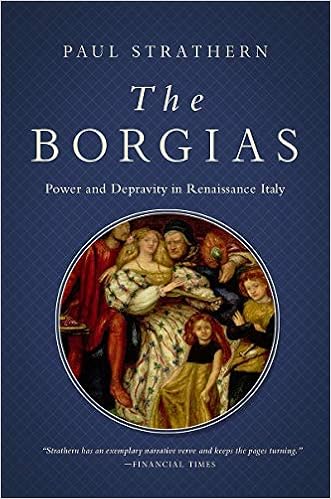
The Borgias by Paul Strathern

The Borgia family have become a byword for evil. Corruption, incest, ruthless megalomania, avarice and vicious cruelty―all have been associated with their name. And yet, paradoxically, this family lived when the Renaissance was coming into its full flowering in Italy. Examples of infamy flourished alongside some of the finest art produced in western history. 


This is but one of several paradoxes associated with the Borgia family. For the family which produced corrupt popes, depraved princes and poisoners, would also produce a saint. These paradoxes which so characterize the Borgias have seldom been examined in great detail. Previously history has tended to condemn, or attempt in part to exonerate, this remarkable family. Yet in order to understand the Borgias, much more is needed than evidence for and against. The Borgias must be related to their time, together with the world which enabled them to flourish. Within this context the Renaissance itself takes on a very different aspect. Was the corruption part of the creation, or vice versa? Would one have been possible without the other? 


One of the author’s great strengths has always been his ability to keep the many assorted players from confusing readers, and that holds true in his latest.  Strathern’s smooth narrative and comprehensive insight bring the Borgias to life for scholars and amateurs alike.

Thursday, September 13, 2018

The Chef's Secret: A Novel by Crystal King

A captivating novel of Renaissance Italy detailing the mysterious life of Bartolomeo Scappi, the legendary chef to several popes and author of one of the bestselling cookbooks of all time, and the nephew who sets out to discover his late uncle’s secrets—including the identity of the noblewoman Bartolomeo loved until he died.

When Bartolomeo Scappi dies in 1577, he leaves his vast estate—properties, money, and his position—to his nephew and apprentice Giovanni. He also gives Giovanni the keys to two strongboxes and strict instructions to burn their contents. Despite Scappi’s dire warning that the information concealed in those boxes could put Giovanni’s life and others at risk, Giovanni is compelled to learn his uncle’s secrets. He undertakes the arduous task of decoding Scappi’s journals and uncovers a history of deception, betrayal, and murder—all to protect an illicit love affair.

As Giovanni pieces together the details of Scappi’s past, he must contend with two rivals who have joined forces—his brother Cesare and Scappi’s former protégé, Domenico Romoli, who will do anything to get his hands on the late chef’s recipes.

Sunday, August 19, 2018

Poison: A favorite means to an end

The Royal Art of Poison: Filthy Palaces, Fatal Cosmetics, Deadly Medicine, and Murder Most Foul" by Eleanor Herman, reviewed by Kay Johnson


Royal Art of Poison book coverThroughout history, especially in Medieval and Renaissance times, royalty and royalty-to-be often had abundant reason to be fearful of poison in their food and drink. Jealousy was common. Enemies could be anywhere and, to avoid big problems, most monarchs employed a taster or, in the case of Louis XIV, 324 of them.

That didn’t help much, says Herman, because nasty substances weren’t just used to steal a crown. Lead was found in cosmetics then. Sulfur was used to powder wigs, and mercury and arsenic, along with human remains, were prescribed as medicine. Urine was used by the clothing industry. Bloodletting was employed to reset “humors.” Rooster dung was given to induce vomiting, and even the air that the average person breathed could be poisonous.

But this book isn’t all about murder — or history, for that matter. Herman spends a good amount of time telling about royal as well as everyday lives and how people lived in the 14th-through-18th-centuries. She then explains how we know what we know now, and why the heyday of poison, if you will, ended.

read more here @ Crow River Media

Tuesday, January 2, 2018

Review: Parlour Games and the Public Life of Women in Renaissance Italy

17170582
George McClure's "Parlour Games and the Public Life of Women in Renaissance Italy" is an academic tome that looks at the use of games in Renaissance Italy, particularly by upper-class women, as a means of displaying their intellect, wit, charm, being confined by the social norms from doing so in a more public forum.

A welcome addition for those with an interest in this particular field of study.

more in-depth reviews here @ Project MUSE and @ American Historical Review


Saturday, June 10, 2017

A fascinating look at the history of toxicology

The first two volumes in the History of Toxicology and Environmental Health Series, edited by Philip Wexler, describe toxicology in antiquity. This new book continues the story by covering the approximate period between 400AD and 1600AD. It consists of 16 chapters written by contributors from various institutions in Europe, the Middle East and North America.

The book ...... [ delves ] into different aspects of toxicology, such as the contributions of scientific scholars of the time, sensational poisoners and poisoning cases, as well as myths. Historical figures, such as the Borgias and Catherine de Medici are discussed. Toxicologists, students, medical researchers, and those interested in the history of science will find insightful and relevant material in this volume.

read more here @ the Pharmaceutical Journal and @ Elsevier
read book here @ Science Direct

Boston library to return historical artifacts to Italy

The Boston Public Library is returning to Italy medieval manuscripts and a volume of works, ending in one case a mystery dating back seven decades.  The items include a manuscript from 1392, an illuminated leaf from a manuscript dating between 1418 and 1422, and a collection of works by Bernardino Telesio, published in 1590.

"Boston Public Library purchased these rare and important materials in good faith for the public to see and study and we took our stewardship of them seriously during the many years that they were in our care," said Beth Prindle, the library's head of Special Collections. "We are fully committed to their safe return."

read more here @ Daily Sabah


Thursday, May 18, 2017

The Fellowship of the Book: Manutius & Bembo

The figure of Aldus Manutius, the “Michelangelo of the Book,” is inseparable from the city where he produced his most important innovations: Venice, the principal printing centre of the Renaissance. 


Aldus’ most notable relationship with Venice, though, emerges through his fellowship with the intellectual and polygraph Pietro Bembo. Whereas Manutius revolutionized printing and reading, Bembo revolutionized the Italian literary language and canon. 

Manutius and Bembo’s partnership was particularly successful mainly because it benefited both sides equally. Bembo owed Manutius his first steps in the literary arena, since Aldus published his first texts – the scientific treatise De Aetna and the dialogue Gli Asolani– and entrusted Bembo with the critical edition of Dante’s and Petrarch’s immortal masterpieces. For the De Aetna, Manutius decided to use a new italic typeface, and commissioned it to his trusted punchcutter Francesco Griffo: in 1495-96, thus, the Bembo typeface was born. 

read entire article - The Fellowship of the Book by Elisa Mondolo here @ SFU Library Special Collections & Rare Books