Showing posts with label 15th century. Show all posts

Thursday, January 1, 2026

Review: Uncrowned Queen by Nicola Tallis

Synopsis: The first comprehensive biography in three decades on Margaret Beaufort, the mother of the Tudor Dynasty.

In 1485, Henry VII became the first Tudor king of England. His victory owed much to his mother, Lady Margaret Beaufort. Over decades and across countries, Margaret had schemed to install her son on the throne and end the War of the Roses. Margaret's extraordinarily close relationship with Henry, coupled with her role in political and ceremonial affairs, ensured that she was treated -- and behaved -- as a queen in all but name. Against a lavish backdrop of pageantry and ambition, court intrigue and war, historian Nicola Tallis illuminates how a dynamic, brilliant woman orchestrated the rise of the Tudors.

~ ~ ~

Well .... no. Not the first comprehensive biography - but certainly one of a few including the recent works by Lauren Johnson and Elizabeth Norton.

Tallis provides the reader with a very accessible biography of a woman who put aside her ego and loyalty to play the long game - that was putting her son Henry on the throne of England.

Much of Margaret's life is covered: her childhood, marriages, birth of her only child; in addition to a history of events of her time leading up to the coronation of Henry as Henry VII. Tallis focuses on the cultural, social and religious aspects of Margaret's life, including he role as patron to both educational and religious establishments, and her role as counsellor and confidante of her son Henry.

There is nothing new here that has not been covered off in previous biographies and histories but as mentioned, it accessible to the lay reader.

Sunday, November 23, 2025

Review: Margaret Beaufort by Lauren Johnson

Synopsis: Survivor. Rebel. Conspirator. Matriarch of a dynasty.

Born into a century of conflict as the daughter of the Duke of Somerset and a descendant of Edward III, Margaret Beaufort was married at twelve, a mother and widow at thirteen, and a player in one of the most violent chapters of English history.

Across three marriages and decades of civil war, Margaret endured loss, intrigue and exile – yet lived to see her only son crowned Henry VII, the first Tudor king. Against a backdrop of shifting power and danger, she helped broker the union that ended the Wars of the Roses, shaped the early Tudor court, and played a formative role in the life of her grandson, Henry VIII.

In this powerful and perceptive biography, historian Lauren Johnson brings Margaret vividly to life as a woman of rare resilience and ambition. With empathy and sharp insight, Johnson reframes our understanding of medieval power and restores Margaret to her rightful place: not simply a mother behind the throne, but a skilled political operator whose determination changed the course of English history.

~ ~ ~

Johnson begins with a very apt observation: "The challenge of locating women in an era when female identity, and especially autonomy, is often concealed and sometimes eradicated hardly needs reciting." This is true whether studying or researching European, African, America, Asian or Pacific Nations women. That Margaret Beaufort was one who did is a true testament to not only her incredible good fortune but her own formidable persistence. She was a woman, Johnson notes, who learnt the art of politicking and concealing her private thoughts and resentments for the good of her kin ... and her only son.

Johnson takes the reader on a journey into Margaret's life both on the domestic and political fronts, beginning with a short history of the Beaufort clan, Margaret's own childhood, marriages and birth of son Henry, through the tumultuous period known as the wars of the roses, to the fall of the last Plantagenet king and the accession of her son Henry as the first Tudor monarch.

The narrative is one that will easily engulf the reader into the period of history through which Margaret lived and died, without becoming bogged down in an over abundance of facts to the point that one quite easily tunes out. Johnson keeps the reader engaged - the prose follows a chronological timeline, and a list of the dramatis personae (and family trees) is listed at the start of the book to assist a reader new to this period.

Margaret Beaufort is a remarkable subject to study and Johnson provides a highly engaging and accessible history and biography.  An impressive study of an oft maligned political survivor.

Monday, November 10, 2025

Review: Edward IV's Fatal Legacy by Hazel Pierce

Synopsis: One of the most overlooked families of the early modern period, the Courtenays played a critical role, and their story of love and loss, loyalty and betrayal, survival and ruin is played out at the courts of four Tudor monarchs.

Katharine, Countess of Devon, was Edward IV's daughter. Her first proposed marriage would have made her Queen of Spain, but she was declared a bastard on the accession of her uncle Richard III. Legitimated under Henry VII, she eventually married Sir William Courtenay, heir to the earldom of Devon. Her closeness to her sister, Queen Elizabeth of York, did not prevent the sudden arrest of her husband in 1502. Whilst earning the regard of her royal brother-in-law, Henry VII, she walked a knife edge until the accession of her nephew, Henry VIII. As a widow, he granted her the lands of the earldom of Devon for life, making her one of the wealthiest female magnates in England.

Her death in 1527 spared her the tragedies which befell her family in the 1530s. Her son Henry, Marquis of Exeter, was first cousin to Henry VIII, with whom he enjoyed a close relationship until the king’s decision to repudiate his queen changed everything. Henry’s marriage to Gertrude Blount, one of the most neglected women of the Tudor period, was one of affection and respect. During the 1530s, she was at the centre of a group opposed to Henry VIII’s repudiation of Catherine of Aragon, passing on information provided by her husband and a small circle of trusted friends to the imperial ambassador, Chapuys. When her husband was arrested in 1538, he, along with others, was executed; only she survived.

Imprisoned in the Tower with her twelve-year-old son, Edward, she was later released while Edward remained incarcerated until the accession of Mary I. Upon his release, many believed he would marry the queen, but instead, he died in exile from suspected poisoning after surviving several assassination attempts by imperial agents. This study of the Courtenay family follows their lives and fortunes from 1479-1558.

~ ~ ~

Let me begin by saying I, personally, consider the title (and cover art) to be misleading (would strongly suggest changing - I can even suggest a few alternates that would actually represent the contents), as it really does a dis-service to the family at the forefront of this tome.

Secondly, whilst the author has demonstrated the wealth of research done, the data dump is frustrating - all your research does not need to be included!! There is the usual P&S author style of writing about others not entirely central to the title or subject at hand (refer data dump above); lots of summations, and rather contradictorily so, lots of detail (again, a good editor should have trimmed this back).

Thirdly, whilst kudos for subject matter, once again let down by presentation style. Initially not overly impressed one third way in. I wearily persevered.

What I did like was primarily the subject matter - the rise and fall of the Courtenays under the Tudors (which is the title I would have gone for). The first part is focused on Katherine Plantagenet - the daughter of King Edward IV, she was a Courtenay by marriage only. Spoiler alert: as her husband died young, there is much focus on Katherine who lived a long life (for folks of her time). Therein point two applies - although there is much to be learned about Katherine and William during the reign of Henry Tudor (her brother-in-law) - who both she and William did manage to outlive.

The second part looks at the exceedingly tumultuous lives of Katherine's son Henry and his wife Gertrude - whom I found the most annoying yet fascinating woman who managed to keep her head during the reign of Henry VIII - how, is a miracle for she was a headstrong, scheming woman! However, she did manage to find herself confined to the Tower, as did her son for her sins.

The son, Edward, is the subject of part three - a young man, heavily influenced by others, who paid a heavy price for his father's loyalty to his friends - imprisonment during his youth. Upon his release, he made up for lost time - a bit like the child popstars of today who are keen to shake off the kiddie-pop image for a more adult one. Unfortunately for Edward, this was his undoing and led to his exile.

There is much to be learned about this family, primarily the English / Devon branch of the family.  There are many branches (or tentacles) that sprouted from this illustrious family tree, and they had their historical and political moments, which should have been summarised not detailed.

I have not come across another biography of this family prior to now so have nothing really to compare it to. It is not for the feint hearted as there is - as I mentioned - a lot of detail. Whilst I was initially not overly impressed, I did come away with a deeper appreciation of the Courtenay family and their place in Tudor history (though I still say less is best!).

If Tudor history is your penchant, then you will definitely want to include this one to your reading list - but take your time - do not rush through it - and probably ditch the audio and e-book versions for a physical copy.


Following this, I did a bit of a google search for any further histories on this family - see below:
  • The Shadow of the White Rose: Edward Courtenay, Earl of Devon, 1526-1556 by James D. Taylor
  • Boconnoc: The History of a Cornish Estate by Catherine Lorigan
  • Memorials of the West, Historical and Descriptive, Volume 44 by W. H. Hamilton Rogers
  • Children of England: The Heirs of King Henry VIII 1547-1558 by Alison Weir (for Edward Courtenay)

Sunday, December 22, 2024

Review: Tudor Executions by Helene Harrison

Synopsis: The Tudors as a dynasty executed many people, both high and low. But the nobility were the ones consistently involved in treason, either deliberately or unconsciously. Exploring the long sixteenth century under each of the Tudor monarchs gives a sense of how and why so many were executed for what was considered the worst possible crime and how the definition of treason changed over the period.

This book examines how and why Tudor nobles like Edward Stafford, 3rd Duke of Buckingham; Queen Consort Anne Boleyn; Henry Howard, Earl of Surrey; and Robert Devereux, 2nd Earl of Essex, fell into the trap of treason and ended up on the block under the executioner’s axe. Treason and the Tudor nobility seem to go hand in hand as, by the end of the sixteenth century and the advent of the Stuart dynasty, no dukes remained in England. How did this happen and why?

~ ~ ~

Rather good insight into the Tudor paranoia over the usurpation ..... I mean succession. And as the reader continues on their grisly journey, they will discover how closely related to each other were both monarch and executed noble, as well as noble to noble.

Harrison begins with Edward Plantagenet, Earl of Warwick (ex. 1499) and completed her list with Robert Devereaux, Earl of Essex (ex. 1601) - spanning the reigns of Henry VII to Elizabeth I. All those "victims" contained within the pages of this tome are already known - so no new surprises. 

The narrative is not cumbersome, the research is obvious without being overbearing, the tome is easily readable, and dare I say it, entertaining.

One definitely for the Tudor history buffs!

Friday, February 9, 2024

Review: The Case of Cem by Vera Mutafchieva

Synopsis: Vera Mutafchieva’s The Case of Cem, presented as a series of depositions by historical figures before a court, tells a straightforward tale: Upon the death of Ottoman Sultan Mehmed the Conqueror in 1481, his eldest son Bayezid takes the throne. However, discontented factions within the Ottoman army urge Mehmed’s second son Cem, a well-educated and experienced warrior, to oppose his brother’s ascension. Bayezid refuses, setting off a ruthless power struggle and forcing Cem into long years of exile, a pawn for European powers as they try to slow the Ottoman Empire’s expansion.

This enticing novel of court intrigue maintains lasting resonance for being a personal exploration of emigration and loss as told through the historical era during which the politics of the East and West were sketched out with utter clarity. These early lines of demarcation, as voiced through Christian and Muslim emissaries, power hungry rulers, unflinching warriors, and poets, have indelibly influenced the word as we know it today.

~ ~ ~

As the synopsis mentions, this historical fiction novel is set out as if the characters were themselves in court, setting out their own history before embarking on their recollection of their involvement in the events surrounding the last years and days of the Ottoman Prince and Sultan Cem. Each character, speaking in the first person, provides their own unique and personal view on events from their interactions with the exiled Cem. Each character provides a little more to the overall story of Cem, with the fictional character of the poet Saadi, providing the main thread linking all to and providing an insight into Cem, as Cem himself does not provide any account for the reader.

Following his failed attempt to take his father's throne and the accession of his brother Bayezid as ruler of the Ottoman Empire, Cem became the ultimate bargaining chip in international political relations between the East (Ottoman Empire) and the West (Kings, Popes, Knights) - all of whom were eager to bring about some truce with the encroaching Ottoman Empire - for themselves, individually, not collectively. Cem is often viewed as "a hapless prisoner and cruelly betrayed paramour of a bored and similarly imprisoned noblewoman".

Cem was far from being a distant figure - having come across him in my readings on the Ottoman Empire (a fascinating lesson in the art of political survival) and other historical tomes where he has featured during his exile, not least as a "guest" of the Hospitallers on Rhodes and of the Borgia Pope in Rome.  Even in death, Cem still provided to be worthy of bargaining.

This is quite a lengthy read but I would say one that is not overly cumbersome - take your time and enjoy the story. A new reader to this period may find this style a bit more user-friendly as opposed to diving head first into Ottoman politics and history (which is quite the fascination).

Monday, December 25, 2023

Review: Dracul - Of The Father by A Brackob

Synopsis: For the first time the true story of the man who founded the Dracula dynasty is revealed.

Stories of Dracula have fascinated people around the world for generations. Both the fictional vampire created by the Irish author Bram Stoker at the end of the nineteenth century and the fifteenth century Prince called Vlad the Impaler, the man regarded as the historical Dracula, have become part of universal culture. Yet few realize that the Wallachian ruler dubbed “the Impaler,” is not the original Dracula. Instead, that distinction belongs to his father, a little-known prince called Vlad Dracul. 

The elder Vlad, who gained the sobriquet Dracul or Dracula when Holy Roman Emperor Sigismund of Luxemburg initiated him into the Order of the Dragon in February 1431, was among the most important political personalities of his day. He far surpassed his more famous namesake in those qualities that define a great ruler.

Several books have been devoted to the study of his famous son, Vlad the Impaler, but any search for the historical Dracula must begin with the story of the father. Now, for the first time, based on extensive documentary research, the true story of the man who founded the Dracula dynasty is revealed.

~ ~ ~

A rather comprehensive history of the Eastern European region, especially as it relates to its overall interactions with the Ottoman Empire. In addition, it is also a rather detail biography on not only the father of the infamous Vlad the Impaler - Vlad Dracul - but also of his equally important grandfather, Mircea the Old.

The author begins with the origins of the epithet "Dracul"; the realm of Wallachia - administration, history, towns, people - as it was under the dynasty; before providing a more broader study of the area, including a focus on its invaders and conquerors, an understanding of regional warfare, and its interactions with the Ottoman Empire in the 14th century.

Chapter Four is dedicated to Mircea the Old - the father of Vlad Dracul and grandfather of Vlad the Impaler. There is a lot going on under Mircea - his ongoing relationships with not only the Ottomans, but also Hungary and Poland. It serves as study of resilience, tenacity and politicking, a trait that his son and successor, Vlad Dracul would also possess.

Civil War in Walachia prevails upon the death of Mircea; the realm is consistently plundered and subjugated as rivals within the ruling family battle it out for supremacy, often with the backing of Wallachia's rival empires. Pretenders are brought forward at various times; hostages are taken; power is consolidated.

Ultimately, Vlad Dracul is successful in attaining Wallachia and successfully repelling its Ottoman invaders. Much of Vlad's military career was set against both the Ottomans (both allies and enemies), and a man who would become his most bitter rival - Jan Hunyadi. At various times, both European rulers and the Papacy call for a Crusade - Vlad is both participant and also an observer.

The dynasty of Vlad Dracul lived in an extraordinary turbulent time in history. Danger was everywhere - there was threats from the Ottomans, the Plague, rival neighbours; there was disunity among the Christian rulers; the Reformation was taking shape; the fall of Byzantium was inevitable; intrigue, suspense, betrayal and warfare were prevalent. Wallachia was literally surrounded by enemies, and its rulers made alliances as the need arose - sometimes those allies were enemies - other times they were both. It was remarkable to discover how these two men - Mircea and Vlad Dracul - were able to navigate the politics of the day. Both were statesmen and military commanders beyond the compare; both were wise, tenacious, and beloved of their people.

This is a worthy addition for anyone whose area of study is not only this region of Eastern Europe, but also this particular ruling family.  A worthy tome to sit beside my copy of the biography of the grandson of Mircea - Vlad the Impaler.


See also: "Mircea the Old" by AK Brackob

Sunday, December 24, 2023

Review: The Kingmaker's Women by Julia Hickey

Synopsis: They were supposed to be pious, fruitful and submissive. The wealthiest women in the kingdom, Anne Beauchamp and her daughters were at the heart of bitter inheritance disputes. Well educated and extravagant, they lived in style and splendour but were forced to navigate their lives around the unpredictable clashes of the Cousins’ War. Were they pawns or did they exert an influence of their own?

The twists and turns of Fate as well as the dynastic ambitions of Richard Neville, Earl of Warwick saw Isabel married without royal permission to the Yorkist heir presumptive, George Duke of Clarence. Anne Neville was married to Edward of Lancaster, the only son of King Henry VI when her father turned his coat. One or the other was destined to become queen. Even so, the Countess of Warwick, heiress to one of the richest titles in England, could not avoid being declared legally dead so that her sons-in-law could take control of her titles and estates.

Tragic Isabel, beloved by her husband, would experience the dangers of childbirth and on her death, her midwife was accused of witchcraft and murder. Her children both faced a traitor’s death because of their Plantagenet blood. Anne Neville became the wife of Richard, Duke of Gloucester having survived a forced march, widowhood and the ambitions of Isabel’s husband. When Gloucester took the throne as Richard III, she would become Shakespeare’s tragic queen. The women behind the myth suffered misfortune and loss but fulfilled their domestic duties in the brutal world they inhabited and fought by the means available to them for what they believed to be rightfully their own.

The lives of Countess Anne and her daughters have much to say about marriage, childbirth and survival of aristocratic women in the fifteenth century.

~ ~ ~

Hickey makes the statement: "... identity and importance came from their role as daughters, and , later, as wives of the great and the good ...". Whilst true of the period, and of the periods both before and after, it is a rather disappointing one to make if you are writing a book that focuses on, brings to the fore, the women who were central in the events known as the Wars of the Roses.

However, as the blurb tells us from the beginning: "The lives of Countess Anne and her daughters have much to say about marriage, childbirth and survival of aristocratic women in the fifteenth century." Unfortunately it is the reverse - the author has much to say on marriage, childbirth and domesticity in the fifteenth century, but very little on her chosen subjects. 

We know there is no documentary trail for us to follow with regards to specifics for these women, and as such, Hickey provides generalities, assumptions and comparisons based on known contemporary sources.

Like many other authors, where the information is just not present, the focus turns to the more documented males and the usual genealogical information (who married who, who inherited what, etc).

The work is taken up to the period of the death of Anne Neville, and finishes up with a brief recap as to what was next for Anne Beauchamp and the fate of her grandchildren under the Tudors. And Hickey does provide the usual accompaniments - family tree, period timeline, a who's who, notes and pictures for those interested. 

Unfortunately, for me - personally - I found nothing new; nothing that I did not already know from my own extensive reading, and nothing that could not be found in even the most general history of the Wars of the Roses. For the newcomer, however, this book would make a good starting point - for the more well-read looking for specifics and more details, then less so.

Saturday, December 23, 2023

The Shadow King by Lauren Johnson

A thrilling new account of the tragic story and troubled times of Henry VI, who inherited the crowns of both England and France and lost both.

Firstborn son of a warrior father who defeated the French at Agincourt, Henry VI of the House of Lancaster inherited the crown not only of England but also of France, at a time when Plantagenet dominance over the Valois dynasty was at its glorious height.

And yet, by the time he died in the Tower of London in 1471, France was lost, his throne had been seized by his rival, Edward IV of the House of York, and his kingdom had descended into the violent chaos of the Wars of the Roses.

Henry VI is perhaps the most troubled of English monarchs, a pious, gentle, well-intentioned man who was plagued by bouts of mental illness. In The Shadow King, Lauren Johnson tells his remarkable and sometimes shocking story in a fast-paced and colorful narrative that captures both the poignancy of Henry’s life and the tumultuous and bloody nature of the times in which he lived.

Royal Witches by Gemma Hollman

The stories of four royal women, their lives intertwined by family and bound by persecution, unravel the history of witchcraft in fifteenth-century England.

Until the mass hysteria of the seventeenth century, accusations of witchcraft in England were rare. However, four royal women, related in family and in court ties— Joan of Navarre, Eleanor Cobham, Jacquetta of Luxembourg and Elizabeth Woodville —were accused of practicing witchcraft in order to kill or influence the king.

Some of these women may have turned to the “dark arts” in order to divine the future or obtain healing potions, but the purpose of the accusations was purely political. Despite their status, these women were vulnerable because of their gender, as the men around them moved them like pawns for political gains.

In Royal Witches, Gemma Hollman explores the lives and the cases of these so-called witches, placing them in the historical context of fifteenth-century England, a setting rife with political upheaval and war. In a time when the line between science and magic was blurred, these trials offer a tantalizing insight into how malicious magic would be used and would later cause such mass hysteria in centuries to come.

Wednesday, May 18, 2022

Review: Soldier, Rebel, Traitor by Alexander Brondarbit

Synopsis: John Wenlock, first Lord Wenlock, was a leading diplomat, courtier and soldier during the Wars of the Roses whose remarkable career offers us a fascinating insight into one of the most turbulent periods in English medieval history. And yet he has hitherto been overshadowed by his more illustrious contemporaries. Alexander Brondarbit’s meticulously researched and perceptive biography is overdue. It establishes Wenlock as a major figure in his own right and records in vivid detail how this shrewd nobleman found his way through the brutal conflicts of his times.

Wenlock served in Henry V’s military campaigns in France in the 1420s before moving on to a career in the royal households of Henry VI, Margaret of Anjou and Edward IV. As a diplomat, he led multiple embassies to Burgundy and France and, in addition to the kings he served, he was closely connected with other notable figures of the age such as Richard Neville, earl of Warwick. But Wenlock’s speciality was on the battlefield – he took part in many raids, skirmishes and sieges and in three major battles including the Battle of Tewkesbury in 1471 where he lost his life.

Using primary sources as well as contemporary assessments in chronicles and letters, Alexander Brondarbit gives a nuanced description of the main episodes in Wenlock’s long career and throws new light on the motivation of a man who has been labelled a ‘Prince of Turncoats’ because of his frequent changes of allegiance.


I am always on the look out for books putting the spotlight onto some of the lesser know, though oft times more interesting, historical personages; so was rather keen to have a read of this book on John Wenlock.

Brondarbit says of Wenlock that his "... career was long, complex and colourful as he engaged in military venture and political intrigue ..." Brondarbit's book is "... meant to reassess one of the more maligned aristocrats ... and present a more nuanced picture of his life .. to understand rather than to rehabilitate ..."

There was much social and economic change in England at this time - the plague increased the standard of living for many people, and saw the demand for skilled labour. Warfare also saw its fair share of change, especially under the young Prince Hal - later Henry V - whose victories in France are still remembered to this day. However, it was not all clear sailing for the English in France - the tide was turning against them as France found inspiration in a peasant girl named Joan. On the political front, King Richard II had been deposed around the time of Wenlock's birth with the assumption of Henry IV onto the throne of England and thus the first of the Lancastrian line till his own death saw the succession of his son, Henry, who would himself be succeeded by his infant son, Henry VI. So you could say that by the time of his very early 20s, Wenlock had lived under four Kings of England! And it was this minority that gave rise to the future political turmoil that would lead into events colloquially known as The Wars of the Roses.

As a second son, Wenlock would be forced to seek advancement elsewhere. Like many young man of his age, he became a soldier in France in 1421 under Sir John Cornwall (himself a retainer of John of Gaunt, the King's grand uncle). This would be his first foray on the Lancastrian side as well as his first stakeholder in Lancastrian Normandy. Following the death of his brother tin 1429, Wenlock returned to England to assume his brother's estates before returning to France. From 1432, Wenlock makes regular appearances in government commissions and parliament; married; increased his land holdings; and in 1441, he entered into the King's household.

This period was the minority of Henry VI, which was considered to be remarkably successful! Fifteen years later not only was Henry still on the throne (he was crowned king of England in 1429, king of France in 1431), but his kingdom was not unduly lawless, the crown was solvent, and a substantial part of Henry V's conquests in France remained in Lancastrian hands.

Wenlock himself was back in France on behalf of the King. Brondarbit describes him as " ... apolitical pragmatist ..[who saw].. war as a means of establishing himself..." especially if it "... dovetailed with Wenlock's own personal aspirations ...". It would be around this time that Wenlock established a (political) relationship with one William de la Pole, Earl of Suffolk, and a favourite of King Henry VI. As an ambassador of the English Court, Wenlock was sent on a diplomatic mission - the marriage negotiations of Henry VI to Margaret of Anjou, which upon her arrival in England, saw Wenlock move into the Queen's household (c.1445) where he gained favour, was knighted (1448) and appointed as her Chamberlain. More diplomatic missions were undertaken over the next decade or so. All in all not bad for a second son whose prospects were considered not that promising.

It has been speculated that at some point on one of his embassies, Wenlock came into the orbit of Richard, Duke of York and his brother-in-law, Richard Neville, Earl of Warwick. There had been growing disenchantment with the current political scene - William de la Pole would bare the brunt of this opposition. He was seen as the man behind the scenes in the removal of powerful political figures (notably Humphrey of Gloucester, the King's uncle, and Cardinal Beaufort); for the growing losses in France (for which the Queen was also blamed); and for the growing mis-administration of government. Suffolk would be removed from power and exiled (though was murdered in the process). The government had huge debts as a result of the ongoing war in France, and as a result, it borrowed heavily from the nobility - often with the promise of repayment or rewards in lieu of payment, both of which was tardy in arriving. In this Wenlock was not alone - and like many others, Wenlock began to place his own survival and self interest ahead of his loyalty to the King.

Richard Plantagenet, 3rd Duke of York was - with some considerable military muscle - on the rise, By 1453 he was not only declared the heir of Henry VI but also protector of the realm. This was also the time the King suffered a catastrophic mental breakdown, rendering him incapable of governing. Suffice to say, that Wenlock drifted into the orbit of York, and became one of the most notable contributors to his cause, as was well-rewarded for his service. His actual reasons are far from clear - they were - like the man - complex, political, personal. He would suffer the ignominy of exile and attainder for his support, those rose again with the ascension of the Sunne in Splendour - Edward.

Wenlock always seemed to move within royal circles, beginning on the periphery and moving ever closer under the Yorkists. His rise naturally coincided with increased personal wealth and prestige. However, as we review his associations, we see that they were not necessarily on the side of the reigning monarch - for example he stood with York against Henry VI and Warwick against Edward IV. This close association with Warwick continued and saw him rebel against Edward IV (who fled into exile in Burgundy) and give his support to the Readeption of Henry VI (1470). Like many others Wenlock and Warwick believed that Edward had wronged those who gave him their initial support, and the influence of the "upstart" Woodvilles with their advantageous (if not at times unseemly) political marriages and insatiable greed.

Wenlock's final battle was at Tewkesbury in May 1471 - he was in the company of Queen Margaret of Anjou and the young Prince Edward. The Yorkists completely defeated their rivals, the Lancastrians. The Lancastrian heir to the throne, Edward, Prince of Wales, and many prominent Lancastrian nobles were killed during the battle or executed. Wenlock was one of them. Brondarbit writes that, in Wenlock's case - and maybe that of many others - ".... the accumulation of influence, wealth and status over the course of nearly five decades of public service was swiftly reversed by a single battle ..." Indeed, his Baronage died with him on the battlefield for there was no heir to follow him.


In "Soldier, Rebel, Traitor: John, Lord Wenlock and the Wars of the Roses", Brondarbit does his due diligence in bringing to the fore, the life of a man so remarkable, and yet unremarked. So unremarked he was that I could not find another single tome on the man - well, maybe one - "The Mystery of Lord Wenlock and His Glastonbury Treasure" by Adrian Fray (which I have not read). But no real biography with any substance.  Brondarbit's book amply and ably fills that vacuum, and is one I would gladly find space for on my "Wars of the Roses" shelves of my personal library.


Sunday, October 3, 2021

Review: Royal Mysteries: The Medieval Period by Timothy Venning

Synopsis: Royal murder mysteries never fail to intrigue readers and TV viewers. Here are some of the most haunting and even horrific episodes from the middle ages, based on latest historical research and historiography, and authentic and rare sources, including archaeology and DNA evidence, uncovering wonderful tales of pathos, tragedy, suffering and romance. This is history for specialists and general readers - and sceptics - given the intense media coverage, including TV, and interest in exciting and accessible popular history. The famous and also less well-known mysteries, which may be new to readers, surrounding British Royalty, are included from around the 11th to the 15th centuries.

The murder mysteries show personal and individual tragedy but are also a vehicle for historical analysis. William II - William Rufus - was he murdered or killed accidentally by a 'stray arrow', allowing brother Henry to seize the throne, or was it God's punishment for William's irreligious living and persecution of the church? Or was Edward II murdered at the instigation of Queen Isabella - 'she-wolf of France' - and her lover, Roger Mortimer. who assumed the throne? Did he survive to live peaceably in Italy? Richard II resembled Edward II, as a rather inadequate figure, and was deposed by his rival, Henry IV. Did he die, and if so, was it murder or suicide? Was Edward IV a bigamist? Mystery, if not murder, but wrapped in dynastic rivalry and sex scandal, and usurpation of the throne. The 'Princes in the Tower' and who who killed them if anyone? A beguiling mystery for over 500 years with their usurping uncle Richard III's guilt contested by 'Ricardians'.


I was eager to read this one as I have a number of Tim's books already on my library shelf - and who doesn't love a good mystery. 

The mysteries being explored were not unknown to me - in fact I explored one of these mysteries myself in greater depth (death of William II) and the controversy surrounding the "Princes" still captures my imagination even today, after much reading on the matter.

Venning takes each mystery, provides some historical background and context, examines the contemporary accounts, looks at all the players before asking the age old question - cui bono? Who stands, or stood, to gain, and so might have been responsible for it or precipitated the actions of a third party?

Venning directs the readers attention to the existence of "fake news" in medieval times wherein the writer or chronicler is playing to their own agenda and contemporary audience, and as such must be viewed as a potential unreliable source.  In fact, as the reader and student of history will know, no source is completely without bias - just because it was written at the time does not necessarily mean it is the most accurate account.  Venning even comments that history is but "... a hall of mirrors with distorted reflections .."

Moving on to the mysteries themselves and what we have learned.  Well not much really.  I was rather disappointed to find that there was no real conclusion one way or the other - no definitive proofs. Venning does not take any particular stance - he explores all aspects of each mystery and just presents us with all the information, evidence and accounts, and leaves it up to the reader to discern what they will from it.

Whilst I will assume (whether rightly or wrongly) that this book is for the consumption of popularist history, I did find the narrative to be rather long-winded, repetitive, and definitely non-linear. I would suggest some fore-knowledge of the subject matter at hand would be appropriate. Overall, I liked it and would probably pick this up again - at a later date.


Also By Author:
- Royal Mysteries: The Anglo-Saxons and Early Britain
- The King Arthur Mysteries: Arthur's Britain and Early Medieval World


Saturday, September 11, 2021

Review: The Day of the Serpent by Cassandra Clark

Synopsis: The murder of a loyal king's man threatens the self-crowned King Henry's new regime in this second gripping medieval mystery featuring friar, sleuth and reluctant spy Brother Chandler. 

January, 1400. The bowman strikes at night, slaying one of King Henry's loyal garrison men before melting back into the darkness. Was the murder the result of a personal quarrel? Or is it, as Henry's stepbrother, Swynford, fears, the start of an uprising against England's self-crowned king? Swynford orders Brother Chandler to investigate, before the spark of rebellion can set the whole country alight. 

Friar, reluctant sleuth, and even more reluctant spy, Brother Chandler is a man with dark secrets and divided loyalties. To the murdered King Richard. To his paymaster, the usurper King Henry. And to beautiful, naive Mattie, a maid in the household of heretical poet Geoffrey Chaucer, who holds dangerous secrets of her own. Trusted by no one, Chandler must walk a tightrope of secrets and lies if he is to uncover the truth about the murder, while ensuring he - and the few people he cares about - stay alive. 


This historical mystery set at the start of the reign of Henry IV of England, and follows on from The Hour of the Fox - so it is advisable to read the series in order.

This second Brother Chandler book opens fairly close to where the first finished - Brother Chandler is en route to Pontefract castle, in the entourage of Thomas Swynford.  Richard II has been deposed by his cousin, Henry of Bolingbroke, who as assumed the throne as Henry IV. But "uneasy lies the head that wears a crown" - especially one that many feels is not rightfully his.  Whilst at Pontefract, Chandler finds himself in the company of the deposed Richard, who is somewhat resigned to his fate even more so in light of a number of rebellions that set out to restore the monarch. Richard alive is a thorn in Henry's side - but how does one dispose of a monarch, even a deposed one, without questions being asked.  

Finally, the deed is done, and the body of the dead monarch is being transported back to London for burial.  His funeral cortege makes off at a slow pace, giving the population ample opportunity to view the corpse.  But it is not an easy journey, as members of the escort are being targeted by a mysterious archer.  Chandler is detailed to investigate by Swynford who is eager to produce a suspect (any suspect) and appease the wary new king.

Against this backdrop of rebellion and sedition, the character of Chaucer makes another appearance, as he is suspected of being the author of a number of heretical texts making the rounds.  This part of the story is told in the first person narrative of Chaucer's maid, Mattie, who is given more of a role in this book than in the first.

There are three narratives being used to tell this story - we have the first person narrative of Mattie for Chaucer and his activities; we have the third person narrative for the bulk of the story; and added to this is the first person chronicle of Brother Chandler, who has decided to document (a true account of) events for posterity.

As I said, it is better to have read the first in the series as a number of characters make a return as does the prophecy theme.  I would have preferred a bit more of an exploration of the roles of the spymasters, who I felt got the short end of the stick in this book. The ending, however, I found to be rather disappointing and has left me wondering what the author's intent is with the character of Brother Chandler.  After reading both, I found myself liking the first one more than this second.

For further background on this series, read my review of The Hour of the Fox.

Friday, April 2, 2021

Review: The Killer of the Princes in the Tower by MJ Trow

Synopsis: The disappearance of two boys during the summer of 1483 has never been satisfactorily explained. They were Edward, Prince of Wales, nearly thirteen at the time, and his brother, Richard of York, nearly ten. With their father, Edward IV, dying suddenly at forty, both boys had been catapulted into the spotlight of fifteenth-century politics, which was at once bloody and unpredictable.

Thanks to the work of the hack 'historians' who wrote for Henry VII, the first Tudor, generations grew up believing that the boys were murdered and that the guilty party was their wicked uncle, Richard, Duke of Gloucester. Richard crowned himself King of England in July 1483, at which time the boys were effectively prisoners in the Tower of London.  After that, there was no further sign of them.

Over the past 500 years, three men in particular have been accused of the boys' murders - Richard of Gloucester; Henry Tudor, Earl of Richmond; and Henry Stafford, Duke of Buckingham. The evidence against them would not stand up in a court of law today, but the court of history is much less demanding and most fingers remain pointed squarely at Richard of Gloucester.

This book takes a different approach, the first to follow this particular line of enquiry. It is written as a police procedural, weighing up the historical evidence without being shackled to a particular 'camp'. The supposition has always been made that the boys were murdered for political reasons. But what if that is incorrect? What if they died for other reasons entirely? What if their killer had nothing to gain politically from their deaths at all?  And, even more fascinatingly, what if the princes in the Tower were not the only victims?

And that there, readers, is the hook that will send you down the proverbial rabbit hole.

I came to this from reading Trow's earlier book on Richard III - Richard III in the North - this tome, however, covers the mystery of the princes in the tower. Using the time honoured technique of analysing means, motive and opportunity, Trow posits the question - qui bono? Who benefits?

Trow sets forth his case utilising methods familiar to anyone who has watched or read a police procedural, court room drama or forensic investigation. As the with any suspicious death, he looks at those closest to the victims - the most obvious suspects (Richard III and Henry VII), some lesser suspects (the adherents, the family) before putting forth one who he considers highly likely and almost unanimously overlooked suspect. A person who had the holy trinity of means, motive and opportunity - a person who quite literally - if it was them - got away with murder, and possibly others. In fact, someone I myself had not even considered!

I found this to be a most compelling read - it covers off the period of the Wars of the Roses, the reigns of Edward IV and Richard III, Bosworth, and the succession of Henry VII, the mystery of the princes and the pretenders rather succinctly without bogging the reader down in a mire of dry information overload (or information dump). There is enough here for even the most casual reader to follow without having to take a crash course in medieval history.

Whether you agree or disagree with Trow's conclusions, this makes for some thought-provoking reading - who knows, maybe there is another unconsidered suspect lurking in the shadows that no-one has considered ... after five centuries, nothing is conclusive but nor should it be dismissed for not following the two "standard" lines of thought.

Definitely one for my own library!

Sunday, February 7, 2021

Review: The Bookseller of Florence by Ross King

Synopsis: The Renaissance in Florence conjures images of beautiful frescoes and elegant buildings--the dazzling handiwork of the city's skilled artists and architects. But equally important for the centuries to follow were geniuses of a different sort: Florence's manuscript hunters, scribes, scholars, and booksellers, who blew the dust off a thousand years of history and, through the discovery and diffusion of ancient knowledge, imagined a new and enlightened world. 

At the heart of this activity, which bestselling author Ross King relates in his exhilarating new book, was a remarkable man: Vespasiano da Bisticci. Born in 1422, he became what a friend called "the king of the world's booksellers." At a time when all books were made by hand, over four decades Vespasiano produced and sold many hundreds of volumes from his bookshop, which also became a gathering spot for debate and discussion. Besides repositories of ancient wisdom by the likes of Plato, Aristotle, and Quintilian, his books were works of art in their own right, copied by talented scribes and illuminated by the finest miniaturists. His clients included a roll-call of popes, kings, and princes across Europe who wished to burnish their reputations by founding magnificent libraries.

Vespasiano reached the summit of his powers as Europe's most prolific merchant of knowledge when a new invention appeared: the printed book. By 1480, the king of the world's booksellers was swept away by this epic technological disruption, whereby cheaply produced books reached readers who never could have afforded one of Vespasiano's elegant manuscripts.

A thrilling chronicle of intellectual ferment set against the dramatic political and religious turmoil of the era, Ross King's brilliant The Bookseller of Florence is also an ode to books and bookmaking that charts the world-changing shift from script to print through the life of an extraordinary man long lost to history--one of the true titans of the Renaissance.


A love of renaissance Florence, books, and a curiosity about Vespasiano, drew me to King's book. How did - for all intents and purposes - a barely educated young man, become one of the most prolific of collectors and sellers of illuminated manuscripts in Florence. King takes us on a personal journey of one man, who strove to educate himself, and through this discover the value and importance of both the gathering and the disseminating of knowledge. He was also a keen observer of the history of both his city and of the times, his notes, lost for some time, were  rediscovered and printed, no doubt on that infernal machine that was the bane of his existence - the printing press.

But this is also a look at art, literature and learning, writing and its presentation; his customers, patrons, and the characters of the age.

King, a renowned expert in art and the Italian Renaissance, provides a fascinating glimpse of a man - born in the right place, at the right time, open to experience an "extraordinary efflorescence of culture". For me, a newly found kinship with a fellow collector.

Tuesday, August 11, 2020

Review: The Borgia's Spy by Andrea Frediani

The Borgias' Spy: An unputdownable, gripping thriller
Synopsis: 1497. Pope Alexander VI Borgia is perfecting his plans for the control of Italy when a heinous crime deprives him of one of the people dearest to him. All of Rome is mobilised to discover the perpetrator but a strange series of coincidences means famous court painter Pinturicchio finds himself on the front line.

To shed light on a murder that has cut the papacy to the quick, Pinturicchio is assisted by the city's most established artists, from Michelangelo Buonarroti and Filippino Lippi to Piermatteo d'Amelia and Perugino. The Borgias have so many enemies that the list of suspects grows by the day, but a masked man may be the key witness to the crime – or even its perpetrator...

Andrea Frediani brings one of the most famous cold cases in history to life in this thrilling tale of intrigue and deceit set in Renaissance Rome.


I love both fiction and non-fiction books featuring the Borgias - so I was looking forward to this story set around the time of the murder of Giovanni (Juan) Borgia.

It was a fascinating take on the mysterious and unsolved murder of Giovanni - there will be no spoilers here. Creative use of the artists of the day to contribute to the narrative for the search of those responsible. This also provided the reader with a glimpse at the intrigue and corruption that was prevalent at the Papal Court (and not just under the Borgias).

The thing that irritated me the most was that my edition needed serious editing / formatting - you finish one sentence in one place only to start the next sentence somewhere else with an entirely different character - it was very annoying and required the need to re-read paragraphs to ensure you knew where you were in the storyline. My edition also had some passages highlighted.

If these formatting issues are dealt with, this will make for a very good read. There is also an authors's note at the end that will be of interest to readers.

Sunday, May 3, 2020

Books: Marshal Boucicaut

The Chivalric Biography of Boucicaut, Jean II le Meingre translated by Craig Taylor & Jane H.M. Taylor
First English translation of the chivalric biography of one of France's leading figures of the middle ages.

Jean le Meingre, Maréchal Boucicaut (1364-1421), was the very flower of chivalry. From his earliest years at the royal court in Paris, he distinguished himself in knightly pursuits: sorties against seditious French nobles, ceremonial jousts against the English enemy, crusading in Tunisia and Prussia, the composition of courtly verses, and the establishment of a chivalric order for the defence of ladies, the Order of the Enterprise of the White Lady of the Green Shield. He was named Marshal of France at the age of only 27.

His chivalric biography, finished in 1409, is one of the most important accounts of the life of a knight from the Middle Ages. Whilst full of praise, it is also highly partisan and carefully selective; it glosses over the darker, much less successful, side of his career - in particular his participation in the catastrophic Nicopolis crusade (1396) and his governorship of Genoa, which came to an end shortly after the completion of the biography, when a rebellion forced him to leave the city, five years before his capture at the battle of Agincourt in 1415 and death in England in 1421.

This first English translation makes available to a wider audience a text that sheds light on the history of France, on crusading in Prussia and the Mediterranean, and on the complicated politics of Italy and the papacy during the Great Schism. It is a highly important contribution to our understanding of chivalric mentalities and attitudes in late-medieval France. It is presented with an introduction and notes.


A Virtuous Knight: Defending Marshal Boucicaut (Jean II Le Meingre, 1366-1421) by Craig Taylor
A radical re-interpretation of the chivalric biography of Boucicaut.

The Livre des fais du bon messire Jehan le Maingre (1409) is one of the most famous chivalric biographies of the Middle Ages. It presents Jean II Le Meingre, known as Boucicaut (1366-1421), as an ideal knight and role model, and has frequently been seen by modern scholars as a last-ditch effort to defend traditional chivalric values that were supposedly in decline. 

Here, however, Craig Taylor argues that the biography is a much more complex and interesting text, fusing traditional notions of chivalry with the most fashionable new ideas in circulation at the French court at the start of the fifteenth century. Rather than a nostalgic criticism of contemporary knighthood, it should be seen as a showcase of the latest ideas on chivalry, written to renew the enthusiasm of the great French princes for a man who was in grave danger of falling out of favour: its purpose was to celebrate and to defend a beleaguered Boucicaut against his critics at the royal court, and to explain his actions as governor of Genoa, his failed crusading enterprises in the Eastern Mediterranean and his unsuccessful efforts to broker a solution to the Papal Schism.

Books: Notable Nobles

Sir Francis Drake: The Queen`s Pirate by Harry Kelsey
"Sir Francis Drake" by Harry KelseyIn this lively and engaging new biography, Harry Kelsey shatters the familiar image of Sir Francis Drake. The Drake of legend was a pious, brave, and just seaman who initiated the move to make England a great naval power and whose acts of piracy against his country’s enemies earned him a knighthood for patriotism. Kelsey paints a different and far more interesting picture of Drake as an amoral privateer at least as interested in lining his pockets with Spanish booty as in forwarding the political goals of his country, a man who became a captain general of the English navy, but never waged traditional warfare with any success.

Drawing on much new evidence, Kelsey describes Drake’s early life as the son of a poor family in sixteenth-century England. He explains how Drake dabbled in piracy, gained modest success as a merchant, and then took advantage of the hostility between Spain and England to embark on a series of daring pirate raids on undefended Spanish ships and ports, preempting Spanish demands for punishment by sharing much of his booty with the Queen and her councillors. Elizabeth I liked Drake because he was a charming rogue, and she made him an integral part of her war plans against Spain and its armada, but she quickly learned not to trust him with an important command: he was unable to handle a large fleet, was suspicious almost to the point of paranoia, and had no understanding of personal loyalty. For Drake, the mark of success was to amass great wealth, preferably by taking it from someone else and the primary purpose of warfare was to afford him the opportunity to accomplish this.


Sir John Hawkins by Harry Kelsey
"Sir John Hawkins" by Harry KelseyAlthough his cousin Sir Francis Drake is more famous, Sir John Hawkins (1532–1595) was a more successful seaman and played a pivotal role in the history of England and the emergence of the global slave trade. Born into a family of wealthy pirates, Hawkins became fascinated by tales of the riches of foreign lands. Early in his career he led an illegal expedition in which he captured three hundred slaves in Sierra Leone and transported them to the West Indies. There he traded them for pearls, hides, and sugar--thus giving birth to the British slave trade. His voyages were so lucrative that Queen Elizabeth herself sponsored subsequent missions.

Discouraged from his career as a pirate by a near-fatal encounter with angry Spanish troops, Hawkins spent much of his later life in England at the service of the queen. Although he committed treason, murder, and adultery at various points in his career, he was nonetheless knighted in 1588 for his role in defeating the Spanish Armada.


Martin Frobisher: Elizabethan Privateer by James McDermott
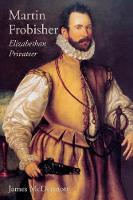
"Martin Frobisher" by James McDermottAdventurous and willful, the swashbuckling Martin Frobisher was both a brave sea-commander who served Elizabeth I with distinction and a privateer who single-mindedly pursued his own interests. This highly entertaining biography provides the first complete picture of the life and exploits of Frobisher—from his voyages in search of the fabled Northwest Passage to his courageous resistance to the Spanish Armada and his exploits as privateer and sometime pirate. The book explores Frobisher’s vigorous personality and its manifestation in the turbulence of his career and his impact on others. It also illuminates the robust world of maritime enterprise in England in the sixteenth century, when the shifting objectives of the Elizabethan age brought together felons, merchants, and great officers of state.

James McDermott, a leading authority on Martin Frobisher and the Northwest Passage, offers a riveting account of the explorer, based on all extant manuscript and documentary sources. McDermott sets aside the distortions of Frobisher’s popular reputation as a hero and offers instead a richly detailed portrait of a fascinating but flawed man whose ceaseless search for wealth and fame defined his extraordinary life.


Arthur Tudor, Prince of Wales: Life, Death and Commemoration edited by Steven Gunn & Linda Monckton
The Tudor king who never was: Arthur's life and death newly examined.Prince Arthur (1486-1502), son of Henry VII and Elizabeth of York, was the great hope of early Tudor England. Today he is largely forgotten, remembered only as Henry VIII's shadowy elder brother, the first husband of Katherine of Aragon. But in his lifetime Arthur counted for much more than that. Groomed for kingship, sent to govern Wales and the Marches, married to secure the Spanish alliance, celebrated in portraits, poems and pageants, Arthur stood at the centre of his father's plans. His death brought a grand funeral and a lasting monument, the chantry chapel covered in Tudor badges that still stands in Worcester Cathedral. 

These richly illustrated essays, by historians, art historians and archaeologists, investigate Arthur's life and posthumous commemoration from every angle. They set him in the context of the fledgling Tudor regime and of the religion, art and architecture of late medieval death and memory. They close with an exploration of the re-enactment of Arthur's funeral at Worcester in 2002, an event that sought to rescue the prince from the oblivion that has been his lot for five hundred years.


The History of William Marshal translated by Nigel Bryant
The History of William Marshal (0)The History of William Marshal is the earliest surviving biography of a medieval knight -- indeed it is the first biography of a layman in the vernacular in European history. Composed in verse in the 1220s just a few years after his death, it is a major primary source not simply for its subject's life but for the exceptionally stormy period he had had to navigate. It could hardly be other than major, given that its subject was regarded as the greatest knight who ever lived and that he rose in the course of his long life to be a central figure in the reigns of no fewer than four kings: Henry II, Richard Lionheart, John and Henry III. This remarkable biography was brought to light in the late nineteenth century thanks to a determined hunt for the manuscript by its first editor, the eminent French scholar Paul Meyer. It gives a vigorous account of events, full of vivid detail and passionate comment and frequent flashes of humour. And it gives revelatory insights into the attitudes and perceptions of the time, especially into the experience and nature of warfare in the late twelfth and early thirteenth centuries.

But while its quality and value have been long acknowledged, the poem has sometimes been deemed less than impartial and objective. Commissioned as it was by Marshal's own son, and intended not least for his family's fond enjoyment, it is little surprise that the poem's adulation of its subject is rarely qualified by regrets for failings or what are nowadays referred to as "errors of judgement". Marshal is presented as -- to all intents and purposes -- flawless: not simply a magnificent warrior, supreme in tournaments and battles alike, but a paragon of the key chivalric virtues of prowess, largesse and unfailing loyalty. But this is not surprising: the idea of the fallible hero is a modern invention, and the writer of this work - like Marshal himself -- was steeped in the old ideals of the chansons de geste as well as the more recent ideology of chivalry. In any case, there can be no denying that Marshal's achievements -- and sometimes his behaviour -- were by any standards extraordinary and seen as such by his contemporaries, and the poem corresponds with what we know of his life from other sources.


Hugh de Lacy, First Earl of Ulster: Rising and Falling in Angevin Ireland by Daniel Brown
This book charts the striking rise, fall and restoration of the first earl of Ulster, Hugh II de Lacy, described by one contemporary chronicler as 'the most powerful of the English in Ireland'. A younger son of the lord of Meath, de Lacy ascended from relatively humble beginnings to join the top stratum of Angevin society, being granted in 1205 the first earldom in Ireland by King John. Subsequently, in 1210, having been implicated in rebellion, Hugh was expelled from Ulster by a royal army and joined the Albigensian crusade against Cathar heretics in southern France. Unusually, after almost two decades in exile and a second revolt against the English crown, de Lacy was restored to the earldom of Ulster by King Henry III in 1227, retaining it to his death, c. 1242.

Situated in the north-east of Ireland, Ulster's remoteness from centres of colonial administration allowed Hugh de Lacy to operate beyond the normal mechanisms of royal control, forging his own connections with other powerful lords of the Irish Sea province. The fluidity of noble identity in frontier zones is also underlined by the career of someone who, according to his political needs, presented himself to different audiences as a courtly sophisticate, freebooting colonist, crusading warrior, or maurauding 'Irish' ruler.

The foundation for this study is provided by Hugh de Lacy's acta, provided as an appendix, and representing the first collection of comital charters in an Irish context. These cast fresh light on the wider themes of power and identity, the intersection of crown and nobility, and the risks and rewards for ambitious frontiersmen in the Angevin world.


John de Vere, Thirteenth Earl of Oxford (1442-1513): `The Foremost Man of the Kingdom' by James Ross
John de Vere, Thirteenth Earl of Oxford (1442-1513): `the Foremost Man of the Kingdom'First book to deal with de Vere's life and extraordinary career, during the Wars of the Roses and beyond.Earl of Oxford for fifty years, and subject of six kings of England during the political strife of the Wars of the Roses, John de Vere's career included more changes of fortune than almost any other. He recovered his earldom after the execution of his father and brother for treason, but his resistance to Edward IV led to a decade in prison. He escaped in time to lead Henry Tudor's vanguard at Bosworth in 1485 and subsequently enjoyed twenty-five years as perhaps "the foremost man of the kingdom", virtually ruling East Anglia for the king.
This is the first full-length study of de Vere's life and career. Through this lens it also tackles a number of broader themes. It reconsiders the role of the nobility under Henry VII, challenging the common perception of Henry as an anti-aristocratic king. It also explores East Anglian political society in the second half of the fifteenth century, how the earl came to dominate it, how successfully he exercised his power, and the personnel, including the Paston family, he used to run the region.


Humphrey Newton (1466-1536): an early Tudor Gentleman by Deborah Youngs
Humphrey Newton (1466-1536): An Early Tudor Gentleman
The public and political lives of the fifteenth- and early sixteenth-century gentry have been extensively studied, but comparatively little is known of their private lives and beliefs. Humphrey Newton of Pownall, Cheshire, offers a rare and fascinating opportunity to redress the balance, thanks to the fortunate survival of a commonplace book he compiled c.1498-1524. Drawing upon this unique manuscript, this interdisciplinary and multi-dimensional study of Newton explores his family life, landed estate, legal work, piety, and his literary skills [he composed nearly twenty courtly love lyrics]. It charts his social advancement and the self-fashioning of his gentle image, while placing him in the context of current discussions of gentry culture.

What makes Newton even more noteworthy is that he was among the unsung and little known stratum of English society historians have labelled the 'lesser' gentry. As such, this book provides the first comprehensive biography of an early Tudor gentleman.


Robert Grosseteste as Bishop of Lincoln: The Episcopal Rolls, 1235-1253 by Edited by Philippa M. Hoskin
Robert Grosseteste as Bishop of Lincoln: The Episcopal Rolls, 1235-1253Robert Grosseteste, teacher, scholar and pastor, remains one of the dominant figures of the medieval English church. A major influence on the early history of Oxford University, his writings on a wide range of theological and scientific subjects have been widely studied. His concern for pastoral care is also well attested; as bishop of Lincoln from 1235 until his death in 1253, he had the opportunity to exercise the pastoral office in the largest diocese in western Europe. But how did Grosseteste's theories of pastoral care work out in practice?

The study of Grosseteste's career as a diocesan bishop has been hampered by the relative inaccessibility of the records of his episcopate, published in an unsatisfactory edition in 1911 and long out of print. This completely new edition of Grosseteste's episcopal rolls makes it possible to take a fresh look at how he tackled the vexed issues of clerical ignorance, pluralism and non-residence in the aftermath of the reforms of the Lateran Council of 1215. They are presented here with an introductory study and elucidatory notes.


Roger of Lauria (c.1250-1305): "Admiral of Admirals" by Charles D. Stanton
Roger of Lauria (c.1250-1305): "Admiral of Admirals" (Warfare in History)Just before Vespers on 30 March 1282 at the Church of the Holy Spirit on the outskirts of Palermo, a drunken soldier of the occupying French forces of Charles of Anjou accosted a young Sicilian noblewoman. It sparked a bloody conflagration, the so-called War of the Sicilian Vespers, that would ultimately involve every part of the Mediterranean. The struggle for the coveted throne of Sicily eventually enmeshed all the great powers of medieval Europe - the pope, the Byzantine Emperor and the kings of France, England and Aragon.

Because the core of the Kingdom of Sicily was a wealthy, strategic island dominating the centre of the Mediterranean, the battles were fought mostly at sea. And in war at sea, a single figure proved pre-eminent: Roger of Lauria - Aragon's "Admiral of Admirals". In the course of some twenty years of naval combat, he orchestrated decisive victories in six pitched battles and numerous limited actions, never once suffering a defeat: a feat never equalled - not even by the legendary Lord Horatio Nelson.

Drawing from multiple Sicilian and Catalan sources as well as Angevin and Aragonese registers, this chronological narrative details the tactics and strategy Lauria employed to become the most successful galley fleet commander of the Middle Ages, while highlighting a crucial conflict at a pivotal point in European history, long overshadowed by the Hundred Years War.