I seem to have developed a macabre interest in anthropodermic bibliopegy – the practice of binding books in human skin. Rest assured that I am not a practitioner of this “art” but rather a curious onlooker.
 |
| Cudmore Book |
The practice of anthropodermic bibliopegy was first practiced and documented in the 17th century and continued into the 19th century. However, the use of the human skin as a medium dates back to antiquity and is usually associated with warfare and the treatment of prisoners.
Surviving historical examples of this technique include anatomy texts bound with the skin of dissected cadavers, volumes created as a bequest and bound with the skin of the testator, and copies of judicial proceedings bound in the skin of the murderer convicted in those proceedings. There are a number of texts today that are bound in the skin which have found a home in a number of well-known academic libraries worldwide.
Examples in Academia:
Harvard Law School: Practicarum quaestionum circa leges regias Hispaniae, a treatise on Spanish law. A faint inscription on the last page of the book states:
The bynding of this booke is all that remains of my deare friende Jonas Wright, who was flayed alive by the Wavuma (an African tribe reputed to inhabit Zimbabwe) on the Fourth Day of August, 1632. King Btesa did give me the book, it being one of poore Jonas chiefe possessions, together with ample of his skin to bynd it. Requiescat in pace.
Brown University, John hay’s Library: contains three human-skin books, including a rare copy of the 16th century anatomy text De Humani Corporis Fabrica by Andreas Vesalius (1514 – 1564), and two 19th-century editions of a medieval morality tale, The Dance of Death.
Bancroft Library at UC Berkeley : 1676 French prayer book bound in human skin.
Wellcome Library: three volumes were reputed to be bound in human skin. It is now thought that only one is bound that way, a 17th-century text on anatomy that was rebound in the 19th century.
College of Physicians of Philadelphia: contains books on the skin condition trichinosis bound by medic John Stockton Hough, who used a patient's skin to bind three volumes.
University of Southern Carolina: is home to an early copy of Dale Carnegie's Lincoln the Unknown which is covered with a jacket containing a patch of skin from an African American man, onto which the title had been embossed.
Dr John Hunter (1728-1793), the famous anatomist, father of British scientific surgery, and the person after whom the London Museum of the Royal College of Surgeons of England is named, reputedly commissioned a textbook on dermatology to be bound in human skin.
The classic medical text, Tables of the Skeleton and Muscles of the Human Body by Bernhard Albinus (translated from Latin into English in 1749), not only was bound in human skin, but the original white skin was dyed black. This was intended to reflect one of the subjects within: "On the location and cause of the colour of Ethiopians and of other peoples."
Dr Victor Cornil (1837-1908), the famous professor of pathological anatomy in the Faculty of Medicine at the University of Paris and author of Syphillis (1882) the definitive work on the subject at the time, possessed a piece of tattooed human skin from the time of Louis XIII. He had his copy of The Three Musketeers, set during the time of Louis XIII, bound in human skin.
Bailey Library at SRU: contains a book of erotic Spanish poetry, El Viaje Largo "The long journey " by Tere Medina (Medina-Navascues) from South America was said created in 1972.
“The cover of this book is made from the leather of the human skin," it reads. "The Aguadilla tribe of the Mayaguez Plateau region preserves the torso epidermal layer of deceased tribal members. While most of the leather is put to utilitarian use by the Aguadillas, some finds its way to commercial trade markets where there is a small but steady demand. This cover is representative of that demand."
The book "Aurora Alegre del dichoso dia de la Gracia Maria Santissima Digna Madre de Dios" written by Joseph Bernardo de Hogal (d.1741) was bound in human skin (1748).
And a human-skin bound ledger was found in downtown Leeds, England, in 2006 written in French handwriting in black ink, appears to date back to the 1700s.
A copy of The Rights of Man and several copies of the French Constitution of 1793 were also said to have been bound in human skin.
While their credibility is questionable, there are some historical reports of a 13th century bible and a text of the Decretals (Catholic canon law) written on human skin.
Criminal Examples:
James Johnson
The earliest known instance of a criminal whose body was ordered by the court to be dissected is found in the sentence of one James Johnson, condemned to the gallows on March 19, 1818, by Mr. Justice Dallas of the Norfolk Assizes, who also ordered that the culprit's body "be delivered to the surgeons to be anatomized."
Following the execution, which took place on the Castle Hill, Norwich, in the presence of 5,000 spectators, the dissection was performed by Mr. Wilson, "a gentleman from London," and Mr. Austen, "a pupil of Mr. Dalrymple's," who prepared the body for a series of daily lectures delivered by a Mr. Crosse. " (Source: Norfolk Annals)
A copy of Samuel Johnson’s dictionary was bound in his skin.
John Horwood
John Horwood was an 18 year old miner from Hanham. John was 17yo when his relationship with Eliza Balsom ended (1820). The following year, Eliza was out walking with her new boyfriend, one William Waddy, when John saw them and in a fit of pique, threw a pebble at her. The pebble hit her on the head, making only a small wound.
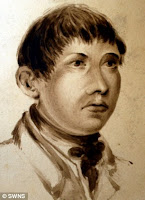 |
| John Horwood |
Eliza was initially treated at home but when she went to Bristol Royal Infirmary to get the wound dressed properly, chief surgeon Richard Smith decreed that it had become infected and decided to operate. In those day, operating meant trephining – drilling a hole in the unfortunate girl’s head – to relieve pressure. This caused a fatal abscess and between some four to seven days later Eliza died (17/2/1821).
Despite the fact that Eliza did not die as a result of John’s impetuosity but rather through Dr Smith’s medical treatment, Smith gave John’s name to the police, and Horwood arrested.
Horwood’s trial took place at the Star Inn in Bedminster (11/4/1821), and Smith, who would hold the position as chief surgeon for 50 years, testified against him as chief witness for the prosecution. Horwood was condemned to death.
In the condemned cell, Horwood did admit to having violent intentions towards his former sweetheart, and on the day of his execution, he left behind a poignant verse which read:
‘John Horwood is my wretched name and Hanham gave me birth. My previous time has been employed in rioting and mirth. ‘Eliza, oh Eliza dear! Thy spirit, oh, is fled! And thy poor mangled body lies now numbered with the dead. ‘Curs’d is the hand that gave the blow. And curs’d the fatal stone, which made thy precious life blood flow. For it has me undone.’
He was hanged at New Bristol Gaol (13/4/1821), three days after his 18th birthday, and his body was requisitioned by Dr Smith for medical research. Horwood’s family pleaded that his body be released to them for burial, but Dr Smith refused. A group of friends and relatives even tried unsuccessfully to hijack the cart taking the body from the prison to the hospital.
Dr Smith dissected the corpse in front of 80 people at one of his medical classes. The findings were then bound with a transcript of the trial in a book. Smith’s final, macabre flourish was to send Horwood’s flayed skin to a tanner, where it was turned into leather and used to cover the book.
Its front was embossed with a skull and crossbones at each corner and the words Cutis Vera Johannis Horwood (‘The Skin of John Horwood’) were added in gilt letters.
Dr Smith kept the skeleton, complete with a noose round the neck, in a cabinet at his Bristol home, showing it off to guests, until it was moved to Bristol University. Horwood’s remains have now been buried by his family.
William Corder – the Red Barn Murderer
“The indictment charged William Corder with having on the 18th of May 1827 murdered Maria Marten by feloniously and wilfully shooting her with a pistol through the body and likewise stabbing her with a dagger The indictment consisted of ten counts.” (Source: Celebrated trials of all countries and remarkable cases of jurisprudence). The museum of Bury St Edmunds, in Suffolk, England contains an account of the trial proceedings against William Corder, bound in the executed murderer's skin.
The Red Barn Murder was a notorious murder committed in Polstead, Suffolk, England, in 1827. A young woman, Maria Marten, was shot dead by her lover, William Corder. The two had arranged to meet at the Red Barn, a local landmark, before eloping to Ipswich. Maria was never heard from again. Corder fled the scene and although he sent Marten's family letters claiming she was in good health, her body was later discovered buried in the barn after her stepmother spoke of having dreamt about the murder.
Corder was tracked down in London, where he had married and started a new life. He was brought back to Suffolk, and after a well-publicised trial, found guilty of murder. He was hanged in Bury St. Edmunds in 1828; a huge crowd witnessed Corder's execution.
See also:
http://en.wikipedia.org/wiki/Red_Barn_Murder
George Cudmore
George Cudmore, a ratcatcher from Roborough, was convicted of killing his wife Grace by poisoning her with a potion of roasted apple and milk, laced with arsenic (1830). This act was said by George to have been instigated by his lover Sarah Dunn. Dunn readily confessed to being aware of Cudmore’s intentions to do away with his wife and that she made no attempt to prevent the deed. Dunn was acquitted and Cudmore was convicted.
Cudmore was hanged at the Devon County Gaol - on the site of the current Exeter Prison - (25/3/1830) at the Lent Assizes in front of a large crowd of onlookers. Cudmore’s last request was that Dunn be kept in Devon County Gaol and made to witness his execution. For some reason that is unclear, his request was granted even though Dunn had been judged not guilty. She reportedly fell into hysterics and fainted when he dropped. As part of his sentence, his dead body would be taken to an Exeter hospital to be dissected.
From the hospital, a piece of his skin which found its way into the hands of Mr W Clifford, an Exeter bookseller, would eventually be flayed, tanned and used to cover an 1852 copy of The Poetical Works of John Milton. An inscription in the front of the book states whose skin it is and his crime. The book is now housed at the Westcountry Studies Library in Exeter.
Henry Garnet
"A True and Perfect Relation of the Whole Proceedings Against the Late Most Barbarous Traitors, Garnet A Jesuit and His Confederates," tells of the grisly end met by the Gunpowder Plotters. It is thought the skin was cut from the corpse of one of Guy Fawkes' fellow conspirators, the Jesuit Priest, Henry Garnet. And, it is said, that if you hold the novel in the right light, you might even see a ghostly face on the cover.
Many believe that marks on the leather are evidence of torture, and says a Latin inscription on the cover which reads "severe penitence punished the flesh" was written to make sure people knew what had happened to the victim. The book, which was made in London in 1606 by Robert Barker, the king's printer.
The Gunpowder Plot of 1605 was an attempt by Catholic rebels to kill Protestant King James I of England, his eldest son and much of the English court and government by exploding gunpowder beneath a session of the Houses of Parliament. The plotters would then have seized the king’s younger children and formed a new, Catholic, government around which they hoped England’s Catholic minority would rise and rally. The plot failed and the plotters were discovered, tracked, arrested and executed.
Henry Garnet (c.1553-4 – 1606) was the son of a Nottingham School Master who, aged 20yo, went to Rome and became a Jesuit (11/9/1575). He left Rome (8/5/1586) when he was summoned to return to England by Father Weston. Following Weston’s arrest, Garnet took over the office of superior, which he held till his death.
Garnet's involvement in the plot to blow up the Houses of Parliament was controversial. He claimed he knew about the conspiracy but was not involved. Some scholars now believe that he was most likely trying to prevent the action against James I rather than conspiring against him.
Garnet is thus described in the proclamation issued for his arrest —
Henry Garnet, alias Walley, alias Darcy, alias Farmer, of a middling stature, full faced, fat of body, of complexion fair, his forehead high on each side, with a little thin hair coming down upon the middest of the fore part of this head; his hair and beard griseled. Of age between fifty and three score. His beard on his cheeks close cut, and his chin very thin and somewhat short. His gait upright, and comely for a feeble man.
 |
| Garnet Book |
But Garnet was captured, confessed he knew of the affair, was found guilty of treason and executed (3/8/1606) at old St Pauls. The king ordered his hanging but he was spared the cruelty of being drawn and quartered. The execution was closely guarded to prevent Catholics from gathering the relics of his martyrdom.
According to legend, a piece of bloodstained straw found at the scene of his execution started to develop an exact image of the priest's face, which is what is said to have happened to the centuries-old book.
See also:
http://en.wikipedia.org/wiki/Henry_Garnet
http://www.gunpowder-plot.org/people/h_garnet.htm


