Showing posts with label stuart england. Show all posts

Monday, January 27, 2025

Review: Stuart Spouses by Heather R Darsie

Synopsis: Stuart Spouses looks at the oft-overshadowed consorts of the Stuart monarchs, from 1406 to 1714. By focusing on these people and detailing their rises to matrimony, the trials and tribulations of their courtships, and the impact their unions and dissolutions had on the kingdoms of Scotland, England, Ireland, and Wales, one learns not only the history of these kingdoms but the true, sometimes soft, power behind the throne.


~ ~ ~

Personally, much of what is contained in this tome is not new to me. I would consider this to be more of an introductory tome for those new to Stuart history and its personalities. It also includes the interregnum period in which Cromwell and his son ruled - I am presuming for chronological purposes, and finishes with the installation of the House of Hanover. Finally, there is the inclusion of poems, written wither by or for the spouses. Though must say, glad to see the inclusion of the male consorts!

Recommended purely as an introductory tome for this period in both English and Scottish history.

Sunday, October 3, 2021

Review: The Dangerous Kingdom of Love by Neil Blackmore

Synopsis: The kingdom of love is a frightening place. A dangerous place. What kind of fool wants to live there? How have I, Francis Bacon, well-known as the cleverest man in England, been caught in this trap? For years I survived the brutal games of the English court, driven by the whims of the idiot King James I - and finally, I was winning. Forget what my friends Ben Jonson and William Shakespeare say about love. I had that which men truly crave above all else: power.

But now, at the moment of my greatest success, a deadly alliance of my enemies has begun closing in on me. Led by the King's beautiful and poisonous lover Carr, this new alliance threatens to turn our foolish King against me, so that I may rot in the Tower.

I refuse to go down without a fight. I have concocted a brilliant new plan: I will find my own beguiling young man and supplant Carr in the King's bed, and take power for myself. All I need to do is find him, my beautiful and mysterious creature, my perfect chess move.

In the dangerous kingdom of love, those who understand desire win. And I intend to win, at all costs.


"I am the cleverest man in England, and its biggest moron"

Sir Francis Bacon - philosopher and statesman, attorney general, lawyer, lord chancellor, literary patron and humanist. A man who has been celebrated as the father of empiricism and the father of the scientific method; and one who was known - in his own time - as a "pederast" and "ganimed" .  

Our novel opens at the court King James VI & I - the year 1613.  Bacon is our narrator. He is at times, crude, rude, self centered, avaricious, always focusing on how he can further advance himself in the eyes of the king and attain wealth and position. He constantly muses that he is surrounding by enemies, and should they (not him) attain the upper hand, then he would be "... the midwife at the birth of my own execution .."

And Bacon's enemies themselves have the potential power over his advancement - there is Edward Coke - barrister, judge & politician - his long-time nemesis; Robert Carr - the King's current favourite; and the Howard family, headed by Thomas, 1st Earl of Suffolk, a rather well connected peer whose family were not averse to a bit of scheming and plotting and self-aggrandisement.

In order for Bacon to succeed, he must remove the obstacles in his path - first and foremost is the favourite Robert Carr. However, it is not that simple - more of a case of one step forward, two steps back, as Bacon's enemies seem to be just that little bit ahead of him.

Then the grand plan - replace the current favourite with a creature of his own making and whose loyalty will be to Bacon. Again - nothing is as straight forward - the search finally turns up one George Villiers, whereupon Bacon enters that "dangerous kingdom of love". Finally installing his favourite, Bacon finds that his triumph is shortlived. However, "Bacon lives to plot another day".

As our narrator, Bacon speaks directly to the the reader in language that is far from courtly; it is full of wit and satire, self-deprecating humor, crude observations and commentary, gossip and inuendo. It is a bawdy, sexually explicit tale that some will find refreshingly comical with a dash of Pythonesque tongue-in-cheek whilst others may find themselves tut-tutting and being personally offended whilst yet reading ever onward.

The author has taken some liberties with history when crafting this tale - Bacon's wife is conveniently forgotten whilethe court resembles something more akin to the set of a Carry On film (and strangely, I kept picturing King James as "Fat Bastard" from Austin Powers franchise).  Finally, like many other readers, I felt that the ending was a little rushed - but then again, the aim of the tale was documenting Bacon's role as royal pimp not documenting Bacon's life as a whole.


This is a fascinating period in history, full of salacious scandal, and inhouse politicking, so well worth a little side trip of exploration.


Further reading:


Tuesday, October 20, 2020

Review: Charles I's Executioners by James Hobson

Charles I's Executioners: Civil War, Regicide and the Republic
Synopsis: On an icy winter's day in January 1649, a unique event in English history took place on a scaffold outside of Whitehall: Charles I, King of England, was executed. The king had been held to account and the Divine Right of Kings disregarded. Regicide, a once-unfathomable act, formed the basis of the Commonwealth's new dawn.

The killers of the king were soldiers, lawyers, Puritans, Republicans and some simply opportunists, all brought together under one infamous banner. While the events surrounding Charles I and Cromwell are well-trodden, the lives of the other fifty-eight men - their backgrounds, ideals and motives - has been sorely neglected.

Their stories are a powerful tale of revenge and a clash of beliefs; their fates determined by that one decision. When Charles II was restored he enacted a deadly wave of retribution against the men who had secured his father's fate. Some of the regicides pleaded for mercy, many went into hiding or fled abroad; others stoically awaited their sentence. This is their shocking story: the ideals that united them, and the decision that unmade them.


The Stuart period of history hasn't really been within my history purview - I know enough about it but have not really researched further indepth, preferring to focus instead on the traditional medieval period. Having said that, I love historical fiction, and with no real time boundaries, I have found myself wandering into the realm of the Stuarts over the past year or so. 

The regicides of Charles I featured in a number of historical fiction accounts of the period, and I became familiar with a few of the names - but not all, and certainly not their fates. So, after picking up a copy of Charles Spenser's "Killers of the King" I took the plunge, and was so pleased to be then able to read Hobson's account.


This is a more simplified version - it is not strictly a biography of the nearly 135 participants in the trial and execution of King Charles I of England, nor does it go into any great detail about the English Civil War (it is assumed that the reader has some fore-knowledge). What Hobson has done instead is present a series of themed vignettes of the 59 who actually signed the warrant of execution for King Charles I of England.

What I discovered was incredibly interesting. The men came mostly from the gentry class; their motivations varied from personal, political, economic, and religious; not all were active to the same capacity; not all were guilty to the same degrees; not all did it for "honourable" reasons. I also learnt that where their signatures were placed on the document was in no way indicative of their importance. The vignettes are not overly detailed - they cover off each individual's family background, motivation, career (pre and post execution) and their fate after the restoration of the English monarchy under Charles II.

Unless you are a keen student of the period, many of names will be very unfamiliar - and even Hobson questions why some were included on the list of those to be executed for treason when some who were more active participants got off scott free. What cannot be taken away from these men - of whom only nine suffered to be hanged, drawn and quartered - was that they all died well, believing in and in some cases, becoming martyrs, for their cause.

If you are looking to add to your knowledge for the English Civil War and the Restoration, you could do no better than to add this book to your recommended reading list. There are many small snippets that have intrigued me and now require further investigation.


further reading:
Killers of the King by Charles Spencer
The King's Revenge by Don Jordan
The Lives of the English Regicides by Mark Noble
The Regicides & the Execution of Charles I by Jason Peacey
A Coffin for King Charles by CV Wedgwood

Sunday, June 21, 2020

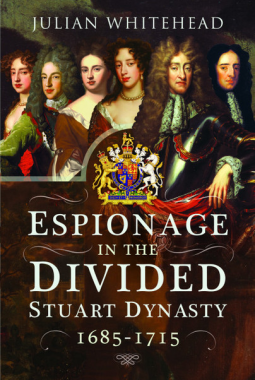
Review: Espionage in the Divided Stuart Dynasty 1685 - 1715 by Julian Whitehead

Synopsis: King James II was the Catholic king of a Protestant nation, but he had inherited a secure crown and was able to put down the rebellion by his nephew the Duke of Monmouth. In just over three years James had been deserted by those he loved and trusted and had to flee to France in exile. His throne was seized by his son-in-law and daughter, and when they died, his younger daughter succeeded. For James it was a personal tragedy of King Lear proportions; for most of his subjects it was a ‘Glorious Revolution’ that saved his kingdoms from Popery.

Over the next hundred years James or his descendants would attempt to win back the crown with French support and conspiring with British Jacobites and Tories. In Espionage in the Divided Stuart Dynasty Julian Whitehead charts the inner workings of government intelligence during this unstable period, where it was by no means a forgone conclusion that James or his heirs would never regain the throne. It throws light on the murky world of spies and double agents at a time of intensive intrigue and betrayal, with many politicians and peers trying to keep a foot in both camps. It was especially important in such circumstances for a monarch to receive good intelligence about the many intrigues, but could those providing the intelligence be trusted?


This is another one of those books which has me conflicted. On the one hand, it is an engrossing tale of the reign of James II of England and the subsequent quest for the throne after he fled in the face of growing religious opposition and the invasion by invitation of William of Orange - "... the overriding issue that was to fracture both family and nation was religion ..". And for someone dipping their toes into this period, it is a highly useful and informative resource.

On the other it purports to be a look at the role of espionage during this particular period in English history - which leads to more conflict as I find this component to be - at times - somewhat overshadowed by the first (ie: the history).

As my reading "career" has progressed, I have surpassed the general histories and am looking for more niche subjects. I guess what I was hoping for was more on the espionage side of things rather than a history of the Jacobites for I think to pick up this tome based on title alone one already assumes some understanding of events. I wanted to know more about the methods - the modus operandi, the people involved, the problems they faced - a bit more along the lines of Michael Smith's "Anatomy of a Spy" wherein each chapter highlights a particular theme with examples given to illustrate.


James II of England
England in the 17th and 18th centuries faced a very fluid, very dangerous and incredibly complex situation of threats from France, Scotland, the Netherlands, the Papacy, and Spain. Here was a country that was outnumbered and surrounded by its much more powerful continental European rivals. Into this mix was added the overt religious and domestic political factions, and finally the Jacobites

As Paul Fritz notes in The Anti-Jacobite Intelligence System of the English Ministers, 1715–1715 - "Their earlier experiences of attempted plots, near assassinations, foreign aid, open rebellion, and the inability to gauge the movement's strength, created in the ministers between 1715 and 1745 an almost pathological fear of a Stuart restoration - Jacobites must be hunted out, their secrets penetrated, their plans squashed. The best evidence of this pre-occupation of the government with fear of a Stuart restoration lies in an examination of its methods of securing intelligence through the post office, the employment of spies, and personal interviews [interrogations] with the Jacobites themselves."

So, to deal with this myriad of problems, England like its European counterparts, set up elaborate intelligence gathering systems. It relied heavily on intercepted mail and dispatches. A few agents in the postal system could intercept likely correspondence and have it deciphered, copied and forwarded to the intended receiver. And here a real gem of information stands out - Cromwell's "machines of intelligence".  What were these machines that could "open, copy and seal letters" that were rebuilt by John Wildman when he was in charge of the Post Office but later destroyed when he was suspected of disloyalty. I wanted to know more but alack and alas nothing more was forthcoming. Moving on, once the information was in hand, analysts (set up in the cabinet noir or black chamber) tried to interpret diplomatic policies and intentions of states. 

Information dispersal via propaganda and disinformation was another favoured tool - "... because just as governments developed their arcana imperii, or secrets of state, outside in the world a new landscape of media thronged with reams of printed newspapers, pamphlets and books, while in coffee houses political gossip and whispered knowledge flourished – of politicians, but also of the state’s secret affairs ...". In addition, the threat of Jacobitism triggered a new period of military map making with the state urgently requiring details on fortifications, landscapes, roads and rebels - a theme that was not touched upon.
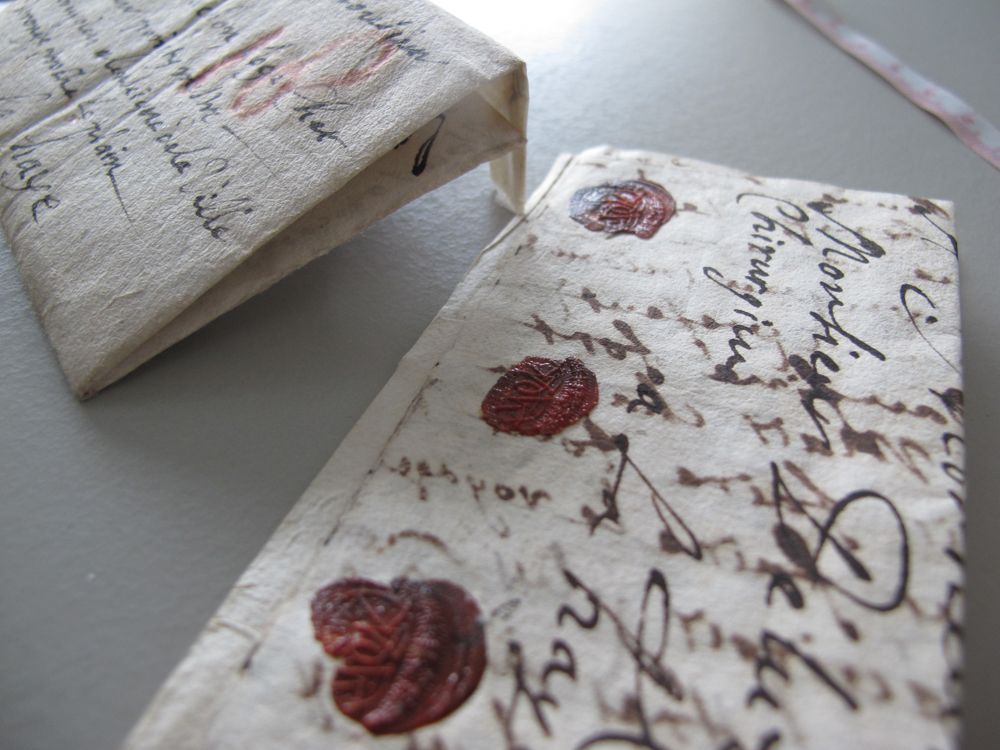
Photos: Treasure Trove of Unopened 17th-Century Letters | Live Science
Sealed Letters
Active agents or spies were also used, especially to estimate military and naval strength and associated activities. These agents, spies and informers were recruited from all aspects of society - diplomats, military, religious, refugees, defectors, fellow exiles, prisoners and captives, local government officials, professional agents provocateur. What I personally gained from this was that espionage was personal - adherence was to religion, nation, monarch but aboveall, to self preservation. Informants transferred their allegiance to whomever paid the most - "... there was money to be had for information ..." - or could offer them the best deal, usually reward or preferment, life and liberty. Lack of opportunity or advancement led some informants to play both sides of the fence. Towards the end of the period under discussion, it is noted that intelligence was "... dominated by adventurers motivated by self-interest and money and thus untrustworthy and often double agents ...". 

Jacobite Rebellion. Several Jacobite uprisings took place in the period 1688-1745
Jacobites
The methods used by the Jacobites, French, Dutch and English were not dissimilar - some were more effective in the collection, collation and usage of intel gathered than others. For as Hugh Douglas, author of Jacobite Spy Wars: Moles, Rogues and Treachery, notes, "... the final betrayal of the Stuart cause had not come about through a mistress's pillow talk: they had finally been shafted by one of their own needy Highland chiefs.."


Further reading:
A history of espionage in early-modern Britain, 1598-1715 by Alan Marshall (publication pending)

The Secret Service under Charles II and James II by James Walker

The Stuart Court in Exile and the Jacobites edited by Eveline Cruickshanks and Edward Corp

The Stuart Secret Army: The Hidden History of the English Jacobites by Evelyn Lord


Friday, September 27, 2019

Love, Madness, and Scandal by Johanna Luthman

Cover for 

Love, Madness, and Scandal


The high society of Stuart England found Frances Coke Villiers, Viscountess Purbeck (1602-1645) an exasperating woman. She lived at a time when women were expected to be obedient, silent, and chaste, but Frances displayed none of these qualities. Her determination to ignore convention contributed in no small measure to a life of high drama, one which encompassed kidnappings, secret rendezvous, an illegitimate child, accusations of black magic, imprisonments, disappearances, and exile, not to mention court appearances, high-speed chases, a jail-break, deadly disease, royal fury, and - by turns - religious condemnation and conversion.


As a child, Frances became a political pawn at the court of King James I. Her wealthy parents, themselves trapped in a disastrous marriage, fought tooth and nail over whom Frances should marry, pulling both king and court into their extended battles. When Frances was fifteen, her father forced her to marry John Villiers, the elder brother of the royal favourite, the Duke of Buckingham. But as her husband succumbed to mental illness, Frances fell for another man, and soon found herself pregnant with her lover's child.

The Viscountess paid a heavy price for her illicit love. Her outraged in-laws used their influence to bring her down. But bravely defying both social and religious convention, Frances refused to bow to the combined authority of her family, her church, or her king, and fought stubbornly to defend her honour, as well as the position of her illegitimate son.

On one level a thrilling tale of love and sex, kidnapping and elopement, the life of Frances Coke Villiers is also the story of an exceptional woman, whose personal experiences intertwined with the court politics and religious disputes of a tumultuous and crucially formative period in English history.


Wednesday, August 14, 2019

Love, Madness, and Scandal by Johanna Luthman

Cover for 

Love, Madness, and Scandal


The high society of Stuart England found Frances Coke Villiers, Viscountess Purbeck (1602-1645) an exasperating woman. She lived at a time when women were expected to be obedient, silent, and chaste, but Frances displayed none of these qualities. Her determination to ignore convention contributed in no small measure to a life of high drama, one which encompassed kidnappings, secret rendezvous, an illegitimate child, accusations of black magic, imprisonments, disappearances, and exile, not to mention court appearances, high-speed chases, a jail-break, deadly disease, royal fury, and - by turns - religious condemnation and conversion.


As a child, Frances became a political pawn at the court of King James I. Her wealthy parents, themselves trapped in a disastrous marriage, fought tooth and nail over whom Frances should marry, pulling both king and court into their extended battles. When Frances was fifteen, her father forced her to marry John Villiers, the elder brother of the royal favourite, the Duke of Buckingham. But as her husband succumbed to mental illness, Frances fell for another man, and soon found herself pregnant with her lover's child. 

The Viscountess paid a heavy price for her illicit love. Her outraged in-laws used their influence to bring her down. But bravely defying both social and religious convention, Frances refused to bow to the combined authority of her family, her church, or her king, and fought stubbornly to defend her honour, as well as the position of her illegitimate son. 

On one level a thrilling tale of love and sex, kidnapping and elopement, the life of Frances Coke Villiers is also the story of an exceptional woman, whose personal experiences intertwined with the court politics and religious disputes of a tumultuous and crucially formative period in English history.

read more here @ OUP Blog - Punishing Peccadilloes


Rebellion by Tim Harris

Cover for 

Rebellion


A gripping new account of one of the most important and exciting periods of British and Irish history: the reign of the first two Stuart kings, from 1567 to the outbreak of civil war in 1642 - and why ultimately all three of their kingdoms were to rise in rebellion against Stuart rule.

Both James VI and I and his son Charles I were reforming monarchs, who endeavoured to bolster the authority of the crown and bring the churches in their separate kingdoms into closer harmony with one another. Many of James's initiatives proved controversial - his promotion of the plantation of Ulster, his reintroduction of bishops and ceremonies into the Scottish kirk, and his stormy relationship with his English parliaments over religion and finance - but he just about got by. Charles, despite continuing many of his father's policies in church and state, soon ran into difficulties and provoked all three of his kingdoms to rise in rebellion: first Scotland in 1638, then Ireland in 1641, and finally England in 1642. 

Was Charles's failure, then, a personal one; was he simply not up to the job? Or was the multiple-kingdom inheritance fundamentally unmanageable, so that it was only a matter of time before things fell apart? Did perhaps the way that James sought to address his problems have the effect of making things more difficult for his son? Tim Harris addresses all these questions and more in this wide-ranging and deeply researched new account, dealing with high politics and low, constitutional and religious conflict, propaganda and public opinion across the three kingdoms - while also paying due attention to the broader European and Atlantic contexts.

Monday, July 22, 2019

Review: Blood on the Stone by Jack Lynch

Blood On The Stone

" .. politics is a world in which nothing is quite as it seems .."

In England, in 1681, the shine is beginning to wear off the reign of Charles II. There are plots against the king; treasonable rumblings; kidnappings; religious dissent; spies and secret clubs; and finally murder. And it is against the backdrop of Parliament's sitting in Oxford that this story is set.

To give perspective: at the time this story is set, Charles II had no legitimate offspring to follow him - his heir as his brother James, who was a Catholic. In 1673, Parliament passed a Test Act to prevent Catholics from holding office, by which the successor to the throne, James, Duke of York, had to resign; and five years later, another Test Act was introduced debarring Catholics from sitting in Parliament. The following year (1679), the first Exclusion Parliament met: the Commons drafted a Bill to exclude the Duke of York from the succession (and threatened to block supply to achieve their ends); this was defeated in the House of Lords the following year. 

Thus we come to the time of our story - 1681 and the third Exclusion Parliament which met at Oxford for barely a week; it would be the last time Parliament met outside Westminster. For Charles, summoning Parliament to meet in Oxford, a Royalist stronghold which had been Charles I's capital during the Civil War, was designed to deprive the Whig opposition of the grassroots support from the London masses. The Whigs - not yet a political party - opposed "popery" and absolute monarchism and supported a constitutional monarchy. In the end, Parliament was dismissed when Charles II determined to rule without Parliament and obtained his much needed funds from the French.

Our story also introduces us to the secretive "Green Ribbons", a political group that was hostile to the court. They usually met in taverns and coffee-houses, and wore a strip of green ribbon as a means of identification and recognition, especially amid the many street brawls and riots. This group was particularly active in London.

Blood on the Stone is told over the course of a week; it rumbles on slowly before the pace quickens towards the end. For me, it was an easy read - I enjoyed the characters and their alternating narratives; the gradual unraveling of events kept me interested to the point that I read on; and the historical note at the end (always a favourite part for me - especially when dealing with events a little left of centre) was much appreciated. This put both the events and characters into real historical perspective.

All in all - a fairly decent start to a possible series .....


further reading:

Culture and Politics at the Court of Charles II, 1660-1685 by Matthew Jenkinson
Radical Whigs and Conspiratorial Politics in Late Stuart England by Melinda S. Zook


Sunday, June 2, 2019

Review: The Judge Hunter by Christopher Buckley

In this latest comic novel from Christopher Buckley, a hapless Englishman embarks on a dangerous mission to the New World in pursuit of two judges who helped murder a king.

Image result for balthasar st michel
London, 1664. Twenty years after the fateful events that saw an English monarch dethroned and executed, the monarchy has been restored as the "merry monarch"  Charles II now sits on the throne. The men who conspired to kill his father, Charles I, are either dead or have fled England. In fact, Ezra Stiles in his "A History of Three of the Judges of King Charles I" notes that of the fifty-nine judges who signed the warrant, twenty-four were dead by 1660; twenty-seven were tried and condemned, of which nine were executed; whilst fifteen fled, their whereabouts largely unknown. Except for three - Whalley, Goff, Dixwell - who all fled to the New World and "found friendly asylum and concealment in Massachusetts and Connecticut." Revenge, however, is never far from the new King's mind.

Baltasar “Balty” St. Michel is the son of a french aristocrat, Alexandre le Marchant de St Michel, who had at one time served briefly as a gentleman carver in the household of Henrietta Maria, Charles I’s queen, and one, Dorothea, daughter of a Hampshire country gentleman. The family fell on hard times and Pepys, who by contrast was on his way up in the world, would find himself with an alarming number of poor relations on his wife Elizabeth’s side, particularly her favourite brother Balty! 

At the time of our story, Balty is twenty-four; has no skills and no employment, and is receiving handouts from his brother-in-law Samuel Pepys, an officer in the king’s navy. Fed up with his sponging in-law, Pepys offers Balty a job "... the one I have in mind has a genuine talent for annoyance ..." Balty is commissioned to go to the New World to track down two of the missing missing judges (Edward Whalley and William Goff) who were responsible for the execution of the last king, Charles I.


When Balty arrives in the New World, he discovers that Boston is governed by emigrant Puritans from England, in conflict with both emerging dissident factions (the Quakers) and the displaced tribes. As the fledgling colony began to thrive, it was harder to maintain the purity imposed at the outset, and all manner of rogue and fortune hunter made his appearance.

Balty traverses colonial America in search of the missing judges, all the while assisted by a Daniel Boone type agent for the English, one Colonel Hiram Huncks, a man with not only a past but with his own secret second commission.  Meanwhile, Samuel Pepys, in his role as Surveyor-General of the Victualling Office, is preparing for a war with the Dutch, which he fears England has no chance of winning - before finding himself not only in hot water but in the Tower!

Related image
17thC Gentleman
The real life Balty is a fitting subject for a spy - elusive, casual, Marlowesque even. Pepys seems to have done well for his brother-in-law in later life, although, from the entries in the Diary, he does not appear to have had a high opinion of him. St. Michel was Muster Master at Deal in 1674, Storekeeper at Tangier in 1681, and Naval Commissioner at Deptford in 1685 (where Marlowe met his end nearly 90 years before).

This reads at a cracking pace - the action never slackens, the humour is witty and at times slightly comediac, whilst the whole tale is interspersed with extracts from Pepys' diary to add to the authenticity of the historical backdrop. 


I loved the historical notes at the end which shows this this was brilliantly researched for a fictional account of adventure and political intrigue in 17th Century England, and of the story of the Dutch and English in the New Colonies. It is about time that some of these "lesser" historical characters take centre stage.

Further Reading:
Traitor's Arms by James Long
More Reviews here:  

Saturday, May 25, 2019

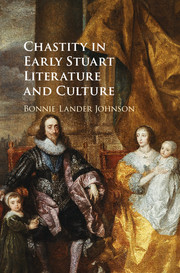
The Language and Literature of Chastity


Chastity in Early Stuart Literature and CultureIn her book Chastity in Early Stuart Literature and Culture, Dr Bonnie Lander Johnson (Faculty of English) describes how chastity became a cult that was as much embodied by the ceremonies and performances of the court as it was espoused by the anti-court Puritan writers working in the new world of popular print. Lander Johnson writes that chastity, as an important Christian virtue, was “one of the key conceptual frameworks through which individual men and women understood their relationship to their own bodies, to their community, to the wider Christian world and to God”. But “the same virtue that could protect the body from infection and a marriage from dissolution could eventually help to topple a government and undo a King”.

Lander Johnson has written her first book in order to look in depth at chastity as a theme running through the life of the royal court, and the circles of power around it, in the first half of the 17th century – as seen through the literature of William Shakespeare, John Milton and a number of lesser known poets and playwrights, including John Ford. It is a scholarly book, aimed at an academic readership, but it touches on universal human preoccupations – how we see ourselves, how we want to be seen, how we curate our own image through private and public performance. 

read more here @ University of Cambridge


Sunday, May 5, 2019

Thief Taker Series by CS Quinn

Synopsis: Charlie Tuesday makes his living tracking villains and cut-purses. But in these dangerous times of Charles II’s debauched court, all is not what it seems. The thief taker was orphaned with a key to a chest of secrets; mysteries even his brilliant detecting has so far failed to uncover.

But something has awoken in England. Ancient blood-spells will rise again. And as plague and fire ravage London, what was locked must be freed.

This is a brilliant series set in Restoration London - King Charles II has returned to England (1660), many years after the execution of his father Charles I and the reign of the Protectorate under Cromwell.  After a decade under Puritan rule, Charles' court is a mix of frivolity and hedonsim, and also of political (and religious) intrigue as he made no secret of the fact he intended to hunt down and punish those responsible for the death of his father.  His reign was dominated by his mistresses and his numerous progeny, the Anglo-Dutch wars, the Plague and the Great Fire.  The perfect setting for a series such as this ... and what we are left with as always is ... what next?

21888226 The Thief Taker:
London 1665: the black death ravages London, a serial killer stalks the streets, and Charlie Tuesday is in pursuit. Framed for murder, Charlie must prove his innocence by catching the killer. Ghosts of the (English) civil war emerge as the plot unravels.  The story held me spellbound - I couldn't see how after 200 pages, Quinn could maintain the momentum, but she does so, and successfully.  I literally could not wait to start on the second in the series.

Fire Catcher:
London 1666: it is the year of the Great Fire.  An old foe is still alive.  Charlie teams up with another who wants revenge whilst the King's mistresses play at politics with both King and Court.  Family secrets intertwine as Charlie is in possession of a key to a mysterious box. Can he find it before it all goes up in flames.

Dark Stars:
London 1666: one month after the great fire. resurgence of a series of gruesome murders and a prophecy about an all-seeing eye send Charlie Tuesday and gypsy girl Lily Boswell on a hunt. The past is resurrected by a new cast of characters. Will Charlie solve the mystery surrounding his family as old foes emerge as old enemies.  As Charlie's family secrets are slowly being teased out, Quinn reveals just enough to tantalise us with the prospect of further adventures.  Nailbiting to the end!

The Changeling Murders:
36604967London 1667: Plots against the crown, while Amesbury (court politician and military man) plays a dangerous double game. Lady Castlemaine, the King's mistress, is not simply out for whatever she can get for her children by the king but also playing a solo hand. In the midst of all this drama, Charlie must find out what has happened to former love, Maria.  As always, the action / drama is non-stop; intrigue and guile rule; revenge and long dead secrets rear their heads when they should have been lying low.  Another well-crafted tale in the series.

Another tome in the series is "Death Magic" a short story set in 1663 with Charlie investigating the death of a maid-servant.  I've not read this one, but do look forward to.


I would also recommend 
Andrew Taylor's Marwood & Lovett series set in the same period
SG MacLean's The Seeker series set in the Cromwellian period
Andrew Swanston's Thomas Hill series set in the reign of Charles I


Sunday, February 3, 2019

Review: The Tragic Daughters of Charles I by Sarah-Beth Watkins

The period of the English Civil War has not historically been an area of reading interest to me; however, a number of fiction and non-fiction books have crossed my path over the last couple of years and my interest has been piqued. I will preface that statement by saying I was not at all unfamiliar with the historical aspects and the main players.


40828182
In short, for those who are unfamiliar with this period, the English Civil War, fought between 1642-1651, saw King Charles I battle Parliament for control of the English government. The war began as a result of a conflict over the power of the monarchy and the rights of Parliament. During the early phases of the war, the Parliamentarians expected to retain Charles as king, but with expanded powers for Parliament. Though the Royalists won early victories, the Parliamentarians ultimately triumphed. As the conflict progressed, Charles was executed and a republic formed. Known as the  Commonwealth of England, this state later became the Protectorate under the leadership of Oliver Cromwell. Though Charles II was invited to take the throne in 1660, Parliament's victory established the precedent that the monarch could not rule without the consent of Parliament and placed the nation on the path towards a formal parliamentary monarchy.

It is against this backdrop that Sarah-Beth Watkins, rather than focusing on the more famous sons, introduces us to Charles I's three eldest surviving daughters - Mary (1631 - 1660), Elizabeth (1635 - 1650), and Henrietta Anne (1644 - 1670). There were two other daughters, Anne (1637 - 1640), though she did not survive childhood (toddlerhood), and baby Catherine (b&d. 1639).

Watkins presents the lives of these young women in accordance with the chronology of Charles I. We are treated to a family history before we start with the elder of the daughters, Mary Stuart, and then each successive daughter, their lives intertwining, not only with each other, but also with their brothers and mother.

Five eldest children of Charles I: Mary, James, Charles, Elizabeth (holding baby Anne)


Watkins tells the story of a separated family - Charles I off fighting or in custody; the children either fled abroad or in the hands of the Parliamentarians; their marriages; their tragic deaths. Each chapter is allocated a time frame from which to place the girls - for example, under the heading of 1634 - 1637, we look at the Queen's last pregnancy; the Queen's flight to France; the escape and smuggling of the baby Henrietta Anne to France to join her mother. These women lived short lives.

Poor Elizabeth who from age six until her death at age 14, was a prisoner of the English Parliament during the English Civil War. Unlike her other siblings, she and her younger brother Henry, were the only ones to see their father before his execution - she left a tragic account of this last meeting. Only after Elizabeth's death would Henry himself be released from his imprisonment.  Elizabeth herself would never know freedom.

Her hands in prayer enfolded, her Bible open spread, 
Her pale cheek on her pillow, the Stuart Rose lay dead. 
Thus nursed in tears and early pangs of sorrow's bitter rod, 
The daughter of the Martyr King went to the martyrs' God.
(Lays of the English Cavaliers by John Jeremiah Daniell, 1866)


Mary Stuart, the eldest daughter, was a fascinating woman. Married off early to William Prince of Orange, she spent most of life in Holland, fighting for her brother Charles' cause and providing what refuge and support she could. Yet ".... Mary had done so much for her brother ... but Charles was still unhappy with her ..." - he comes off as rather a rather ungrateful sod. Not only fighting for his cause but also acting as regent for her infant son!

Lastly, there is Henrietta Anne. Smuggled out of England and into France as a baby, she would grow to find herself at odds with the rest of her siblings, especially over the issue of religion. From this point onwards (about the halfway mark in the book) the focus is on Henrietta Anne. Her short yet eventful life was marked by scandal, political intrigues, an unhappy marriage (she said of her husband "... his hatred is unreasonable ..."), illness and pregnancies.  In fact, Henriette Anne could quite easily have had her own book so remarkable was her life!

" ...Stuart princesses lived complicated lives in turbulent times ... all of them suffered from great unhappiness as well as moments of joy ... their lives ended way too soon .."

This could quite easily have been applied to any number of women of this and earlier time periods. Women were expected to marry and provide heirs; princesses were expected to support their family's interests abroad as well as their husbands  - many times, these interests were conflicting; their efforts to procreate often ended their lives all too soon.

I have not in the past actively sought out books on any of the offspring of Charles I, though Watkins' book does collate the biographical information of the surviving daughters into one.  Whilst I would have preferred each daughter to have her own dedicated chapter or chapters, combining them does cut down on the repetition of information, and the use of time markers as chapter headings does given us an idea of where they are placed in the chronology of both their father Charles I and their brother Charles II's reigns.

What I enjoyed, and what readers will enjoy, are the final chapters which sums up the genealogical legacy of Mary and Henriette Anne.

Further reading:
Epistolary Power: the Correspondence of the Dutch and Frisian Stadtholders’ Wives, 1605–1725 (Mary Stuart has over 300 letters on file here that you can read either in their original format or translated).
Descedants of Charles I of England
Royal Renegades: The Children of Charles I by Linda Porter