Showing posts with label scotland. Show all posts

Monday, October 27, 2025

Review: The Lewis Trilogy by Peter May

The Blackhouse
The Isle of Lewis is the most remote, harshly beautiful place in Scotland, where the difficulty of existence seems outweighed only by people's fear of God. But older, pagan values lurk beneath the veneer of faith, the primal yearning for blood and revenge.

When a brutal murder on the island bears the hallmarks of a similar slaying in Edinburgh, police detective Fin Macleod is dispatched north to investigate. But since he himself was raised on Lewis, the investigation also represents a journey home and into his past.

Each year the island's men perform the hunting of the gugas, a savage custom no longer necessary for survival, but which they cling to even more fiercely in the face of the demands of modern morality. For Fin the hunt recalls a horrific tragedy, which after all this time may have begun to demand another sacrifice.


The Lewis Man
A MAN WITH NO NAME. An unidentified corpse is recovered from a Lewis peat bog; the only clue to its identity being a DNA sibling match to a local farmer. A MAN WITH NO MEMORY. But this islander, Tormod Macdonald - now an elderly man suffering from dementia - has always claimed to be an only child. A MAN WITH NO CHOICE. When Tormod's family approach Fin Macleod for help, Fin feels duty-bound to solve the mystery.


The Chessmen
Fin Macleod, now head of security on a privately owned Lewis estate, is charged with investigating a spate of illegal game-hunting taking place on the island. This mission reunites him with Whistler Macaskill—a local poacher, Fin's teenage intimate, and possessor of a long-buried secret. But when this reunion takes a violent, sinister turn, Fin realizes that revealing the truth could destroy the future.


The Black Loch
A MURDER
The body of eighteen-year-old TV personality Caitlin is found abandoned on a remote beach at the head of An Loch Dubh - the Black Loch - on the west coast of the Isle of Lewis. A swimmer and canoeist, it is inconceivable that she could have drowned.

A SECRET
Fin Macleod left the island ten years earlier to escape its memories. When he learns that his married son Fionnlagh had been having a clandestine affair with the dead girl and is suspected of her murder, he and Marsaili return to try and clear his name.

A TRAP
But nothing is as it seems, and the truth of the murder lies in a past that Fin would rather forget, and a tragedy at the cages of a salmon farm on East Loch Roag, where the tense climax of the story finds its resolution.

~ ~ ~

I have read the first three in the series, and all stories follow on from the previous - I have yet to read the fourth instalment. These are not your typical police procedural nor detective fiction; but there is certainly mystery, crime, drama.

The stories are a look into the darker side of a small enclosed, almost claustrophobic community, with long hidden secrets, whose community, like the island itself, is not without scars, and no-one remains untouched by tragedy. The truth of murder lies in a past best forgotten.

The Blackhouse sees the return to Lewis of Fin Macleod, sent to investigate a local death. His presence brings to light that long buried secrets from the past, which is a catalyst for the crimes he is sent to investigate. Even Fin himself has secrets so deeply buried that he has forgotten them.

The Lewis Man delves into the past of another island family with the discovery of the bog-body of a murdered man. But are those revealing what they know reliable narrators.

The Chessman deals with past events linked back to Fin's university days and a local rock band.

May has a way of slowly luring in the reader until they find themselves fully immersed in not only the narrative and characters, but the island of Lewis itself. May's prose is dark and brooding, at times even menacing, that one almost feels the isolation and harsh ruggedness of the Outer Hebrides.

For those with an interest in family drama with long hidden secrets, this series is one for you.

Monday, January 27, 2025

Review: Stuart Spouses by Heather R Darsie

Synopsis: Stuart Spouses looks at the oft-overshadowed consorts of the Stuart monarchs, from 1406 to 1714. By focusing on these people and detailing their rises to matrimony, the trials and tribulations of their courtships, and the impact their unions and dissolutions had on the kingdoms of Scotland, England, Ireland, and Wales, one learns not only the history of these kingdoms but the true, sometimes soft, power behind the throne.


~ ~ ~

Personally, much of what is contained in this tome is not new to me. I would consider this to be more of an introductory tome for those new to Stuart history and its personalities. It also includes the interregnum period in which Cromwell and his son ruled - I am presuming for chronological purposes, and finishes with the installation of the House of Hanover. Finally, there is the inclusion of poems, written wither by or for the spouses. Though must say, glad to see the inclusion of the male consorts!

Recommended purely as an introductory tome for this period in both English and Scottish history.

Monday, July 3, 2023

Vikings of the Irish Sea by David Griffiths

"Vikings of the Irish Sea: Conflict and Assimilation Ad 790-1050" looks at the activities of the Vikings in the Irish Sea, a band of water that has been important since prehistoric times in the history of maritime cultural exchange between Britain and Ireland as well as the Scandinavian countries. The Vikings fully exploited their naval dominance to exert their influence across this area and David Griffiths presents a unique overview of the results of this dominance. 

The book will look, in detail at the activities of the Vikings in Wales, North West England, the Isle of Man, Scotland and Ireland. The archaeological evidence such as silver hoards and burials, along with the evidence of place-names, settlement and sculpture provide a fascinating insight into the mechanisms of Viking power in these areas.

Wednesday, January 4, 2023

Royal Childhood and Child Kingship by Emily Joan Ward

Refining adult-focused perspectives on medieval rulership, Emily Joan Ward exposes the problematic nature of working from the assumption that kingship equated to adult power. 

Children's participation and political assent could be important facets of the day-to-day activities of rule, as this study shows through an examination of royal charters, oaths to young boys, cross-kingdom diplomacy and coronation. 

The first comparative and thematic study of child rulership in this period, Ward analyses eight case studies across northwestern Europe from c.1050 to c.1250. The book stresses innovations and adaptations in royal government, questions the exaggeration of political disorder under a boy king, and suggests a ruler's childhood posed far less of a challenge than their adolescence and youth. 

Uniting social, cultural and political historical methodologies, Ward unveils how wider societal changes between the eleventh and thirteenth centuries altered children's lived experiences of royal rule and modified how people thought about child kingship.

Sunday, March 27, 2022

Review: Aedan of the Gaels by Keith Coleman

Synopsis: This is the first full-length work devoted to Aedan mac Gabrain, 6th century king of Dal Riata in Scotland. An associate of the famous St. Columba, he was the first recorded king to be ordained in the British Isles and was the most powerful ruler in his generation. His astonishing military reach took him from Orkney, Pictland, Ireland, Northumbria and the Isle of Man. 

This book details his dominant career, which came to a shattering end after decades of warfare at the Battle of Degsaston in AD 603. Beyond the record of warfare, there is a unique and tantalising accumulation of legend concerning Aedan, from stories about his birth, to tales of him in battle with Irish heroes. English sources mention him and he is one of the few Gaelic kings to feature prominently in Welsh tradition, where he is remembered as a uniquely powerful player in the north of Britain. Modern writers highlight Aedan as the father of a prince named Arthur, which has led to his place in Arthurian studies. Aedan's prominence in his era qualifies him as a fascinating figure, whose life and legend are accessibly explored in this exciting account of this unique ruler.


Aedan macGabrain (r. 574–608) was a 6th century Irish warlord of the Dal Riata (Riada) - an area which encompassed the western seaboard of Scotland and the north-eastern corner of Ireland, on each side of the North Channel. At its height in the 6th and 7th centuries - the period under Aedan and his successors - it covered what is now Argyll in Scotland and part of County Antrim in Northern Ireland. After a period of expansion, Dál Riata eventually became associated with the Gaelic Kingdom of Alba.

The sources for Áedán's life include Bede's Historia ecclesiastica gentis Anglorum; the Annals of Ulster and the Annals of Tigernach; and Adomnán's Life of Saint Columba. The Senchus fer n-Alban, a census and genealogy of Dál Riata, purports to record his ancestry and that of his immediate descendants. However, - not one of these sources are contemporary, which makes a re-telling of his life rather difficult. And thus with few concrete fact about him, any considerations are based upon supposition and guesswork, and many points are thus open to dispute.

Much of the earlier history of both Ireland and Pictland is shrouded in a mist that hovers between reality and legend and mythology, and this earlier period is often view through a much later lens.

Coleman does his best to utilise the historic sources, archaeological evidence, and myths and legends, to shed some light onto this period and its ruler. He uses comparative examples to "fill out" a proposed timeline and biography. The early histories were mainly oral except when documented by clerics usually in the form of a Vitae of their patron, and always from a distance and with an agenda or moral in mind. Much of what is covered is - as mentioned - open to interpretation and this itself is explored and placed in context.

Having said that, I enjoyed reconnecting with one of the larger than life, mysterious, yet real characters of history. And like today, the lines of reality are sometimes blurred with those of myth.


Further Reading:

Monday, November 29, 2021

Review: The Heretic by Liam McIlvanney

Synopsis: From the award-winning author comes a much-anticipated sequel to the Scottish Crime Book of the Year The Quaker 

Glasgow 1975
A deadly fire
An arson attack on a Glasgow warehouse causes the deaths of a young mother and child. Police suspect it’s the latest act in a brutal gang warfare that’s tearing the city apart – one that DI Duncan McCormack has been tasked with stopping.

A brutal murder
Five years ago he was walking on water as the cop who tracked down a notorious serial killer. But he made powerful enemies and when a mutilated body is found in a Tradeston slum, McCormack is assigned a case that no one wants. The dead man is wearing a masonic ring, though, and Duncan realizes the victim is not the down-and-out his boss had first assumed.

A catastrophic explosion
As McCormack looks into both crimes, the investigations are disrupted by a shocking event. A bomb rips through a pub packed with people – and a cop is killed in the blast. The cases are stacking up and with one of his own unit now dead, McCormack is in the firing line.

But he’s starting to see a thread – one that connects all three attacks…


Following on from "The Quaker", "The Heretic" sees DI Duncan McCormack return from London back to the Serious Crime Squad based at Temple Police Station. He is not a welcome figure, despite having caught two serial killers, one of which was a serving police officer; his colleagues are quick to label his a "grass" and a "scab"; he is not a local so will always be considered an outsider.

However, McCormack's prime target is local crime boss Walter Maitland, who seems to be made from teflon, as nothing sticks This raises questions as to why Maitland is always one step ahead of the police - is the game rigged?. At the height of the "cleansing workers" strike, a vagrant is brutally murdered and left, with no identification, amongst the piles of garbage (trash), in the hopes of not being immediately found. McCormack is quickly taken off the Maitaland case and handed the less glamourous murder by his boss, DCI Haddow, who hates McCormack with a passion.

Crime has spread its tentacles, like a giant octopus, into all facets of local life, so that solving one unremarkable murder will take McCormack and his team full circle and back to their main quarry. Many seemingly unrelated threads are slowly woven together to form a cohesive, yet disturbing outcome.

McIlvanney's narrative is as gritty as the landscape itself: all the violence, social and religious prejudices and sectarianism of the time are to be found here. His characters display all the complexities and foibles of humanity: flawed, corrupt, ambitious, fragile, human.

Image by Nick Hedges
The 1970s and early 1980s were dark periods as steelworks, coal mines, engine factories and other heavy industries went out of business, leading to mass de-industrialisation. This led to mass unemployment and high levels of urban decay, with great swathes of derelict and contaminated land. The tenement housing on the peripheral had been built quickly, cheaply and with few amenities, and at length became run down and by the mid-70s were slums that could put Victorian England to shame. The streets were granite-setted, noisy, but solid; the population tightly packed in apartments that are mostly small, dark and dirty. Poor social housing, high levels of unemployment and poverty and the lack of social mobility scarred the landscape.

McCormack is heard to remark that "..... crime rises, like the bloody heat ..".  Strathclyde Police was the territorial police force which formed as a result of the amalgamation of eight regional police forces in 1975. Crime was mostly gang related and insular - as former head of Strathclyde's Serious Crime Squad, Joe Jackson relates:
"They only worked with the guys from their area and it was very hard to break into that. We could always get some people who would be grasses and we could work on that, plus there would be decent people in the areas who would help us build a picture of who was in the gangs and who was associated with them. But it was a tough game."
The Sex Discrimination Act of 1975 finally enabled women to be recruited on the same terms and conditions as men. Women were finally incorporated into the same line management structures, undertaking similar work to their male colleagues, for the first time. Up to this period, female officers could only join as part of a "completely separate" unit known as the Policewomen's Department which was seen as a "support" for male officers, remaining in the office, doing the admin work, and up to 1968, forced to retire when they were married. Nevertheless challenges remained in relation to cultural attitudes and equal representation - read more in this 2017 interview with retired Detective Chief Inspector Nanette Pollock in The Herald.

McIlvanney, as I have mentioned, has nailed the time period, and despite multiple references, I would definitely recommend reading "The Quaker" first. Looking forward to reading more.


Friday, September 10, 2021

Review: Crown & Sceptre by Tracy Borman

Synopsis: The author of The Private Lives of the Tudors illuminates the almost thousand-year history of the British monarchy.

Since William the Conqueror, duke of Normandy, crossed the English Channel in 1066 to defeat King Harold II and unite England's various kingdoms, forty-one kings and queens have sat on Britain's throne. "Shining examples of royal power and majesty alongside a rogue's gallery of weak, lazy, or evil monarchs," as Tracy Borman describes them in her sparkling chronicle, Crown & Sceptre. Ironically, during very few of these 955 years has the throne's occupant been unambiguously English--whether Norman French, the Welsh-born Tudors, the Scottish Stuarts, and the Hanoverians and their German successors to the present day.

Acknowledging the intrinsic fascination with British royalty, Borman lifts the veil to reveal the remarkable characters and personalities who have ruled and, since the Restoration of the monarchy in 1660, more ceremonially reigned. It is a crucial distinction explaining the staying power of the monarchy as the royal family has evolved and adapted to the needs and opinions of its people, avoiding the storms of rebellion that brought many of Europe's royals to an abrupt end. Richard II; Henry VIII; Elizabeth I; George III; Victoria; Elizabeth II: their names evoke eras and the dramatic events Borman recounts. She is equally attuned to the fabric of monarchy: royal palaces; the way monarchs have been portrayed in art, on coins, in the media; the ceremony and pageantry surrounding the crown.

Elizabeth II is already one of the longest reigning monarchs in history. Crown & Sceptre is a fitting tribute to her remarkable longevity and that of the magnificent institution she represents.


Again, I am very wary when it comes to books with the title "new" in them as I invariably find nothing new. And again there was really nothing new here for me. I am going to preface this review, however, by stating that I read only up to the reign of Anne for beyond that was not really within my purview - therefore whether there was anything "new" or not to be gleaned I will leave in the capable hands of another reader.

Borman compartmentalizes the book according to familial term designated for each ruler and their dynasty. As such, it is broken down as follows (making it easier to chose where you want to start):

Part One - Normans: William I to Stephen
Part Two - Plantagenets: Henry II through to Richard II
Part Three - Tudors: Henry VII to Elizabeth I
Part Four - Stuarts: James VI & I to Anne, and also includes the interegnum of the Protectorate
Part Five - Hanoverians: George I to Edward VII
Part Six - Windsors: George V to Elizabeth II.

Each section provides enough detail on and about each monarch and their reign; however, there are the usual tropes associated with a number of monarchs that I would hesitate in recommending it as an unbiased primer for someone starting.  Having said that, there is enough here from which to launch into more detailed or specialised accounts.

Now whilst I mentioned that for me there was nothing new in the bulk of the narrative - there were a couple of little nuggets that I would have loved more detail on, as Borman disappointingly does not follow up with any actual source material. These are:

Page 22: Borman mentions that Matilda of Flanders, wife to William I, had once been told some prophecy foretelling the deaths of three of her sons in the New Forest.
Page 118: Henry IV's last words acknowledging himself as an usurper to his son and heir Henry V - the only reference is the Oxford Book of Anecdotes! But that is hardly a reliable source surely. I want to know who originally documented this.
Page 155: Borman in discussing the discovery of the remains of bones in the Tower - and their general acceptance without any proof that they are the two lost princes - makes mention that workman accidentally damaged the vault of Edward IV and Elizabeth Woodville (c.1789) and discovered two smaller tombs contained within. These were then attributed to two of their children, whose actual tombs were located elsewhere within St George's Chapel. So who was buried within - again, a source for this would be appreciated.

These nuggets are the type of thing that stands out for me - but as no source was / can be provided, it just falls within the realm of whimsical hearsay, and places this book back firmly on the shelf of popularist general history.

Still, there are many who will appreciate the condensed accounts of England's monarchs, spanning a period of some nine hundred odd years.

Sunday, April 25, 2021

By My Sword Alone by David Black

The Battle of Glenshiel, 1719. Thirteen-year-old James Lindsay watches the action unfold as the Jacobite forces supported by his family are defeated. For the rebels, it is the beginning of the end. But for James, forever marked by the battle, it is truly just the beginning.

Later, forced to flee Scotland, James finds himself on the European mainland and eventually in the Roman palace of his own ‘king’. There, he experiences all kinds of adventure, from the romantic to the brutal. Chastened by time and experience, he gradually loses the naivety of youth and takes a more mercenary approach as the great events of history unfold.

Yet all the while, he is aware of developing philosophies and how they are extending, slowly, into the lives of men and women – and monarchs. On he battles, through the Age of Enlightenment – until he meets a woman who challenges everything …

By My Sword Alone is a striking blend of historical novel and psychological profile that immerses readers in the thought, politics and bloodshed of eighteenth-century Europe. It will please David Black’s many fans and likely win him many more.


Friday, April 2, 2021

Review: Scourge of Henry VIII by Melanie Clegg

Synopsis: Although Mary, Queen of Scots continues to fascinate both historians and the general public alike, the story of her mother, Marie de Guise, is much less well known. A political power in her own right, she was born into the powerful and ambitious Lorraine family, spending her formative years at the dazzling and licentious court of Francois I. Although briefly courted by Henry VIII, she instead married his nephew, James V of Scotland, in 1538.

James' premature death four years later left their six day old daughter, Mary, as Queen and presented Marie with the formidable challenge of winning the support of the Scottish people and protecting her daughter s threatened birthright. Content until now to remain in the background and play the part of the obedient wife, Marie spent the next eighteen years effectively governing Scotland, devoting her considerable intellect, courage and energy to safeguarding her daughter s inheritance by using a deft mixture of cunning, charm, determination and tolerance.

The last serious biography of Marie de Guise was published in 1977 and whereas plenty of attention has been paid to the mistakes of her daughter s eventful but brief reign, the time has come for a fresh assessment of this most fascinating and under appreciated of sixteenth century female rulers."


Considering I already have over half of the reference sources listed at the end, this was nothing new for me. As an introduction to Marie de Guise, it is suitable and admirable in bringing to life a woman so often overshadowed by her daughter, Mary.

However, like many others, I had an issue with the title - one expected to see Marie and Henry duke it out but alas, alack,and anon ...... twould have been better titled "A Life of Marie de Guise".  And to say that the last serious biography on Marie was 1977 is to overlook quite a number of tomes published since then, including works by Linda Porter, Pamela Ritchie, even a reprint of Dr Rosalind Marshall's book (used by Clegg as a source).


Saturday, March 28, 2020

Kings, Usurpers, and Concubines in the 'Chronicles of the Kings of Man and the Isles' by R. Andrew McDonald

Kings, Usurpers and Concubines explores the representation of sea kings, sinners, and saints in the mid-thirteenth century Chronicles of the Kings of Man and the Isles, the single most important text for the history of the kingdoms of Man and the Isles, c.1066-1300. 

The focus of the Chronicles on the power struggles, plots and intrigues within the ruling dynasties of Man and the Isles offers an impressive array of heroes and villains. The depiction of the activities of heroic sea kings like Godred Crovan, tyrannical usurpers like Harald son of Godred Don, and their concubines and wives, as well as local heroes like Saint Maughold, raises important questions concerning the dynamic interactions of power, gender and historical writing in the medieval Kingdoms of Man and the Isles, and provide new insights into the significance of the text that is our most important source of information on these ‘Forgotten Kingdoms’ of the medieval British Isles.


list of books by R. Andrew McDonald @ Goodreads

Saturday, November 9, 2019

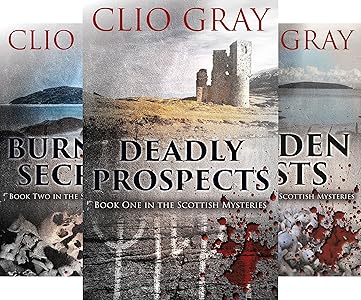
Review: Scottish Series by Clio Gray

Down in the coalmine, underneath the ground
Where a gleam of sunshine never can be found
Digging up the dusky diamonds all the seasons round
Deep down in the coalmine, underneath the ground


I came to this series after reading Gray's "Legacy of the Lynx" so was looking forward to a change of scenery - 1860s Scotland - a time of pivotal change in the Scottish Highlands. Poverty had always been one of the main reason for Scottish emigration. Two-thirds of the land is harsh – rocky, ill-drained, swept by rain-bearing winds off the Atlantic, and far from the centre of Mediterranean and European trade and culture. The first Scottish communities away from home were founded by traders.

In the 1800s, Scotland's population was on the decrease - until about 1855, when a vast number of the local population of the Highlands were forced to leave the land because of enforced evictions. In the Lowlands, emigration was almost always the outcome of wanting to improve one’s living standards. 

Scottish MysteriesThe eviction of Highlanders from their homes peaked in the 1840s and early 1850s as the Highland economy had collapsed, while the population still rose. When the earnings from kelp production and black cattle dried up, the landlords saw sheep as a more profitable alternative. The introduction of sheep meant the removal of people, and this become known as ‘the Clearances’. Combined with the prospect of starvation faced by much of the crofting population when the potato crop failed in the late 1830s and again in the late 1840s, emigration seemed the only option. 

The Emigration Act of 1851, however, made emigration more accessible to the poorest, with the Highlands and Islands Emigration Society set up to manage the process of resettlement. The Duke of Sutherland was one of a number of landlords who financed emigration schemes. The main exodus occurred in the islands, particularly Skye, Mull, the Long Island and the mainland parishes of the Inner Sound. After 1855, mass evictions were unusual and emigration became more a matter of choice than compulsion. Between 1855 and 1895 the decline in the Highland population was actually less than in the rural Lowlands. 


So a little bit about each of the books in the series and the historical background before I get down to the review. 

Book One: The Broro Murders (aka: Deadly Prospects) 
Deadly Prospects: A gripping historical thriller with a brilliant twist (Scottish Mysteries Book 1) by [Gray, Clio]1869, Sutherland, Scotland, and the Kildonan Gold Rush is in full swing. And then one of the panners is murdered, and strange scratchings left on stones where he is found. Brogar Finn and Sholto McKay are on hand to investigate the extent of the Gold Rush, and it falls to them to solve this murder, and the others that soon follow. 

Historical Background: 
Sutherland: isolated, remote, with rugged mountains, steep cliffs and deep fjords, dates from viking times. This was the home of the powerful and warlike Clan Mackay, and was considered relatively poor compared to rest of Scotland, with the majority of its people eking out a living from fishing. 

Sutherland is perhaps best known for the Highland Clearances, the eviction of tenants from their homes and/or associated farmland in the 18th and 19th centuries century by the landowners. Typically, this was to make way for large sheep farms (see above). The Sutherland Estate (consisting of about two thirds of the county) had the largest scale clearances that occurred in the Highlands, much of this being carried out in 1812, 1814 and 1819-20. In this last period (the largest of the three listed), 1,068 families were evicted: representing an estimated 5,400 people. This population was provided with resettlement in coastal areas, with employment available in fishing or other industries. However, many instead moved to farms in Caithness or left Scotland to emigrate to Canada, the US or Australia.

The Brora Mine was indeed owned by the Dukes of Sutherland up to 1873. Although the area was already being mined, this particular colliery came into existence (c.1810) as a result of a partnership between William Hughes, a mining engineer and William Young, lawyer and a sub factor of the Sutherland Estate (who became infamous for his part in the Clearances under Elizabeth, Countess & Duchess of Sutherland d.1839). Work continued in 1814 and 1815 not only on the mine but on the surrounding infrastructure, including a distillery, the development of a harbour and a railway to take the coal down to the sea. It was, however, during this period, financial challenges, mismanagement and accidents beset the mine before a survey by mining engineer, William Bald, reported favourably about the coal. Despite some misgivings the Sutherland family continued to back Young financially even though expenditure was vastly exceeding estimates. It all soon fell apart. The salt tax was abolished in 1823; its production then became unremunerative, and as coal was not in much demand among a people who were accustomed to, and could easily get, plenty of peat, the Brora works, after languishing for nearly five years with the 2nd Duke unwilling to sanction further expenses, were closed in 1828.

However, in 1872, the 3rd Duke of Sutherland re-opened Brora Colliery, and for a number of years had it under estate management. Queen Victoria visited the mine just after its reopening, travelling on the newly completed railway pulled by a locomotive named “Florence”. The colliery was managed by M.Crowe in 1893 before being leased to a Mr John Melville (c.1896). From this point, coal was mined for manufacturing purposes - specifically salt - and was eventually abandoned in 1975. It was the only Jurassic coal mine in Scotland and was never taken into state ownership. 

The Kildonan Gold Rush was a gold rush that occurred in the Strath of Kildonan, Sutherland, in the Highlands of Scotland in 1869. Gold was first discovered in the area in 1818 when a solitary nugget of gold weighing about ten pennyweights was found in the River Helmsdale. It is claimed a ring was made out of this and is in the possession of the Sutherland family. But when public interest was sparked following a newspaper announcement in 1868, a gold rush started. 

The credit for the discovery goes to Robert Nelson Gilchrist, a native of Kildonan, who had spent 17 years in the goldfields of Australia. On his return home, he was given the permission by the Duke of Sutherland to pan the gravels of the Helmsdale River. Many of the prospectors were novices but a hard core of miners from Australia and America helped to provide some much-needed expertise in gold recovery. In April 1869, however, the Duke of Sutherland introduced a system of licenses which cost one pound per month for each claim measuring 40 square feet. In addition to this, the prospectors were expected to pay a royalty of 10% on all gold found; not surprisingly, much gold was never declared but was used in barter for food, tools and accommodation. Two small 'towns' had come into being. Baille an Or - a settlement of huts (shanty town) catering for over 600 prospectors - was established by the banks of the Kildonan Burn, and Carn na Buth (meaning Hill of the Tents) served the workers on the Suisgill Burn. Very soon a 'saloon' was added to the Town of Gold (Baille an Or) and provided meals and accommodation for the mining fraternity.

However, the falling price of gold coupled with diminishing levels of finds and better opportunities in the local herring fishery, meant numbers fell to around 50 by the autumn. The Duke was losing potential income from salmon fishermen and deer stalkers, so in December he announced that “all exploration for gold would cease with effect from 1 January 1870"; despite this, the lure of gold tempted several opportunists over the following years.


Book Two: Burning Secrets 
Burning Secrets: A gripping historical mystery (Scottish Mysteries Book 2) by [Gray, Clio]1869, Strontian, Scotland, a village on Ardnamurchan Peninsula, is inhabited by mining folk and crofters, eking out a living from the unforgiving land and turning a blind eye to the smugglers who plague the coast. But one man sets himself apart from the rest – Gustav Wengler, the owner of the mine and an eccentric mathematician, who isolates himself on Havengore Island with a collection of unexplained white monuments. His assistant Archie Louden acts as his only envoy to the outer world; however Archie never makes it home from an important mission to Copenhagen. 

Historical background: 
In 1830 sources write that "The village of Strontian is very pleasantly situated, directly at the head of Loch Sunart, the hills adjoining to which are crowned with beautiful and very thriving plantations. The Loch itself is here extremely picturesque ... In a neighbourhood civilized and populous it would speedily become a favourite retreat." 

In the 1830s, residents from Strontian and the surrounding area were among the first to use the "Bounty Scheme" to emigrate to Australia. The Brilliant, a Canadian-built ship, sailed from Tobermory to New South Wales in 1837 with 322 passengers, 105 of whom were from Ardnamurchan and Strontian. The Bounty Scheme, which ran from 1835 to 1841, was proposed by Edward Gibbon Wakefield as a way for Australian settlers to subsidise the emigration of skilled tradespeople from Britain. 

In the hills to the north of Strontian, lead was mined in the 18th century and in these mines the mineral strontianite was discovered, from which the element strontium was first isolated. The history of mining in the Strontian area dates to 1722. The first large-scale application of strontium was in the production of sugar from sugar beet. Although a crystallisation process using strontium hydroxide was patented by Augustin-Pierre Dubrunfaut in 1849, the large-scale introduction came with the improvement of the process in the early 1870s. The Strontian mine was abandoned by June 1889.


Book Three: Hidden Pasts 
Hidden Pasts: A gripping historical thriller (Scottish Mysteries Book 3) by [Gray, Clio]Hestan Island, marooned in the Solway Firth, is tethered to the mainland at low tide by a causeway called The Rack; Hestan was home to two men quietly living out their lives, until a boy is almost crushed to death in their tiny copper mine, when their shared past begins to unravel. Over at Balcary House, Brogar Finn and Sholto McKay arrive, and soon become involved in the affairs on Hestan, which in turn leads them back through the bloody wars of Crimea and the lands of the Tartars. 

Historical Background: 
The isle of Hestan lies at the mouth of Auchencairn Bay in the region of Dumfries and Galloway in the former county of Kirkcudbrightshire. A lighthouse was built on the eastern side of the island by Alan Stevenson in 1850, with a small cottage of the light-keeper. Other notable buildings in the are include Balcary Tower, built c. 1860, for the french mistress one one Colonel Johnstone when he was Laird of Auchencairn House, which itself was built around this time for Ivie Mackie, Lord Mayor of Manchester (1857 - 1860) - though I can find very little on any of these real-life characters! 

At certain conditions of low tide the island is accessible on foot as there is a natural causeway of shingle and mussels from Almorness Point to the northern tip of Hestan (known as The Rack). The island can also be reached on foot from Rockcliffe during the time of spring tides, but requires wading knee deep across the lowest parts of the river Urr out on the mudflats. 

At the southern tip of the island are the so-called “Daft Ann’s Steps”, a series of rocky outcrops that jut out into the sea and are permanently submerged. Apparently they take their name from a girl who lived in the nearby village of Auchencairn. She drowned while attempting to reach the mainland from the south end of the island via the “steps”, instead of using the longer but safer approach from the north. 

In the 18th century the island was used as a centre of smuggling activity, with goods being stored in the caves on the south west of the island where there was reputed to have been shelves cut into the rock. Balcary House, on the opposite shore, now Balcary Bay Hotel, was used by a firm of smugglers - the Mull of Galloway Smuggling Company (established by Messrs Thomas Clark, Hugh Crain and Matthew Quirk, and Englishman Richard Barton). These smugglers used its cellars to conceal their contraband (mainly salt) and was said to have been large enough to house 200 horses!. One of the more colourful local characters of this period was Johnnie Girr and the Stewartry of Kirkcudbright was the birthplace of one John Paul Jones, whose friends and enemies alike would accuse him of piracy!.

As Walter Scott observed: “Smuggling was almost universal in Scotland for people unaccustomed to imposts and regarding them as an unjust aggression upon their ancient liberties; made no scruples to elude them where it was possible to do so.” Solway Firth and Galloway is said to have provided some of the most active smuggling routes in the country, with the proximity to the English Border making it the stop-off of choice for those shifting illegal goods. Much of the contraband was stored on the Isle of Man - which was independent during the 18th Century - and brought in fast moving smuggling fleets to the Scottish mainland. The poet Robert Burns was amongst those trying to halt the free traders in the area after being appointed an excise man at Dumfries in 1791.

Now the mining theme for this outing is copper. Hestan has had copper mines on the eastern side of the island since the 1840s, though this could hardly be considered as a large-scale operation as the island itself measures approximately 460 by 270 metres. The copper mined from Hestan was shipped to Swansea.


The stories in Clio Gray's "Scottish Mysteries" are spread across both the Scandinavian world and northern Scotland. For centuries there were political links across the North Sea. The first Viking raid on Iona is thought to have taken part in 794, and much of the Hebrides and Caithness would come under Norse rule. Orkney and Shetland continued to be earldoms under Norway until 1468. This settlement resulted in the Scandinavian-derived Norn language being spoken on Orkney and Shetland until the 18th Century, and influencing the Shetlandic and Orcadian dialects to this day.

As RM Ballantyne in Erling the Bold (1869) says: "Yes, there is perhaps more of Norse blood in your veins than you wot of, reader, whether you be English or Scotch; for those sturdy sea rovers invaded our lands from north, south, east, and west many a time in days gone by, and held it in possession for centuries at a time, leaving a lasting and beneficial impress on our customs and characters. We have good reason to regard their memory with respect and gratitude, despite their faults and sins, for much of what is good and true in our laws and social customs, much manly and vigorous in the British Constitution, of our intense love of freedom and fairplay, are pith, pluck, enterprise, and sense of justice that dwelt in the breasts of the rugged old Sea-kings of Norway!"

Each of the books feature a mining theme: coal and gold, strontium, copper; as well as links to events in the past. As we are taken on a journey over the northern parts of Scotland, what I appreciated in the all the books was the location map - for whilst I was familiar with a few of the place names, the maps help put things into perspective. 

The author makes use of the chapters to introduce characters that form part of the narrative - whether fleetingly or on a more permanent basis - so the setting of each scene is crafted before things begin to take off. I especially enjoyed the characters of Brogar Finn and Sholto McKay, trouble-shooters for the Pan-European Mining Company, who make a nice change from your standard fictional amateur investigator.

With each book, Gray tempts us - the reader - with a story peppered with well researched historical fact and a carefully woven plot, that like the dangerous quicksand of the Solway Firth mudflats, can suck the reader in unawares, escape being nigh on impossible.


further reading:
Scottish Mining website
Smugglers Britain
Scandinavian Scotland


Sunday, September 29, 2019

Frontiers for Peace in the Medieval North: The Norwegian-Scottish Frontier c. 1260-1470.


Cover Frontiers for Peace in the Medieval North
Frontiers for Peace in the Medieval North by Ian Peter Grohse deals with the Isles of Orkney between the 1266 Treaty of Perth, in which the Norwegian king ceded the Hebrides and the Isle of Man to Scotland, and 1468, when Orkney was itself pledged to the Scottish crown. Its central thesis is that this period was a time of relative peace that did not witness Orcadians and Norwegians struggling against encroaching Scots.

The book begins by arguing that the Norwegian and Scottish kings promoted mobility between Orkney and mainland Scotland. According to Ian Peter Grohse, they saw Orkney as a convenient site for diplomacy between the two countries. 

The Orcadian earls, administrators, and bishops were employed by the Norwegian kings as agents of this diplomacy. Especially the earls of Orkney played a pivotal role, as they held the earldoms of Orkney and Caithness in tandem, and were therefore vassals of both the Norwegian and Scottish kings. Many of Orkney’s earls and administrators were Scottish in origin, which, Grohse emphasizes, shows that the Norwegian rulers were not led by anti-Scottish sentiments in appointing their frontier officials. Military precautions were taken to defend Orkney, but the Scottish crown never attacked the islands. 

In previous literature, the intrusion of Scottish law was perceived as a real threat to Orkney’s law and custom. Grohse refutes this and shows a continuity of Norwegian law well beyond the period under investigation. The last chapter is an application of the concept of “nativism” to the Orcadians’ outlook on foreigners and immigrants.

read complete review by Daan Keijser @ H-Net Reviews


Friday, September 27, 2019

The Politics of Counsel in England and Scotland, 1286-1707 by Jacqueline Rose

Cover for 

The Politics of Counsel in England and Scotland, 1286-1707


Counsel was a fundamental element of the theoretical framework and practical workings of medieval and early modern government. Good rule was to be ensured by governors hearing wise advisers. This process of counsel assumed particular importance in England and Scotland between the 14th and 17th centuries because of the close adherence to ideas of the common good, commonwealth, and community in this period.


Yet this era saw major changes in who gave counsel and how it operated. This volume identifies both patterns and moments of change while also recognising continuities. It examines counsel in the context of Anglo-Scottish warfare and unions, the Reformations, and early colonising ventures, as well as in the contingent circumstances of individual reigns and long-term evolutions in the nature of government.

Depicting counsel as ubiquitous yet archivally elusive, this volume uses government records, pamphlets, plays, poetry, histories, and oaths to establish a new framework for understanding advice. As it shows, a widespread belief in good counsel masked fundamental tensions between accountability and secrecy, inclusive representation and political cohesiveness, and between upholding and restraining sovereign authority.


Monday, September 23, 2019

Being Protestant in Reformation Britain by Alec Ryrie

The Reformation was about ideas and power, but it was also about real human lives. Alec Ryrie provides the first comprehensive account of what it actually meant to live a Protestant life in England and Scotland between c. 1530-1640, drawing on a rich mixture of contemporary devotional works, sermons, diaries, biographies, and autobiographies to uncover the lived experience of early modern Protestantism.


Beginning from the surprisingly urgent, multifaceted emotions of Protestantism, Ryrie explores practices of prayer, of family and public worship, and of reading and writing, tracking them through the life course from childhood through conversion and vocation to the deathbed. He examines what Protestant piety drew from its Catholic predecessors and contemporaries, and grounds that piety in material realities such as posture, food and tears.

This perspective shows us what it meant to be Protestant in the British Reformations: a meeting of intensity (a religion which sought authentic feeling above all, and which dreaded hypocrisy and hard-heartedness) with dynamism (a progressive religion, relentlessly pursuing sanctification and dreading idleness). That combination, for good or ill, gave the Protestant experience its particular quality of restless, creative zeal.

The Protestant devotional experience also shows us that this was a broad-based religion: for all the differences across time, between two countries, between men and women, and between puritans and conformists, this was recognisably a unified culture, in which common experiences and practices cut across supposed divides. Alec Ryrie shows us Protestantism, not as the preachers on all sides imagined it, but as it was really lived.


Saturday, April 13, 2019

Dance If Ye Can: A Dictionary of Scottish Battles by Malcolm Archibald

Dance If Ye Can: A Dictionary of Scottish Battles by [Archibald, Malcolm]Dance If Ye Can is an introduction to the huge variety of battles fought in Scotland, or fought by the Scots in the nearly nine hundred years when they were an independent nation.


The first part of the book serves as an introduction to Scottish history, while the second section portrays the Scottish soldier throughout history. Part three gives an alphabetical guide and brief notes of the many hundred battles, skirmishes and sieges that pepper the history of Scotland.

Unlike most battle books, Dance If Ye Can does not concentrate solely on the well-known battles. Rather, it gives space to many of the near-forgotten skirmishes and clan battles, as well as the more famous encounters such as Bannockburn and Culloden. 

The earliest battles concern the Roman invasion of 83 AD, while the last was the German attack on the Royal Navy in the Firth of Forth in 1939. In between are mentions of the wars against the Norse and the English, with various civil wars and disturbances, the Jacobite Risings and the clan wars of the Borders and Highlands.

The final section is a timeline of Scottish history that brings the book to the post-devolution period in the twenty-first century.

Saturday, March 30, 2019

Review: Odin's Game by Tim Hodkinson

Orkney, 931: A young woman flees her home to secure a life for her unborn child. Eighteen years later, a witch foretells that she must lose him once more. The subject of a Viking prophecy, it is Einar's destiny to leave Iceland and fight his father – of whom only only one will survive. As the clouds of war gather, he will fight unimaginable foes, forge new friendships, and discover what it truly means to be a warrior. Not everyone will survive, but who will conquer all?

Image result for thorfinn skull splitterI was immediately drawn to the first two words - Orkney 931. Finally some new historical fiction set in the 10th century, and littered with actual historical characters that were, themselves, larger than life. In the Scandinavian world, this was a period rife with political turmoil, with, at times, murderous power struggles between nations and families; it was an age of exploration and settlement as the Scandinavian world spreads out over northern Europe - to Greenland, Iceland, Scotland, Kiev; it was an age where old Gods were being replaced by one God, though in some instances it was hardly a smooth and voluntary process.

Into this we are introduced to Unn Kjartinsdottir, a woman who fled her home and now must send her only son, Einar, out into the Viking world to face his fate. This tale is styled in the manner of your typical hero's quest - a young man come of age must go out in the world, seek his true identity, battle with heroes against villains, or with villains against others, and return home. However, in this instance, this is also a saga steeped in fact and history, that takes us on a journey that is far from straight forward - the Viking world was as combative as it was poetic.

The story begins in Iceland - a land settled by those fleeing persecution or tyranny in the Norse Kingdom. As a fledgling nation populated mainly by farmers, the land is "ruled by The Law not Kings" with the Icelandic Free State coming into being in 930 with the establishment of the Althing (parliament). Its is about this time that Icelandic historians began to document the nation's history in books commonly referred to as the Sagas of Icelanders. Another topic discussed in detail is religion. The Norse Gods were still powerful influences in everyday life, whilst Christianity was still in its infancy. It wasn't until many decades after our story does the nation - as a whole - convert to Christianity (through an act of parliament). In fact new research has suggested that the eruption of the volcano Eldgjá in 939, may have been viewed as an apocalytic omen, signalling the end of the old Gods and the arrival of a new God as laid out in the "Vǫluspá" . 

Among the cast of wonderfully crafted dramatis personae, we are, as I mentioned, introduced to such real life extraordinary characters as Thorfinn "skull-splitter" Jarl of Orkney, Eric "blood-axe"; Gurthfrith, King of Dublin, each worthy of a tome of their own: 

Thorfinn "skull-splitter": the Heimskringla of Icelandic historian Snorri Sturluson, and the anonymous compiler of the Orkneyinga Saga, write that Thorfinn was the most powerful of all the earls of Orkney. He is said to have been earl for seventy-five years and ruler of nine earldoms in Scotland, of the Hebrides, and of part of Ireland. A sizable part of the account in the Orkneyinga Saga concerns his wars with a "King of Scots" named Karl Hundason whose identity is very uncertain.

Eric "blood-axe": Eric was the son of Norwegian King Harald Fairhair. According to the colourful Icelandic sagas he began his Viking career aged 12. On one expedition he met and married a witch called Gunnhild, the daughter of the king of Denmark. The sagas paint Bloodaxe – a name they gave to Eric – as a barbarian, a murderous tyrant whose savagery was shocking even by Viking standards. Contemporary evidence, mainly from the Anglo-Saxon chronicles, is less vivid.

Image result for vikings in icelandGuthfrith of Dublin: a Viking leader who ruled Dublin and briefly Viking Northumbria in the early 10th century. How he came to rule Dublin is often a matter of debate. He may initially have been a de facto ruler in his kinsman's stead, before heading to Northumbria to take control there. Six months later, after being ejected from Northumbria, he returns to Dublin, where he reigns and continues his wars against the Vikings of Limerick until his death a few years later.

This was a world I was familiar with, having read many of the Scandinavian Sagas - a must if you are looking to delve deeper into this era. The tale that Hodkinson weaves in the Skaldic tradition is a page-turner - a gripping action adventure like the sagas of old; and once finished, you just want to go back and read it all over again.  In fact the scene is set for more adventures.


read more here

Tuesday, December 25, 2018

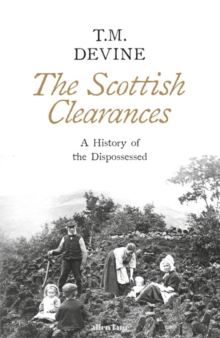
The Scottish Clearances by TM Devine - a review

The name of the book, The Scottish Clearances: A History of the Dispossessed, 1600-1900, highlights Sir Tom Devine’s central premise that what occurred was a deliberate and nationwide process that affected lowland areas as much, arguably more so, than the Highlands. At the heart of the narrative is an evidentially robust but also often grim and very human story of how Scotland was transformed from the rural society of old to the largely urban nation we know today. The end of traditional Highland life is here, warts and all, but crucially so too is the far less well-known story of the demise of an entire class of lowland folk, the cottars.


Ewen MacAskill's review at The Guardian:
In this book, he chronicles land ownership, the clan system and shifting attitudes towards Highlanders, from heroic soldiers to lazy aborigines. But this is a serious book, which includes a large section on dispossession in the Borders – intended to put what happened in the Highlands and Islands into perspective.


read more here
@ The Scotsman - The Highland Clearances
@ Wikipedia - The Highland Clearances
@ The Herald - review


Sunday, October 14, 2018

The Scottish Clearances: A History of the Dispossessed, 1600‑1900 by TM Devine

The Scottish Clearances : A History of the Dispossessed, 1600-1900, Hardback BookThe Highland Clearances are modern Scotland’s foundational tragic story. More than the Jacobite rebellions, or the story of the Scottish regiments, more than the Enlightenment, more than the medieval wars of independence, they have established Scotland’s identity: that of an oppressed, misunderstood people unto whom great evil was done.


The clearances, which stretch back to the 1760s, but were at their height from 1815 to the 1850s, have their own poems, novels, songs and iconography.


A definitive new history of the terrible process by which much of Scotland was 'cleared' of many inhabitants, written by Scotland's foremost living historian.


read more here


Saturday, May 12, 2018

Quines by Gerda Stevenson celebrates the women of Scotland

From The National:

Image result for quinesThe book features portraits in poetry, most in English, a third in Scots, which tell the story of 57 individual women and a football team – the 11 Scottish women who beat England 3-0 in Edinburgh in May, 1881, the first recorded international women’s match, while the second game a few days later in Glasgow was abandoned when male protestors ran on to the pitch.


“I used many sources of information,” explained Stevenson, “especially the Biographical Dictionary of Scottish Women which is a fantastic resource, and googling, and talking to people, and buying second-hand books about these women, many of which are out of print. It’s not that they were written out of history, it’s just that were never written in.”

National columnist Lesley Riddoch’s verdict is straightforward: “Quines is a vivid explosion of thought, description and bold opinion, clothing Scots history at last with the myriad contribution of its women. This is a wonderful, life-affirming book.”


Sunday, January 14, 2018

Centuries of Dunfermline's history revealed in Patricia's new book

A North Queensferry author has penned a new book which features Dunfermline’s Burgh history. Patricia Dennison’s revealing text tells the story of urban development in Scotland over the course of the millennium. The evolution of urban life, in its different guises, is detailed throughout ‘The Evolution of Scotland’s Towns: Creation, Growth and Fragmentation’.

“Nothing defines the history of the ordinary person in Scotland better than the history of our towns,” she said.