Showing posts with label medieval history. Show all posts

Monday, April 22, 2024

Review: The Sisters of Richard III by Sarah J Hodder

Synopsis: This book is the narrative of three women of York, sisters to not one, but two kings of England. Anne, Elizabeth and Margaret Plantagenet were the daughters of Richard, Duke of York and his wife, Cecily Neville, and therefore sisters to Edward IV and Richard III. These women watched from the sidelines as their father challenged England’s anointed king and lost his life, as their brothers fought together for the throne of England and then amongst themselves and as the Plantagenet dynasty fell, making way for the reign of the Tudors.

But they were not just bystanders; they had their own stories to tell. Anne of York was married to the Lancastrian Duke of Exeter who sided against her father and brother, before finding later happiness, albeit briefly, with her second husband. Elizabeth of York married John de la Pole, Duke of Suffolk and became the mother of eleven children who would become thorns in the side of the Tudor kings and Margaret of York became Duchess of Burgundy, a hugely influential woman in her adopted kingdom although she never stopped supporting her family back in England. Between them, they witnessed and contributed to one of the most turbulent times in English history yet they have naturally been overshadowed by their more famous brothers. This is their story.

~ ~ ~

The story of the three Yorkists sisters - Anne, Elizabeth and Margaret - as told against the backdrop of the Wars of the Roses. And the story of the sisters is one full of persistence in keeping both the Yorkist cause and that of their family name, alive. With their mother Cecily, these three women were the great survivors of this tumultuous period in history.

Hodder provides the reader with a well-researched tome that covers off the events of the Wars of the Roses, whilst linking the lives of these women to both their family and the events.

That there may have been a perception that they had gone unremarked is only due to the fact that two of their brothers - Edward IV and Richard III - outshone them. However, they did not go completely unobserved - a careful historian or student of history will find all three women,scattered across the pages of numerous tomes. What Hodder does is bring this all under one book cover and puts their lives into context with events as their not only occurred but also how they impacted this particular family.

The keen reader of the Wars of the Roses history will enjoy this as will someone who is coming new into this period. There were many extraordinary women at this point in history - this is the story of three of them (four if you also count in their mother, Cecily).

Monday, July 3, 2023

The White Ship by Nicholas Salaman

Based on a true story, this tale of passion and revenge brings the past to life. Normandy in 1118 is a hotbed of malcontent barons kept in fragile order by Henry I, King of England and Duke of Normandy. Fresh from early years in a monastery, Berthold - the bastard son of one of these barons - meets Juliana, a countess and daughter of the King. He falls in love, or lust (he isn’t sure), but sees that his chance could come with work in her small court. Soon, though, he finds himself caught up in a ruthless feud between Juliana and her father. Juliana's daughters are offered as hostages for a strategic castle, and even love is not enough to allay a tragedy that will change the course of history.

For all fans of historical fiction and especially readers of Ken Follett's The Pillars of the Earth 

Vikings of the Irish Sea by David Griffiths

"Vikings of the Irish Sea: Conflict and Assimilation Ad 790-1050" looks at the activities of the Vikings in the Irish Sea, a band of water that has been important since prehistoric times in the history of maritime cultural exchange between Britain and Ireland as well as the Scandinavian countries. The Vikings fully exploited their naval dominance to exert their influence across this area and David Griffiths presents a unique overview of the results of this dominance. 

The book will look, in detail at the activities of the Vikings in Wales, North West England, the Isle of Man, Scotland and Ireland. The archaeological evidence such as silver hoards and burials, along with the evidence of place-names, settlement and sculpture provide a fascinating insight into the mechanisms of Viking power in these areas.

Wednesday, January 4, 2023

Royal Childhood and Child Kingship by Emily Joan Ward

Refining adult-focused perspectives on medieval rulership, Emily Joan Ward exposes the problematic nature of working from the assumption that kingship equated to adult power. 

Children's participation and political assent could be important facets of the day-to-day activities of rule, as this study shows through an examination of royal charters, oaths to young boys, cross-kingdom diplomacy and coronation. 

The first comparative and thematic study of child rulership in this period, Ward analyses eight case studies across northwestern Europe from c.1050 to c.1250. The book stresses innovations and adaptations in royal government, questions the exaggeration of political disorder under a boy king, and suggests a ruler's childhood posed far less of a challenge than their adolescence and youth. 

Uniting social, cultural and political historical methodologies, Ward unveils how wider societal changes between the eleventh and thirteenth centuries altered children's lived experiences of royal rule and modified how people thought about child kingship.

Monday, January 2, 2023

Four Princesses From Provence by Amelia Rogers

BOSTON, Dec. 28, 2022 /PRNewswire/ -- Author Amelia Rogers' novel, "Four Princesses from Provence," highlights the importance of women's roles in history.

This novel tells the tale of the four daughters of the Count of Provence. With their charms, beauty and intelligence, they rise to the top of the hierarchy — moving from their father's small kingdom in the south of France to positions of power across Europe. One sister discovers that her new life is a whole different world from the one she knew, and it's going to change everything she believes and knows.

While dynastic struggles of the Middle Ages have inspired many popular media pieces such as Game of Thrones, there is less knowledge of the period and its people in their full historical context. The author aims to fill this gap while, at the same time, creating an entertaining and dynamic experience for the reader.

Author Rogers is an Italian, and she became a writer because she wanted to know about the past. It makes her dream, and she has a desire to share this enchantment with others. An author with a classical background, her inspiration for "Four Princesses from Provence" comes from her love for the great poet, Dante. His masterpiece, "Paradise," mentions four daughters of the ruler of Provence, each of whom became a queen in various countries of Europe. Rogers also loves the period of the Middle Ages and had a desire to know more about this often neglected and misunderstood chapter in world history.

When asked about the best parts of her book, Rogers answered: "Since the time that I read about him during my school days, I have been a little in love with Manfred — the son of the Holy Roman Emperor, Frederick, and the man loved by Beatrice who is one of the four princesses and the protagonist of the book. Dante describes Manfred as 'comely and fair, and gently of aspect.' He would be a hero of any romantic story. Even his sins are forgiven by God and by Dante who placed him in Purgatory rather than in Hell (the Inferno)."

Rogers wants to bring the past to life by giving her readers an understanding of the historical context that shaped important events such as the Hundred Years War and the Crusades. Most of all, she hopes that they think about the underappreciated but crucial role that women played in shaping these events.

Find out more about "Four Princesses from Provence" at https://www.medievalwomenbyameliarogers.com.


Sunday, December 25, 2022

Review: Medieval Royal Mistresses by Julia Hickey

Synopsis: Marriage for Medieval kings was about politics, power and the provision of legitimate heirs. Mistresses were about love, lust and possession. It was a world that included kidnap, poison, murder, violation, public shaming and accusations of witchcraft. Ambition and quick wits as well as beauty were essential attributes for any royal mistress. Infamy, assassination and imprisonment awaited some royal mistresses who tumbled from favour whilst others disappeared into obscurity or respectable lives as married women and were quickly forgotten.

Meet Nest of Wales, born in turbulent times, whose abduction started a war; Alice Perrers and Jane Shore labelled ‘whores’ and ‘wantons’; Katherine Swynford who turned the medieval world upside down with a royal happy-ever-after and Rosamund Clifford who left history and stepped into legend.

Discover how serial royal womanisers married off their discarded mistresses to bind their allies close. Explore the semi-official roles of some mistresses; the illegitimate children who became kings; secret marriage ceremonies; Edith Forne Sigulfson and Lady Eleanor Talbot who sought atonement through religion as well as the aristocratic women who became the victims of royal lust.

Most of the shameful women who shared the beds of medieval kings were silenced, besmirched or consigned to the footnotes of a patriarchal worldview but they negotiated paths between the private and public spheres of medieval court life - changing history as they went.


My views on this book are conflicting. On the one hand, kudos for seeking out some of the lesser known historical women and providing something despite there being very little to go on in some instances. But on the other hand, this really has provided nothing that a good google search could not turn up. On the one hand, there is an interesting selection of mistresses; yet on the other, they are tried and true selections with a number of inclusions I found myself questioning as to their inclusion at all.

I found the subtitle not only deceiving and infuriating but rather trite - "Mischievous Women who Slept with Kings and Princes" . Where were these vamps and ingenues, these Mata Haris who plied their wares before all manner of royalty, these saucy and salacious bawds who managed to seduce and satiate royal carnal desires all for gain. Cue Sid James and the Carry-On gang - disappointingly no. If the focus was to bring these women to the fore, calling them "shameful" from the very outset does nothing to further that aim.

Beginning in the late 10th century with Canute and finishing off with the last Plantagenet King Edward IV, we are treated to not only a history lesson but also a rather dry series of biographies. Hickey repeats all the usual rumours, innuendos and scandals, providing very little by way of anything new. The selections are narrowly focused on and in the British Isles - the side trip to France seemed out of place. As I mentioned before, there were a number of inclusions that really should not have been there at all as there were no sufficient proofs, and then there were the generalisations where names were unknown.

What I was looking for and yet found lacking was any real exploration of the role of the royal mistress. Many of these women had no choice in this - women were chattels - property of first their fathers then husbands, and ultimately of their direct lord; very few were able to assert the independence of thought and action that many of us can do today. It is a shame that through a lack of any detailed accounts of many, their lives are seen only as a mere footnote in the pages of the lives of the men with whom they were associated.

This tome is not overly long, however, the material contained therein was not sufficient to keep me fully engaged. Being extremely well read on much of the content already, I was looking for that little something more - that new take, some new theory or thoughts, even some small snippet of of the promise of something new. The phrase quality not quantity comes to mind in this instance - we know you have done your due diligence, but there is no need to cram it all into one space as it shows that you really don't know what to do with it all.

I am sure that there is a market for this and there will be many who will enjoy this immensely, unfortunately, I am not to be one of them.

Sunday, April 17, 2022

Review: The Normans by Judith Green

Synopsis: A bold new history of the rise and expansion of the Norman Dynasty across Europe from Byzantium to England.

In the eleventh century the climate was improving, population was growing, and people were on the move. The Norman dynasty ranged across Europe, led by men who achieved lasting fame like William the Conqueror and Robert Guiscard. These figures cultivated an image of unstoppable Norman success and their victories make for a great story, but how much of it is true?

In this insightful history, Judith Green challenges old certainties and explores the reality of Norman life across the continent. There were many soldiers of fortune, but their successes were down to timing, good luck, and ruthless leadership. Green shows the Normans’ profound impact, from drastic change in England to laying the foundations for unification in Sicily, to their contribution to the First Crusade. Going beyond the familiar, she looks at personal dynastic relationships and the important part women played in what at first sight seems a resolutely masculine world.


I will preface this review by saying - reader beware.! This is not a casual and cursory look at the Normans that will appeal to the general masses; it is a more focused narrative that assumes that you - the reader - have done your due diligence and a sufficient enough grasp of the topic at hand to absorb the information contained therein.

The focus of Green's book is the Normans and their activities as related to a specific time period - the 11th Century - and is narrowed down to particular theatres of war - England, Normandy, Byzantium, Sicily & Southern Italy, Antioch & the Holy Land. It is also a look at how contemporary writers and chroniclers viewed them as well as their own perceptions of self.

Green begins with a look at the various contemporary writers and chroniclers in England (Malmesbury, Worcester, Huntingdon, Monmouth), Normandy (Dudo William of Jumieges, Vitalis, Wace), Southern Italy & Sicily (Malatera, William of Apulia, Amatus of Montecassin), and of course the Crusades (Ralph of Caen). This list is by no means complete as there are a number of others included as well. In this chapter Green also explores the relationships between subject matter and author, the issues of patronage, potential audience and the accessibility of sources.

We next move to Normandy for a look at the structure of Norman society, its emergence, the outward persona of warrior class, and the internal struggles within for dominance. This leads into the next chapter "swords for hire" and a look at the role of Normans as mercenaries throughout Europe and the Baltic. Here Green notes that 11th Century Europe was swarming with armed men who for for wealth, land and prestige. So what made this particular group that much more successful than others - this is what is explored. Green includes a number of prominent families in her narrative, as well as some much lesser ones (which are the ones I am always on the look out for).

Moving south, we explore the activities and personalities of the Normans in Southern Italy and Sicily from their earliest arrival as armed pilgrims to the arrival of Robert Guiscard and the legitimisation of the new kingdom and its conquests. A brief side visit to Byzantium is also covered off for this will have an impact of future relationships.  This is one of my favourite periods of Norman History (and dominates my personal library).

Doubling back, Green takes us to one of the more well know of the Norman conquests - England in 1066. This was no gentle take-over but one that would see years of resistance and rebellion, and the invasions of neighbouring nations of Scotland, Wales and Ireland. This period would also see the creation of the Domesday Book - a survey every shire in England, and some parts of Wales, to list all holdings and calculate the dues owed to William.

And then to our final field of activity - The Crusades and the establishment of the Norman Principality of Antioch. Green provides an assessment of the various Norman leaders (Bohemond, Tancred, Robert of Normandy), their motives for embarking on this great military and religious endeavour, their successes and their failures.


The remaining chapters encompasses a more rounded view of the Normans, covering such topics as government and power, settlement and conquest, church and state, culture and construction. And it is this lasting legacy that Green concludes with, wherein she notes that they were - in essence - "... ruthless opportunists [who] were able to change the political history of Europe ...". But this is merely one one part of who the Normans were - for they were also exceptional strategists, inventive, progressive, militaristic, pious, opportunistic, ruthless - and utterly compelling and unforgettable.

This is definitely one for my own library shelves, and my own personal collection of Norman literature.

Sunday, October 3, 2021

Review: Royal Mysteries: The Medieval Period by Timothy Venning

Synopsis: Royal murder mysteries never fail to intrigue readers and TV viewers. Here are some of the most haunting and even horrific episodes from the middle ages, based on latest historical research and historiography, and authentic and rare sources, including archaeology and DNA evidence, uncovering wonderful tales of pathos, tragedy, suffering and romance. This is history for specialists and general readers - and sceptics - given the intense media coverage, including TV, and interest in exciting and accessible popular history. The famous and also less well-known mysteries, which may be new to readers, surrounding British Royalty, are included from around the 11th to the 15th centuries.

The murder mysteries show personal and individual tragedy but are also a vehicle for historical analysis. William II - William Rufus - was he murdered or killed accidentally by a 'stray arrow', allowing brother Henry to seize the throne, or was it God's punishment for William's irreligious living and persecution of the church? Or was Edward II murdered at the instigation of Queen Isabella - 'she-wolf of France' - and her lover, Roger Mortimer. who assumed the throne? Did he survive to live peaceably in Italy? Richard II resembled Edward II, as a rather inadequate figure, and was deposed by his rival, Henry IV. Did he die, and if so, was it murder or suicide? Was Edward IV a bigamist? Mystery, if not murder, but wrapped in dynastic rivalry and sex scandal, and usurpation of the throne. The 'Princes in the Tower' and who who killed them if anyone? A beguiling mystery for over 500 years with their usurping uncle Richard III's guilt contested by 'Ricardians'.


I was eager to read this one as I have a number of Tim's books already on my library shelf - and who doesn't love a good mystery. 

The mysteries being explored were not unknown to me - in fact I explored one of these mysteries myself in greater depth (death of William II) and the controversy surrounding the "Princes" still captures my imagination even today, after much reading on the matter.

Venning takes each mystery, provides some historical background and context, examines the contemporary accounts, looks at all the players before asking the age old question - cui bono? Who stands, or stood, to gain, and so might have been responsible for it or precipitated the actions of a third party?

Venning directs the readers attention to the existence of "fake news" in medieval times wherein the writer or chronicler is playing to their own agenda and contemporary audience, and as such must be viewed as a potential unreliable source.  In fact, as the reader and student of history will know, no source is completely without bias - just because it was written at the time does not necessarily mean it is the most accurate account.  Venning even comments that history is but "... a hall of mirrors with distorted reflections .."

Moving on to the mysteries themselves and what we have learned.  Well not much really.  I was rather disappointed to find that there was no real conclusion one way or the other - no definitive proofs. Venning does not take any particular stance - he explores all aspects of each mystery and just presents us with all the information, evidence and accounts, and leaves it up to the reader to discern what they will from it.

Whilst I will assume (whether rightly or wrongly) that this book is for the consumption of popularist history, I did find the narrative to be rather long-winded, repetitive, and definitely non-linear. I would suggest some fore-knowledge of the subject matter at hand would be appropriate. Overall, I liked it and would probably pick this up again - at a later date.


Also By Author:
- Royal Mysteries: The Anglo-Saxons and Early Britain
- The King Arthur Mysteries: Arthur's Britain and Early Medieval World


Tuesday, August 31, 2021

Review: Usurpers: a New Look at Medieval Kings by Michele Morrical

Synopsis: In the Middle Ages, England had to contend with a string of usurpers who disrupted the British monarchy and ultimately changed the course of European history by deposing England's reigning kings and seizing power for themselves. Some of the most infamous usurper kings to come out of medieval England include William the Conqueror, Stephen of Blois, Henry Bolingbroke, Edward IV, Richard III, and Henry Tudor. Did these kings really deserve the title of usurper or were they unfairly vilified by royal propaganda and biased chroniclers?

In this book we examine the lives of these six medieval kings, the circumstances which brought each of them to power, and whether or not they deserve the title of usurper. Along the way readers will hear stories of some of the most fascinating people from medieval Europe, including Empress Matilda, the woman who nearly succeeded at becoming the first ruling Queen of England; Eleanor of Aquitaine, the queen of both France and England who stirred her own sons to rebel against their father, Henry II; the cruel and vengeful reign of Richard II which caused his own family to overthrow him; the epic struggle for power between Henry VI, Margaret of Anjou, Richard of York, and Edward IV during the Wars of the Roses; the notorious Richard III and his monstrous reputation as a child-killer; and Henry VII who rose from relative obscurity to establish the most famous royal family of all time: the Tudors.


Whilst I appreciate that this promises a rather unique look at the reigns of some notable kings and whether they were worthy of the title "usurper" that had been applied to them, this really did not ignite any spark.

If you are going to use the words "a new look" in the title, then there should be something new that has not been repeated elsewhere. If I have picked up your tome with the title "usurpers" in it - it means that I have read the usual tomes, have a working background knowledge, and don't need the details of each kings' reign ..... in detail, including a history of events of the previous rulers.

Even a cursory read of the synopsis will tell you that there is more being included than needs to be - in fact - where really does Eleanor of Aquitaine fit into the subjects being studied - Henry II is not being accused of being a usurper nor is Richard or John. Begs a number of questions ... 

If you plan to provide an analysis of the reign of kings considered as usurpers, then more than a one to two page assessment at the end of what I considered to be an information dump, is required. What I am after is a unique, unbiased, assessment of why each deserved or did not deserve the title of usurper - not just a throw-away "because he snuffed out the previous ruler" or "because of his father's political ambitions" or "because his stole it {the crown} away".  And the synopsis will also tell you - if you read between the lines - what the verdict already is!

The assessment, whatever the author's opinion is, needs to be weighted against the reign, the actions, and viewed in the context of the period in order to be able to formulate a cohesive analysis. Sure provide some background - but - after I finished and looked at the sources provided and noted that I had read them all - sometimes less is more - a short sharp summary of events. I know you've done the research - what I want to see is how you've applied it to the premise - did the book meet the brief. Well ... briefly.

I would put this in the category of more popularist history - certainly, from the tone of the narrative, the language, it is not an academic text - I was left wondering who the intended audience was. Even if the reader had read nothing about the history of England from the time of Alfred to Henry VIII, I would be hesitant is suggesting this as an initial text. I actually did not enjoy reading this at all.  I think this is more of a case of someone thought it was a good idea to cobble together a number of blog posts and present them in book form (and not for the first time from this publisher unfortunately).

Everyone is entitled to their own opinion - and this is mine (based upon many, many years of reading and studying history).


Saturday, August 21, 2021

W H Allen lands Ramirez's 'vivid and evocative' look at medieval women

W H Allen has landed the "remarkable" Femina: A New History of the Middle Ages by Oxford University lecturer and BBC historian Janina Ramirez.

Out in March 2022 and based on 10 years of research, Femina will bring "remarkable medieval women to the fore and offer the first comprehensive look at why they were written out of history". Ramirez will create a "vivid and evocative" picture of the lives of the women who influenced medieval society, including Aethelflaed, Margery Kempe and King Jadwiga, as well as individuals discovered more recently, like the Loftus Princess and the Cathar spies. It promises to ultimately reveal "how and why these remarkable people were removed from our collective memories, and highlight the misconceptions that have underpinned our historical narratives".

Lucy Oates, commissioning editor, acquired UK and Commonwealth rights from Rosemary Scoular at United Agents. She said: "The Middle Ages are seen as a bloodthirsty time of Vikings, saints and kings: a patriarchal society that oppressed and excluded women. But by digging a little deeper into the truth, drawing on evidence from all disciplines, we can see that the ‘dark’ ages were anything but. Janina has such an enthusiasm for her subject, and as a visual historian brings the past to life with creativity and passion. I’m absolutely delighted to be publishing her at W H Allen."

Ramirez added: "This book is not simply about introducing you to women from history who are inspiring. It's about seeing the past and our relationship with it differently. It's about understanding how our access to history has been curated and manipulated, and how our perceptions can change going forward.

read more here from The Bookseller


Saturday, July 3, 2021

Review: Never Greater Slaughter by Michael Livingston

Synopsis: Late in AD 937, four armies met in a place called Brunanburh. On one side stood the shield-wall of the expanding kingdom of the Anglo-Saxons. On the other side stood a remarkable alliance of rival kings - at least two from across the sea - who'd come together to destroy them once and for all. The stakes were no less than the survival of the dream that would become England. The armies were massive. The violence, when it began, was enough to shock a violent age. 

Brunanburh may not today have the fame of Hastings, Crecy or Agincourt, but those later battles, fought for England, would not exist were it not for the blood spilled this day. Generations later it was still called, quite simply, the 'great battle'. But for centuries, its location has been lost.

Today, an extraordinary effort, uniting enthusiasts, historians, archaeologists, linguists, and other researchers - amateurs and professionals, experienced and inexperienced alike - may well have found the site of the long-lost battle of Brunanburh, over a thousand years after its bloodied fields witnessed history. This groundbreaking new book tells the story of this remarkable discovery and delves into why and how the battle happened. Most importantly, though, it is about the men who fought and died at Brunanburh, and how much this forgotten struggle can tell us about who we are and how we relate to our past.


“No slaughter yet was greater made e’er in this island, of people slain, 
before this same, with the edge of the sword”

Brunanburh - like many other battles both before and after, is neither memorialised nor physically remembered with monument or building.

In Never Greater Slaughter: Brunanburh and the Birth of England we are treated to a detailed history leading up to the battle, looking at the military, the political and the personal, using archaeology and contemporary sources, and well as putting some of these sources under the microscope. Livingston then goes on to reconstruct the battle using known sources and basic assumptions - and here his research comes to the fore.


The author, as is his prerogative, has his own theory on the most likely location of Brunanburh, though he does explore other options - and as he mentions "... nothing better stokes enthusiasm than a case of the unknowns ...". Livingston puts forth his case for his location convincingly, whilst acknowledging that this may not agree with others investigating this particular battle. Yet you are drawn to Mike's passion and want to be a part of the search yourself!  There is still much work to be done as nothing is definitive nor conclusive.

I found this to be a well researched, informative and accessible read. Whether you agree of not with Livingston's theories, he has covered off a lot of the leg work for you to do your own research and to draw your own conclusions, because in the end, it is merely a ".... best guess of where it was and how it was ...".

Sunday, June 13, 2021

Edward I and the Governance of England, 1272–1307 by Caroline Burt

This important exploration of the reign of Edward I – one of England's most lionised, feared and successful monarchs – presents his kingship in a radical new light. 

Through detailed case studies of Shropshire, Warwickshire and Kent, Caroline Burt examines how Edward's governance at a national level was reflected in different localities. She employs novel methodology to measure levels of disorder and the effects of government action, and uncovers a remarkably sophisticated approach to governance. 

This study combines an empirical examination of government with an understanding of developing political ideas and ideological motivation, and contributes towards a greater understanding of the development of local government and politics in England in the thirteenth and fourteenth centuries. Edward emerges as a king with a coherent set of ideas about the governance of his realm, both intellectually and practically, whose achievements were even more remarkable than has previously been recognised.

Friday, April 2, 2021

Review: Bohemond of Taranto by George Theotokis

Synopsis: Bohemond of Taranto, Lord of Antioch, unofficial leader of the First Crusade, was a man of boundless ambition and inexhaustible energy - he was, in the words of Romuald of Salerno, 'always seeking the impossible'. While he failed in his quest to secure the Byzantine throne, he succeeded in founding the most enduring of all the crusader states. Yet few substantial accounts of the life of this remarkable warrior have been written and none have been published in English for over a century - and that is why this absorbing new study by Georgios Theotokis is of such value.

He concentrates on Bohemond as a soldier and commander, covering his contribution to the crusades but focusing in particular on his military achievements in Italy, Sicily, the Balkans and Anatolia. Since medieval commanders generally receive little credit for their strategic understanding, he examines Bohemond's war-plans in his many campaigns, describes how he adapted his battle-tactics when facing different opponents and considers whether his approach to waging war was typical of the Norman commanders of his time.


Before complaining that this is NOT a biography (as a small number of reviewers / readers have), the synopsis clearly states that the author " ... concentrates on Bohemond as a soldier and commander, covering his contribution to the crusades but focusing in particular on his military achievements in Italy, Sicily, the Balkans and Anatolia ...".  

And whilst Theotokis does cover off - albeit briefly - a history of the Normans in southern Italy and Bohemond's antecedent's, this is an assessment of his achievements (and failures) as a strategist and commander, focusing on the most prominent parts of Bohemond's military career.  As such, it is quite an admirable undertaking.

If you have sought this book out, then there is an implied assumption that a cursory knowledge of the times and of the crusades is held by the reader. I am not going to re-hash any of this information here either on Bohemond or the Crusades - and will suggest undertaking further reading if your interest is so piqued.

The military focus is centred around Bohemond's involvement in both his own and his father's campaigns in Italy, Anatolia, the Balkans, and the Latin East. The sources used as contemporary - and like today's - occasionally tinged with bias. Yes, it would be great to be able to access more sources from his "enemies" - and hopefully one day these will become more readily available and a truer picture of this restless, enigmatic and oft times, impetuous warrior may be told.

In the meantime, I would suggest reading this along with the more dedicated Crusader and Norman narratives. This is definitely one for my own library (alongside Theotokis' other tome - The Norman Campaigns in the Balkans).

Sunday, December 20, 2020

Review: the Rise and Fall of a Medieval Family: The Despensers by Kathryn Warner

Synopsis: The Despensers were a baronial English family who rose to great prominence in the reign of Edward II (1307-27) when Hugh Despenser the Younger became the king's chamberlain, favourite and perhaps lover. He and his father Hugh the Elder wielded great influence, and Hugh the Younger's greed and tyranny brought down a king for the first time in English history and almost destroyed his own family. 
Rise and Fall tells the story of the ups and downs of this fascinating family from the thirteenth to the fifteenth centuries, when three Despenser lords were beheaded and two fell in battle. We begin with Hugh the Justiciar, who died rebelling against King Henry III and his son in 1265, and end with Thomas Despenser, summarily beheaded in 1400 after attempting to free a deposed Richard II, and Thomas's posthumous daughter Isabella, a countess twice over and the grandmother of Richard III's queen.

From the medieval version of Prime Ministers to the (possible) lovers of monarchs, the aristocratic Despenser family wielded great power in medieval England. Drawing on the popular intrigue and infamy of the Despenser clan, Kathryn Warner's book traces the lives of the most notorious, powerful and influential members of this patrician family over a 200 year span.


This for me is a hard review to write and I have literally left it unwritten for sometime after reading this book.

On the one hand, writing about one of England's most despised medieval families, in a favourable light, but still warts and all, is no simple task. Documenting the families' politically activities over a mere 200 years again is no walk in the park.

What I took away from this book was that the Despencers were always closely connected with the reigning royal family of the day - and they maintained their support of the royal line through thick and thin. They did not shy away from political or military service, and gladly served their monarch. The Despencers were also, I think a rather closely knit familial group - for the most part, barring a few renegade members from lesser branches. They supported each other - they had each others' backs. And they accumulated wealth - great wealth, some of it centralised in the hands of a few, but from my understanding, even the lesser branches were doing much better than some of the more powerful nobles of the day.

This is obviously a very well researched and documented book - Warner is noted for her focus on the reign of Edward II and all that which is associated with it. And she is at ease her with her subject matter. Which brings up my next point.

For me, this felt like a genealogical dump. So much was focused on who married who, who inherited what, who took what from whom, that the narrative of the "rise and fall" was somewhat lost - its thin threads are in there but they are quite fragile. In fact, after looking at some of the reviews, I was worried I was the only one who felt the story was lost amid the overwhelming amount of genealogical data. 

When composing this review, what I did, in essence, was put myself in the shoes of someone who was maybe just starting out their own journey of discovery of the era. I imagine them looking at the spine of the book on the shelf, picking up the book, admiring the cover, reading the blurb, maybe reading the intro. What worries me is if they skip the intro and dive right in to be confronted by page after page of whom begat whom (which I can get chapter and verse from Genesis). Then, the book is quietly returned to the shelf and passed by for something more user-friendly.

Writing a two hundred year history of an important family and binding it all together with the contemporaneous events is no slight feat. It is hard to know what to include but more importantly, what to exclude. Just because you have all of this information to hand, doesn't mean it has to be included. Whilst the book does include family trees and a list of who's who for each chapter, I think the focus should have been more concentrated on those (few) who were responsible for the rise and the ultimate fall of this great family.  Afterall, in the great scheme of things, political power and influence was only held by a few. I just wanted a bit more meat on the bone - a bit more of an analysis of events and the impact of the actions undertaken by certain members.  

Alternately, it could have be written in two parts - maybe the first part concentrating on the political history, and then the second part on the more detailed genealogical discussion (for the purist). Anyone is is avidly interested in this period and has done their due diligence will certainly pick this up for their own collection. 

Saturday, April 11, 2020

Review: Blood Royal by Robert Bartlett

Synopsis: Throughout medieval Europe, for hundreds of years, monarchy was the way that politics worked in most countries. This meant power was in the hands of a family - a dynasty; that politics was family politics; and political life was shaped by the births, marriages and deaths of the ruling family.


How did the dynastic system cope with female rule, or pretenders to the throne? How did dynasties use names, the numbering of rulers and the visual display of heraldry to express their identity? And why did some royal families survive and thrive, while others did not?

Drawing on a rich and memorable body of sources, this engaging and original history of dynastic power in Latin Christendom and Byzantium explores the role played by family dynamics and family consciousness in the politics of the royal and imperial dynasties of Europe.

From royal marriages and the birth of sons, to female sovereigns, mistresses and wicked uncles, Robert Bartlett makes enthralling sense of the complex web of internal rivalries and loyalties of the ruling dynasties and casts fresh light on an essential feature of the medieval world.


This is really an analysis of family politics of royal and imperial dynasties throughout Latin Christendom and Byzantium 500 - 1500.

10 Surprising facts about Medieval Marriage and Divorce
We begin with the life cycle: however, before an heir can be born, the choice of bride must considered.  Bartlett discusses the intricacies associated with the marriage contract, pregnancy and childbirth, the potential for a childless marriage or bachelor king, or the repudiation of a bride and annulment of the marriage.

All things proceeding as planned, the bride gives birth to the much awaited offspring, what then?  For "what happens in bed had political consequences". Acknowledgement of a designated heir and or coronation secures the succession to a point but then we can run into problems such as a minority and interregnum or worse, adult sons - kings-in-waiting - circling and waiting for their chance. But what if the marriage produces only females - we then have now the succession of a queen and the associated issues of finding a potential husband, or the possible exclusion from rule altogether for the female heir.

Whilst considering the legitimate succession of son or daughter, we must also look to those illegitimate heirs and their rights to the succession for in many instances the "father's blood was enough to transmit eligibility to the throne" and sometimes preference was given to an illegitimate male over a legitimate female.

" ... ruling dynasties were not biological units but political ones.  Collateral branches might be excluded or pruned ... governed by biological uncertainty ..."

Still looking at the life cycle of a dynasty, Bartlett takes us through changes both within and without that can affect the success of a dynasty - hereditary or elective, too few heirs / too many heirs or rivals, provision of a patrimony for younger brothers especially as it may involve subdivision of dynastic lands. And if the heir is young and there is a minority, what of the "wicked" uncle or stepmother. It is not only the traditional forms of succession that are discussed but also how the dynasty worked within the Church, a Republic or City State to secure longevity.  Bartlett finishes his look at the life cycle with death, whether through illness, accident, warfare, assassination, disfigurement, or the figurative death of the dynasty through extinction.

Beginning of genealogy of King William I (1066-87)in the centre ...The second part of this work looks at the "sense of dynasty" - a bit more of an academic detour looking at the terminology and naming of dynasties, and of associating periods in time through the dynasty - ie: Tudor, Plantagenet, Capetian.  We also look at names, naming patterns, name changes and of course, the numbering of successive monarchs.  Diverging a little more, Bartlett considers how astrology, prophets, even sorcery and magic can have an impact in the face of dynastic uncertainty. He also takes a look at how monarchs themselves perceive their dynasty - the foundation legends, their public image and the medieval PR that goes into maintaining it.

One of my favourite chapters concerns pretenders and "returners" - the latter being a phrase I had not fully considered. We are treated to all manner of imposters, pretenders, substitution, deposition and imprisonment, and the "resurrection" of monarchs long thought dead.

Bartlett tells us that ".. ancient royalty is simply conquest that has endured ..".


This work will make a must have resource / reference for those with a penchant for medieval history. It is extremely well researched - so all the hard work is done for you - and is extensively noted with a comprehensive bibliography. There are many unique examples peppered throughout to support the information - so not just the standard, more familiar dynasties - which is easy to both read and understand.

Definitely one for my own personal library.

Sunday, March 29, 2020

Books: Medieval Germany

Kingship, Rebellion and Political Culture: England and Germany, c.1215 - c.1250 by Bjorn Weiler
Taking as its starting point two uprisings in England and Germany (Richard Marshal in 1233-4 and Henry (VII) in 1234-5), this book offers a new take on the political culture of high medieval Europe. Themes include: the role of violence; the norms of political behaviour; the public nature of politics; and the social history of political exchange.


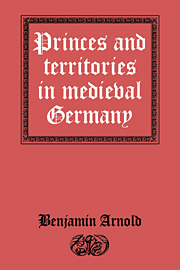
Princes and Territories in Medieval Germany by Benjamin Arnold
Princes and Territories in Medieval GermanyThis book addresses the most important question in pre-modern German political history: why did a multiplicity of states and territories emerge by the end of the Middle Ages instead of an incipient 'nation state' under the crown? The answer is found not in the supposed failures of German kingship, but instead in the creative aristocratic successes of the secular dynasties and princes of the Church. We see how their collective efforts in the centuries after 1050 added up to a more markedly territorial structure of regional power, already emerging by the thirteenth century as a result of their endeavours in the economy, internal and external colonization, and the establishment of new castles, towns, monasteries and communications; in local, ecclesiastical and imperial law, and the jurisdictional reform which they imposed in their regions; and in the uses of dynastic politics, including feuds as well as alliances, inheritance and partition.


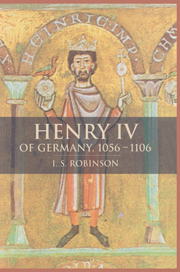
Henry IV of Germany 1056–1106 by IS Robinson
Henry IV of Germany 1056–1106This is the first book in English devoted to the German king and emperor Henry IV (1056–1106), whose reign was one of the most momentous in German history and a turning-point in the history of the medieval empire (the kingdoms of Germany, Italy and Burgundy). The reign was marked by continuous rebellions and fluctuating fortune. Earlier monarchs had also witnessed conflict between crown and aristocracy, but Henry IV's reign differed in that his conflicts could never be definitively resolved either by negotiation or by war. During the 1070s the young king gained a lasting reputation for tyranny, while his assertion of the crown's traditional rights over the imperial church aroused papal opposition. The alliance between the German princes and the papacy haunted Henry IV for the rest of his life. He meanwhile, by turns opportunist and compromiser, dedicated himself at all times to preserving the traditional rights of the monarchy.


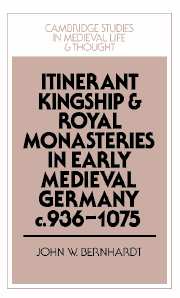
Itinerant Kingship and Royal Monasteries in Early Medieval Germany, c.936–1075 by John W. Bernhardt
Itinerant Kingship and Royal Monasteries in Early Medieval Germany, c.936–1075In examining the relationship between the royal monasteries in tenth- and eleventh-century Germany and the German monarchs, this book assimilates a great deal of European scholarship on a central problem - that of the realities and structures of power. It focuses on the practical aspects of governing without a capital and while constantly in motion, and on the payments and services which monasteries provided to the king and which in turn supported the king's travel economically and politically. Royal-monastic relations are investigated in the context of the 'itinerant kingship' of the period to determine how this relationship functioned in practice. It emerges that German rulers did in fact make much greater use of their royal monasteries than has hitherto been recognised.

Saturday, March 28, 2020

Kings, Usurpers, and Concubines in the 'Chronicles of the Kings of Man and the Isles' by R. Andrew McDonald

Kings, Usurpers and Concubines explores the representation of sea kings, sinners, and saints in the mid-thirteenth century Chronicles of the Kings of Man and the Isles, the single most important text for the history of the kingdoms of Man and the Isles, c.1066-1300. 

The focus of the Chronicles on the power struggles, plots and intrigues within the ruling dynasties of Man and the Isles offers an impressive array of heroes and villains. The depiction of the activities of heroic sea kings like Godred Crovan, tyrannical usurpers like Harald son of Godred Don, and their concubines and wives, as well as local heroes like Saint Maughold, raises important questions concerning the dynamic interactions of power, gender and historical writing in the medieval Kingdoms of Man and the Isles, and provide new insights into the significance of the text that is our most important source of information on these ‘Forgotten Kingdoms’ of the medieval British Isles.


list of books by R. Andrew McDonald @ Goodreads

Saturday, March 14, 2020

The King’s Bishops by E. Crosby

This is the first detailed comparative study of patronage as an instrument of power in the relations between kings and bishops in England and Normandy after the Conquest. Esteemed medievalist Everett U. Crosby considers new perspectives of medieval state-building and the vexed relations between secular and ecclesiastical authority. 


Sunday, November 17, 2019

Review: The Ismaili Assassins by James Waterson

4895606
Synopsis: The Ismaili Assassins were an underground group of political killers who were ready to kill Christians and Muslims alike with complete disregard for their own lives. These devoted murderers were under the powerful control of a grand master who used assassination as part of a grand strategic vision that embraced Egypt, the Levant and Persia and even reached the court of the Mongol Khans in far away Qaraqorum. The Assassins often slayed their victims in public, cultivating their terrifying reputation. They assumed disguises and their weapon of choice was a dagger. The dagger was blessed by the grand master and killing with it was a holy and sanctified act poison or other methods of murder were forbidden to the followers of the sect.


The Ismailis have had a long and eventful history, stretching over more than 12 centuries, during which they subdivided into a number of major branches and minor groupings. They came into existence as a separate Shi‘i community around the middle of the eighth century; and, in medieval times, they twice founded states of their own, the Fatimid caliphate and the Nizari state. 

The first group of assassins to be found in the historical record is that of the Hashshashin who operated in Persia, Syria, and Turkey, eventually spreading throughout the Middle East. Being much weaker than their main adversaries in conventional military terms, the Nizaris relied on guerrilla warfare that included espionage, infiltration of enemy territory, and targeted killings of enemy leaders. 

When the fortress of the Assassins was conquered in 1256, their library was destroyed so there are no written historical accounts from the sect itself available to us. Those accounts that have survived into our times have come down to us in the form of the recollections from two openly hostile sources - Sunni Muslims and Crusaders.  The more outlandish aspects of the legends, such as the use of drugs, are not supported by Ismaili sources. Even the name Assassin, from the Arabic hashashi, was a pejorative term and was never used by the Nizaris themselves. Nor were the Nizaris unique in their use of political murder. Sunnis and Crusaders in the Middle East also practiced assassination. And, of course, Europeans were perfectly adept at killing off their political rivals long before the Nizaris came along.

The distorted image of the Ismailis in general and the Nizari Ismailis in particular was maintained in orientalist circles until the opening decades of the twentieth century, although this fanciful impressions of the Orient had long persisted since the Middle Ages. Like the proverbial Chinese whisper, these idea evolved over time until legend was regarded as fact. A truly scholarly assessment of the Ismailis had to await the recovery and study of a large number of Ismaili texts, a process that did not start until later in the 20th century when progress in Islamic studies, and a remarkable modern breakthrough in the study of the history and doctrines of the Ismailis, have finally made it possible to dispel once and for all some of the seminal legends of the ‘Assassins’.

Image result for ismaili assassins
As per the synopsis, "The Ismaili Assassins explores the origins, actions and legacy of this notorious sect. Enriched with eyewitness accounts from Islamic and Western sources, this important book unlocks the history of the Crusades and the early Islamic period, giving the reader entry into a historical epoch that is thrilling and pertinent."

I came into this wanting to know more about the sect that I had come across in my own studies of the Crusades - those allegedly responsible for the murders of Raymond II of Tripoli and Conrad of Montferrat. I was not disappointed. Waterson presents us with a historically accurate and detailed account of the Ismaili Asaassins, from their earliest inception to their devastation at the hands of the Mongols, and all the complicated political and dynastic maneuvering in between. definitely one for the history shelf of my Library.


further reading
The Templars and the Assassins: The Militia of Heaven by James Wasserman
Eagle's Nest: Ismaili Castles in Iran and Syria by Peter Willey
The Assassin Legends: Myths of the Isma'ilis by Farhad Daftary, Antoine Isaac Baron & Silvestre de Sacy
The Assassins: A Radical Sect in Islam by Bernard Lewis
The Assassins of Alamut by Anthony Campbell
Ismaili History and Intellectual Traditions by Farhad Daftary
Hasan-I-Sabbah: His Life and Thought by Dr Ali Mohammad Rajput
The Secret Order of Assassins: The Struggle of the Early Nizârî Ismâʻîlîs Against the Islamic World by Marshall G. S. Hodgson
The Isma'ilis: Their History and Doctrines by Farhad Daftary


further reading online
National Geographic Magazine
History Net


Saturday, November 16, 2019

Review: Stephen and Matilda's Civil War - Cousins of Anarchy by Matthew Lewis

Synopsis: The Anarchy was the first civil war in post-Conquest England, enduring throughout the reign of King Stephen between 1135 and 1154. It ultimately brought about the end of the Norman dynasty and the birth of the mighty Plantagenet kings. When Henry I died having lost his only legitimate son in a shipwreck, he had caused all of his barons to swear to recognize his daughter Matilda, widow of the Holy Roman Emperor, as his heir and remarried her to Geoffrey, Count of Anjou. When she was slow to move to England on her father’s death, Henry’s favorite nephew Stephen of Blois rushed to have himself crowned, much as Henry himself had done on the death of his brother William Rufus. By following both sides of the dispute and seeking to understand their actions and motivations, Matthew Lewis aims to reach a more rounded understanding of this crucial period of English history and asks to what extent there really was anarchy.

Again, this is not a period that I have come into blindly - I have a number of books on the subject matter on my own books shelves. What I found in Lewis' book, with his alternating chapters between Stephen and Matilda, was a more balanced history of this turbulent period.

For most, the most common definition of this period is summarised as follows:
The Anarchy was a civil war in England and Normandy between 1135 and 1153, which resulted in a widespread breakdown in law and order. The conflict was a succession crisis precipitated by the accidental death by drowning of William Adelin, the only legitimate son of Henry I, in the sinking of the White Ship in 1120
However, what Lewis questions is that whilst this period was called The Anarchy, did this period between the death of Henry I (1153) and the accession of Henry II (1154) - see a complete and total breakdown and absence of government during Stephen's reign. For the very definition of the word anarchy is ".. a state of disorder due to absence or non-recognition of authority or other controlling systems ..." and ".. absence of government and absolute freedom of the individual, regarded as a political ideal. ..."  For this was not the case - a king was in situ and recognised by both the Church and the Anglo-Norman Magnates, including Robert of Gloucester.

The Anarchy was quite simply a civil war in which there were four potential claimants - with only two interested enough to battle it out for a period of 19 years - Stephen and Matilda. I am taken back to the events of the Norman Conquest, when the death of a King left the playing field wide open - in this instance, we are not only left with a male relative who was favoured by the late King but with a female, whilst of unquestionable royal blood, at a time when such acceptance of a sole female monarch was just not on the cards. There was only one crown ... and for as long as one wanted it and the other refused to give it up, there were be no coming to terms.

The actual violence and destruction was not as widespread as is documented by the three main contemporary writers of the times, all of whose accounts are riddled with their own forms of bias. These chronicles were in essence, written by churchmen, recounting localised events and their direct effects whilst providing an opportunistic moral lesson at the same time.

England was hardly the peaceful realm when Stephen took the throne (for succession was still not hereditary at this point) - Normandy was in rebellion, Scotland and Wales were simmering with tension, and the selection of a king was more preferable to ".. the enforcement of lineal descent ...'' and the oaths made under duress in favour of the late king's nominated heir. Matilda was absent and in no hurry; Stephen, like his uncle before him, was on the spot, and once anointed, few with loathe to remove him  "... for who can stretch out his hand against the Lord’s anointed ....".

As I mentioned, Lewis portrays both Stephen and Matilda evenly.  Stephen is lauded for his careful balancing act in governing and maintaining unity of the realm whilst not upsetting the powerful magnates around him and on both sides of the Channel; and Matilda, who had " ... achieved more than many of her sex in her period .." and like so many women both before and after her, is only remembered for the men in her life. This is a fascinating period of history filled with powerful personalities that is worth exploring, and this book will provide a good introduction into the period.


further reading:
The Anarchy of King Stephen's Reign edited by Edmund King
Matilda: Empress, Queen, Warrior by Catherine Hanley
King Stephen and the Anarchy by Chris Peers
Stephen and Matilda: The Civil War of 1139-53 by Jim Bradbury
The Empress Matilda: Queen Consort, Queen Mother and Lady of the English by Marjorie Chibnall
The Reign of Stephen: Kingship, Warfare and Government in Twelfth-Century England by Keith J. Stringer
King Stephen's Reign (1135-1154) edited by Paul Dalton & Graeme J. White
King Stephen by Donald Matthew
Henry I by C. Warren Hollister
Henry I: King of England and Duke of Normandy by Judith A. Green
The Government of England Under Henry I by Judith A. Green