Showing posts with label crusades. Show all posts

Monday, September 29, 2025

Review: Medieval Nuns At War by Elizabeth Quillen

Synopsis: Medieval Nuns at War by Elizabeth Quillen uncovers the extraordinary lives of nuns who defied expectations, embracing roles that went far beyond contemplation and prayer. From the rebellion of Princess Clothild and her sister Basina, who led mercenaries to storm their abbey, to Queen Radegund's quest for autonomy within the cloistered world of Poitiers, these stories reveal women unafraid to wield power in times of crisis. "These women made their marks briefly, but brightly in the pages of chronicles, poems, and letters," Quillen writes, bringing to life their audacity and ambition in shaping medieval society.

Quillen's deeply researched narrative explores how these nuns balanced spiritual devotion with an intense drive for influence, often clashing with both secular and ecclesiastical authorities. Not content to remain within convent walls, women like Leoba, who served as an imperial regent, and Hildegund von Schonau, who disguised herself as a monk to escape persecution, exemplify the resilience of medieval nuns. Quillen illustrates how convents functioned as political centres, not isolated enclaves, with nuns as pivotal figures in military defence, treaty negotiations, and even political rebellion.

For readers fascinated by the hidden currents of medieval history, Medieval Nuns at War is a rare treasure. Quillen's captivating prose and meticulous scholarship shed new light on these "rebellious, resilient, and rowdy women," who not only fought for survival but also left indelible marks on their societies. Through letters, chronicles, and centuries-old biographies, this book finally gives these fearless women the recognition they deserve as warriors, leaders, and guardians of their communities.

~ ~ ~

Having read this book, I am probably not the best person to provide a review for a reader new to this topic. I read (and have read) quite extensively across the periods of history under study here, am familiar with the names and stories, so I get a little picky with topics that don't live up to their hype - specifically some of the tediously anachronistic titles that don't follow up with any meaningful substance.

The subjects at hand were at least varied from the Merovingian period right through the Crusades and to the 17th century - and kudos certainly for providing a modicum of originality in the choice of subjects. However, the lack of adequate information and the overall density of that provided made for very dull reading, and a tome that had to be "propped up" with other pieces of information not directly relevant to the topic at hand (the chapter on the Crusades stands out in this).

To be honest, the more I think about this, the more I wonder what the actual premise was ...... provide a sourcebook on nuns or other female religieuse who went to war / war zones, or who battled it out for power between themselves or rival institutions - both could have been achievable with a great deal of selective editing, and a few more examples.  

We the reader are fully aware of the political role played but some female religieuse, who stepped out of their community and into the secular world - even more documentation and examples in this field would have been welcomed - but again, there was a scarcity.  The focus in some chapters was so narrow that there was inadequate data to fill them - and so the "puff" was added - again, other examples would have been quite sufficient.

Again, one must be careful when one attributes so much to their subject but fails to deliver.  The reader does not like to be deceived.

The more I read, the more diverse I am becoming, looking for niche topics. I am not concerned with quantity - just quality! Less is more I believe someone once said - the same applies to books. We know you have done your research - it doesn't need for every piece to be put into print. This just didn't work for me.

The two stars is for Catelina de Erauso, whom I discovered many many years ago, and am glad to see someone else has now.

Monday, December 30, 2024

Review: Sword Brethren by Jon Byrne

Synopsis: 1242. After being wounded in the Battle on the Ice, Richard Fitz Simon becomes a prisoner of Prince Alexander Nevsky of Novgorod. Alexander, intrigued by his captive’s story, instructs his scholar to assist Richard in writing about his life.

Richard’s chronicle begins in 1203, when his training to be a knight is disrupted by treachery. He is forced to flee England for Lübeck, where he begins work for a greedy salt merchant. After an illicit love affair, his new life is thrown into turmoil, and he joins the Livonian Brothers of the Sword as they embark on imposing the will of God on the pagans of the eastern Baltic.

Here, he must reconcile with his new life of prayer, danger and duty – despite his own religious doubts, with as many enemies within the fortified commandery as the wilderness outside. However, when their small outpost in Riga is threatened by a large pagan army, Richard is compelled to make a crucial decision and fight like never before.

~ ~ ~

The premise intrigued me. Much has been written about the Crusades to Outremer, France, Constantinople and Spain, but very little has been dedicated to what is referred to as the Northern Crusades - the Christianisation of the Baltic by the Teutonic Knights and their kindred orders.

This fictional work is told in hindsight, narrated by our protagonist Richard, a Norman from England, who has found his way into one of the most conclusive battles of the 13th Century against the legendary Alexander Nevsky. How did he end up there is the crux of the narrative, as it is told in flashback by the aged and war weary Richard. His story begins with events in England and the reasons for his departure and eventual arrival in Lubeck. With a far from settled life, Richard is bound for Riga with the Sword Brethren.

Whilst the pace slowed in some places, I was overall engaged with the narrative (I did read it in one sitting), so much so that it had me reaching for my copy of Eric Christiansen's "The Northern Crusades" and flicking back to see that, yes, the Sword Brethren did actually exist! The Sword Brethren, however, were not the only Order battling away in the Baltic - there were many fingers in the pie, sometimes working together, oft times at odds with each other. It is a truly fascinating period of history, and one I am glad to see brought into the mainstream readership.

Looking forward to the continuation of Richard's narrative as the series progresses.

Monday, April 22, 2024

Review: House of Lilies by Justine Firnhaber-Baker

Synopsis: The definitive history of the Capetians, the crusading dynasty that made the French crown the wealthiest and most powerful in medieval Europe and forged France as we know it today

In House of Lilies , historian Justine Firnhaber-Baker tells the epic story of the Capetian dynasty of medieval France, showing how their ideas about power, religion, and identity continue to shape European society and politics today.

Reigning from 987 to 1328, the Capetian kings became the most powerful monarchy of the Middle Ages and established the foundations of a shared French culture. Consolidating a fragmented realm that eventually stretched from the Rhône to the Pyrenees, they were the first royal house to adopt the fleur-de-lys, displaying this lily emblem to signify their divine favor and legitimate their rule. The Capetians played a part in some of the most dramatic and far-reaching episodes in European history, including the Crusades, bloody waves of religious persecution, and a series of wars with England. The Capetian age saw the emergence of Gothic architecture, the romantic ideals of chivalry and courtly love, and the Church’s role at the center of daily life.

Evocatively interweaving these pivotal developments with the human stories of the rulers who drove them, House of Lilies is the definitive history of the dynasty that forged France—and Europe—as we know it.

~ ~ ~

Four stars for the following reasons:

* easy to read
* informative though not dull or dry
* covers the Capetian Dynasty well, including the women
* well researched
* additional notes, maps, family trees

Covering nearly over three centuries of French history and international politicking, Firnhaber-Baker does a remarkable job at presenting one of the pivotal dynasties in French history - the Capetians. This work has all the elements: religious fervor and upheaval, crusades,scandal, warfare, adultery, ambition, family drama, politicking - and on a magnificent grandiose scale.

Each monarch has their own dedicated chapter which covers off the pivotal moments of their reign, including each monarch's relationships with France's closest neighbours - England, Normandy, Flanders, Blois, Anjou, Valois - as France as we know it today, was still very much in its infancy and only really beginning to coalesce.

Recommended reading for those with an interest in French history and royal dynasties.

Sunday, April 17, 2022

Review: The Normans by Judith Green

Synopsis: A bold new history of the rise and expansion of the Norman Dynasty across Europe from Byzantium to England.

In the eleventh century the climate was improving, population was growing, and people were on the move. The Norman dynasty ranged across Europe, led by men who achieved lasting fame like William the Conqueror and Robert Guiscard. These figures cultivated an image of unstoppable Norman success and their victories make for a great story, but how much of it is true?

In this insightful history, Judith Green challenges old certainties and explores the reality of Norman life across the continent. There were many soldiers of fortune, but their successes were down to timing, good luck, and ruthless leadership. Green shows the Normans’ profound impact, from drastic change in England to laying the foundations for unification in Sicily, to their contribution to the First Crusade. Going beyond the familiar, she looks at personal dynastic relationships and the important part women played in what at first sight seems a resolutely masculine world.


I will preface this review by saying - reader beware.! This is not a casual and cursory look at the Normans that will appeal to the general masses; it is a more focused narrative that assumes that you - the reader - have done your due diligence and a sufficient enough grasp of the topic at hand to absorb the information contained therein.

The focus of Green's book is the Normans and their activities as related to a specific time period - the 11th Century - and is narrowed down to particular theatres of war - England, Normandy, Byzantium, Sicily & Southern Italy, Antioch & the Holy Land. It is also a look at how contemporary writers and chroniclers viewed them as well as their own perceptions of self.

Green begins with a look at the various contemporary writers and chroniclers in England (Malmesbury, Worcester, Huntingdon, Monmouth), Normandy (Dudo William of Jumieges, Vitalis, Wace), Southern Italy & Sicily (Malatera, William of Apulia, Amatus of Montecassin), and of course the Crusades (Ralph of Caen). This list is by no means complete as there are a number of others included as well. In this chapter Green also explores the relationships between subject matter and author, the issues of patronage, potential audience and the accessibility of sources.

We next move to Normandy for a look at the structure of Norman society, its emergence, the outward persona of warrior class, and the internal struggles within for dominance. This leads into the next chapter "swords for hire" and a look at the role of Normans as mercenaries throughout Europe and the Baltic. Here Green notes that 11th Century Europe was swarming with armed men who for for wealth, land and prestige. So what made this particular group that much more successful than others - this is what is explored. Green includes a number of prominent families in her narrative, as well as some much lesser ones (which are the ones I am always on the look out for).

Moving south, we explore the activities and personalities of the Normans in Southern Italy and Sicily from their earliest arrival as armed pilgrims to the arrival of Robert Guiscard and the legitimisation of the new kingdom and its conquests. A brief side visit to Byzantium is also covered off for this will have an impact of future relationships.  This is one of my favourite periods of Norman History (and dominates my personal library).

Doubling back, Green takes us to one of the more well know of the Norman conquests - England in 1066. This was no gentle take-over but one that would see years of resistance and rebellion, and the invasions of neighbouring nations of Scotland, Wales and Ireland. This period would also see the creation of the Domesday Book - a survey every shire in England, and some parts of Wales, to list all holdings and calculate the dues owed to William.

And then to our final field of activity - The Crusades and the establishment of the Norman Principality of Antioch. Green provides an assessment of the various Norman leaders (Bohemond, Tancred, Robert of Normandy), their motives for embarking on this great military and religious endeavour, their successes and their failures.


The remaining chapters encompasses a more rounded view of the Normans, covering such topics as government and power, settlement and conquest, church and state, culture and construction. And it is this lasting legacy that Green concludes with, wherein she notes that they were - in essence - "... ruthless opportunists [who] were able to change the political history of Europe ...". But this is merely one one part of who the Normans were - for they were also exceptional strategists, inventive, progressive, militaristic, pious, opportunistic, ruthless - and utterly compelling and unforgettable.

This is definitely one for my own library shelves, and my own personal collection of Norman literature.

Tuesday, September 7, 2021

Fulk and Melisende : King and Queen of Jerusalem by Danielle Park

Synopsis: Melisende and Fulk governed the Kingdom of Jerusalem during a period of significant change which coincided with the rise of Zengi and the subsequent union of Mosul and Aleppo under one ruler, the atabeg's attempts to control Damascus, and the consolidation of a more coherent and cohesive anti-Frankish campaign from the Muslim forces. This book will provide an extensive survey of Fulk and Melisende's reign, place their rule within the broader framework of kingship in the Crusader States, and consider the developments that took place under their governance. 

This volume will begin by addressing the couple's 'back-history' - Melisende's role as heiress, Fulk's political and military background in Anjou, and his experiences in the Holy Land before his second marriage - which must have shaped their approach to the government of the Latin East. Later chapters will investigate the dynamics of their political partnership, assess the decisions made in the kingdom of Jerusalem, determine their roles and impact in the internal and external politics and diplomacy, and detail the couple's working relationship through evaluation of their charters - which dealt with diverse matters such as law, donations and the endorsing of transactions. 


A final section of the book will focus on the memory of their reign and discuss the perceptions of both the king and queen as expressed during their lifetimes in contemporary letters and narrative accounts, and afterwards in later chronicles, charters, and manuscript illustrations down to the end of the thirteenth century. This will explore the gendered depictions of the pair and how well they fitted into the established patterns of gender and power, particularly in the light of Fulk acquiring his title through marriage rather than his own bloodline, and the impact of her husband's death on expectations of Melisende.

The Making of Crusading Heroes and Villains by Mike Horswell & Kristin Skottki

Engaging the Crusades is a series of volumes which offer windows into a newly emerging field of historical study: the memory and legacy of the crusades. Together these volumes examine the reasons behind the enduring resonance of the crusades and present the memory of crusading in the modern period as a productive, exciting, and much needed area of investigation.

This new volume explores the ways in which significant crusading figures have been employed as heroes and villains, and by whom. Each chapter analyses a case study relating to a key historical figure including the First Crusader Tancred; ‘villains’ Reynald of Châtillon and Conrad of Montferrat; the oft-overlooked Queen Melisende of Jerusalem; the entangled memories of Richard ‘the Lionheart’ and Saladin; and the appropriation of St Louis IX by the British. Through fresh approaches, such as a new translation of the inscriptions on the wreath laid on Saladin’s tomb by Kaiser Wilhelm II, this book represents a significant cutting-edge intervention in thinking about memory, crusader medievalism, and the processes of making heroes and villains.

The Making of Crusading Heroes and Villains is the perfect tool for scholars and students of the crusades, and for historians concerned with the development of reputations and memory.


Saturday, August 7, 2021

Review: Crusaders and Revolutionaries: De Montfort by Darren Baker

Synopsis: One of the families that dominated the thirteenth century were the de Montforts. They arose in France, in a hamlet close to Paris, and grew to prominence under the crusading fervour of that time, taking them from leadership in the Albigensian wars to lordships around the Mediterranean. They marry into the English aristocracy, join the crusade to the Holy Land, then another crusade in the south of France against the Cathars.The controversial stewardship of Simon de Montfort (V) in that conflict is explored in depth. It is his son Simon de Montfort (VI) who is perhaps best known. His rebellion against Henry III of England ultimately establishes the first parliamentary state in Europe.

The decline of the family begins with Simon’s defeat and death at Evesham in 1265. Initially they revive their fortunes under the new king of Sicily, but they scandalise Europe with a vengeful political murder. By this time it is the twilight of the crusades era and the remaining de Montforts either perish or are expelled. Eleanor de Montfort, the last Princess of Wales, dies in childbirth and her daughter is raised as a nun.


I had been drawn to the de Montforts many years ago, long before this book was quite possibly conceived, so was immediately attracted to the fact that the focus of this was on the family themselves, particularly as pertaining to the remnants of the family post Evesham.

The de Montforts appeared on the political scene during the crusading era, and were, for all intents and purposes, enthusiastic in their support. This did not necessarily mean that they were always in agreeance with motivations of those pulling the strings, however, it may help us to understand the religious fervour of later generations.

They were a family with their collective fingers in many political pies - their ties with other notable and powerful families as well as the crowns of both England and France, I feel, had been long forgotten until now as Baker weaves all the threads together into one tome. The de Montforts' connections - socially, politically and familially - often saw them at odds with each other, despite the fact that they were an extremely tight-knit family collective - and Baker demonstrates this well.

There is ample research done of the early de Montforts but the focus will always be on father and son - Simon V and Simon VI - whose exploits have come down to us over the many years, and are explored in depth here as well. But as I mentioned earlier, for me, it was the latter de Montforts that I was particularly interested in, and was able to glean a few snippets to enhance my knowledge. And readers will be interested in the role of the de Montfort women, who were no shrinking violets.

The de Montforts ended how they began, in obscurity. But whilst in the ascendant, they were the Icarus of their generation - flying that little bit too close to the sun. This is one tome that I will definitely be adding to my own library.

Saturday, July 24, 2021

Review: The Knights Templar by Michael Kerrigan

Synopsis: The Templars, the Knights Hospitallers, the Teutonic Knights – the chivalric orders founded during the Crusades evoke romantic images of warrior monks who were fierce but spiritual, chaste and pious yet battle-ready. But what were they really like? How did their organisations form, rise and decline? And how much of what we think about them is myth?

The Knights Templar tells the stories of the major and minor military orders from the 11th century to – in the case of the surviving orders – the present day. Organised chronologically, the book follows the fates of orders, from the foundation of the Knights of St Peter in 1053 to the major crusading era in the Holy Land in the 12th and 13th centuries, from the Teutonic Knights in the Baltic to the Reconquista in Iberia and on to the Hospitallers’ later ventures in the Mediterranean and even in the Caribbean.

Full of surprising details, the book not only explores how the military and religious aspects of the orders were reconciled, but also looks more broadly at the orders’ work, from the Templars’ role in the development of modern banking to hospital, castle and cathedral building, from the Teutonic Knights’ treatment of non-believers to the Hospitallers’ battles against Barbary pirates. Illustrated with 180 colour and black-&-white photographs, artworks and maps, The Knights Templar is a fascinating history of about some of Europe’s most often misunderstood organisations.


Definitely aimed at the "commercial" market and the younger reader, and certainly not the advanced reader looking for a more scholarly tome.

Introduction is on the early knights, courtly love, Arthurian mythos, with a side tour to the world of the Benedictine monks. The focus is not just the Templars, but also the Hospitallers, Teutonic Knights, and other European knightly orders in both the Holy Land and Europe as centered mainly around the Mediterranean. Kerrigan also covers off the basics, and the usual myths and allegations.

There are plenty of maps, images, side text boxes and catchy headings which reminded me of the presentation style of the current popular "History" magazines (which I do buy myself - for the articles of course!).

Well below my reading level - and quite frankly, nothing new has been presented here.

Friday, April 2, 2021

Review: Bohemond of Taranto by George Theotokis

Synopsis: Bohemond of Taranto, Lord of Antioch, unofficial leader of the First Crusade, was a man of boundless ambition and inexhaustible energy - he was, in the words of Romuald of Salerno, 'always seeking the impossible'. While he failed in his quest to secure the Byzantine throne, he succeeded in founding the most enduring of all the crusader states. Yet few substantial accounts of the life of this remarkable warrior have been written and none have been published in English for over a century - and that is why this absorbing new study by Georgios Theotokis is of such value.

He concentrates on Bohemond as a soldier and commander, covering his contribution to the crusades but focusing in particular on his military achievements in Italy, Sicily, the Balkans and Anatolia. Since medieval commanders generally receive little credit for their strategic understanding, he examines Bohemond's war-plans in his many campaigns, describes how he adapted his battle-tactics when facing different opponents and considers whether his approach to waging war was typical of the Norman commanders of his time.


Before complaining that this is NOT a biography (as a small number of reviewers / readers have), the synopsis clearly states that the author " ... concentrates on Bohemond as a soldier and commander, covering his contribution to the crusades but focusing in particular on his military achievements in Italy, Sicily, the Balkans and Anatolia ...".  

And whilst Theotokis does cover off - albeit briefly - a history of the Normans in southern Italy and Bohemond's antecedent's, this is an assessment of his achievements (and failures) as a strategist and commander, focusing on the most prominent parts of Bohemond's military career.  As such, it is quite an admirable undertaking.

If you have sought this book out, then there is an implied assumption that a cursory knowledge of the times and of the crusades is held by the reader. I am not going to re-hash any of this information here either on Bohemond or the Crusades - and will suggest undertaking further reading if your interest is so piqued.

The military focus is centred around Bohemond's involvement in both his own and his father's campaigns in Italy, Anatolia, the Balkans, and the Latin East. The sources used as contemporary - and like today's - occasionally tinged with bias. Yes, it would be great to be able to access more sources from his "enemies" - and hopefully one day these will become more readily available and a truer picture of this restless, enigmatic and oft times, impetuous warrior may be told.

In the meantime, I would suggest reading this along with the more dedicated Crusader and Norman narratives. This is definitely one for my own library (alongside Theotokis' other tome - The Norman Campaigns in the Balkans).

Wednesday, November 4, 2020

Siege Warfare during the Crusades by Michael Fulton

Sieges played a key role in the crusades, but they tend to be overshadowed by the famous battles fought between the Franks and the Muslims, and no detailed study of the subject has been published in recent times. 

He considers the history of siege warfare in the Holy Land from every angle – the tactics and technology, the fortifications, the composition of the opposing armies, and the ways in which sieges shaped Frankish and Muslim strategy at each stage of the conflict. The differences and similarities between the Eastern and Western traditions are explored, as is the impact of the shifting balance of power in the region.

The conclusions may surprise some readers. Neither the Muslims nor the Franks possessed a marked advantage in siege technology or tactics, their fortifications reflected different purposes and an evolving political environment and, although there were improvements in technologies and fortifications, the essence of siege warfare remained relatively consistent.


read review by Peter Purton @ De Re Militari

Saturday, October 24, 2020

Baldric of Bourgueil: "History of the Jerusalemites" translated by Susan Edgington

The first translation of Baldric's Historia Ierosolimitana, a spirited account of the First Crusade, into modern English.

The Historia Ierosolimitana is a prose narrative of the events of the First Crusade written at the abbey of Bourgueil in the Loire Valley around 1105. Its author, the abbot Baldric, used the anonymous Gesta Francorum for much of the factual material presented, but provided literary enhancements and amplifications of the historical narrative and the characters found therein, in order, as Baldric says, to make the Historia a more worthy account of the miraculous events it describes.

This volume provides the first modern-language translation of the Historia, with a full introduction setting out its historical, social, political and manuscript contexts, and notes. It will contribute to a revised exploration of the First Crusade, and facilitate much wider debates about the place of history writing in medieval culture, textuality and manuscript transmission.

Saturday, June 27, 2020

Review: Anna Komnene and the Alexiad by Loulia Kolovou

Anna Komnene and the Alexiad: The Byzantine Princess and the First CrusadeSynopsis: Anna Komnene is one of the most curious figures in the history of an intriguing empire. A woman of extraordinary education and intellect, she was the only Byzantine female historian and one of the first and foremost historians in medieval Europe. Yet few people know of her and her extraordinary story. Subsequent historians and scholars have skewed the picture of Anna as an intellectual princess and powerful author. She has been largely viewed as an angry, bitter old woman, who greedily wanted a throne that did not belong to her. Accusations of conspiracy and attempted murder were hurled at her and as punishment for her 'transgressions' she was to live the last days of her life in exile. It was during her time in a convent, where she was not a nun, that she composed the Alexiad, the history of the First Crusade and the Byzantine Emperor, Alexios I Komnenos (1081-1118), her father.

This book aims to present Anna Komnene - the fascinating woman, pioneer intellectual, and charismaticc author - to the general public. Drawing on the latest academic research to reconstruct Anna's life, personality and work, it moves away from the myth of Anna the conspirator and 'power-hungry woman' which has been unfairly built around her over centuries of misrepresentation. It places Anna Komnene in the context of her own time: the ancient Greek colony and medieval Eastern Roman empire, known as Byzantium, with the magnificent city of Constantinople at its heart. At the forefront of an epic clash between East and West, this was a world renowned for its dazzling wealth, mystery and power games. It was also known for a vigorous intellectual renaissance centuries before its western counterpart. This was a world with Anna Komnene directly at the centre. 


Whilst a little prior knowledge would be suggested, it is not necessary. Anyone with an interest in Byzantium, female historians, notable women, will find this to be a welcome addition to their own libraries.

Kolovou discusses Anna's family (important in the scheme of things), her birth, childhood, education, marriage - all though in the context of her father's reign as Emperor. Throughout, Kovolou uses many sources (including Anna's own words), not just those previously favoured by Western writers, to give a more rounded picture of Anna. Kovolou also addresses ambiguous passages or prior critiques of The Alexiad, and sets them up in the context that they were not only originally written but also according to Anna's own education and scholastic reading. Yes there were times when the author mentioned "more of that later" - only to indicate that the current discussion would not be derailed by going off topic midway through to pick up on something that would be presented in more detail - and in context - later on the book.

Most readers of The Alexiad will pick up this tome for Anna's detail on the First Crusade - and as has been mentioned, it is the only Greek source available. I myself was tempted on more than one occasion to pick up my copy of The Alexiad and read it in conjunction with Kovolou's work - indeed, the author says at the end that it is her hope that the reader will do just that!

With a glossary of terms, maps, family trees a timeline for Anna herself, and an easy narrative, the reader will have no trouble following the story of this remarkable woman and her creation - The Alexiad.


Sunday, May 10, 2020

Books: The Crusades

Medicine in the Crusades: Warfare, Wounds and the Medieval Surgeon by Piers D. Mitchell
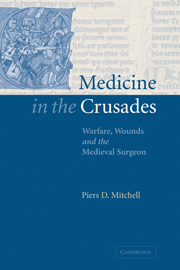
Medicine in the CrusadesThis is the first book to be published on any aspect of medicine in the crusades. It will be of interest not only to scholars of the crusades specifically, but also to scholars of medieval Europe, the Byzantine world and the Islamic world. Focusing on injuries and their surgical treatment, Piers D. Mitchell considers medical practitioners, hospitals on battlefields and in towns, torture and mutilation, emergency and planned surgical procedures, bloodletting, analgesia and anesthesia. He provides an assessment of the exchange of medical knowledge that took place between East and West in the crusades, and of the medical negligence legislation for which the kingdom of Jerusalem was famous. The book presents a radical reassessment of many outdated misconceptions concerning medicine in the crusades and the Frankish states of the Latin East.


The Cambridge Companion to the Literature of the Crusades edited by Anthony Bale
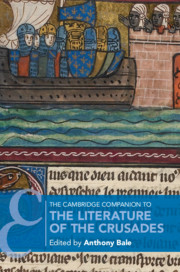
The Cambridge Companion to the Literature of the CrusadesHow were the Crusades, and the crusaders, narrated, described, and romanticised by the various communities that experienced or remembered them? This Companion provides a critical overview of the diverse and multilingual literary output connected with crusading over the last millennium, from the first writings which sought to understand and report on what was happening, to contemporary medievalism, in which crusading is a potent image of holy war and jihad. The chapters show the enduring legacy of the crusaders' imagery, from the chansons de geste to Walter Scott, from Charlemagne to Orlando Bloom. Whilst the crusaders' hold on Jerusalem was relatively short-lived, the desire for Jerusalem has had a long afterlife in many cultural contexts and media.


The Tunis Crusade of 1270: A Mediterranean History by Michael Lower
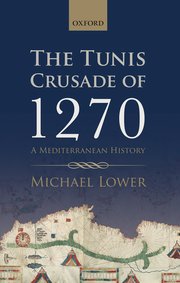
Cover for 

The Tunis Crusade of 1270Why did the last of the major European campaigns to reclaim Jerusalem end in an attack on Tunis, a peaceful North African port city thousands of miles from the Holy Land? In the first book-length study of the campaign in English, Michael Lower tells the story of how the classic era of crusading came to such an unexpected end. Unfolding against a backdrop of conflict and collaboration that extended from England to Inner Asia, the Tunis Crusade entangled people from every corner of the Mediterranean world. Within this expansive geographical playing field, the ambitions of four powerful Mediterranean dynasts would collide. While the slave-boy-turned-sultan Baybars of Egypt and the saint-king Louis IX of France waged a bitter battle for Syria, al-Mustansir of Tunis and Louis's younger brother Charles of Anjou struggled for control of the Sicilian Straits. When the conflicts over Syria and Sicily became intertwined in the late 1260s, the Tunis Crusade was the shocking result.

While the history of the crusades is often told only from the crusaders' perspective, in The Tunis Crusade of 1270, Lower brings Arabic and European-language sources together to offer a panoramic view of these complex multilateral conflicts. Standing at the intersection of two established bodies of scholarship - European History and Near Eastern Studies - this volume contributes to both by opening up a new conversation about the place of crusading in medieval Mediterranean culture.


Crusading in the Fifteenth Century: Message and Impact by Norman Housley
This collection of essays by European and American scholars addresses the changing nature and appeal of crusading during the period which extended from the battle of Nicopolis in 1396 to the battle of Mohács in 1526. Contributors focus on two key aspects of the subject. One is developments in the crusading message and the language in which it was framed. These were brought about partly by the appearance of new enemies, above all the Ottoman Turks, and partly by shifting religious values and innovative currents of thought within Catholic Europe. The other aspect is the wide range of responses which the papacy's repeated calls to holy war encountered in a Christian community which was increasingly heterogeneous in character. This collection represents a substantial contribution to the study of the Later Crusades and of Renaissance Europe.


The Siege of Acre, 1189-1191 Saladin, Richard the Lionheart, and the Battle That Decided the Third Crusade by John D Hosler
"The Siege of Acre, 1189-1191" by John D. HoslerThe first comprehensive history of the most decisive military campaign of the Third Crusade and one of the longest wartime sieges of the Middle Ages.

The two-year-long siege of Acre (1189–1191) was the most significant military engagement of the Third Crusade, attracting armies from across Europe, Syria, Mesopotamia, Egypt, and the Maghreb. Drawing on a balanced selection of Christian and Muslim sources, historian John D. Hosler has written the first book-length account of this hard-won victory for the Crusaders, when England’s Richard the Lionheart and King Philip Augustus of France joined forces to defeat the Egyptian Sultan Saladin. Hosler’s lively and engrossing narrative integrates military, political, and religious themes and developments, offers new perspectives on the generals, and provides a full analysis of the tactical, strategic, organizational, and technological aspects on both sides of the conflict. It is the epic story of a monumental confrontation that was the centerpiece of a Holy War in which many thousands fought and died in the name of Christ or Allah.


The Crusader Armies 1099–1187 by Steve Tibble
"The Crusader Armies" by Steve TibbleA major new history of the Crusades that illuminates the strength and sophistication of the Western and Muslim armies.

During the Crusades, the Western and Muslim armies developed various highly sophisticated strategies of both attack and defense, which evolved during the course of the battles. In this ambitious new work, Steve Tibble draws on a wide range of Muslim texts and archaeological evidence as well as more commonly cited Western sources to analyze the respective armies’ strategy, adaptation, evolution, and cultural diversity and show just how sophisticated the Crusader armies were even by today’s standards.

In the first comprehensive account of the subject in sixty years, Tibble takes a fresh approach to Templars, Hospitallers, and other key Orders and makes the controversial proposition that the Crusades were driven as much by sedentary versus nomadic tribal concerns as by religious conflict. This fluently written, broad-ranging narrative provides a crucial missing piece in the study of the West’s attempts to colonize the Middle East during the Middle Ages.


The Crusader States and their Neighbours: A Military History, 1099-1187 by Nicholas Morton
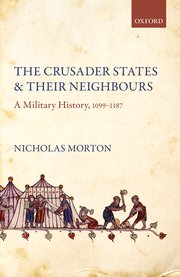
Cover for 

The Crusader States and their NeighboursThe Crusader States and their Neighbours explores the military history of the Medieval Near East, piecing together the fault-lines of conflict which entangled this much-contested region. This was an area where ethnic, religious, dynastic, and commercial interests collided and the causes of war could be numerous. Conflicts persisted for decades and were fought out between many groups including Kurds, Turks, Armenians, Arabs, and the crusaders themselves. Nicholas Morton recreates this world, exploring how each faction sought to advance its own interests by any means possible, adapting its warcraft to better respond to the threats posed by their rivals. Strategies and tactics employed by the pastoral societies of the Central Asian Steppe were pitted against the armies of the agricultural societies of Western Christendom, Byzantium, and the Islamic World, galvanising commanders to adapt their practices in response to their foes. Today, we are generally encouraged to think of this era as a time of religious conflict, and yet this vastly over-simplifies a complex region where violence could take place for many reasons and peoples of different faiths could easily find themselves fighting side-by-side.


Accursed Tower:The Crusaders' Last Battle for the Holy Land by Roger Crowley
"Accursed Tower" by Roger CrowleyThe city of Acre, powerfully fortified and richly provisioned, was the last crusader stronghold. When it fell in 1291, two hundred years of Christian crusading in the Holy Land came to a bloody end. With his customary narrative brilliance and immediacy, Roger Crowley chronicles the tumultuous and violent attack on Acre, the heaviest bombardment before the age of gunpowder, which left this once great Mediterranean city a crumbling ruin.

The ‘Accursed Tower’ was the focal point of this siege. As the last garrison of the Crusader defences, it came to symbolise the disintegration of the old world and the rise of a new era of Islamic jihad. Crowley’s narrative is based on forensic research, drawing heavily on little known first hand sources, both Christian and Arabic. This is a fast-paced and gripping account of a pivotal moment in world history.


Crusading Spirituality in the Holy Land and Iberia, c.1095-c.1187 by William J. Purkis
Crusading Spirituality In The Holy Land And Iberia, C.1095 C.1187For much of the twelfth century the ideals and activities of crusaders were often described in language more normally associated with a monastic rather than a military vocation; like those who took religious vows, crusaders were repeatedly depicted as being driven by a desire to imitate Christ and to live according to the values of the primitive Church.

This book argues that the significance of these descriptions has yet to be fully appreciated, and suggests that the origins and early development of crusading should be studied within the context of the "reformation" of professed religious life in the twelfth century, whose leading figures (such as St Bernard of Clairvaux) advocated the pursuit of devotional undertakings that were modelled on the lives of Christ and his apostles. It also considers topics such as the importance of pilgrimage to early crusading ideology and the relationship between the spirituality of crusading and the activities of the Military Orders, offering a revisionist assessment of how crusading ideas adapted and evolved when introduced to the Iberian peninsula in c.1120. In so doing, the book situates crusading within a broader context of changes in the religious culture of the medieval West.


Crusading and Pilgrimage in the Norman World edited by Kathryn Hurlock & Paul Oldfield
Crusading and Pilgrimage in the Norman WorldThe reputation of the Normans is rooted in warfare, faith and mobility. They were simultaneously famed as warriors, noted for their religious devotion, and celebrated as fearless travellers. In the Middle Ages few activities offered a better conduit to combine warfare, religiosity, and movement than crusading and pilgrimage. However, while scholarship is abundant on many facets of the Norman world, it is a surprise that the Norman relationship with crusading and pilgrimage, so central in many ways to Norman identity, has hitherto not received extensive treatment.

The collection here seeks to fill this gap. It aims to identify what was unique or different about the Normans and their relationship with crusading and pilgrimage, as well as how and why crusade and pilgrimage were important to the Normans. Particular focus is given to Norman participation in the First Crusade, to Norman interaction in later crusading initiatives, to the significance of pilgrimage in diverse parts of the Norman world, and finally to the ways in which crusading and pilgrimage were recorded in Norman narrative. Ultimately, this volume aims to assess, in some cases to confirm, and in others to revise the established paradigm of the Normans as crusaders par excellence and as opportunists who used religion to serve other agendas.


Thursday, January 2, 2020

Review: The Land Beyond the Sea by Sharon Kay Penman

31568110Synopsis: 1172. The Kingdom of Jerusalem, also known as 'Outremer', the land beyond the sea. Outremer was a young realm, one baptized in blood when the men of the First Crusade captured Jerusalem from the Saracens in 1099. Those crusaders who stayed had to adapt to an utterly new world, a land of blazing heat and exotic customs and enemies who were also neighbors.

Balian d'Ibelin had long enjoyed a relationship of mutual respect with Saladin. But Saladin was set upon taking Jerusalem by storm, seeing it as a blood debt, retribution for the massacre in 1099. Defeating Saladin would have been a challenge for any king, but while Baldwin IV was intelligent, educated, charismatic, courageous, and dedicated to the welfare and protection of his people, he was also doomed by his affliction with leprosy. However, he fought his disease as fiercely as he fought the Saracens, though, and when he learned that Saladin was planning to invade Outremer, he won a remarkable victory over a much larger Saracen army at Montisgard in 1177; Saladin himself barely escaped capture. Balian took part in that battle, too, for he was loyal to his young, dying king. Eventually, Balian's finest hour would come, for he convinced Saladin to accept a peaceful surrender . . .


This is my style of book - my favourite period in history - characters I am well familiar with - an author whose works I love. What more could I want! 

This is the fictional account of the reign of Baldwin IV of Jerusalem - also known as the Leper King. Baldwin's reign coincided with the period that fell in between the Second and the Third Crusades, and encompassed such events as the fall of Edessa, the fall of Jerusalem to Saladin, the defeat of the Crusader King at the Battle of Hattin, and the lead up to the Siege of Acre.

Baldwin succeeded his father when aged 13yo. Despite the young king’s extraordinary fortitude, his precarious health necessitated continuous regencies and created a problem of succession until his sister Sibylla bore a son, the future Baldwin V, to William of Montferrat. Sibylla's subsequent marriage in 1180 to Guy de Lusignan, a newcomer to the East and brother of Amalric, accentuated existing rivalries between the barons. A kind of “court party”—centring around the queen mother, Agnes of Courtenay, her daughter Sibylla, and Agnes’s brother, Joscelin III of Edessa, and now including the Lusignans—was often opposed by another group comprising mostly the so-called native barons—old families, notably the Ibelins, Reginald of Sidon, and Raymond III of Tripoli. In addition to these internal problems, the kingdom was the most isolated ever. Urgent appeals to the West and the efforts of Pope Alexander III had brought little response.

Baldwin IV died in March 1185, leaving, according to previous agreement, Raymond of Tripoli as regent for the child king Baldwin V. But when Baldwin V died in 1186, the court party outmaneuvered the other barons and, disregarding succession arrangements that had been formally drawn up, hastily crowned Sibylla. She in an extraordinary turn of events, crowned her husband, Guy of Lusignan. Such was the political status of the Crusader States.

Penman's story focuses on one of the many extraordinary real-life characters of this period - Balian de Ibelin, Lord of Ramla - whose family was one of the most prominent in the Crusader Kingdom. She also breathes new life into many others, especially Agnes de Courtenay, who was often hard done by many past historians.

Fans and history buffs will appreciate the Epilogue and the Author's Notes at the end.

The Crusader period is fast becoming the new setting for many a work of historical fiction. And if the reader is interested, I would suggest following up the authors listed below:

see also my following blog posts:


Monday, September 30, 2019

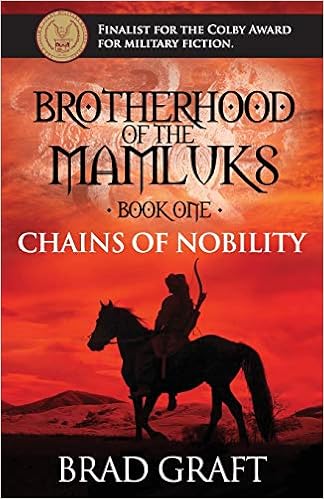
Brotherhood of the Mamluks

Book 1 - Chains of Nobility

Duyal, a teenage nomad living on the vast Russian steppe, is captured during a Mongol invasion and forced on a long, deadly journey into the war-torn Middle East. Purchased by a Kurdish prince in eastern Turkey, his destination is an Islamic citadel, filled with similarly enslaved strangers and one merciless instructor—a man determined to purge the weaklings from his ranks and forge the survivors into Mamluks, Islamic Knights unmatched in wielding sword, arrows, and lance from atop Arabian steeds.

When Duyal becomes entangled in his instructor’s schemes and his mates witness another comrade’s unjust execution, the recruits can take it no longer. Their wrath is unleashed.

Chains of Nobility is the first book in the Brotherhood of the Mamluks trilogy. Set during the 13th century, the book is an immersive dive into the world of military slavery—a Muslim institution largely unheard of in the West, whose ranks ousted the Crusaders and Mongols from the Levant, preserving Islam.


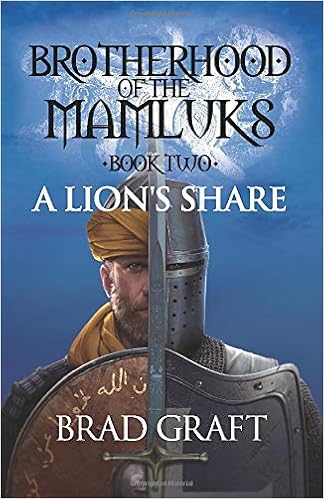
Book 2 - A Lion's Share
A Lion’s Share is the second book in the Brotherhood of the Mamluks trilogy. The story is set in the 13th Century Middle East, during the Seventh Crusade. Told from the Egyptian perspective, it is a rare view of life among the Mamluks—elite Muslim warriors largely unheralded in the West—whose ranks ousted the Crusaders and Mongols from the Levant, preserving Islam.

On the eve of a historic battle, Leander, a disenchanted Crusader, surrenders to Muslim amirs with the intent of joining the revered Bahri Mamluks. His move seems fated. The young Frenchman avoids the mass slaughter suffered by the Christian alliance and earns himself a place with the elite cavalry regiment, serving the Sultan of Egypt. Yet once King Louis IX of France seeks vengeance and sets Cairo as the objective of his campaign, Leander is faced with warfare against his native people as he defends his new home, comrades, and religion.

When the Bahri’s adored sultan dies and Leander becomes tangled in forbidden love with an Egyptian woman, his world unravels further. As the Mamluks seize rule for themselves, a rivalry between opposing regiments turns bloody and the newly-formed Mamluk Sultanate tumbles into chaos, with Leander and his mates scrambling not only for position within the realigned empire, but also for their lives.


Sunday, September 15, 2019

Review: The Song of Simon de Montfort by Sophie Therese Ambler

45878408. sx318
Synopsis: this is the story of this extraordinary man: heir to a great warrior, devoted husband and father, fearless crusader knight and charismatic leader. It is the story of a man whose passion for good governance was so fierce that, in 1258, frustrated by the King’s refusal to take the advice of his nobles and the increasing injustice meted out to his subjects, he marched on Henry III’s hall at Westminster and seized the reins of power.


Montfort established a council to rule in the King’s name, overturning the social order in a way that would not be seen again until the rule of Oliver Cromwell in the seventeenth century. Having defeated the King at the Battle of Lewes in 1264, Montfort and his revolutionary council ruled England for some fifteen months, until the enmity between the two sides exploded on that August day in 1265. When the fighting was over, Montfort and a host of his followers had been cut down on the battlefield, in an outpouring of noble blood that marked the end of chivalry in England as it had existed since the Norman Conquest.


" ... he was a man who would flee neither torment nor death for the sake of his oath ..."

Simon de Montfort is considered to be one of the important personages in English history, being credited as the founder of what is now the modern English Parliament. But much happened before that would influence events in the future. 

For many years King Henry III had run the country poorly. He had married a French woman, Eleanor of Provence, and many members of her family and of the French court came to England with her. The French replaced Henry's advisers and began to spend the country's money. Things came to a head in 1258 after a series of bad harvests and wet winters. This resulted in starvation for the country's poor and reduced taxes for the king. 

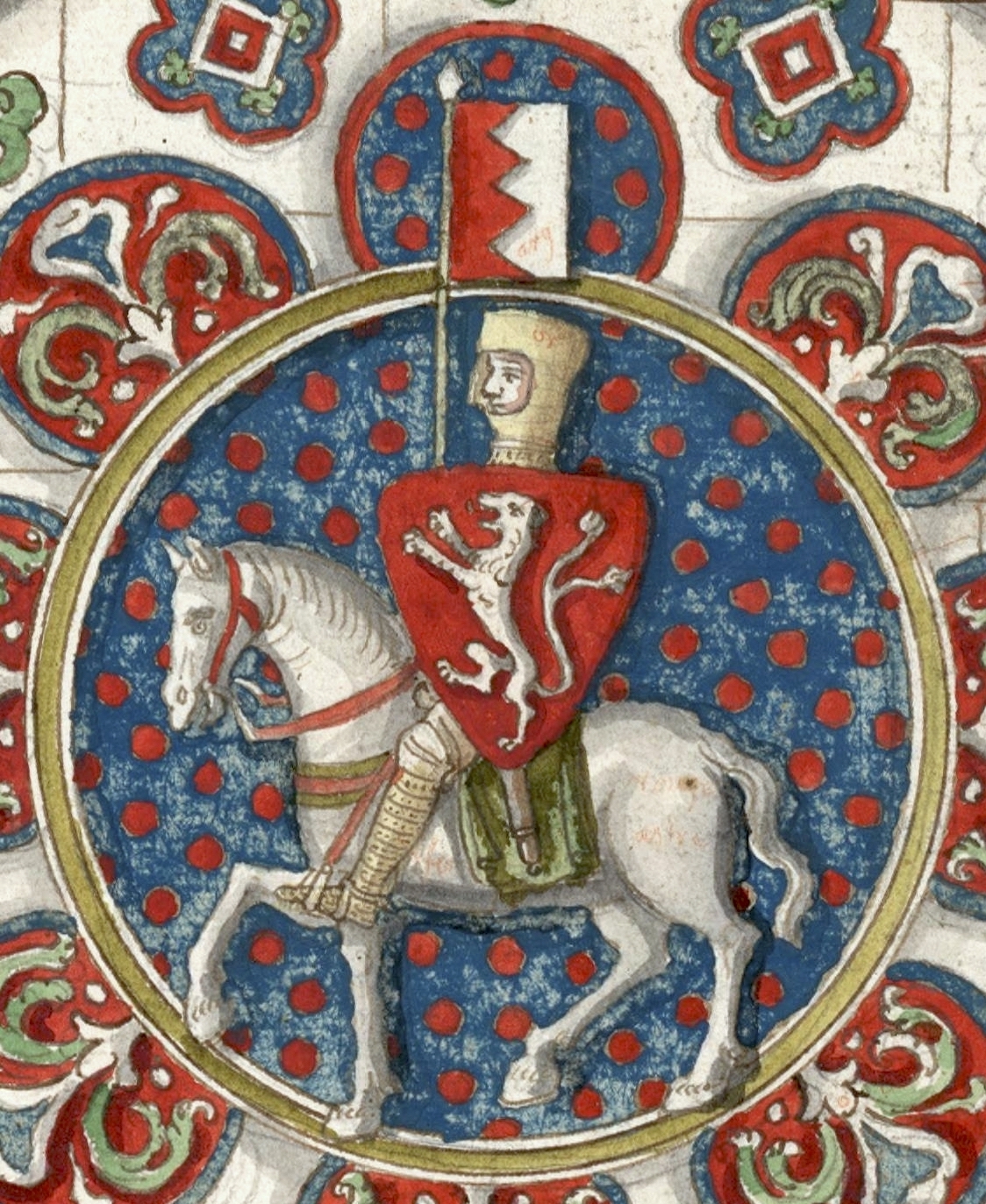
Image result for simon de montfortTo make matter worse Henry approached Parliament for funds to pay for a military mission to Sicily to put he son Prince Edward on the Sicilian throne. The time had come for the barons to voice their concerns. The group of barons, including Richard de Clare (Earl of Gloucester), John Fitz Geoffrey, Roger Bigod (Earl of Norfolk), Hugh Bigod (Roger's brother), Peter of Savoy, Peter de Montfort (not a relation of Simon), and finally Simon de Montfort (Earl of Leicester), vowed to stand together and oppose the king. Simon de Montfort was a close friend of the king and was married to the king's sister, Eleanor, but the country's future was more important to the Earl than his friendship with the king.

The barons arranged to meet King Henry at Oxford in June of 1258. As an act of faith Simon handed his castles at Odiham and Kenilworth over to the king. When the barons appeared before Henry they were fully armed and gave him no choice but to agree to their demands. The 'Provisions of Oxford' as they are known set out a system of government in which a council of fifteen members were to advise the king. The fifteen were selected by a committee of four, two from the barons and two from the king. The activities of the council were also to be checked by Parliament. A year later amendments to the running of the council were made by the 'Provisions of Westminster'.

Henry needed help to oppose the barons so he approached the French king Louis IX. At the Treaty of Paris in 1259 Henry agreed to admit that England had no rights to the lands of Normandy, Maine, Anjou and Poitou that had been lost by King John. Henry was allowed to keep lands in Gascony and Aquitaine as long as he accepted the French king as his overlord in these areas. In return King Louis promised to assist Henry in the fight against the barons.

Henry also approached the Pope for help. The Pope agreed that the Provisions of Oxford were illegal as Henry had been forced to sign the documents. Freed from the obligations forced upon him by the barons Henry resumed power. With an army of French bodyguards he went on the offensive against the barons. At the Battle of Lewes King Henry and his eldest son Prince Edward, the future king of England, were captured by the barons and held prisoner.

In 1265 Simon de Montfort laid the foundations for the current English Parliament. For the first time each county of England was allowed to elect and send two knights to Parliament to represent their areas. Each borough was also to elect and send two representatives.


The barons began to quarrel amongst themselves and a split developed. Prince Edward escaped from captivity and joined the group of barons opposing Simon de Montfort. At the Battle of Evesham on August 4, 1265 Simon de Montfort was killed. Although small pockets of resistance remained, the rebellion was over and King Henry again took control of the country.  "The murder of Evesham," wrote Robert of Gloucester, "for battle it was none."


The Song is really a family history, beginning with Simon's early life, that of his married life and political career, and finally that of his family after his death. Based heavily on the writings of Peter of les Vaux-de-Cernay, Simon's story is told in an easy - slightly romanticised- style, which at times reads like it was written in Victorian times. Much attention is given to the history and politics of the day, supported by copious notes and explanations. This is really important in telling the story of de Montfort as much of his life was taken up with political and religious campaigns.  What we also discover is that de Montfort is a man of unfailing conviction and loyalty.  He has and is for me, one of the more interesting characters from the pages of history, and someone I have read extensively on.

However, the author states, quite early on, that this tome will also contribute to scholarship on the Crusades. Having read quite extensively on the subject of the Crusades, including the Albigensian Crusade, which is more pertinent to Simon's story, the author hasn't really added anything new on that front, which is rather curious as the author is a historian of the Crusades.  

The story presented of de Montfort, his life, his career, and his legacy, is extensively research and well documented in "the Song".  Those not overly familiar with this period will have no trouble following events as they unfold, though a little knowledge is not a bad thing.  It is a tome I would quite happily have sitting on the shelves of my own personal library.

I would be interested in comparing this title with another that sits on my shelves, "Simon de Montfort" by Darren Baker (previous published as "With All For All") as well as "Simon de Montfort" by JR Maddicott (considered the definitive biography).


read also: 


Saturday, June 29, 2019

Bookshelf: Military History, Crusades & Warfare

Had a tidy up of my books last weekend.  Just my "military" & crusades collection (mix of fiction & non-fiction with some religious overtones on the top shelf). 

The book that started it all is on the bottom shelf - the one with the raggedy green spine, sixth from left - Castles and Battles (well loved, well read, well worn, not so well aged).


Saturday, January 19, 2019

The New Book That Will Change How We Understand The Crusades

From Forbes:

Jay Rubenstein is a MacArthur Fellow (2007) and currently Riggsby Director of the Marco Institute for Medieval and Renaissance Studies and the Alvin and Sally Beaman Professor of History at the University of Tennessee, Knoxville. His new book, Nebuchadnezzar's Dream: The Crusades, Apocalyptic Prophecy, and the End of History, argues that the Crusades really need to be understood from within, that medievals themselves began seriously thinking about what this all meant in the wake of the capture of Jerusalem in 1099 CE. This shocked their system and so sought meaning in what was most familiar to them, the Christian Bible - more specifically still the dream of the Babylonian King Nebuchadnezzar in Daniel 2.

read more here @ Forbes which features an interview with article author, Matthew Gabriele