Showing posts with label poison. Show all posts

Saturday, February 8, 2025

Review: A Poisoner's Tale by Cathryn Kemp

Synopsis: The legendary figure of notorious seventeenth-century Italian poisoner Giulia Tofana, thought to be the first female serial killer in history, is brought to life in this feminist retelling.

Palermo 1632: Giulia is thirteen when she learns her mother greatest secret: Teofania makes an undetectable, slow-acting, lethal poison—Acqua Tofana—which she uses to free the broken and abused women of Palermo. Now Teofania wants to pass her recipe on to her daughter, and Giulia soon realizes that in a time when women have no voice, justice is sometimes best served in a cup of wine or broth.

Rome, 1656: Years later, within the alleys and shadows of the Eternal City, Giulia forms her own circle of female poisoners, who work together under the guise of an apothecary shop to sell poison to women in need.

But even in a time of plague, when death looms over the city, it doesn’t go unnoticed that the men of Rome are starting to fall like flies. And with the newly elected pope determined to rid the city of witches and heretics, Giulia is more vulnerable than ever. How far is she willing to go to continue her mother’s legacy?

Weaving together the stories of the women Giulia helped, the men she killed, and those who wanted her dead, this is a tale of magic, secrets, vengeance, and sin in the back streets of Rome—and, ultimately, a fight for power.

~ ~ ~

This is a fictional account of 17th century poisoner, Guila Teofania, whose mother was a former courtesan and whose step-father was an abusive, predatory man with links to the Inquisition. Guila sold a poison called Aqua Tofana (supposedly invented by Thofania d'Adamo, who may have been Giulia's mother) to women who wanted to murder their abusive husbands.

The story is narrated in the first person by Guila and then as the tale progresses, alternates with that of Fabio Chigi, Pope Alexander VII (although I found this to be unnecessary, he could have, like the character of Bracchi, remained in the third person narrative).

Whilst the historical Guila Tofana's life and that of her (step)daughter and women's circle is shrouded in mystery, Kemp combines the myths and truths to weave a narrative that is at times compelling and frustrating. 

By frustrating I mean the characters, who despite being on the radar of the Inquisition - and especially Inquisitor Stefano Bracchi - do nothing to conceal their activities and in fact draw further attention to themselves - which for me boils down to stupidity or egotism (author's prerogative and the reader is the proverbial fly on the wall).

The tale is well constructed - whatever the reality - and the reader will get a sense of life in Renaissance Italy.  Life for the majority of women was beyond their control - they were ruled by their fathers, their husbands, their male relative and the Church.

Modern readers may have a hard time understanding the motives behind the many women that sought out the poisoners.  In the book "The Black Widows of the Eternal City: The True Story of Rome's Most Infamous Poisoners", by Graig Monson, therein lies the story of Girolama Spana, the alleged daughter of Guila. One of the women to utilise the services of the poisoners - Caterina Nucci - is brought before the Inquisition for questioning after two husband's met similar fates:


Women who sought out their own destiny were often treated with suspicion and branded as witches, and Kemp's book gives the reader a first hand glance at this. There is all the drama of the chase and hunt for these women by Bracchi, and the very real threat of the Inquisition and exposure and death.

For a debut novel, this is quite good - and I did enjoy reading this tale of a group of notorious female poisoners!


Saturday, February 22, 2020

Review: The Emperor's Assassin by Autumn Bardot

Synopsis: History paints her as the first female serial killer…
The Emperor's AssassinLocusta is the daughter of a winemaker in the Roman province of Gaul. She enjoys the indulged childhood of the elite, her concerns only about the day’s amusements. She rides gentle ponies, attends parties, reads Ovid, and learns the herbal arts from her servant. But the day after meeting her betrothed, Locusta discovers the consequences of possessing such dangerous knowledge.

Ordered to leave her pastoral life, Locusta is thrust into a world of intrigue, scandal, and murder—where treason lurks behind every corner and defying an emperor means death. Locusta’s life changes forever when a young Emperor Nero requires her herbal expertise. And commands her to be his personal poisoner. Caught in an imperial web, Locusta must embrace her profession or die.


Who was this ancient roman series killer and how did some become the "personal poisoner" of Emperor Nero? That hooked me in from the beginning. Whilst familiar with all the usual suspects of the early Roman period, Locusta was not one that came to mind quite readily and I was intrigued to read more, even if only from a fictional account.

Bardot uses the first person narrative to recount Locusta's story - in her own words so to speak. We begin with a naive provincial girl who learns the hard way that her own idyllic life is not truly reflective of the Roman Empire as a whole. From the loss of innocence grows the worldly wisdom as she uses her skills in herbal knowledge to recreate a life for herself. It is only when sent to Rome where the ".. decadent world of the the Roman elite was laid wide open .." that this naivety is really drummed home. The use of the maid Priscilla as a " entree " into or teacher of, these dark arts, creates a sort of empathy with Locusta as if this was not all of her own doing but as a direct result of her personal circumstance .... she readily recounts that " .. my first ethics lesson in poisoning ... confess to noone ..".

So, for those not familiar with the " ... poisoned filled world ... " of the scandalous Roman Empire where ".. the wicked hold hands like old friends.." under the reigns of Caligula and Nero, it is from the great writers of the period that we are first introduced to the poisoner, Locusta. 

Suetonius in his Life of Nero :


From Tacitus' Annals:


From Cassius Dio's Roman History:


From Juvenal's Satires:


There is no doubt that these pages from the early Roman writers inspired Bardot to give life to this mysterious woman. After being sent to Rome and coming to the attention of a number of noble women, it is when she is introduced to the Empress Agrippina that Locusta's life as a poisoner begins. As Emperor Nero avails himself of her talents, she is well rewarded with property, money and gifts; though finds herself at his beck and call to perform those deeds he would prefer kept well hidden. She consoles herself with the thought that to reject Nero would be to sign her own death warrant, and so she does what she can to ensure her own survival.

The introduction of the character of the centurion Marcus earlier in the piece provides another component to the Locusta story, and one that plays out in the final chapters of both this book and her (fictional) life.

The life and death of Locusta is shrouded in mystery and fueled by chinese whispers with each re-telling. There are many legends of her graphic and barbarous death following the death of her patron, Nero, from being raped to death by a specially trained giraffe to being torn apart by wild animals in the arena as befits a notorious sorceress. It is presumed that she perished shortly after Galba succeeded.

Bardot provides us with an entertaining story that more than adequately fits in with what I call the "rehabilitation genre" - whereby - mostly - historical women with a less than pristine pasts are given a dusting off and are having their stories told from a slightly different perspective (history being written by the victors, etc etc). It is an enthralling tale, and the reader certainly finds empathy with the character of Locusta, which is the ultimate aim of the author. It is also a tale of the cesspit that was ancient Rome - the salacious scandals, the sex and violence, the notoriety of its citizens, murder, greed, envy, social position.

If you are looking for a "new" historical heroine, then you have found her in Locusta.


Sunday, August 19, 2018

Poison: A favorite means to an end

The Royal Art of Poison: Filthy Palaces, Fatal Cosmetics, Deadly Medicine, and Murder Most Foul" by Eleanor Herman, reviewed by Kay Johnson


Royal Art of Poison book coverThroughout history, especially in Medieval and Renaissance times, royalty and royalty-to-be often had abundant reason to be fearful of poison in their food and drink. Jealousy was common. Enemies could be anywhere and, to avoid big problems, most monarchs employed a taster or, in the case of Louis XIV, 324 of them.

That didn’t help much, says Herman, because nasty substances weren’t just used to steal a crown. Lead was found in cosmetics then. Sulfur was used to powder wigs, and mercury and arsenic, along with human remains, were prescribed as medicine. Urine was used by the clothing industry. Bloodletting was employed to reset “humors.” Rooster dung was given to induce vomiting, and even the air that the average person breathed could be poisonous.

But this book isn’t all about murder — or history, for that matter. Herman spends a good amount of time telling about royal as well as everyday lives and how people lived in the 14th-through-18th-centuries. She then explains how we know what we know now, and why the heyday of poison, if you will, ended.

read more here @ Crow River Media

Friday, June 29, 2018

How we discovered three poisonous books in our university library


Some may remember the deadly book of Aristotle that plays a vital part in the plot of Umberto Eco’s 1980 novel The Name of the Rose. Poisoned by a mad Benedictine monk, the book wreaks havoc in a 14th-century Italian monastery, killing all readers who happen to lick their fingers when turning the toxic pages. Could something like this happen in reality? Poisoning by books?

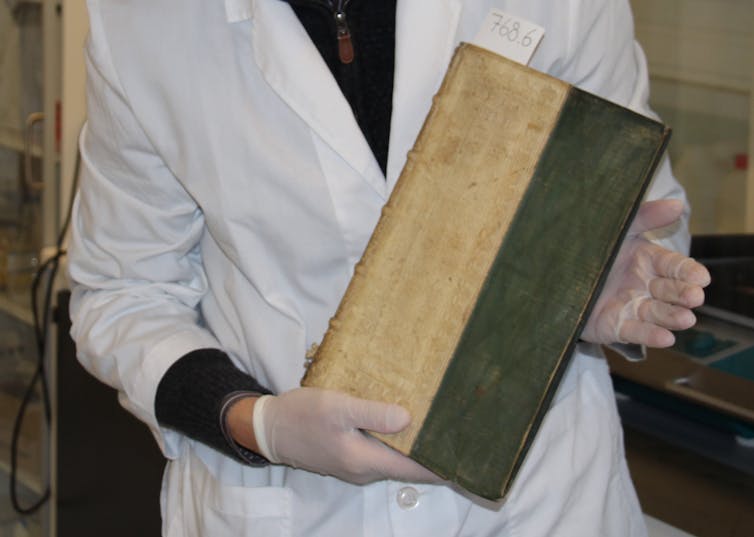
Our recent research indicates so. We found that three rare books on various historical topics in the University of Southern Denmark’s library collection contain large concentrations of arsenic on their covers. The books come from the 16th and 17th centuries.

The poisonous qualities of these books were detected by conducting a series of X-ray fluorescence analyses (micro-XRF). This technology displays the chemical spectrum of a material by analysing the characteristic “secondary” radiation that is emitted from the material during a high-energy X-ray bombardment. Micro-XRF technology is widely used within the fields of archaeology and art, when investigating the chemical elements of pottery and paintings, for example.


read more here @ The Conversation

Saturday, June 10, 2017

A fascinating look at the history of toxicology

The first two volumes in the History of Toxicology and Environmental Health Series, edited by Philip Wexler, describe toxicology in antiquity. This new book continues the story by covering the approximate period between 400AD and 1600AD. It consists of 16 chapters written by contributors from various institutions in Europe, the Middle East and North America.

The book ...... [ delves ] into different aspects of toxicology, such as the contributions of scientific scholars of the time, sensational poisoners and poisoning cases, as well as myths. Historical figures, such as the Borgias and Catherine de Medici are discussed. Toxicologists, students, medical researchers, and those interested in the history of science will find insightful and relevant material in this volume.

read more here @ the Pharmaceutical Journal and @ Elsevier
read book here @ Science Direct