Showing posts with label russian history. Show all posts

Tuesday, January 9, 2024

Review: A Present Past by Sergei Lebedev

Synopsis: The Soviet and post-Soviet world, with its untold multitude of crimes, is a natural breeding ground for ghost stories. No one writes them more movingly than Russian author Sergei Lebedev, who in this stunning volume probes a collective guilty conscience marked by otherworldliness and the denial of misdeeds. 

These eleven tales share a mystical topography in which the legacy of totalitarian regimes is ever-present—from Katyn to Chechnya, from Lithuanian KGB documents to the streetscape of unified Berlin, from the fragments of family history to the echoes of foot soldiers in Russia’s wars of aggression. 

In these stories, as in Lebedev’s acclaimed novels, the voices of things, places, animals, and people seek justice for a restless past, where steel claws scrape just beneath the surface and where the heredity of evil is uninterrupted, unacknowledged, unnamed.

~ ~ ~

I loved Lebedev's "Untraceable" - so was looking forward to reading more from him.

This series of short stories, haunting tales of a Soviet past intruding on a Soviet present, were very different from the abovementioned work, but were intriguing in themselves nonetheless. I would have to say that my favourite tale was "Titan" - the story of a person of interest to the Soviet Secret Police, who managed to turn the tables on them in a rather unique way.

For anyone wanting to further explore Russian literature, definitely pick this up!

Sunday, November 3, 2019

Review: Russia's Women Snipers


I have lately read two compelling books on two very different, and yet very similar, women who voluntarily entered into military service for their country.

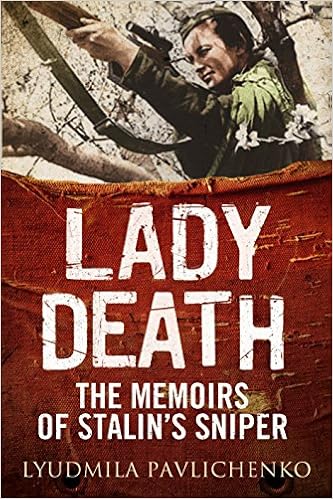
The first "Lady Death" is the story of Lyudmila Pavlichenko, one of over 2000 female snipers, yet one of the more well-known names with 309 recorded kills, including 29 enemy sniper kills, to her name. After being "retired" from active duty, she visited the USA and UK, before returning to train other snipers.

So, a little more about Lyudmila: born in today's Ukraine, Lyudmilia had an affinity with athletics and sports, and was a sharp shooter from an early age. She married at the tender age of 16, had one child, before divorcing her husband. Entering university, studying history and competing in athletics. Following the German invasion of Russia in 1941, Lyudmila signed on to join the infantry in Odessa, eventually being assigned to the 25th Chapayev Rifle Division due to her skill with the rifle. She fought in Odessa, Crimea, racking up the confirmed kills. Wounded after only a year in combat, she became the poster-girl of the Red Army's propaganda machine. Touring the USA, she famously responded to reporters by saying: "... In the Soviet Union I am looked upon as a citizen, as a fighter, as a soldier for my country.” and that "“our women were on a basis of complete equality long before the war ..."  Highly decorated and achieving the rank of major, she trained other snipers until the end of the war, returning to finish her education and work as an historian. Suffering what is now documented as post traumatic stress disorder, Pavlichenko also had to deal with the rumours the rumor that she was nothing more than a propaganda myth actually started within the Soviet armed forces. There is the possibility that Pavlichenko’s own account of her time at the front may have been doctored by Soviet military censors — a very common occurrence at the time — there is no doubting that the woman herself was “the real deal.”  She died aged 58yo.


Because of chronic problems in finding the manpower to fulfill military and industrial tasks, the Soviet government recruited some 7.75 million women, not just to support the soldiers but to join the fight. Around a million women fought in various branches of the Soviet military. Some nursed and supported, as in other countries, but others drove tanks, operated machine guns, and flew fighter planes. Between 1941–1945, it was estimated that a total of 2,484 Soviet female snipers were functioning in this role, between then, credited with more than 12,000 confirmed kills, and of whom about 500 survived the war.

Joining up as a sniper was a strange experience for many women. Though the Soviet army as an institution accepted them, some individuals did not. Families urged their daughters to stay safely at home rather than to fight. Some officers looked down upon the women under their command, not believing that they could be effective combatants. But others were supportive, especially after they saw these women in action.

At recruiting offices, women had theirs braids cut off and were put into men’s uniforms, as there were none tailored to fit women. Then they were sent off to train. Some were specially selected for sniping because they demonstrated a skill. In other cases, this was simply the most convenient place to send them. Training was intense but also hurried. The USSR needed to get troops to the front to counter the German invasion. The women trained as snipers soon found themselves on the front, often hunting their prey amid cities ruined by siege. It was believed that women made the perfect sniper because they could endure stress and cold better than men, and they had “more patience” to wait for the perfect shot.

Snipers usually worked in pairs. Together, they found a place to hide away from the main Soviet forces. There they lay concealed by scenery and camouflage, watching for an opportunity. When an enemy presented himself, they would try to take him down with a single shot to the head. Then they would wait patiently again for their next target, silent and still, or move on if they believed they were in danger. 


As mentioned, Lyudmilia was one of many. Anorther who survived, yet was not as famous as Lyudmilia, was Yulia Zhukova, whose memoirs come to us in "Girl with a Sniper Rifle".

Front CoverYulia's story is slightly different in that she was no sharp-shooter prior to enlisting, which she saw as her patriotic duty. A sickly child who worked in the local factory to support the war effort, she was determined to contribute more. She was dedicated member of the Komsomol (the Soviet communist youth organization) and her parents worked for the NKVD. Completing her training at the central Women's Sniper School, by the time Yulia saw active service in East Prussia and Poland in 1944, female snipers were not unusual. Wounded, she returned to combat until the war ended. Unlike Lyudmilia, she was not a poster-girl for the Russians, but returned to her village and life, struggling to deal with and accept her part in the war; acceptance did not come until much later in life.


Both memoirs are highly readable offering a different yet similar view of their experiences - we often comment that fact is sometimes more enthralling than fiction.  Pavlichenko, the historian, would take a more academic approach, supplementing her diary with historical research; whilst Zhukova relied on memory, letters (that escaped being destroyed as she tried to forget her past) and remembrances of her fellow cadets. Both women were dedicated in their commitment to both Russia and the Russian war effort - "... dying for the motherland was considered a worthwhile sacrifice ...".  It is hoped that readers will discover, through both works, the comradery, strength of spirit, unflinching loyalty that these two women - and the many others like them - displayed in the face of the terror of war.  How many readers are left wondering whether or not they could do the same.


further reading:
Avenging Angels: Soviet Women Snipers on the Eastern Front, 1941-1945 by Lyuba Vinogradova
Soviet Women Snipers: of the Second World War by Youri Obratztsov
The Unwomanly Face of War: An Oral History of Women in World War II by Svetlana AlexievichHeroines of the Soviet Union 1941–45 by Henry Sakaida
Roza Shanina Russian Sniper by Robert Corrigan
Soviet Women in Combat: A History of Violence on the Eastern Front by Anna Krylova

Saturday, February 17, 2018

Prince Felix Yusupov - The Man Who Killed Rasputin

So, just recently I cam across this new title: Prince Felix Yusupov: The Man Who Murdered Rasputin by Christopher Dobson

This powerful biography tells the compelling story of Prince Felix Yusupov — the man who murdered Rasputin.
The murder of the Tsarina’s ‘Mad Monk’ sent shock waves through pre-revolutionary Russia. Many foretold it would mean the end of the monarchy — and they might have been right. 
Prince Felix Yusupov: The Man Who Murdered Rasputin by [Dobson, Christopher]But the murderers and their leader, the notorious Prince Yusupov, saw Rasputin’s hold over Nicholas II and his wife as an evil influence that was destroying Russia, whose armies were being slaughtered in the First World War.
Yusupov was one of the richest men in Russia. He was also handsome, amusing and vain, boasting of the smallest waist of any man in Europe. 
Though married to the Tsar’s niece, Irina, he was homosexual and often paraded in women’s clothes — as such he even excited the attention of King Edward VII at the Théâtre des Capucines.
During the revolution he was rescued at the eleventh hour with other members of the Imperial Family and went to Paris where he settled. His flamboyant lifestyle, his business adventures, court cases and struggles to raise money on the Yusupov jewels, as well as his friendships with the great of the time, including the Windsors, make exciting reading.
Based on personal interviews and meticulous research, this enthralling biography captures the flavour of a bizarre, eventful and extraordinary life.

read more about Prince Felix Yusupov:
@ The History Reader
@ Penguin Books
@ The Daily Telegraph


Review - Killing Rasputin by Magarita Nelipa

KILLING RASPUTIN: The Murder That Ended The Russian Empire
KILLING RASPUTIN: The Murder That Ended The Russian Empire by Margarita Nelipa - This work is based upon the report of Vladimir Rudnev, investigator into Rasputin's influence over the Tsar (28.03.1919), revised and updated again since its publication in 2010.


Its divided into three parts: (1) biographic information about Rasputin and his life; (2) the cold case review of the murder; and (3) connecting the murder with the downfall of the Russian Empire.

"It has happened! .... Because of an empty and shortsighted obstinacy of one women - the final catastrophe happened."

This is a well researched, heavily detailed tome with a huge cast of characters (imperial, political, noble). Nelipa's use of records obtained from Russian sources gives insights into how this man was viewed by the Russian royal family and the Russian nobility. She explores the many differing sources to provide explanations behind the mythology of both the man and the murder.

It would probably have made for easier reading had I had the actual book in my hand so that I could have easily references those involved (I was reading an online copy). Personally, I preferred part 2 - the cold case analysis.

Sunday, December 31, 2017

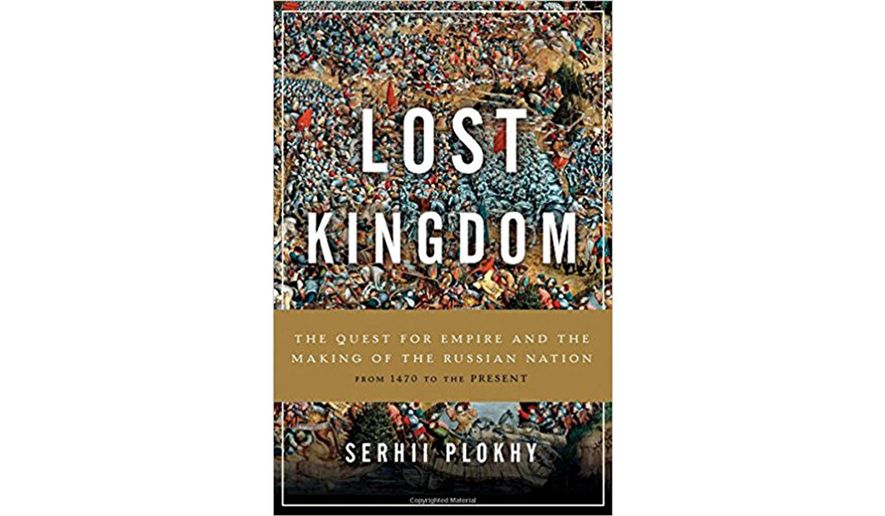
'Lost Kingdom' by Serhii Plokhy


The Harvard historian Serhii Plokhy, the leading Western scholar on Ukraine, details Moscow’s historic insistence that Russia and its East Slavic neighbors occupy a joint historical space, and essentially comprise a single nation — despite strong language, cultural and religious differences.

Ukraine attempts to retain its independent, medieval Kyvian state over the centuries had off-again/on-again successes. At one point it was amalgamated into Poland.

In the 19th century Russian imperial authorities compromised (in a sense) by creating a tripartite nation composed of three tribes: Great Russian, Little Russian (Ukraine) and Belarusian. Russian revolutions in 1905 and 1917 destroyed the forced alliance, and Ukraine was independent again until the communists seized power after World War I. The “Lost Kingdom” of Mr. Plokhy’s title refers to its involuntary incorporation into the USSR.

read more here
@ Kirkus Reviews
@ Publisher Weekly
@ Hachette Books

For more on the history of the Ukraine:
  • A History of Ukraine: The Land and Its Peoples by Paul Magocsi
  • The Gates of Europe: A History of Ukraine by Serhii Plokhy
  • History of Ukraine-Rus': The Cossack age 1650-1653 by Mihail Sergeevič Gruševskij
  • Ukraine and Russia: Representations of the Past by Serhii Plokhy
  • Culture, Nation, and Identity: The Ukrainian-Russian Encounter, 1600-1945 by Andreas Kappeler, Zenon E. Kohut, & Frank E. Sysyn

Monday, October 12, 2015

Timeless tale of a medieval saint


A novel about the life of a 15th-century Russian monk might sound an unlikely bestseller, but Eugene Vodolazkin’s extraordinary tale Lavrus became a literary sensation, won Russia’s Big Book award in 2013, and was shortlisted for numerous other prizes. This fall it’s published in English.

So what is the appeal? Vodolazkin’s spiritual odyssey transcends history, fusing archaism and slang to convey the idea that “time is a sort of misunderstanding.” Towards the end, the eponymous hero “Laurus”, a medieval doctor, holy fool, pilgrim and - finally - hermit, is leaning on an old pine tree. The ants are swarming over the bark and through the monk’s beard, embodying the idea that he has almost become part of the forest he lives in. The image is typical of Vodolazkin’s poetic vision.