Showing posts with label memoirs. Show all posts

Friday, February 7, 2025

Review: The Concentration Camp Brothel by Robert Sommer

Synopsis: In his seminal work, The Concentration Camp Brothel, Robert Sommer reveals the hidden horrors of sexual forced labor within the SS camp system, a subject long overshadowed and seldom acknowledged in the discourse on the Holocaust.

Through his rigorous examination of over 70 archives and poignant interviews with more than 30 survivors, including former visitors of camp brothels, Sommer paints a vivid and harrowing picture of the atrocities committed. This book is the first to offer a comprehensive exploration of the establishment, operation, and profound impact of brothels in Nazi concentration camps.

Sommer's research meticulously details the brothels' integration into the concentration camp system, their role in the Nazi exploitation of bodies for control and profit, and the complex reactions of the prisoner society to these establishments. He explores the desperate survival strategies employed by the women forced into sexual labor, and the chilling motivations of their exploiters.

The book also places the tragedy of camp brothels in the broader context of sexual violence under Nazi rule, making a critical connection between these acts of exploitation and the overall history of the Holocaust. This updated English edition incorporates new findings and perspectives since the original German publication in 2009, providing a more comprehensive understanding of the subject. The foreword by Annette F. Timm adds further context and contemporary analysis, enhancing the book's relevance and depth.

~ ~ ~

A confronting lost and ignored piece of Holocaust history. A forgotten voice given a hearing; its victims left physically and emotionally scarred, viewed as collaborators despite their own incarceration; so despised by their own that many refused to openly acknowledge this part of their lives. 

Using memoirs of those who would talk and other historical documents, this is a meticulous account of the brothels that were set up and operated, albeit for a short period of time, in Nazi concentration camps. These brothels were for the use of prisoners, not the guards or officers; mainly Ayran women were "employed" - women who had already been incarcerated for what was termed "anti-social behaviours"; the brothels were used as an "incentive" to increase the productivity of the imprisoned, forced labourers.

The stats at the end of the book are eye-opening - the youngest woman was seventeen, the oldest thirty-five.

It should be remembered that since the recognition of sex slavery in International Law (c. 2002), these victims are still ignored, uncompensated (as this was considered "voluntary"), outcast.

This is a well researched and confronting piece of history that - like its victims - deserves more recognition.


Sunday, December 22, 2024

Review: Shakespeare: The Man Who Pays the Rent by Judi Dench & Brendan O'Hea

Synopsis: Discover the work of the greatest writer in the English language as you've never encountered it before by ordering internationally renowned actor Dame Judi Dench's SHAKESPEARE: The Man Who Pays The Rent—a witty, insightful journey through the plays and tales of our beloved Shakespeare.

Taking a curtain call with a live snake in her wig...

Cavorting naked through the Warwickshire countryside painted green...

Acting opposite a child with a pumpkin on his head...

These are just a few of the things Dame Judi Dench has done in the name of Shakespeare.

For the very first time, Judi opens up about every Shakespearean role she has played throughout her seven-decade career, from Lady Macbeth and Titania to Ophelia and Cleopatra. In a series of intimate conversations with actor & director Brendan O'Hea, she guides us through Shakespeare's plays with incisive clarity, revealing the secrets of her rehearsal process and inviting us to share in her triumphs, disasters, and backstage shenanigans.

Interspersed with vignettes on audiences, critics, company spirit and rehearsal room etiquette, she serves up priceless revelations on everything from the craft of speaking in verse to her personal interpretations of some of Shakespeare's most famous scenes, all brightened by her mischievous sense of humour, striking level of honesty and a peppering of hilarious anecdotes, many of which have remained under lock and key until now.

Instructive and witty, provocative and inspiring, this is ultimately Judi's love letter to Shakespeare, or rather, The Man Who Pays The Rent.
~ ~ ~

Brendan O'Hea interviews Dame Judi Dench who reflects on her connection to the Bard through her time on stage and film, undertaking roles from Shakespeare's plays. A fun read that is not an analysis of the plays, but a noted actor's reflections, documented in a series of interviews conducted over a period of four years.

For lovers of the Bard and fans of Judi!

Monday, November 29, 2021

Apparently There Were Complaints by Sharon Gless

Emmy Award­–winning actress Sharon Gless tells all in this laugh-out-loud, juicy, and touching memoir about her five decades in Hollywood, where she took on some of the most groundbreaking roles of her time.

Anyone who has seen Sharon Gless act in Cagney and Lacey, Queer as Folk, Burn Notice, and countless other shows and movies, knows that she’s someone who gives every role her all. She holds nothing back in Apparently There Were Complaints, a hilarious, deeply personal memoir that spills all about Gless’s five decades in Hollywood.

A fifth-generation Californian, Sharon Gless knew from a young age that she wanted to be an actress. After some rocky teenage years that included Sharon’s parents’ divorce and some minor (and not-so-minor) rebellion, Gless landed a coveted spot as an exclusive contract player for Universal Studios. In 1982, she stepped into the role of New York Police Detective Christine Cagney for the series Cagney and Lacey, which eventually reached an audience of 30 million weekly viewers and garnered Gless with two Emmy Awards. The show made history as the first hour-long drama to feature two women in the leading roles.

Gless continued to make history long after Cagney and Lacey was over. In 2000, she took on the role of outrageous Debbie Novotny in Queer as Folk. Her portrayal of a devoted mother to a gay son and confidant to his gay friends touched countless hearts and changed the definition of family for millions of viewers.

Apparently There Were Complaints delves into Gless’s remarkable career and explores Gless’s complicated family, her struggles with alcoholism, and her fear of romantic commitment as well as her encounters with some of Hollywood’s biggest names. Brutally honest and incredibly relatable, Gless puts it all out on the page in the same way she has lived—never with moderation.


Check out the reviews on the official Simon & Schuster page

Saturday, July 24, 2021

Review: Taking The Fight South - Howard Ball

Synopsis: Taking the Fight South provides a timely and telling reminder of the vigilance democracy requires if racial justice is to be fully realized.

Distinguished historian and civil rights activist Howard Ball has witten dozens of books during his career, including the landmark biography of Thurgood Marshall, A Defiant Life, and the critically acclaimed Murder in Mississippi, chronicling the Mississippi Burning killings. In Taking the Fight South, arguably his most personal book, Ball focuses on six years, from 1976 to 1982, when, against the advice of friends and colleagues in New York, he and his Jewish family moved from the Bronx to Starkville, Mississippi, where he received a tenured position in the political science department at Mississippi State University. For Ball, his wife Carol, and their three young daughters, the move represented a leap of faith, ultimately illustrating their deep commitment toward racial justice.

Ball, with breathtaking historical authority, narrates the experience of his family as Jewish outsiders in Mississippi, an unfamiliar and dangerous landscape contending with the aftermath of the civil rights struggle. Signs and natives greeted them with a humiliating and frightening message: "No Jews, Negroes, etc., or dogs welcome." From refereeing football games, coaching soccer, and helping young black girls integrate the segregated Girl Scout troops in Starkville, to life-threatening calls from the KKK in the middle of the night, from his work for the ACLU to his arguments in the press and before a congressional committee for the extension of the 1965 Voting Rights Act, Ball takes the reader to a precarious time and place in the history of the South. He was briefly an observer but quickly became an activist, confronting white racists stubbornly holding on to a Jim Crow white supremacist past and fighting to create a more diverse, equitable, and just society.

Ball's story is one of an imitable advocate who didn't just observe as a passive spectator but interrupted injustice. Taking the Fight South will join the list of required books to read about the Black Lives Matter movement and the history of racism in the United States. The book will also appeal to readers interested in Judaism because of its depiction of anti-Semitism directed toward Starkville's Jewish community, struggling to survive in the heart of the deep and very fundamentalist Protestant South


This was an interesting read. Here was a man who not only "talked the talk" but "walked the walk" - a man of conviction, who refused to to be bullied. He was / is, what we would colloquially call a "shit stirrer".

This memoir was written many years after the event - he spent a mere six years in the South as a fish out of water - though I feel this is highly relevant reading in today's politically and racially charged arena.

It is only later does the author - a much published and respected political science commentator - realise the impact of his earlier decisions on his own family. 

Tuesday, June 1, 2021

Review: The Grey Men by Ralph Hope

Synopsis: In 1990 the Berlin Wall fell and the East German security service folded. By that time, they had amassed over a billion pages of manilla files detailing the lives of their citizens. Overnight, almost a hundred thousand Stasi employees, many of them experienced officers with access to highly personal information, found themselves unemployed. This is the story of what they did next.

Former FBI Agent Ralph Hope uses critical insider knowledge and access to Stasi records to track and expose ex-officers working everywhere from the Russian energy sector to the police and even the government department tasked with prosecuting Stasi crimes. He examines why the key players have never been called to account and, in doing so, asks whether we have really learned from the past at all.

The Grey Men comes as an urgent warning from the past at a time when governments the world over are building an unprecedented network of surveillance over their citizens.


I was drawn to this for the simple reason, that I, like many others, wanted to know what happened after the fall of the Berlin Wall, which, if you can believe it, was the result of a slip of the tongue and a shrug of the shoulders.

Having read about the years of the dictatorship and other books wherein survivors tell their own personal stories, I was interested to hear how the 90000 odd members of the Stasi washed up. Curiously, that the fact that of the 90000 members, 182 were charges, 87 convicted and 1 sentenced to prison! Surely these stats were wrong! But no, having weathered the initial storm, the Stasi were still there, albeit under another name, another identity, working for another government, working for themselves, shielded by strict privacy laws which prevented the world from knowing who they actually were or are.

Hope, a former FBI agent, obviously had greater access to information and people than the average author, so the stories of survivors and the information garnered was eye-opening to say the least.

It is as we draw ever further away from post-war East Germany that Hope draws upon what he deems are the similarities between the Stasi and some of today's politically active groups, with what he terms the "decomposition of the individual" wherein social media now becomes the anonymous bogeyman to espouse ideas once shunned and to attack those who dare to speak out.

It is interesting reading for those interested.

Sunday, February 28, 2021

Review: You Will Have A Black Labrador by Nino Gugunishvili

Synopsis: Love, memories, family, enduring friendships, cooking, movies, dogs, travels, hairstyles, and saying Yes to many No’s in a witty, yet often sentimental, journey of self-discovery…

You Will Have a Black Labrador is a collection of semiautobiographical essays forming a narrative about a modern Georgian woman. Her stories range from the search for a perfect romantic partner to exploring food as an integral part of the Georgian culture. 

Many of the vignettes center on childhood memories or weird family traditions, such as the way family members stay connected no matter if they’re deceased or alive. One essay reveals how making a simple omelette can change your life; and that No can be the most powerful word in any language. She shows us, too, that a haircut can be a tribute to the movies you love as well as a path to your freedom; and how owning a dog always brings unexpected experiences. 

In this poignantly humourous collection, reality mixes and interferes with an imaginative world in so many surprising ways.


Short stories and contemporary literature are two genres I have never actively sought out. I don't mind a modern biography or even lengthier autobiographical memoirs - but the shorter style I gave a wide berth.

However, late last year I was introduced to a number of new authors, writing both contemporary fiction, memoirs and short stories - and loved what I was reading. Nino Gugunishvili was one of those authors. Her book - From My Balcony to Yours - a collection of covid lockdown anecdotes - resonated (read it - you will find it will with you too!). And this currently collection of vingettes, with her quirky sense of humour and heart-felt warmth and understanding of family, will also hit the spot.

This is just the perfect book for a lazy Sunday afternoon, with a good coffee (something else we have in common) and a comfy pair of socks!


About Nino:
Nino lives in Tbilisi, Georgia. Her educational and professional background includes film, television, and journalism.

Author Links:
Twitter: https://twitter.com/NinoGuguni
Instagram: https://instagram.com/ngugunishvili
Facebook: https://www.facebook.com/NinoGugunish/
Goodreads: https://www.goodreads.com/author/show/14276355.Nino_Gugunishvili

Wednesday, January 20, 2021

Review: Dear Dory by Tom Kreffer

Synopsis: Imagine discovering you're about to become a parent, even though doctors told you the chances of making a baby were close to zero.

Now, a soon-to-be first-time father is charting a course through the perilous and choppy waters of living with a pregnant woman. He's dodging hormonal right hooks, evading emotional explosions, saying all the wrong things (like 'Are you okay?') and trying to figure out how the hell you install a car seat.

Written as a journal to his unborn child, Dear Dory is the unfiltered, irreverently funny, honest and heartfelt account of one man's journey to fatherhood as he contemplates his new identity as a Daddy and prepares for the responsibility of a lifetime.

WARNING: This book contains a truckload of profanity. 


I will go out on a limb and say that this is not typical of the type of book I would normally pick up - I have a huge penchant for history and its related memoir genre. However, this book, offered by the author, Tom Kreffer, was a blast!

It is one man's documenting of his personal perspective of the events from the discovery to the leading up to that all important delivery date and his own impending fatherhood. It is written by a man for his child -- it covers the highs and lows of living with a pregnant woman - and many men will find a kinship with Tom in this - how he got away with much contained therein with his manhood still intact is a miracle!.

The diary style entries are humourous, satirical, reflective, refreshing, and heartfelt. Tom recounts his fear, joys, relief as both he and his wife travel the much worn path of scans, appointments, false alarms, "to tell or not to tell" family and friends, baby expos, mood swings (and the appearance of what Tom refers to as "Miss Heidi"). And as Tom reflects ... "... this pregnancy stuff is fucking nuts! .."

Just keep swimming, Dory! How I loved that name! I do hope Tom continues to use it as a nickname for the young squib when they arrive!

This is a must read for every prospective parent - and those already with children will no doubt be sagely nodding their heads amid bursts of laughter and self-recognition!


Wednesday, January 13, 2021

Review: From My Balcony To Yours by Nino Gugunishvili

Synopsis: Who would have thought that Global Pandemic, Self-Isolation, Cluster, and a Lockdown were to become the trendiest words in 2020? Who would have imagined the world would freeze and people would stay home shattered with fear, panic, uncertainty towards their future?How do we adjust to this changing reality, when none of our questions have answers when plans turn upside down, things get totally out of control?

In her new book: “From My Balcony to Yours,” author Nino Gugunishvili shares her personal account during the first several months of the COVID -19 global pandemic in the form of short stories and observations.


So utterly relatable - personal, humourous, emotional, compact.

A series of small observations as one woman documents her life during covid lockdown from March to September 2020. Nino writes of all the emotions she experiences, emotions that will be familiar to us all - from acceptance and contemplation, to fear, anger, apathy, anticipation. Her stories will touch everyone in some small personal way.

Nino describes covid as a "... noisy, unwanted neighbour you have to share your apartment with ..." whilst also acknowledging that " ... there were more dramatically things happening ...." around the globe, even more poignant when reminiscing about her childhood. And then there is one line that will resonate with us all - "... socks are my best friends ...".

This charming tale will find a home with all readers for we all have this one great shared experience wherever we are in the world. A must read!

Sunday, February 23, 2020

Face It by Debbie Harry

As a musician, an actor, a muse, an icon, the breadth of Debbie Harry’s impact on our culture has been matched by her almost Sphinx-like reticence about her inner life. Through it all – while being acclaimed as one of the most beautiful women in the world, prized by a galaxy of leading photographers and fashion designers, beloved by legions of fans for her relentless, high-octane performances, selling 50 million albums or being painted by Andy Warhol – Debbie Harry has infused her perennial Blondie persona with a heady mix of raw sexuality and sophisticated punk cool.

In Face It, Debbie Harry invites us into the complexity of who she is and how her life and career have played out over the last seven decades. Upending the standard music memoir, with a cutting-edge style keeping with the distinctive qualities of her multi-disciplined artistry, Face It includes a thoughtful introduction by Chris Stein, rare personal photos, original illustrations, fan artwork installations and more.

Peppered with colourful characters, Face It features everyone from bands Blondie came up with on the 1970s music scene – The Ramones, Television, Talking Heads, Iggy Pop and David Bowie – to artists like Jean-Michel Basquiat, Marina Abramovi and H.R. Giger of Alien fame. It explores her successful acting career (she has starred in over 30 film roles, including David Cronenberg’s Videodrome and John Waters’s Hairspray), her weekends with William S. Burroughs and her attempted abduction by serial killer Ted Bundy. 

Ranging from the hardscrabble grit and grime of the early New York City years to times of glorious commercial success, interrupted by a plunge into heroin addiction, the near-death of partner Chris Stein, a heart-wrenching bankruptcy and Blondie’s break-up as a band, an amazing solo career and then a stunning return with Blondie, this is a cinematic story of an artist who has always set her own path.

Sunday, November 3, 2019

Review: Russia's Women Snipers


I have lately read two compelling books on two very different, and yet very similar, women who voluntarily entered into military service for their country.

The first "Lady Death" is the story of Lyudmila Pavlichenko, one of over 2000 female snipers, yet one of the more well-known names with 309 recorded kills, including 29 enemy sniper kills, to her name. After being "retired" from active duty, she visited the USA and UK, before returning to train other snipers.

So, a little more about Lyudmila: born in today's Ukraine, Lyudmilia had an affinity with athletics and sports, and was a sharp shooter from an early age. She married at the tender age of 16, had one child, before divorcing her husband. Entering university, studying history and competing in athletics. Following the German invasion of Russia in 1941, Lyudmila signed on to join the infantry in Odessa, eventually being assigned to the 25th Chapayev Rifle Division due to her skill with the rifle. She fought in Odessa, Crimea, racking up the confirmed kills. Wounded after only a year in combat, she became the poster-girl of the Red Army's propaganda machine. Touring the USA, she famously responded to reporters by saying: "... In the Soviet Union I am looked upon as a citizen, as a fighter, as a soldier for my country.” and that "“our women were on a basis of complete equality long before the war ..."  Highly decorated and achieving the rank of major, she trained other snipers until the end of the war, returning to finish her education and work as an historian. Suffering what is now documented as post traumatic stress disorder, Pavlichenko also had to deal with the rumours the rumor that she was nothing more than a propaganda myth actually started within the Soviet armed forces. There is the possibility that Pavlichenko’s own account of her time at the front may have been doctored by Soviet military censors — a very common occurrence at the time — there is no doubting that the woman herself was “the real deal.”  She died aged 58yo.


Because of chronic problems in finding the manpower to fulfill military and industrial tasks, the Soviet government recruited some 7.75 million women, not just to support the soldiers but to join the fight. Around a million women fought in various branches of the Soviet military. Some nursed and supported, as in other countries, but others drove tanks, operated machine guns, and flew fighter planes. Between 1941–1945, it was estimated that a total of 2,484 Soviet female snipers were functioning in this role, between then, credited with more than 12,000 confirmed kills, and of whom about 500 survived the war.

Joining up as a sniper was a strange experience for many women. Though the Soviet army as an institution accepted them, some individuals did not. Families urged their daughters to stay safely at home rather than to fight. Some officers looked down upon the women under their command, not believing that they could be effective combatants. But others were supportive, especially after they saw these women in action.

At recruiting offices, women had theirs braids cut off and were put into men’s uniforms, as there were none tailored to fit women. Then they were sent off to train. Some were specially selected for sniping because they demonstrated a skill. In other cases, this was simply the most convenient place to send them. Training was intense but also hurried. The USSR needed to get troops to the front to counter the German invasion. The women trained as snipers soon found themselves on the front, often hunting their prey amid cities ruined by siege. It was believed that women made the perfect sniper because they could endure stress and cold better than men, and they had “more patience” to wait for the perfect shot.

Snipers usually worked in pairs. Together, they found a place to hide away from the main Soviet forces. There they lay concealed by scenery and camouflage, watching for an opportunity. When an enemy presented himself, they would try to take him down with a single shot to the head. Then they would wait patiently again for their next target, silent and still, or move on if they believed they were in danger. 


As mentioned, Lyudmilia was one of many. Anorther who survived, yet was not as famous as Lyudmilia, was Yulia Zhukova, whose memoirs come to us in "Girl with a Sniper Rifle".

Front CoverYulia's story is slightly different in that she was no sharp-shooter prior to enlisting, which she saw as her patriotic duty. A sickly child who worked in the local factory to support the war effort, she was determined to contribute more. She was dedicated member of the Komsomol (the Soviet communist youth organization) and her parents worked for the NKVD. Completing her training at the central Women's Sniper School, by the time Yulia saw active service in East Prussia and Poland in 1944, female snipers were not unusual. Wounded, she returned to combat until the war ended. Unlike Lyudmilia, she was not a poster-girl for the Russians, but returned to her village and life, struggling to deal with and accept her part in the war; acceptance did not come until much later in life.


Both memoirs are highly readable offering a different yet similar view of their experiences - we often comment that fact is sometimes more enthralling than fiction.  Pavlichenko, the historian, would take a more academic approach, supplementing her diary with historical research; whilst Zhukova relied on memory, letters (that escaped being destroyed as she tried to forget her past) and remembrances of her fellow cadets. Both women were dedicated in their commitment to both Russia and the Russian war effort - "... dying for the motherland was considered a worthwhile sacrifice ...".  It is hoped that readers will discover, through both works, the comradery, strength of spirit, unflinching loyalty that these two women - and the many others like them - displayed in the face of the terror of war.  How many readers are left wondering whether or not they could do the same.


further reading:
Avenging Angels: Soviet Women Snipers on the Eastern Front, 1941-1945 by Lyuba Vinogradova
Soviet Women Snipers: of the Second World War by Youri Obratztsov
The Unwomanly Face of War: An Oral History of Women in World War II by Svetlana AlexievichHeroines of the Soviet Union 1941–45 by Henry Sakaida
Roza Shanina Russian Sniper by Robert Corrigan
Soviet Women in Combat: A History of Violence on the Eastern Front by Anna Krylova

Monday, September 23, 2019

Record Play Pause by Stephen Morris

‘Unique and thoughtful’: Stephen Morris’s musical memoirThere’s some great foreshadowing in the first volume of drummer Stephen Morris’s enjoyable memoir. “Drummers, Stephen,” says his dad in the early 1970s. “They all end up taking morphine and drinking absinthe. You don’t want to end up like that, do you?” Morris says no, but this book is, to start with, less about Joy Division (and not about New Order until the final chapter) and more about his vivid childhood in Macclesfield as a “compulsive liar and compulsive crier”. Written in a wryly conversational tone, the dialogue from 40 years ago is often too good to be true, but makes for a unique and thoughtful musical memoir about a boy inching his way to success, then having to deal with tragedy.


From the Publisher:
Joy Division became the favourite for a new name. We decided to try it out on people and see how it went down. In Macclesfield, predictably, it didn't go down too well.

'Sounds like the fuckin' Salvation Army or sommat' was the man-in-the-pub's response, and I suppose he did have a point. But after a while whatever you call yourself, however silly it sounds at first, does take on another meaning. Once it gets tangled up with how you look and the music that you play, it becomes part of your image, but we didn't think of implications of that . . .

Before he was responsible for some of the most iconic drumming in popular music, Stephen Morris grew up in 1960s and '70s industrial Macclesfield, on a quiet road that led seemingly to nowhere. Far removed from the bright lights and manic energy of nearby Manchester, he felt stifled by suburbia and feared he might never escape. Then he joined Joy Division - while they were still known as Warsaw - a pioneer of the rousing post-punk sound that would revolutionise twentieth-century rock.

Following two landmark albums and widespread critical acclaim, Joy Division were at the height of their powers and poised to break the US, when lead singer, Ian Curtis, committed suicide.

Part memoir, part scrapbook and part aural history: Stephen Morris's innate sense of rhythm and verve pulses through Record Play Pause. From recollections of growing up in the North West to the founding of New Order, Morris never strays far from the music. And by turns profound and wry, this book subverts the mythology and allows us to understand music's power to define who we are and what we become.

Saturday, July 20, 2019

Journal of My Life During The French Revolution

Journal of My Life During The French Revolution by [Elliott, Grace Dalrymple]Grace Dalrymple Elliott, a young Scotswoman, courtesan and socialite, living in Paris was there to witness it all.  Born in 1754, Grace Dalrymple Elliott became one of the most sought after women in Europe.  Educated in a French convent, her barrister father Hew Dalrymple later introduced her to Edinburgh society where she received numerous marriage proposals.


Grace, however, fearless, beautiful and wild, was to reject tradition.  Unhappily married and then divorced, she went on to have affairs with the Prince of Wales and the Duke of Orleans, later known as Philippe Egalité.   She lived a scandalous and remarkable life, maintaining dangerous alliances and surviving treachery and betrayal. 

Entertaining her relationship with the Duke of Orleans, Grace had unprecedented access to the highest ranks of court life, which she vividly recounts.  After her arrival in Paris she was forced to escape violent Revolutionists and the Mob to stay in Meudon, where she was at the mercy of domestic spies and harboured a wanted man.  Unable to flee to England, she was then imprisoned in an infamous institution and became gravely ill.  Surrounded by death and the fear of royalists, Grace only narrowly escaped the guillotine herself, and was finally released to tell her story when the revolutionary leader Robespierre died. 

Her memoir, an eyewitness account of the Revolution, recounts a time of turbulent politics, dark days and lethal enemies during an infamous time in history, which she witnessed while living in Paris.

Monday, June 10, 2019

Family Secrets: The Scandalous History of an Extraordinary Family by Derek Malcolm

‘Some people’s secrets should never be told. The secret, though, that surrounded my parents’ unhappy life together, was divulged to me by accident . . .’


Family Secrets: The scandalous history of an extraordinary family by [Malcolm, Derek]Hidden under some papers in his father’s bureau, the sixteen-year-old Derek Malcolm finds a book by the famous criminologist Edgar Lustgarten called The Judges and the Damned. Browsing through the Contents pages Derek reads, ‘Mr Justice McCardie tries Lieutenant Malcolm – page 33.’ But there is no page 33. The whole chapter has been ripped out of the book. 

Slowly but surely, the shocking truth emerges: that Derek’s father, shot his wife’s lover and was acquitted at a famous trial at the Old Bailey.  The victim was the self-titled Count de Borch, Count de Borch, aka Anton Baumberg, a dubious character, womaniser and possibly a white slaver and spy for the Germans, who had seduced the lieutenant's wife, Dorothy.

The trial was unique in British legal history as the first case of a crime passione, where a guilty man is set free, on the grounds of self-defence. Husband and wife lived together unhappily ever after, raising Derek in their wake. 

Then, in a dramatic twist, following his father’s death, Derek receives an open postcard from his Aunt Phyllis, informing him that his real father is the Italian Ambassador to London . . . 

By turns laconic and affectionate, Derek Malcolm has written a richly evocative memoir of a family sinking into hopeless disrepair.


From The Church Times 15th September 1917
[The trial that followed the shooting in his Paddington lodgings of the self-styled Count de Borch, Anton Baumberg, by an army officer home from the Front, had provided a distraction from the war news. Was it, some were asking, a case of a husband’s right to avenge his wife’s honour?]
THE trial of Lieutenant [Douglas] Malcolm on the charge of murder let loose a flood of talk about what is known in some other countries as the “unwritten law”. Counsel for the prosecution emphatically affirmed that no such thing is known in the English Courts. If a person’s death is compassed with intention to kill, the slayer is a murderer, and counsel for the defence abstained from resting his case on the plea of the “unwritten law”. He argued that the prisoner, when he shot Baumberg, was acting in self-defence, and the jury accepted this theory, with the result that Lieut. Malcolm was acquitted. It was certainly better so: the law was not strained. This deplorable case raises the question why such people as Baumberg are allowed to be at large. He was known to the police as an undesirable alien, preying on weak women, keeping company with spies, and supporting himself by other infamous practices. He ought long ago to have been placed out of mischief, either by deportation or by internment. His removal through death rids us only of one among many of his sort. Possibly the fact that public attention has been drawn to the existence of this type of persons in our midst may induce the authorities to deal with them effectively.

Saturday, May 25, 2019

Fantasy adventures of early-modern Walter Mitty


The fictitious adventures of a 17th century con artist, who fooled London society for years with his made-up travellers’ tales, were put on public display at St John’s College, Cambridge five years previous.

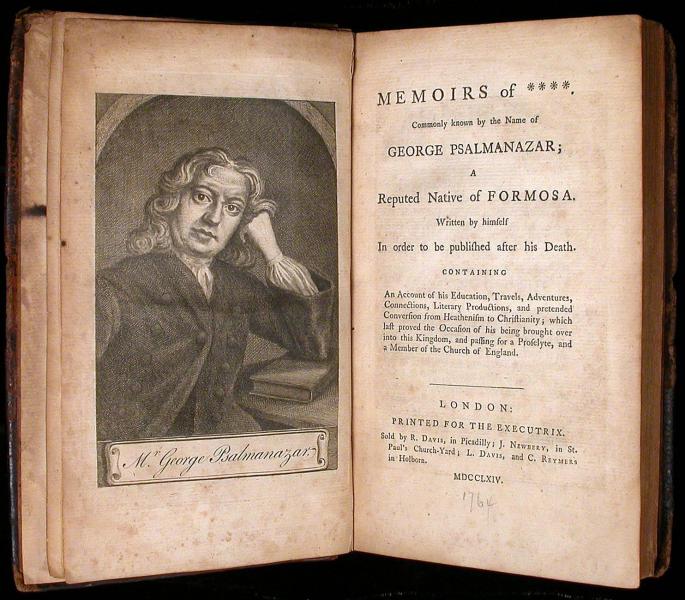
The 1704 work, The History of Formosa, describes in great detail the culture, language and customs of the island nation of Formosa, modern-day Taiwan. The book was supposedly written by a native of Formosa who was brought to Europe by Jesuit missionaries, but all is not as it seems.

The catch is that the author, who called himself ‘George Psalmanazar’, was actually a white, blond-haired Frenchman who had never left Europe. Every detail of Formosan life that the book describes is completely made up. Psalmanazar was a fantasist who, like an early Walter Mitty, spent his life in a world of his own imagination. His hoax was so successful that to this day, we still don’t know his real name.

To modern readers, Psalmanazar’s stories seem far-fetched but they successfully fooled an English audience with little or no experience of other cultures and a view of the world that saw foreign people as primitive and savage. Psalmanazar’s book was an unqualified success. 

Even today, we still know very little about who Psalmanazar really was, because his posthumously-published autobiography deliberately obscures the details. 

In his final years, he wrote a frank confession with instructions in his will for it to be published after his death in 1763. This account, entitled Memoirs of XXX, Commonly known by the name of George Psalmanazar, a reputed native of Formosa.

Sunday, November 25, 2018

Scoundrels by Major Cornwall and Major Trevelyan

These memoirs are authored by two disreputable spies; or cads, rakes, rascals, bounders - call them what you will. Based in the form of a manuscript submitted to a publisher, these two "gentlemen" - Major Victor Montgomery Cornwall and Major Arthur St John Trevelyan - have been under house arrest for 30 years and for what we do not yet know - and have decided, by means of a series of letters (ie: snail mail) to relive certain aspects of their lives (adventures) to set the record straight and vindicate themselves.


I will preface this by saying that these memoirs are at times, humourous, vulgar, questionable, comedic, slapstick, incredible. These are tales of war, sex, love, adventure, deceit, murder, with the central point being the Scoundrels Club of Piccadilly. 
As over-confident seventeen year olds, Trevelyan and I were initiated into Scoundrels Club. Lunk Snr immediately handed us an undertaking, club parlance for ‘something that needs squaring away, putting right, or sweeping under the carpet’. Little did we know it would mark the start of a long and illustrious career of lying, cheating, stealing and skullduggery. Or to dignify it, espionage."
One must begin with the first in the series - Scoundrels - wherein we are introduced to the two Majors as they are now and as they begin to look back (from the 1920s to the 1950s). Sometimes the story-telling is more along the lines of a game on one-up-manship (there is also a healthy dose of animosity between the two) wherein we are treated to both sides of the story, and where the Majors' nemesis, in the form of former school chum Gruber Hansclapp, emerges.

The memoirs are also based around a series of well-known historical events - which readers will readily identify with, though will find themselves questioning if either of the Majors actually appeared in anything they have previously read.

Scoundrels: The Hunt for Hansclapp continues in the same vein - and takes place in the period from the 1950s to 1970s. And outwitting them at every turn - their Moriarty - is Gruber Hansclapp. Will they get their man - will the mystery of their house arrest be revealed - will the ever be released back into the real world.

It's billed as "... historically accurate, morally questionable and absolutely true ..." and dare I say, so politically incorrect! So if you are easily offended - step away now.


Interview with James Peak & Duncan Crowe (publishers or trustees of the memoirs) here @ The Turnaround Blog


Monday, July 2, 2018

She Didn’t Know How to Read, but Her Stories Captured History

Review by Gaiutra Bahadur for The New York Times:

Aida Edemariam may not have intended the title of her book to recall the Wife of Bath, of Chaucer’s “Canterbury Tales.” Still, three themes fundamental to that canonical work are also at the capacious, warmly beating heart of “The Wife’s Tale,” Edemariam’s chronicle of her grandmother’s life in 20th-century Ethiopia. Chaucer’s medieval classic unfolds as a storytelling battle among pilgrims traveling to the shrine of an English archbishop martyred in a church-and-state intrigue. 

The Wife throws down with a story about a knight who, to escape punishment for rape, embarks on a quest to find out what makes women happiest. (Sovereignty over their husbands, it turns out.) 


Edemariam’s sublimely crafted tribute to her grandmother also involves sparring storytellers, religion (including pilgrimage and church-and-state intrigues) and the happiness and sovereignty of married women.


Saturday, May 26, 2018

The Fascinating Story of the Russians Who Spied for the West on Moscow

31448970. sy475 Jefferson Flanders reviews Spies in the Family by Eva Dillon for History News Network:

We have learned since the end of the Cold War that the West had well-placed spies in the Kremlin, and that those double agents provided timely intelligence about Soviet aims and intentions. It’s impossible to gauge their full impact in hastening the fall of the Communist regime, but it’s clear that these inside sources helped policymakers in London, Paris, and Washington in assessing the thinking of the Politburo and other Soviet leaders.

A new memoir/history by Eva Dillon, Spies in the Family, offers a fascinating and deeply sympathetic account of perhaps the most important of the Kremlin spies, Dmitri Polyakov, code name TOPHAT, who was the third major GRU (military intelligence) officer to pass vital information to the CIA. All three were discovered. Polyakov lasted the longest; the other two—Pyotr Popov and Oleg Penkovsky—were betrayed, it is believed, by British mole George Blake (who is in his 90s, living in exile in Moscow).


Saturday, December 30, 2017

The hidden lives of army wives

A stolen chest of letters – penned by an army wife to her husband on the battlefields of the Second World War – has helped a Cambridge academic and biographer trace the history of the women behind the men in uniform.

Army Wives by Midge Gillies, Academic Director for Creative Writing at the Institute of Continuing Education (ICE), uses first-hand accounts, diaries and letters to piece together some of the extraordinary stories of servicemen’s wives through history – from Crimea to the war in Afghanistan

Exploring all aspects of army life across the centuries; from the impact of life-changing injuries to séances, public memorials and death in foreign fields, Army Wives seeks to understand the singular experience of what it means for women to be part of the ‘army family’.

read more here @ University of Cambridge and @ Murdoch Books

Wednesday, December 27, 2017

Review - The Bandy Papers by Donald Jack


Bart Bandy is the anti-hero who seems to always come up trumps in this first volume of his wartime exploits. I kept imaging Bart in the visage of Rik Mayall's "Lord Flashheart" from the "Blackadder" series, with the naive innocence of Inspector Gadget.

Bandy's memoirs begin with his early years in Canada, then onto the battlefields of France during WWI, and then to his career in the Royal Flying Corps.

It is a humourous and witty tale written in the style of a "boys own adventure".  And finding out that the author served in the RAF in WWII, makes me wonder if this is slightly auto-biographical.  A ripping good yarn.

For fans of - "Flashman", "Biggles", and "Inspector Clouseau" or maybe even, "Inspector Gadget".  I could maybe also add for those you (like me) enjoyed Spike Milligan's books of his wartime exploits.

Link to full series here @ Farrago Books and @ Wikipedia

Sunday, December 24, 2017

Lieutenant Nun by Catalina De Erauso

From Penguin Random House:
Lieutenant Nun by Catalina De ErausoOne of the earliest known autobiographies by a woman, this is the extraordinary tale of Catalina de Erauso, who in 1599 escaped from a Basque convent dressed as a man and went on to live one of the most wildly fantastic lives of any woman in history. A soldier in the Spanish army, she traveled to Peru and Chile, became a gambler, and even mistakenly killed her own brother in a duel. During her lifetime she emerged as the adored folkloric hero of the Spanish-speaking world. This delightful translation of Catalina’s own work introduces a new audience to her audacious escapades.