Showing posts with label french history. Show all posts

Monday, April 22, 2024

Review: House of Lilies by Justine Firnhaber-Baker

Synopsis: The definitive history of the Capetians, the crusading dynasty that made the French crown the wealthiest and most powerful in medieval Europe and forged France as we know it today

In House of Lilies , historian Justine Firnhaber-Baker tells the epic story of the Capetian dynasty of medieval France, showing how their ideas about power, religion, and identity continue to shape European society and politics today.

Reigning from 987 to 1328, the Capetian kings became the most powerful monarchy of the Middle Ages and established the foundations of a shared French culture. Consolidating a fragmented realm that eventually stretched from the Rhône to the Pyrenees, they were the first royal house to adopt the fleur-de-lys, displaying this lily emblem to signify their divine favor and legitimate their rule. The Capetians played a part in some of the most dramatic and far-reaching episodes in European history, including the Crusades, bloody waves of religious persecution, and a series of wars with England. The Capetian age saw the emergence of Gothic architecture, the romantic ideals of chivalry and courtly love, and the Church’s role at the center of daily life.

Evocatively interweaving these pivotal developments with the human stories of the rulers who drove them, House of Lilies is the definitive history of the dynasty that forged France—and Europe—as we know it.

~ ~ ~

Four stars for the following reasons:

* easy to read
* informative though not dull or dry
* covers the Capetian Dynasty well, including the women
* well researched
* additional notes, maps, family trees

Covering nearly over three centuries of French history and international politicking, Firnhaber-Baker does a remarkable job at presenting one of the pivotal dynasties in French history - the Capetians. This work has all the elements: religious fervor and upheaval, crusades,scandal, warfare, adultery, ambition, family drama, politicking - and on a magnificent grandiose scale.

Each monarch has their own dedicated chapter which covers off the pivotal moments of their reign, including each monarch's relationships with France's closest neighbours - England, Normandy, Flanders, Blois, Anjou, Valois - as France as we know it today, was still very much in its infancy and only really beginning to coalesce.

Recommended reading for those with an interest in French history and royal dynasties.

Thursday, February 8, 2024

Review: The Bastard Prince of Versailles by Will Bashor

Synopsis: A historical novel inspired by real events, The Bastard Prince of Versailles, narrates the escapades of a misborn "prince" during the reign of Louis XIV in seventeenth-century France.

Louis de Bourbon wasn't a real prince-even though his father was King Louis XIV. The illegitimate son of the King and his mistress, Louise de La Vallière, young Louis has been kept far from the court's eyes until summoned to bid adieu to his mother. To atone for her adultery, she joins a convent, abandoning Louis to an uncertain future. When Louis is humiliated by his father for his role in a secret gay society, he struggles to redeem himself through heroism and self-sacrifice in the king's army on the battlefield.

~ ~ ~

The fictional account of the very short life of Louis, Count of Vermandois, son of King Louis XIV of France and his mistress, Louise de Valliere.

The synopsis covers it all really - Louis' short life from his birth to his ultimate sexual corruption by the Chevalier de Lorraine in revenge of some slight done unto him by the King, to his exile and death (1683).

During the reign of Louis XIV homosexuality was punishable with death.  However, it was, in reality - at least at the French Court -  difficult to pursue such deviates when the King’s own brother was a noted invert, beneath contempt but above the law. As most marriages in the aristocracy were arrangements of property, French society condoned concubinage; nearly every man who could afford it had a mistress; men plumed themselves on their liaisons almost as much as on their battles; a woman felt desolate if no man but her husband pursued her; and some faithless husbands winked at their wives’ infidelities.

This is the world into which the pretty, young and naive young Louis was thrust once Louis XIV decided his offspring would be better educated and monitored at Versailles.

At times, the narrative feels overly long and rambling, however, this is a fair reconstruction of Louis' young life.  Those with an interest in French history and the court of the Sun King will find this enjoyable.

Saturday, September 21, 2019

The Real Traviata: The Song of Marie Duplessis by René Weis

The Real Traviata is the rags-to-riches story of a tragic young woman whose life inspired one of the most famous operas of all time, Verdi's masterpiece La traviata, as well as one of the most scandalous and successful French novels of the nineteenth century, La Dame aux Camelias, by Alexandre Dumas fils.


The woman at the centre of the story, Marie Duplessis, escaped from her life as an abused teenage girl in provincial Normandy, rising in an amazingly short space of time to the apex of fashionable life in nineteenth century Paris, where she was considered the queen of the Parisian courtesans. Her life was painfully short, but by sheer willpower, intelligence, talent, and stunning looks she attained such prominence in the French capital that ministers of the government and even members of the French royal family fell under her spell.

In the 1840s, she commanded the kind of 'paparazzi' attention that today we associate only with major royalty or the biggest Hollywood stars. Aside from the younger Dumas, her conquests included a host of writers and artists, including the greatest pianist of the century, Franz Liszt, with whom she once hoped to elope. When she died Theophile Gautier, one of the most important Parisian writers of the day, penned an obituary fit for a princess. Indeed, he boldly claimed that she had been a princess, notwithstanding her peasant origin and her distinctly demi-monde existence.

And although now largely forgotten, in the years immediately after her death, Marie's legend if anything grew in stature, with her immortalization in Verdi's La traviata, an opera in which the great Romantic composer tried to capture her essence in some of the most heart-wrenching and lyrical music ever composed.

The Girl Who Loved Camelliasread more 

Sunday, July 28, 2019

Review: The Cardinal's Man by MG Sinclair

35077553. sy475 Synopsis: With enemies advancing on all sides and Cardinal Richelieu health failing, France is at breaking point. Yet salvation may arrive in the most unlikely form...

Born into poverty and with terrible deformities, Sebastian Morra is a dwarf with the wit of Tyrion Lannister and three foot, four inches of brazen pluck. Through a mixture of brains and luck, he has travelled far from his village to become a jester at the royal court. And with a talent for making enemies, he is soon drawn into the twilight world of Cardinal Richelieu, where he discovers he might just be the only man with the talents to save France from her deadliest foes.


Another novel inspired by one of Velasquez's paintings of the dwarfs at the Spanish royal court. In this instance, the main character is Don Sebastian de Morra, whose story is set in both the royal court of Louis XIII of France then the Spanish Court during the reign of King Philip IV.  Who could ask for a better backdrop into which a distinctive character is inserted, and is central - yet despite his wit, Sebastian is still out of his depth in a court full of plots and intrigue. 

Sinclair is upfront when he claims there is very little to go on by way biographical information on Sebastian de Morra and so has provided him with a most likely personal history from son of peasants in Camoches to his education by local priest, and appointment as a clerk to the Viscount Turenne in Paris. This harsh early life will eventually teach Sebastian the skills he will come to need when he is taken on by the King's Chamberlain, Alain Bouchard, and gains entry into the royal court of King Louis XII of France.

The French Court during the 1620 - 1640s was dominated by the powerful Cardinal Richelieu, who played a major role in determining France's political direction. Under Louis and Richelieu, the French Crown successfully intervened in the Thirty Years' War against the (Spanish) Habsburgs, managed to keep the French nobility in line, and retracted the political and military privileges previously granted to the Huguenots. In addition, Louis had the port of Le Havre modernised, built a powerful navy, and made territorial advances in North Africa, Asia, the Americas.

This novel offers an alternate view of the French Court and Cardinal Richelieu through the eyes of another, as what most people know of / remember about Cardinal Richelieu comes from his portrayal by Dumas in his books on the Three Muskateers. It makes a nice change to see his vulnerability.

Towards the end of his life, Richelieu alienated many people, including Pope Urban VIII. Richelieu was displeased by the Pope's refusal to name him the papal legate in France; although the conflict was largely healed when the Pope granted a cardinalate to Jules Mazarin, one of Richelieu's foremost political allies (and his political successor). 

As he neared death, Richelieu faced a plot that threatened to remove him from power. The Cardinal had introduced a young man named Henri Coiffier de Ruzé, Marquis de Cinq-Mars to Louis XIII's court. The Cardinal had been a friend of Cinq-Mars' father. More importantly, Richelieu hoped that Cinq-Mars would become Louis' favourite, so that he could indirectly exercise greater influence over the monarch's decisions. Cinq-Mars had become the royal favourite, but, contrary to Cardinal Richelieu's belief, he was not easy to control. The young Marquis realized that Richelieu would not permit him to gain political power and thus found himself mixed up in the Comte de Soissons' failed conspiracy against Richelieu, but his part in it was not yet discovered. Cinq-Mars then schemed with leading nobles, including the King's brother, Gaston, the Duc d'Orléans, to raise a rebellion; and then signed his name on a secret agreement with the King of Spain, who promised to aid the rebels. Richelieu's spy service discovered the plot, and the Cardinal received a copy of the treaty. Cinq-Mars was promptly arrested and executed; although Louis approved the use of capital punishment, he grew more distant from Richelieu as a result. It is as part of the Cardinal's spy network that author Sinclair has inserted the character of de Morra.

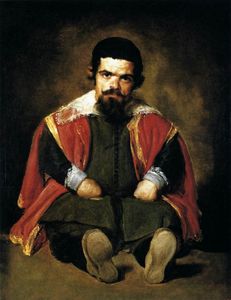
The Dwarf Sebastian de Morra
But de Morra was a man of two royal courts, and in 1643 - 1644 he finds himself at the court of Philip IV of Spain - we know this only based on his portrait by Diego Velasquez,said painted in 1644. It has been speculated that de Morra was acquired by King Phillip IV from his younger brother Cardinal Infante Fernando, possibly on the latter's death in 1641 certainly not sooner if de Morra was still in Richelieu's pay up until that cardinal's death in 1643. He was then given over to Prince Baltasar Carlos until the prince's death sometime after, aged only 16yo (1646). 

Following the death of his son, Philip IV fell into a period of melancholy; he slowly replaced his former fallen favourite with another; and was found to be in  thrall to the religious mystic, Sister María de Ágreda with whom he was in constant correspondance. When Philip died (1665), he left a four year old son Charles as his heir under the regency of the boy's mother. A political power struggle for control of the young king ensued between the queen regent and the king's illegitimate half brother. Charles' own death (1700) would spark off the Spanish War of Succession.

Where was de Morra amid all of this political turmoil? Some have him dying three years after Prince Carlos, (October 1649) following three years of service at the Spanish court. Or quite possibly later - we will never truly know.

Sinclair's novel was is quite easy to read; the main characters are well known; the cast is not overly large. Sinclair has provided us the reader with a well researched and well told tale, that is not quite a traditional novel and not quite a biography but rather a blend of both; and told from the point of view of Sebastian.

see also my review of The Queen's Prophet by Dawn Patitucci

further reading:


Saturday, July 20, 2019

Journal of My Life During The French Revolution

Journal of My Life During The French Revolution by [Elliott, Grace Dalrymple]Grace Dalrymple Elliott, a young Scotswoman, courtesan and socialite, living in Paris was there to witness it all.  Born in 1754, Grace Dalrymple Elliott became one of the most sought after women in Europe.  Educated in a French convent, her barrister father Hew Dalrymple later introduced her to Edinburgh society where she received numerous marriage proposals.


Grace, however, fearless, beautiful and wild, was to reject tradition.  Unhappily married and then divorced, she went on to have affairs with the Prince of Wales and the Duke of Orleans, later known as Philippe Egalité.   She lived a scandalous and remarkable life, maintaining dangerous alliances and surviving treachery and betrayal. 

Entertaining her relationship with the Duke of Orleans, Grace had unprecedented access to the highest ranks of court life, which she vividly recounts.  After her arrival in Paris she was forced to escape violent Revolutionists and the Mob to stay in Meudon, where she was at the mercy of domestic spies and harboured a wanted man.  Unable to flee to England, she was then imprisoned in an infamous institution and became gravely ill.  Surrounded by death and the fear of royalists, Grace only narrowly escaped the guillotine herself, and was finally released to tell her story when the revolutionary leader Robespierre died. 

Her memoir, an eyewitness account of the Revolution, recounts a time of turbulent politics, dark days and lethal enemies during an infamous time in history, which she witnessed while living in Paris.

Sunday, May 19, 2019

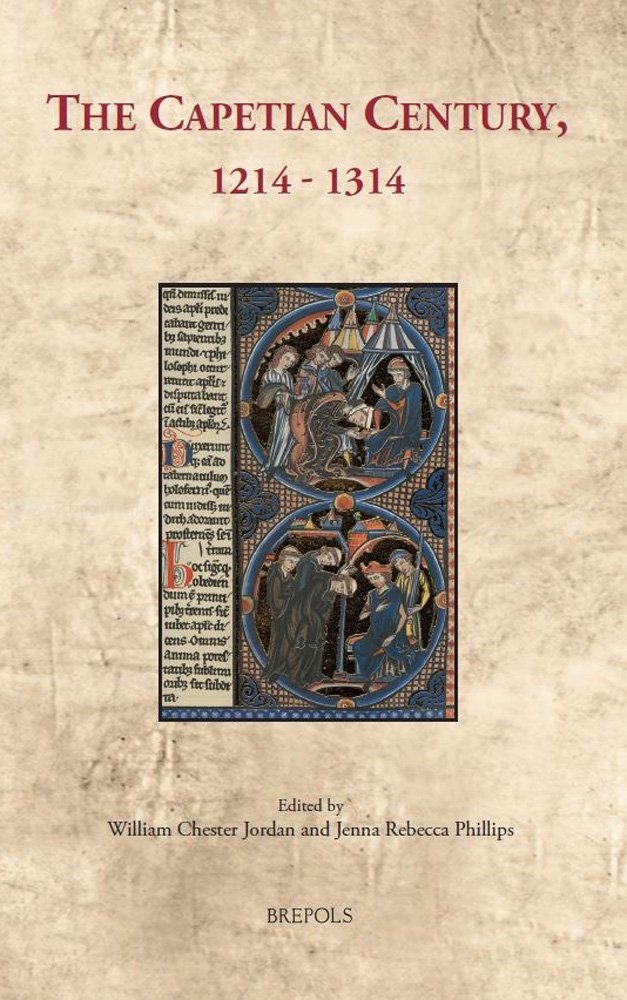
The Capetian Century, 1214 to 1314 ed by William Chester Jordan & Jenna Rebecca Phillips

From Amazon UK

This volume provides a fresh look at the Capetian century (1214-1314), a period that changed the cultural and political fabric and laid the foundation for the modernisation of the medieval West. The period from the birth of Louis IX to the death of Philip the Fair is remarkable for a series of developments and accomplishments associated with the Capetian kings of France. Innovations in architecture, manuscript illumination, and music all helped shape the cultural fabric of French and European life. Administrative historians emphasize the development of political institutions that have been said to lay foundations of the modern State. 'Moral reform', partly in support of the crusading movement, led to various changes in policies toward Jews, prostitutes, heretics, and many other social groups. This volume brings together essays presented at the Capetian Century Conference held at Princeton University, commemorating two seminal anniversaries bracketing the 'Capetian Century'--the Battle of Bouvines (1214), and the death of Philip the Fair (1314).

I think this will make a nice addition to my French History shelf in my personal library, sitting alongside a tome by Hallam & Everard on Capetian France

Saturday, March 16, 2019

Remembering a Woman Who Was a Leader of the French Resistance


Lynne Olson’s “Madame Fourcade’s Secret War” tells of a woman who led the fight against the Nazis while combating sexism among her colleagues.


Why have most of us never heard of Marie–Madeleine Fourcade? Why is her name missing from the honor roll of war heroes carved into thousands of monuments in hundreds of French village squares? Might the fact that this hero — the leader of one of France’s most successful anti-Nazi resistance organizations — was not a hero, but a heroine, have something to do with her absence from history? There is reason to believe so. At the end of World War II, the triumphant Gen. Charles de Gaulle designated 1,038 people as resistance heroes. Only six of those heroes were women, and Fourcade, who ran the longest-running spy network, was not among them. In “Madame Fourcade’s Secret War,” her fast-paced and impressively researched account, Lynne Olson corrects that historical injustice. Marie-Madeleine Fourcade emerges as a vivid and pivotal player in the French Resistance.

Olson writes with verve and a historian’s authority. Fourcade, she tells us, was beautiful and liked men, but she was obsessed with defeating the despised Boches. A master of disguises, she frequently changed her hair color, and sometimes used distorting dentures and other theatrical tricks.

read more here @ The New York Times

Sunday, March 3, 2019

ASTERIX AT 60: The storied history of a still-indomitable gaul

Image result for asterix and obelixFrom The Mail:

There are some very special Frenchmen who have truly endeared themselves to the great British public. Victor Hugo has managed it (we all love Les Mis), Claude Monet generally goes down all right, and those of a certain persuasion may have fond memories of Thierry Henry.

But for the true adoration of the nation, one name stands (metaphorically) tall above the rest. I'm referring, of course, to Asterix the Gaul.

After six decades of boar-hunting, Roman-bashing, magic potion-swilling and menhir-delivering, the mischievous, mustachioed warrior has barely aged a day.

read more here @ The Mail


Sunday, February 3, 2019

Review: Twisted Fate by Frank Harrrelson

43376443
Synopsis: Twisted Fate tells the saga of families in France caught up in the Protestant Reformation begun in the sixteenth century by Martin Luther in Germany and John Calvin in Switzerland. The Reformation caused great conflict between the Catholic Church in France and the Huguenots, who desired religious toleration from the church and from the government. The reader gets involved in the lives of these families filled with political intrigue, murder, suspense, persecution, survival, and ultimately enduring love.


I am going to be reviewing this twice over as I stopped reading this part way through then came back to it.

Review 1: January 22nd 2019:
To say I was finding this challenging would be misleading - though I have come to a complete stop - such a promising start .. such an interesting topic to tackle ... thinking maybe this could have been tightened up a little or serialised earlier ... on the backburner for now.


Review 2: February 3rd, 2019:
History is my forte - I love it, and have a huge personal library covering off a number of topics, including French History. So whilst the struggles of the Huguenots attracted me to this work, the final "presentation" detracted form my reading pleasure.

Whilst this is essentially a (fictional) history of the beginnings of the author's family and the events that led to their arrival in America, it is also a history of the Huguenot town of La Rochelle. And this is where the conflict begins (no pun intended) - it is part historical fiction and part factual history, with the author attempting to give us the reader, as much information as possible on this period in French history. And, personally, this does not work for me. 

I will preface this second review with a sentence from the synopsis:
The reader gets involved in the lives of these families filled with political intrigue, murder, suspense, persecution, survival, and ultimately enduring love.

The lives of the characters (of which there are so many you don't know who to focus on) are drawn out, day by day to the point of tedium, and often scenes are repetitive as characters re-tell what has happened to them to other characters - in detail - after we, the readers, have already read all of this - in detail. The historical facts are detailed, at times, whole chapters dedicated to bringing us up to speed on our French History - it felt like a school lesson. Did I mention the detail? Thus for me, it got to the point that I just had to set this aside, unfinished. 

But my curiosity finally got the better of me, and I ploughed on - I wanted to find out how this story ended and just which of the characters made it to America and in what circumstances (hint: its in the final chapters).

I think, with hindsight, the author should have stuck with either a fictional account OR a factual account; and the editor / publisher should have stepped in here. For an historical novel, it is heavily annotated. Just reading a note I had written down " reads like a genealogy lesson" - and maybe a family tree might have been a more welcome addition or even a list of characters. No, on second thoughts, this should have been a "family history" type book rather than a fictional / factual account, with the historical facts then interspersed, which would have made much more sense.

This, for me, became a case where reading became a chore rather than a pleasure.

Further Reading:
City on the Ocean Sea: La Rochelle, 1530-1650 : Urban Society, Religion, and Politics on the French Atlantic Frontier by Kevin C Robbins
Protestant exiles from France in the reign of Louis XIV; or, the Huguenot refugees & their descendants in Great Britain & Ireland by David C Agnew (3 Vols) - read online HERE

Saturday, November 24, 2018

Kate Mosse on The Burning Chambers


Bestselling author Kate Mosse visited the graveyard in Franschhoek several years ago and felt such a strong sense of the links between the southwest of France and the Cape, the landscape and Huguenot history that, she says, a shiver ran down her spine. It inspired The Burning Chambers.

Readers are plunged into 16th-century France, to a time of bloody strife between Protestants and Catholics, persecution of the Huguenots and the massacre of Toulouse. Like her Languedoc trilogy (Labyrinth, Sepulchre and Citadel), this novel is set predominantly in Carcassonne.

“All my fiction is inspired by place, by landscape,” she says. Mosse knows the place – she goes there every month to write. When she’s there the history of this fortified medieval city is palpable to her. She’s walked the ancient streets and climbed the towers and seen the sun on the citadel, and this intimate knowledge she bring to The Burning Chambers.

read more here @ Sunday Times Books and Kate Mosse's WEBSITE

Sunday, July 15, 2018

The Napoleon the French Turned Their Backs On

Review from History News Network:

Rarely in history has a country so blindly, maliciously and relentlessly turned against the memory of one of its national leaders in blatant defiance of the historical facts, as French historians have against Louis Napoleon Bonaparte, Napoleon III. And they continue to do so to this day. The complete distortion and denial of Napoleon III’s true achievements began with his arch political opponent, Adolphe Thiers, in his undisguised strongly biased history of this period. Thiers reminds readers that Napoleon III was defeated by Prussian armies in 1870 and brought shame to the country. Overlooked were the real, solid achievements of the Second Empire. 

And yet, despite all his faults, Louis Napoleon’s intentions were honorable and most constructive, providing a long-term legacy, introducing progressive education, new hospitals and a greatly expanding economy thanks to a thriving commercial and industrial revolution. Napoleon III also succeeded in removing some of the shackles of the working class. He completely rebuilt the national economy, created genuine prosperity for the country’s first middle classes, and launched the country into a modern new world.


Sunday, July 8, 2018

Bastille Mysteries

Having added "The Odd Fellow" by Ian Honeysett to my kindle reading list, I was intrigued by what more there was on offer by this author.  Not being incredibly au fait with the period of the French Revolution (aside from Hugo, Dumas, Sabatini & Baroness Orczy), I was intrigued in this set of three historical mysteries set in this period.

The Bastille Mysteries website:

Image result for bastille mysteriesThe "Bastille Mysteries" is a series of crime & suspense novels set during the French Revolution.

The first is "The Eighth Prisoner" and takes place in 1789 as the Bastille falls. The second, "The Year of the Oath", is set in 1790 when all clergy are required to swear an Oath of allegiance to the State. And the latest release is "Death A La Carte", set in 1791 when a struggle for control of the Capital's dining empire occurs.


The main characters are: Rouget Maison of the Paris Police; Abbé Pierre Reynard & Christine Gilbert, his housekeeper's daughter


Revolutionary France
A country in turmoil; overthrow of the monarchy; the reign of terror; a climate of fear and suspicion, of social and economic change; what better setting for a series of mysteries.


see also 


Saturday, June 9, 2018

Before Church and State: A Study of Social Order in the Sacramental Kingdom of St. Louis IX

Image result for Before Church and State: A Study of the Social Order in the Sacramental Kingdom of St. Louis IXSynopsis from St. Paul Center:

Before Church and State: A Study of Social Order in the Sacramental Kingdom of St. Louis IX by Andrew Willard Jones explores in great detail the “problem of Church and State” in thirteenth-century France. It argues that while the spiritual and temporal powers existed, they were not parallel structures attempting to govern the same social space in a contest over sovereignty. Rather, the spiritual and the temporal powers were wrapped up together in a differentiated and sacramental world, and both included the other as aspects of their very identity. The realm was governed not by proto-absolutist institutions, but rather by networks of friends that cut across lay/clerical lines. Ultimately, the king’s “fullness of power” and the papacy’s “fullness of power” came together to govern a single social order.

Before Church and State reconstructs this social order through a detailed examination of the documentary evidence, arguing that the order was fundamentally sacramental and that it was ultimately congruent with contemporary incarnational and trinitarian theologies and the notions of proper order that they supported. Because of this, modern categories of secular politics cannot be made to capture its essence but rather paint always a distorted portrait in modernity’s image.

In addition to a detailed reconstruction of the institutions of the kingdom, the work offers a reading of the political and ecclesiological thought of St. Thomas Aquinas that is consistent with that reconstruction. Thomas is here rescued from the liberal or Whig reading that has dominated in recent centuries and is returned to his thirteenth century context.

Previously, scholars interested in challenging modern conceptions of the secular and the religious when treating the Middle Ages, have had to rely largely on historical scholarship written from within the conventional modern paradigm. In this text, Jones provides these scholars with a methodologically and technically rigorous alternative. If the book’s thesis is widely accepted, it will call for the reconsideration of the accepted narrative of medieval Church and State.


read review here @ National Catholic Register

Image result for Before Church and State: A Study of the Social Order in the Sacramental Kingdom of St. Louis IX

Saturday, March 31, 2018

‘Francis I’ Review: A Royal Renaissance

Image result for francis 1 leonie friedaHarper Collins:

Catherine de Medici’s father-in-law, King Francis of France, was the perfect Renaissance knight, the movement’s exemplar and its Gallic interpreter. An aesthete, diplomat par excellence, and contemporary of Machiavelli, Francis was the founder of modern France, whose sheer force of will and personality molded his kingdom into the first European superpower. Arguably the man who introduced the Renaissance to France, Francis was also the prototype Frenchman—a national identity was modeled on his character. So great was his stamp, that few countries even now are quite so robustly patriotic as is France. Yet as Leonie Frieda reveals, Francis did not always live up to his ideal; a man of grand passions and vision, he was also a flawed husband, father, lover, and king.

With access to private archives that have never been used in a study of Francis I, Frieda explores the life of a man who was the most human of the monarchs of the period—and yet, remains the most elusive.


The French king sent agents to Italy to find paintings for the royal collection, now the core of the Louvre museum. Other foreign initiatives went less well. John Steele Gordon reviews “Francis I” by Leonie Frieda.

When Francis I was born in 1494, no one thought he would become king of France. He was, after all, only a third cousin of the reigning king, Charles V III, who was just 24 years old and in good health. But Charles’s four children all died in or near infancy, and the king himself suddenly died in 1498. The throne then went to Louis XII, a cousin of Charles’s. Louis, 35 when he came to the throne, tried valiantly to sire a son and heir, even marrying a third wife just three months before his own death despite his rapidly declining health. But he failed in his mission, and his two daughters were debarred from the throne by law. Thus in 1515 it came about that Francis, at the age of 20, became king. As Leonie Frieda shows us in “Francis I: The Maker of Modern France,” a superb and vivid biography, he made the most of it.

This is a roistering biography of a priapic king, which entertainingly fails to make the case for his greatness, says Gerard DeGroot.

Thoroughgoing biography of the French ruler who allied with Islam in an effort to resist his Habsburg neighbors. Though a figure of major importance, Francis has been forgotten against better known contemporaries such as England’s Henry VIII. Frieda’s work helps restore him to history.

Was François I the first Renaissance king of France — or the last medieval one?


Sunday, June 11, 2017

Review: The Fortunes of France by Robert Merle

This is an epic thirteen book series which "tells the story of Pierre de Siorac, a young Huguenot nobleman, and follows his adventures as he tries to balance his competing loyalties, to his faith and king, during the bloody French Wars of Religion of the sixteenth century, which pitted Catholics and Protestants against each other and tore the country in two."

These books are very descriptive – sometimes painfully so, and, I cannot emphasis the word enough, detail events from the French perspective. The story telling is, at times,  cumbersome as it reads like a history lesson, again from the French perspective.  We are also treated to a very detailed monologue of the cast of characters and their history.  In the beginning, I could not follow who was actually narrating events – it is Pierre (bc.1551), who retells of events that have occurred in the past until we reach current events (Book 3).

Book 1: The Bretheren - covers the period 1547 -1565
We are introduced to the Protestant de Siorac family, living in the Perigord region of France, and are told how they and their entourage came to occupy Mespech (1545) – these are “the Bretheren” of the title (Jean de Siorac, Jean de Sauveterre, and three other veteran soldiers).

Book 2: City of Wisdom & Blood - covers the period 1565 – 1570
Now an adult, Pierre de Siorac leaves Mespech and travels sto Montpellier, accompanied by his brother Samson and the crafty Miroul. This new life away from the safety of their home will bring with it many dangers and delights.

Book 3: Heretic Dawn - begins from 1570
Pierre de Siorac travels to Paris, where he becomes embroiled in personal and political intrigues at the royal court before the capital erupts in the communal violence of the St Bartholomew’s Day Massacre, and he and his companions must fight for their lives.


It is a series definitely worth pursuing – I read the kindle versions of these three books, which probably detracted from my reading pleasure, as I do prefer to have a "hard copy" in my hand when reading

See Also:

Wednesday, May 17, 2017

Movie: The Last Duel

One of my favourite books is set to become a movie - Eric Jager's The Last Duel.

Shaun Grant has been set to adapt the Eric Jager novel The Last Duel for Jeff Robinov’s Studio 8Francis Lawrence (Hunger Games: Mockingjayis to direct with Erwin Stoff producing. Set in France,The Last Duel is the true story of a duel in 1386 between knights Jean de Carrouges and Jacques Le Gris. It was the final duel sanctioned by the French government, ruled at the time by King Charles VI.  Grant scripted the Justin Kurzel-directed Australian film Snowtown, a chronicle of the fact-based Snowtown murders. He also wrote Berlin Syndrome, an adaptation of the psychological thriller novel by Melanie Joosten that Cate Shortland will direct this summer.  

Read more @ Hroarr - What Really Happened at the Last Duel - Part 1 & Part 2 by Ariella Elema

Wednesday, February 22, 2017

A Lady Crowned with Fleurs-de-Lys

The story centers on Isabella, a princess from the German territory of Bavaria. The young royal is chosen to be the bride of Charles, the young king of France. Her idyllic life with her loving husband and doting children is left uninterrupted for many years until a series of unfortunate events leads to her downfall. After her death, she is no longer thought of as the princess who enchanted everyone on her wedding day. Rather, she is regarded as a corrupted woman whose name is associated with depravity and blind ambition.

Further Reading: 
  • The Life & Afterlife of Isabeau of Bavaria by Tracy Adams
  • The Role of Isabeau of Bavaria in the Government of France by Colleen Lily Mooney
  • The Active Queenship of Isabeau of Bavaria, 1392-1417: Voluptuary, Virago Or Villainess? by Rachel C. Gibbons

Spinning a Historical Tale

For centuries, silk has been associated with wealth and royalty. Lesser known, though, is the fabric’s crucial role in French history — and how that reputation was cemented by women and immigrants.
In her book, “The Silk Industries of Medieval Paris: Artisanal Migration, Technological Innovation, and Gendered Experience” (University of Pennsylvania Press, 2016), UC Santa Barbara historian Sharon Farmer races the roots of modern silk production in France back to medieval Paris, a bustling hub for luxury goods and fine textiles.
Read entire article here @ The Current (UC Santa Barbara)

Princess Michael of Kent - Writing 'The Anjou Trilogy'

From Midnight Walks to Medieval Murders: Writing 'The Anjou Trilogy' | The Huffington Post

Princess Michael of Kent blogs about writing, research & her upcoming trilogy:

Research is rather like becoming a detective. Every clue, no matter how small, is exciting and can lead one on to the next, another piece in the jigsaw found and I continue trying to form a picture of a personality. This is the part of my journey as a writer which I enjoy the most — discovering the essence of a character through tiny little asides and titbits of no apparent significance but which can, on occasion, add something significant to their persona.
And then there are the locations. I never write about a place I have not visited, and therefore I do travel a great deal. 
I am a night-writer. It is the only time I am undisturbed and often at my laptop until three or four in the morning. 
Strangely enough, each one of my chosen subjects about whom I have written has led me to the next. 

Read complete article here @ Huffington Post
Read more about Princess Michael of Kent


Ermengarde of Narbonne - The Viscount's Daughter


In 12th century France, women were generally regarded as useful only in the home – meant to run the household and raise children. It was men's work to handle politics and warfare. There have been exceptions to this unwritten rule throughout history, and one such exception was Ermengarde, viscountess of Narbonne. Her exceptional role in France's history was what drew author Phyllis Hall Haislip to write her first novel for adults.

"The Viscount's Daughter," published in 2013, is the first volume in a planned trilogy following Ermengarde's life.

Few facts are known about Ermengarde. She inherited her title at approximately the age of five, after the death of her father. Because she was too young to lead, another nobleman, Alphonse I of Toulouse, assumed regency of Narbonne. When Ermengarde reached adolescence, he married her to add her lands to his own. Other local landowners objected to Toulouse's greed, and the conflict soon escalated to violence. Through all this, Ermengarde fought both against the dismantling of her father's legacy and the undesirable advances of her husband.

Haislip conducted extensive research for her novel, even traveling to visit the places Ermengarde and her contemporaries once lived to ensure accuracy in her descriptions.

Much of the work is based on the author's own imagination, because many details of Ermengarde's life have been lost over the centuries, but the book remains true to the culture and region of France in the mid-1100s.

Read More here @ Daily Press

From Amazon: The Viscount's Daughter, The Viscountess, The Viscountess & the Templars

Further Reading: Ermengard of Narbonne and the World of the Troubadours by Frederic Cheyette