Showing posts with label spanish history. Show all posts

Tuesday, September 24, 2019

Royal Favouritism by Alistair Malcolm

Cover for 

Royal Favouritism and the Governing Elite of the Spanish Monarchy, 1640-1665


Royal Favouritism and the Governing Elite of the Spanish Monarchy, 1640-1665 presents a study of the later years of the reign of Philip IV from the perspective of his favourite (valido), don Luis Méndez de Haro, and of the other ministers who helped govern the Spanish Habsburg Monarchy. It offers a positive vision of a period that is often seen as one of failure and decline. Unlike his predecessors, Haro exercised the favour that he enjoyed in a discreet way, acting as a perfect courtier and honest broker between the king and his aristocratic subjects. 

Nevertheless, Alistair Malcolm also argues that the presence of a royal favourite at the head of the government of Spain amounted to a major problem. The king's delegation of his authority to a single nobleman was considered by many to have been incompatible with good kingship, and Philip IV was himself very uneasy about failing in his responsibilities as a ruler. Haro was thus in a highly insecure situation, and sought to justify his regime by organizing the management of a prestigious and expensive foreign policy. In this context, the eventual conclusion of the very honourable peace with France in 1659 is shown to have been as much the result of the independent actions of other ministers as it was of a royal favourite very reluctantly brought to the negotiating table at the Pyrenees. 

By conclusion, the quite sudden collapse of Spanish European hegemony after Haro's death in 1661 is represented as a delayed reaction to the repercussions of a flawed system of government.

Sunday, July 28, 2019

Review: The Cardinal's Man by MG Sinclair

35077553. sy475 Synopsis: With enemies advancing on all sides and Cardinal Richelieu health failing, France is at breaking point. Yet salvation may arrive in the most unlikely form...

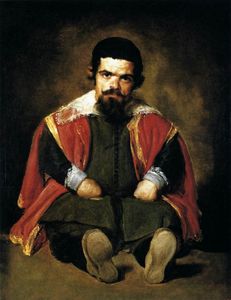
Born into poverty and with terrible deformities, Sebastian Morra is a dwarf with the wit of Tyrion Lannister and three foot, four inches of brazen pluck. Through a mixture of brains and luck, he has travelled far from his village to become a jester at the royal court. And with a talent for making enemies, he is soon drawn into the twilight world of Cardinal Richelieu, where he discovers he might just be the only man with the talents to save France from her deadliest foes.


Another novel inspired by one of Velasquez's paintings of the dwarfs at the Spanish royal court. In this instance, the main character is Don Sebastian de Morra, whose story is set in both the royal court of Louis XIII of France then the Spanish Court during the reign of King Philip IV.  Who could ask for a better backdrop into which a distinctive character is inserted, and is central - yet despite his wit, Sebastian is still out of his depth in a court full of plots and intrigue. 

Sinclair is upfront when he claims there is very little to go on by way biographical information on Sebastian de Morra and so has provided him with a most likely personal history from son of peasants in Camoches to his education by local priest, and appointment as a clerk to the Viscount Turenne in Paris. This harsh early life will eventually teach Sebastian the skills he will come to need when he is taken on by the King's Chamberlain, Alain Bouchard, and gains entry into the royal court of King Louis XII of France.

The French Court during the 1620 - 1640s was dominated by the powerful Cardinal Richelieu, who played a major role in determining France's political direction. Under Louis and Richelieu, the French Crown successfully intervened in the Thirty Years' War against the (Spanish) Habsburgs, managed to keep the French nobility in line, and retracted the political and military privileges previously granted to the Huguenots. In addition, Louis had the port of Le Havre modernised, built a powerful navy, and made territorial advances in North Africa, Asia, the Americas.

This novel offers an alternate view of the French Court and Cardinal Richelieu through the eyes of another, as what most people know of / remember about Cardinal Richelieu comes from his portrayal by Dumas in his books on the Three Muskateers. It makes a nice change to see his vulnerability.

Towards the end of his life, Richelieu alienated many people, including Pope Urban VIII. Richelieu was displeased by the Pope's refusal to name him the papal legate in France; although the conflict was largely healed when the Pope granted a cardinalate to Jules Mazarin, one of Richelieu's foremost political allies (and his political successor). 

As he neared death, Richelieu faced a plot that threatened to remove him from power. The Cardinal had introduced a young man named Henri Coiffier de Ruzé, Marquis de Cinq-Mars to Louis XIII's court. The Cardinal had been a friend of Cinq-Mars' father. More importantly, Richelieu hoped that Cinq-Mars would become Louis' favourite, so that he could indirectly exercise greater influence over the monarch's decisions. Cinq-Mars had become the royal favourite, but, contrary to Cardinal Richelieu's belief, he was not easy to control. The young Marquis realized that Richelieu would not permit him to gain political power and thus found himself mixed up in the Comte de Soissons' failed conspiracy against Richelieu, but his part in it was not yet discovered. Cinq-Mars then schemed with leading nobles, including the King's brother, Gaston, the Duc d'Orléans, to raise a rebellion; and then signed his name on a secret agreement with the King of Spain, who promised to aid the rebels. Richelieu's spy service discovered the plot, and the Cardinal received a copy of the treaty. Cinq-Mars was promptly arrested and executed; although Louis approved the use of capital punishment, he grew more distant from Richelieu as a result. It is as part of the Cardinal's spy network that author Sinclair has inserted the character of de Morra.

The Dwarf Sebastian de Morra
But de Morra was a man of two royal courts, and in 1643 - 1644 he finds himself at the court of Philip IV of Spain - we know this only based on his portrait by Diego Velasquez,said painted in 1644. It has been speculated that de Morra was acquired by King Phillip IV from his younger brother Cardinal Infante Fernando, possibly on the latter's death in 1641 certainly not sooner if de Morra was still in Richelieu's pay up until that cardinal's death in 1643. He was then given over to Prince Baltasar Carlos until the prince's death sometime after, aged only 16yo (1646). 

Following the death of his son, Philip IV fell into a period of melancholy; he slowly replaced his former fallen favourite with another; and was found to be in  thrall to the religious mystic, Sister María de Ágreda with whom he was in constant correspondance. When Philip died (1665), he left a four year old son Charles as his heir under the regency of the boy's mother. A political power struggle for control of the young king ensued between the queen regent and the king's illegitimate half brother. Charles' own death (1700) would spark off the Spanish War of Succession.

Where was de Morra amid all of this political turmoil? Some have him dying three years after Prince Carlos, (October 1649) following three years of service at the Spanish court. Or quite possibly later - we will never truly know.

Sinclair's novel was is quite easy to read; the main characters are well known; the cast is not overly large. Sinclair has provided us the reader with a well researched and well told tale, that is not quite a traditional novel and not quite a biography but rather a blend of both; and told from the point of view of Sebastian.

see also my review of The Queen's Prophet by Dawn Patitucci

further reading:


Sunday, May 19, 2019

Medieval History Titles

Below is a summary of some of the latest releases in medieval history that have sparked my interest:


The Westford Kight by David Goudswar
The Westford Knight is a mysterious, controversial stone carving in Massachusetts. Some believe it is an effigy of a 14th century knight, evidence of an early European visit to the New World by Henry Sinclair, the Earl of Orkney and Lord of Roslin. In 1954, an archaeologist encountered the carving, long known to locals and ascribed a variety of origin stories, and proposed it to be a remnant of the Sinclair expedition. The story of the Westford Knight is a mix of history, archaeology, sociology, and Knights Templar lore. This work unravels the threads of the Knight’s history, separating fact from fantasy.


The Two Walter Raleighs by Fred Tromly
Sir Walter Raleigh’s biographers have given little attention to his tragic relationship with his son Wat (Walter). They began in proud identification, each seeing himself in the other. But after the father’s political downfall and imprisonment for treason, he lost his authority in the family, and the son began to reject paternal advice and his studies and to engage in violent quarrels and duels. Often the father used his influence to rescue his son from his rash acts. Things came to a head after Wat was sued by a young woman for violent assault, and imprisoned. The aged Raleigh had been freed from the Tower to lead an expedition to Guiana, and—as recently discovered documents reveal—he delivered his son from the law by commissioning him as a captain on his flagship, ominously named the Destiny. In a shared tragedy, Wat was killed in a skirmish, and the grieving Raleigh returned to England, broken in spirit and ready for the execution that awaited him.


The Other British Isles by David Moore
Their names bespeak a rich past. From the Norse Hjaltland comes the modern Shetland: islands nominally Scottish, steeped in Nordic culture, closer to the Arctic Circle than to London. Important Neolithic sites are at Skara Brae and Maes Howe in the Orkneys. Holy Iona, island center of Celtic Christianity, the Isle of Man, former seat of rule over the Irish Sea, and Anglesey and Islay, homes of medieval courts at Aberffraw and Loch Finlaggan, are just a few of the more than 6,000 islands that form the archipelago known as the British Isles. The offshore isles are home to half a million people. Focusing on the eight islands or chains that have long supported substantial populations, this history tells the stories of Shetland, Orkney, the Hebrides, Anglesey, the Channel Islands, the Scilly Isles, and the Isles of Man and Wight, from their Neolithic settlement, to Roman, Norse and Norman occupation, to the struggle to maintain their uniqueness in today’s world.


Sworn Bond In Tudor England by Thea Cervone
The swearing of oaths is a cultural phenomenon that pervades English history and was remarkably important during the sixteenth century. This multi-disciplinary work explores how writers of the Tudor era addressed the subject in response to the profound changes of the Reformation and the creative explosion of the Elizabethan period. Topics include how the art of rhetoric was deployed in polemic, the way in which oaths formed bonds between Church and State, and how oaths functioned in literature, as ceremony and as a language England used to describe itself during times of radical change.


Rulers & Realms In Medieval Iberia 711 - 1492 by Timothy Flood
The Muslim conquest of Iberia in 711 began nearly eight centuries of struggle for control of the peninsula. The invaders quickly achieved military supremacy, but political dominance was less complete. Within a few years, a small band of Christian rebels defied Muslim authority, establishing their own ruling class in the northern mountains of Asturias. The opposing forces competed for control until the Catholic Monarchs Fernando and Isabel established absolute rule in 1492. Drawing on the latest scholarship, this comprehensive study traces the succession of Iberian sovereigns during a complicated period in early European history.


Gothic Kings of Britain by Phillip Potter
This biographical history tells the story of 31 Gothic monarchs (Cnut to Richard II of England, Malcolme III to David II of Scotland) who fought in the crusades, enforced their feudal rights throughout the kingdom, sponsored the growth of representative government through a parliament, and ultimately created a military power that would dominate European affairs. In the process, the narrative recaptures the dramatic and chaotic span of the years between 1000 and 1400, when the great European monarchies were still in their formative stages. The book discusses the lives of English and Scottish kings in the context of their eras, discussing their achievements and failures, their relations with the Church and foreign powers, and their overall influence on the suppression of the nobility and the development of the monarchy as the primary governing institution of both Scotland and England.

Tuesday, February 12, 2019

SAVAGE FRONTIER: The Pyrenees in History by Matthew Carr

From Geographical:

Second to none in grandeur and great historic episodes, the Pyrenees have nevertheless been relegated to runner-up status behind the Alps and Himalaya. In comparison, little is known or told about the colourful characters and historic events that over the centuries have formed part of the history of this mountain range. Matthew Carr has rectified this injustice in a fascinating narrative revealing the past and present of the Pyrenees, which have seen the passage of great figures, from Charlemagne to Napoleon.

The Pyrenees extend almost 300 miles from the Bay of Biscay to the Mediterranean, separating the Iberian Peninsula from the European mainland. The mountains pass between Spain and France, are high and often difficult, but they were crossed by invading armies as well as innumerable medieval (and contemporary) pilgrims on their way to Santiago de Compostela. On his travels through these mountains, it struck Carr that there had not been a book in English that looked at the mountains’ history and culture as a distinctive subject in their own right.

Carr traces the path of anarchist guerrillas, refugees, crusaders, witches and inquisitors. But this is not a quarrying of romanticism, for the author also exposes the mountains’ unpleasant face: the featureless high-rise ski buildings of Vielha and ski chalets and holiday apartments that blight the picturesque valleys of the Catalan and Aragonese Pyrenees. That aside, the book stands as a celebration of the Pyrenees as a gateway for invasion in wartime and, in times of peace, a haven and inspiration for luminaries such as Victor Hugo and George Sand.

Friday, January 4, 2019

Review: The Queen's Prophet by Dawn Patitucci

Set in the reign of King Philip IV of Spain, this is a tale of the Spanish Court as seen through the eyes of one of the Queen's entourage - her dwarf, Maribarbola. 


Dwarves were a common sight at the royal court in the 17th Century - Philip IV of Spain was reputed to have over 100 - they were considered rare attractions, bought and sold, owned and traded, or simply delivered as gifts throughout Europe. More often than not, their role was mostly for the entertainment and companionship of royal children. These unfortunates, sometimes crippled and weak-minded but sometimes wise, often served as court jesters, where they had to endure the rude remarks and practical jokes of the courtiers, their feelings as human beings were generally ignored. They were decked with finery, adorned with jewellery and gold, and shown off at ceremonies of state, or on festive occasions, revealing the voyeurism with which the royal rulers made these people the objects of their shameless whimsy, caprice and power. They were often depicted in painting with their royal patron, their small stature and / or deformity reinforcing the idea of perfection and superiority of the ruling dynasty. 

They were maintained by the King according to a tradition extending back well into the Middle Ages. The tradition was motivated by charity, but many 'fools' came to be appreciated for their wit, arousing great affection and sometimes achieving great fame. Because they were not taken seriously, they were licenced to parody or flout the etiquette with which courtiers and royalty had to conform, which seems to have been especially appreciated at the rigid court of Philip IV.

And it is from a portrait by the artist Velazquez of the Spanish Infanta Margaret Theresa entitled Las Meninas, featuring two of the court's dwarves, that author Dawn Patitucci has taken as inspiration for her story. Pictured, just to the right are the dwarves Maribarbola (Maria Barbara or Maria Barbola) and Nicholas (Nicolasico) Pertusato.

The story follows the early years of Maria Barbola in private service (1626 - 1654), and then upon the death of her mistress, Mari (as she will henceforth be known), embarks on a new course. She meets up with Udo the magician in a marketplace and travels with him to France under the guise of a seer. Dwarves were often thought to have the power of second sight and were often employed as seers or prophets. As mentioned above, their feelings were often ignored, as Mari soon finds out when Udo sells her to the agent of the Queen of Spain, Mariana of Austria (1634 - 1696), and she finds herself amidst the turbulence of the Spanish royal court (1651).

Here Patitucci deftly weaves her tale. The Spanish court was, at this time, a hot-bed of political intrigue and rivalry, and religious ferver (the Inquisition was still a significant force but its influence would start to wane). Philip IV had a system of employing favourites - "validos" - which created an undercurrent of one-up-manship among the many nobles jockeying for position. Mari's rival (or nemesis), the dwarf Nicholas, was attached to the court of the King, and appears to be pre-eminent among Philip's many dwarves. The marriage between uncle and niece (Philip and Mariana) was not an entirely happy one, with the ever present question of the production of a living male heir - only two of her five children would survive, a daughter, Margaret Theresa, and later, a son - Charles "the bewitched" (c. 1661). As Mariana found herself often excluded from power and her husband, she often relied on those around her to provide both comfort and information.  This is the role of Mari - confidant and spy.

Following the death of Philip (1665), Mariana found herself as regent for her three year old son, Charles (Carlos). It was a troubling time: Mariana continued to follow the custom of relying on favourites, which only magnified the petty jealousies and rivalries of the nobility, resulting in internal feuding between those who would rule in Charles' name. We must remember, Charles himself was hardly in the best of health; he suffered a number of physical disabilities, which were attributed to sorcery, though they had long been thought to be as a result of the constant in-breeding of the Habsburgs. Even once he achieved his majority (1675) and due to his illnesses, Mariana continued to rule as regent in his name and a bitter power struggle ensued for control of both the King and the government. She saw her only surviving daughter married (1666) to her uncle, Leopold I, Holy Roman Emperor - a prestigious marriage to be sure, but one that would have unforeseen consequences.

External factors also contributed to tension at court. Decades of war with France drained the Spanish coffers - in fact the country had been declared bankrupt a numbers of times, and Spain's position of supremacy within a European context was being questioned (especially with the loss of Portugal). However, an unpopular and uneasy peace with France, a war for control in the Spanish Netherlands, an ailing economy, saw a palace coup being lead by Don Juan, Philip IV's illegitimate son, and power wrested from the hands of the Queen Regent. Don Juan's regency was short-lived - he died the following year (many whispered poison). Mariana resumed her regency; however the arrival of a newcomer in the form of Charles II's bride, Marie Louise of Orleans saw her influence diminish (1679) - though briefly as Marie Louise herself succumbed (again poison is whispered). It is only through the use of German auxillieries that Mariana manages to retain control, long enough for Charles to marry a second time (1690).

And where was Mari in all of this - at the heart of it all - providing a different perspective to these events as they unfolded. And we are instantly drawn to her as the heroine - we are empathetic and feel strongly the slights she herself must have felt. As events played out across the pages, I was sorely tempted to research how things ended before I had finished - but I held off - the story kept me captivated - who would prevail? Mari or Nicholas? What I appreciated were the author's notes at the end that gave an insight into events of the day, very useful for those for whom this period is not their forte.

Mariana died in 1696 - she did not live to see her only son die young (1700) - a death which sparked off what is known today as the Spanish Wars of Succession - a battle for the Spanish throne between the Spanish Habsburgs (heirs of Philip IV by his second wife led by Charles' sister Margaret Theresa) and their relatives, the French Bourbons (heirs of Philip IV by his first wife and led by Charles' half-sister, Maria Theresa).  This war would ultimately see Charles' grand-nephew (and chosen heir), Philip of Anjou succeed as Philip V of Spain.  On a side note, it would be Philip V who, when he reorganised the court offices, would abolish the role of fools and dwarves.

What happened to Mari following the death of the Queen Regent Mariana - it was said she returned to her native Austria where she died (quite possibly that same year).


Monday, December 24, 2018

Review: Mala Vida by Marc Fernandez

Mala Vida: A Novel
In a dark and often overlooked chapter of General Francisco Franco’s 1939-75 dictatorship, the newborns of some left-wing opponents of the regime, or unmarried or poor couples, were removed from their mothers and adopted. The practice was later expanded. New mothers were frequently told their babies had died suddenly after birth and the hospital had taken care of their burials, when in fact they were given or sold to another family.

A line from the novel - no, this real life drama was being played out today as 85yo Eduardo Vela, who worked as a gynaecologist at the now-defunct San Ramón clinic in Madrid, arrived in court to face charges of taking a child from her biological mother and giving her to another woman, falsifying birth records in the process. The system – which allegedly involved a vast network of doctors, nurses, nuns and priests – outlived Franco’s death in 1975 and carried on as an illegal baby trafficking network until 1987 when a new law regulating adoption was introduced.

So this then is the premise of the story. However, we only discover this after a few chapters in as we are at first deceived into thinking that this is a political murder mystery with links back to the Franco era, due to the alternating narrative between the unnamed assassin and Diego Martin, the investigative journalist (and late night DJ).

This extremely controversial subject is tackled well, though I can't help thinking that this could have been teased out a little longer over a few more pages - all too soon certain anomalies are cleared up and the conclusion arrives all too neatly.

Having said that, this was a nice blend of historical fact and crime fiction.

read more here


Tuesday, October 30, 2018

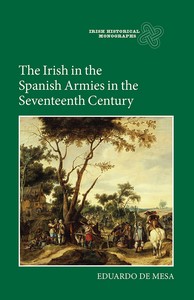
The Irish in the Spanish Armies in the Seventeenth Century by Eduardo de Mesa

Irish in Spanish ArmiesReview by Craig Nakashian for De Re Militari:

Eduardo de Mesa’s tome on Irish soldiers that served in Habsburg Spain’s armies succeeds on at least five levels. First, it establishes a significant (and convincing) revisionist position on the military revolution. Second, this work constitutes a contribution to the literature on early modern European identity. Third, de Mesa makes accessible a trove of archival evidence. Fourth, readers with interests beyond Ireland’s shores and the Spanish Road will find insights illuminating the broader topography of the early modern world. Finally, the book advances the historiography that underscores Ireland’s importance in the early modern state-system.

Medieval historians have long recognized that although on the geographical periphery of Europe, Ireland occupied a central place in letters, theology and culture. Early modernists increasingly have appreciated the reach and relevance of the Irish. As de Mesa documents, Irish arms were, in certain well-defined periods, instrumental in preserving the fortunes of the Catholic Crusade against Protestantism and in championing the survival of the House of Habsburg. The book’s conclusion makes clear how political and military reverberations from Ireland affected Habsburg strategy.

Saturday, September 22, 2018

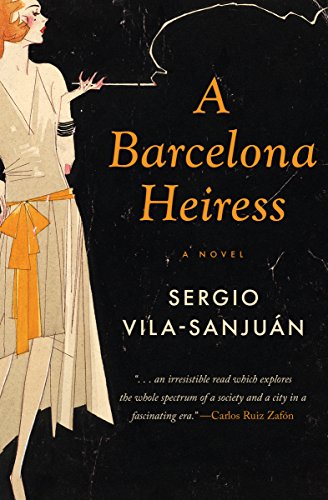
Review - Barcelona Heiress by Sergio Vila-Sanjuan

Barcelona, 1920s - a city racked by a tsunami of radical and bloody events that led to a confrontation between those citizens without rights - the working classes -and the bourgeoise, who after profitting greatly during the first world war at the expense of the labouring classes, were now determined to protect their own interests at any cost and were hell-bent on crushing the lower classes, using whatever weapons or institutions they could.

Unionism took hold in the previous decade, and a series of rolling strikes by workers would culminate in the La Canadiense strike of 1919 - a general strike involving the entire population of the city, lasting the biblical forty days, in which the workers demanded better working conditions. It was only a decade since the events of Tragic Week when workers rose up, buildings were destroyed and 150 were reportedly killed, and more than 1,700 individuals were indicted in military courts for "armed rebellion". Events still very much prevalent in the minds of Barcelona's citizens.

The working class, the industrial class, and the military were united together in the hope of removing the corrupt central government, but were unsuccessful. Fears of communism grew. A military coup brought Miguel Primo de Rivera to power in 1923, and he ran Spain as a military dictatorship. Anarchism became popular among the working class, and was far stronger in Spain than anywhere else in Europe at the time

As support for his regime gradually faded, Primo de Rivera resigned in January 1930. There was little support for the monarchy in the major cities, and King Alfonso XIII abdicated; the Second Spanish Republic was formed, whose power would remain until the culmination of the Spanish Civil War.

Barcelona Heiress is said to be based on real-life events that occurred during this time, and from the notes left by the author's grandfather (on whom I could find no information - I would have been interested to know who the author's grandfather was and what his role was in all of this).

The fictional narrative is from the perspective of Pablo Vilar, a journalist and lawyer, and man with connections to a diverse group of people that stretches across a vast area of the social strata (a bit like the infamous Inocencio Feced - a sinister figure from the 1920s; a man on familiar terms with all sorts of people in Barcelona ranging from the police chief Arlegui to the Libre’s president, Ramón Sales, as well as the Libertarian Movement and, naturally, the city’s underworld.)

There is also the parallel story of a vigilante who provides justice when the courts didn't. At the height of civil unrest in Barcelona. business owners hired assassins to infiltrate workers organisations and to murder troublesome union leaders; newspapers and their staff were targetted, as were lawyers defending unionists. The nobility, politicians, police, and church were not exempt from the violence and assassinations. Repression would be harsh and very one-sided.

The author assumes the readers' familiarity with the subject matter as a given. Had the author provided a short background to this story, then the fictional narrative would have made more sense. As it was, the execution was lacking as there was no real connection between narratives - it comes off as a disjointed attempt to recreate the glitz and glamour of the Gatsby era with the setting in Barcelona.

Side note: the author's father, the writer and historian José Luis Vila-San-Juan wrote 'The daily life in Spain under the dictatorship of Primo de Rivera'.