Showing posts with label medieval france. Show all posts

Monday, April 22, 2024

Review: House of Lilies by Justine Firnhaber-Baker

Synopsis: The definitive history of the Capetians, the crusading dynasty that made the French crown the wealthiest and most powerful in medieval Europe and forged France as we know it today

In House of Lilies , historian Justine Firnhaber-Baker tells the epic story of the Capetian dynasty of medieval France, showing how their ideas about power, religion, and identity continue to shape European society and politics today.

Reigning from 987 to 1328, the Capetian kings became the most powerful monarchy of the Middle Ages and established the foundations of a shared French culture. Consolidating a fragmented realm that eventually stretched from the Rhône to the Pyrenees, they were the first royal house to adopt the fleur-de-lys, displaying this lily emblem to signify their divine favor and legitimate their rule. The Capetians played a part in some of the most dramatic and far-reaching episodes in European history, including the Crusades, bloody waves of religious persecution, and a series of wars with England. The Capetian age saw the emergence of Gothic architecture, the romantic ideals of chivalry and courtly love, and the Church’s role at the center of daily life.

Evocatively interweaving these pivotal developments with the human stories of the rulers who drove them, House of Lilies is the definitive history of the dynasty that forged France—and Europe—as we know it.

~ ~ ~

Four stars for the following reasons:

* easy to read
* informative though not dull or dry
* covers the Capetian Dynasty well, including the women
* well researched
* additional notes, maps, family trees

Covering nearly over three centuries of French history and international politicking, Firnhaber-Baker does a remarkable job at presenting one of the pivotal dynasties in French history - the Capetians. This work has all the elements: religious fervor and upheaval, crusades,scandal, warfare, adultery, ambition, family drama, politicking - and on a magnificent grandiose scale.

Each monarch has their own dedicated chapter which covers off the pivotal moments of their reign, including each monarch's relationships with France's closest neighbours - England, Normandy, Flanders, Blois, Anjou, Valois - as France as we know it today, was still very much in its infancy and only really beginning to coalesce.

Recommended reading for those with an interest in French history and royal dynasties.

Sunday, March 27, 2022

Review: The Dark Queens by Shelley Puhak

Synopsis: The remarkable, little-known story of two trailblazing women in the Early Middle Ages who wielded immense power, only to be vilified for daring to rule.

Brunhild was a Spanish princess, raised to be married off for the sake of alliance-building. Her sister-in-law Fredegund started out as a lowly palace slave. And yet—in the 6th-century Merovingian Empire, where women were excluded from noble succession and royal politics was a blood sport—these two iron-willed strategists reigned over vast realms for decades, changing the face of Europe.

The two queens commanded armies and negotiated with kings and popes. They formed coalitions and broke them, mothered children and lost them. They fought a years-long civil war—against each other. With ingenuity and skill, they battled to stay alive in the game of statecraft, and in the process laid the foundations of what would one day be Charlemagne’s empire. Yet after Brunhild and Fredegund’s deaths—one gentle, the other horrific—their stories were rewritten, their names consigned to slander and legend.

In The Dark Queens, award-winning writer Shelley Puhak sets the record straight. She resurrects two very real women in all their complexity, painting a richly detailed portrait of an unfamiliar time and striking at the roots of some of our culture’s stubbornest myths about female power. The Dark Queens offers proof that the relationships between women can transform the world.


Merovingian France may not have been on everyone's radar but it had been on mine for quite a number of years - and I had written about both on a old webpage I created back in the late 1990s (now archived for posterity). And in particular, the incredible and oft times deadly rivalry between two women who managed to wield more power than their contemporaries.

So when the opportunity to read Puhak's book, I jumped at the chance. Puhak describes her main aim as being the resurrection of two women "scratched out of history" - much like two earlier notable women - Hatshepsut of the 18th Dynasty in Ancient Egypt and Wu Zhao of 7th Century Tang Dynasty of China.

Firstly we have Brunhilde/a, Queen and wife of Sigebert, King of Austrasia. A women of pedigree who - like her sister before her - was destined for a marriage of political consequence.  And then secondly we have Fredegund/a, a slave-girl at the court of Neustria, who in this capacity came to the attention of Chilperic I, and who clawed her way to becoming his third wife - a position she had no intention of relinquishing.

Merovingian Kingdom
The rivalry between not only these two women but also by the sons of Clothar I King of the Franks, upon the disintegration of his kingdom, would resonate through the generations to come, resulting in the death knell for the dynasty which came barely two centuries later.

Puhak gives the reader a history of the region and social structure, the dynasty, the family, as well as court politics and religion, before finishing with the legacy and fate of the two queens and their offspring.

Both women suffered the same fate in the end - to either be written out of the history books or the have their reputations so besmirched as to become the epitome of the fallen Eve or Jezebel reincarnate. And the fate of Brunhilde would not rear its ugly head under the Tudor Dynasty, when Henry VIII dispatched the aged Duchess of Salisbury in 1541.

Puhak brings all of her research together to provide the reader with an accessible account of the Merovingian period under these two women. Ample notes and sources will be much appreciated by those seeking to further enrich their own knowledge of the dynasty.

Monday, August 31, 2020

Review: The Cellars of Notre Dame by Barbara Frale

The Cellars of Notre DameSynopsis: Paris, 1298. Disguised as an outlaw, a personage of the highest rank sneaks through the cellars of Notre Dame. The maze of secret tunnels hides a laboratory. Here, occult studies are conducted under the guidance of the renowned scientist, Arnaldo da Villanova. Studies which remain a secret.

Rome, 1301. Denounced for impiety by mysterious informers in Paris, Villanova seeks refuge in Italy and becomes Pope Boniface VIII's personal physician. Yet Villanova knows a secret, one capable of discrediting and overthrowing the French monarchy. He's not safe. It's clear someone wants to silence him forever.  Will he pay the price for the secret he keeps with his life?


Two things attracted me to this book - the subject matter and the author, whose book on the Templars I had read in the past.

Medieval politics is a difficult path to navigate at the best of times. Throw in some papal discord, political and religious machinations, mysterious cabals, superstition, rumour and inuendo, and two political giants in Philip the Fair of France and Pope Boniface VIII (described as two pillars holding up the world), and you have the makings of a very good historical fiction thriller. 

Barely four years into his papal reign, Boniface VIII often involved himself in the foreign affairs of many nations, including in France, Sicily, Italy and Scotland. These chronic and oft unwelcome interventions were the cause of many bitter quarrels. France, at this time, was a war with England over Gascony, and Philip was constantly putting his hands into the coffers to fund these military actions. It was Philip's taxing of the clergy that also brought him into conflict with the papacy.

Frale is a noted historian and paleographer at the Vatican Secret Archives, and her previous works have been in the non-fiction genre. This is her first novel as far as I am aware. The amount of research that has gone into this book is (at times, painfully) evident.

I would strongly suggest that having some interest in this particular period would be a good thing as there are a plethora of characters (real and fictional) that walk across the pages; some add to the story, others are not so critical, leaving me wondering if they were necessary in the first place (mayhap a short list of essential characters at the very start might have been an idea).

The character of Arnoldo de Villanova intrigued me greatly. Was he real or one of those fictional characters that are there to drive the storyline. But no,Arnoldo is real and his exile is documented. I was pleased to see another side to Philip's chief minister, Guillaume de Nogaret. There are many more real-life characters worthy of further research. Truly a cast that would make Cecil B deMille envious.

In additional, there are also a number of themes running through the narrative - some evident; others not so; and these are not cleared up until towards the end. At times, the reader could be left wondering which narrative it is that they should be following and what should be discarded. Much of what is covered off here sets the scene of some more well known historical events that were to tragically play out in the years to come.

" ... you cannot escape the past .... 
 the past always returns and sets before us 
the mistakes we have made ..."

Despite this being an area of interest for me (ie: medieval history and politics), the dearth of information provided sometimes felt oppressive - at page 50 I felt like I was at page 500! So I will stress that this undertaking is not for the faint-hearted.

However, once you get past all of this, the story itself posits a rather  interesting premise, which will have some rushing to their history books or google in search of answers. I will most likely be reading this again.

Monday, May 11, 2020

Books: Notable Women

Servilia and Her Family by Susan Treggiari

Cover for 

Servilia and her Family


Servilia is often cited as one of the most influential women of the late Roman Republic. Though she was a high-born patrician, her grandfather died disgraced and her controversial father was killed before he could stand for the consulship; she herself married twice, but both husbands were mediocre. Nevertheless, her position in the ruling class still afforded her significant social and political power, and it is likely that she masterminded the distinguished marriages of her one son, Brutus, and her three daughters. During her second marriage she began an affair with Iulius Caesar, which probably lasted for the rest of his life and is further indicative of the force of her charm and her exceptional intelligence.

The patchiness of the sources means that a full biography is impossible, though in suggesting connections between the available evidence and the speculative possibilities open to women of Servilia's status this volume aims to offer an insightful reconstruction of her life and position both as a member of the senatorial nobility and within her extended and nuclear family. The best attested period of Servilia's life, for which the chief source is Cicero's letters, follows the murder of Caesar by her son and her son-in-law, Cassius, who were leaders among the crowd of conspirators in the Senate House on the Ides of March in 44 BC. We find her energetically working to protect the assassins' interests, also defending her grandchildren by the Caesarian Lepidus when he was declared a public enemy and his property threatened with confiscation. Exploring the role she played during these turbulent years of the late Republic reveals much about the ways in which Romans of both sexes exerted influence and sought to control outcomes, as well as about the place of women in high society, allowing us to conclude that Servilia wielded her social and political power effectively, though with discretion and within conventional limits.


Spartan Women by Susan Pomeroy

Cover for 

Spartan Women


Sparta, which existed from 800 B.C. until A.D. 200, was renowned in the ancient world as a stoic and martial city-state, and most of what we know about Sparta concerns its military history and male-dominated social structure. Yet Spartan women were in many ways among the most liberated of the ancient world, receiving formal instruction in poetry, music, dance, and physical education. And the most famous of mythic Greek women, Helen of Troy, was originally a Spartan. Written by one of the leading authorities on women in antiquity, Spartan Women seeks to reconstruct the lives and the world of Sparta's women, including how their legal status changed over time and how they held on to their surprising autonomy.

In this book, Sarah Pomeroy covers over a thousand years in the lives of Sparta's women from both the elite and lower classes. This is the first book-length examination of Spartan women, and Pomeroy comprehensively analyses ancient texts and archaeological evidence to construct the history of these elusive though much noticed women. Spartan Women is an authoritative and fresh account that will appeal to all readers interested in ancient history and women's studies.


Elizabeth of York and Her Six Daughters-in-Law: Fashioning Tudor Queenship, 1485–1547 by Retha Warnick
coverThis study of early modern queenship compares the reign of Henry VII’s queen, Elizabeth of York, and those of her daughters-in-law, the six queens of Henry VIII. It defines the traditional expectations for effective Tudor queens—particularly the queen’s critical function of producing an heir—and evaluates them within that framework, before moving to consider their other contributions to the well-being of the court. This fresh comparative approach emphasizes spheres of influence rather than chronology, finding surprising juxtapositions between the various queens’ experiences as mothers, diplomats, participants in secular and religious rituals, domestic managers, and more. More than a series of biographies of individual queens, Elizabeth of York and Her Six Daughters-in-Law is a careful, illuminating examination of the nature of Tudor queenship. 


coverThree Medieval Queens: Queenship and the Crown in Fourteenth-Century England by Lisa Benz St John
This book is an innovative study offering the first examination of how three fourteenth-century English queens, Margaret of France, Isabella of France, and Philippa of Hainault, exercised power and authority. It frames its analysis around four major themes: gender; status; the concept of the crown; and power and authority.


Berenguela of Castile (1180-1246) and Political Women in the High Middle Ages by Miriam Shadis
coverThe women in the family which ruled thirteenth-century Castile used maternity, familial and political strategy, and religious and cultural patronage to secure their personal power as well as to promote their lineage. Leonor of England, and her daughters Blanche of Castile (queen of France), Urraca (queen of Portugal), Costanza (a Cistercian nun of Las Huelgas) and Leonor, (queen of Aragon) provide the context for a study focusing on Berenguela of Castile, queen of Leon through marriage and of Castile by right of inheritance, whose most significant accomplishment was to enable the successful rule of her son Fernando.


"Trying Neaira" by Debra HamelTrying Neaira: The True Story of a Courtesan’s Scandalous Life in Ancient Greece by Debra Hamel
Neaira grew up in a Corinthian brothel in the fourth century B.C., became a high-priced courtesan and a sex slave, then settled into a thirty-year relationship with Stephanos of Athens. But next she found herself in court, charged with transgressing Athens’s marriage laws. This book reconstructs the amazing facts of Neaira’s life and trial, illuminating the social, legal, and cultural worlds of ancient Greece.


Women of Byzantium by Carolyn L. Connor
"Women of Byzantium" by Carolyn L.              ConnorWomen played key roles in Byzantine society: some ruled or co-ruled the empire, and others commissioned art and buildings, went on pilgrimages, and wrote. This engrossing book draws on evidence ranging from pictorial mosaics and inscriptions on the walls of churches to women’s poetry and histories, examining for the first time the lives, occupations, beliefs, and social roles of Byzantine women.

In each chapter Carolyn L. Connor introduces us to a single woman—from the elite to the ordinary—and uses her as a springboard to discuss Byzantine society. Frequently quoting from contemporary accounts, Connor reveals what these women thought of themselves and their lives and how they remembered the lives of women who had lived earlier.
Informative, sympathetic, and engagingly written, this book is a window into Byzantine culture and women’s history that has never before been opened.


Eleanor of Aquitaine: Lord and Lady edited by Bonnie Wheeler and John Carmi Parsons
coverEleanor's patrilineal descent, from a lineage already prestigious enough to have produced an empress in the eleventh century, gave her the lordship of Aquitaine. But marriage re-emphasized her sex which, in the medieval scheme of gender-power relations relegated her to the position of Lady in relation to her Lordly husbands. In this collection, essays provide a context for Eleanor's life and further an evolving understanding of Eleanor's multifaceted career. A valuable collection on the greatest heiress of the medieval period.


Matilda of Scotland: A Study in Medieval Queenship by Lois L. Huneycutt
Matilda of ScotlandA study of Matilda of Scotland (wife to Henry I) and the political acumen and personal skills she brought to the role of queen.Matilda of Scotland was the daughter of Malcolm II of Scotland and his Anglo-Saxon queen Margaret. Her marriage to Henry I of England in 1100 thus brought to Henry, descendant of the conquering Normans, a direct and politically desirable link to Matilda's ancestor Alfred the Great.

Her life makes clear that Matilda had outstanding talents. She was educated in the exclusive convents of Romsey and Wilton, a grounding which enabled her to further the literate court culture of the twelfth century, and under her control was a substantial demesne that allowed her to exercise both lay and ecclesiastical patronage. In the matter of ruling, she was an active partner in administering Henry's cross-channel realm, served as a member of his curia regis, and on occasion acted with what amounted to vice-regal authority in England while Henry was in Normandy.

Chroniclers of the twelfth and thirteenth centuries often refer to her as Mathilda bona regina, or Matildis beatae memoriae, and for a time she was popularly regarded as a saint. Huneycutt's study shows how Matilda achieved such acclaim, both because the political structures of her day allowed her the opportunity to do so and because she herself was skilled at manipulating those structures.

This study will be valuable to those interested in not only English political history, but also to historians of women, the medieval church, and medieval culture.


Elizabeth de Burgh, Lady of Clare (1295-1360): Household and Other Records edited by Jennifer Ward
Elizabeth de Burgh, Lady of Clare (1295-1360): Household and Other Records
Noble widows were powerful figures in the later Middle Ages, running their own estates and exercising considerable influence. Elizabeth de Burgh (1295-1360), daughter of one of the most powerful earls in England and cousin of Edward II, lost her third husband at the age of twenty-six, and spent the rest of her life as a widow. In 1317, having inherited one-third of the lands of her brother, Gilbert de Clare, earl of Gloucester and Hertford, who had been killed at Bannockburn three years earlier, she established herself at Clare, which became her main administrative centre for her estates in East Anglia, Dorset and South Wales. She enjoyed a noble lifestyle, was lavish in her hospitality to family and friends, entertaining Edward III in 1340, and she displayed her piety through her patronage of religious houses and her foundation of Clare College in Cambridge.

Her life and activities are portrayed in vivid detail in her household accounts and her will, selected extracts from which are provided in this volume. Altogether, 102 accounts of various types survive from the years of her widowhood, and the records here have been chosen to illustrate the great range of information provided, throwing light on Clare castle itself and its furnishings, daily life and religious practice, visitors, food and drink, livery and retainers, travel, and business. They paint of a vivid picture of the life and work of a noble family in the fourteenth century.


Tuesday, March 31, 2020

Review: In the Company of Fools by Tania Bayard

52070479. sx318 sy475 Synopsis: Paris 1396: Scribe Christine de Pizan is shocked when the Duke of Orleans' fools find a baby, wrapped in rags and covered in sores, abandoned in the palace gardens. Was there really a wicked plan to substitute the child for the queen's own baby daughter and blame the Duchess of Orleans, Valentina Visconti? Who would commit such an evil act, and why? 

Accused of being a sorceress, Valentina is the victim of much slander and has powerful enemies at the palace, where rumours of witchcraft and superstition run riot. Convinced of the duchess's innocence, Christine is determined to uncover the truth, and soon makes a number of disturbing discoveries. Could the palace fools be the key to unlocking the mystery?


This is the third in the series featuring Christine de Pisan, and I would suggest starting from the beginning with In the Presence of Evil and In the Shadow of the Enemy and many of the characters and themes in this instalment have their origins in the first two books, as does the historical background.

Valentina Visconti (1366 - 1408) - Genealogy
Valentina Visconti
It is three years since the events in the previous books; the French court is still a hot bed of political intrigue, the King is still battling bouts of insanity, and witchcraft and sorcery are being touted as the causes for all that has befallen France. Due to her proximity to the King, someone is out to blacken the name of Valentina Visconti, Duchess of Orleans, and it is the Fools of the Duke, her husband, that provide both the impetus and clues that Christine will need to solve this mystery.


Some Historical Background:
Valentina was born in Milan as the second of the four children of Gian Galeazzo Visconti, first Duke of Milan, and his first wife Isabelle, a daughter of King John II the Good of France. She was therefore she was the cousin of the current King of France, Charles VI and niece of Philip, Duke of Burgundy. Isabeau of Bavaria was the granddaughter of Bernabò Visconti, whom Gian Galeazzo treacherously displaced in Milan, and thus a bitter rival of both Valentina and her father.

Louis I, Duke of Orléans - Wikipedia
Louis I of Orleans
With Charles VI incapable of ruling, Isabeau presided over a regency counsel, on which sat the nobles of the kingdom. Philip the Bold, Duke of Burgundy (the king's uncle), who acted as regent during the king's minority (from 1380 to 1388), was a great influence on the queen (he had organized the royal marriage during his regency). However, influence progressively shifted to Louis I, Duke of Orléans, the king's brother and another contender for power, and it was suspected, the queen's lover. Proximity to the king at crucial moments rather than simple access to him was regarded as vital for advancing oneself and one's interests. There ensued a generation in which court politics was subsumed in wider political factions which sought to control the court from outside.

As a result of the ongoing power struggles for control of the King coupled with the intrigues of the courtiers and nobles - each with their own agendas - and the enmity of the queen, salacious gossip abounded. Pre-eminant among those rumours were that Valentina, who was very close to the King, had bewitched him (causing his madness); and that Isabeau was having an affair with Louis, Valentina's husband and brother of the King. 

From the late 1390s, Orléans - ever in need of greater funds in view of the smallness of his appanage - was exercising much more pressure on the financial officialdom in order to sustain his policies and incurring the unpopularity for which he was to pay dearly. It was here that the clash with Burgundy really became truly venomous. The costs of political stability in the period were enormous. Payments, pensions and one-off presents to courtiers, great officers of the crown and great nobles were a substantial drain on yearly revenues. Hence the competition for control of the revenues.  This rivalry between Louis of Orleans and Philip of Burgundy was such that the end result was outright civil war.

Into this meltingpot of rumour and innuendo, throw in some talk of witchcraft and sorcery. The medieval court was the centre of political life during the Middle Ages, where officials of all ranks attended to governmental affairs. As a place of wealth, influence and power, intrigues were an ordinary suspicion and the court was the ideal environment for popular magical practices to cultivate as the employment of magical practitioners provided great political advantages.

Astrologers delivered a calendar of ideal times for rulers to make political decisions and alchemists, the possibility of riches and prolonged life. A knowledge of chemicals and herbs would have proved useful in intrigues where poisons and love spells were in demand. As fear and usage of magic was ever present, courtiers engaged in the practice of possessing precious stones whose properties protected them from such inflictions. Within the court there were also those who, whilst brandishing significant amounts of influence, held no formal office. As such, those driven by these ambitions employed magic to assist in their plots to beat rivals and gain their desired position. However, in this turbulent political climate fear and suspicion of magical practitioners and accusations of harmful magic increased. Even the Duke of Orelans was not immune when he too was accused of using sorcery (specifically a waxen image said baptized by a monk) against Charles VI (1392).

Finally both ‘factions’ sought to appeal to public opinion by distributing political programs in the form of letters, pamphlets, songs and pasquils  (lampoons) for street distribution which stressed the good of the kingdom, the control of abuses and “reform”, and were a much used weapon in turning public opinion against a potential rival through scandal and innuendo.

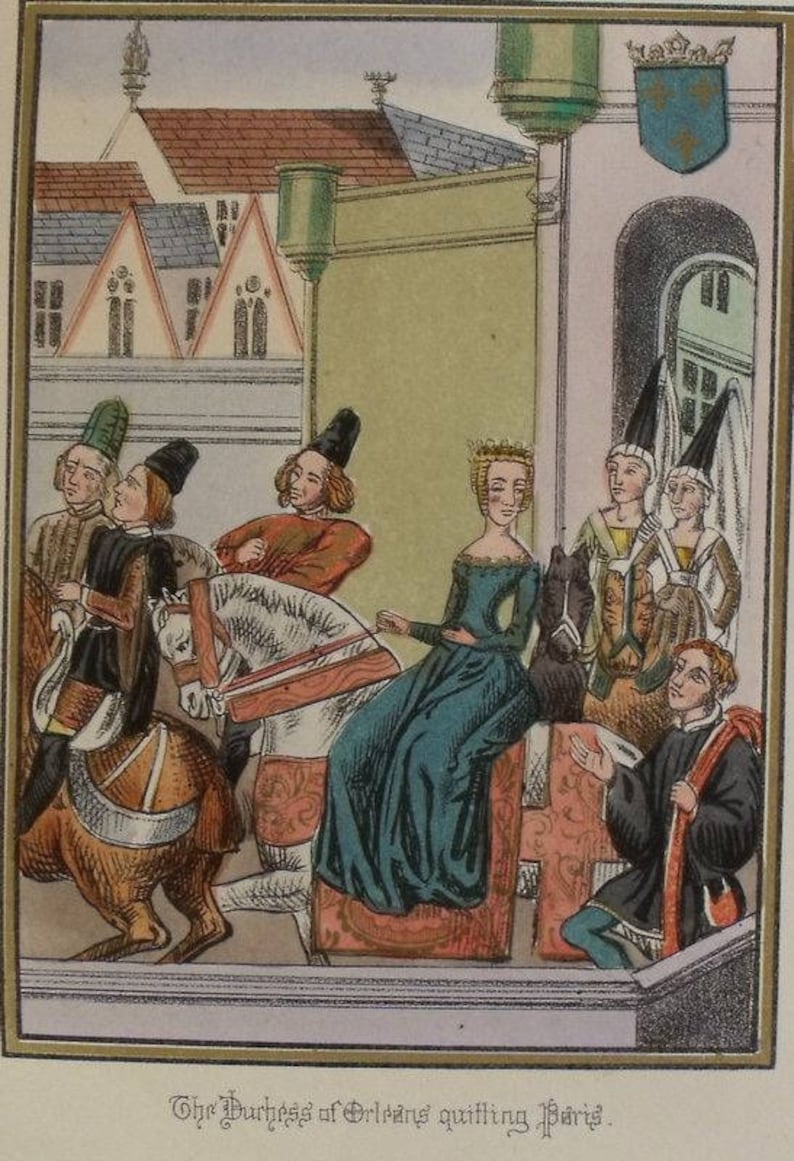
1868 The Duchess of Orleans Valentina Visconti Quitting Paris | Etsy
With public and court opinion against her, rumours of sorcery and witchcraft, Valentina was ultimately exiled from the court and forced to leave Paris. She remained at Blois till her death in 1408.

Gian Galeazzo reacted to gossip about Valentina at the French Court by threatening to declare war on France and to send knights to defend his daughter's honor. There is no record of him doing so. However, after the disaster of Nicopolis (1396), he was strongly suspected of having betrayed the Crusaders as vengeance for his daughter being accused of being behind the illness of King Charles VI of France, as well as for France's increasing control over the city of Genoa that he had attempted to hamper, and for which he had been rebuked by Enguerrand VII de Coucy before the battle.

Now to those other characters - the Fools. Court dwarfs - not to be confused with jesters who were employed for entertainment and amusement - were owned and traded amongst the people of the court, and delivered as gifts to fellow kings and queens. Dwarfs usually had a permanent function and were registered in the personnel rolls as "court dwarf", "personal dwarf" or "chamber dwarf". This enabled them to play an important role in ceremonial culture and gave them close access to the ruler. This close relationship led to multiple roles beyond the foolish task as a natural clown. Court dwarfs served as a substitute for children, companion for royal children, or even diplomats. At the end of their career, these privileged dwarfs would usually receive a pension and other benefits.

Bayard touches upon many of the above background topics - the fools, magic, alchemy, sorcery - to provide us with an insider's view of the French Court. We are reunited with Christine's old foe, Henri le Picout, and allies Marion, the prostitute and Brother Michel of the Abbey of Saint Denis. Whilst not particularly action driven, the reader will find themselves so swept up in the storytelling that they will not realise just how far they have been drawn along. I am looking forward to the next in the series. 


Sunday, March 29, 2020

Books: Hundred Years War

Prisoners of War in the Hundred Years War: Ransom Culture in the Late Middle Ages by Rémy Ambühl
Prisoners of War in the Hundred Years WarThe status of prisoners of war was firmly rooted in the practice of ransoming in the Middle Ages. By the opening stages of the Hundred Years War, ransoming had become widespread among the knightly community, and the crown had already begun to exercise tighter control over the practice of war. This led to tensions between public and private interests over ransoms and prisoners of war. Historians have long emphasised the significance of the French and English crowns' interference in the issue of prisoners of war, but this original and stimulating study questions whether they have been too influenced by the state-centred nature of most surviving sources. Based on extensive archival research, this book tests customs, laws and theory against the individual experiences of captors and prisoners during the Hundred Years War, to evoke their world in all its complexity.


The Hundred Years War: England and France at War c.1300–c.1450 by Christopher Allmand
The Hundred Years WarThis is a comparative study of how the societies of late-medieval England and France reacted to the long period of conflict between them commonly known as the Hundred Years War. Beginning with an analysis of contemporary views regarding the war. Two chapters follow which describe the military aim of the protagonists, military and naval organisation, recruitment, and the raising of taxes. 

The remainder of the book describes and analyses some of the main social and economic effects of war upon society, the growth of a sense of national consciousness in time of conflict, and the social criticism which came from those who reacted to changes and development brought about by war. Although intended primarily as a textbook for students, Dr Allmand's study is much more than that. It makes an important general contribution to the history of war in medieval times, and opens up new and original perspectives on a familiar topic.


The Hundred Years War: The English in France, 1337-1453 by Desmond Seward
Front CoverFrom 1337 to 1453 England repeatedly invaded France on the pretext that her kings had a right to the French throne. Though it was a small, poor country, England for most of those "hundred years" won the battles, sacked the towns and castles, and dominated the war. The protagonists of the Hundred Years War are among the most colorful in European history: Edward III, the Black Prince; Henry V, who was later immortalized by Shakespeare; the splendid but inept John II, who died a prisoner in London; Charles V, who very nearly overcame England; and the enigmatic Charles VII, who at last drove the English out. Desmond Seward's critically-acclaimed account of the Hundred Years War brings to life all of the intrigue, beauty, and royal to-the-death-fighting of that legendary century-long conflict.


The Hundred Years War by Anne Curry
Front CoverAlthough the term 'Hundred Years War' was not coined until the 1860s, the Anglo-French conflicts of the later Middle Ages have long been of interest to historians. A fundamental question remains - was this a feudal war fought over ancient English rights in Gascony, or was it a dynastic war in which English kings battled for the crown of France itself?

This book, now fully revised and updated to take account of the latest scholarship, examines the origins and phases of the war and explores the trends in historical opinion from the fourteenth century to the present day. Anne Curry provides a straightforward narrative of English involvement in France, placing the well known military events in their diplomatic context. By focusing on the treaties of 1259, 1360 and 1420, Curry argues that there was not one 'hundred year war' but rather three separate yet linked conflicts, all with significant implications for the European scene as a whole, and for Anglo-French relations in the centuries to come.


The Age of the Hundred Years War by Clifford J. Rogers, Kelly DeVries, John France
Front CoverThis seventh volume of the Journal of Medieval Military History has a particular focus on western Europe in the late middle ages, and specifically the Hundred Years War; however, the breadth and diversity of approaches found in the modern study of medieval military history remains evident. Some essays focus on specific texts and documents, including Jean de Bueil's famous military treatise-cum-novel, Le Jouvencel; other studies in the volume deal with particular campaigns, from naval operations to chevauchées of the mid-fourteenth century. There are also examinations of English military leaders of the Hundred Years War, approaching them from prosopographical and biographical angles. The volume also includes a seminal piece, newly translated from the Dutch, by J.F. Verbruggen, in which he employs the financial records of Ghent and Bruges to illuminate the arms of urban militiamen at the end of the middle ages, and analyzes their significance for the art of war.


Seats of Power in Europe During the Hundred Years War: An Architectural Study from 1330 to 1480 by Anthony Emery
The Hundred Years' War between England and France is a story of an epic conflict between two nations whose destinies became inextricably entwined throughout the later Middle Ages. During that time the balance of architectural power moved from religious to secular domination, the Gothic form continued to grow and the palace-fortress was in the ascendancy. Seats of Power in Europe is a major new study of the residences of the crowned heads and the royal ducal families of the countries involved in the Hundred Years' War. Though they were the leading protagonists and therefore responsible for the course of the war, do their residences reflect an entirely defensive purpose, a social function, or the personality of their builders? As well as the castles of England and France it also looks at rulers residences in other European countries who supported one of the protagonists. They include Scotland, Castile, Aragon, Navarre, Portugal, the Low Countries, the imperial territories of Bohemia, and the papacy in Avignon and then Rome.

The study concentrates on sixty properties extending from the castles at Windsor and Denilworth to those at Saumur and Rambures, and from the palaces at Avignon and Seville to the manor-houses at Germolles and Launay. A number of subsidiary or associated properties are also considered in more broad-based sections. Each region and its residences are prefaced by supporting historical and architectural surveys to help position the properties against the contemporary military, financial, and aesthetic backgrounds.


Knights and Peasants: The Hundred Years War in the French Countryside by Nicholas Wright
This study of the soldier-peasant relationship in the context of the Hundred Years War (1337-1453) aims to bring out the realities of the situation. It seeks an understanding of different attitudes: how aristocratic soldiers reconciled the ideals of chivalry with exploitation of non-combatants, and how French peasants reacted to the soldiery, drawing on the late-medieval literature of chivalry and political commentary in England and (especially) in France. Employing additional documentary material, including the largely unpublished records of the French royal chancery, the book also describes the ways in which individual peasants and village communities were exploited by soldiers, and how, in order to survive, they adjusted to and reacted against their treatment.


Siege Warfare During the Hundred Years War by Peter Hoskins
Histories of the Hundred Years War have been written, and accounts of the famous battles, but until now no book has concentrated on the sieges that played a decisive role in the protracted struggle between England and France. Edward III's capture of Calais in 1347 was of crucial importance for the English, and the failure of the English siege of Orléans in 1429 was a turning point for the French after the disaster of Agincourt. Throughout the war, sieges were a major weapon in the strategic armories of both sides, and Peter Hoskins's perceptive and graphic study is a fascinating analysis of them.

He describes the difficulties faced by besieger and besieged, examines the logistics and resource implications of sieges, and provides a comparative assessment of siege warfare alongside set-piece battles and the English strategy of chevauchées. Key sieges are reconstructed in vivid detail, other sieges are summarized, and the book is fully illustrated with photographs and plans.

Books: Medieval and Renaissance France

Epitaph for an Era: Politics and Rhetoric in the Carolingian World by Mayke de Jong
Epitaph for an Era
Wala, abbot of Corbie, played a major role in the rebellions against Emperor Louis the Pious, especially in 830, for which he was exiled. Radbert defended his beloved abbot, known to his monks as Arsenius, against accusations of infidelity in an 'epitaph' (funeral oration), composed as a two-book conversation between himself and other monks of Corbie. Whereas the restrained first book of Radbert's Epitaphium Arsenii was written not long after Wala's death in 836, the polemical second book was added some twenty years later. This outspoken sequel covers the early 830s, yet it mostly addresses the political issues of the 850s, as well as Radbert's personal predicament. In Epitaph for an Era, an absorbing study of this fascinating text, Mayke de Jong examines the context of the Epitaphium's two books, the use of hindsight as a rhetorical strategy, and the articulation of notions of the public good in the mid-ninth century.

Kingship and Politics in the Late Ninth Century: Charles the Fat and the End of the Carolingian Empire by Simon MacLean
Kingship and Politics in the Late Ninth CenturyThis is a major study of the collapse of the pan-European Carolingian empire and the reign of its last ruler, Charles III 'the Fat' (876–888). The later decades of the empire are conventionally seen as a dismal period of decline and fall, scarred by internal feuding, unfettered aristocratic ambition and Viking onslaught. This book offers an alternative interpretation, arguing that previous generations of historians misunderstood the nature and causes of the end of the empire, and neglected many of the relatively numerous sources for this period. Topics covered include the significance of aristocratic power; political structures; the possibilities and limits of kingship; developments in royal ideology; the struggle with the Vikings and the nature of regional political identities. In proposing these explanations for the empire's disintegration, the book has broader implications for our understanding of this formative period of European history more generally.


The French Renaissance Court by Robert J. Knecht
"The French Renaissance Court" by Robert J.              KnechtThe definitive account of the French court, 1483-1589.  The court of France in the sixteenth century has often been seen merely as a focus of political intrigue and conflict, but it was also a cultural center in which the visual arts, music, literature, and sport flourished. This book traces for the first time in English the court’s evolution from a nomadic institution to a more sedentary one over the course of a century that began gloriously for France and ended in the horrors of civil war.

Robert Knecht, a renowned expert on Renaissance France, explores the political and cultural importance of the French court through seven reigns from Charles VIII to Henry III, including the tumultuous regency of Catherine de' Medici. Against a sharp precis of political events, he details the structure, daily activities, and festivals of the court. Sumptuously illustrated throughout, this is an enthralling account of an opulent and dynamic institution in which image and representation were key.


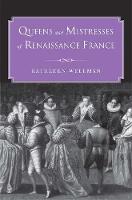
Queens and Mistresses of Renaissance France by Kathleen Wellman
"Queens and Mistresses of Renaissance France" by Kathleen WellmanThis book tells the history of the French Renaissance through the lives of its most prominent queens and mistresses, beginning with Agnès Sorel, the first officially recognized royal mistress in 1444; including Anne of Brittany, Catherine de Medici, Anne Pisseleu, Diane de Poitiers, and Marguerite de Valois, among others; and concluding with Gabrielle d’Estrées, Henry IV’s powerful mistress during the 1590s.

Wellman shows that women in both roles—queen and mistress—enjoyed great influence over French politics and culture, not to mention over the powerful men with whom they were involved. The book also addresses the enduring mythology surrounding these women, relating captivating tales that uncover much about Renaissance modes of argument, symbols, and values, as well as our own modern preoccupations.


Louis: The French Prince Who Invaded England by Catherine Hanley
"Louis" by Catherine HanleyIn 1215 a group of English barons, dissatisfied with the weak and despicable King John, decided that they needed a new monarch. They wanted a strong, experienced man, of royal blood, and they found him on the other side of the Channel: astonishingly, the most attractive candidate for the crown of England was Louis, eldest son and heir of the king of France.

In this fascinating biography of England’s least-known “king”—and the first to be written in English—Catherine Hanley explores the life and times of “Louis the Lion” before, during, and beyond his quest for the English throne. She illuminates the national and international context of his 1216 invasion, and explains why and how after sixteen fruitless months he failed to make himself King Louis I of England. Hanley also explores Louis’s subsequent reign over France until his untimely death on the Albigensian Crusade. Published eight centuries after the creation of Magna Carta and on the 800th anniversary of Louis’s proclamation as king, this fascinating story is a colorful tale of national culture, power, and politics that brings a long-forgotten life out of the shadows of history.


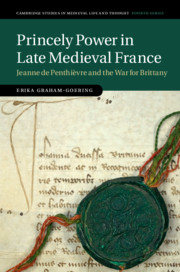
Princely Power in Late Medieval France: Jeanne de Penthièvre and the War for Brittany by Erika Graham-Goering
Princely Power in Late Medieval FranceJeanne de Penthièvre (c.1326–1384), duchess of Brittany, was an active and determined ruler who maintained her claim to the duchy throughout a war of succession and even after her eventual defeat. This in-depth study examines Jeanne's administrative and legal records to explore her co-rule with her husband, the social implications of ducal authority, and her strategies of legitimization in the face of conflict. While studies of medieval political authority often privilege royal, male, and exclusive models of power, Erika Graham-Goering reveals how there were multiple coexisting standards of princely action, and it was the navigation of these expectations that was more important to the successful exercise of power than adhering to any single approach. Cutting across categories of hierarchy, gender, and collaborative rule, this perspective sheds light on women's rulership as a crucial component in the power structures of the early Hundred Years' War, and demonstrates that lordship retained salience as a political category even in a period of growing monarchical authority.


War and Government in the French Provinces by David Potter
War and Government in the French ProvincesFew studies of the history of provincial France have hitherto spanned the conventional medieval/early-modern divide, and David Potter's detailed examination of war and government in Picardy, a region of France hitherto neglected by historians, has much to say about the development of French absolutism. Picardy emerged as a province after the campaigns of 1470–1477, and its experience of the first period of absolutism provides an enlightening contrast with that of other, more outlying provinces: the Picard nobility was notable for the extent of its participation in the army, the court and the government of France. David Potter provides a detailed analysis of the organisation of French military power in the province, and its impact during the period of the Habsburg-Valois wars. The work concludes with Picardy about to enter a difficult period of civil war.


The Law of Treason and Treason Trials in Later Medieval France by S. H. Cuttler
The Law of Treason and Treason Trials in Later Medieval FranceThis book presents a balanced account not only of the theoretical framework and legal complexities of the law of treason in later medieval France, but also of the extent and political context of that law's enforcement. By shedding some light on a larger issue - the interplay of law and politics, authority and power - the book contributes to our understanding of the French monarchy's efforts in the crucial fourteenth and fifteenth centuries to protect, extend and enforce its authority. The crown needed virtually all its judicial resources to cope with treason. Summary judgement and judgement by notoriety had largely given way by the fifteenth century to institutionalized procedures; special mention is made of trial by commission and the trial of peers. In the last five chapters the prosecution of treason is treated narratively to illuminate the policies of individual kings. Throughout the book comparisons are made with the English law.

Sunday, March 1, 2020

Review: Anne & Louis - Rulers & Lovers by Rozsa Gaston

49093636. sy475 Synopsis: In 1501, Anne of Brittany devises the perfect match for her only child by Louis XII, King of France. Their daughter will become the most powerful woman in Europe if she marries the future Holy Roman Emperor. But Louis balks. Instead, he wishes her to marry his successor. How else to keep his own bloodline on the throne?

Anne is incensed. Why should her daughter not rule Brittany one day as her successor? Better to be a decision maker as ruler of Brittany, where women are not forbidden to rule, than only to sit next to France’s future king as queen-consort, bereft of political power.

Anne wants Louis to stay out of Italy, but Louis is determined to gain a foothold there for France. Joining Ferdinand of Spain in a secret pact to partition southern Italy, Louis soon discovers, with devastating results, the age of chivalry is over.

As lovers, Anne and Louis are in accord. As rulers, their aims differ. Who will prevail?

Book Three of the Anne of Brittany Series, of which Anne and Charles is Book One, and Anne and Louis is Book Two.


Unfortunately, this was not for me.

I gave it two stars for tackling someone other than Eleanor of Aquitaine, Elizabeth I, or whoever is the current flavour of the month with historical fiction authors.  I am familiar with this period and the style of narrative just did not drawn me in and the characters left me flat. I could easily have left this unfinished but decided to persevere to the end.  For continuity purposes, I suggest reading the first two and the prequel, especially if new to this period and the characters. 

Sunday, February 2, 2020

Author: Tracey Warr

Tracey Warr was not an author that had been on my reading radar at all until one of her titles crossed my path and piqued my interest.

Her Amazon bio states: "Her fiction is based on historical research and she imagines in the gaps between known historical facts. ". This is something that all writers of historical fiction do.

It was her choice of female characters that caught my eye - and the time period in which her fiction is set. So, briefly - and not having yet read any of the following - is a snapshot of four that may make it to me TBR list:

Almodis: The Peaceweaver
A story of love, adventure and scandal, based on the real life of the eleventh-century countess Almodis de la Marche. Through her marriages to three important historical figures, Almodis founds a maternal dynasty that rules southern France and northern Spain during the height of the Occitan culture. It is a time of troubadours, of cathedral and castle building, and the shaping of Europe after Charlemagne. A time in which Occitan noblewomen hold equal power with their husbands under the vestiges of Roman and Visigothic law. But Almodis path to power and happiness is fraught with drama. Her first husband scandalises her contemporaries by rejecting her, she is excommunicated by the Pope and her third husband kidnaps her from her second miserable marriage. Covert journeys across the Pyrenees, escapes from incarceration and murder punctuate this extraordinary story, vividly bringing to life Almodis early medieval world.


The Viking Hostage
Set in late 10th century France and Wales, The Viking Hostage tells the intertwining stories of three women living through turbulent times of Viking raids, Christian conversions, and struggles for power across Europe at the turn of the millennium. Sigrid is a Norwegian sold into slavery in the French Limousin, stubbornly clinging to her pagan identity. Aina is a rich heiress, betrothed as a child to a man who does not offer her the adventure she craves. Adalmode is the daughter of the Viscount of Limoges, whose father has forbidden her passion for a young man imprisoned in his dungeon for a great crime. Their stories question and tangle with the nature of human nobility and of freedom in the highly stratified, unequal, and often brutal society of early medieval Europe.


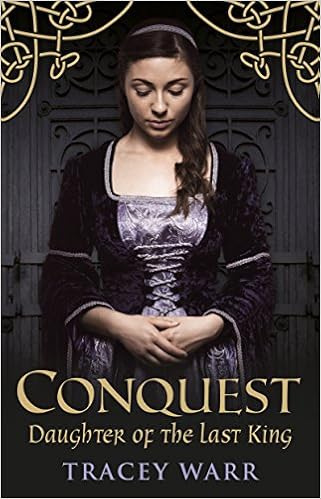
Conquest: Daughter of the Last King
1093. The three sons of William the Conqueror - Robert Duke of Normandy, William II King of England and Count Henry - fight with each other for control of the Anglo-Norman kingdom created by their father's conquest. Meanwhile, Nest ferch Rhys, the daughter of the last independent Welsh king, is captured during the Norman assault of her lands. Raised with her captors, the powerful Montgommery family, Nest is educated to be the wife of Arnulf of Montgommery, in spite of her pre-existing betrothal to a Welsh prince. Who will Nest marry and can the Welsh rebels oust the Normans? 'Daughter of the Last King' is the first in the Conquest Trilogy.


Conquest 2: The Drowned Court
1107. Henry I finally reigns over England, Normandy and Wales, but his rule is far from secure. He faces a series of treacherous assassination attempts, and rebellion in Normandy is scuppering his plans to secure a marriage for his son and heir. With the King torn between his kingdoms and Nest settled with her Norman husband, can she evade Henry's notice or will she fall under his control once more? As her brother Gruffudd garners support in an effort to reclaim his kingdom, Nest finds she cannot escape the pull of her Welsh heritage. While the dissent grows and a secret passion is revealed, the future of Nest and her Norman sons is placed in dire peril. In this riveting sequel to 'Daughter of the Last King', Nest must decide to whom her heart and loyalty belongs.


So, not only I am interested to see the third in the Conquest Trilogy (The Anarchy and covers the years 1122-1146, the final years of the reign of Henry I and then the subsequent struggle for the throne between Henry’s daughter Matilda and his nephew, Stephen of Blois), but this new tome that she is working on - again courtesy of her Amazon bio:
She received an Author’s Foundation Award from the Society of Authors for a biography she is working on about three French noblewomen, three sisters, who held power in 11th century Toulouse, Carcassonne, Barcelona and the Pyrenees.


Sunday, May 19, 2019

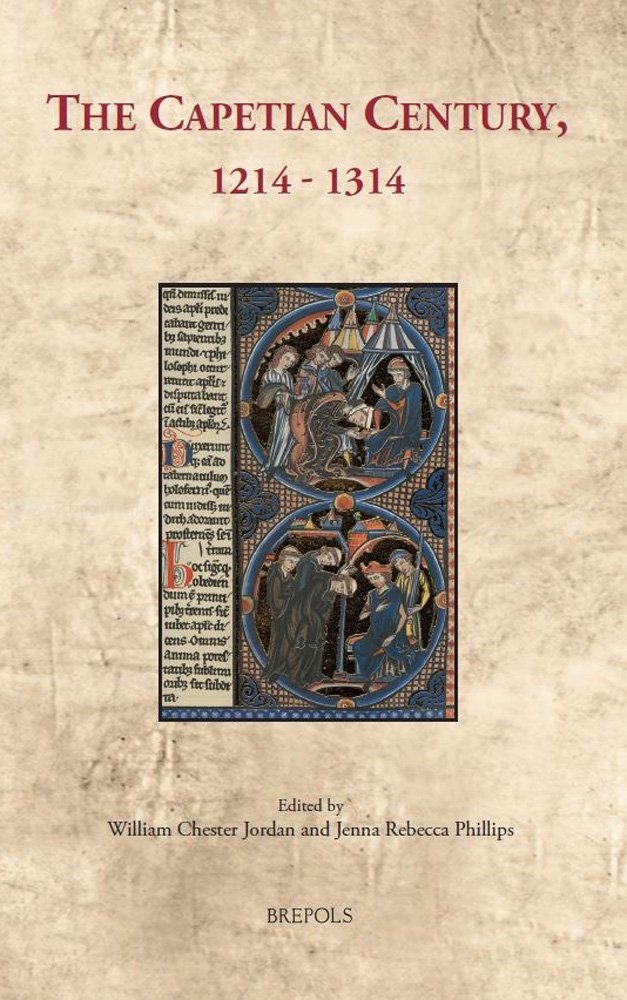
The Capetian Century, 1214 to 1314 ed by William Chester Jordan & Jenna Rebecca Phillips

From Amazon UK

This volume provides a fresh look at the Capetian century (1214-1314), a period that changed the cultural and political fabric and laid the foundation for the modernisation of the medieval West. The period from the birth of Louis IX to the death of Philip the Fair is remarkable for a series of developments and accomplishments associated with the Capetian kings of France. Innovations in architecture, manuscript illumination, and music all helped shape the cultural fabric of French and European life. Administrative historians emphasize the development of political institutions that have been said to lay foundations of the modern State. 'Moral reform', partly in support of the crusading movement, led to various changes in policies toward Jews, prostitutes, heretics, and many other social groups. This volume brings together essays presented at the Capetian Century Conference held at Princeton University, commemorating two seminal anniversaries bracketing the 'Capetian Century'--the Battle of Bouvines (1214), and the death of Philip the Fair (1314).

I think this will make a nice addition to my French History shelf in my personal library, sitting alongside a tome by Hallam & Everard on Capetian France

Sunday, January 6, 2019

Review: In the Shadow of the Enemy by Tanya Bayard

In the Shadow of the Enemy (Christine De Pizan Mystery #2)
Book 2 in the Christine de Pizan mysteries - following directly on from "In the Presence of Evil".

"... Brother Michel will record what everyone believes .."

This series, set in France in the 1390s during the reign of mad King Charles VI, features recently widowed Christine de Pizan who is employed as a scribe for the French Queen, Isabeau of Bavaria. The French Court in this period was a hot-bed of political and sexual intrigue, with the various factions fighting for control of both the government and the King (think Wars of the Roses).   For those unfamiliar with the period, Christine de Pizan was actually a court writer during the reign of Charles VI, and was indeed patronised by both the Queen, Isabeau of Bavaria, and the king's brother, Louis, Duke of Orleans. 

Christine's father Thomas worked as a physician, court astrologer and councillor of the Republic of Venice. Thomas de Pizan accepted an appointment to the court of Charles V of France as the king's astrologer and moved to Paris (1368). Christine de Pizan married the notary and royal secretary Etienne du Castel (c.1379). Pizan's husband died of the plague (1389), her father had died the year before. Pizan was left to support her mother and her children. When she tried to collect money from her husband's estate, she faced complicated lawsuits regarding the recovery of salary due her husband. In order to support herself and her family Christine turned to writing - hence her duties for the French court. 

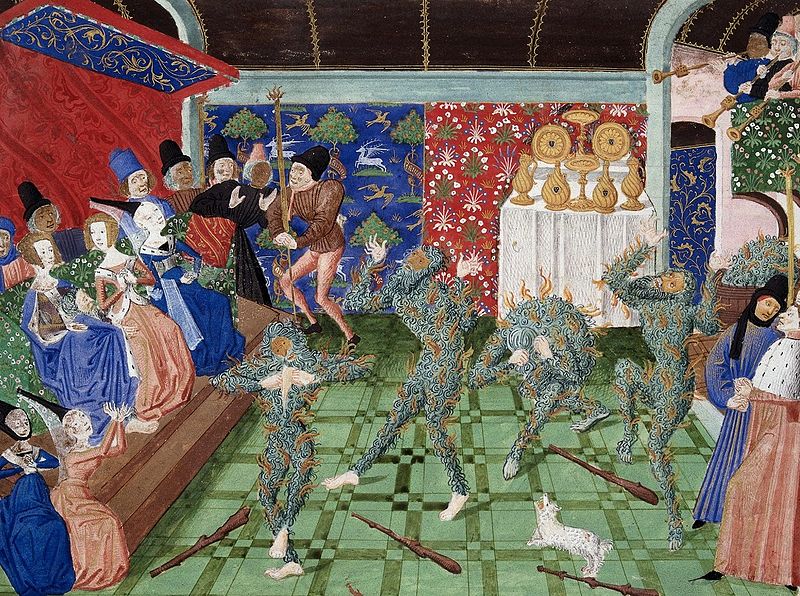
The Shadow of the Enemy directly follows on from In The Presence of Evil - in fact, for the characters, the events are imprinted on their memories so much so this forms one of the main plots. Christine is asked by Queen Isabeau to investigate the incident that would become known as the Bal des Ardents ("Ball of the Burning Men") as she feels that the threat to Charles is to be found closer than she would like. 

This famous incident in French history occurred on 29th January 1393.  A masked ball had been organized by the Queen, Isabeau of Bavaria, to celebrate the wedding of one of her ladies-in-waiting at the Hôtel Saint-Pol. At the suggestion of Huguet de Guisay, the king and four other lords dressed up as wild men and danced about. They were dressed "in costumes of linen cloth sewn onto their bodies and soaked in resinous wax or pitch to hold a covering of frazzled hemp, so that they appeared shaggy & hairy from head to foot". At the suggestion of one Yvain de Foix, the king commanded that the torch-bearers were to stand at the side of the room. Nonetheless, the king's brother Louis I, Duke of Orléans, who had arrived late, approached with a lighted torch in order to discover the identity of the masqueraders, and he set one of them on fire. There was panic as the fire spread. The Duchess of Berry threw the train of her gown over the king. Several knights who tried to put out the flames were severely burned. Four of the wild men perished: Charles de Poitiers, son of the Count of Valentinois; Huguet de Guisay; Yvain de Foix; and the Count of Joigny. Another – Jean, son of the Lord of Nantouillet – saved himself by jumping into a dishwater tub. 

Add to this another subplot based upon previous events in both French history and in Charles' life - the battle of the Golden Spurs - and its horrific aftermath. The Battle of the Golden Spurs (also known as the Battle of Courtrai), was fought between the Kingdom of France and the County of Flanders at Courtrai (Kortrijk ) on 11th July 1302. The Flemish were in rebellion against the French and massacred the French of the city of Bruges. The King of France at the time, Philip IV, organised an enormous army to march against the Flemish and seek retribution. The result was a rout of the French nobles, who suffered heavy losses at the hands of the Flemish. The battle soon became known as the Battle of the Golden Spurs after the 500 pairs of spurs that were captured in the battle and offered at the nearby Church of Our Lady. After the Battle of Roosebeke (27th November 1382), the spurs were taken back by the French and Courtai (Kortrijk) was viciously sacked by Charles VI in retaliation. As this event is featured at the start of the novel, we are left wondering how it will be linked to Christine.

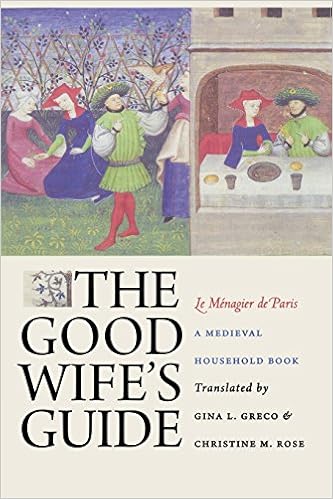
Image result for the book of moral and practical advice for a young wifeThroughout In The Shadow of the Enemy we get more of a feel for Christine's work as a writer at the royal court which is really just starting for the purposes of the novel. Christine wrote a number of books of advice to princesses, princes and knights remained in print until the 16th century. And our story is littered with references to this. In fact, this may be a homage to The Good Wife's Guide (Le Ménagier de Paris): A Medieval Household Book. Written in the late 14th C by an anonymous French writer, the book is addressed to a fifteen-year-old bride, narrated in the voice of her husband, a wealthy, aging Parisian. The book was designed to teach this young wife the moral attributes, duties, and conduct befitting a woman of her station in society, in the almost certain event of her widowhood and subsequent remarriage. The work also provides a rich assembly of practical materials for the wife's use and for her household, including treatises on gardening and shopping, tips on choosing servants, directions on the medical care of horses and the training of hawks, plus menus for elaborate feasts, and more than 380 recipes. I like how author Tanya Bayard as attributed this to Christine and leaves us wondering how this book is linked to Christine's search for Martin de Bois, the missing husband of Klara, a young bride taken in by Christine's mother. 
Christine, who grew up at the Court but is now not of the court, uses her skills and connections as well as relying on others outside of the court, to solve the mysteries at hand. I like the characters of both Marion (the prostitute) and Alips (the Queen's dwarf) and the roles assigned to both, and how the characters, including Henri Le Picart, are a little more developed. This is a much more rounded story - we get a definite feel for the political machinations of the time when not only the king's uncles, but his wife and his  brother are all vying for power and control, and those in positions of power struggle to retain what they consider theirs by right. It is not until we near the end that we get just the merest hint of the shadow in question that is being cast across the king and court, and yet we are never quite sure who is involved.

An enjoyable read - and I love the fact that this series is set at the French Court rather than the English. Another historical mystery solved with a new twist added ... can't wait for the next in the series.