Showing posts with label medieval england. Show all posts

Monday, October 6, 2025

Review: Desolation by Keith Moray

Synopsis: The Black Rood of Scotland, stolen. A coroner of York, murdered. An evil worse than plague itself, at large…

1361, York. As the country recovers from the war with France, and whispers that the pestilence has returned to England grow louder, fear is in the heart of every nobleman and commoner alike. Sir Ralph de Mandeville, ex-solider and newly appointed Justice of the Peace is sent to Langbarugh, just outside York, to investigate the murder of Coroner Sir Boderick de Whitby.

More deaths quickly follow, and while these are swiftly dealt with as plague victims, Sir Ralph and his two assistants Merek and Peter soon uncover something altogether more horrifying… A greater evil is at large in the northern wapentakes.

As panic escalates and the lines between plague and murder blur, Sir Ralph is thrust into a desperate race against time. Every shadow hides a potential killer, every cough could be a death knell. Can he unmask a murderer lurking in the terrifying shadow of the Black Death before they’re all consumed by a terror more sinister than any plague?

~ ~ ~

This series is set during the reign of King Edward III of England when the country was at war with France - the Hundred Years War.  The Black Death - or Plague - made its return - it would claim at least 20% of the population.  The Justices of the Peace Act was introduced, which created a new national role for justices of the peace (JPs) who were responsible for enforcing labor laws enacted in response to the economic changes caused by the Black Death.

The first in a new series wherein a number of local deaths is set firmly at the door of the plague - afterall, who in their right mind would look too closely at the putrefying corpse of a plague victim. However, it is the murder of a coroner and the theft of one of Scotland's most revered relics, that sets Ralph de Mandeville and his assistants on the trail of something more sinister.

There are many themes tackled in this tome - law and order, religion and superstition, necromancy and alchemy, doomsday preachers, murder, spite, and local jealousies and history.

Moray writes in an engaging manner, which slowly draws the reader in, setting the scene before our trio arrive to begin their investigations. A gentle history lesson to ensure the reader has a grasp of events and social customs of the period, is woven into the narrative - it is a subject not unknown to this author.  

Looking forward to the next installment in this new series.

Sunday, April 13, 2025

Review: The Whispering Dead of Rewley Abbey by Peter Stephenson

Synopsis: "The Whispering Dead of Rewley Abbey" is the first in a series of murder mysteries following the sinister deaths in Rewley Abbey (Cistercian monks) and Godstow Abbey (Benedictine nuns) from the end of the 13th century to King Henry VIII's dissolution of the convents and monasteries in the 16th century.

Intrigue and secrets abound as a determined nun deciphers the clues in this timeless historical thriller for both young adults and seasoned readers.

~ ~ ~

Fairly basic cosy historical mystery fiction set in 13th Century England with an investigating Nun and Lady of the Manor as the main characters.

An up and coming lecturer at Balliol College, Oxford is murdered; a drunken violent student is a suspect; will what lies beneath the surface of the "town and gown" battles reveal the secret to the mystery that Sister Agnes must solve. 

The author uses quick, easy to read chapters to push the narrative along, however, we get no real sense of the characters (which are a little too modern for my liking). Using poetic license, the author loosely represents the period of the 13th century.

As the first in a series, this is adequate though I would hope to see more development as the series progresses.

Monday, November 29, 2021

Review: The Challenges of King by KM Ashman

Synopsis: The fight for England began long before 1066…

AD 1045. Godwin of Wessex, one of the most powerful earls in the country, prepares for the marriage of his daughter to King Edward of England. The mood is jubilant, his family’s relationship with the Crown secured through matrimony. But one man seeks to undermine him at every opportunity.

French-born Bishop of London, Robert of Jumièges, has the ear of the king. As a trusted adviser, his position is one of power and privilege, and he wields it to gain ever-greater influence over the English Crown for his kinsmen in Normandy, at Godwin’s expense.

As the bishop’s control increases, the king’s relationship with the House of Godwin frays until, eventually, it breaks down completely. With civil war looming, Godwin fights to pull England back from the brink. But with the king under Norman influence, it could be too little, too late.

The Challenges of a King is the first book in a thrilling new series from K. M. Ashman exploring the politics, promises and intrigue that led three men to contest the throne in 1066, and to the final successful invasion of England. Perfect for fans of Conn Iggulden and Bernard Cornwell.


"Challenges of a King", the first in a forthcoming series is set in England during the 1040s and 1050s when Edward the Confessor was King,  details the rise and fall of the family of Godwin, Earl of Wessex.

The House of Godwin came into prominence under King Canute, when they emerged from obscurity to remain in the limelight and as part of the political machinery of Anglo-Saxon England until the reign of Edward the Confessor. The two eldest sons of Godwin, Sweyn and Harold, were also elevated to earldoms.


The narrative alternates between Edward and the Godwins, and gives us a sense that Edward was in control of his own destiny and of the political machinations that would ultimately lead up to the events at Hastings as we know them. One cannot but side with the Godwins against Edward's Norman advisers, who were attempting to divert the succession away from the Anglo-Saxon dynasts.

Whilst the action is predominantly confined to the halls of power, we get a true sense of the impending drama that is about to unfold. Looking forward to the next in the series.


Sunday, October 3, 2021

Review: Royal Mysteries: The Medieval Period by Timothy Venning

Synopsis: Royal murder mysteries never fail to intrigue readers and TV viewers. Here are some of the most haunting and even horrific episodes from the middle ages, based on latest historical research and historiography, and authentic and rare sources, including archaeology and DNA evidence, uncovering wonderful tales of pathos, tragedy, suffering and romance. This is history for specialists and general readers - and sceptics - given the intense media coverage, including TV, and interest in exciting and accessible popular history. The famous and also less well-known mysteries, which may be new to readers, surrounding British Royalty, are included from around the 11th to the 15th centuries.

The murder mysteries show personal and individual tragedy but are also a vehicle for historical analysis. William II - William Rufus - was he murdered or killed accidentally by a 'stray arrow', allowing brother Henry to seize the throne, or was it God's punishment for William's irreligious living and persecution of the church? Or was Edward II murdered at the instigation of Queen Isabella - 'she-wolf of France' - and her lover, Roger Mortimer. who assumed the throne? Did he survive to live peaceably in Italy? Richard II resembled Edward II, as a rather inadequate figure, and was deposed by his rival, Henry IV. Did he die, and if so, was it murder or suicide? Was Edward IV a bigamist? Mystery, if not murder, but wrapped in dynastic rivalry and sex scandal, and usurpation of the throne. The 'Princes in the Tower' and who who killed them if anyone? A beguiling mystery for over 500 years with their usurping uncle Richard III's guilt contested by 'Ricardians'.


I was eager to read this one as I have a number of Tim's books already on my library shelf - and who doesn't love a good mystery. 

The mysteries being explored were not unknown to me - in fact I explored one of these mysteries myself in greater depth (death of William II) and the controversy surrounding the "Princes" still captures my imagination even today, after much reading on the matter.

Venning takes each mystery, provides some historical background and context, examines the contemporary accounts, looks at all the players before asking the age old question - cui bono? Who stands, or stood, to gain, and so might have been responsible for it or precipitated the actions of a third party?

Venning directs the readers attention to the existence of "fake news" in medieval times wherein the writer or chronicler is playing to their own agenda and contemporary audience, and as such must be viewed as a potential unreliable source.  In fact, as the reader and student of history will know, no source is completely without bias - just because it was written at the time does not necessarily mean it is the most accurate account.  Venning even comments that history is but "... a hall of mirrors with distorted reflections .."

Moving on to the mysteries themselves and what we have learned.  Well not much really.  I was rather disappointed to find that there was no real conclusion one way or the other - no definitive proofs. Venning does not take any particular stance - he explores all aspects of each mystery and just presents us with all the information, evidence and accounts, and leaves it up to the reader to discern what they will from it.

Whilst I will assume (whether rightly or wrongly) that this book is for the consumption of popularist history, I did find the narrative to be rather long-winded, repetitive, and definitely non-linear. I would suggest some fore-knowledge of the subject matter at hand would be appropriate. Overall, I liked it and would probably pick this up again - at a later date.


Also By Author:
- Royal Mysteries: The Anglo-Saxons and Early Britain
- The King Arthur Mysteries: Arthur's Britain and Early Medieval World


Review: The Two Isabellas of King John by Kristen McQuinn

Synopsis: King John of England was married to two women: Isabella of Gloucester and Isabelle of Angouleme. The two women were central to shaping John and his reign, each in her own way molding the king and each other over their lives. Little is known about Isabella of Gloucester and she has largely become an historical footnote; Isabelle of Angouleme has a reputation as a witch and poisoner. However, both were products of their time, victims and pawns of the powerful men whose voices overwrote the experiences of women. By examining these two very different women through a modern feminist lens, The Two Isabellas offers new insight into one of England's lesser-known queens and a different interpretation of one of its least popular kings.

In The Two Isabellas of King John, Kristen McQuinn offers new and intriguing insights into two of England's important yet little understood queen-consorts, the wives of King John. Taking a feminist light, McQuinn brightly shines it on both England's least well-known consort, Isabella of Gloucester, his first wife, and one of its least popular, Isabelle of Angouleme, his child bride.


Firstly I am troubled by the use of phrases such as "feminist light" and "feminist lens" - quite frankly what does this mean. I grew up in the era where "women's lib" and "feminism" were concepts and movements that touched on every area of a woman's experiences — politics, work, family, equality and sexuality. These hard won victories are currently being enjoyed by latter generations, so to bandy such phrases about today, puts me a little on edge. Don't get me wrong, I am all for looking at historical characters and events in a new light, but why does the work of a female author looking at a female character need to be labelled "feminist". And what is a "modern feminist lens" - how is it different from the views of the numerous female authors who blazed a trail beforehand.

Secondly, I really take umbrage at the following phrase: " ... offers new insight into one of England's lesser-known queens and a different interpretation of one of its least popular kings .." Quite frankly what does this actually mean - what new insight because - for me - there was no new insight, no shining light on two lesser known queens, no new interpretation on the view of John's reign.  Lately the number of history books using the phrases "new information" and "new insights" that have actually delivered on this I could count on one hand (excluding my thumb).

And so, sixty-five pages down, there was nothing remotely resembling anything close to a biography or life story for either women - just a lot of "academic" twaddle, assumptions and educated guesses with the occasional mention of either or both. A lot of "concepts" being explored but not a lot substance on either woman so far. In fact, I was ready to chuck the whole thing in there and then. But I persevered through dry and boring monotone, page after page, on the role of women, queens and mothers, childhood and childbirth, fashion, trade, architecture and education, with little to endear this reader and nothing this reader had not discovered in other tomes previously written, many of which stand as the pre-eminent works not only of their own times but even now.

A couple of phrases I did pick up on - but again I have said them so often myself - is that the lives of medieval women - regardless of social status - was typically viewed through the agency of the men in their lives - their fathers and other male kin, their husbands, and finally their sons. McQuinn does acknowledge that "... the roles of women, even queens, most often fell with the private family-orientated realm, and thus outside the purview of most chroniclers .."  Hence, with very little information on either woman to use and turn into a singular biography, we are left looking at both their lives in relation to their marriage to the same man - King John of England. Darren Baker in his work "The Two Eleanors of Henry III" (read my review here) presented something similar and managed to pull it off slightly better than McQuinn has done.

The only time we really get a sense of the presence of either woman is from about page 80 to about 120 - a mere forty pages - the bulk of which is dedicated to Isabella of Angouleme, John's second wife - his first wife, Isabella of Gloucester hardly features at all. And here, the same information can be found in any number of tomes already published on both John and the era in question.

And yet, again, accordingly to the blurb: "The two women were central to shaping John and his reign, each in her own way molding the king and each other over their lives." I am sorry, but I must have been reading a completely different book. Based upon the fact the McQuinn constantly tells us that there is a distinct lack of knowledge on either woman, that they themselves left no personal accounts, and that contemporary accounts show neither woman in a positive light, how can one make the sweeping statement that they were "central to shaping John and his reign".  In fact, the underlying message I got from all of this was the laying of blame for John's behaviour firmly at the feet of both women, which is more in line with a misogynist viewpoint than a feminist one. 

Overall, I came away from this less than impressed.  I skimmed through the final chapter (on the portrayal of both in fiction) and headed straight for the sources - no surprises there for me - and some of those listed I found myself questioning the usage of but that's just my humble opinion.

For me, this was just another in a long line of tomes being churned out by this publisher that all promise the same thing - and funnily enough, deliver it - and that thing being delivered is not much at all.  Would I recommend this - no I wouldn't - not for the generalist reader nor the specialist reader.

I can hear the tut-tutting already. Am I being too harsh, surely there were some redeeming features.  Well, the only redeeming feature is that the author is to be applauded for taking on this task in the first place.  I do know how hard it is to craft a decent tome around a subject matter where there is little or no information - but please don't provide me with something that you can't deliver on.  If there is nothing on your chosen subject - acknowledge and move on!  I personally would much prefer a smaller volume than pages of padding.


Saturday, September 11, 2021

Review: The Day of the Serpent by Cassandra Clark

Synopsis: The murder of a loyal king's man threatens the self-crowned King Henry's new regime in this second gripping medieval mystery featuring friar, sleuth and reluctant spy Brother Chandler. 

January, 1400. The bowman strikes at night, slaying one of King Henry's loyal garrison men before melting back into the darkness. Was the murder the result of a personal quarrel? Or is it, as Henry's stepbrother, Swynford, fears, the start of an uprising against England's self-crowned king? Swynford orders Brother Chandler to investigate, before the spark of rebellion can set the whole country alight. 

Friar, reluctant sleuth, and even more reluctant spy, Brother Chandler is a man with dark secrets and divided loyalties. To the murdered King Richard. To his paymaster, the usurper King Henry. And to beautiful, naive Mattie, a maid in the household of heretical poet Geoffrey Chaucer, who holds dangerous secrets of her own. Trusted by no one, Chandler must walk a tightrope of secrets and lies if he is to uncover the truth about the murder, while ensuring he - and the few people he cares about - stay alive. 


This historical mystery set at the start of the reign of Henry IV of England, and follows on from The Hour of the Fox - so it is advisable to read the series in order.

This second Brother Chandler book opens fairly close to where the first finished - Brother Chandler is en route to Pontefract castle, in the entourage of Thomas Swynford.  Richard II has been deposed by his cousin, Henry of Bolingbroke, who as assumed the throne as Henry IV. But "uneasy lies the head that wears a crown" - especially one that many feels is not rightfully his.  Whilst at Pontefract, Chandler finds himself in the company of the deposed Richard, who is somewhat resigned to his fate even more so in light of a number of rebellions that set out to restore the monarch. Richard alive is a thorn in Henry's side - but how does one dispose of a monarch, even a deposed one, without questions being asked.  

Finally, the deed is done, and the body of the dead monarch is being transported back to London for burial.  His funeral cortege makes off at a slow pace, giving the population ample opportunity to view the corpse.  But it is not an easy journey, as members of the escort are being targeted by a mysterious archer.  Chandler is detailed to investigate by Swynford who is eager to produce a suspect (any suspect) and appease the wary new king.

Against this backdrop of rebellion and sedition, the character of Chaucer makes another appearance, as he is suspected of being the author of a number of heretical texts making the rounds.  This part of the story is told in the first person narrative of Chaucer's maid, Mattie, who is given more of a role in this book than in the first.

There are three narratives being used to tell this story - we have the first person narrative of Mattie for Chaucer and his activities; we have the third person narrative for the bulk of the story; and added to this is the first person chronicle of Brother Chandler, who has decided to document (a true account of) events for posterity.

As I said, it is better to have read the first in the series as a number of characters make a return as does the prophecy theme.  I would have preferred a bit more of an exploration of the roles of the spymasters, who I felt got the short end of the stick in this book. The ending, however, I found to be rather disappointing and has left me wondering what the author's intent is with the character of Brother Chandler.  After reading both, I found myself liking the first one more than this second.

For further background on this series, read my review of The Hour of the Fox.

Friday, September 10, 2021

Review: Lions of the Grail by Tim Hodkinson

Synopsis: First in an adventure-filled historical series following Irish Knight Templar, Richard Savage, as he is forced to spy on his homeland for the King of England.

1315 AD. Ireland and England are ravaged by bitter war. Rotting in an English prison, condemned as a heretic, Irish Knight Templar Richard Savage is given one chance of reprieve. But there is a catch. He must return to Ireland as a traitor, and work as a spy there for the King of England.

Savage returns to his homeland, but even here he can trust no one. He soon discovers the Scots intend to invade and someone in Ireland is helping them. The King of Scotland also claims to possess a mysterious holy treasure, and many are flocking to his cause. And what's more, Savage discovers he left more than just memories behind in Ireland...

Amid feasts, tournaments, invasion and war, can Savage decide whose side he is really on, discover whether this holy relic is real and, above all, stay alive?


As an avid reader of Hodkinson's Whale Road Chronicles, and having some fore-knowledge of the period in history, I was interested to see how the Scottish invasion of Ireland under the Bruces would pan out under Hodkinson's skillful narration.

This is the first in the series. So for those unfamiliar with the era, Edward Bruce fought alongside his brother Robert throughout his struggle for the Scottish throne, which culminated in the battle of Bannockburn, in which the Scots were victorious (1315). Continuing their war against England, especially after the Isle of Man fell under Scots loyal to England, Robert Bruce decided to open a second front in Ulster. As there had been no High King in Ireland for some time, Bruce figured that in making Edward King of Ireland, concessions could be made in return for localised support.  The Annals of Ulster record the event as follows:
U1314.2
Robert Bruce, king of Scotland, came to Ireland along with many gallowglasses in aid of Edward, his brother, to expel the Foreigners from Ireland.
This is where our story opens, in the events leading up to the invasion of Ireland by the Scots. Our protagonist, Richard Savage, is a Templar of Irish descent, imprisoned in England after the decimation of the Order by Philip of France in 1314. When the King of England, Edward II, needs to get a feel for what is happening in Ireland, he drags Savage out of his imprisonment and sends him across to Ulster to gauge the loyalty of those there and to scupper any plans for "a grand Gaelic alliance against England". As Savage is trusted by neither side, there is plenty of action, battles, captures, escapes, rescues, disguises, secret codes, assassins, an old enemy AND a holy relic.  There is enough to keep the reader entertained, much being centered around the town and castle of Carrickfergus, and ais is duly noted in the narrative "... one thing was sure - there would be more fighting ...".

Now, there has been plenty of speculation as to the relationship between the Knights Templars and Scotland. Treasure hunters claim that in the 14th century, the Knights Templar fled to Scotland with a trove of valuables because they received support and protection from King Robert the Bruce. Templar scholar and medieval historian Helen Nicholson said that any remaining Knights Templar were more likely to be found in Cyprus. One of the first to link the Templar fleet to Scotland was George Frederick Johnson, a Scottish exile in Germany in the mid-18th Century, who said that the Templars had sailed to Scotland. However, Johnson's claims proved to be as fraudulent as he himself was later discovered to be.

A number of actual historical figures make their appearance throughout, including the likes of Roger Mortimer, Richard de Burgh, Thomas de Mandeville, John de Bermingham and the Bruces - Robert and Edward. There is, of course, Edward II - though based upon the description of him in this instance, I find myself imagining him as Claude Rains in his role as Prince John in the 1938 adaption of Robin Hood. Similarly, I picture Lancaster as Basil Rathbone in his role from the same film.

Claude Rains and Basil Rathbone

The female character - to be honest - I could take or leave. Sometimes they are not necessary to the narrative - the cast of characters does not - in my opinion - always need to be "inclusive" or "politically correct" to tell a good story. There does not always have to be some "love interest" to lure in the female reader - sometimes their inclusion feels forced and detracts from the storyline. However, as one continues reading, the female character does have some sort of role.

What I find rather poignant about this whole episode can be summed up in this quote:
"   it's sad that a country that has struggled so long to gain it's own freedom should so soon seek to visit war and oppression on another ... "

I am looking forward to seeing how the rest of the series progresses.


Saturday, September 4, 2021

The Challenges of a King (The Road to Hastings Book 1) by KM Ashman

The fight for England began long before 1066…

AD 1045. Godwin of Wessex, one of the most powerful earls in the country, prepares for the marriage of his daughter to King Edward of England. The mood is jubilant, his family’s relationship with the Crown secured through matrimony. But one man seeks to undermine him at every opportunity.

French-born Bishop of London, Robert of Jumièges, has the ear of the king. As a trusted adviser, his position is one of power and privilege, and he wields it to gain ever-greater influence over the English Crown for his kinsmen in Normandy, at Godwin’s expense.

As the bishop’s control increases, the king’s relationship with the House of Godwin frays until, eventually, it breaks down completely. With civil war looming, Godwin fights to pull England back from the brink. But with the king under Norman influence, it could be too little, too late.

The Challenges of a King is the first book in a thrilling new series from K. M. Ashman exploring the politics, promises and intrigue that led three men to contest the throne in 1066, and to the final successful invasion of England. Perfect for fans of Conn Iggulden and Bernard Cornwell.

Wednesday, August 25, 2021

Review: Wolf at the Door by Sarah Hawkswood

Synopsis: All Hallow’s Eve, 1144.
The savaged body of Durand Wuduweard, the solitary and unpopular keeper of the King’s Forest of Feckenham, is discovered beside his hearth, his corpse rendered barely identifiable by sharp teeth.

Whispers of a wolf on the prowl grow louder and Sheriff William de Beauchamp’s men, Hugh Bradecote and Serjeant Catchpoll, are tasked with cutting through the clamour. They must uncover who killed Durand and why while beset by superstitious villagers, raids upon manors and further grim deaths. Out of the shadows of the forest, where will the wolf’s fangs strike next?


As per my review on River of Sins, book seven in the Bradecote and Catchpoll series, the setting for this latest in firmly during the time of The Anarchy.

This time we are transported back to the medieval village of Feckenham. A village has been situated at Feckenham since the 9th century, and has been known by various names, including Feccheham (11th century), Fekkeham, Fekeham (12th century).

In the Middle Ages, Feckenham stood in the middle of the ancient Royal Forest of Feckenham, and was the administrative centre for this substantial royal forest covering much of Worcestershire.  The forest was used by the Kings of England who had a lodge in the park of Feckenham Manor (current structure dates from the 16th century).

The forest's titular head was the keeper, whose role was essentially honorary. Under the keeper were verderers who were the main enforcers of forest law, investigating infractions and trespasses; and then there were the Woodwards (wardens) who guarded royal timber rights and venison.  These appointments  were often viewed in light of communal status and be of considerable prestige and preferment; and at times a source of jealously and rivalry.

Forest Law was especially harsh and a cause of considerable grievance. You can read more about these laws here at Early English Laws

The town of Worcester, having survived attacks, fire, ransoms, owed its loyalty to the King, Stephen, and his representative, the Sheriff of Worcester.  At this point in time, the Sheriff was one William de Beauchamp, who inherited the title from his father Walter de Beauchamp. This Walter had been granted the right to hunt wolves and foxes in the royal forests of Worcestershire by Henry I; it is also said that he probably held the office of royal forester for Worcestershire as well as sheriff. Historians Judith Green and C. Warren Hollister both favour this, and that the son, William, succeeded to these title upon Walter's death c.1130-1133.

The word sheriff comes down to us from the Old English term for  a royal official (or shire reeve), who was responsible for keeping the peace throughout a shire or county on behalf of the king. Shrieval judicial and administrative activities were broad - one of the main responsibilities was the annual collection of taxes for the Exchequer. He presided over the county courts, but was not per se judge and the requirement for judical competence was rather vague. The sheriff generally carried out the King’s orders, with an armed county posse if necessary. He could be ordered to carry out particular investigations. He had authority to raise the "hue and cry" for the pursuit of thieves and other criminals. The hue and cry was a form of posse, in which once the shout was sounded that a crime such as robbery, theft, assault, or murder was committed; all that heard it were obligated and bound by honor to join the pursuit until the scoundrel was captured or the reeve called off the search.

For the purposes of our novel, justice has been delegated to the Undersheriff of Worcestershire, Hugh Bradecote, his gruff and worldly assistant Serjeant Catchpoll, and Catchpoll’s protege, Walkelin. Our trio are sent out to investigate the death of the local woodward, however, this presents no easy task as there is talk of wolves, or more specifically, werewolves. The word werewolf comes from the Old English word werwulf, a compound of wer "man" and wulf "wolf". Werewolves were mentioned in a number of medieval law codes, including that of King Canute (r.1016 - 1035), whose Ecclesiastical Ordinances inform us that the codes aim to ensure that “…the madly audacious werewolf do not too widely devastate, nor bite too many of the spiritual flock.’ There was widespread belief in these creatures throughout northern Europe so this was not just a localised belief at this particular time.


With the Middle Ages being an age of uncertainty and an overall lack of knowledge in the very world that surrounded the people living in this time, superstitions became apart of everyday life and could even be considered routine. While today many of the fears of the people of the Middle Ages which were the root cause of superstition are considered non-realistic and just completely ridiculous, the fear that these people felt strongly impacted their lives and the societies in which they lived. For our investigators,  reality is cloaked in superstition, and to solve this crime, they must strip away the unreal and present the actual to a community living in terror of the unknown.

All of the above aspects are woven together in a highly engaging tale; with the characters holding their own across the narrative.  The reader gets a real feel for the period and its peoples, as they struggle not only with their daily lives but in reconciling what  their beliefs and the opposing reality presents.

A series worthy of investing in.

Read More


Sunday, June 13, 2021

Edward I and the Governance of England, 1272–1307 by Caroline Burt

This important exploration of the reign of Edward I – one of England's most lionised, feared and successful monarchs – presents his kingship in a radical new light. 

Through detailed case studies of Shropshire, Warwickshire and Kent, Caroline Burt examines how Edward's governance at a national level was reflected in different localities. She employs novel methodology to measure levels of disorder and the effects of government action, and uncovers a remarkably sophisticated approach to governance. 

This study combines an empirical examination of government with an understanding of developing political ideas and ideological motivation, and contributes towards a greater understanding of the development of local government and politics in England in the thirteenth and fourteenth centuries. Edward emerges as a king with a coherent set of ideas about the governance of his realm, both intellectually and practically, whose achievements were even more remarkable than has previously been recognised.

Sunday, October 4, 2020

Review: Richard III and the North by MJ Trow

Richard III in the North
Synopsis: Richard III is England's most controversial king. Forever associated with the murder of his nephews, the Princes in the Tower, he divides the nation. As spectacular as his death at Bosworth in August 1485 - the last king of England to die in battle - the astonishing discovery of his bones under a Leicester car park five centuries later renewed interest in him and re-opened old debates. Is he the world's most wicked uncle; or is he (in the words of the man who most smeared him) 'a prince more sinned against than sinning'?

Richard was not born in the North; neither did he die there, but this detailed look at his life, tracing his steps over the thirty-three years that he lived, focuses on the area that he loved and made his own. As Lord of the North, he had castles at Middleham and Sheriff Hutton, Penrith and Sandal. He fought the Scots along the northern border and on their own territory. His son was born at Middleham and was invested as Prince of Wales at York Minster, where Richard planned to set up a college of 100 priests.

His white boar device can be found in obscure corners of churches and castles; his laws, framed in the single parliament of his short reign, gave rights to the people who served him and loved him north of the Trent. And when he felt threatened or outnumbered by his enemies during the turbulent years of the Wars of the Roses, it was to the men of the North that he turned for support and advice. They became his knights of the body; members of the Council of the North which outlived Richard by a 150 years. They died with him at Bosworth.

Although we cannot divorce Richard from the violent politics of the day or from events that happened far to the South, it was in the North that Richard's heart lay.  The North was his home. It was the place he loved.


I will admit to being a little biased - I have read a number of non-fiction (Vlad) and fiction (Marlowe) by MJ Trow. I find the writing style to be more conversational than academic, more so in this tome.

What we have here is a great (abridged) introduction to the Wars of the Roses and the family of Richard III. Trow uses the fortifications and castles associated with the Yorkist cause and with Richard himself as the anchor point from which to condense and recount Richard's thirty-three years.

As many would already know, following the accession of Edward IV, Richard received many honours and land, predominantly based in the north of England - t would be here that he would create long lasting ties with local landowners, religious and civil leaders - he was a popular figure.

However, not all the anchor points are linked with the north but with the family, and there is much discussion about these places not only associated with Richard, but also key points in the family history and with events being played out. 

Richard's links to the north were not only about his own time there, but also with how the northern barons - more often or not Lancastrians - impacted his childhood, adulthood, his political and personal perceptions. Trow tells us that Richard was often associated as a "northerner" due to his deliberate decision to base himself there - to live and to work - and muses that had things followed the anticipated successional course, Richard may have indeed spent much more time in the North. Regardless of how things finally played out, his legacy is and will always be associated with the North. And funnily enough, much of what Richard set about creating, the Tudors adopted themselves.

Trow also delves into the myths and perceptions of Richard himself, including the vexing question of the Princes in the Tower, finishing up with the discovery of Richard 's remains and his final internment.

Trow provides a "floor plan" for all the anchor buildings and possible plans for the major battles. All sources (of which a selected few are listed at the end) are considered and scrutinised, but here also Trow laments that lack of contemporary sources that shed light into the man himself that have not be "rewritten" or "formualted" with a specific target audience or patron in mind.

There are many books on the Wars of the Roses, Richard III and the Tudors, Trow's book will appeal to many - it is an accessible, uncomplicated history of the period and the man.


Tuesday, August 25, 2020

Slavery in Early Mediaeval England from the Reign of Alfred until the Twelfth Century by David A.E. Pelteret

This important study seeks to assemble the evidence, drawn from a variety of sources in Old English and Latin, to convey a picture of slaves and slavery in England, viewed against the background of English society as a whole.

Slaves were part of the fabric of English society throughout the Anglo-Saxon era and the twelfth century, but as the base of the social pyramid, they have left no known written records; there are, however, extensive references to them throughout the documents and writings of the period. 

This important study seeks to assemble the evidence, drawn from a variety of sources in Old English and Latin, to convey a picture of slaves and slavery in England, viewed against the background of English society as a whole. An extensive appendix on the vernacular terminology of slavery reveals the concepts of enslavement to be embedded in the religious imagery of the period.

Tuesday, June 30, 2020

Court of Richard II and Bohemian Culture by Alfred Thomas

Bohemian culture exercised an important influence on the court of King Richard II, but it has been somewhat overlooked, with previous scholarship on its writers and artists generally confined to the role played by the French court of King Charles V and the Italian city states of Milan and Florence. 

This book aims to fill that gap. It argues that Richard's marriage to Anne of Bohemia, daughter of the Holy Roman Emperor Charles IV, one of the greatest rulers and patrons of the age, exposed England to the full extent of this international court culture. 

Ricardian writers, including Chaucer, Gower and the Gawain-poet, wrote in their native language not because they felt "English" in the modern national sense but because they aspired to be part of a burgeoning vernacular European culture stretching from Paris to Prague and from Brabant to Brandenburg; thus, one of the major periods of English literature can only be properly understood in relation to this larger European context.

Monday, May 11, 2020

Books: Notable Women

Servilia and Her Family by Susan Treggiari

Cover for 

Servilia and her Family


Servilia is often cited as one of the most influential women of the late Roman Republic. Though she was a high-born patrician, her grandfather died disgraced and her controversial father was killed before he could stand for the consulship; she herself married twice, but both husbands were mediocre. Nevertheless, her position in the ruling class still afforded her significant social and political power, and it is likely that she masterminded the distinguished marriages of her one son, Brutus, and her three daughters. During her second marriage she began an affair with Iulius Caesar, which probably lasted for the rest of his life and is further indicative of the force of her charm and her exceptional intelligence.

The patchiness of the sources means that a full biography is impossible, though in suggesting connections between the available evidence and the speculative possibilities open to women of Servilia's status this volume aims to offer an insightful reconstruction of her life and position both as a member of the senatorial nobility and within her extended and nuclear family. The best attested period of Servilia's life, for which the chief source is Cicero's letters, follows the murder of Caesar by her son and her son-in-law, Cassius, who were leaders among the crowd of conspirators in the Senate House on the Ides of March in 44 BC. We find her energetically working to protect the assassins' interests, also defending her grandchildren by the Caesarian Lepidus when he was declared a public enemy and his property threatened with confiscation. Exploring the role she played during these turbulent years of the late Republic reveals much about the ways in which Romans of both sexes exerted influence and sought to control outcomes, as well as about the place of women in high society, allowing us to conclude that Servilia wielded her social and political power effectively, though with discretion and within conventional limits.


Spartan Women by Susan Pomeroy
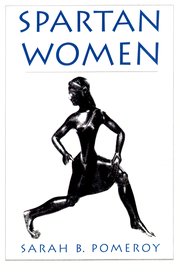
Cover for 

Spartan Women


Sparta, which existed from 800 B.C. until A.D. 200, was renowned in the ancient world as a stoic and martial city-state, and most of what we know about Sparta concerns its military history and male-dominated social structure. Yet Spartan women were in many ways among the most liberated of the ancient world, receiving formal instruction in poetry, music, dance, and physical education. And the most famous of mythic Greek women, Helen of Troy, was originally a Spartan. Written by one of the leading authorities on women in antiquity, Spartan Women seeks to reconstruct the lives and the world of Sparta's women, including how their legal status changed over time and how they held on to their surprising autonomy.

In this book, Sarah Pomeroy covers over a thousand years in the lives of Sparta's women from both the elite and lower classes. This is the first book-length examination of Spartan women, and Pomeroy comprehensively analyses ancient texts and archaeological evidence to construct the history of these elusive though much noticed women. Spartan Women is an authoritative and fresh account that will appeal to all readers interested in ancient history and women's studies.


Elizabeth of York and Her Six Daughters-in-Law: Fashioning Tudor Queenship, 1485–1547 by Retha Warnick
coverThis study of early modern queenship compares the reign of Henry VII’s queen, Elizabeth of York, and those of her daughters-in-law, the six queens of Henry VIII. It defines the traditional expectations for effective Tudor queens—particularly the queen’s critical function of producing an heir—and evaluates them within that framework, before moving to consider their other contributions to the well-being of the court. This fresh comparative approach emphasizes spheres of influence rather than chronology, finding surprising juxtapositions between the various queens’ experiences as mothers, diplomats, participants in secular and religious rituals, domestic managers, and more. More than a series of biographies of individual queens, Elizabeth of York and Her Six Daughters-in-Law is a careful, illuminating examination of the nature of Tudor queenship. 


coverThree Medieval Queens: Queenship and the Crown in Fourteenth-Century England by Lisa Benz St John
This book is an innovative study offering the first examination of how three fourteenth-century English queens, Margaret of France, Isabella of France, and Philippa of Hainault, exercised power and authority. It frames its analysis around four major themes: gender; status; the concept of the crown; and power and authority.


Berenguela of Castile (1180-1246) and Political Women in the High Middle Ages by Miriam Shadis
coverThe women in the family which ruled thirteenth-century Castile used maternity, familial and political strategy, and religious and cultural patronage to secure their personal power as well as to promote their lineage. Leonor of England, and her daughters Blanche of Castile (queen of France), Urraca (queen of Portugal), Costanza (a Cistercian nun of Las Huelgas) and Leonor, (queen of Aragon) provide the context for a study focusing on Berenguela of Castile, queen of Leon through marriage and of Castile by right of inheritance, whose most significant accomplishment was to enable the successful rule of her son Fernando.


"Trying Neaira" by Debra HamelTrying Neaira: The True Story of a Courtesan’s Scandalous Life in Ancient Greece by Debra Hamel
Neaira grew up in a Corinthian brothel in the fourth century B.C., became a high-priced courtesan and a sex slave, then settled into a thirty-year relationship with Stephanos of Athens. But next she found herself in court, charged with transgressing Athens’s marriage laws. This book reconstructs the amazing facts of Neaira’s life and trial, illuminating the social, legal, and cultural worlds of ancient Greece.


Women of Byzantium by Carolyn L. Connor
"Women of Byzantium" by Carolyn L.              ConnorWomen played key roles in Byzantine society: some ruled or co-ruled the empire, and others commissioned art and buildings, went on pilgrimages, and wrote. This engrossing book draws on evidence ranging from pictorial mosaics and inscriptions on the walls of churches to women’s poetry and histories, examining for the first time the lives, occupations, beliefs, and social roles of Byzantine women.

In each chapter Carolyn L. Connor introduces us to a single woman—from the elite to the ordinary—and uses her as a springboard to discuss Byzantine society. Frequently quoting from contemporary accounts, Connor reveals what these women thought of themselves and their lives and how they remembered the lives of women who had lived earlier.
Informative, sympathetic, and engagingly written, this book is a window into Byzantine culture and women’s history that has never before been opened.


Eleanor of Aquitaine: Lord and Lady edited by Bonnie Wheeler and John Carmi Parsons
coverEleanor's patrilineal descent, from a lineage already prestigious enough to have produced an empress in the eleventh century, gave her the lordship of Aquitaine. But marriage re-emphasized her sex which, in the medieval scheme of gender-power relations relegated her to the position of Lady in relation to her Lordly husbands. In this collection, essays provide a context for Eleanor's life and further an evolving understanding of Eleanor's multifaceted career. A valuable collection on the greatest heiress of the medieval period.


Matilda of Scotland: A Study in Medieval Queenship by Lois L. Huneycutt
Matilda of ScotlandA study of Matilda of Scotland (wife to Henry I) and the political acumen and personal skills she brought to the role of queen.Matilda of Scotland was the daughter of Malcolm II of Scotland and his Anglo-Saxon queen Margaret. Her marriage to Henry I of England in 1100 thus brought to Henry, descendant of the conquering Normans, a direct and politically desirable link to Matilda's ancestor Alfred the Great.

Her life makes clear that Matilda had outstanding talents. She was educated in the exclusive convents of Romsey and Wilton, a grounding which enabled her to further the literate court culture of the twelfth century, and under her control was a substantial demesne that allowed her to exercise both lay and ecclesiastical patronage. In the matter of ruling, she was an active partner in administering Henry's cross-channel realm, served as a member of his curia regis, and on occasion acted with what amounted to vice-regal authority in England while Henry was in Normandy.

Chroniclers of the twelfth and thirteenth centuries often refer to her as Mathilda bona regina, or Matildis beatae memoriae, and for a time she was popularly regarded as a saint. Huneycutt's study shows how Matilda achieved such acclaim, both because the political structures of her day allowed her the opportunity to do so and because she herself was skilled at manipulating those structures.

This study will be valuable to those interested in not only English political history, but also to historians of women, the medieval church, and medieval culture.


Elizabeth de Burgh, Lady of Clare (1295-1360): Household and Other Records edited by Jennifer Ward
Elizabeth de Burgh, Lady of Clare (1295-1360): Household and Other Records
Noble widows were powerful figures in the later Middle Ages, running their own estates and exercising considerable influence. Elizabeth de Burgh (1295-1360), daughter of one of the most powerful earls in England and cousin of Edward II, lost her third husband at the age of twenty-six, and spent the rest of her life as a widow. In 1317, having inherited one-third of the lands of her brother, Gilbert de Clare, earl of Gloucester and Hertford, who had been killed at Bannockburn three years earlier, she established herself at Clare, which became her main administrative centre for her estates in East Anglia, Dorset and South Wales. She enjoyed a noble lifestyle, was lavish in her hospitality to family and friends, entertaining Edward III in 1340, and she displayed her piety through her patronage of religious houses and her foundation of Clare College in Cambridge.

Her life and activities are portrayed in vivid detail in her household accounts and her will, selected extracts from which are provided in this volume. Altogether, 102 accounts of various types survive from the years of her widowhood, and the records here have been chosen to illustrate the great range of information provided, throwing light on Clare castle itself and its furnishings, daily life and religious practice, visitors, food and drink, livery and retainers, travel, and business. They paint of a vivid picture of the life and work of a noble family in the fourteenth century.


Wednesday, April 29, 2020

The Anarchy by Teresa Cole

When the mighty Henry I died in December 1135, leaving no legitimate son, who was to replace him on the throne of England? Would it be Stephen, nephew to the king and showered with favours that maybe gave him ideas above his station? Or could it be a woman, Henry’s own choice, his daughter Matilda, who had been sent away when eight years old to marry the Holy Roman Emperor, widowed, then forced into a hated second marriage for political reasons?

Stephen was the first to act, seizing the throne that had been promised to Matilda, but he would find taking a crown far easier than keeping it. The resulting struggle became known as ‘the Anarchy,’ a time when fortune changed sides as frequently and dramatically as in any page-turning thriller, and with a cast of characters to match - some passionately supporting Stephen or Matilda, others simply out to grab what they could from the chaos. These supporting players are not overlooked here: Henry of Blois, brother of Stephen, Bishop of Winchester, and largely orchestrator of the church’s response to the conflict; Robert of Gloucester, illegitimate son of Henry I and chief supporter of his half-sister; and Geoffrey of Anjou, husband of Matilda, determined to secure Normandy (traditional enemy of Anjou) for himself.

Covering all the twists and turns of this war between cousins, as first one side then the other seemed within touching distance of total victory, The Anarchy blends contemporary, sometimes eyewitness accounts with modern analysis to describe a period of England’s history so dark and lawless that those who lived through it declared that ‘Christ and his saints slept.'

Sunday, March 29, 2020

Books: Hundred Years War

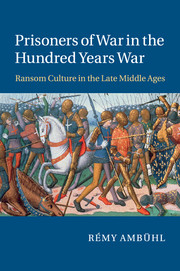
Prisoners of War in the Hundred Years War: Ransom Culture in the Late Middle Ages by Rémy Ambühl
Prisoners of War in the Hundred Years WarThe status of prisoners of war was firmly rooted in the practice of ransoming in the Middle Ages. By the opening stages of the Hundred Years War, ransoming had become widespread among the knightly community, and the crown had already begun to exercise tighter control over the practice of war. This led to tensions between public and private interests over ransoms and prisoners of war. Historians have long emphasised the significance of the French and English crowns' interference in the issue of prisoners of war, but this original and stimulating study questions whether they have been too influenced by the state-centred nature of most surviving sources. Based on extensive archival research, this book tests customs, laws and theory against the individual experiences of captors and prisoners during the Hundred Years War, to evoke their world in all its complexity.


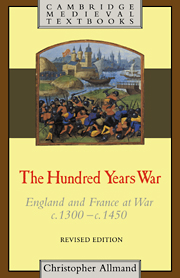
The Hundred Years War: England and France at War c.1300–c.1450 by Christopher Allmand
The Hundred Years WarThis is a comparative study of how the societies of late-medieval England and France reacted to the long period of conflict between them commonly known as the Hundred Years War. Beginning with an analysis of contemporary views regarding the war. Two chapters follow which describe the military aim of the protagonists, military and naval organisation, recruitment, and the raising of taxes. 

The remainder of the book describes and analyses some of the main social and economic effects of war upon society, the growth of a sense of national consciousness in time of conflict, and the social criticism which came from those who reacted to changes and development brought about by war. Although intended primarily as a textbook for students, Dr Allmand's study is much more than that. It makes an important general contribution to the history of war in medieval times, and opens up new and original perspectives on a familiar topic.


The Hundred Years War: The English in France, 1337-1453 by Desmond Seward
Front CoverFrom 1337 to 1453 England repeatedly invaded France on the pretext that her kings had a right to the French throne. Though it was a small, poor country, England for most of those "hundred years" won the battles, sacked the towns and castles, and dominated the war. The protagonists of the Hundred Years War are among the most colorful in European history: Edward III, the Black Prince; Henry V, who was later immortalized by Shakespeare; the splendid but inept John II, who died a prisoner in London; Charles V, who very nearly overcame England; and the enigmatic Charles VII, who at last drove the English out. Desmond Seward's critically-acclaimed account of the Hundred Years War brings to life all of the intrigue, beauty, and royal to-the-death-fighting of that legendary century-long conflict.


The Hundred Years War by Anne Curry
Front CoverAlthough the term 'Hundred Years War' was not coined until the 1860s, the Anglo-French conflicts of the later Middle Ages have long been of interest to historians. A fundamental question remains - was this a feudal war fought over ancient English rights in Gascony, or was it a dynastic war in which English kings battled for the crown of France itself?

This book, now fully revised and updated to take account of the latest scholarship, examines the origins and phases of the war and explores the trends in historical opinion from the fourteenth century to the present day. Anne Curry provides a straightforward narrative of English involvement in France, placing the well known military events in their diplomatic context. By focusing on the treaties of 1259, 1360 and 1420, Curry argues that there was not one 'hundred year war' but rather three separate yet linked conflicts, all with significant implications for the European scene as a whole, and for Anglo-French relations in the centuries to come.


The Age of the Hundred Years War by Clifford J. Rogers, Kelly DeVries, John France
Front CoverThis seventh volume of the Journal of Medieval Military History has a particular focus on western Europe in the late middle ages, and specifically the Hundred Years War; however, the breadth and diversity of approaches found in the modern study of medieval military history remains evident. Some essays focus on specific texts and documents, including Jean de Bueil's famous military treatise-cum-novel, Le Jouvencel; other studies in the volume deal with particular campaigns, from naval operations to chevauchées of the mid-fourteenth century. There are also examinations of English military leaders of the Hundred Years War, approaching them from prosopographical and biographical angles. The volume also includes a seminal piece, newly translated from the Dutch, by J.F. Verbruggen, in which he employs the financial records of Ghent and Bruges to illuminate the arms of urban militiamen at the end of the middle ages, and analyzes their significance for the art of war.


Seats of Power in Europe During the Hundred Years War: An Architectural Study from 1330 to 1480 by Anthony Emery
The Hundred Years' War between England and France is a story of an epic conflict between two nations whose destinies became inextricably entwined throughout the later Middle Ages. During that time the balance of architectural power moved from religious to secular domination, the Gothic form continued to grow and the palace-fortress was in the ascendancy. Seats of Power in Europe is a major new study of the residences of the crowned heads and the royal ducal families of the countries involved in the Hundred Years' War. Though they were the leading protagonists and therefore responsible for the course of the war, do their residences reflect an entirely defensive purpose, a social function, or the personality of their builders? As well as the castles of England and France it also looks at rulers residences in other European countries who supported one of the protagonists. They include Scotland, Castile, Aragon, Navarre, Portugal, the Low Countries, the imperial territories of Bohemia, and the papacy in Avignon and then Rome.

The study concentrates on sixty properties extending from the castles at Windsor and Denilworth to those at Saumur and Rambures, and from the palaces at Avignon and Seville to the manor-houses at Germolles and Launay. A number of subsidiary or associated properties are also considered in more broad-based sections. Each region and its residences are prefaced by supporting historical and architectural surveys to help position the properties against the contemporary military, financial, and aesthetic backgrounds.


Knights and Peasants: The Hundred Years War in the French Countryside by Nicholas Wright
This study of the soldier-peasant relationship in the context of the Hundred Years War (1337-1453) aims to bring out the realities of the situation. It seeks an understanding of different attitudes: how aristocratic soldiers reconciled the ideals of chivalry with exploitation of non-combatants, and how French peasants reacted to the soldiery, drawing on the late-medieval literature of chivalry and political commentary in England and (especially) in France. Employing additional documentary material, including the largely unpublished records of the French royal chancery, the book also describes the ways in which individual peasants and village communities were exploited by soldiers, and how, in order to survive, they adjusted to and reacted against their treatment.


Siege Warfare During the Hundred Years War by Peter Hoskins
Histories of the Hundred Years War have been written, and accounts of the famous battles, but until now no book has concentrated on the sieges that played a decisive role in the protracted struggle between England and France. Edward III's capture of Calais in 1347 was of crucial importance for the English, and the failure of the English siege of Orléans in 1429 was a turning point for the French after the disaster of Agincourt. Throughout the war, sieges were a major weapon in the strategic armories of both sides, and Peter Hoskins's perceptive and graphic study is a fascinating analysis of them.

He describes the difficulties faced by besieger and besieged, examines the logistics and resource implications of sieges, and provides a comparative assessment of siege warfare alongside set-piece battles and the English strategy of chevauchées. Key sieges are reconstructed in vivid detail, other sieges are summarized, and the book is fully illustrated with photographs and plans.