Showing posts with label anglo-saxons. Show all posts

Tuesday, November 3, 2020

Review: 1066 - A Guide to the Battles and the Campaigns by Livingston & DeVries

Synopsis: The Battle of Hastings, fought on 14 October 1066, changed the course of English history. This most famous moment of the Norman Conquest was recorded in graphic detail in the threads of the Bayeux Tapestry, providing a priceless glimpse into a brutal conflict.

In this fresh look at the battle and its surrounding campaigns, leading medieval military historians Michael Livingston and Kelly DeVries combine the imagery of the tapestry with the latest modern investigative research to reveal the story of Hastings as it has never been told and guide visitors around the battlefield today.

This absorbing new account of the battle will be fascinating reading for anyone keen to find out what really happened in 1066: the journeys by which Harold Godwinson and William of Normandy came to the battlefield, and the latest reconstructions of the course of the fighting on that momentous day. It is also a practical, easy-to-use guide for visitors to the sites associated with the conquest as well as the Hastings battlefield itself.


This is a well researched and easy to read entry into the period immediately before, during and after the Norman Invasion of England in 1066.

Written so that even someone with no knowledge of events can follow, Livingston and DeVries provide ample information without overwhelming the reader with a vast amount of research. What they do provide is an analysis of the events, battles and key players, whilst using separate text boxes for other key subject matters (ie: weapons, armies, tactics, etc). Each chapter includes or is finished with what the authors term as a "tour" of places and structures pivotal to the events.

The narrative is written simply yet informatively, utilising known chroniclers, the sagas, archaeological evidence, photos and maps to gently guide the reader. An extensive reading list concludes.

Definitely a book to be considered as a primer or introductory text for the Norman Invasion of 1066.


Tuesday, August 25, 2020

Slavery in Early Mediaeval England from the Reign of Alfred until the Twelfth Century by David A.E. Pelteret

This important study seeks to assemble the evidence, drawn from a variety of sources in Old English and Latin, to convey a picture of slaves and slavery in England, viewed against the background of English society as a whole.

Slaves were part of the fabric of English society throughout the Anglo-Saxon era and the twelfth century, but as the base of the social pyramid, they have left no known written records; there are, however, extensive references to them throughout the documents and writings of the period. 

This important study seeks to assemble the evidence, drawn from a variety of sources in Old English and Latin, to convey a picture of slaves and slavery in England, viewed against the background of English society as a whole. An extensive appendix on the vernacular terminology of slavery reveals the concepts of enslavement to be embedded in the religious imagery of the period.

Saturday, August 15, 2020

Review: English Collusion & the Norman Conquest by Arthur C Wright

English Collusion and the Norman Conquest
Synopsis: The reality of war, in any period, is its totality. Warfare affects everyone in a society. Here, for the first time, is a comprehensive analysis of eleventh century warfare as exposed in the record of the Norman Conquest of England. King William I experienced a lifetime of conflict on and off so many battlefields.

In English Collusion and the Norman Conquest, Arthur Wright's second book on the Norman Conquest, he argues that this monarch has received an undeserved reputation bestowed on him by clerics ignorant alike of warfare, politics, economics and of the secular world, men writing half a century after events reported to them by doubtful sources. How much of this popular legend was actually created by an avaricious Church?

Was he just a lucky, brutal soldier, or was he instead a gifted English King who could meld cultures and talents? This is a tale of blood, deceit, ambition and power politics which pieces together the self-interested distortion of events, brutalizing conflict and superb strategic acumen by using and analyzing contemporary evidence the like of which is not to be found elsewhere in Europe.

By 1072 King William should have been secure upon the English throne, so what went wrong? How did a Norman Duke and a few thousand mercenaries take and hold such a wealthy and populous Kingdom? Even in the 'Harrowing of the North', which probably saw the death of tens of thousands, who was really to blame and why did it happen? 


Definition of collusion: the secret or illegal cooperation or conspiracy in order to deceive others.


I chose this book for two reasons: one being that I have a huge interest in this period and as such I am more than familiar with the events (before, during and after), the main players and the various pro and anti sentiments; and secondly, I had read the author's previous work - Decoding the Bayeux Tapestry.

To say that I was a little baffled would be an under-statement. What I thought I would be getting was an in-depth study on the type of aid William received from the English Anglo-Saxons or anyone else in his efforts to mount and maintain what is known today as the Norman Conquest. 

What I feel I actually got was something quite different. This is essentially a work on the feudalism and nationhood and its varying interpretations and applications; a commentary on the character of William (including his military acumen); and  detailed account of the invasion and the economy.  It was - for me - also accompanied by a headache! 

As someone who has read extensively on this subject, and considers herself to have a rather developed vocabulary, I found myself confused as to the points being made and constantly reaching for the dictionary or google word search to understand what was actually being said. In the past, based on sentence structure alone, I could usually work out what an unfamiliar word or phrase meant. In addition, I felt the tone to be rather condescending; the commentary often rambling, confusing and glib, peppered with conjecture and speculation; and a prevalent disdain for any previous research conducted by past historians. 

The chapter "Overview" pretty much summed up the tome - but I was at a loss as to why it was marked as chapter 10 (at page 140) - this should have been at the front and could easily have replaced all the previous chapters.

Let me save you all the time and provide you with a summary:
.... the Normans are not super-heroes; English resistance to William was a fantasy; all rebellion boils down to money; no-one at this time swore an oath of loyalty to a King but only to his immediate lord; the was no such thing as feudalism or nationhood; and unity came down to taxation ...

What was very disappointing was that there was no real discussion as to the exact nature of this "collusion" by the local populace to the invasion, nor were there any real examples given in support. I mean, this is why I requested the title in the first place - I have enough background to want to narrow down and explore specific and diverse subject matters that tie in with the main theme.  I wanted to know who did the colluding, how they did it, what was their motivation for doing so, and what were the results and consequences, not only for themselves but for the country as a whole. 

Wright states that much of his conclusions are based upon his own research which is set apart from the "speculated history in the accepted history books". In fact, from what I can ascertain in the notes section, a great deal of the sources quoted are the author's own. I am all for looking at different angles and proposing contradictory opinions on subject matters, but it does need to not only be well-argued but well-sourced. Convince me, present me with a plausable alternative, plant a seed that will lead me off to explore and research further!

I am not sure who the target audience is for this particular book, but it is certainly not for those just dipping their toes into this specific period and set of events, or even someone with a modicum of knowledge.  In fact, I would be very interested in the opinions of others with regards to this work.


Wednesday, September 25, 2019

Edward the Elder and the Making of England by Harriet Harvey Wood

Edward the Elder and the Making of England by [Harvey Wood, Harriet]
Three men have been credited with being the first king of England – Alfred the Great, his son Edward the Elder and Edward’s son and Alfred’s grandson, Athelstan. It is an undoubted fact that, were it not for the work of Alfred, there might never have been the possibility of an English kingdom in the sense that we now understand it.


It is also true that Athelstan was the first explicitly to rule over an English kingdom in roughly its present shape and extent. What, then, was the contribution of Edward to the evolution of what his son was to inherit? As a child, he saw his father at the lowest point of his fortunes; as a boy, he grew up under the constant threat of further Danish invasion.

Edward came to adulthood in the knowledge that it was his responsibility to safeguard his country. By his death, he was undoubtedly the most powerful and respected ruler, not only in England but in western Europe, and he achieved this through both martial and legislative prowess. Edward built on his father’s work but he immeasurably expanded it, and the chroniclers who wrote in the centuries which immediately followed his death remembered him as ‘greatly excelling his father in extent of power’.

Edward the Elder succeeded Alfred as king of the Anglo-Saxons; he died as king of the English. And yet virtually nothing has been written about him. Until now.  While biographies of Alfred and studies of the achievements of Athelstan pour from the press, Edward is forgotten. Yet he was the first ruler to leave behind him the possibility of a united England, a country in which men thought of themselves as English, speaking a language which all would have described as English, which had never existed in quite this form before.

Anyone looking to fully understand and appreciate the making of medieval England must look to understand and appreciate Edward the Elder and his reign.

Saturday, September 21, 2019

Review: Angles or Angels? by David Stokes

Angles or Angels?: To unite a kingdom, a family will be divided forever by [Stokes, David]Synopsis: Regional kingdoms are engaged in a ruthless struggle for supremacy. To the south, Saxon kings predominate but, in the north, British leaders are combining in a final effort to overthrow their two Angle rivals in Deira and Bernicia. To survive, the Angle warlords must put aside their ancient rivalry. Acha, daughter of one king is chosen to act as ‘peace-weaver’ by marrying the rival leader. But when her intended husband kills her father and disinherits her young brother, she has to choose between her lover, her family and her duty to the wider kin. Against a backdrop of military campaigns that decide the shape of northern Britain, this story follows the personal tragedies that force siblings into rival camps. The outcome may be a united kingdom but families will be divided forever.


Move over Vikings, the Anglo-Saxons are coming!
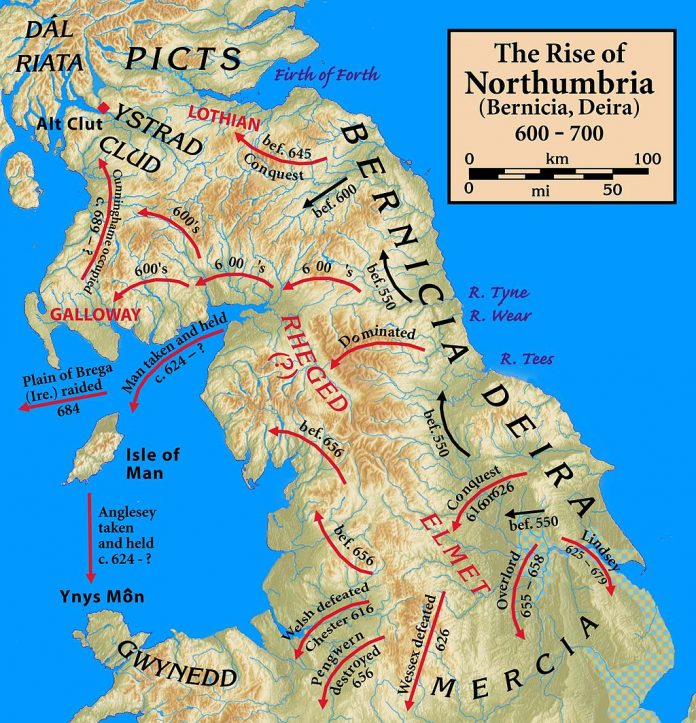
It is so nice to see another author tackling the so called Dark Ages - in this instance it is 7th Century Britain - Bernicia and Deria - which will unite to form Northumbria - but that is still a few years away yet.

A little background to kick things off: Ida was the first king of Bernicia; and it many have been Ida who initiated the conflict with Deira by expanding his kingdom toward the south. Aethelfrith, grandson of Ida, expanded his kingdom through military conquest and repopulating formerly British regions with citizens from Bernicia. In c.600 he defeated the Britons decisively at the Battle of Catraeth (a tragic defeat for the British forces commemorated in the 13th century CE Welsh poem Y Gododdin) and by 604 had control of Deira and united it with Bernicia.

When Aethelfrith united Bernicia and Deira, he disinherited the ruling house of Deira, notably Prince Edwin (r. 616-633 CE) the son of King Aelle of Deira (r. 560 CE). Aethelfrith encouraged unity of the two kingdoms by marrying Edwin’s sister Acha but Edwin posed a recognisable threat to Aethelfrith’s reign and wisely fled Northumbria. Aethelfrith did, in fact, want Edwin killed but the prince was given sanctuary in the kingdoms of East Anglia, of the Welsh, and Mercia.

Image result for map northumbria 7th centuryWhen Aethelfrith died, Edwin returned from exile and claimed the throne, ruling from Deira. He capitalized on the gains made by Aethelfrith and expanded the kingdom further, prompting responses from Mercia and Wessex.

But our story is still in its infancy - In the last years of Aelle of Deira, plans are made for his daughter Acha to marry Aethelfrith (aka the Destroyer) and bring peace between the two kingdoms in the face of the encroaching southern kingdoms. We are witness to Aethelfrith's rise and take over of Deira following the death of Aelle, and the reverberations of his actions - which, no doubt will be expanded upon in the ensuing tomes.

The extreme and varying fortunes of the main kingdoms in seventh-century England illustrate the instability and fragility of political authority during this period. There is a plethora of great characters and events from which a narrative can be created for the reading pleasure of those with an interest in this particular period of history.


further reading:
Edoardo Albert (Northumbrian Thrones):
Edwin, High King of Britain; Oswald: Return of the King; Oswui: King of Kings

Matthew Harffy (Bernicia Chronicles):
The Serpent Sword; The Cross and the Curse; Blood and Blade; Killer of Kings; Warrior of Woden; Storm of Steel; Fortress of Fury; Kin of Cain


Sunday, August 18, 2019

Amberley Publishing - Interest History Titles

Amberley Publishing have some history titles out that have caught my eye - thought I would share:


La Reine Blanche by Sarah Bryson
This is the story of Mary Tudor, told through her own words via primary sources, state papers and letters, for the first time.


The Anarchy: the Darkest Days of Medieval England by Teresa Cole
The Anarchy blends contemporary, sometimes eyewitness accounts with modern analysis to describe a period of England’s history so dark and lawless that those who lived through it declared that ‘Christ and his saints slept.'


Edward the Elder: King of the Anglo-Saxons by Michael John Key
Edward the Elder succeeded his father Alfred the Great to the kingdom of Wessex ... and deserved to be recognised for his contribution to Anglo-Saxon history and a new assessment of his reign is overdue. He proved equal to the task of cementing and extending the advances made by his father, and paved the way for the eventual unification of the Anglo-Saxon kingdoms and the nation-state of England. The course of English medieval history after his death was a direct outcome of military successes during his reign.


Plantagenet Queens & Consorts: Family, Duty & Power by Dr Steven J. Corvi
Examination of the lives and influence of ten figures, comparing their different approaches to the maintenance of political power in what is always described as a man’s world. On the contrary, there is strong evidence to suggest that these women had more political impact than those who came later – with the exception of Elizabeth I – right up to the present day. Beginning with Eleanor of Provence, loyal spouse of Henry III, the author follows the thread of queenship: Philippa of Hainault, Joan of Navarre, Katherine Valois, Elizabeth Woodville, and others, to Henry VII’s Elizabeth of York. 


The House of Grey: Friends & Foes of Kings by Melita Thomas
The Grey family was one of medieval England’s most important dynasties, serving the kings of England as sheriffs, barons and military leaders from the reign of William the Conqueror. Family came to prominence in the period known as the Wars of the Roses and under the Tudor Monarchs.


Lovell Our Dogge: The Life of Viscount Lovell by Michèle Schindler
Francis Lovell was not only an ally of Richard III but his closest friend, and one of the wealthiest barons in England. Author Michèle Schindler returns to primary sources to reveal the man who was not only a boyhood friend of the king-to-be as a ward of Edward IV, but also linked to him by marriage: his wife, Anne FitzHugh, was first cousin to Richard’s wife, Anne Neville.


Ranulf de Blondeville: The First English Hero Iain Soden
The study of a nobleman whose exploits became the stuff of medieval romance, once recounted in the same breath as Robin Hood. Ranulf de Blondeville was fabulously rich and powerful. He served six kings, endured difficult regime-change, fought his way across half of France and back and more than once turned wrested victory from defeat. He never forgot that his roots were Norman although his efforts were for England, where he made his home.


Lawson Lies Still in the Thames: The Extraordinary Life of Vice-Admiral John Lawson by Gill Blanchard
This biography charts the tumultuous life and times of an ordinary seaman born in Scarborough who would come to play a major role in the English Civil War, the Restoration, the Anglo-Dutch Wars and the start of the transformation of England into a global political and economic power in the seventeenth century.


Sunday, July 21, 2019

Law and Order in Anglo-Saxon England - Tom Lambert


Law and Order in Anglo-Saxon England explores English legal culture and practice across the Anglo-Saxon period, beginning with the essentially pre-Christian laws enshrined in writing by King AEthelberht of Kent in c. 600 and working forward to the Norman Conquest of 1066. It attempts to escape the traditional retrospective assumptions of legal history, focused on the late twelfth-century Common Law, and to establish a new interpretative framework for the subject, more sensitive to contemporary cultural assumptions and practical realities.

The focus of the volume is on the maintenance of order: what constituted good order; what forms of wrongdoing were threatening to it; what roles kings, lords, communities, and individuals were expected to play in maintaining it; and how that worked in practice. Its core argument is that the Anglo-Saxons had a coherent, stable, and enduring legal order that lacks modern analogies: it was neither state-like nor stateless, and needs to be understood on its own terms rather than as a variant or hybrid of these models. 

Tom Lambert elucidates a distinctively early medieval understanding of the tension between the interests of individuals and communities, and a vision of how that tension ought to be managed that, strikingly, treats strongly libertarian and communitarian features as complementary. Potentially violent, honour-focused feuding was an integral aspect of legitimate legal practice throughout the period, but so too was fearsome punishment for forms of wrongdoing judged socially threatening. 


Law and Order in Anglo-Saxon England charts the development of kings' involvement in law, in terms both of their authority to legislate and their ability to influence local practice, presenting a picture of increasingly ambitious and effective royal legal innovation that relied more on the cooperation of local communal assemblies than kings' sparse and patchy network of administrative officials.

Sunday, June 2, 2019

Review: Cuthbert of Farne by Katharine Tiernan

Northumbria - 7th Century: The Anglo-Saxon kingdom of Northumbria was originally two kingdoms: Bernicia in the north and Deira in the south. These two countries were often in conflict before their eventual semi-permanent unification in 654. While violent conflicts between Bernicia and Deira played a significant part in determining which line ultimately gained supremacy in Northumbria, marriage alliances also helped bind these two territories together. During his reign, King Oswiu presided over the Synod of Whitby, a religious meeting designed to reconcile religious differences between Roman (new) and Celtic (old) Catholicism, in which he eventually backed the Roman beliefs, thereby bringing Northumbria in line with Southern England and Western Europe. It must be remembered that this kingdom had only converted to christianity in 627 - a mere 37 years prior to Whitby!

43911047
Cuthbert grew up in or around Old Melrose Abbey, a daughter-house of Lindisfarne. He had decided to become a monk after seeing a vision on the night in 651 that St Aidan, the founder of Lindisfarne, died, but he seems to have seen some military service first. He was quickly made guest-master at the new monastery at Ripon, soon after 655, but had to return with Eata of Hexham to Melrose when Wilfrid was given the monastery instead. About 662 he was made prior at Melrose, went on a mission to Pictland (663), was appointed prior to Lindisfarne (665) before retiring to become a hermit (676). Following Wilfred's downfall in 684 he was made bishop of Lindisfarne, but by late 686 he resigned and again returned to his hermitage (on Inner Farne) as he felt he was about to die, although he was probably only in his early 50s (c.687). 


Tiernan's novel follows the story of Cuthbert fairly closely and is interspersed with stories of the Northumbrian royal family as well as Cuthbert's rival, Wilfred, and of the holy abbess and royal virgin Elfleda, the daughter of Oswiu of Northumbria, who succeeded St Hilda as abbess of Whitby (680). For those readers unfamiliar with Anglo-Saxon history, this may be a challenge - it was a period of intense political and religious turmoil. I myself found it a bit confusing as the author decided to change the names of the main historical characters, which I personally felt was unnecessary.

Overall, this is still a good introductory novel for those with a fledgling interest in Anglo-Saxon religion and politics, as well as one on one of the most important religious figure of northern England, whose life spanned the transitional period from paganism to Christianity and whose cult is still active today. For as Bede himself says: "but even when the servant of Christ was dead and buried, the miracles which he worked whilst alive did not cease."

Note: 
An early anonymous Life of Cuthbert was written about 700, but the discovery of Cuthbert's uncorrupted body gave a new impetus to the cult, and Bede used the earlier Life to write his own verse Life, around 716, and a longer, prose Life around 721. 

Katharine on Cuthbert
Beshara Magazine - The Red Sail
Beshara Magazine - St Cuthbert of Farne
Place of Repose: A Tale of St Cuthbert’s Last Journey 


Read more on Cuthbert
St. Cuthbert, His Cult and His Community to AD 1200 edited by Gerald Bonner, David W. Rollason, & Clare Stancliffe
St. Cuthbert: His Life and Cult in Medieval Durham by Dominic Marner
Two Lives of St. Cuthbert edited by Bertram Colgrave
Life and Miracles of St. Cuthbert by Venerable Bede


Saturday, April 13, 2019

John Broughton's Dark Age Novels

Saints & Sinners:

Saints and Sinners (Mixed Blessings Book 1) by [Broughton, John]Saxon times are not called the Dark Ages for nothing. It is a violent, unrecognisable world of kill or be killed …  In seventh century England, tribes and so-called kings vie for power and blood flows freely throughout the land.  Aethelred, ruler of Mercia, is being pressed from all sides – north, south, east and west. And his wife, Osthryth, daughter of a rival Northumbrian king, is murdered in unknown circumstances.  Osthryth’s ring falls into the hands of warrior noble Aethelbald who is accused of her murder and forced to leave Mercia by his conniving cousin Coeolred who has eyes on the throne. 


Mixed Blessings:
Mierce, the English Midlands, 8th Century A.D.   Æthelbald, King of Mierce, is a man of ambition. Having created much-needed stability within his domain, he now aspires to the taking of surrounding kingdoms to expand and fortify his own. With stealth and cunning, Æthelbald manipulates other men of power, like chess pieces, to achieve his goals.

As Æthelbald’s reign grows and strengthens, so too does the authority of the church, whose leverage over monarchical matters becomes increasingly overbearing. The church does not approve of King Æthelbald’s exploits with innocent women and seeks to bring him into line with the threat of eternal damnation.  This, the sequel to Saints and Sinners, chronicles the life of an English king in the days where the boundaries of kingdoms and social propriety were undergoing rapid change.


Perfecta Saxonia:
King Alfred never achieved his dream of uniting the disparate Anglo-Saxon kingdoms into one Perfecta Saxonia.  The man destined to fulfill Alfred's dream is his grandson, Athelstan, as the spark of unity begins in the Saxon kingdom of Wessex. Abandoned by his father and raised by his uncle, young Athelstan faces numerous adversities on his way to becoming a mighty warrior and diplomat.  But can he overcome the odds to transform England from an insignificant island off the Western European mainland, into the leading centre of tenth-century diplomacy and learning?


Wyrd of the Wolf:
In seventh century England, political and religious upheaval mean that nobody is safe.   As the old gods are eroded by the new church, and tribes and ambitious men vie for power, property and precedence, blood is shed throughout the land.  In the south, ealdorman Aelfhere believes that for his only child, sixteen-year-old daughter Cynethryth, marriage to a Saxon king is the way to security. And so, somewhat against her own wishes, Cynethryth is betrothed. Yet as battle rages around her, and with her betrothed away to fight, Cynethryth too becomes a victim of war. 


In the Name of the Mother:
It is 689 AD, and Cynethryth is returning from Rome, carrying her dead husband's child.  She soon gives birth to a son, Aethelheard, whose parentage alone places him in danger. His mother has a tough choice to make and travels to Dorset, where the king is a cousin of her late husband.  After the king adopts the boy, he grows up in the dangerous company of rebellious princes, all who wish to overthrow the mighty Ine, king of Wessex.


The Purple Thread:
It is 733 AD in Anglo-Saxon Britain – a time and a world of warriors, wars and religious extremes.  Begiloc, a young freedman from Wimborne with a wife and son, is most definitely a man of action. But his world is turned upside down when the young Briton and best friend Meryn are ordered away to protect English missionaries in Germany.  For a man accustomed to brutality, Begiloc has a soft spot for the purple-tinged mountains, waterfalls, lakes, animals, trees and flowers – beginning to muse whether they, rather than Man, do not better embody the essence of God.  However, mission follows mission across the continent and Begiloc is driven ever further from his loved ones at home.


Die for a Dove:
Invasion, 674 AD and Werburgh, great-niece of the Abbess of Ely travels by night to bury and save the abbey treasure under a wayside cross in the kingdom of Lindsey.  Werburgh has crafted a magnificent gold and garnet jewel in the form of a dove. A cryptic inscription on the back indicates the location of the treasure. The dove becomes a family heirloom and only resurfaces in the English Civil War.  The reappearance of a cryptic clue to the whereabouts of the forgotten dove leads to a hunt across two continents and a trail of deaths.

Ulf's Tale by [Broughton, John]Ulf's Tale:
A Swedish nobleman. A kidnapped child. The choice between power and morality.  At the start of the slaughter-marred eleventh-century, nine-year-old Ulf is taken hostage by King Aethelred.  It’s the beginning of a life of luxury and opportunity for Ulf. But treachery and plotting throughout the country threaten uneasy alliances, while ambitious rivals attempt to seize power for themselves.  His own life threatened, Ulf embarks on a quest for unity to bring peace to the Baltic states. Will his own moral convictions be enough to overcome divided loyalties, religious clashes and ambitious kings?


Sunday, January 20, 2019

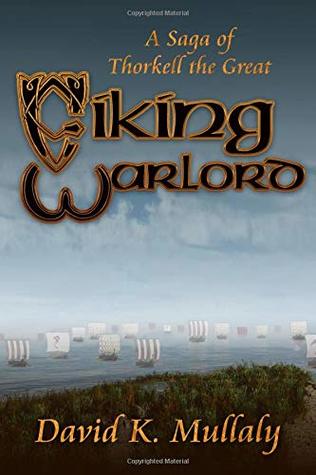
Review: Viking Warlord - A Saga of Thorkell the Great by David Mullaly

Some stories are meant to be both savoured and devoured - this is one of them.

42142226The late Anglo-Saxon period of English history which saw the rise of the - for want of a better word - Danish invasions, was a period I was fascinated in, with my own library containing a number of tomes on the subject matter.     Like David, I too was fascinated by Thorkell the Tall (the Great, the High), being inclined as I am to the more obscure historical characters, and those with a less than pristine reputation - the supporting cast.  To put him in context, he is the Danish William Marshall.  Indeed, this is another example of where the facts are far more interesting.

The tale takes place in both the 10th and 11th centuries, when England was under the rule of Aethelred II (also known as the Unready) and paying what is known as the Danegeld to keep the maruading Danish host, first under Harold Bluetooth and then his son Sweyn Forkbeard, at bay.  From Skane (part of the then Danish empire), came Thorkell, who proved himself as a warrior in such a way that he became one of the leaders of the Danes on their raids.

The Anglo-Saxon Chronicle (hereafter ASC) records the arrival at Sandwich 1st  August 1009 of an "immense hostile host", one manuscript specifying "to which we gave the name of Thurkil´s host", which invaded Kent, the Isle of Wight, Sussex, Hampshire and Berkshire, before returning to Kent to take up "winter-quarters on the Thames" and the following year invading East Anglia and other parts of England, culminating in the kidnap and murder of Ælfheah Archbishop of Canterbury.

Florence of Worcester records that "Danicus comes Turkillus" invaded England with a fleet, dated to 1009 from the context, and that other fleets led by "duces Hemingus et Eglafus" landed in August at "Tenedland" [Thanet] after which the invaders joined forces to devastate Kent, the Isle of Wight, Sussex and Southampton, and establish themselves in the Thames valley for the winter.

William of Malmesbury says that "Turkill the Dane, who had been the chief cause of the archbishop´s murder, had settled in England and held the East Angles under subjection" and that he "sent messengers to Suane [Sweyn Forkbeard] king of Denmark inviting him to come to England".

As the contemporary chronicles record, Thorkell spent three years successfully raiding with his brother Hemming, until they were eventually "bought off" for the considerable amount of £48,000 (1012). In the end, this army were hired as mercenaries by Aethelred II to protect him from an impending invasion. Joining him in the defence of London was another character - Olaf Haraldsson (later St Olaf of Norway). Many of these larger than life characters that wander across the pages were in fact real.
Related image
The Anglo-Saxon Chronicle records the invasion of England led by Sweyn King of Denmark in 1013, stating that the invaders "went east to London" where "the citizens would not submit…because King Æthelred was inside and Thurkil with him".

When Sweyn invades, Aethelred is forced to flee to Normandy; but Sweyn's victory is shortlived as he dies "... a death with no honour ..." Following this period we see Thorkell rejoin the retinue of Cnut. How and why this occurred is open to speculation but having been Cnut's foster father and also a valuable warrior, Cnut may have been content (for the moment) to welcome Thorkell back into the fold.  How and why aside, Thorkell defected back to join Cnut's invasion fleet in August 1015 and fought with the Danes at Ashington [Assandun] in October 1016.

William of Malmesbury records that Cnut King of England divided the kingdom into four parts "he himself took the West Saxons, Edric [Streona] the Mercians, Turkill the East Angles, Iric [Erik Haakonsson] the Northumbrians". Simeon of Durham records that King Cnut granted East Anglia to "earl Turkill" in 1017 whilst the ASC (1017) records that when dividing the kingdom, "East Anglia for Thurkyll".

It is only after Cnut takes power that his true character is revealled - his cruelty grows - "... gaining a kingdom can change a man .  And he wasn't finished ..." - it was not just with the family of his predecessor that Cnut turned his attentions but to his own supporters " ...for it is dangerous for a leader to owe someone more than he can give ...." (we now know where Henry VIII took his playbook from). As the body count rises, Thorkell's comrade Eric Haakonsson is reflective " .... conflicting loyalties can bleed us dry ...".

It is probable that the king appointed Thorkell regent of England in 1019, during his absence in Denmark, he was afterall, the most prominent of Cnut's magnates and his name featured prominently on charters of the period; however, there was an obvious falling out as William of Malmesbury wries that "in process of time…Turkill and Iric were driven out of the kingdom and sought their native land" - the ASC (1021) "This year, King Knute, at Martinmas, outlawed Earl Thurkyll.." Florence of Worcester records that King Canute expelled "Turkillum…comitem cum uxore sua Edgitha" from England 11th November, dated to 1021.  

All we really know is that Eadric was executed within a year of Cnut's accession (According to the Encomium Emmae, Cnut ordered Eric to "pay this man what we owe him" and he chopped off his head with his axe); Thorkell was outlawed and returns to Skane (c.1021), and that Erik fades from the pages, presumed dead, though his lands don't pass to his successor till 1033. According to the Norse sources Erik died of a hemorrhage after having a medieval medicine either just before or just after a pilgrimage to Rome (no sources mention exile). Could it be a purging of the old guard, could Cnut have perceived Thorkell as a real threat - a rival - for power in England, and as such removed him.

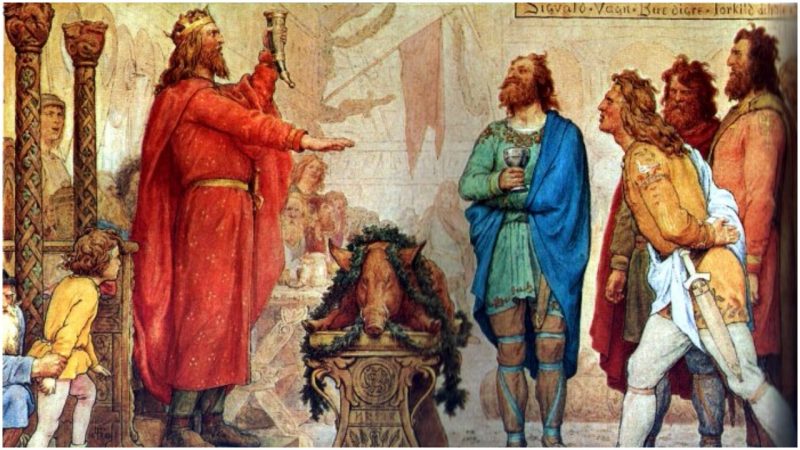
Related imageThe ASC  adds in a later passage that the Thorkell and Cnut entered a pact of reconciliation (1023) under which Thorkell would govern Denmark, keeping each other's sons as hostages: ".. He committed Denmark and his son to the care of Thurkyll ...".  Thorkell remained regent for about three years, being replaced by Ulf, Knud's brother-in-law.  So what happens next after c. 1025 / 1026 - we can only presume he returned to Skane; however there is this interesting passage in the ASC for the year 1039:  "... The Welsh slew Edwin, brother of Leofric, and Thurkil and Elfget, and many good men with them..." - if this were the case, Thorkell would have been in his 60s - if this is our Thorkell at all ..... and the question remains, what was he doing in the Mercian army attacking Rhyd y Groes (near Welshpool).


What David has done is gathered together a plethora of resources from which to craft a compelling and invigorating story of Thorkell in the skaldic tradition. In Scandinavia a skald was " ... a composer and reciter of poems honouring heroes and their deeds .." Their oft-times lengthy verses commemorated kings and others, and celebrated their many deeds of daring-do; and over time, their position at court become more prominent as they became the oral recorders of their own history.

And so Thorkell's story unravels in front of a renown skald, Eyolf (composor the Bandadrápa - the deeds of Eiríkr Hákonarson), whom he has summoned to appear before him so that he might recount his story and have it re-told far and wide - for Thorkell is now an aged warrior, battle-hardened, who has witnessed (and done) much. He now fears that if his story is not told, he will be forgotten by all but his own kin.

As the chapters progress, Thorkell's story is spun and teased out before a captive audience - his family, neighbours, and we the reader. As always, each night's telling is left with the proverbial cliff-hanger, a dispersal of wisdom, or running commentary (a bit akin to today's modern television serials). David neatly wraps up Thorkell's story so that we are given a possible outcome to his final years.

What I found most refreshing was that unlike some historical novels, this one was not loaded up with local vernacular and colloquisms and period dialect used by numerous authors of historical fiction to add authenticity, but which so often encumbers and destroys a story unnecessarily. I get that characters come from different areas, but I want to spend my time enjoying a novel not trying work out what they are saying. Thankfully not an issue here - the structure flowed seamlessly.

As Thorkell himself says: " ... most of our lives are what happens between one fight and the next ..."


I am looking forward to reading Eadric and the Wolves - the story of Eadric of Mercia, who features in Thorkell's story.
Seen as a villain by many during his lifetime and after, he is surrounded by people who casually employ treachery, and institutions that consistently act in bad faith. In this thoroughly researched novel, David Mullaly tells a story that challenges the traditional narrative about Eadric.  Appearances can be profoundly deceiving. Loyalty in the defense of evil is no virtue, and what may look like betrayal could be the only good option for a brave leader.


Notes:
There was no standardised spelling of names and places names; scribes tended to write phonetically, and hence there names recorded in the various chronicles of the times can look completely different (ie: Knud Kvud, Cnut, Canute).

There was more than one copy of the Anglo Saxon Chronicle - and once copied and dispersed, each was independently updated (hence some inconsistencies with dates / names / events).

Further reading:
The Saga of the Jomsvikings trans Lee M. Hollander
An Onslaught of Spears: The Danish Conquest of England by Jeffrey James
The Saga of the Jomsvikings trans NF Blake

Saturday, October 27, 2018

The Anglo-Saxon Fenland by Dr Susan Oosthuizen


The Anglo-Saxon Fenland, the latest book by Dr Susan Oosthuizen, Reader in Medieval Archaeology at ICE, has just been published. It unexpectedly reveals a traditional landscape managed by relatively prosperous communities who lived in stable societies into which newcomers from north-west Europe were absorbed. The 'dark' ages have finally stumbled into the light.

The Anglo-Saxon Fenland
Synopsis from Oxbow Books:
Archaeologies and histories of the fens of eastern England, continue to suggest, explicitly or by implication, that the early medieval fenland was dominated by the activities of north-west European colonists in a largely empty landscape. Using existing and new evidence and arguments, this new interdisciplinary history of the Anglo-Saxon fenland offers another interpretation. The fen islands and the silt fens show a degree of occupation unexpected a few decades ago. Dense Romano-British settlement appears to have been followed by consistent early medieval occupation on every island in the peat fens and across the silt fens, despite the impact of climatic change. The inhabitants of the region were organised within territorial groups in a complicated, almost certainly dynamic, hierarchy of subordinate and dominant polities, principalities and kingdoms. Their prosperous livelihoods were based on careful collective control, exploitation and management of the vast natural water-meadows on which their herds of cattle grazed. This was a society whose origins could be found in prehistoric Britain, and which had evolved through the period of Roman control and into the post-imperial decades and centuries that followed. The rich and complex history of the development of the region shows, it is argued, a traditional social order evolving, adapting and innovating in response to changing times.

Sunday, September 16, 2018

Æthelflæd by Tim Clarkson

From Birlinn Ltd.:

At the end of the ninth century AD, a large part of what is now England was controlled by the Vikings – heathen warriors from Scandinavia who had been attacking the British Isles for more than a hundred years. Alfred the Great, king of Wessex, was determined to regain the conquered lands but his death in 899 meant that the task passed to his son Edward. In the early 900s, Edward led a great fightback against the Viking armies. He was assisted by the English rulers of Mercia: Lord Æthelred and his wife Æthelflæd (Edward’s sister).

After her husband’s death, Æthelflæd ruled Mercia on her own, leading the army to war and working with her brother to achieve their father’s aims. Known to history as the Lady of the Mercians, she earned a reputation as a competent general and was feared by her enemies. She helped to save England from the Vikings and is one of the most famous women of the Dark Ages. This book, published 1100 years after her death, tells her remarkable story.


About The Author
Tim Clarkson is an independent researcher and historian who previously worked in academic librarianship. He gained an MPhil in archaeology and a PhD in medieval history, both from the University of Manchester. His other books include The Men of the North, The Makers of Scotland and Strathclyde and the Anglo-Saxons in the Viking Age.


Note:
I have a few of Tim's books, so maybe I am slightly biased.  I do enjoy the topics on which he writes - so make sure you visit his website Senchus - and see what else takes his interest.

Saturday, August 18, 2018

Review: The Vikings - From Odin to Christ by Martyn and Hannah Whittock

Synopsis: The popular image of the Vikings is of tall red-headed men, raping and pillaging their way around the coast of Europe, stopping only to ransack monasteries and burn longships. But the violent Vikings of the 8th century became the pious Christians of the 11th century, who gave gold crosses to Christian churches and in whose areas of rule pagan idols were destroyed and churches were built.

So how did this radical transformation happen, and why? What difference did it make to the Vikings, and to those around them, and what is their legacy today? This book takes a "global" look at this key period in Viking history, exploring all the major areas of Viking settlement. Written to be an accessible and engaging overview for the general reader.


For me, this was a highly informative journey into the transformation of the "pagan" Viking into the acceptable "christian" that is well annotated and referenced, and makes use of the voices of the Vikings themselves, through their sagas, to provide context. The authors explore the conversion of the Viking peoples and how and why this religious transformation took place.  What is interesting is the differing views on what constituted conversion, where the roots of conversion eminated from, and the how each conversion event was unique. 

The authors make clever use of their chapters to sort out and compartmentalise the history of the conversion of each group or nation, making it more accessible to the reader.  We take a look at who were the Vikings of the pre-christian world, and compare that with our modern perception of them. We look at how different forms of Christianity were the driving forces behind the conversions - German, Irish, British and Greek missionaries each had their sphere of influence and success.

First up is the raids on Anglo Saxon England, Ireland, Frisia and the Frankish Empire.  Were these raids a serious threat to the already established Christian religions - for following these attacks was a serious collapse in pastoral care throughout into which the pagan religions filled the vacuum.

To the subject at hand - we now get down to the chapters that are the most interesting, and I will give a brief summary of each, starting with Chapter 4 -"The Cross and the Hammer" - the Vikings in northern England, the dominance of pagan rule, and of co-existance and assimilation.

Chapter 5 find us in 8th Century Ireland, with the inability of local leaders to unite and form a cohesive front against the Viking attacks and the establishment of permanent bases - at least not until the Battle of Clontarf.  The foundation of Normandy is covered in Chapter 6, with the transition of conversion taking a mere century, and the development of Church reform under these newly christianised leaders gained prominance.

Now we get to the main Viking nations: Chapter 7 covers the conversion process in 10th Century Denmark under the leadership of of Harold Bluetooth, despite earlier missions two centuries prior; and also clarifies some of the misnomers of the reign of both Svein Forkbeard and Cnut.  Chapter 8 takes us to Norway, whose missionary kings - the Olafs - lead the fight against pagan resistance.  The use of burials as an indicator of the level of the reaches of conversion, and the connection between conversion and the expansion of royal power is also discussed. 

Sweden and the arrival of the German missionaries in the 9th Century is covered in Chapter 9.  This conversion took much longer as this area was not so politically unified as its neighbours.  Unity and royal power increased at the same rate as the conversion, and was more or less complete with the incorporation of Finland by 13th Century.

Chapter 10 deals with the spread of the Vikings in the east, namely through the Byzantine Empire, the Baltic, the establishment of the kingdom of Rus, the reach of trade as far as Baghdad, and of course, the hero Harald Hardrada.  The colonisation and conversion of the North Atlantic Viking outposts of Iceland, Greenland, and the Faroe Islands in Chapter 11 quite naturally leads into the the voyages of the Greenlanders to Vinland in the 11th Century, and the first American Christians.

Back we head to Anglo Saxon England, and the reign of the first Viking Kings, Svein of Denmark and his son Cnut the Great, under who, as a loyal son the the Chruch, actively suppressed paganism.  The obliteration of Pictish culture under the Vikings in the islands to the north and the west (Hebrides, Orkneys, Shetland, et el), and the missions from Germany and Ireland, forms one of our final chapters.  It is assimilation, expansion, trade, spread of ideas, and the unity of political power in the mid 12th century that finally ended the "Viking Age".

This is truly a remarkable journey of the Christianisation of the Scandinavian world that really kicked off in the late 9th century and lasted for a period of three hundred years.

Sunday, June 11, 2017

The Warrior Queen: The Life and Legend of Aethelflaed

In her book The Warrior Queen: The Life and Legend of Aethelflaed, Daughter of Alfred the Great, Joanna Arman delves into the life of this enigmatic Anglo-Saxon woman, who was recognised by contemporaries as a diplomat, military leader and ruler - things to which women of her times were not credited. And yet by all accounts, fact reads much better than fiction. I am looking forward to reading this when finally released.

Book Blurb:
Æthelflæd, eldest daughter of Alfred "the Great," has gone down in history as an enigmatic and almost legendary figure. To the popular imagination, she is the archetypal warrior queen, a Medieval Boudicca, while in fiction she has also been cast as the mistreated wife who seeks a Viking lover, and struggles to be accepted as a female ruler in a patriarchal society. The sources from her own time, and later, reveal a more complex and fascinating image of the "Lady of the Mercians." A skilled diplomat who forged alliances with neighboring territories, she was a shrewd and ruthless leader willing to resort to deception and force to maintain her power. Yet she was also a patron of learning, who used poetic tradition and written history to shape her reputation as a Christian maiden engaged in an epic struggle against the heathen foe.

Read more here:
@ Female First - 10 things you didn't know about Aethelflaed by Joanna Arman
@ Medieval Archives - review of The Warrior Queen 
@ Litera Scripta - Aethelflaed, Lady of the Mercians by Kaylin Oldham

Wednesday, February 22, 2017

Viking Society Publications

The Viking Society for Northern Research is making virtually all its publications (and some other related items) from inception in 1893 to the present freely available on this website, though recent titles may not be released until three years from the date of publication.

These digital versions are not intended to replace our printed publications, and titles currently in print will remain available to buy in book form as long as there is a demand for them (the list can be seen at www.vsnr.org/publications/ ). The digital versions are intended to make the range of our publications known to a wider public, and may be used for reference purposes, to evaluate books for purchase or for university courses and for private study. The copyright belongs either to the authors or to the Viking Society, as stated at the beginning of each work, and permission must be obtained from the Society to use downloaded versions either in whole or in part for any other purpose.

See full list here @ Viking Society Publications

Sunday, October 23, 2016

Bernicia Chronicles: The Northern Queen


This month in the "What I Learnt..." series, Matthew Harffy talks to author Kelly Evans about her new novel "The Northern Queen" and researching for her novels.

Born in Canada of Scottish extraction, Kelly graduated in History and English from McMaster University in Ontario, Canada. After graduating Kelly moved to the UK where she continued her studies in history, focusing on Medieval England and the Icelandic Sagas (with a smattering of Old Norse and Old English). Her first novel, The Northern Queen, was released in 2015 and she is currently working on the second book in her Anglo-Saxon series, set in the years prior to the Norman invasion.


Read rest of the blog article here at Matthew Harffy's Bernicia Chronicles

Saturday, January 4, 2014

Review - The Ruin


"A gritty tale of Dark Age Britain, where heroes are few and the lives of thousands hinge upon the whims of greedy and unscrupulous men. In fifth century Britannia .... Eiteol, a cloddish nobleman, manages to save the dictator Vertigern from an assassination attempt and the pair must flee for their lives …...."

The story is that of the early invasions of Britain by the Saxons, Angles & Jutes, during the 5th century. It is a time of chaos and ever-wavering loyalties and the leaders fight each other and themselves for power and control - and prominent is the backdrop of the story of the Night of the Long Knives

Here are names that may be tantalizingly familiar to those whose forte is the early Anglo-Saxon history of Britain: Horsa, Hengist, Vortigern (here called Vertigern), one Eldol (called Eiteol), Gildas (Glivis), and Arthur (called Ambris, and finally Flavius Ambrosius Aurelinus). Many other of the “founding” Saxons, Angles & Jutes are here in some form as are the missionary figures who feature in the early christianisation of Britain (including St Germanus).

It is a fast paced story – though those unfamiliar with this period may find the going a little hard (ie: keeping track of the main characters) but there is enough action to keep the reader entertained.

This story is a glimpse into the past, although I wonder whether the author considers that there is more to tell …. 


For more about Vortigern visit: Vortigern Studies
For more on the author visit: John Sawney

Tuesday, August 13, 2013

August Additions

Yes, as the July additions are slowly making their way to the Library, August's list has just been sent off - here they are:

Anglo-Saxon England by F.M. Stenton
Covers the emergence of the earliest English kingdoms to the establishment of the Anglo-Norman monarchy in 1087. Professor Stenton examines the development of English society, from the growth of royal power to the establishment of feudalism after the Norman Conquest.

Fourteen Byzantine Rulers by Michael Psellus
Chronicles the Byzantine Empire, beginning in 1025. This title shows an understanding of the power politics that characterized the empire and led to its decline.

The Other Tudors by Philippa Jones
Everybody thinks they know the tale of King Henry VIII's wives: divorced, beheaded died; divorced, beheaded, survived. But behind this familiar story, lies a far more complex truth. This book brings together the 'other women' of King Henry VIII. It examines the tales of the women who Henry loved but never married.

Richard III the Young King To Be by Josephine Wilkinson
This new biography concentrates on the much neglected early part of Richard's life - from his birth in 1452 as a cadet of the House of York to his marriage to the beautiful Anne Neville - and shows how his experiences as the son of an ambitious duke, a prisoner of war, an exile, his knightly training and awe of his elder brother, King Edward IV, shaped the character of England's most controversial monarch. 

The Rulers of the South - Sicily, Calabria, Malta - Vol II by Francis Marion Crawford
This early works is a comprehensive and informative look at the subject and is extensively illustrated throughout. Contents include; The Goths and the Byzantines, The Saracens, The Normans, In Later Times, and, The Mafia..... 

Joan of Arc by Kelly DeVries
Why did the soldiers of France follow a woman into battle when no troops of the Hundred Years War had done so before, and how was she able to win? This book is essential reading for anyone interested in the Middle Ages and the phenomenon of the girl warrior.

The Maid and the Queen by Nancy Goldstone
How did an illiterate seventeen-year-old peasant girl manage to become one of histories most salient females? It is almost 600 years since Joan of Arc heard the voices of angels that would change her life forever: in a breathtaking story her quest saved France from English domination and restored France's hereditary monarchy. 

The Kings & Queens of Wales by Timothy Venning
A considered attempt to set out what we can know about the rulers of what is now Wales in the early medieval period, Timothy Venning's new book does not shy away from problems of dating and interpretation in the use of the meagre source material.

The Kings & Queens of Anglo-Saxon England by Timothy Venning
In The Kings & Queens of Anglo-Saxon England, Venning examines the rulers of Anglo-Saxon England, beginning with the legendary leaders of the Anglo-Saxon invasion as Hengest and Horsa or Cerdic and Cynric and moving on through such figures as Aethelbert of Kent, the first king to be converted to Christianity and his daughter Aethelburh, whose marriage began the conversion of Northumbria, to Alfred of Wessex and his dynasty, the Viking invasions, and the last of the Anglo-Saxon kings, Harold Godwineson.