Showing posts with label normans. Show all posts

Sunday, April 17, 2022

Review: The Normans by Judith Green

Synopsis: A bold new history of the rise and expansion of the Norman Dynasty across Europe from Byzantium to England.

In the eleventh century the climate was improving, population was growing, and people were on the move. The Norman dynasty ranged across Europe, led by men who achieved lasting fame like William the Conqueror and Robert Guiscard. These figures cultivated an image of unstoppable Norman success and their victories make for a great story, but how much of it is true?

In this insightful history, Judith Green challenges old certainties and explores the reality of Norman life across the continent. There were many soldiers of fortune, but their successes were down to timing, good luck, and ruthless leadership. Green shows the Normans’ profound impact, from drastic change in England to laying the foundations for unification in Sicily, to their contribution to the First Crusade. Going beyond the familiar, she looks at personal dynastic relationships and the important part women played in what at first sight seems a resolutely masculine world.


I will preface this review by saying - reader beware.! This is not a casual and cursory look at the Normans that will appeal to the general masses; it is a more focused narrative that assumes that you - the reader - have done your due diligence and a sufficient enough grasp of the topic at hand to absorb the information contained therein.

The focus of Green's book is the Normans and their activities as related to a specific time period - the 11th Century - and is narrowed down to particular theatres of war - England, Normandy, Byzantium, Sicily & Southern Italy, Antioch & the Holy Land. It is also a look at how contemporary writers and chroniclers viewed them as well as their own perceptions of self.

Green begins with a look at the various contemporary writers and chroniclers in England (Malmesbury, Worcester, Huntingdon, Monmouth), Normandy (Dudo William of Jumieges, Vitalis, Wace), Southern Italy & Sicily (Malatera, William of Apulia, Amatus of Montecassin), and of course the Crusades (Ralph of Caen). This list is by no means complete as there are a number of others included as well. In this chapter Green also explores the relationships between subject matter and author, the issues of patronage, potential audience and the accessibility of sources.

We next move to Normandy for a look at the structure of Norman society, its emergence, the outward persona of warrior class, and the internal struggles within for dominance. This leads into the next chapter "swords for hire" and a look at the role of Normans as mercenaries throughout Europe and the Baltic. Here Green notes that 11th Century Europe was swarming with armed men who for for wealth, land and prestige. So what made this particular group that much more successful than others - this is what is explored. Green includes a number of prominent families in her narrative, as well as some much lesser ones (which are the ones I am always on the look out for).

Moving south, we explore the activities and personalities of the Normans in Southern Italy and Sicily from their earliest arrival as armed pilgrims to the arrival of Robert Guiscard and the legitimisation of the new kingdom and its conquests. A brief side visit to Byzantium is also covered off for this will have an impact of future relationships.  This is one of my favourite periods of Norman History (and dominates my personal library).

Doubling back, Green takes us to one of the more well know of the Norman conquests - England in 1066. This was no gentle take-over but one that would see years of resistance and rebellion, and the invasions of neighbouring nations of Scotland, Wales and Ireland. This period would also see the creation of the Domesday Book - a survey every shire in England, and some parts of Wales, to list all holdings and calculate the dues owed to William.

And then to our final field of activity - The Crusades and the establishment of the Norman Principality of Antioch. Green provides an assessment of the various Norman leaders (Bohemond, Tancred, Robert of Normandy), their motives for embarking on this great military and religious endeavour, their successes and their failures.


The remaining chapters encompasses a more rounded view of the Normans, covering such topics as government and power, settlement and conquest, church and state, culture and construction. And it is this lasting legacy that Green concludes with, wherein she notes that they were - in essence - "... ruthless opportunists [who] were able to change the political history of Europe ...". But this is merely one one part of who the Normans were - for they were also exceptional strategists, inventive, progressive, militaristic, pious, opportunistic, ruthless - and utterly compelling and unforgettable.

This is definitely one for my own library shelves, and my own personal collection of Norman literature.

Monday, November 29, 2021

Review: The Challenges of King by KM Ashman

Synopsis: The fight for England began long before 1066…

AD 1045. Godwin of Wessex, one of the most powerful earls in the country, prepares for the marriage of his daughter to King Edward of England. The mood is jubilant, his family’s relationship with the Crown secured through matrimony. But one man seeks to undermine him at every opportunity.

French-born Bishop of London, Robert of Jumièges, has the ear of the king. As a trusted adviser, his position is one of power and privilege, and he wields it to gain ever-greater influence over the English Crown for his kinsmen in Normandy, at Godwin’s expense.

As the bishop’s control increases, the king’s relationship with the House of Godwin frays until, eventually, it breaks down completely. With civil war looming, Godwin fights to pull England back from the brink. But with the king under Norman influence, it could be too little, too late.

The Challenges of a King is the first book in a thrilling new series from K. M. Ashman exploring the politics, promises and intrigue that led three men to contest the throne in 1066, and to the final successful invasion of England. Perfect for fans of Conn Iggulden and Bernard Cornwell.


"Challenges of a King", the first in a forthcoming series is set in England during the 1040s and 1050s when Edward the Confessor was King,  details the rise and fall of the family of Godwin, Earl of Wessex.

The House of Godwin came into prominence under King Canute, when they emerged from obscurity to remain in the limelight and as part of the political machinery of Anglo-Saxon England until the reign of Edward the Confessor. The two eldest sons of Godwin, Sweyn and Harold, were also elevated to earldoms.


The narrative alternates between Edward and the Godwins, and gives us a sense that Edward was in control of his own destiny and of the political machinations that would ultimately lead up to the events at Hastings as we know them. One cannot but side with the Godwins against Edward's Norman advisers, who were attempting to divert the succession away from the Anglo-Saxon dynasts.

Whilst the action is predominantly confined to the halls of power, we get a true sense of the impending drama that is about to unfold. Looking forward to the next in the series.


Friday, September 10, 2021

Review: Crown & Sceptre by Tracy Borman

Synopsis: The author of The Private Lives of the Tudors illuminates the almost thousand-year history of the British monarchy.

Since William the Conqueror, duke of Normandy, crossed the English Channel in 1066 to defeat King Harold II and unite England's various kingdoms, forty-one kings and queens have sat on Britain's throne. "Shining examples of royal power and majesty alongside a rogue's gallery of weak, lazy, or evil monarchs," as Tracy Borman describes them in her sparkling chronicle, Crown & Sceptre. Ironically, during very few of these 955 years has the throne's occupant been unambiguously English--whether Norman French, the Welsh-born Tudors, the Scottish Stuarts, and the Hanoverians and their German successors to the present day.

Acknowledging the intrinsic fascination with British royalty, Borman lifts the veil to reveal the remarkable characters and personalities who have ruled and, since the Restoration of the monarchy in 1660, more ceremonially reigned. It is a crucial distinction explaining the staying power of the monarchy as the royal family has evolved and adapted to the needs and opinions of its people, avoiding the storms of rebellion that brought many of Europe's royals to an abrupt end. Richard II; Henry VIII; Elizabeth I; George III; Victoria; Elizabeth II: their names evoke eras and the dramatic events Borman recounts. She is equally attuned to the fabric of monarchy: royal palaces; the way monarchs have been portrayed in art, on coins, in the media; the ceremony and pageantry surrounding the crown.

Elizabeth II is already one of the longest reigning monarchs in history. Crown & Sceptre is a fitting tribute to her remarkable longevity and that of the magnificent institution she represents.


Again, I am very wary when it comes to books with the title "new" in them as I invariably find nothing new. And again there was really nothing new here for me. I am going to preface this review, however, by stating that I read only up to the reign of Anne for beyond that was not really within my purview - therefore whether there was anything "new" or not to be gleaned I will leave in the capable hands of another reader.

Borman compartmentalizes the book according to familial term designated for each ruler and their dynasty. As such, it is broken down as follows (making it easier to chose where you want to start):

Part One - Normans: William I to Stephen
Part Two - Plantagenets: Henry II through to Richard II
Part Three - Tudors: Henry VII to Elizabeth I
Part Four - Stuarts: James VI & I to Anne, and also includes the interegnum of the Protectorate
Part Five - Hanoverians: George I to Edward VII
Part Six - Windsors: George V to Elizabeth II.

Each section provides enough detail on and about each monarch and their reign; however, there are the usual tropes associated with a number of monarchs that I would hesitate in recommending it as an unbiased primer for someone starting.  Having said that, there is enough here from which to launch into more detailed or specialised accounts.

Now whilst I mentioned that for me there was nothing new in the bulk of the narrative - there were a couple of little nuggets that I would have loved more detail on, as Borman disappointingly does not follow up with any actual source material. These are:

Page 22: Borman mentions that Matilda of Flanders, wife to William I, had once been told some prophecy foretelling the deaths of three of her sons in the New Forest.
Page 118: Henry IV's last words acknowledging himself as an usurper to his son and heir Henry V - the only reference is the Oxford Book of Anecdotes! But that is hardly a reliable source surely. I want to know who originally documented this.
Page 155: Borman in discussing the discovery of the remains of bones in the Tower - and their general acceptance without any proof that they are the two lost princes - makes mention that workman accidentally damaged the vault of Edward IV and Elizabeth Woodville (c.1789) and discovered two smaller tombs contained within. These were then attributed to two of their children, whose actual tombs were located elsewhere within St George's Chapel. So who was buried within - again, a source for this would be appreciated.

These nuggets are the type of thing that stands out for me - but as no source was / can be provided, it just falls within the realm of whimsical hearsay, and places this book back firmly on the shelf of popularist general history.

Still, there are many who will appreciate the condensed accounts of England's monarchs, spanning a period of some nine hundred odd years.

Saturday, September 4, 2021

The Challenges of a King (The Road to Hastings Book 1) by KM Ashman

The fight for England began long before 1066…

AD 1045. Godwin of Wessex, one of the most powerful earls in the country, prepares for the marriage of his daughter to King Edward of England. The mood is jubilant, his family’s relationship with the Crown secured through matrimony. But one man seeks to undermine him at every opportunity.

French-born Bishop of London, Robert of Jumièges, has the ear of the king. As a trusted adviser, his position is one of power and privilege, and he wields it to gain ever-greater influence over the English Crown for his kinsmen in Normandy, at Godwin’s expense.

As the bishop’s control increases, the king’s relationship with the House of Godwin frays until, eventually, it breaks down completely. With civil war looming, Godwin fights to pull England back from the brink. But with the king under Norman influence, it could be too little, too late.

The Challenges of a King is the first book in a thrilling new series from K. M. Ashman exploring the politics, promises and intrigue that led three men to contest the throne in 1066, and to the final successful invasion of England. Perfect for fans of Conn Iggulden and Bernard Cornwell.

Friday, August 20, 2021

Review: Oath Bound by Richard Cullen

Synopsis: First in an action-packed historical series featuring Danish warrior Styrkar, and his journey through the Battle of Hastings and the violence of the Norman Conquest.

The champion of a dead king has nothing left to lose... And nothing more to fear.

England, 1066: Styrkar the Dane stumbles wounded and delirious from the corpse-strewn battlefield of Senlac Hill, the Battle of Hastings still fresh in his mind. He has watched his king butchered at the hands of foreign knights, seen his countrymen defeated in battle, and he will not stop until there is a reckoning.

Styrkar embarks on a bloody quest to avenge his dead master, becoming an outlaw in the wilds and earning a fearsome reputation. When a Breton knight seeks to track down this fugitive and make his own name, he can little envisage the task he has set himself. For Styrkar, the Red Wolf, last surviving housecarl to King Harold Godwinson, will carve the story of his vengeance in Frankish flesh... or die in the attempt.


Young Styrkar, the victim of Norse raiders, finds himself a slave not once but twice over, his final master being Harold Godwinsson - or King Harold II, the last Anglo-Saxon King of England. Following the defeat of Harold at Senlac, Styrkar vows to avenge the death of Harold on the Normans, becoming a figure of myth and terror - a boogeyman,preying on the unsuspecting and inspiring fear and dread in all. But there is one on his trail, one who seeks to capture, in the name of personal glory.

Styrkar's story is broken into four manageable parts: his life up to the sighting of the Normans; the invasion, battle and defeat of Harold; his vengeance against the Normans, and the cat and mouse battle with his nemesis.

We begin to get a feel for the character of Styrkar as the novel progresses, with the themes of loyalty and revenge ably explored. The author provides an atmospheric realism that will draw the reader into events that left their mark on the English landscape.

For those with an interest in the 11th century, this will make a nice detour and is only the beginning of a new series. Fans of Harrfy, Cornwell, and Hosker.

Looking forward to seeing how the series progresses.


Saturday, July 24, 2021

Review: The Invention of Sicily by Jamie Mackay

Synopsis: A fascinating cultural history of this most magical of islands.Sicily has always acted as a gateway between Europe and the rest of the world. Fought over by Phoenicians and Greeks, Romans, Goths and Byzantines, Arabs and Normans, Germans, Spanish and French for thousands of year, Sicily became a unique melting pot where diverse traditions merged, producing a unique heritage and singular culture.

In this fascinating account of the island from the earliest times to the present day, author and journalist Jamie Mackay leads us through this most elusive of places. From its pivotal position in the development of Greek and Roman mythology, and the beautiful remnants of both the Arab and Norman invasions, through to the rise of the bandits and the Cosa Nostra, The Invention of Sicily charts the captivating culture and history of Sicily.

Mackay weaves together the political and social development of the island with its fascinating cultural heritage, discussing how great works including Lampedusa’s masterpiece The Leopard and its film adaptation by Visconti, and the novels of Leonardo Sciascia, among many others, have both been shaped by Sicily’s past, and continue to shape it in the present.


To be totally honest, I only read this one for selected chapters that covered the period from 826AD to 1693AD to enhance my already sound knowledge of this period in Sicily's history (and to pick up any nuggets I may have missed elsewhere).

Overall, it was an easy to read primer that flowed well; it was well researched and informative. It will provide an ample launching pad for someone who is interested in Sicily, its history and its diverse cultures and population.

Friday, April 2, 2021

Review: Bohemond of Taranto by George Theotokis

Synopsis: Bohemond of Taranto, Lord of Antioch, unofficial leader of the First Crusade, was a man of boundless ambition and inexhaustible energy - he was, in the words of Romuald of Salerno, 'always seeking the impossible'. While he failed in his quest to secure the Byzantine throne, he succeeded in founding the most enduring of all the crusader states. Yet few substantial accounts of the life of this remarkable warrior have been written and none have been published in English for over a century - and that is why this absorbing new study by Georgios Theotokis is of such value.

He concentrates on Bohemond as a soldier and commander, covering his contribution to the crusades but focusing in particular on his military achievements in Italy, Sicily, the Balkans and Anatolia. Since medieval commanders generally receive little credit for their strategic understanding, he examines Bohemond's war-plans in his many campaigns, describes how he adapted his battle-tactics when facing different opponents and considers whether his approach to waging war was typical of the Norman commanders of his time.


Before complaining that this is NOT a biography (as a small number of reviewers / readers have), the synopsis clearly states that the author " ... concentrates on Bohemond as a soldier and commander, covering his contribution to the crusades but focusing in particular on his military achievements in Italy, Sicily, the Balkans and Anatolia ...".  

And whilst Theotokis does cover off - albeit briefly - a history of the Normans in southern Italy and Bohemond's antecedent's, this is an assessment of his achievements (and failures) as a strategist and commander, focusing on the most prominent parts of Bohemond's military career.  As such, it is quite an admirable undertaking.

If you have sought this book out, then there is an implied assumption that a cursory knowledge of the times and of the crusades is held by the reader. I am not going to re-hash any of this information here either on Bohemond or the Crusades - and will suggest undertaking further reading if your interest is so piqued.

The military focus is centred around Bohemond's involvement in both his own and his father's campaigns in Italy, Anatolia, the Balkans, and the Latin East. The sources used as contemporary - and like today's - occasionally tinged with bias. Yes, it would be great to be able to access more sources from his "enemies" - and hopefully one day these will become more readily available and a truer picture of this restless, enigmatic and oft times, impetuous warrior may be told.

In the meantime, I would suggest reading this along with the more dedicated Crusader and Norman narratives. This is definitely one for my own library (alongside Theotokis' other tome - The Norman Campaigns in the Balkans).

Tuesday, November 3, 2020

Review: The White Ship by Charles Spencer

Synopsis: The sinking of the White Ship is one of the greatest disasters in English history. Here, Sunday Times bestselling author Charles Spencer tells the real story behind the legend to show how one cataclysmic shipwreck changed England’s course.

In 1120, the White Ship was known as the fastest ship afloat. When it sank sailing from Normandy to England it was carrying aboard the only legitimate heir to King Henry I, William of Ætheling. The raucous, arrogant young prince had made a party of the voyage, carousing with his companions and pushing wine into the eager hands of the crew. It was the middle of the night when the drunken helmsman rammed the ship into rocks.

The next day only one of the three hundred who had boarded the ship was alive to describe the horrors of the slow shipwreck. William, the face of England’s future had drowned along with scores of the social elite. The royal line severed and with no obvious heir to the crown, a civil war of untold violence erupted. Known fittingly as ‘The Anarchy’, this game of thrones saw families turned in on each other, with English barons, rebellious Welsh leaders and Scottish invaders all playing a part in the bloody, desperate scrum for power.

One incredible shipwreck and two decades of violent uncertainty; England’s course had changed forever. 


Spencer uses the White Ship itself as an anchor for the story of one of the most tragic events in English history - in fact Spencer writes, "... there as not a part of Henry's Anglo-Norman realm that remained shielded from the impact of the catastrophe ...".

In this tale, Spencer takes you the reader on a tour of the timeline of events from William the Conqueror leading up to the tragedy at sea, and the repercussions for the English throne beyond this.

His narrative is casual, almost conversational, as if he were giving you a conducted tour of Althorp. Yet this same narrative, with the gentle resonance of Spencer's voice, is concise, informative not dry or stuffy. For me, this is well-worn ground - however, I at no time found my attention waivering only eagerly looking forward to the build up to the disaster and to the fate of England, left without a legitimate male heir for the concept of a woman ruling in the 12th century was anathema in both England and Normandy. Spencer takes us through an abridged version of what became known as "The Anarchy" finishing up with the settlement of succession onto Henry Plantagenet.

Spencer finishes with this rather poignant quote from William of Malmesbury "... no ship that ever sailed brought England such disaster ..."

Highly recommended and one I will be adding to my shelves (upon which I already have two of Spencer's books - Killers of the King and To Catch A King).


Further reading:
The Anarchy by Teresa Cole
The Anarchy of King Stephen's Reign edited by Edmund King
King Stephen & The Anarchy by Chris Peers
Stephen & Matilda's Civil War by Matthew Lewis
Matilda: Empress, Queen, Warrior by Catherine Hanley
Stephen & Matilda by Jim Bradbury
The Normans by David Crouch
Henry I by Judith Green
King Stephen's Reign by Graeme White & Paul Dalton

The White Ship by Nicholas Salaman (fictional account)

Review: 1066 - A Guide to the Battles and the Campaigns by Livingston & DeVries

Synopsis: The Battle of Hastings, fought on 14 October 1066, changed the course of English history. This most famous moment of the Norman Conquest was recorded in graphic detail in the threads of the Bayeux Tapestry, providing a priceless glimpse into a brutal conflict.

In this fresh look at the battle and its surrounding campaigns, leading medieval military historians Michael Livingston and Kelly DeVries combine the imagery of the tapestry with the latest modern investigative research to reveal the story of Hastings as it has never been told and guide visitors around the battlefield today.

This absorbing new account of the battle will be fascinating reading for anyone keen to find out what really happened in 1066: the journeys by which Harold Godwinson and William of Normandy came to the battlefield, and the latest reconstructions of the course of the fighting on that momentous day. It is also a practical, easy-to-use guide for visitors to the sites associated with the conquest as well as the Hastings battlefield itself.


This is a well researched and easy to read entry into the period immediately before, during and after the Norman Invasion of England in 1066.

Written so that even someone with no knowledge of events can follow, Livingston and DeVries provide ample information without overwhelming the reader with a vast amount of research. What they do provide is an analysis of the events, battles and key players, whilst using separate text boxes for other key subject matters (ie: weapons, armies, tactics, etc). Each chapter includes or is finished with what the authors term as a "tour" of places and structures pivotal to the events.

The narrative is written simply yet informatively, utilising known chroniclers, the sagas, archaeological evidence, photos and maps to gently guide the reader. An extensive reading list concludes.

Definitely a book to be considered as a primer or introductory text for the Norman Invasion of 1066.


Saturday, August 15, 2020

Review: English Collusion & the Norman Conquest by Arthur C Wright

English Collusion and the Norman Conquest
Synopsis: The reality of war, in any period, is its totality. Warfare affects everyone in a society. Here, for the first time, is a comprehensive analysis of eleventh century warfare as exposed in the record of the Norman Conquest of England. King William I experienced a lifetime of conflict on and off so many battlefields.

In English Collusion and the Norman Conquest, Arthur Wright's second book on the Norman Conquest, he argues that this monarch has received an undeserved reputation bestowed on him by clerics ignorant alike of warfare, politics, economics and of the secular world, men writing half a century after events reported to them by doubtful sources. How much of this popular legend was actually created by an avaricious Church?

Was he just a lucky, brutal soldier, or was he instead a gifted English King who could meld cultures and talents? This is a tale of blood, deceit, ambition and power politics which pieces together the self-interested distortion of events, brutalizing conflict and superb strategic acumen by using and analyzing contemporary evidence the like of which is not to be found elsewhere in Europe.

By 1072 King William should have been secure upon the English throne, so what went wrong? How did a Norman Duke and a few thousand mercenaries take and hold such a wealthy and populous Kingdom? Even in the 'Harrowing of the North', which probably saw the death of tens of thousands, who was really to blame and why did it happen? 


Definition of collusion: the secret or illegal cooperation or conspiracy in order to deceive others.


I chose this book for two reasons: one being that I have a huge interest in this period and as such I am more than familiar with the events (before, during and after), the main players and the various pro and anti sentiments; and secondly, I had read the author's previous work - Decoding the Bayeux Tapestry.

To say that I was a little baffled would be an under-statement. What I thought I would be getting was an in-depth study on the type of aid William received from the English Anglo-Saxons or anyone else in his efforts to mount and maintain what is known today as the Norman Conquest. 

What I feel I actually got was something quite different. This is essentially a work on the feudalism and nationhood and its varying interpretations and applications; a commentary on the character of William (including his military acumen); and  detailed account of the invasion and the economy.  It was - for me - also accompanied by a headache! 

As someone who has read extensively on this subject, and considers herself to have a rather developed vocabulary, I found myself confused as to the points being made and constantly reaching for the dictionary or google word search to understand what was actually being said. In the past, based on sentence structure alone, I could usually work out what an unfamiliar word or phrase meant. In addition, I felt the tone to be rather condescending; the commentary often rambling, confusing and glib, peppered with conjecture and speculation; and a prevalent disdain for any previous research conducted by past historians. 

The chapter "Overview" pretty much summed up the tome - but I was at a loss as to why it was marked as chapter 10 (at page 140) - this should have been at the front and could easily have replaced all the previous chapters.

Let me save you all the time and provide you with a summary:
.... the Normans are not super-heroes; English resistance to William was a fantasy; all rebellion boils down to money; no-one at this time swore an oath of loyalty to a King but only to his immediate lord; the was no such thing as feudalism or nationhood; and unity came down to taxation ...

What was very disappointing was that there was no real discussion as to the exact nature of this "collusion" by the local populace to the invasion, nor were there any real examples given in support. I mean, this is why I requested the title in the first place - I have enough background to want to narrow down and explore specific and diverse subject matters that tie in with the main theme.  I wanted to know who did the colluding, how they did it, what was their motivation for doing so, and what were the results and consequences, not only for themselves but for the country as a whole. 

Wright states that much of his conclusions are based upon his own research which is set apart from the "speculated history in the accepted history books". In fact, from what I can ascertain in the notes section, a great deal of the sources quoted are the author's own. I am all for looking at different angles and proposing contradictory opinions on subject matters, but it does need to not only be well-argued but well-sourced. Convince me, present me with a plausable alternative, plant a seed that will lead me off to explore and research further!

I am not sure who the target audience is for this particular book, but it is certainly not for those just dipping their toes into this specific period and set of events, or even someone with a modicum of knowledge.  In fact, I would be very interested in the opinions of others with regards to this work.


Saturday, November 16, 2019

Review: Stephen and Matilda's Civil War - Cousins of Anarchy by Matthew Lewis

Synopsis: The Anarchy was the first civil war in post-Conquest England, enduring throughout the reign of King Stephen between 1135 and 1154. It ultimately brought about the end of the Norman dynasty and the birth of the mighty Plantagenet kings. When Henry I died having lost his only legitimate son in a shipwreck, he had caused all of his barons to swear to recognize his daughter Matilda, widow of the Holy Roman Emperor, as his heir and remarried her to Geoffrey, Count of Anjou. When she was slow to move to England on her father’s death, Henry’s favorite nephew Stephen of Blois rushed to have himself crowned, much as Henry himself had done on the death of his brother William Rufus. By following both sides of the dispute and seeking to understand their actions and motivations, Matthew Lewis aims to reach a more rounded understanding of this crucial period of English history and asks to what extent there really was anarchy.

Again, this is not a period that I have come into blindly - I have a number of books on the subject matter on my own books shelves. What I found in Lewis' book, with his alternating chapters between Stephen and Matilda, was a more balanced history of this turbulent period.

For most, the most common definition of this period is summarised as follows:
The Anarchy was a civil war in England and Normandy between 1135 and 1153, which resulted in a widespread breakdown in law and order. The conflict was a succession crisis precipitated by the accidental death by drowning of William Adelin, the only legitimate son of Henry I, in the sinking of the White Ship in 1120
However, what Lewis questions is that whilst this period was called The Anarchy, did this period between the death of Henry I (1153) and the accession of Henry II (1154) - see a complete and total breakdown and absence of government during Stephen's reign. For the very definition of the word anarchy is ".. a state of disorder due to absence or non-recognition of authority or other controlling systems ..." and ".. absence of government and absolute freedom of the individual, regarded as a political ideal. ..."  For this was not the case - a king was in situ and recognised by both the Church and the Anglo-Norman Magnates, including Robert of Gloucester.

The Anarchy was quite simply a civil war in which there were four potential claimants - with only two interested enough to battle it out for a period of 19 years - Stephen and Matilda. I am taken back to the events of the Norman Conquest, when the death of a King left the playing field wide open - in this instance, we are not only left with a male relative who was favoured by the late King but with a female, whilst of unquestionable royal blood, at a time when such acceptance of a sole female monarch was just not on the cards. There was only one crown ... and for as long as one wanted it and the other refused to give it up, there were be no coming to terms.

The actual violence and destruction was not as widespread as is documented by the three main contemporary writers of the times, all of whose accounts are riddled with their own forms of bias. These chronicles were in essence, written by churchmen, recounting localised events and their direct effects whilst providing an opportunistic moral lesson at the same time.

England was hardly the peaceful realm when Stephen took the throne (for succession was still not hereditary at this point) - Normandy was in rebellion, Scotland and Wales were simmering with tension, and the selection of a king was more preferable to ".. the enforcement of lineal descent ...'' and the oaths made under duress in favour of the late king's nominated heir. Matilda was absent and in no hurry; Stephen, like his uncle before him, was on the spot, and once anointed, few with loathe to remove him  "... for who can stretch out his hand against the Lord’s anointed ....".

As I mentioned, Lewis portrays both Stephen and Matilda evenly.  Stephen is lauded for his careful balancing act in governing and maintaining unity of the realm whilst not upsetting the powerful magnates around him and on both sides of the Channel; and Matilda, who had " ... achieved more than many of her sex in her period .." and like so many women both before and after her, is only remembered for the men in her life. This is a fascinating period of history filled with powerful personalities that is worth exploring, and this book will provide a good introduction into the period.


further reading:
The Anarchy of King Stephen's Reign edited by Edmund King
Matilda: Empress, Queen, Warrior by Catherine Hanley
King Stephen and the Anarchy by Chris Peers
Stephen and Matilda: The Civil War of 1139-53 by Jim Bradbury
The Empress Matilda: Queen Consort, Queen Mother and Lady of the English by Marjorie Chibnall
The Reign of Stephen: Kingship, Warfare and Government in Twelfth-Century England by Keith J. Stringer
King Stephen's Reign (1135-1154) edited by Paul Dalton & Graeme J. White
King Stephen by Donald Matthew
Henry I by C. Warren Hollister
Henry I: King of England and Duke of Normandy by Judith A. Green
The Government of England Under Henry I by Judith A. Green

Saturday, July 20, 2019

Review: Decoding the Bayeux Tapestry by Arthur C Wright

41093412
I am really in two minds with this read. On the one hand, I liked the fact that it was a study of the Bayeux Tapestry via the marginalia (the images in the top and bottom borders); on the other hand, it left me quite baffled.

Whilst I have read a lot on the tapestry and the period in question, most of what I had read covered off the main, central component - the part that everyone is familiar with - and the various interpretations (ie: Norman POV, English / Anglo Saxon POV). I had not really considered the margins as telling another story - hence my curiosity when this tome was available.

However, the more I read of this book, the more confused I became. I am not a student of symbolism, allegories, fables, and their interpretations, so I really was at a loss to see what the author was seeing. Where I saw colourful critters, the author saw secret messages and conspiracy - and I do love a good conspiracy! I felt like I was in a Dan Brown novel and any moment now, Brown's protagonist, Robert Langdon, was going to be drawing lines to the Holy Grail. So for the theory to make sense, one needs to know what the symbolism means from the very get-go. And the multitude of underlying tones leaves all of this open to diverse speculation and interpretation, and in my case, confusion.

Having said that, one question the author posed regarding the tapestry really did intrigue me - what would it have meant at the time? And more to the point, to whom? Who was the intended audience at a time when the vast majority of the population was illiterate. This in itself leads to speculation as to who crafted this embroidery (ie: made it) , who commissioned the piece (ie: suggested it be made and quite possibly set the tone), where is the missing piece, why was it removed, and what image did it contain to warrant its removal. These questions in themselves demand further investigation - and some of the answers put forward by the author do pique one's imagination.  This would be something I would happily traverse a rabbit hole for.

If your interest is deeply focused on this subject, then this book will definitely be of interest.


Sunday, December 31, 2017

Review: Queens of the Conquest by Alison Weir.


"Saga of England's medieval Queens is vivid and stirring, packed with tragedy, high drama, and even comedy. It is a chronicle of love, passion, high intrigue, murder, war, treason, betrayal and sorrow, peopled by a cast of heroines, villains, amazons, stateswomen, adulteresses and lovers."

Weir claims her aim in writing this tome was to strip away the "romantic mythology and legends" - and yet each chapter has its own flowery title. She also claims that it is "not an academic history but a narrative of the times" - and yes it is.

What I actually found was an attempt at updating Agnes Strickland's "Lives of the Queens of England" (pub 1840s) - and there is nothing wrong in that (I have also read Strickland's works), and as more information comes to hand, research quite naturally is updated. Having said that, sometimes when one reads a new work, one has a sense of deja vu.

This tome encompasses the women of the early Norman period: Matilda of Flanders, Matilda of Scotland, Adeliza of Louvain, Matilda of Boulogne and Empress Maud - all fascinating women in their own right. Some chapters are longer than others - sometimes, with information is just not there for the author to really delve into the character of these women. There follows the usual sources, letters, bibliography at the end.

Look - an entry level book for the beginner, but nothing new for the purist looking for something with a bit more guts to it.


more about Agnes Strickland here @ wikipedia
more about Alison Weir here @ her website

Tuesday, October 11, 2016

June & October 2016 Additions to the Library

I have been doing a bit of a stock-take in the Library and have discovered that quite a few books have not made it on the stock list. So, after spending an afternoon (or two) reviewing what I have on the shelves, I have discovered I have, on occasion, six occasions to be exact, have duplicated books. Okay, a couple of times it has mean both a hardback and paperback copy of the same book; however, in the other instances it has mean that, because of my own poor record-keeping, I have made multiple purchases. Never mind, one can never have too many books.

So, here are the latest additions:

  • Foxe's Book of Martyrs - John Foxe
  • Hawkwood - Jack Ludlow
  • The Nevills of Middleham - K. L. Clark
  • King Rufus - Emma Mason
  • Richard, Duke of York - Matthew Lewis
  • Joan of Kent - Penny Lawne
  • The Mythology of Richard III - John Ashdown-Hill
  • The Demon's Brood - Desmond Seward
  • God's Wolf - Jeffrey Lee
  • The War on Heresy - R. I. Moore
  • The French in the Kingdom of Sicily, 1266-1305 - Jean Dunbabin
  • John of Brienne - Guy Perry
  • The Bigod Earls of Norfolk in the Thirteenth Century - Marc Morris
  • The Norman Campaigns in the Balkans, 1081-1108 - Georgios Theotokis
  • Lady Macbeth - Susan Fraser King
  • The Borders - Alistair Moffat
In addition, I have also added: these ones in "The Witcher" series by Andrzej Sapkowski:
  • The Last Wish
  • Blood of Elves
  • The Time of Contempt
  • Baptism of Fire
  • The Tower of Swallows
  • Sword of Destiny

Wednesday, July 6, 2016

May & June Additions To The Library

I have been a little lax in updating the new additions to my Library, so here are the additions for May & June 2016 - quite an eclectic collection.


(1) The Accursed Kings series by Maurice Duron.     

This French series is set in the reign of Philip IV 'the Fair" of France and his counterpart, Edward II of England.  It begins with a curse, and is followed closely by political intrigue, murder, and adultery.  I have this series on DVD and have wanted to own the books for some time.


(2) Eclectic Europe: A rather wide-ranging subject matter from Scotland & Wales, to the Normans & Norsemen, and back to the Renaissance Italy with Sam Black's "The Ground is Burning".


(3) Secondhand Gold: A few favourites discovered at the local secondhand shop - Breaker Morant is an Aussie legend, so a must have for this Aussie girl. Eoin Colfer's "Artemis Fowl" series has a place alongside "Harry Potter". And who doesn't love a good medieval murder mystery?


(4) The Witcher series by Andrzej Sapkowski (The Last Wish, Blood of Elves, Time of Contempt, Baptism of Fire, Tower of Swallows, Sword of Destiny) - all wrapped up for a forthcoming birthday present - though the seventh book is on pre-order.


Tuesday, December 22, 2015

December's Additions 2015

December is nearly over, but these latest additions to the Library arrived about a week ago!

Domesday Book: A Complete Translation
Compiled in a matter of months in 1086 at the behest of William the Conqueror, Domesday quickly established itself as document of immense legal importance. It was last consulted for legal precedent in 1982. It is also the most remarkable portrait of England in the late eleventh century. 

Sisters to the King by Maria Perry
In the Tudor age, both Margaret and Mary were thought to be more important personalities than Henry's six wives. Margaret became Queen of Scotland at the age of 13. Mary, Henry's famously beautiful younger sister, was married off to the ageing King of France. Against convention both chose their second husbands for love. 

Mary Rose : Tudor Princess, Queen of France, the Extraordinary Life of Henry VIII's Sister by David Loades
David Loades' biography, the first for almost 50 years, brings the princess alive once more. Of all Tudor women, this Queen of France and later Duchess of Suffolk remains an elusive, enigmatic figure.

Cecily Neville : Mother of Kings by Amy Licence
One of a huge family herself, Cecily would see two of her sons become kings of England, but the struggles that tore apart the Houses of Lancaster and York also turned brother against brother. Cecily's life cannot have been easy. 

Lordship in Four Realms : The Lacy Family, 1166-1241 by Colin Veach
This book examines the rise and fall of the aristocratic Lacy family in England, Ireland, Wales and Normandy. This involves a unique analysis of medieval lordship in action, as well as a re-imagining of the role of English kingship in the western British Isles and a rewriting of seventy-five years of Anglo-Irish history.

The Greatest Knight : The Remarkable Life of William Marshal, the Power Behind Five English Thrones by Thomas Asbridge
In The Greatest Knight, renowned historian Thomas Asbridge draws upon an array of contemporary evidence, including the thirteenth-century biography, to present a compelling account of William Marshal's life and times, from rural England to the battlefields of France, the desert castles of the Holy Land and the verdant shores of Ireland. Charting the unparalleled rise to prominence of a man bound to a code of honour, yet driven by unquenchable ambition, this knight's tale lays bare the brutish realities of medieval warfare and the machinations of royal court, and draws us into the heart of a formative period of our history, when the West emerged from the Dark Ages and stood on the brink of modernity.

Tuesday, September 29, 2015

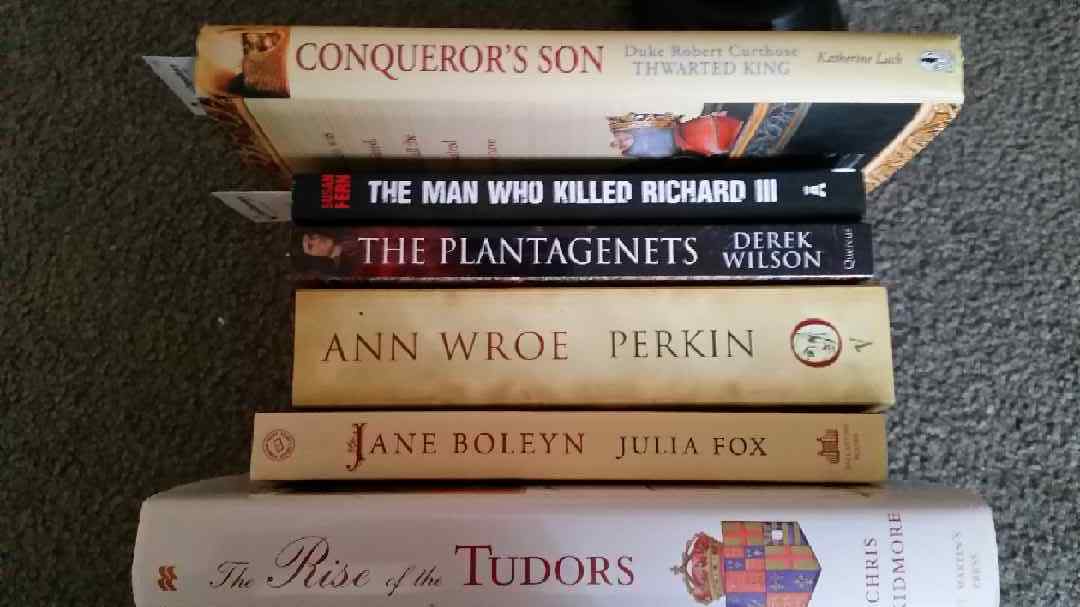
Septembers Additions - Part 2


Part 2 of September's additions to the Library include:


Conqueror's Son : Duke Robert Curthose, Thwarted King by Katherine Lack - In "Conqueror's son" Katherine Lack redresses the balance of opinion on Robert Curthose. There is no doubt that Robert was rebellious, but the fact remains that the throne of England was meant to pass to him on the death of William the Conqueror. William Rufus and Henry I were thus usurpers, which casts a new light on English history.

The Man Who Killed Richard III : Who Dealt the Fatal Blow at Bosworth? by Susan Fern - On 22 August 1485 on a battlefield in Bosworth, Leicestershire, King Richard III, the last of the Plantagenet kings, was dealt a death blow by the man who had sworn loyalty to him only a few months earlier. That man was Rhys ap Thomas, a Welsh lord, master of Carew Castle in Pembrokeshire. For his service that day he was knighted on the field of battle by Henry Tudor. 

The Plantagenets : The Kings That Made Britain by Derek Wilson - Featuring some of England's greatest but also most notorious kings, the house of Plantagenet would reign for over 300 blood-soaked, yet foundational, years. 

Perkin: A Story of Deception by Anne Wroe - Anne Wroe manages to achieve the impossible: to reconstruct the life of a young man whose identity can never be taken for granted. On the way she described in breathtaking detail the illusions, longing and deceptions that characterised the last years of the fifteenth century: a world quickly losing its medieval certainties, and trembling on the brink of a whole new age of discovery.

Jane Boleyn : The Infamous Lady Rochford by Julia Fox - The story of Henry VIII's queens - as seen through the eyes of Jane Rochford, sister-in-law to Anne Boleyn and cousin to Katherine Howard. Jane Rochford was sister-in-law to Anne Boleyn and Lady of the Bedchamber to Katherine Howard, whom she followed to the scaffold in 1542. 

The Rise of the Tudors : The Family That Changed English History by Chris Skidmore - The Rise Of The Tudors is much more than the account of the dramatic events of that fateful day in August 1485. It is a tale of brutal feuds and deadly civil wars, and the remarkable rise of the Tudor family from obscure Welsh gentry to the throne of England--a story that began sixty years earlier with Owen Tudor's affair with Henry V's widow, Katherine of Valois.

Sunday, January 4, 2015

January Arrivals

Just before Xmas Day, the following books were ordered for addition to my Library.

Stewart Binns' : "Conquest, Anarchy, Crusade & Lionheart".
Set in the period after the Norman Conquest till the reign of Richard I, so looking forward to this series.


Elizabeth Van Houts' "The Normans In Europe".

Another one of those books on the Normans that I had read but had not yet added to my Library.

Alexander Callander Murray's "From Roman to Merovingian Gaul".
From Roman to Merovingian Gaul documents events that are both remarkable in themselves and that demonstrate what made this era of history distinct. A nice addition to my French History shelf as I have books following this period but not dealing with this history of this area prior it.


Sunday, July 6, 2014

July Additions to the Library

Well, as mentioned in my last post, the Library is well and truly open for business, and taking in new titles. Here are some that should be arriving this month:


The First Crusade: The Call From The East by Peter Frankopan
The First Crusade is one of the best-known and most written-about events in history. This book intends to address the history of the First Crusade from the perspective of the east, examining the role of the Byzantine Empire and its ruler, Emperor Alexios I Komnenos.
(have been promising myself to get this one for some time)

The Writings of Agnes of Harcourt: The "Life of Isabelle of France" and the "Letter" on Louis IX and Longchamp trans: Sean L Field
An abbess in the Franciscan abbey of Longchamp, Agnes of Harcourt wrote a biography of Isabelle of France and a letter detailing Louis IX's involvement with the abbey, both of which provide a window on 13th-century religious life. This translation also contains an introduction to her life and work.

The Murder, Betrayal, and Slaughter of the Glorious Charles, Count of Flanders by Galbert Of Bruges, translated by Jeff Rider
The craven murder of Glorious Charles, who had no progeny and had not yet named a successor, upset the fragile balance of power between England, France and the Holy Roman Empire, giving rise to a prolonged struggle for the countship and bloody civil war while impacting the commercial life of the most prosperous regions of medieval Europe.

William Marshal: The Flower of Chivalry by Georges Duby
Recreates the life of William Marshal, the Earl of Pembroke from a thirteenth century poem and describes medieval daily life
(another one that has spent way too long on the TBR list)

The Normans by Trevor Rowley
The Normans were a relatively short-lived cultural and political phenomenon. They emerged early in the tenth century and had disappeared off the map by the mid-thirteenth century. Drawing on the archaeological and historical evidence, this title examines how the Normans were able to conquer and dominate significant parts of Europe.

The Gesta Tancredi of Ralph of Caen trans Bernard S. Bachrach and David S Bachrach
Presents a narrative of the First Crusade and its immediate aftermath, covering the period 1096-1105, but is often neglected, due in no small part to the difficulties of its Latin.

Burgundians in the Mist by Marc Comtois
A historical work focusing on the Burgundians--a Germanic people of the Late Antique/Early Medieval period--and the role they played in the transition of Western Europe in the wake of the Fall of the Rome.

Strongbow: The Norman Invasion of Ireland by Conor Kostick
The coming of the Normans to Ireland from 1169 is a pivotal moment in the country's history. It is a period full of bloodthirsty battles, both between armies and individuals. With colourful personalities and sharp political twists and turns, Strongbow's story is a fascinating one. Combining the writing style of an award-winning novelist with expert scholarship, historian Conor Kostick has written a powerful and absorbing account of the stormy affairs of an extraordinary era.

Galloglas: Hebridean and West Highland Mercenary by John Marsden
This exciting new work offers a Scottish perspective on a particularly bloody chapter of Irish history. The Galloglas were a group of mercenary warriors from Western Scotland who settled in Ireland and achieved extraordinary prominence over the next 300 years. By the 15th century they had become Ireland's first professional warrior class.

Sunday, December 15, 2013

December Additions To The Library

December is done and dusted, and the order for December has gone in - though I anticipate a January delivery due to the Christmas break.

Gaelic and Gaelicized Ireland in the Middle Ages by Kenneth Nicholls
This edition is completely revised and enlarged in the light of research, by the author and other scholars, carried out on the subject in the intervening period. New information on late Irish law and the institutions of the autonomous lordships has been added, as well as illustrative matter.

Years of Wonders by Geraldine Brooks
In 1666, a young woman comes of age during an extraordinary year of love and death. Inspired by the true story of Eyam, a "plague village" in the rugged hill country of England, "Year of Wonders" is a richly detailed evocation of a singular moment in history.

Elizabeth Woodville by David Baldwin
Elizabeth Woodville is undoubtedly a historical character whose life no novelist would ever have dared invent. In this revealing account of Elizabeth's life David Baldwin sets out to tell the story of this complex and intriguing woman.

The Struggle for Mastery: Britain 1066-1284 by David Carpenter
The two-and-a-half centuries after 1066 were momentous ones in the history of Britain. In 1066, England was conquered. The Anglo-Saxon ruling class was destroyed and the English became a subject race, dominated by a Norman-French dynasty and aristocracy. This book shows how the English domination was by no means a foregone conclusion.

Special Operations in the Age of Chivalry, 1100-1550 by Yuval Noah Harari
Alongside the familiar pitched battles, regular sieges, and large-scale manoeuvres, medieval and early modern wars also involved assassination, abduction, treason and sabotage. This book surveys a wide variety of such undercover operations from the eleventh to the sixteenth century.

The Anglo Saxon Chronicle by Anglo-Saxon Chronicle English
In the late 9th Century, under King Alfred the Great of England, scholars compiled a history of the island from the invasion by Julius Caesar to 891. The narrative, drawn from many historical accounts, was known as the Anglo Saxon Chronicle. After Alfred's death, the Chronicles were continued, with some versions being updated yearly until 1154. 

Katherine Swynford by Jeannette Lucraft
In this fascinating book, Jeanette Lucraft treats Katherine as a missing person and reconstructs her and her times to uncover the mystery of the 'other woman' in John of Gaunt's life.

The Normans in Europe by Arthur Henry Johnson
The sword and the cross The Normans (or Northmen) forged an empire that lasted four hundred years. Though principally known for their seat of power in Normandy, they originated from Viking stock and at the height of their supremacy had made their influence felt throughout Europe and into the Middle East. This was a martial people and its leaders took and held power with a cunning, ruthless and often cruel efficiency whilst at the same time contributing to the culture of their time. 

Medieval Punishments by William Andrews
Dive into the macabre history of England and Old Europe in this treasure chest of historical punishments. In the pages of Medieval Punishments are punishments from a less enlightened period, creating a thoroughly researched historical document that sheds light on the evolution of society and how humans have maintained social order and addressed crime. 

Stasiland by Anna Funder
In 1989, the Berlin Wall fell; shortly afterwards the two Germanies reunited, and East Germany ceased to exist. In a country where the headquarters of the secret police can become a museum literally overnight, and one in 50 East Germans were informing on their countrymen and women, there are a thousand stories just waiting to get out. Anna Funder tells extraordinary tales from the underbelly of the former East Germany.