Showing posts with label richard III. Show all posts

Friday, April 2, 2021

Review: The Killer of the Princes in the Tower by MJ Trow

Synopsis: The disappearance of two boys during the summer of 1483 has never been satisfactorily explained. They were Edward, Prince of Wales, nearly thirteen at the time, and his brother, Richard of York, nearly ten. With their father, Edward IV, dying suddenly at forty, both boys had been catapulted into the spotlight of fifteenth-century politics, which was at once bloody and unpredictable.

Thanks to the work of the hack 'historians' who wrote for Henry VII, the first Tudor, generations grew up believing that the boys were murdered and that the guilty party was their wicked uncle, Richard, Duke of Gloucester. Richard crowned himself King of England in July 1483, at which time the boys were effectively prisoners in the Tower of London.  After that, there was no further sign of them.

Over the past 500 years, three men in particular have been accused of the boys' murders - Richard of Gloucester; Henry Tudor, Earl of Richmond; and Henry Stafford, Duke of Buckingham. The evidence against them would not stand up in a court of law today, but the court of history is much less demanding and most fingers remain pointed squarely at Richard of Gloucester.

This book takes a different approach, the first to follow this particular line of enquiry. It is written as a police procedural, weighing up the historical evidence without being shackled to a particular 'camp'. The supposition has always been made that the boys were murdered for political reasons. But what if that is incorrect? What if they died for other reasons entirely? What if their killer had nothing to gain politically from their deaths at all?  And, even more fascinatingly, what if the princes in the Tower were not the only victims?

And that there, readers, is the hook that will send you down the proverbial rabbit hole.

I came to this from reading Trow's earlier book on Richard III - Richard III in the North - this tome, however, covers the mystery of the princes in the tower. Using the time honoured technique of analysing means, motive and opportunity, Trow posits the question - qui bono? Who benefits?

Trow sets forth his case utilising methods familiar to anyone who has watched or read a police procedural, court room drama or forensic investigation. As the with any suspicious death, he looks at those closest to the victims - the most obvious suspects (Richard III and Henry VII), some lesser suspects (the adherents, the family) before putting forth one who he considers highly likely and almost unanimously overlooked suspect. A person who had the holy trinity of means, motive and opportunity - a person who quite literally - if it was them - got away with murder, and possibly others. In fact, someone I myself had not even considered!

I found this to be a most compelling read - it covers off the period of the Wars of the Roses, the reigns of Edward IV and Richard III, Bosworth, and the succession of Henry VII, the mystery of the princes and the pretenders rather succinctly without bogging the reader down in a mire of dry information overload (or information dump). There is enough here for even the most casual reader to follow without having to take a crash course in medieval history.

Whether you agree or disagree with Trow's conclusions, this makes for some thought-provoking reading - who knows, maybe there is another unconsidered suspect lurking in the shadows that no-one has considered ... after five centuries, nothing is conclusive but nor should it be dismissed for not following the two "standard" lines of thought.

Definitely one for my own library!

Sunday, October 4, 2020

Review: Richard III and the North by MJ Trow

Richard III in the North
Synopsis: Richard III is England's most controversial king. Forever associated with the murder of his nephews, the Princes in the Tower, he divides the nation. As spectacular as his death at Bosworth in August 1485 - the last king of England to die in battle - the astonishing discovery of his bones under a Leicester car park five centuries later renewed interest in him and re-opened old debates. Is he the world's most wicked uncle; or is he (in the words of the man who most smeared him) 'a prince more sinned against than sinning'?

Richard was not born in the North; neither did he die there, but this detailed look at his life, tracing his steps over the thirty-three years that he lived, focuses on the area that he loved and made his own. As Lord of the North, he had castles at Middleham and Sheriff Hutton, Penrith and Sandal. He fought the Scots along the northern border and on their own territory. His son was born at Middleham and was invested as Prince of Wales at York Minster, where Richard planned to set up a college of 100 priests.

His white boar device can be found in obscure corners of churches and castles; his laws, framed in the single parliament of his short reign, gave rights to the people who served him and loved him north of the Trent. And when he felt threatened or outnumbered by his enemies during the turbulent years of the Wars of the Roses, it was to the men of the North that he turned for support and advice. They became his knights of the body; members of the Council of the North which outlived Richard by a 150 years. They died with him at Bosworth.

Although we cannot divorce Richard from the violent politics of the day or from events that happened far to the South, it was in the North that Richard's heart lay.  The North was his home. It was the place he loved.


I will admit to being a little biased - I have read a number of non-fiction (Vlad) and fiction (Marlowe) by MJ Trow. I find the writing style to be more conversational than academic, more so in this tome.

What we have here is a great (abridged) introduction to the Wars of the Roses and the family of Richard III. Trow uses the fortifications and castles associated with the Yorkist cause and with Richard himself as the anchor point from which to condense and recount Richard's thirty-three years.

As many would already know, following the accession of Edward IV, Richard received many honours and land, predominantly based in the north of England - t would be here that he would create long lasting ties with local landowners, religious and civil leaders - he was a popular figure.

However, not all the anchor points are linked with the north but with the family, and there is much discussion about these places not only associated with Richard, but also key points in the family history and with events being played out. 

Richard's links to the north were not only about his own time there, but also with how the northern barons - more often or not Lancastrians - impacted his childhood, adulthood, his political and personal perceptions. Trow tells us that Richard was often associated as a "northerner" due to his deliberate decision to base himself there - to live and to work - and muses that had things followed the anticipated successional course, Richard may have indeed spent much more time in the North. Regardless of how things finally played out, his legacy is and will always be associated with the North. And funnily enough, much of what Richard set about creating, the Tudors adopted themselves.

Trow also delves into the myths and perceptions of Richard himself, including the vexing question of the Princes in the Tower, finishing up with the discovery of Richard 's remains and his final internment.

Trow provides a "floor plan" for all the anchor buildings and possible plans for the major battles. All sources (of which a selected few are listed at the end) are considered and scrutinised, but here also Trow laments that lack of contemporary sources that shed light into the man himself that have not be "rewritten" or "formualted" with a specific target audience or patron in mind.

There are many books on the Wars of the Roses, Richard III and the Tudors, Trow's book will appeal to many - it is an accessible, uncomplicated history of the period and the man.


Friday, April 3, 2020

Review: The King's Dogge by Nigel Green

19200848Synopsis: Set in an England beset by power wrangling and warfare at the end of the 15th century, The King’s Dogge (the first of a two book series) tells of Francis Lovell’s meteoric rise from humble squire to closest ally of King Richard III.

Having courageously fought at Barnet for the great noble the Earl of Warwick, Lovell is introduced to Richard of Gloucester. Impressed by Lovell’s military acumen, Gloucester assigns him the unenviable task of fighting the Scots in the West March. His initiative wins him a knighthood and turns him into Gloucester’s most prized asset. In time, Lovell comes to respect Gloucester and a close friendship blossoms, each aware of one another’s weaknesses but together able to advance one another’s careers – military and political respectively. Lovell’s future is further shaped by Gloucester’s scheming wife Anne Neville, whose ambition exceeds that of her husband. 

But when their Machiavellian scheming leads to the cold-blooded murder of the princes in the tower, Lovell is forced to weigh his conscience against his sense of duty and ask himself what dark acts he is prepared to carry out in Gloucester’s name. 

The King’s Dogge is a fictional account of the rule of King Richard III as seen from the perspective of his closest adviser, Francis Lovell. It weaves a story around true events and throws the actions of the king into a new perspective when viewed against the ambition of his wife, Anne Neville. 


So, let's start with Francis Lovell. As a child, he was given over to the Earl of Warwick in who's household young Richard had spent some time. Whether they were under the same roof at the same time is uncertain. Married at a very early age, Francis was linked to Warwick, and gave his support to his father-in-law in his rebellion against Edward (1470). The following year, still a minor, he was given over into the guardianship of Edward's sister. He had, by age 18, inherited a considerable fortune.

Not only was Lovell linked by marriage to the Earl of Warwick, so too was he linked to Richard as their respective wives were cousins.

His political career lasted a mere ten years. He is said to have accompanied Richard to Scotland and was knighted (1481), coming into his service a year prior. His loyalty to Richard following the latter's accession to the throne (1483) was well rewarded. There is some conjecture as to whether he was at Bosworth (1485) with Richard or stationed somewhere else. What is certain is that he escaped soon after. As this is where we are left in Green's novel.

Now to the others mentioned in the famous poem:
“The Catte, the Ratte and Lovell our dogge
Rulyth all Englande under a hogge.”

Sir William Catesby: one of Richard's closest advisors and was well rewarded when Richard became king (1483). He fought at Bosworth, was captured and executed (1485).

Sir Richard Ratcliffe: a close companion of Richard whilst he was Duke of Gloucester. He too was well rewarded when Richard came to the throne (1483). He died at Bosworth with the king (1485).


So how does Green's novel stack up with what is known about both Lovell and Richard III? Richard was well liked in the North, and this fictional account based on Lovell's first-hand views are not very balanced. Richard is portrayed as something akin to Shakepseare's Macbeth wherein he is dominated by his scheming wife, with Lovell as the loyal Banquo as depicted by Holinshed in his Chronicles (from which Shakespeare borrowed copiously). As a high-profile Yorkist, the Lovell presented here is rather wishy-washy. 

This type of fiction may have been forgiven had this been written a century ago, but with access to today's research, the reader requires some degree of authenticity. Then again, as historical fiction, it is every author's right to interpret events their own way.

The first person narrative severely limits the scope of the story as we only see things as and when Lovell does and gain no perspective of how these events sit in a wider purview. As a novel depicting the relationship between Richard and Lovell, this does not fully meet the brief. As a novel about Lovell, well, this hits slightly closer to the mark. 


further reading:
Lovell Our Dogge by Michele Schindler
Francis, Viscount Lovel "Time Reveals All Things" by Joe Ann Ricca
Last Champion of York: Francis Lovell, Richard III's Truest Friend by Stephen David
The Secret Diary of Francis Lovell by Dawn Wheeler


Saturday, June 29, 2019

Bookshelf: Wars of the Roses to Tudors

So, again, after a bit of a tidy up, I have managed to sort through the various tomes and arrange them in some sort of order.  These shelves are dedicated to various topics and biographies pertaining to the Wars of the Roses and slightly beyond to the Tudors.  It is a mix of fiction and non-fiction, and is rather an eclectic mix.


Sunday, June 9, 2019

The Brothers York: An English Tragedy by Thomas Penn

The Brothers YorkIn early 1461, a seventeen-year-old boy won a battle on a freezing morning in the Welsh marches, and claimed the crown of England as Edward IV, first king of the usurping house of York. It was a time when old certainties had been shredded: by popular insurgency, economic crisis, feuding and a corrupt, bankrupt government presided over by the imbecilic, Lancastrian King Henry VI. The country was in need of a new hero. Magnetic, narcissistic, Edward found himself on the throne, and alongside him his two younger brothers: the unstable, petulant George, Duke of Clarence, and the boy who would emerge from his shadow, Richard, Duke of Gloucester.


Charismatic, able and ambitious, the brothers would become the figureheads of a spectacular ruling dynasty, one that laid the foundations for a renewal of English royal power. Yet a web of grudges and resentments grew between them, generating a destructive sequence of conspiracy, rebellion, deposition, fratricide, usurpation and regicide. The house of York's brutal end came on 22 August 1485 at Bosworth Field, with the death of the youngest brother, now Richard III, at the hands of a new usurper, Henry Tudor.

Brothers York is the story of three remarkable brothers, two of whom were crowned kings of England and the other an heir presumptive, whose antagonism was fuelled by the mistrust and vendettas of the age that brought their family to power. The house of York should have been the dynasty that the Tudors became. Its tragedy was that it devoured itself.

Tuesday, September 29, 2015

Septembers Additions - Part 2


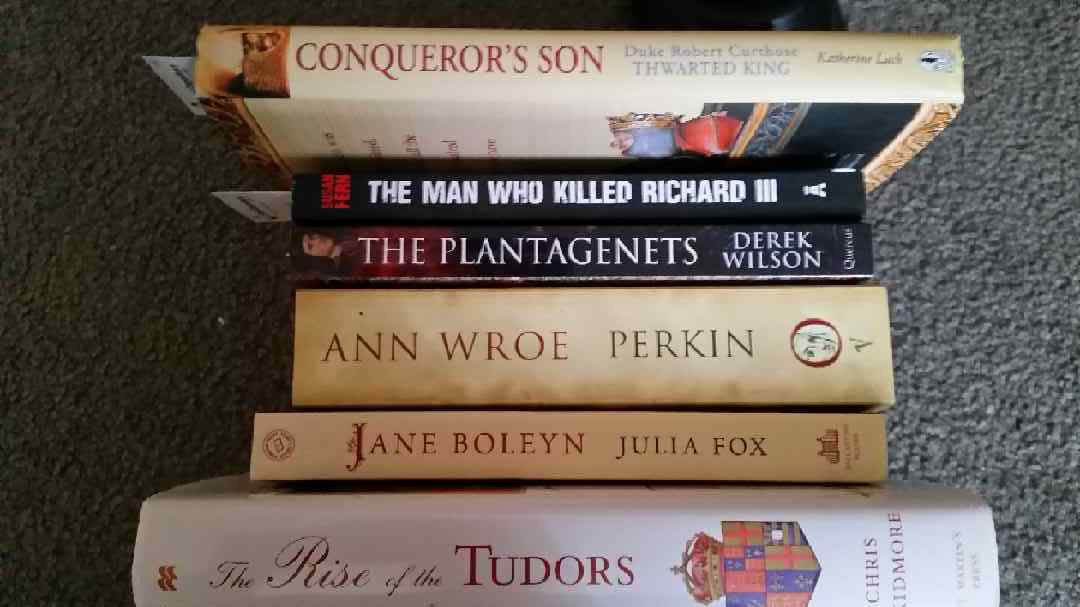
Part 2 of September's additions to the Library include:


Conqueror's Son : Duke Robert Curthose, Thwarted King by Katherine Lack - In "Conqueror's son" Katherine Lack redresses the balance of opinion on Robert Curthose. There is no doubt that Robert was rebellious, but the fact remains that the throne of England was meant to pass to him on the death of William the Conqueror. William Rufus and Henry I were thus usurpers, which casts a new light on English history.

The Man Who Killed Richard III : Who Dealt the Fatal Blow at Bosworth? by Susan Fern - On 22 August 1485 on a battlefield in Bosworth, Leicestershire, King Richard III, the last of the Plantagenet kings, was dealt a death blow by the man who had sworn loyalty to him only a few months earlier. That man was Rhys ap Thomas, a Welsh lord, master of Carew Castle in Pembrokeshire. For his service that day he was knighted on the field of battle by Henry Tudor. 

The Plantagenets : The Kings That Made Britain by Derek Wilson - Featuring some of England's greatest but also most notorious kings, the house of Plantagenet would reign for over 300 blood-soaked, yet foundational, years. 

Perkin: A Story of Deception by Anne Wroe - Anne Wroe manages to achieve the impossible: to reconstruct the life of a young man whose identity can never be taken for granted. On the way she described in breathtaking detail the illusions, longing and deceptions that characterised the last years of the fifteenth century: a world quickly losing its medieval certainties, and trembling on the brink of a whole new age of discovery.

Jane Boleyn : The Infamous Lady Rochford by Julia Fox - The story of Henry VIII's queens - as seen through the eyes of Jane Rochford, sister-in-law to Anne Boleyn and cousin to Katherine Howard. Jane Rochford was sister-in-law to Anne Boleyn and Lady of the Bedchamber to Katherine Howard, whom she followed to the scaffold in 1542. 

The Rise of the Tudors : The Family That Changed English History by Chris Skidmore - The Rise Of The Tudors is much more than the account of the dramatic events of that fateful day in August 1485. It is a tale of brutal feuds and deadly civil wars, and the remarkable rise of the Tudor family from obscure Welsh gentry to the throne of England--a story that began sixty years earlier with Owen Tudor's affair with Henry V's widow, Katherine of Valois.

Tuesday, June 23, 2015

May Additions

Although May has long gone and June has all but vanished, below are the recent additions to the Library for May 2015.


I love Marlowe and Richard III - so these will make welcome additions to my Wars of the Roses - Elizabethan Poets shelves.  I am not averse to reading various authors - it just adds to a more rounded view of a character.  So read nothing into the choice of authors!