Showing posts with label tudor history. Show all posts

Thursday, January 1, 2026

Review: Uncrowned Queen by Nicola Tallis

Synopsis: The first comprehensive biography in three decades on Margaret Beaufort, the mother of the Tudor Dynasty.

In 1485, Henry VII became the first Tudor king of England. His victory owed much to his mother, Lady Margaret Beaufort. Over decades and across countries, Margaret had schemed to install her son on the throne and end the War of the Roses. Margaret's extraordinarily close relationship with Henry, coupled with her role in political and ceremonial affairs, ensured that she was treated -- and behaved -- as a queen in all but name. Against a lavish backdrop of pageantry and ambition, court intrigue and war, historian Nicola Tallis illuminates how a dynamic, brilliant woman orchestrated the rise of the Tudors.

~ ~ ~

Well .... no. Not the first comprehensive biography - but certainly one of a few including the recent works by Lauren Johnson and Elizabeth Norton.

Tallis provides the reader with a very accessible biography of a woman who put aside her ego and loyalty to play the long game - that was putting her son Henry on the throne of England.

Much of Margaret's life is covered: her childhood, marriages, birth of her only child; in addition to a history of events of her time leading up to the coronation of Henry as Henry VII. Tallis focuses on the cultural, social and religious aspects of Margaret's life, including he role as patron to both educational and religious establishments, and her role as counsellor and confidante of her son Henry.

There is nothing new here that has not been covered off in previous biographies and histories but as mentioned, it accessible to the lay reader.

Sunday, November 23, 2025

Review: Margaret Beaufort by Lauren Johnson

Synopsis: Survivor. Rebel. Conspirator. Matriarch of a dynasty.

Born into a century of conflict as the daughter of the Duke of Somerset and a descendant of Edward III, Margaret Beaufort was married at twelve, a mother and widow at thirteen, and a player in one of the most violent chapters of English history.

Across three marriages and decades of civil war, Margaret endured loss, intrigue and exile – yet lived to see her only son crowned Henry VII, the first Tudor king. Against a backdrop of shifting power and danger, she helped broker the union that ended the Wars of the Roses, shaped the early Tudor court, and played a formative role in the life of her grandson, Henry VIII.

In this powerful and perceptive biography, historian Lauren Johnson brings Margaret vividly to life as a woman of rare resilience and ambition. With empathy and sharp insight, Johnson reframes our understanding of medieval power and restores Margaret to her rightful place: not simply a mother behind the throne, but a skilled political operator whose determination changed the course of English history.

~ ~ ~

Johnson begins with a very apt observation: "The challenge of locating women in an era when female identity, and especially autonomy, is often concealed and sometimes eradicated hardly needs reciting." This is true whether studying or researching European, African, America, Asian or Pacific Nations women. That Margaret Beaufort was one who did is a true testament to not only her incredible good fortune but her own formidable persistence. She was a woman, Johnson notes, who learnt the art of politicking and concealing her private thoughts and resentments for the good of her kin ... and her only son.

Johnson takes the reader on a journey into Margaret's life both on the domestic and political fronts, beginning with a short history of the Beaufort clan, Margaret's own childhood, marriages and birth of son Henry, through the tumultuous period known as the wars of the roses, to the fall of the last Plantagenet king and the accession of her son Henry as the first Tudor monarch.

The narrative is one that will easily engulf the reader into the period of history through which Margaret lived and died, without becoming bogged down in an over abundance of facts to the point that one quite easily tunes out. Johnson keeps the reader engaged - the prose follows a chronological timeline, and a list of the dramatis personae (and family trees) is listed at the start of the book to assist a reader new to this period.

Margaret Beaufort is a remarkable subject to study and Johnson provides a highly engaging and accessible history and biography.  An impressive study of an oft maligned political survivor.

Monday, November 10, 2025

Review: Edward IV's Fatal Legacy by Hazel Pierce

Synopsis: One of the most overlooked families of the early modern period, the Courtenays played a critical role, and their story of love and loss, loyalty and betrayal, survival and ruin is played out at the courts of four Tudor monarchs.

Katharine, Countess of Devon, was Edward IV's daughter. Her first proposed marriage would have made her Queen of Spain, but she was declared a bastard on the accession of her uncle Richard III. Legitimated under Henry VII, she eventually married Sir William Courtenay, heir to the earldom of Devon. Her closeness to her sister, Queen Elizabeth of York, did not prevent the sudden arrest of her husband in 1502. Whilst earning the regard of her royal brother-in-law, Henry VII, she walked a knife edge until the accession of her nephew, Henry VIII. As a widow, he granted her the lands of the earldom of Devon for life, making her one of the wealthiest female magnates in England.

Her death in 1527 spared her the tragedies which befell her family in the 1530s. Her son Henry, Marquis of Exeter, was first cousin to Henry VIII, with whom he enjoyed a close relationship until the king’s decision to repudiate his queen changed everything. Henry’s marriage to Gertrude Blount, one of the most neglected women of the Tudor period, was one of affection and respect. During the 1530s, she was at the centre of a group opposed to Henry VIII’s repudiation of Catherine of Aragon, passing on information provided by her husband and a small circle of trusted friends to the imperial ambassador, Chapuys. When her husband was arrested in 1538, he, along with others, was executed; only she survived.

Imprisoned in the Tower with her twelve-year-old son, Edward, she was later released while Edward remained incarcerated until the accession of Mary I. Upon his release, many believed he would marry the queen, but instead, he died in exile from suspected poisoning after surviving several assassination attempts by imperial agents. This study of the Courtenay family follows their lives and fortunes from 1479-1558.

~ ~ ~

Let me begin by saying I, personally, consider the title (and cover art) to be misleading (would strongly suggest changing - I can even suggest a few alternates that would actually represent the contents), as it really does a dis-service to the family at the forefront of this tome.

Secondly, whilst the author has demonstrated the wealth of research done, the data dump is frustrating - all your research does not need to be included!! There is the usual P&S author style of writing about others not entirely central to the title or subject at hand (refer data dump above); lots of summations, and rather contradictorily so, lots of detail (again, a good editor should have trimmed this back).

Thirdly, whilst kudos for subject matter, once again let down by presentation style. Initially not overly impressed one third way in. I wearily persevered.

What I did like was primarily the subject matter - the rise and fall of the Courtenays under the Tudors (which is the title I would have gone for). The first part is focused on Katherine Plantagenet - the daughter of King Edward IV, she was a Courtenay by marriage only. Spoiler alert: as her husband died young, there is much focus on Katherine who lived a long life (for folks of her time). Therein point two applies - although there is much to be learned about Katherine and William during the reign of Henry Tudor (her brother-in-law) - who both she and William did manage to outlive.

The second part looks at the exceedingly tumultuous lives of Katherine's son Henry and his wife Gertrude - whom I found the most annoying yet fascinating woman who managed to keep her head during the reign of Henry VIII - how, is a miracle for she was a headstrong, scheming woman! However, she did manage to find herself confined to the Tower, as did her son for her sins.

The son, Edward, is the subject of part three - a young man, heavily influenced by others, who paid a heavy price for his father's loyalty to his friends - imprisonment during his youth. Upon his release, he made up for lost time - a bit like the child popstars of today who are keen to shake off the kiddie-pop image for a more adult one. Unfortunately for Edward, this was his undoing and led to his exile.

There is much to be learned about this family, primarily the English / Devon branch of the family.  There are many branches (or tentacles) that sprouted from this illustrious family tree, and they had their historical and political moments, which should have been summarised not detailed.

I have not come across another biography of this family prior to now so have nothing really to compare it to. It is not for the feint hearted as there is - as I mentioned - a lot of detail. Whilst I was initially not overly impressed, I did come away with a deeper appreciation of the Courtenay family and their place in Tudor history (though I still say less is best!).

If Tudor history is your penchant, then you will definitely want to include this one to your reading list - but take your time - do not rush through it - and probably ditch the audio and e-book versions for a physical copy.


Following this, I did a bit of a google search for any further histories on this family - see below:
  • The Shadow of the White Rose: Edward Courtenay, Earl of Devon, 1526-1556 by James D. Taylor
  • Boconnoc: The History of a Cornish Estate by Catherine Lorigan
  • Memorials of the West, Historical and Descriptive, Volume 44 by W. H. Hamilton Rogers
  • Children of England: The Heirs of King Henry VIII 1547-1558 by Alison Weir (for Edward Courtenay)

Tuesday, December 31, 2024

Review: Yorkist Pretenders to the Tudor Throne by Kieran Molloy

Synopsis: For more than a decade after the Battle of Bosworth in 1485, Henry VII's fledgling dynasty was threatened by two Yorkist claimants. Lambert Simnel's rebellion, though short-lived, ended at the Battle of Stoke in 1487, a far bloodier affair than Bosworth two years earlier. The second rebellion, centred on Perkin Warbeck, ended in ignominious surrender but was the fulcrum of a power struggle involving the major European powers for most of the 1490s.

Who were these two men? Were they the imposters claimed by the King and generally accepted as such by most historians, or were they the nobles they claimed to be - Edward, Earl of Warwick and Richard, second son of Edward IV? What became of the other “Prince in the Tower”, Edward V? Were Edward IV's two sons really murdered by their uncle, Richard, Duke of Gloucester, or were both alive and involved in the two rebellions? Was there any link between the rebellions, or were they the last desperate and uncoordinated rolls of the dice by remnants of the House of York unwilling to accept the new Tudor regime? Do we really know what became of Simnel and Warbeck after their rebellions failed other than what Henry VII told us?

Part I of this book examines the evidence for the identity of Lambert Simnel while Part II recreates a courtroom trial for Perkin Warbeck allowing you, the reader, to act as jury.

~ ~ ~

The two stars are for the first part only - this was the study of Lambert Simnel, and whilst I was expecting something a bit more scholarly, this section was dealt with in an even-handed manner, providing a case for and against the various claimants.

HOWEVER, part two was a poorly executed shambles and had me asking WTF?. This smacks of laziness in an effort to reach a publication deadline and treats the reader with contempt.

Had this investigation into the Perkin Warbeck case continued in the same vein as part one, then this would be a three possibly four stars rated book.

This needs some serious re-thinking and re-editing before publication or your audience is lost.

Sunday, December 22, 2024

Review: Tudor Executions by Helene Harrison

Synopsis: The Tudors as a dynasty executed many people, both high and low. But the nobility were the ones consistently involved in treason, either deliberately or unconsciously. Exploring the long sixteenth century under each of the Tudor monarchs gives a sense of how and why so many were executed for what was considered the worst possible crime and how the definition of treason changed over the period.

This book examines how and why Tudor nobles like Edward Stafford, 3rd Duke of Buckingham; Queen Consort Anne Boleyn; Henry Howard, Earl of Surrey; and Robert Devereux, 2nd Earl of Essex, fell into the trap of treason and ended up on the block under the executioner’s axe. Treason and the Tudor nobility seem to go hand in hand as, by the end of the sixteenth century and the advent of the Stuart dynasty, no dukes remained in England. How did this happen and why?

~ ~ ~

Rather good insight into the Tudor paranoia over the usurpation ..... I mean succession. And as the reader continues on their grisly journey, they will discover how closely related to each other were both monarch and executed noble, as well as noble to noble.

Harrison begins with Edward Plantagenet, Earl of Warwick (ex. 1499) and completed her list with Robert Devereaux, Earl of Essex (ex. 1601) - spanning the reigns of Henry VII to Elizabeth I. All those "victims" contained within the pages of this tome are already known - so no new surprises. 

The narrative is not cumbersome, the research is obvious without being overbearing, the tome is easily readable, and dare I say it, entertaining.

One definitely for the Tudor history buffs!

Monday, April 22, 2024

Review: The Mysterious Death of Katherine Parr by June Woolerton

Synopsis: What killed Katherine Parr?

She was the ultimate Tudor survivor, the queen who managed to outwit and outlive Henry VIII. Yet just over eighteen months after his passing, Katherine Parr was dead. She had been one of the most powerful people in the country, even ruling England for her royal husband, yet she had died hundreds of miles from court and been quickly buried in a tiny chapel with few royal trappings. Her grave was lost for centuries only for her corpse to be mutilated after it was rediscovered during a tea party. The death of Katherine Parr is one of the strangest of any royals – and one of the most mysterious.

The final days of Henry VIII’s last queen included a faithless husband and rumors of a royal affair while the weeks after her funeral swirled with whispers of poison and murder. The Mysterious Death of Katherine Parr dives into the calamitous and tumultuous events leading up to the last hours of a once powerful queen and the bizarre happenings that followed her passing.

From the elaborate embalming of her body, that left it in a state of perfect preservation for almost three centuries despite a burial just yards from her place of death, to the still unexplained disappearance, without trace, of her baby, the many questions surrounding the death of Queen Katherine are examined in a new light.

This brand new book from royal author and historian June Woolerton brings together, for the first time, all the known accounts of the strange rediscovery of Katherine’s tomb and the even odder decision to leave it open to the elements and grave-robbers for decades to ask – how did Katherine Parr really die?

~ ~ ~

When Henry VIII died in 1547, his widow Katherine Parr was not only still considered to be Queen, she was also free to remarry - which she did, six months later, to the man who became her fourth husband, Thomas Seymour. Then Katherine found herself pregnant - and eight days after the birth of her only child, a daughter, Katherine was dead and hastily buried.

Woolerton takes the reader through the discovery of Katherine's tomb at Sudeley, the rumours surrounding her death, and her rather hasty and low key funeral. Katherine's husband - Thomas Seymour - hot-foots it back to London, leaving the newborn in the care - initially - of Katherine's attendants. We already know that Katherine's daughter Mary will soon be left without both mother or father, as after a plot was discovered to put the protestant Elizabeth on the throne, her father Sir Thomas Seymour was beheaded for treason.

Woolerton explores Katherine's final months and days, and notes her actions were in sharp contrast to the self-assured woman she was prior to and during her marriage to Henry VIII - and considers this against the backdrop of what we already know - or think we know. Katherine's funeral, in stark contrast to other female monarchs was, as mentioned, a rather hasty and covert affair, not even attended by her husband - and Woolerton delves into this quite deeply, as she does with Katherine's will.

I found Woolerton's exploration of events quite engaging and her open-mindedness to other hypothesis rather refreshing. She posits a number of plausible theories for Katherine's actions and behaviours after Henry's death whilst exploring Seymour's own actions against the changing political tableau.

A must for Tudor lovers, and for those with an interest in royalty and notable women.

Thursday, April 2, 2020

Review: A Dangerous Inheritance by Alison Weir

Synopsis: England's Tower of London was the terrifying last stop for generations of English political prisoners. A Dangerous Inheritance weaves together the lives and fates of four of its youngest and most blameless: Lady Katherine Grey, Lady Jane's younger sister; Kate Plantagenet, an English princess who lived nearly a century before her; and Edward and Richard, the boy princes imprisoned by their ruthless uncle, Richard III, never to be heard from again. Across the years, these four young royals shared the same small rooms in their dark prison, as all four shared the unfortunate role of being perceived as threats to the reigning monarch.


Again I will preface this by saying that I am not a huge fan of Weir, however, I was interested to see how this would play out with three of the main characters (the Plantagenets: Kate, Edward, Richard) having lived and died long before Katherine Grey came on the scene. There are essentially three stories: Katherine Grey, Kate Plantagenet, and the Princes in the Tower.

I will start with Kate Plantagenet, illegitimate daughter of Richard III, and of whom very little by way of fact is known, especially of her childhood. Could she have known John de la Pole, Earl of Lincoln, with whom she was said to have had a relationship with in the novel? It is possible that she knew him if she was living in the household of her uncle as following the death of Richard's own son Edward, first Edward of Warwick then John de la Pole became his nominated heir. As both Edward and John were nephews of Richard, would he have counternounced a relationship between his own daughter (illegitimate or not) and his nephew and heir?. 

After Richard succeeded to the throne Katherine was married to William Herbert, Earl of Huntingdon, (1455-1491) as his second wife. On 29th February, 1484 Herbert covenanted 'to take to wife Dame Katherine Plantagenet, daughter to the King, before Michaelmas of that year'. Richard paid for the wedding and granted the couple an annuity of 400 marks from the lordships of Newport, Brecknok, and Hay on March 3, 1484. They probably lived at Raglan Castle, the Herbert family seat in Monmouthshire.

When Henry Earl of Richmond landed in south Wales in 1485, it is likely that a Herbert sent word to Richard of Henry's landing. William Herbert. however is not recorded as having fought for his father-in-law at Bosworth, though de la Pole quite possibly did. At the coronation of Elizabeth of York in November 1487, William Herbert is referred to as a widower, the marriage is not thought to have produced any children. What happened to Katherine is speculation - though it is commonly thought that she had died prior (she is last mentioned in March 1485), possibly in childbirth.

Now to Katherine Grey - one of the famous Grey sisters, the others being Jane and Mary; all granddaughters of Henry VIII"s sister, Mary. Katherine was initially wed to Henry, Lord Herbert, the son of the Earl of Pembroke (1553) - however when the plot to put Jane on the throne failed, this marriage was annulled and she was returned to her family (1554). She and her sister Mary were, at one stage, considered as potential heirs to their cousin, Elizabeth I of England. However, Katherine incurred the wrath of Elizabeth by secretly marrying (1560) Edward Seymour, 1st Earl of Hertford (it was forbidden to marry without the Queen's consent - it was considered treason to do so). Arrested (c.1561) after the Queen was informed of their clandestine marriage, Katherine was confined to a life in captivity until her death (1568), having borne two sons in the Tower of London.

The only tenuous link between the two women is that both their husbands were, at one point, Earls of Pembroke and both were in close proximity to the throne.  


So my thoughts.  Unfortunately, I found it rather average.  What appeared to me to be two potentially separate stories were merged together with the mystery of the princes binding them together in some strange manner.    The different narratives - first person for Katherine, third for Kate - does not really work and was at times unclear in its direction.  The addition of the "supernatural" element (supposedly binding both women together through history) merely creates a fog over the narrative and lends itself to confusion.  Then Weir trots out her standard anti-Richard bias.

Did either of women embark on a search for the truth behind the "princes in the tower" mystery?  Highly unlikely as I think both would have been more focused on their own survival in what were periods of great uncertainty.  Her handling of the paranormal component was not done well - she could easily have left Kate Plantagenet out of it altogether, the story may have flowed a bit better. And I question whether Katherine Grey would have even considered that Richard was innocent of the crimes landed at his doorstep, if indeed she gave any  thought to this at all.

I did like Weir's portrayal of Elizabeth's nastier side - people tend to forget that she was a jealous and vindictive woman, only seeing her as Gloriana. That was a refreshing change and the one upside.

So for me, this was average novel from Weir.  Just because she has written much on the era does not make what she writes as the gospel truth or perfect, there is always a great deal of supposition and inference in her works. This was not her best work of fiction - and is really only one for the Tudor fans. 

Sunday, July 14, 2019

Diarmaid MacCulloch: ‘I got very irritated with Henry VIII’

From The Guardian: 

Thomas Cromwell
Diarmaid MacCulloch’s vast and exhaustive Thomas Cromwell: A Life, published in 2018, was described by Hilary Mantel – no slouch when it comes to the book’s subject – as “the biography we have been awaiting for 400 years”. Delving deeply into Cromwell’s private papers, MacCulloch argues for Cromwell’s central position in the supercharged power-politics of Henry VIII’s court.

MacCulloch studied under the great Tudor historian Sir Geoffrey Elton. He has written extensively on ecclesiastical history, and was ordained a deacon in the 1980s. He declined ordination to the priesthood because of the church’s attitude to homosexuality, but remains “a candid friend of Christianity”. He is now professor of the history of the church at Oxford University.

read interview here @ The Guardian

Saturday, June 29, 2019

Bookshelf: Wars of the Roses to Tudors

So, again, after a bit of a tidy up, I have managed to sort through the various tomes and arrange them in some sort of order.  These shelves are dedicated to various topics and biographies pertaining to the Wars of the Roses and slightly beyond to the Tudors.  It is a mix of fiction and non-fiction, and is rather an eclectic mix.


Sunday, May 26, 2019

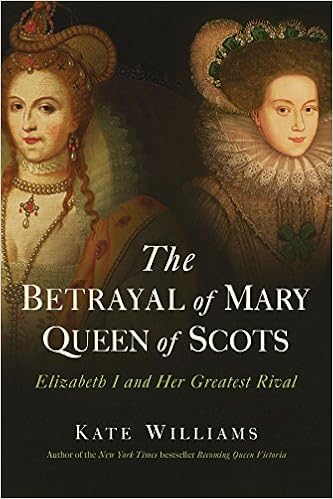
The Betrayal of Mary, Queen of Scots by Kate Williams

Image result for The Betrayal of Mary, Queen of ScotsElizabeth and Mary were cousins and queens, but eventually it became impossible for them to live together in the same world. This is the story of two women struggling for supremacy in a man’s world, when no one thought a woman could govern. They both had to negotiate with men—those who wanted their power and those who wanted their bodies—who were determined to best them. In their worlds, female friendship and alliances were unheard of, but for many years theirs was the only friendship that endured. They were as fascinated by each other as lovers; until they became enemies. Enemies so angry and broken that one of them had to die, and so Elizabeth ordered the execution of Mary. But first they were each other’s lone female friends in a violent man’s world. 

Their relationship was one of love, affection, jealousy, antipathy—and finally death. This book tells the story of Mary and Elizabeth as never before, focusing on their emotions and probing deeply into their intimate lives as women and queens. They loved each other, they hated each other—and in the end they could never escape each other.


Mary’s story has been often told, but it has been interpreted differently through the generations. While some earlier historians viewed the queen as complicit in her rape and subsequent marriage, Williams analyzes events with a modern perspective, incorporating what we now know about the trauma of sexual assault. The author also stresses how the two queens, unlike kings who governed autocratically, were consistently forced to relinquish some of their power. In framing Mary’s story as being one about “how we really think of women and their right to rule,” Williams hints at its ongoing resonance.


Thursday, December 27, 2018

Review - Margaret Tudor - Two Lives

I have now read two recent and separate accounts of the life of Margaret Tudor, Queen of Scots, Princess of England - the "other Tudor Princess".

The first, about a year ago, was by Sarah-Beth Watkins - Margaret Tudor, Queen of Scots: The Life of King Henry VIII’s Sister - and the second, just recently, by Melanie Clegg - Margaret Tudor: The Life of Henry VIII's Sister.

Margaret Tudor, Queen of Scots - Sarah-Beth Watkins
I would view this as an entry level biography, which gives us a glimpse into her early life as a Tudor princess; her struggles as Queen of Scotland and then as regent for her young son, James V; her failed marriages; constant political struggles between England & Scotland; and ultimately, her fight to ensure her son gained his inheritance.

These were turbulent times and would be even more so for an inexperienced young woman thrust upon the political scene, viewed with suspicion by both her new country and the land she left behind.

Watkins concludes with a wrap of the fate of her children and her legacy - which resulted in the marriage of Mary Queen of Scots to her cousin, Henry Stuart, Lord Darnley, thus uniting the two lines of descent from her.

It is a small tome - which no doubt could have been bulked out with descriptions of people and places, her wardrobe and a history of the times, but we would still not get anything of Margaret herself - so I am glad this was not done.  In the end, Margaret's life is spent in the shadows of the men in her life: father, husband, brother, son.


Margaret Tudor by Melanie Clegg
This time we begin with the accession of Henry VII, Margaret's father, to the throne of England, before moving onto Margaret's childhood and betrothal aged 7yo to the 23yo James IV of Scotland. In this tome, we are treated to a more indepth study of the Tudor court and household as a whole - and how certain events touched upon Margaret - so there is a lot on her siblings.

What did become evident, was how very similar the events surrounding her own betrothal and marriage mirrored those of her sister-in-law Katherine of Aragon: the haggling over dowry, the delays, the on again / off again political manouevring from both James IV and Henry VII; and later, the pregnancies, miscarriages, and loss of babies, whilst surrounded by her husband's litter of illegitimate offspring.

Once in Scotland, Margaret's troubles did not end - the constant animosity between her husband and her brother, both wanting her loyalty, whilst simultaneously being viewed with suspicion and distrust.  Following the death of James at Flodden (1513), Margaret, barely 23yo, finds herself ill-equipped to deal with the pressure and political intricacies required to fend off both internal rivals and her own brother during the regency of her infant son, James V.  A disastrous foray into an ill-conceived second marriage did not make for easy bedfellows of the Scottish nobility.  And even when able to shake off the shackles of this failed marriage, and seeing her son finally consecrated as King, she embarks on a third marriage, which pretty much ends up like the previous.

What this tome does do is gives us the young Margaret - petulant, fond of getting her own way, desirous of being the centre of attention, and casting her into a role where she is merely a powerless  figurehead.  Her struggles for recognition as was her due as Dowager Queen show that a woman's lot, no matter what her status, can be a hard one: one bad marriage can result in the loss of status, income, children, where you are left literally begging for support whilst ignored by both your own family and adoptive country, leaving you alone and embittered, casting around for allies that do not always her you interests at heart.
I think that is what the reader will take away most from this - that the grass is not always greener on the other side, and the fairy tale of being princess and queen does in reality, not always have a happy ending.


Both tomes are well written and well researched, and are recommended as a good entree into the world of one of the lesser documented of the Tudor princesses.


More on Margaret:
Queen Margaret Tudor: The Story of a Courageous But Forgotten Monarch by Stuart McCabe
Margaret Tudor, Queen of Scots by Patricia Hill Buchanan
The Rose and the Thorn: The Lives of Mary and Margaret Tudor by Nancy Lenz Harvey
The Thistle and the Rose - The Sisters of Henry VIII by Hester W. Chapman

Sunday, September 16, 2018

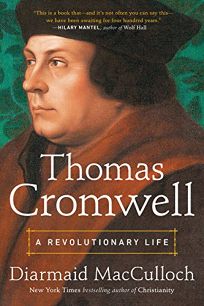
Thomas Cromwell: A Life by Diarmaid MacCulloch

Thomas Cromwell: A Revolutionary LifeReview by Dan Jones for The Sunday Times:

Minutes before his head was struck off with an axe, Thomas Cromwell, Henry VIII’s disgraced former minister, made a speech. “I have been a great traveller in this world,” he said, “and being but of a base degree, was called to high estate and [since] the time I came thereunto, I have offended my prince.” He asked God for mercy, made some disingenuous remarks about the king’s grace, then went calmly to his death. Accounts vary as to the efficiency of the headsman, but as Diarmaid MacCulloch writes with the dry wit that characterises this triumphant and definitive biography, “even botched beheadings are soon over”.

For a time, the self-made 'ruffian' (as he described himself) - ruthless, adept in the exercise of power, quietly determined in religious revolution - was master of events. MacCulloch's biography for the first time reveals his true place in the making of modern England and Ireland, for good and ill.

read more @ Penguin Books and @ Publishers Weekly


Saturday, August 11, 2018

Review: Anne of Cleves - Henry VIII's Unwanted Wife by Sarah-Beth Watkins

Anne of Cleves: Henry VIII's Unwanted Wife
This is a nice concise entry level introduction into Anne of Cleves, fourth wife of King Henry VIII of England. It gives us an entree into the life of a woman, who despite her royal lineage, was never destined to be queen, and who it seemed (according to the author), was quite content to remain a "homebody" at the court of her family.

She was, when the search for a new wife for Henry VIII began in @ 1537, "... one at the end of an unflattering list ... report not favourable .." And yet, queen she became - and she seemed to make the most of her life as an independent woman of means following the divorce from Henry when " .... my husband hath nevertheless taken and adopted me for his sister ...."

A base for further reading.

Sunday, September 17, 2017

Review: The Children of Henry VIII

There are two works of the same name but by different authors - and I have read both.

The Children of Henry VIII by by 

"At his death in 1547, King Henry VIII left four heirs to the English throne: his only son, the nine-year-old Prince Edward; the Lady Mary, the adult daughter of his first wife, Catherine of Aragon; the Lady Elizabeth, the daughter of his second wife, Anne Boleyn, and his young great-niece, the Lady Jane Grey. These are the players in a royal drama that ultimate led to Elizabeth's ascension to the throne--one of the most spectacularly successful reigns in English history."

Weir book focuses on Henry's three legitimate children, Edward VI, Mary I, Elizabeth I, and also Jane Grey - for continuity of reigns.  Its is certainly an extensively researched book, for those who would quite naturally gravitate towards this work, there is nothing outstandingly new presented.  The focus is on the relationships between the siblings rather than any in-depth political treatise, and finishes up with Elizabeth I on the throne.

The Children of Henry VIII by 

"Behind the facade of politics and pageantry at the Tudor court, there was a family drama.  Nothing drove Henry VIII, England's wealthiest and most powerful king, more than producing a legitimate male heir and so perpetuating his dynasty. To that end, he married six wives, became the subject of the most notorious divorce case of the sixteenth century, and broke with the pope, all in an age of international competition and warfare, social unrest and growing religious intolerance and discord. "

Intriguing - yes.  This is not a standard biography of each of Henry's children, but more an intertwining history.  Into this mix is included the often over-looked Henry FitzRoy, which makes for a refreshing change, and was one of the main reasons I picked this up.  However, Guy does not paint a very flattering picture of either of Henry's daughters, not of his wives, which I found a little annoying.   This short tome would be considered more of an entree into the world of the Tudors than anything else.


Sunday, June 18, 2017

All Things Tudor

Whilst looking at the blurb of a tome that caught my eye, I came across a number of books dedicated to the Tudors and their times - some old, some new. Let me share a few of the ones that interested me the most:

So High a Blood: The Life of Margaret, Countess of Lennox by Morgan Ring
From a richly detailed backdrop of political and religious turbulence Margaret emerges, full of resilience, grace and intelligence. Drawing on previously unexamined archival sources, So High a Blood presents a fascinating and authoritative portrait of a woman with the greatest of ambitions for her family, her faith and her countries.
Read review here @ Historia Magazine 

Crown of Blood: The Deadly Inheritance of Lady Jane Grey by Nicola Tallis
In this dramatic retelling of an often misread tale, historian and researcher Nicola Tallis explores a range of evidence that had never before been used in a biography to sweep away the many myths and reveal the moving, human story of an extraordinarily intelligent, independent and courageous young woman.

The Seymours of Wolf Hall: A Tudor Family Story by David Loades
This is the epic rise and fall of the family at the heart of the Tudor court and of Henry VIII’s own heart; he described Jane as ‘my first true wife’ and left express orders to be buried next to her tomb at Windsor Castle. The family seat of Wolfhall or ‘Wolf Hall’ in Wiltshire is long gone, but it lives on as an icon of the Tudor age.

Charles Brandon: Henry VIII's Closest Friend by Steven Gunn
Steven Gunn explains how Brandon not only survived these vicissitudes of fortune and managed to retain the king’s friendship, but steadily increased his own power, wealth and standing. When Charles died in 1545, Henry ordered him laid to rest in St George’s Chapel in Windsor, where Henry had buried his favourite wife, Jane Seymour, and where he would end up himself a mere eighteen months after his one true friend.

Prince Arthur: The Tudor King Who Never Was by Sean Cunningham
This book explores all of these aspects of Prince Arthur’s life, together with his relationship with his brother, and assesses what type of king he would have been.

Scourge of Henry VIII: The Life of Marie de Guise by Melanie Clegg
The last serious biography of Marie de Guise was published in 1977 and whereas plenty of attention has been paid to the mistakes of her daughter's eventful but brief reign, the time has come for a fresh assessment of this most fascinating and under appreciated of sixteenth century female rulers.

Young and Damned and Fair: The Life and Tragedy of Catherine Howard at the Court of Henry VIII by Gareth Russell
A riveting account of Catherine Howard’s tragic marriage to one of history’s most powerful rulers. It is a grand tale of the Henrician court in its twilight, a glittering but pernicious sunset during which the king’s unstable behaviour and his courtiers’ labyrinthine deceptions proved fatal to many, not just to Catherine Howard.

The Tudor Brandons: Mary and Charles - Henry VIII's Nearest & Dearest by Sarah-Beth Watkins
This fascinating book studies the life and times of Mary Tudor and Charles Brandon, Henry VIII's dearest sister and his closest companion. 

Arbella Stuart: The Uncrowned Queen by Jill Armitage
Jill Armitage revitalises Arbella’s tale, focusing on her lineage, her life and her legacy. Through her story we discover a well-born, well-educated woman desperate to control her own fate, but who is ultimately powerless against those in the scheming Tudor court; and the author explores the harsh consequence that comes from being on the wrong side of the revenge of a jealous, calculating queen.

Owen Tudor: Godfather of the Tudors by Terry Breverton
Without the secret marriage for love, there would have been no Tudor dynasty.

The Lost Kings: Lancaster, York and Tudor by Amy Licence
But the majority of these young men died in their teens, on the brink of manhood. They represent the lost paths of history, the fascinating “what-ifs” of the houses of York and Tudor. They also diverted the route of dynastic inheritance, with all the complicated implications that could bring, passing power into some unlikely hands. This book examines ten such figures in detail, using their lives to build a narrative of this savage century.

House of Beaufort: The Bastard Line that Captured the Crown by Nathan Amin
The Wars of the Roses were a tumultous period in English history, with family fighting family for the greatest prize in the kingdom – the throne of England. But what gave the eventual victor, Henry Tudor, the right to claim the throne? What made his mother the great heiress of medieval England? And how could an illegitimate line come to challenge the English monarchy?

The Woman in the Shadows by Carol McGrath
The powerful, evocative new novel by the critically acclaimed author of The Handfasted Wife, The Woman in the Shadows presents the rise of Thomas Cromwell, Tudor England's most powerful statesman, through the eyes of his wife Elizabeth.


Wednesday, March 1, 2017

Three Sisters, Three Queens

From #1 New York Times bestselling author Philippa Gregory, the little-known story of three Tudor women who are united in sisterhood and yet compelled to be rivals when they fulfill their destinies as queens.

When Katherine of Aragon is brought to the Tudor court as a young bride, the oldest princess, Margaret, takes her measure. With one look, each knows the other for a rival, an ally, a pawn, destined—with Margaret’s younger sister Mary—to a unique sisterhood. The three sisters will become the queens of England, Scotland, and France.

United by family loyalties and affections, the three queens find themselves set against each other. But as they experience betrayals, dangers, loss, and passion, the three sisters find that the only constant in their perilous lives is their special bond, more powerful than any man, even a king.

Read More Here @ Three Sisters, Three Queens

Sunday, December 18, 2016

14 Historical Fiction Books About Anne Boleyn

14 Historical Fiction Books About Anne Boleyn 
Anne Boleyn by trickd
Anne Boleyn’s tragic death and dramatic life — including her marriages, sibling relationships, alleged crimes, and subsequent martyrdom — have cemented her place as a notorious historical figure. From biographies to movie adaptations, Boleyn’s life still fascinates us to this day. If you’re someone who loves to read about this controversial queen, check out the novels HERE, complete with publishers’ descriptions.
To which I will add these older editions:
  •  The Lady In The Tower - Jean Plaidy
  • Anne of a Thousand Days - Edward Fenton
  • The Tudors: King takes Queen - Michael Hirst & Elizabeth Massie
  • Anne Boleyn: A Tragedy - George Henry Boker
  • The Star of the Court - S. Bunbury
  • Anne Boleyn: A Dramatic Poem - Rev. H.H. Milman
  • Anne Boleyn: A Tragedy - Francis A.H. Terrell
  • A lady Raised High: A Novel of Anne Boleyn - Laurien Gardner
  • Anne Boleyn: A Tragedy In Six Acts - M.L. Tyler
  • Had The Queen Lived: An Alternate History of Anne Boleyn - Raven A. Nuckols
  • Anne Boleyn's Ghost - Liam Archer
  • In Bed With Anne Boleyn: A Novel - Lacey Baldwin Smith
  • My Story -Anne Boleyn & Me: A Tudor Girl's Diary 1525 - 1536 - Alison Prince
  • The Curse of Anne Boleyn: A Novel - C.C. Humphreys
  • The Boleyn Inheritance - Alison Weir
  • To Die For: A Novel of Anney Boleyn - Sandra Byrd
  • In the Shadows of Lions: A Novel of Anne Boleyn - Ginger Garrett
  • The Boleyn Wife - Brandy Purdy
  • I Diced With God - The Life of Henry VIII as seen by His Majesty - Dorthy Davies
  • The French Executioner - The Story of Jean Rombaud & Anne Boleyn - C.C. Humphreys


Sunday, October 30, 2016

Thomas Cromwell - A Life In Print

Aside from the famous six wives, Henry VIII's "faithful servant" Thomas Cromwell has recently come to the fore with both the reading and viewing public alike. There are now more "modern" accounts (both factual and fictional) of the life of this dogged Tudor statesman than you can poke a stick at - and I will share a few with you.

The most current rendition of the life of Thomas Cromwell is Tracey Borman's "Thomas Cromwell: The Untold Story of Henry VIII's Most Faithful Servant" (a copy which sits on my own library shelves). A review by The Independent says: " ...  Tracy Borman shows in this excellent, scrupulous biography, Anne’s shockingly fast fall from grace was largely engineered by Thomas Cromwell, a rather plain and overweight Putney-born man in his fifties whose intelligence and daring had made him the king’s closest advisor." The articles goes on further to say that "Borman has scoured the sources to explore the life and personality of the man who in effect created the break from the Church of Rome and her book is an impressive investigation into one of our most elusive characters in history."

This was in comparison to Hilary Mantle's "Wolf Hall" (2009) and "Bring Up The Bodies" (2012) (and the third, soon to be released book in the trilogy - "The Mirror & The Light") whom the same article says "Hilary Mantel’s crafting of Cromwell in her bestselling novels has been a triumph: sensitive, intellectual, brutal, strong. "

For many, however, Thomas Cromwell was not particularly well-known until Hilary Mantel’s best-selling novels (and the series based upon them) brought this protagonist to wider public attention. The Independent article goes further to say: "But the publishers have given Tracy Borman’s biography of Thomas Cromwell an unfortunate subtitle: “The untold story of Henry VIII’s most faithful servant.” It is no such thing. Besides Ms. Mantel’s fictional versions, Ms. Borman lists 10 previous lives of Cromwell in her bibliography."

And well she may - and here are a few worthy tomes to consider:
  • "Thomas Cromwell: Servant to Henry VIII (2013) by David Loades
  • "Thomas Cromwell: The Rise And Fall Of Henry VIII's Most Notorious Minister" (2012) by Robert Hutchinson
  • "The Rise and Fall of Thomas Cromwell: Henry VIII's Most Faithful Servant" (2011) by John Schofield
  • "Thomas Cromwell" (2013) by J Patrick Coby
  • "The Rise of Thomas Cromwell: Power and Politics in the Reign of Henry VIII, 1485-1534" (2015) by Michael Everette
  • "Life and Letters of Thomas Cromwell" - 6vols (2000) by Roger Bigelow Merriman
  • "The Crown and the Cross: A Biography of Thomas Cromwell" (1950) by Theodore Maynard
  • "Thomas Cromwell: Tudor Minister" by B. W. Beckingsale (1978)
  • "The Character and Times of Thomas Cromwell: A Sixteenth Century Criticism" (1887) by Arthur Howard Galton
  • "Thomas Cromwell" (1991) by Geoffrey Rudolph Elton
  • "Policy and Police: The Enforcement of the Reformation in the Age of Thomas Cromwell" (1985) by G. R. Elton 

There are indeed numerous books on the English Reformation, the Dissolution of the Monasteries, and the Reign of Henry VIII in which Thomas Cromwell plays a role not consigned to the shadows.

Further readings & reviews:


Tuesday, September 29, 2015

Septembers Additions - Part 2


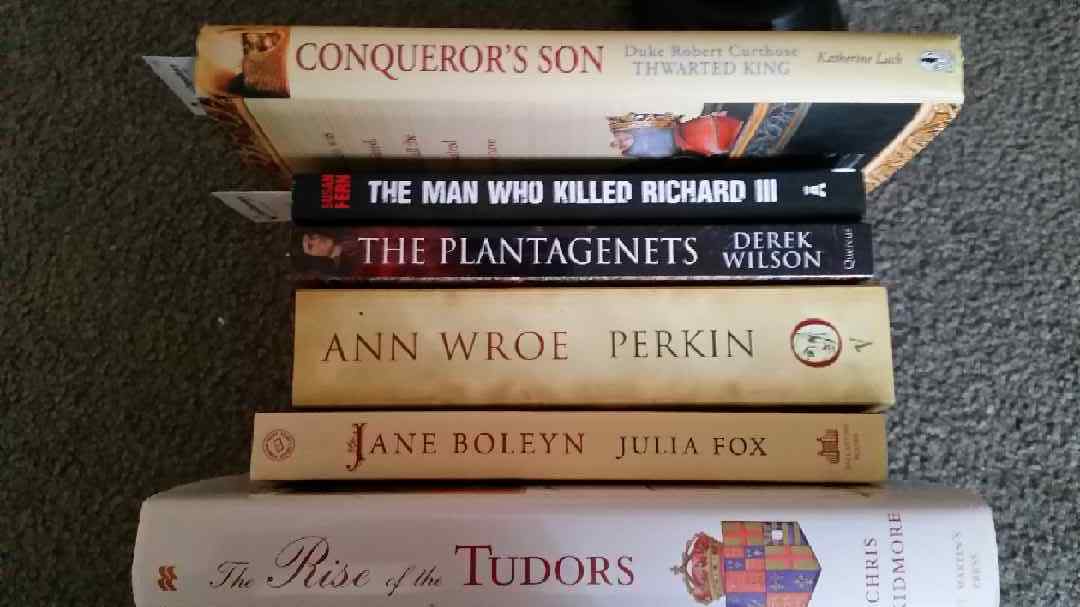
Part 2 of September's additions to the Library include:


Conqueror's Son : Duke Robert Curthose, Thwarted King by Katherine Lack - In "Conqueror's son" Katherine Lack redresses the balance of opinion on Robert Curthose. There is no doubt that Robert was rebellious, but the fact remains that the throne of England was meant to pass to him on the death of William the Conqueror. William Rufus and Henry I were thus usurpers, which casts a new light on English history.

The Man Who Killed Richard III : Who Dealt the Fatal Blow at Bosworth? by Susan Fern - On 22 August 1485 on a battlefield in Bosworth, Leicestershire, King Richard III, the last of the Plantagenet kings, was dealt a death blow by the man who had sworn loyalty to him only a few months earlier. That man was Rhys ap Thomas, a Welsh lord, master of Carew Castle in Pembrokeshire. For his service that day he was knighted on the field of battle by Henry Tudor. 

The Plantagenets : The Kings That Made Britain by Derek Wilson - Featuring some of England's greatest but also most notorious kings, the house of Plantagenet would reign for over 300 blood-soaked, yet foundational, years. 

Perkin: A Story of Deception by Anne Wroe - Anne Wroe manages to achieve the impossible: to reconstruct the life of a young man whose identity can never be taken for granted. On the way she described in breathtaking detail the illusions, longing and deceptions that characterised the last years of the fifteenth century: a world quickly losing its medieval certainties, and trembling on the brink of a whole new age of discovery.

Jane Boleyn : The Infamous Lady Rochford by Julia Fox - The story of Henry VIII's queens - as seen through the eyes of Jane Rochford, sister-in-law to Anne Boleyn and cousin to Katherine Howard. Jane Rochford was sister-in-law to Anne Boleyn and Lady of the Bedchamber to Katherine Howard, whom she followed to the scaffold in 1542. 

The Rise of the Tudors : The Family That Changed English History by Chris Skidmore - The Rise Of The Tudors is much more than the account of the dramatic events of that fateful day in August 1485. It is a tale of brutal feuds and deadly civil wars, and the remarkable rise of the Tudor family from obscure Welsh gentry to the throne of England--a story that began sixty years earlier with Owen Tudor's affair with Henry V's widow, Katherine of Valois.

Wednesday, April 17, 2013

Review: Anne of Cleves: Henry's Luckiest Wife


I had the pleasure of reading a new (and soon to be published) work by David featuring the fourth wife of Henry VIII of England and entitled "Anne of Cleves: Henry's Luckiest Wife".

Anne has had a bit of a rough time at the hands of chroniclers and writers, being described as being most unpleasant in appearance and personal charm, folksy and uncultured, the Flanders Mare; and yet she also comes across as smart, personable and even pleasant of appearance, and certainly shrewd enough to make a financially beneficial “divorce” from Henry which set her up for the rest of her life in England.  Even today, Anne remains an enigma.

This retelling of Anne’s life is initially told to us in the first person by Anne herself, as she reflects upon her life and the events leading up to her marriage to Henry VIII, King of England.  Anne’s recollections are interspersed with a more standard retelling of events as they occurred before, during and after her marriage.  We find Anne adjusting to court life around her and to her change of status once the divorce was made formal. We are then taken through the events that took place from the death of Henry VIII to Anne’s own demise.

I found this to be a rather enjoyable read, and David presents Anne in a more personable light, attributing to her some measure of intelligence and understanding of the politics of the day, as well as being a typical Tudor-era woman who enjoyed the finer things in life – friends, fashion, gossip, the good life.

Anne certainly was the luckiest of Henry’s wives – she married Henry and managed to keep her head!  And she outlasted both Henry and all his other wives, dying aged 41 in 1557.

For those with a love of all things Tudor, this is a must for your personal library.

David has written a number of  works that readers will enjoy – I certainly found his book on Shakespeare quite intriguing!


You can see a full list of David's books at his website - author website and Goodreads website