Showing posts with label sagas. Show all posts

Sunday, December 25, 2022

Review: The Loki Sword by Angus Donald

Synopsis: An ancient blade, fit for the gods but tainted with a deadly curse. Bjarki Bloodhand has finally managed to subdue his gandr, the spirit that gives him the ferocity of a bear in battle. Yet losing his berserker prowess may leave him at the mercy of his foes.

Meanwhile, his half-sister, the shield maiden Tor Hildarsdottir, has slain two warriors from the personal retinue of the new Jarl of Norrland – and now faces brutal reprisals for their deaths.

Valtyr Far-Traveller claims he has a solution to their problems: a long voyage south to the wild Slav lands to find a fabled lost sword said to once belong to the Norse trickster god.

The journey will prove more perilous than anything Bjarki or Tor has ever attempted before. Can all three heroes hope to survive the desperate hunt for... The Loki Sword?


This third instalment in the Fire Born saga sees our intrepid trio - Bjarki, Tor and Valtyr - go in search of the famed Loki Sword. The epic takes place around Silesia and Prussia, with their enemies - the Black Cloaks - or Franks, hard on their heels at every turn. Will our adventurers and their motley band succeed in their quest or fall victim to betrayal and conspiracy?

As usual, Angus Donald imbues his books in the history and mythology of the period, creating an insight into 8th Century northern European world, whilst at the same time, propelling (and projecting) the reader, full body, into the story.

Sunday, May 22, 2022

Review: The Bear's Blade by Tim Hodkinson

Synopsis: How do you defeat the undefeatable?

935 AD, Norway. Recovering from horrendous injuries, Einar finds himself unable to fight. He is not strong enough to defeat his rival, Eirik, who has seized Orkney despite Einar being the rightful Jarl.

Eirik's men soon raid the Norwegian coast, led by a warrior called the Bear. Cruel and ferocious, the Bear possesses a legendary blade – one that gives him a skill in battle that cannot be matched. Such an extraordinary sword could be key to Einar's plans – but first he and the Wolf Coats must contend with the Bear himself.

Caught between old foes and new ones, Einar must use all his wits to survive. But is a man who cannot wield a sword capable of being a true Viking warrior?


Book Five in the Whale Road Series ... and it doesn't disappoint. Wounded from a dual with his father, and unable to defeat his rival and nemisis, Einar realises that the ".. powers of chaos are loose ...". Separated from the Wolf Coats, Einar must heal and adapt in the face of Viking onslaughts that gives rise to a new terror - The Bear!.

Einar soon realises that this mighty warrior wields a sword more powerful than the Wolf Coats own Ulfberht sword - and to discover the secret of this powerful weapon, Einar must become a cuckoo in the nest of the Bear! Meanwhile, Eirik Bloodaxe is still a thorn in the side of the Wolf Coats - and vice versa. Eirik's queen Gunnhild will stop at nothing to see her husband secure on the throne of Orkney even if this means performing a sacred ritual and sacrifice.

Once again, the tension mounts with the increase in action, as our motley band of warriors hurtle towards their inevitable confrontation with Eirik - will they prevail, will Einar resume the path of the warrior? All we know for sure is that the Wolf Coats will live to fight another day .... afterall, it's hard to keep a good band of warriors down!


Monday, June 14, 2021

Review: The Serpent King by Tim Hodkinson

Sysnopsis:
AD936 
The fight for vengeance has no victors...
The great warrior, Einar Unnsson, wants revenge. His mother's assassin has stolen her severed head and Einar is hungry for his blood. Only one thing holds him back. He is a newly sworn in Wolf Coat, and must accompany them on their latest quest.

The Wolf Coats are a band of fearsome bloodthirsty warriors, who roam the seas, killing any enemies who get in their way. Now they're determined to destroy their biggest enemy, King Eirik, as he attempts to take the throne of Norway.

Yet, for Einar, the urge to return to Iceland is growing every day. Only there, in his homeland, can he avenge his mother and salve his grief. But what Einar doesn't know is that this is where an old enemy lurks, and his thirst for vengeance equals Einar's...


This is a bloody brilliant series! And can I say that when we ever get to the end, I will be starting from the beginning in a self-indulgent binge session.

So, what's happening in Europe and Scandinavia in 936AD. In Iceland, what is referred to as the "age of settlement" was coming to its conclusion. The Landnámabók (“Book of the Settlements”, written c. 13th century) records how the first set of law codes was presented to the Athling (assembly of free men) in around 930AD. Communities tended to be a form of self-government, though often in co-operation with other nearby settlements; the bloodfeud was being replaced by a system of fines; and Christianity was decades away from yet taking foot.

Norway was still in thrall to Eirik Bloodaxe but not for much longer. Eirik's half-brother Haakon, who had been fostered by King Athelstan, as part of an agreement made by his father King Harald Farhair, was being fitted out with with ships and men for an expedition against his half-brother. Eirik was on the back foot and looking for allies. And it is to Orkney that Eirik looks, and where Einar's greatest foe - his own father Thorfinn Skull-Splitter - resides.

But do not for one moment suppose that medieval politics was in any way, shape or form, clear cut. Rulers and their followers formed alliances as and when it was prudent to do so; loyalty was bought and sold across the Kingdoms of Northumbria, Scotland, Dublin, Man, and Norway; kings were raised up and brought down with unnerving regularity. These leaders were often larger than life characters, who, had their deeds not been so readily documented, may have passed unremarked from the pages of history. This was the time of heroes and sagas; great battles and adventures; of an old world fighting to hold back the ever encroaching tide of the new.

It is back into this muddy whirlpool of politics, religion, loyalty and revenge that we once again find our motely band of Wolf Coats, as old enemies return and new ones are sent forth to distract and delay them at every turn. As Einar muses:" ... all the vipers are here .... I am right in the middle of a snakepit ..." Einar himself is still seeking out those responsible for his mother's murder and his journey will ultimately come full circle. Though what awaits him at its ends is quite unexpected.

Hodkinson once again draws the unaware reader ever deeper into the tale (or saga if you will) - like quicksand, once you have taken your first tentative steps, the ground falls away from under your feet, and you are carried along - in this instance, at the author's whim.  

At the end of every book, I constantly find myself asking what more can there be - how can Hodkinson keep the reader spellbound - and yet he somehow manages it, channeling the skalds of old as the words flow from pen to paper, with nary a dull moment in between.  If you haven't yet taken the journey down the Whale Road, it is high time you did.


About the author
Tim Hodkinson was born in 1971 in Northern Ireland. He studied Medieval English and Old Norse Literature at University with a subsidiary in Medieval European History. He has been writing all his life and has a strong interest in the historical, the mystical and the mysterious. After spending several happy years living in New Hampshire, USA, he has now returned to life in Northern Ireland with his wife Trudy and three lovely daughters in a village called Moira.


Tim is currently working on a series of viking novels for Aries Fiction, an imprint of Head of Zeus.

Buy links:
Amazon: https://amzn.to/3oNubLI
Kobo: https://bit.ly/3wKzs9Z
Google Play: https://bit.ly/34edsYu
iBooks: https://apple.co/3ukCyzy

Follow Tim:
Twitter: @TimHodkinson

Follow Aries:
Twitter: @AriesFiction
Facebook: @AriesFiction
Website: www.headofzeus.com


Saturday, June 5, 2021

Blog Tour - The Serpent King by Tim Hodkinson

Yes again I am on the blog tour for the new instalment in Tim Hodkinson's "Whale Road Chronicles". Book four - The Serpent King - is due our shortly and is the next in the continuing saga of Einar and the motley band of Wolf Coats.

Come back and check out my review when the tours passes this way! In the meantime, if you haven't already, dip into the first three!


Monday, March 22, 2021

Review: The Last Berserker by Angus Donald

Synopsis: 771AD, Northern Europe. An epic battle for the soul of the North.

Bjarki Bloodhand and Tor Hildarsdottir are journeying south into Saxony. Their destination is the Irminsul, the One Tree that links the Nine Worlds of the Middle-Realm. In this most holy place, they hope to learn how to summon their animal spirits so they can enter the ranks of the legendary berserkir: the elite frenzied fighters of the North.

One Christian king Karolus, newly crowned King of the Franks, has a thorn in his side: the warlike Saxon tribes on his northern borders who shun the teachings of the Church, blasphemously continuing to worship their pagan gods.

The West’s greatest warlord vows to stamp out his neighbours’ superstitions and bring the light of the True Faith to the Northmen – at the point of a sword. It will fall to Bjarki, Tor and the men and women of Saxony to resist him in a struggle for the fate of all Europe.


Another in a great line up of "hero quest" historical fiction that is set in the Northern Hemisphere - particularly Scandinavia - from the 8th -11th centuries. So if you are a fan of Matthew Harffy's A Time for Swords and Tim Hodkinson's Whale Road Chronicles, this this one is for you.

Recently outlawed Bjarki Bloodhand suddenly finds himself on the road in the company of shield-maiden Torfinna Hildarsdottir and the mysterious Valtyr Far-Traveller, Their destination is not certain as they head towards the Dane-mark of King Siegfried. For war is looming with the Franks under the charismatic leader Karolus. However, as both display traits of the Rekkr, it is to the mysterious and sacred groves of Irminsul to find out if they have what takes to be a true Rekkr (or Berserker).

There are - of course - many adventures and battles along the way as our intrepid duo find themselves at odds not only with Charlemange but also the new religion - Christianity - which is establishing a firm foothold.  Throughout, both struggle to find and harness the power of their "gandr" or warrior totem spirit.  Will they find this inner strength in time to save the north from the Frankish incursions or will they be too late ...

Love the historical context that the author then treats us to at the end - I always like to know - apart from the obvious - where they draw their inspiration from and if based on real life events. And for those wishing to delve into this genre and the sagas of the Scandinavians, you may find certain parallels in the story of Beowulf or the saga of Bodvar Bjarki.

A great start to what promises to be the first in a new action-adventure series.


Sunday, January 20, 2019

Review: Viking Warlord - A Saga of Thorkell the Great by David Mullaly

Some stories are meant to be both savoured and devoured - this is one of them.
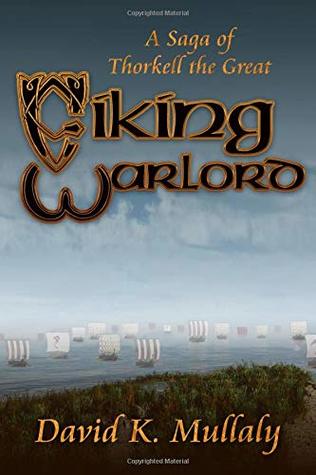
42142226The late Anglo-Saxon period of English history which saw the rise of the - for want of a better word - Danish invasions, was a period I was fascinated in, with my own library containing a number of tomes on the subject matter.     Like David, I too was fascinated by Thorkell the Tall (the Great, the High), being inclined as I am to the more obscure historical characters, and those with a less than pristine reputation - the supporting cast.  To put him in context, he is the Danish William Marshall.  Indeed, this is another example of where the facts are far more interesting.

The tale takes place in both the 10th and 11th centuries, when England was under the rule of Aethelred II (also known as the Unready) and paying what is known as the Danegeld to keep the maruading Danish host, first under Harold Bluetooth and then his son Sweyn Forkbeard, at bay.  From Skane (part of the then Danish empire), came Thorkell, who proved himself as a warrior in such a way that he became one of the leaders of the Danes on their raids.

The Anglo-Saxon Chronicle (hereafter ASC) records the arrival at Sandwich 1st  August 1009 of an "immense hostile host", one manuscript specifying "to which we gave the name of Thurkil´s host", which invaded Kent, the Isle of Wight, Sussex, Hampshire and Berkshire, before returning to Kent to take up "winter-quarters on the Thames" and the following year invading East Anglia and other parts of England, culminating in the kidnap and murder of Ælfheah Archbishop of Canterbury.

Florence of Worcester records that "Danicus comes Turkillus" invaded England with a fleet, dated to 1009 from the context, and that other fleets led by "duces Hemingus et Eglafus" landed in August at "Tenedland" [Thanet] after which the invaders joined forces to devastate Kent, the Isle of Wight, Sussex and Southampton, and establish themselves in the Thames valley for the winter.

William of Malmesbury says that "Turkill the Dane, who had been the chief cause of the archbishop´s murder, had settled in England and held the East Angles under subjection" and that he "sent messengers to Suane [Sweyn Forkbeard] king of Denmark inviting him to come to England".

As the contemporary chronicles record, Thorkell spent three years successfully raiding with his brother Hemming, until they were eventually "bought off" for the considerable amount of £48,000 (1012). In the end, this army were hired as mercenaries by Aethelred II to protect him from an impending invasion. Joining him in the defence of London was another character - Olaf Haraldsson (later St Olaf of Norway). Many of these larger than life characters that wander across the pages were in fact real.
Related image
The Anglo-Saxon Chronicle records the invasion of England led by Sweyn King of Denmark in 1013, stating that the invaders "went east to London" where "the citizens would not submit…because King Æthelred was inside and Thurkil with him".

When Sweyn invades, Aethelred is forced to flee to Normandy; but Sweyn's victory is shortlived as he dies "... a death with no honour ..." Following this period we see Thorkell rejoin the retinue of Cnut. How and why this occurred is open to speculation but having been Cnut's foster father and also a valuable warrior, Cnut may have been content (for the moment) to welcome Thorkell back into the fold.  How and why aside, Thorkell defected back to join Cnut's invasion fleet in August 1015 and fought with the Danes at Ashington [Assandun] in October 1016.

William of Malmesbury records that Cnut King of England divided the kingdom into four parts "he himself took the West Saxons, Edric [Streona] the Mercians, Turkill the East Angles, Iric [Erik Haakonsson] the Northumbrians". Simeon of Durham records that King Cnut granted East Anglia to "earl Turkill" in 1017 whilst the ASC (1017) records that when dividing the kingdom, "East Anglia for Thurkyll".

It is only after Cnut takes power that his true character is revealled - his cruelty grows - "... gaining a kingdom can change a man .  And he wasn't finished ..." - it was not just with the family of his predecessor that Cnut turned his attentions but to his own supporters " ...for it is dangerous for a leader to owe someone more than he can give ...." (we now know where Henry VIII took his playbook from). As the body count rises, Thorkell's comrade Eric Haakonsson is reflective " .... conflicting loyalties can bleed us dry ...".

It is probable that the king appointed Thorkell regent of England in 1019, during his absence in Denmark, he was afterall, the most prominent of Cnut's magnates and his name featured prominently on charters of the period; however, there was an obvious falling out as William of Malmesbury wries that "in process of time…Turkill and Iric were driven out of the kingdom and sought their native land" - the ASC (1021) "This year, King Knute, at Martinmas, outlawed Earl Thurkyll.." Florence of Worcester records that King Canute expelled "Turkillum…comitem cum uxore sua Edgitha" from England 11th November, dated to 1021.  

All we really know is that Eadric was executed within a year of Cnut's accession (According to the Encomium Emmae, Cnut ordered Eric to "pay this man what we owe him" and he chopped off his head with his axe); Thorkell was outlawed and returns to Skane (c.1021), and that Erik fades from the pages, presumed dead, though his lands don't pass to his successor till 1033. According to the Norse sources Erik died of a hemorrhage after having a medieval medicine either just before or just after a pilgrimage to Rome (no sources mention exile). Could it be a purging of the old guard, could Cnut have perceived Thorkell as a real threat - a rival - for power in England, and as such removed him.

Related imageThe ASC  adds in a later passage that the Thorkell and Cnut entered a pact of reconciliation (1023) under which Thorkell would govern Denmark, keeping each other's sons as hostages: ".. He committed Denmark and his son to the care of Thurkyll ...".  Thorkell remained regent for about three years, being replaced by Ulf, Knud's brother-in-law.  So what happens next after c. 1025 / 1026 - we can only presume he returned to Skane; however there is this interesting passage in the ASC for the year 1039:  "... The Welsh slew Edwin, brother of Leofric, and Thurkil and Elfget, and many good men with them..." - if this were the case, Thorkell would have been in his 60s - if this is our Thorkell at all ..... and the question remains, what was he doing in the Mercian army attacking Rhyd y Groes (near Welshpool).


What David has done is gathered together a plethora of resources from which to craft a compelling and invigorating story of Thorkell in the skaldic tradition. In Scandinavia a skald was " ... a composer and reciter of poems honouring heroes and their deeds .." Their oft-times lengthy verses commemorated kings and others, and celebrated their many deeds of daring-do; and over time, their position at court become more prominent as they became the oral recorders of their own history.

And so Thorkell's story unravels in front of a renown skald, Eyolf (composor the Bandadrápa - the deeds of Eiríkr Hákonarson), whom he has summoned to appear before him so that he might recount his story and have it re-told far and wide - for Thorkell is now an aged warrior, battle-hardened, who has witnessed (and done) much. He now fears that if his story is not told, he will be forgotten by all but his own kin.

As the chapters progress, Thorkell's story is spun and teased out before a captive audience - his family, neighbours, and we the reader. As always, each night's telling is left with the proverbial cliff-hanger, a dispersal of wisdom, or running commentary (a bit akin to today's modern television serials). David neatly wraps up Thorkell's story so that we are given a possible outcome to his final years.

What I found most refreshing was that unlike some historical novels, this one was not loaded up with local vernacular and colloquisms and period dialect used by numerous authors of historical fiction to add authenticity, but which so often encumbers and destroys a story unnecessarily. I get that characters come from different areas, but I want to spend my time enjoying a novel not trying work out what they are saying. Thankfully not an issue here - the structure flowed seamlessly.

As Thorkell himself says: " ... most of our lives are what happens between one fight and the next ..."


I am looking forward to reading Eadric and the Wolves - the story of Eadric of Mercia, who features in Thorkell's story.
Seen as a villain by many during his lifetime and after, he is surrounded by people who casually employ treachery, and institutions that consistently act in bad faith. In this thoroughly researched novel, David Mullaly tells a story that challenges the traditional narrative about Eadric.  Appearances can be profoundly deceiving. Loyalty in the defense of evil is no virtue, and what may look like betrayal could be the only good option for a brave leader.


Notes:
There was no standardised spelling of names and places names; scribes tended to write phonetically, and hence there names recorded in the various chronicles of the times can look completely different (ie: Knud Kvud, Cnut, Canute).

There was more than one copy of the Anglo Saxon Chronicle - and once copied and dispersed, each was independently updated (hence some inconsistencies with dates / names / events).

Further reading:
The Saga of the Jomsvikings trans Lee M. Hollander
An Onslaught of Spears: The Danish Conquest of England by Jeffrey James
The Saga of the Jomsvikings trans NF Blake

Saturday, November 10, 2018

Guide to the Classics: The Icelandic Saga


Icelanders love books, both reading and writing them, and in recent years, translations of contemporary Icelandic literature have made it into bookshops and literary pages abroad in increasing numbers.

“Saga” is an Icelandic word that means “something said, a narrative.” Originally, the term is likely to have been applied to stories that were probably formed and transmitted orally. Later, they came to be recorded in writing, in handwritten manuscripts, many of which survive to the present day, though a good number have perished over the past 500 years or so.

Sagas of kings are historical biographies of the kings of Norway (and to a lesser extent, of Denmark) from prehistoric times into the 14th century.

The most widely accessible at present are probably the most recent Penguin translations, which are new editions of a five-volume series originally published in Iceland in 1997 as “The Complete Sagas of Icelanders.” 

My personal favourite compilation is Jane Smiley's "Sagas of the Icelanders

Saturday, September 29, 2018

Master of War Series by David Gilman

I confess to not having read the first two in the series when I embarked upon read the third - Gates of the Dead by David Gilman - but found that I could read this one with no trouble (there are hints at Blackstone's background along the way). 


What attracted me to the story was the character of Sir Thomas Blackstone - for me he was a cross between Richard I, Sir John Hawkwood, Sir John Mandeville and William Marshall (plus a few others). All were larger than life men of their times - soldiers, adventurers - where fact was far more interesting than fiction - they were the type of real historical characters that make good fictional ones.

I like epic sagas where the main protagonist embarks on a quest / a mission / revenge for a past wrong. If this is your type of history, then you will enjoy reading this series.


Here is a bit of a synopsis of each book in the series to date:

Master of War - The Blooding:
England, 1346: For Thomas Blackstone the choice is easy - dance on the end of a rope for a murder he did not commit, or take up his war bow and join the king's invasion of France. As he fights his way across northern France, Blackstone will learn the brutal lessons of war - from the terror and confusion of his first taste of combat, to the savage realities of siege warfare. Vastly outnumbered, Edward III's army will finally confront the armoured might of the French nobility on the field of Crécy. It is a battle that will change the history of warfare, a battle that will change the course of Blackstone's life, a battle that is just the first chapter in a book of legend - Blackstone: Master of War.


Master of War - Defiant Unto Death:
The Black Prince has launched a devastating raid deep into France, laying waste to everything in his path. In response, the French have mustered an army that outnumbers the English forces 10 to 1 and and are determined to drive their hated foe from the land after years of bloody conquest.  Sir Thomas Blackstone, the British archer knighted on the field of Crecy, has used the intervening years to forge his own war band and has hacked out his own fiefdom in central France. He knows the English are outnumbered, outmanoeuvred and exhausted... but that will not stop him from fighting his way to one of history's greatest military victories.  But the field of battle is not only arena in which Blackstone will have to fight for his life... Although Poitiers was a great victory for the English its aftermath will cost Blackstone dear.


Master of War - Gate of the Dead:
Tuscany, 1358: Thomas Blackstone has built a formidable reputation in exile, fighting as a mercenary amid the ceaseless internecine warring of Italy's City States. But success has bred many enemies, and when a dying man delivers a message recalling him to England, it seems almost certain to be a trap. Yet Blackstone cannot disobey – the summons is at the Queen's demand.  On his journey, Blackstone will brave the terrors of the High Alps in winter, face the Black Prince in tournament, confront the bloody anarchy of a popular revolt and submit to trial by combat.  And every step of the way, he will be shadowed by a notorious assassin with orders to despatch him to Hell.

Master of War - Viper's Blood:
1360. With the English army at the gates of Paris, Blackstone faces his deadliest mission yet in the fourth instalment of the Master of War.  Edward III has invaded France at the head of the greatest host England has ever assembled. But his attempt to win the French crown is futile. The Dauphin will no longer meet the English in the field and the great army is mired in costly sieges, scavenging supplies from a land ruined by decades of conflict.  Facing a stalemate – or worse – the English are forced to agree a treaty. But peace comes at a price. The French request that Blackstone escort their King's daughter to Italy to see her married to one of the two brothers who rule Milan – the same brothers who killed Blackstone's family to revenge the defeats he inflicted on them. Blackstone, the French are certain, will never leave Milan alive... 

Master of War - Scourge of Wolves:
Winter, 1361: After two decades of conflict, Edward III has finally agreed a treaty with the captive French King, John II. In return for his freedom, John has ceeded vast tracts of territory to the English. But for five long years mercenary bands and belligerent lords have fought over the carcass of his kingdom. They will not give up their hard-won spoils to honour a defeated king's promises.  If the English want their prize, they'll have to fight for it... Thomas Blackstone will have to fight for it.  As he battles to enforce Edward's claim, Thomas Blackstone will see his name blackened, his men slaughtered, his family hunted. He will be betrayed and, once again, he'll face the might of the French army on the field. But this time there will be no English army at his back. He'll face the French alone.

Monday, March 12, 2018

Review: Raven Saga by Giles Kristian

Preceeding all the hooplah of the series, "Vikings", was this trilogy by Giles Kristian. The story of a young man, taken as plunder when Norsemen attack his village, to metamorphysis into the warrior Raven. This is a period of history that holds great interest to me - I love the Viking Sagas, the journey of King Harald, of Egil, of Leif, and not to mention the heroic women. The historical re-creation of a time when the coastlines of what is now Ireland, Scotland and England, were subjected to the raiding of the Norse and the emergence of some larger than life characters is fascinating. And this is primary what drew me to book one, and the two subsequent tomes.


Book One - Raven - Blood Eye:
For two years Osric has lived a simple life, apprentice to the mute old carpenter who took him in when others would have him cast out. But when Norsemen from across the sea burn his village they also destroy his new life, and Osric finds himself a prisoner of these warriors. 

Immersed in the Norsemen's world and driven by their lust for adventure, Osric proves a natural warrior and forges a blood bond with Sigurd, who renames him Raven. When the Fellowship faces annihilation from Ealdorman Ealdred of Wessex, Raven chooses a bloody and dangerous path, accepting the mission of raiding deep into hostile lands to steal a holy book from Coenwolf, King of Mercia. There he will find much more than the Holy Gospels of St Jerome. And he will find betrayal at the hands of cruel men, some of whom he regarded as friends...

So, what did I think? I don't mind the first person narrative as we are immediately drawn to the character of Osric / Raven. The promises a tale of adventure, of battles, of plunder, of brotherhood, of betrayal - standard go-to plotline - young man captured, finds fidelity among the warriors, enter one bad guy hell bent on destroying the Fellowship, hero finds love and betrayal. But I found it a little flat - maybe it was just not the right time when I initially read this tale (2012), but looking back at my notes, I don't think so. Others have raved that Kristian is surely the heir-apparent to Bernard Cornwall - this really has no bearing on my review as I am not such a fan of Cornwall.


Book Two - Raven - Sons of Thunder:
Raven and his Wolfpack of Norsemen have been double crossed. The traitor Ealdred seeks to sell a holy book to the Emperor Charlemagne which will ensure riches beyond his wildest dreams. Greed drives him forward, but a band of fearsome warriors is in pursuit across the sea to Charlemagne's Frankish empire -- with the bloodiest of revenge on their minds.

Slaughter is certain as the Fellowship trap Ealdred and his men at the mouth of the river Sicauna in Frankia. Sigurd the Lucky challenges Ealdred's bodyguard Mauger in an ancient duel called the holmgang, and only one will walk away with his life. 

The continuing saga of the Viking Raven and his band of warrior brothers with the Fellowship on the trail of the evil Ealdred and pursue him to the lands of Charlemagne. This builds on book one, and I was pleased to say that the action and adventure picks up, and my reading interest was suitably maintained. The characters are finally developing, and the descriptive narrative of the journey is engaging. A much stronger outing with this book as Kristian has managed to capture the times (the good, the bad, the ugly) well. 


Book Three - Raven - Odin's Wolves:
Plunging through the living hell of Pope Leo’s shattered, perverted Rome, the dragon-faced ships of Sigurd the Lucky are manned by a strange and fearsome crew: among the Norsemen is Raven, a young man of uncertain parentage ...robbed of the woman he loves, destined to play a cunning role in the boldest of attacks. For the Vikings are on their way to glimmering Constantinople to put a deposed emperor back on his rightful throne—and claim the most magnificent prize of all. 

Travelling through Rome, the Fellowship is on its way to Constantinople. And here again I found the story a little bland, until the last when the action finally kicks in. I found the journey wasn't as fluid as in book two.

On another note, it is rather strange that after reading this series I found out that these stories fall in the latter stages in the life of Sigurd Haraldarson, and that there is a set of books dealing with his earlier story. I am pleased, in a strange way to hear this, as I felt more empathy with Sigurd than Raven. I might even revisit the Raven series after tackling Sigurd.


For more on Sigurd see:
  • God of Vengeance
  • Winters Fire
  • Wings of the Storm


Sunday, June 11, 2017

Review: The Fortunes of France by Robert Merle

This is an epic thirteen book series which "tells the story of Pierre de Siorac, a young Huguenot nobleman, and follows his adventures as he tries to balance his competing loyalties, to his faith and king, during the bloody French Wars of Religion of the sixteenth century, which pitted Catholics and Protestants against each other and tore the country in two."

These books are very descriptive – sometimes painfully so, and, I cannot emphasis the word enough, detail events from the French perspective. The story telling is, at times,  cumbersome as it reads like a history lesson, again from the French perspective.  We are also treated to a very detailed monologue of the cast of characters and their history.  In the beginning, I could not follow who was actually narrating events – it is Pierre (bc.1551), who retells of events that have occurred in the past until we reach current events (Book 3).

Book 1: The Bretheren - covers the period 1547 -1565
We are introduced to the Protestant de Siorac family, living in the Perigord region of France, and are told how they and their entourage came to occupy Mespech (1545) – these are “the Bretheren” of the title (Jean de Siorac, Jean de Sauveterre, and three other veteran soldiers).

Book 2: City of Wisdom & Blood - covers the period 1565 – 1570
Now an adult, Pierre de Siorac leaves Mespech and travels sto Montpellier, accompanied by his brother Samson and the crafty Miroul. This new life away from the safety of their home will bring with it many dangers and delights.

Book 3: Heretic Dawn - begins from 1570
Pierre de Siorac travels to Paris, where he becomes embroiled in personal and political intrigues at the royal court before the capital erupts in the communal violence of the St Bartholomew’s Day Massacre, and he and his companions must fight for their lives.


It is a series definitely worth pursuing – I read the kindle versions of these three books, which probably detracted from my reading pleasure, as I do prefer to have a "hard copy" in my hand when reading

See Also:

Saturday, April 1, 2017

Viking Women: Not as Different as You Might Think - Medievalists.net

Heather Day Gilbert talks about her book God's Daughter at Medievalist dot net
My novel, God’s Daughter, tells the story of Gudrid Thorbjarnardottir. I know you Viking-o-philes know exactly who I’m talking about, but I’ll elaborate a bit. She’s the first documented European woman to have a baby on North American shores. She traveled here with her sailor husband, Thorfinn Karlsefni (“Finn” in my novel). She was a Christian. She was wise and beautiful. And she was the ward of Eirik the Red.
I wanted to base my novel as closely as possible on the Icelandic Sagas. Even though the sagas are sparse, you get a really good feel for the Viking women who lived around AD 1000.
I hope my story, told from Gudrid’s point-of-view, shows Viking women in a whole new light. Forget horned helmets and funky braids. Viking women weren’t that different from us. And they’re worth learning more about.
You can read more on Gudrid Thorbjarnardottir here at:
- Murder Is Everywhere
- The Ages of Exploration
- Travelling feminist (Penguin Unearthed)
- Hurstwic
- Discoveries of the Americas
- Wikipedia


Wednesday, February 22, 2017

Viking Society Publications

The Viking Society for Northern Research is making virtually all its publications (and some other related items) from inception in 1893 to the present freely available on this website, though recent titles may not be released until three years from the date of publication.

These digital versions are not intended to replace our printed publications, and titles currently in print will remain available to buy in book form as long as there is a demand for them (the list can be seen at www.vsnr.org/publications/ ). The digital versions are intended to make the range of our publications known to a wider public, and may be used for reference purposes, to evaluate books for purchase or for university courses and for private study. The copyright belongs either to the authors or to the Viking Society, as stated at the beginning of each work, and permission must be obtained from the Society to use downloaded versions either in whole or in part for any other purpose.

See full list here @ Viking Society Publications