Showing posts with label templars. Show all posts

Sunday, December 24, 2023

Review: The Last True Templar by Boyd and Beth Morrison

Synopsis: A Perilous Quest. A Deadly Legacy.

Italy, 1351. English knight Gerard Fox and the resourceful Willa have come through a death-defying journey across war-torn Europe. Now looking towards their future together, they must first find a way to reconcile with their difficult pasts.

In a small village between Florence and Siena, Fox and Willa are caught up in a deadly ambush. After rescuing the enigmatic woman who is the target of the attack, they take refuge in her opulent villa and learn her heartbreaking story – a tale of loss, deception... and a burning desire for freedom.

Soon, Fox and Willa are involved in a perilous quest to save her family's legacy... and to do so, they will have to solve a mystery that points the way to the fabled lost treasure of the Knights Templar.

~ ~ ~

This second book follows on from the first - The Lawless Land - with ex-communicated Templar and English knight Gerard Fox and his companion, the ever resourceful Willa, now in Italy and on the trail of the hidden Templar treasure.

There is a bit of back and forth between the final days of the Templars in Paris (1314) and the "contemporary" storyline (1351) as the backstory and characters are introduced to and fleshed out for, the reader. There is the usual "cat and mouse" scenario as the details of the secret as slowly teased out, before the final stand-off, and a new adventure for our dynamic duo.

Its a fun, medieval action adventure to while away a couple of lazy days!

Friday, September 10, 2021

Review: Lions of the Grail by Tim Hodkinson

Synopsis: First in an adventure-filled historical series following Irish Knight Templar, Richard Savage, as he is forced to spy on his homeland for the King of England.

1315 AD. Ireland and England are ravaged by bitter war. Rotting in an English prison, condemned as a heretic, Irish Knight Templar Richard Savage is given one chance of reprieve. But there is a catch. He must return to Ireland as a traitor, and work as a spy there for the King of England.

Savage returns to his homeland, but even here he can trust no one. He soon discovers the Scots intend to invade and someone in Ireland is helping them. The King of Scotland also claims to possess a mysterious holy treasure, and many are flocking to his cause. And what's more, Savage discovers he left more than just memories behind in Ireland...

Amid feasts, tournaments, invasion and war, can Savage decide whose side he is really on, discover whether this holy relic is real and, above all, stay alive?


As an avid reader of Hodkinson's Whale Road Chronicles, and having some fore-knowledge of the period in history, I was interested to see how the Scottish invasion of Ireland under the Bruces would pan out under Hodkinson's skillful narration.

This is the first in the series. So for those unfamiliar with the era, Edward Bruce fought alongside his brother Robert throughout his struggle for the Scottish throne, which culminated in the battle of Bannockburn, in which the Scots were victorious (1315). Continuing their war against England, especially after the Isle of Man fell under Scots loyal to England, Robert Bruce decided to open a second front in Ulster. As there had been no High King in Ireland for some time, Bruce figured that in making Edward King of Ireland, concessions could be made in return for localised support.  The Annals of Ulster record the event as follows:
U1314.2
Robert Bruce, king of Scotland, came to Ireland along with many gallowglasses in aid of Edward, his brother, to expel the Foreigners from Ireland.
This is where our story opens, in the events leading up to the invasion of Ireland by the Scots. Our protagonist, Richard Savage, is a Templar of Irish descent, imprisoned in England after the decimation of the Order by Philip of France in 1314. When the King of England, Edward II, needs to get a feel for what is happening in Ireland, he drags Savage out of his imprisonment and sends him across to Ulster to gauge the loyalty of those there and to scupper any plans for "a grand Gaelic alliance against England". As Savage is trusted by neither side, there is plenty of action, battles, captures, escapes, rescues, disguises, secret codes, assassins, an old enemy AND a holy relic.  There is enough to keep the reader entertained, much being centered around the town and castle of Carrickfergus, and ais is duly noted in the narrative "... one thing was sure - there would be more fighting ...".

Now, there has been plenty of speculation as to the relationship between the Knights Templars and Scotland. Treasure hunters claim that in the 14th century, the Knights Templar fled to Scotland with a trove of valuables because they received support and protection from King Robert the Bruce. Templar scholar and medieval historian Helen Nicholson said that any remaining Knights Templar were more likely to be found in Cyprus. One of the first to link the Templar fleet to Scotland was George Frederick Johnson, a Scottish exile in Germany in the mid-18th Century, who said that the Templars had sailed to Scotland. However, Johnson's claims proved to be as fraudulent as he himself was later discovered to be.

A number of actual historical figures make their appearance throughout, including the likes of Roger Mortimer, Richard de Burgh, Thomas de Mandeville, John de Bermingham and the Bruces - Robert and Edward. There is, of course, Edward II - though based upon the description of him in this instance, I find myself imagining him as Claude Rains in his role as Prince John in the 1938 adaption of Robin Hood. Similarly, I picture Lancaster as Basil Rathbone in his role from the same film.

Claude Rains and Basil Rathbone

The female character - to be honest - I could take or leave. Sometimes they are not necessary to the narrative - the cast of characters does not - in my opinion - always need to be "inclusive" or "politically correct" to tell a good story. There does not always have to be some "love interest" to lure in the female reader - sometimes their inclusion feels forced and detracts from the storyline. However, as one continues reading, the female character does have some sort of role.

What I find rather poignant about this whole episode can be summed up in this quote:
"   it's sad that a country that has struggled so long to gain it's own freedom should so soon seek to visit war and oppression on another ... "

I am looking forward to seeing how the rest of the series progresses.


Monday, August 31, 2020

Review: The Cellars of Notre Dame by Barbara Frale

The Cellars of Notre DameSynopsis: Paris, 1298. Disguised as an outlaw, a personage of the highest rank sneaks through the cellars of Notre Dame. The maze of secret tunnels hides a laboratory. Here, occult studies are conducted under the guidance of the renowned scientist, Arnaldo da Villanova. Studies which remain a secret.

Rome, 1301. Denounced for impiety by mysterious informers in Paris, Villanova seeks refuge in Italy and becomes Pope Boniface VIII's personal physician. Yet Villanova knows a secret, one capable of discrediting and overthrowing the French monarchy. He's not safe. It's clear someone wants to silence him forever.  Will he pay the price for the secret he keeps with his life?


Two things attracted me to this book - the subject matter and the author, whose book on the Templars I had read in the past.

Medieval politics is a difficult path to navigate at the best of times. Throw in some papal discord, political and religious machinations, mysterious cabals, superstition, rumour and inuendo, and two political giants in Philip the Fair of France and Pope Boniface VIII (described as two pillars holding up the world), and you have the makings of a very good historical fiction thriller. 

Barely four years into his papal reign, Boniface VIII often involved himself in the foreign affairs of many nations, including in France, Sicily, Italy and Scotland. These chronic and oft unwelcome interventions were the cause of many bitter quarrels. France, at this time, was a war with England over Gascony, and Philip was constantly putting his hands into the coffers to fund these military actions. It was Philip's taxing of the clergy that also brought him into conflict with the papacy.

Frale is a noted historian and paleographer at the Vatican Secret Archives, and her previous works have been in the non-fiction genre. This is her first novel as far as I am aware. The amount of research that has gone into this book is (at times, painfully) evident.

I would strongly suggest that having some interest in this particular period would be a good thing as there are a plethora of characters (real and fictional) that walk across the pages; some add to the story, others are not so critical, leaving me wondering if they were necessary in the first place (mayhap a short list of essential characters at the very start might have been an idea).

The character of Arnoldo de Villanova intrigued me greatly. Was he real or one of those fictional characters that are there to drive the storyline. But no,Arnoldo is real and his exile is documented. I was pleased to see another side to Philip's chief minister, Guillaume de Nogaret. There are many more real-life characters worthy of further research. Truly a cast that would make Cecil B deMille envious.

In additional, there are also a number of themes running through the narrative - some evident; others not so; and these are not cleared up until towards the end. At times, the reader could be left wondering which narrative it is that they should be following and what should be discarded. Much of what is covered off here sets the scene of some more well known historical events that were to tragically play out in the years to come.

" ... you cannot escape the past .... 
 the past always returns and sets before us 
the mistakes we have made ..."

Despite this being an area of interest for me (ie: medieval history and politics), the dearth of information provided sometimes felt oppressive - at page 50 I felt like I was at page 500! So I will stress that this undertaking is not for the faint-hearted.

However, once you get past all of this, the story itself posits a rather  interesting premise, which will have some rushing to their history books or google in search of answers. I will most likely be reading this again.

Sunday, May 3, 2020

Books: Medieval Spain

The Unconquered Knight: A Chronicle of the Deeds of Don Pero Niño, Count of Buelna by Gutierre Diaz de Gamez
The heroic exploits of the 15th-century Count of Buelna, including tournament glories, knightly romance and the bitter hardships of life on campaign.

Gutierre Diaz de Gamez entered the service of Pero Niño, count of Buelna, in 1402, when they were both about 23, and served as head of his military household for nearly fifty years. He began a chronicle of his master's deeds in about 1431, and it is this eyewitness account of the life of a knight, both in war and peace, which is translated here. 

It is written in praise of his master, but beneath the veneer of hero-worship a good deal of the reality of a knight's existence shows through: even in the prologue, Diaz de Gamez gives a bitter picture of the hardships of a military campaign: 'Knights who are at the wars eat their bread in sorrow; their ease in weariness and sweat... Mouldy bread or biscuit, meat cooked or uncooked, water from a pond or a butt, poor sleep with their armour still on their backs, the enemy an arrow-shot off...' On the other hand, he can evoke the glories of a tournament, in which his master excelled, and his triumphs as a military commander both by sea and land. It is a story full of colour, adventure and romance, and one which deserves its place in the chronicles of chivalry.


The Duke of Alba by Henry Kamen
"The Duke of Alba" by Henry KamenFerdinand Alvarez de Toledo, the third duke of Alba (1507–82), is known to history as “the butcher of Flanders.” The general who carried out Philip II’s repressive policies in the Netherlands, he was responsible for the massacre of thousands of men, women, and children, considering it better to lay waste an entire country than leave it in the hands of heretics. Alba came to represent for contemporaries as well as for future generations the unacceptable face of Spanish imperialism.

In this intriguing re-evaluation, Henry Kamen narrates the duke’s personal history, looking beyond the conventional image to reveal motives and to explain rather than simply to condemn. Kamen examines the early years of Alba’s life, his travels over the whole of Europe, and the complex military and political career that made him Spain’s leading general of the imperial age. Drawing on the duke’s rich and expressive surviving correspondence, Kamen explores Alba’s beliefs and considers his infamous actions within the contexts of his time and of the monarchs—Emperor Charles V and King Philip II of Spain—whom he served.


Phillip II by Henry Kamen
"Philip of Spain" by Henry KamenPhilip II of Spain—ruler of the most extensive empire the world had ever known—has been viewed in a harsh and negative light since his death in 1598. Identified with repression, bigotry, and fanaticism by his enemies, he has been judged more by the political events of his reign than by his person. This book, published four hundred years after Philip's death, is the first full-scale biography of the king. Placing him within the social, cultural, religious, and regional context of his times, it presents a startling new picture of his character and reign.

Drawing on Philip's unpublished correspondence and on many other archival sources, Henry Kamen reveals much about Philip the youth, the man, the husband, the father, the frequently troubled Christian, and the king. Kamen finds that Philip was a cosmopolitan prince whose extensive experience of northern Europe broadened his cultural imagination and tastes, whose staunchly conservative ideas were far from being illiberal and fanatical, whose religious attitudes led him to accept a practical coexistence with Protestants and Jews, and whose support for Las Casas and other defenders of the Indians in America helped determine government policy. Shedding completely new light on most aspects of Philip's private life and, in consequence, on his public actions, the book is the definitive portrayal of Philip II.


Commander of the Armada: The Seventh Duke of Medina Sidonia by Peter Pierson
"Commander of the Armada" by Peter PiersonThe seventh Duke of Medina Sidonia is best known as the man who led to defeat the Spanish Armada of 1588. This book by Peter Pierson is the first complete biography in any language of this important figure. Based on previously inaccessible documents from the Medina Sidonia archives, it offers fascinating material on sixteenth-century Spain and new and exciting details about the armada campaign.

Pierson begins by describing the Duke’s youth and his close ties to the court of Philip II. He discusses the Duke’s lifelong involvement with the shipping that navigated the treasure route from Spain to the Indies, his significant role in Philip’s successful quest for the Portuguese Crown, and his appointment as Captain General of the Ocean-Sea. Spain’s war with England dominates the central chapters of the book. Pierson relates how Medina Sidonia embargoed ships and recruited men for the armada, the largest fleet yet concentrated in early modern Europe, and he analyzes Philip’s choice of the Duke to command the armada. 

Pierson provides a radical reinterpretation of the armada campaign, and with the aid of ten superb maps and diagrams he reconstructs the positions of the two navies, the number and names of ships, and their movements from the fleet’s departure for England to the surviving vessel’s arrival home. Pierson continues with Medina Sidonia’s life after the armada campaign and discusses his second appearance on the world stage, as the unsuccessful defender of Cádiz against a major Anglo-Dutch attack in 1596. 


"The Count-Duke of Olivares" by J. H. ElliottThe Count-Duke of Olivares: The Statesman in an Age of Decline by JH Elliott
A masterful biography of Don Gaspar de Guzmán, Count Duke of Olivares—righthand advisor to Spain’s Philip IV, archrival of Cardinal Richelieu, and a central figure in seventeenth-century Europe. Written by the eminent historian J. H. Elliott and based on many original sources, this elegant book is a landmark in the study of a man and an age.


The Catalan Rule of the Templars: A Critical Edition and English Translation from Barcelona, Archivo de la Corona de Aragón, `Cartas Reales', MS 3344 translated by J.M. Upton-Ward
The Catalan Rule of the Templars: A Critical Edition and English Translation from Barcelona, Archivo de la Corona de Arag�n, `cartas Reales', MS 3344The Knights Templar, part monastic order, part military force, lived by a firm code, or rule, which exists in differing versions. This Spanish version is a follow-up to J.M. Upton-Ward's highly successful edition of the French Rule. 

The introduction to this Catalan Rule, Barcelona Archivo de la Corona de Aragón, Cartes Reales, MS 3344, discusses the content, language and dating of the manuscript. It also provides background information derived from the French Rule (which the reader may require for a fuller appreciation of the text - see author note below) on the circumstances of the Knights Templar.

There is a brief description of the provincial organisation of the Order with particular reference to the houses in Aragon, where it is most likely that the manuscript was used; a summary of clauses; and a concordance with de Curzon's 1886 edition of the French Rule. Compared to de Curzon's edition, the Barcelona text is incomplete, but it contains important clauses not found in other manuscripts. 

A partial transcription claiming to represent all the clauses without equivalents in de Curzon's edition was published in 1889, but it omitted several clauses now published here for the first time. 

Footnotes to the English translation elucidate the text; give biographical information on the named officers of the Order where possible; and indicate significant differences compared with the French Rule.


The Victors and the Vanquished: Christians and Muslims of Catalonia and Aragon, 1050–1300 by Brian A Catlos
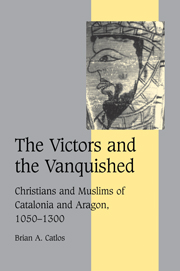
The Victors and the VanquishedThis is a revisionary study of Muslims living under Christian rule during the Spanish 'reconquest'. It looks beyond the obvious religious distinctions and delves into the subtleties of identity in the thirteenth-century Crown of Aragon, uncovering a social dynamic in which sectarian differences comprise only one of the many factors in the causal complex of political, economic and cultural reactions. 

Beginning with the final stage of independent Muslim rule in the Ebro valley region, the book traces the transformation of Islamic society into mudéjar society under Christian domination. This was a case of social evolution in which Muslims, far from being passive victims of foreign colonisation, took an active part in shaping their institutions and experiences as subjects of the Infidel. Using a diverse range of methodological approaches, this book challenges widely held assumptions concerning Christian-Muslim relations in the Middle Ages, and minority-majority relations in general.


Sunday, May 20, 2018

Review: Mystery of the Templars by Martina Andre

Mystery of the Templars
I so wanted to like it (due to my long fascination with the Templars) but it really just lost me and I consider it a waste of my valuable reading time.

My goodness - with the wealth of information, intrigue, legends, scandal and conspiracy theories surrounding the Templars, there was so much that could have been written, but just wasn't taken advantage of in this instance.  

The inclusion of the character of Amalie was unnecessary and left me completely flat - the action scenes with the Templars were fast paced and dynamic enough for a decent storyline. Then it takes a Da Vinci Code turn when the main character, Gerald of Breydenback, finds himself going forward in time, then back, and then forward again to live happily ever after. 

I honestly didn't know if this was supposed to be a thriller with historical overtones, or a poor man's "Outlander" (which I also could not get into).  A good plot that was poorly executed.