Showing posts with label medieval germany. Show all posts

Sunday, March 27, 2022

Review: The Dark Queens by Shelley Puhak

Synopsis: The remarkable, little-known story of two trailblazing women in the Early Middle Ages who wielded immense power, only to be vilified for daring to rule.

Brunhild was a Spanish princess, raised to be married off for the sake of alliance-building. Her sister-in-law Fredegund started out as a lowly palace slave. And yet—in the 6th-century Merovingian Empire, where women were excluded from noble succession and royal politics was a blood sport—these two iron-willed strategists reigned over vast realms for decades, changing the face of Europe.

The two queens commanded armies and negotiated with kings and popes. They formed coalitions and broke them, mothered children and lost them. They fought a years-long civil war—against each other. With ingenuity and skill, they battled to stay alive in the game of statecraft, and in the process laid the foundations of what would one day be Charlemagne’s empire. Yet after Brunhild and Fredegund’s deaths—one gentle, the other horrific—their stories were rewritten, their names consigned to slander and legend.

In The Dark Queens, award-winning writer Shelley Puhak sets the record straight. She resurrects two very real women in all their complexity, painting a richly detailed portrait of an unfamiliar time and striking at the roots of some of our culture’s stubbornest myths about female power. The Dark Queens offers proof that the relationships between women can transform the world.


Merovingian France may not have been on everyone's radar but it had been on mine for quite a number of years - and I had written about both on a old webpage I created back in the late 1990s (now archived for posterity). And in particular, the incredible and oft times deadly rivalry between two women who managed to wield more power than their contemporaries.

So when the opportunity to read Puhak's book, I jumped at the chance. Puhak describes her main aim as being the resurrection of two women "scratched out of history" - much like two earlier notable women - Hatshepsut of the 18th Dynasty in Ancient Egypt and Wu Zhao of 7th Century Tang Dynasty of China.

Firstly we have Brunhilde/a, Queen and wife of Sigebert, King of Austrasia. A women of pedigree who - like her sister before her - was destined for a marriage of political consequence.  And then secondly we have Fredegund/a, a slave-girl at the court of Neustria, who in this capacity came to the attention of Chilperic I, and who clawed her way to becoming his third wife - a position she had no intention of relinquishing.

Merovingian Kingdom
The rivalry between not only these two women but also by the sons of Clothar I King of the Franks, upon the disintegration of his kingdom, would resonate through the generations to come, resulting in the death knell for the dynasty which came barely two centuries later.

Puhak gives the reader a history of the region and social structure, the dynasty, the family, as well as court politics and religion, before finishing with the legacy and fate of the two queens and their offspring.

Both women suffered the same fate in the end - to either be written out of the history books or the have their reputations so besmirched as to become the epitome of the fallen Eve or Jezebel reincarnate. And the fate of Brunhilde would not rear its ugly head under the Tudor Dynasty, when Henry VIII dispatched the aged Duchess of Salisbury in 1541.

Puhak brings all of her research together to provide the reader with an accessible account of the Merovingian period under these two women. Ample notes and sources will be much appreciated by those seeking to further enrich their own knowledge of the dynasty.

Wednesday, December 2, 2020

Review: Cathedral by Ben Hopkins

Cathedral

Synopsis: A thoroughly immersive read and a remarkable feat of imagination, Cathedral tells a sweeping story about obsession, mysticism, art, and earthly desire in gripping prose. It deftly combines historical fiction and a tale of adventure and intrigue.

At the center of this story is the Cathedral. Its design and construction in the 12th and 13th centuries in the town of Hagenburg unites a vast array of unforgettable characters whose fortunes are inseparable from the shifting political factions and economic interests vying for supremacy. Around this narrative center, Ben Hopkins has constructed his own monumental edifice, a novel that is rich with the vicissitudes of mercantilism, politics, religion, and human enterprise.


Ben Hopkins' "Cathedral" is definitely one for readers of The Pillars of the Earth and Cathedral of the Sea, both of which I have and love, so it's a no-brainer that this tome will be joining them on my book shelves. Like those two tomes mentioned, Hopkins' "Cathedral" has a carefully constructed and engaging narrative, a mix of first and third person, of the citizens of Hagenberg and is told against the backdrop of the construction of the city's Cathedral, their lives intersecting across the pages as the years progress. And like the two aforementioned tomes, "Cathedral" may also be worthy of a mini-series of its own

Hopkins' "Cathedral" deftly taps into the psyche of the people associated with its construction - the masters, the guilds, the merchants, the Church, the nobles, whilst exploring the complexity of the mores and prejudices, the political and religious discord of the time. Many of the cathedral workforce was itinerant, moving from one job to another, and so new social elements or social / religious groups would be introduced into these often small, insular communities. 

When I read historical fiction I love to know if events were based on real people, places and events - and to that end I go in search of the "back story". I am now going to touch on some of the themes within the narrative that fascinated me. 


Medieval Cathedral Building 
The building of monumental cathedrals in the middle ages was a reflection of faith and the channel for much of the creative energy of medieval European society. As cathedrals took decades, and often even centuries to complete, few people who worked on them expected to see them finished during their lifetimes. Being involved in the construction of a cathedral, even as the building patron, required a willingness to be part of a process that was larger than oneself. As architectural technology developed further, greater expanses of glass became possible. This led to stained glass becoming an important decorative medium in religious buildings

The most obvious starting point was for an architect to be found who would design a cathedral. An architect would also know who were the best master craftsmen to employ – and many highly skilled men were needed. Each master of his own trade ran a workshop for his own particular trade - these were skilled men and they would not do any labouring – unskilled labourers who lived near to where a cathedral was being built would do this. Many of the skilled workers relied on other trades to keep them at work.

It was typically the Cathedral Chapter that determined how much money could be spent on what. It was the Chapter that would decide on the final design of the cathedral – and it was the Chapter that would instruct the architect on just what they wanted. The cost of these buildings was vast – but the money to pay for these huge buildings came from the people via the many payments they had to make to the Roman Catholic Church in Medieval times.


Holy Roman Empire & Habsburgs
Alsace and Strasbourg have been the object of rival claims by France and Germany up until the very recent past and have experienced multiple changes of possession. Alsace experienced great prosperity during the 12th and 13th centuries under Hohenstaufen emperors. Frederick I set up Alsace as a province to be ruled by ministeriales, a non-noble class of civil servants. The idea was that such men would be more tractable and less likely to alienate the fief from the crown out of their own greed. The province had a single provincial court and a central administration. The Holy Roman Emperor Frederick II designated the Bishop of Strasbourg to administer Alsace, but the authority of the bishop was challenged by Count Rudolf of Habsburg, who received his rights from Frederick II's son Conrad IV


Cathedral of Hagenberg or Strasbourg
Unlike the actual city of Hagenberg (located in Austria), our fictional city is located along the Rhine, and - to my mind anyway - the fictional Cathedral of Our Lady of Hagenberg seems to have much in common with the Strasbourg's Notre Dame Cathedral (or Cathedral of Our Lady). 

The Cathedral of Strasbourg was founded in 1015 on the remains of a previous cathedral. This wooden structure burnt down in 1176-177 and was replaced by a new, Gothic stone building was being built from 1220. Its construction was financed by the free city of Strasbourg , a rich merchant and financial republic. It is also one of two contemporary structures that made use of architectural drawings.

Strasbourg began to grow to become the most populous and commercially important town in the region. Until 1200, the development was limited to the island, which was covered with a grid of narrow streets and lanes.  As the economy flourished, the original medieval city began expanding. 

France and Germany had a long history of "warrior bishops". These bishops in medieval Germany were born into aristocratic or knightly families which prided themselves upon their proficiency in war­fare. It appears that Hopkins tapped into this as inspiration for one of the components of his nove1.  The city of Strasburg rose in defence of its rights against the new bishop, Walter of Hohengeroldseck (r. 1260 - 1263), in 1261. Benjamin Arnold as written a fascinating piece on this phenomenon entitled "German Bishops and their Military Retinues in the Medieval Empire" as has Nicholas Friend in his thesis entitled "Holy Warriors and Bellicose Bishops: The Church and Warfare in Early Medieval Germany".  After this long struggle, its citizens gained the status of a free imperial city in 1262. 


Church & Inquisition in Germany
In 13th cent Germany & France, the Inquisition was alive and well. Their focus was on the Waldensians and Albigensians or Cathars. Conrad of Marpurg, Inquisitor General over Germany sought them out with impugnity in the 1230s, after Pope Gregory IX began to commission Dominicans and Franciscans in Germany, France,Spain and Italy as delegated judges tasked with the prosecution of heresy in 1231.

The bishops were, by default, responsible for the purity of faith in their dioceses. The de-cretal Ad abolendam of Lucius III (1184) ordered that bishops and archbishops, acting either in their own person or through their archdeacon, should conduct an inquiry once or twice a year within those parishes in which any form of heresy had begun to circulate, If there was an indication of heresy, the suspects were to be called to the bishop or to the archdeacon to exculpate themselves through oath. Those who might defy oath-taking,fail to exculpate themselves, or relapse into heresy after purgation, were to be judged by the bishop and handed over to the secular arm. (source: Bishops and the inquisition of heresy in late medieval Germany by Reima Välimäki in Dominus Episcopus Medieval Bishops between Diocese and Court).


Cathars
The Cathars were largely local, Western European/Latin Christian phenomena, springing up in the Rhineland cities (particularly Cologne) in the mid-12th century, northern France around the same time, and particularly the Languedoc—and the northern Italian cities in the mid-late 12th century. 

The Inquisition was established in 1233 to uproot the remaining Cathars. Repentant lay believers were punished, but their lives were spared as long as they did not relapse. Having recanted, they were obliged to sew yellow crosses onto their outdoor clothing and to live apart from other Catholics, at least for a while. Those Cathars who refused to recant or relapsed were hanged, or burnt at the stake. Hunted by the Inquisition and deserted by the once supportive nobles of their districts, the Cathars became elusive, scattered fugitives. 

In the Languedoc and northern Italy, the Cathars attained their greatest popularity, surviving in the Languedoc, in much reduced form, up to around 1325 and in the Italian cities until the Inquisitions of the 14th century finally extirpated them.


Medieval Jewish Community
Into our small fictional community, many arrive looking for work - as do our main characters of Rettich and Emmle Schaffer. The arrival of new transient groups also exposes the community to new thoughts and ideas - and different religious beliefs (see above for the Cathars). 

Early on we are introduced to the resident Jewish population, and the role assigned to them by the dictates of the day - finance. Because pre-modern Christianity did not permit money-lending for interest and because Jews generally could not own land, they played a vital role as money-lenders and traders.  As European commerce grew in the late Middle Ages, some Jews became prominent in trade, banking, and moneylending, and Jews’ economic and cultural successes tended to arouse the envy of the populace.

Jews were denied citizenship and its rights, barred from holding posts in government and the military, and excluded from membership in guilds and the professions.  However, where they were permitted to participate in the larger society or were merely tolerated, Jews thrived. 

The history of the Jews in Alsace is assumed to dates back to around the year 1000. Although Jewish life in Alsace was often disrupted by outbreaks of pogroms, at least during the Middle Ages, and reined in by harsh restrictions on business and movement, it has had a continuous existence ever since it was first recorded. The city-dwelling Jews of the Middle Ages, lived in walled-up, segregated ghetto districts, which naturally aroused suspicion. Jews were subsequently forbidden to settle in the town and were reminded every evening at 10 o'clock by a Cathedral bell and a municipal herald blowing the "Grüselhorn" to leave. 

The outbreak of plague became the trigger for Black Death persecutions. in 1349, Jews of Alsace were wrongfully accused of poisoning the wells with plague. On February 14, Saint Valentine's day, several hundred Jews were massacred during the Strasbourg pogrom - either burned at the stake, or rounded up in synagogues and private houses that were then set aflame. This mass slaughter of German Jews saw them flee in large numbers to Poland. You can read more about this in "Jews in the Medieval German Kingdom" by Alfred Haverkamp


The Characters
The medieval bishops of Hagenberg are, to my mind, based on the medieval Bishops of Strasbourg, specifically: Berthold I von Teck (r.1223 – 1244); Heinrich III von Stahleck (r.1243 - 1260); Walter von Geroldseck (r. 1260 - 1263) - see above; and Heinrich IV von Geroldseck (r. 1263 – 1273).  I am also thinking that one Arnold von Uissigheim (ex. 1336), a medieval German highwayman, bandit, and renegade knight, is possibly the basis of the character of the Count von Schwanenstein.  Baron von Kronthal is surely named from the area located twenty-one kilometres west of Strasbourg. And could the cathedral architect Achim von Esinbach be based on Erwin von Steinbach, architect of the Cathedral of Strasbourg master mason and architect (1277-1318)?  


Throughout Hopkins' complex narrative of political and religious discord, the fictional characters develop as the story and the cathedral building progresses. All are linked by money which sees personal ambitions and fortunes rise and fall, as the city of Hagenberg expands and becomes possibly a distorted image of that which originally aspired to be.


Verdict: Immense, immersive, imaginative, indelible, impressive.


Sunday, March 29, 2020

Books: Medieval Germany

Kingship, Rebellion and Political Culture: England and Germany, c.1215 - c.1250 by Bjorn Weiler
Taking as its starting point two uprisings in England and Germany (Richard Marshal in 1233-4 and Henry (VII) in 1234-5), this book offers a new take on the political culture of high medieval Europe. Themes include: the role of violence; the norms of political behaviour; the public nature of politics; and the social history of political exchange.


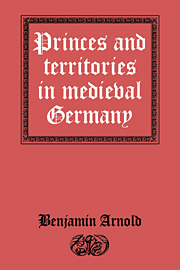
Princes and Territories in Medieval Germany by Benjamin Arnold
Princes and Territories in Medieval GermanyThis book addresses the most important question in pre-modern German political history: why did a multiplicity of states and territories emerge by the end of the Middle Ages instead of an incipient 'nation state' under the crown? The answer is found not in the supposed failures of German kingship, but instead in the creative aristocratic successes of the secular dynasties and princes of the Church. We see how their collective efforts in the centuries after 1050 added up to a more markedly territorial structure of regional power, already emerging by the thirteenth century as a result of their endeavours in the economy, internal and external colonization, and the establishment of new castles, towns, monasteries and communications; in local, ecclesiastical and imperial law, and the jurisdictional reform which they imposed in their regions; and in the uses of dynastic politics, including feuds as well as alliances, inheritance and partition.


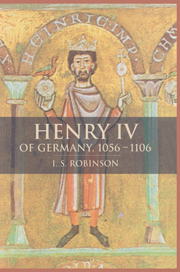
Henry IV of Germany 1056–1106 by IS Robinson
Henry IV of Germany 1056–1106This is the first book in English devoted to the German king and emperor Henry IV (1056–1106), whose reign was one of the most momentous in German history and a turning-point in the history of the medieval empire (the kingdoms of Germany, Italy and Burgundy). The reign was marked by continuous rebellions and fluctuating fortune. Earlier monarchs had also witnessed conflict between crown and aristocracy, but Henry IV's reign differed in that his conflicts could never be definitively resolved either by negotiation or by war. During the 1070s the young king gained a lasting reputation for tyranny, while his assertion of the crown's traditional rights over the imperial church aroused papal opposition. The alliance between the German princes and the papacy haunted Henry IV for the rest of his life. He meanwhile, by turns opportunist and compromiser, dedicated himself at all times to preserving the traditional rights of the monarchy.


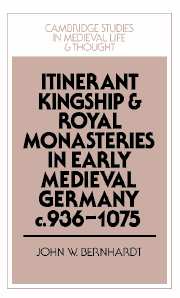
Itinerant Kingship and Royal Monasteries in Early Medieval Germany, c.936–1075 by John W. Bernhardt
Itinerant Kingship and Royal Monasteries in Early Medieval Germany, c.936–1075In examining the relationship between the royal monasteries in tenth- and eleventh-century Germany and the German monarchs, this book assimilates a great deal of European scholarship on a central problem - that of the realities and structures of power. It focuses on the practical aspects of governing without a capital and while constantly in motion, and on the payments and services which monasteries provided to the king and which in turn supported the king's travel economically and politically. Royal-monastic relations are investigated in the context of the 'itinerant kingship' of the period to determine how this relationship functioned in practice. It emerges that German rulers did in fact make much greater use of their royal monasteries than has hitherto been recognised.

Friday, October 4, 2019

Ottonian Queenship - Simon MacLean

Cover for 

Ottonian Queenship


This is the first major study in English of the queens of the Ottonian dynasty (919-1024). The Ottonians were a family from Saxony who are often regarded as the founders of the medieval German kingdom. They were the most successful of all the dynasties to emerge from the wreckage of the pan-European Carolingian Empire after it disintegrated in 888, ruling as kings and emperors in Germany and Italy and exerting indirect hegemony in France and in Eastern Europe. 

It has long been noted by historians that Ottonian queens were peculiarly powerful - indeed, among the most powerful of the entire Middle Ages. Their reputations, particularly those of the empresses Theophanu (d.991) and Adelheid (d.999) have been commemorated for a thousand years in art, literature, and opera. But while the exceptional status of the Ottonian queens is well appreciated, it has not been fully explained. Ottonian Queenship offers an original interpretation of Ottonian queenship through a study of the sources for the dynasty's six queens, and seeks to explain it as a phenomenon with a beginning, middle, and end. 

The argument is that Ottonian queenship has to be understood as a feature in a broader historical landscape, and that its history is intimately connected with the unfolding story of the royal dynasty as a whole. Simon MacLean therefore interprets the spectacular status of Ottonian royal women not as a matter of extraordinary individual personalities, but as a distinctive product of the post-Carolingian era in which the certainties of the ninth century were breaking down amidst overlapping struggles for elite family power, royal legitimacy, and territory. Queenship provides a thread which takes us through the complicated story of a crucial century in Europe's creation, and helps explain how new ideas of order were constructed from the debris of the past.

Saturday, November 24, 2018

Frederick Barbarossa: the Prince and the Myth by John Freed


Frederick Barbarossa is arguably one of the most important German rulers of the Middle Ages, and certainly one of the best known. Still, English-speaking readers have had to wait a long time for a biography of this Holy Roman Emperor. Yale University Press has now published John B. Freed’s monumental and learned biography of the emperor.

For specialists of Barbarossa’s reign, particularly in Germany, the book does not offer many new interpretations, but to wish for more detail in a book of 700 pages may seem improper. Moreover, it is not a book aimed at these specialists. It is, rather, the first English-language biography of Frederick Barbarossa in several decades. It offers an excellent introduction to all relevant sources, which Freed commands in the fashion of a true master, and into most of the relevant scholarly debates, at least in German. Freed has written an erudite and immensely readable biography of Frederick that is very rich in historical detail and that – despite some problems – offers a reliable introduction into German history of the 12th century and into the debates among German scholars about this time. It will remain, for generations to come, and rightfully so, the standard work in English on Frederick Barbarossa and Germany in the 12th century.

read more here @ Reviews in History

Thursday, December 29, 2016

Review: Ellin Carsta - The Draper's Daughter


For me, the tale started slowly, and at one stage I did consider leaving it there as there was no immediate connection with the subject and subject matter - but I persevered. 

The story, set in Cologne 1351, is of a remarkable young woman, who defies the conventions of the times by wanting to continue in her father's cloth trade. Family set backs, and a truly odious brother, ensure that the reader is constantly on the side of the underdog - in this case, our heroine Elizabeth.


What is remarkable was the depiction of Elizabeth's determination to overcome convention and stride out on her own - and author Ellin Carsta conveys this struggle well. However, being not over familiar with 14th Century Germany, and especially the pogroms against the Jews, a little (not a lot) more background would have assisted since this period is referenced.

The language is simple and not overly complex, and the author makes no attempt write in any Germanic dialect or accent, or use words a reader may not fully grasp (as other writers do and which nearly always comes off sounding phoney and contrived) - so the narrative flowed smoothly.

Overall, despite a slow start and thoughts to the contrary, I could not set the book aside until I reached its climatic conclusion.


Review @ Goodreads