Saturday, April 13, 2019

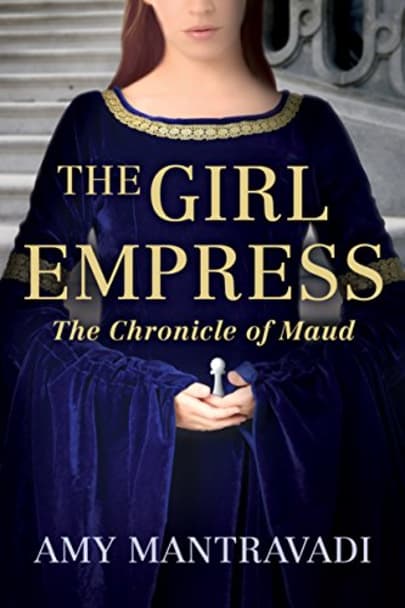
The Girl Empress by Amy Mantravadi

The Girl Empress coverThe history books remember her as Empress Mathilda, but her path to sovereignty began when she was just a girl named Maud. Engaged, estranged, and crowned by the age of twelve, this is her story . . .


As the firstborn legitimate child of King Henry I of England, Princess Maud is faced with the fiercest crisis of her eight-year-old life when she learns that she will be sent to Germany to marry the Holy Roman Emperor. To make matters worse, her husband-to-be is in the midst of a disagreement with the Pope, and the threat of civil war continuously rages. Thrust into the middle of the greatest political controversy in Europe, Maud must learn to navigate the turbulent political waters while also managing her own transition from girl to woman.

Students of history will know the ending: Maud will successfully become Empress of the Holy Roman Empire, Queen of Germany, Queen of Italy, and the sole legitimate heir to the English throne. But The Girl Empress invites readers to join Maud on the journey of a lifetime, experiencing the depths of her hopes and dreams, her anxieties and strengths, her successes and failures. The history books haven’t done her justice.

Scotland Yard Casebook by Joan Lock

Scotland Yard Casebook by [Lock, Joan]In 1878 the Criminal Investigation Department replaced Scotland Yard's corrupt and discredited Detective Branch.


In this classic story of the early days of detection, Joan Lock tells the fascinating story of the creation of the CID, the scandal which preceded it, and the successes and failures of the new organization, including early cases such as the four murders by Ernest Southey, the ferocious outbreak of dockland killings in 1869 and the more familiar Bravo, Neill Cream and Jack the Ripper crimes.

She describes Scotland Yard's gradual, if sometimes tardy, acceptance of identification and communication aids such as photography, the telegraph, telephone, Bertillon's anthropometric measurements and the fingerprint system.

First World War spy and Dear John jealousy murders were followed by Roaring Twenties' swindles and the arrival of motor car bandits — which in turn led to the formation of the Flying Squad and the adoption of mobile wireless telegraphy. 

The introduction of women detectives is also discussed and the difficulties they experienced in establishing their place in a male dominated force.

Joan Lock closes the gap between the academic police historian and the writer of popular true crime, making this book a fascinating read for crime experts and the general reader alike.


The Trials of Five Queens by R. Storry Deans

The Trials of Five Queens: Katherine of Aragon, Anne Boleyn, Mary, Queen of Scots, Marie Antoinette, and Caroline of Brunswick by [Deans, R. Storry]Katherine of Aragon, Anne Boleyn, Mary, Queen of Scots, Marie Antoinette, and Caroline of Brunswick - R. Storry Deans shows in this far-encompassing and illuminating work, these five queens were less than happy and fortunate.  Connected across three countries and three centuries by their treatment and trials, Deans paints vivid portraits of the five women with the help of private letters and court transcripts that surrounded each trial.


With intimate details of the hearings that awaited them, The Trials of Five Queens recounts an informative and entertaining history of murder, adultery, divorce and revolution centred around royal women under intense scrutiny. Both a five-part biography of the queens as well as a study of the revered yet secretive and tumultuous institutions to which they belonged.

Dance If Ye Can: A Dictionary of Scottish Battles by Malcolm Archibald

Dance If Ye Can: A Dictionary of Scottish Battles by [Archibald, Malcolm]Dance If Ye Can is an introduction to the huge variety of battles fought in Scotland, or fought by the Scots in the nearly nine hundred years when they were an independent nation.


The first part of the book serves as an introduction to Scottish history, while the second section portrays the Scottish soldier throughout history. Part three gives an alphabetical guide and brief notes of the many hundred battles, skirmishes and sieges that pepper the history of Scotland.

Unlike most battle books, Dance If Ye Can does not concentrate solely on the well-known battles. Rather, it gives space to many of the near-forgotten skirmishes and clan battles, as well as the more famous encounters such as Bannockburn and Culloden. 

The earliest battles concern the Roman invasion of 83 AD, while the last was the German attack on the Royal Navy in the Firth of Forth in 1939. In between are mentions of the wars against the Norse and the English, with various civil wars and disturbances, the Jacobite Risings and the clan wars of the Borders and Highlands.

The final section is a timeline of Scottish history that brings the book to the post-devolution period in the twenty-first century.

No Limits to Their Sway by Edgardo Perez Morales

No Limits to Their Sway: Cartagena's Privateers and the Masterless Caribbean in the Age of Revolutions by Edgardo Perez Morales offers a fresh perspective on a Revolutionary era, focusing on the role of Afro-Caribbean privateers in the struggle for South American independence from Spain Following the 1808 French invasion of the Iberian Peninsula, an unprecedented political crisis threw the Spanish Monarchy into turmoil. 

On the Caribbean coast of modern-day Colombia, the important port town of Cartagena rejected Spanish authority, finally declaring independence in 1811. With new leadership that included free people of color, Cartagena welcomed merchants, revolutionaries, and adventurers from Venezuela, the Antilles, the United States, and Europe. Most importantly, independent Cartagena opened its doors to privateers of color from the French Caribbean. Hired mercenaries of the sea, privateers defended Cartagena's claim to sovereignty, attacking Spanish ships and seizing Spanish property, especially near Cuba, and establishing vibrant maritime connections with Haiti. 

Most of Cartagena's privateers were people of color and descendants of slaves who benefited from the relative freedom and flexibility of life at sea, but also faced kidnapping, enslavement, and brutality. Many came from Haiti and Guadeloupe; some had been directly involved in the Haitian Revolution. While their manpower proved crucial in the early Anti-Spanish struggles, Afro-Caribbean privateers were also perceived as a threat, suspected of holding questionable loyalties, disorderly tendencies, and too strong a commitment to political and social privileges for people of color. 

Based on handwritten and printed sources in Spanish, English, and French, this book tells the story of Cartagena's multinational and multicultural seafarers, revealing the Trans-Atlantic and maritime dimensions of South American independence.

Falconland: The Story of Frederick II by Reggie Connell

Falconland: The Story of Frederick II: A Novel of Medieval Historical Fiction by [Connell, Reggie]
Falconland chronicles the events of King Frederick’s life by transporting readers to medieval Europe in the 12th century. It is a time when church, king and emperor struggle for power, highborn families fight for control of lands, and a dark force is rising in the Vatican.


It is a character-rich story that takes you into the minds of these fascinating medieval characters – both historical and fictional.

It begins in the quiet town of Jesi; tucked away in the foothills of northeastern Italy near the Adriatic Sea. It is December 26th, 1194AD.

In the distance, a weather-beaten carriage and a legion of knights are nearing the town’s gate. The carriage is carrying Queen Constance of Sicily. The queen is pregnant, and will be unable to make it to her palace before the birth of her baby. Because of her advanced age, she has decided to have the delivery in public view…so that no one can challenge his royal claims.

It concludes with a teenage boy overcoming enormous tragedy, and taking on a pope and an emperor to claim the crowns they took from him when he was a child. Falconland will have you cheering for Frederick II from page one until its conclusion.


John Broughton's Dark Age Novels

Saints & Sinners:

Saints and Sinners (Mixed Blessings Book 1) by [Broughton, John]Saxon times are not called the Dark Ages for nothing. It is a violent, unrecognisable world of kill or be killed …  In seventh century England, tribes and so-called kings vie for power and blood flows freely throughout the land.  Aethelred, ruler of Mercia, is being pressed from all sides – north, south, east and west. And his wife, Osthryth, daughter of a rival Northumbrian king, is murdered in unknown circumstances.  Osthryth’s ring falls into the hands of warrior noble Aethelbald who is accused of her murder and forced to leave Mercia by his conniving cousin Coeolred who has eyes on the throne. 


Mixed Blessings:
Mierce, the English Midlands, 8th Century A.D.   Æthelbald, King of Mierce, is a man of ambition. Having created much-needed stability within his domain, he now aspires to the taking of surrounding kingdoms to expand and fortify his own. With stealth and cunning, Æthelbald manipulates other men of power, like chess pieces, to achieve his goals.

As Æthelbald’s reign grows and strengthens, so too does the authority of the church, whose leverage over monarchical matters becomes increasingly overbearing. The church does not approve of King Æthelbald’s exploits with innocent women and seeks to bring him into line with the threat of eternal damnation.  This, the sequel to Saints and Sinners, chronicles the life of an English king in the days where the boundaries of kingdoms and social propriety were undergoing rapid change.


Perfecta Saxonia:
King Alfred never achieved his dream of uniting the disparate Anglo-Saxon kingdoms into one Perfecta Saxonia.  The man destined to fulfill Alfred's dream is his grandson, Athelstan, as the spark of unity begins in the Saxon kingdom of Wessex. Abandoned by his father and raised by his uncle, young Athelstan faces numerous adversities on his way to becoming a mighty warrior and diplomat.  But can he overcome the odds to transform England from an insignificant island off the Western European mainland, into the leading centre of tenth-century diplomacy and learning?


Wyrd of the Wolf:
In seventh century England, political and religious upheaval mean that nobody is safe.   As the old gods are eroded by the new church, and tribes and ambitious men vie for power, property and precedence, blood is shed throughout the land.  In the south, ealdorman Aelfhere believes that for his only child, sixteen-year-old daughter Cynethryth, marriage to a Saxon king is the way to security. And so, somewhat against her own wishes, Cynethryth is betrothed. Yet as battle rages around her, and with her betrothed away to fight, Cynethryth too becomes a victim of war. 


In the Name of the Mother:
It is 689 AD, and Cynethryth is returning from Rome, carrying her dead husband's child.  She soon gives birth to a son, Aethelheard, whose parentage alone places him in danger. His mother has a tough choice to make and travels to Dorset, where the king is a cousin of her late husband.  After the king adopts the boy, he grows up in the dangerous company of rebellious princes, all who wish to overthrow the mighty Ine, king of Wessex.


The Purple Thread:
It is 733 AD in Anglo-Saxon Britain – a time and a world of warriors, wars and religious extremes.  Begiloc, a young freedman from Wimborne with a wife and son, is most definitely a man of action. But his world is turned upside down when the young Briton and best friend Meryn are ordered away to protect English missionaries in Germany.  For a man accustomed to brutality, Begiloc has a soft spot for the purple-tinged mountains, waterfalls, lakes, animals, trees and flowers – beginning to muse whether they, rather than Man, do not better embody the essence of God.  However, mission follows mission across the continent and Begiloc is driven ever further from his loved ones at home.


Die for a Dove:
Invasion, 674 AD and Werburgh, great-niece of the Abbess of Ely travels by night to bury and save the abbey treasure under a wayside cross in the kingdom of Lindsey.  Werburgh has crafted a magnificent gold and garnet jewel in the form of a dove. A cryptic inscription on the back indicates the location of the treasure. The dove becomes a family heirloom and only resurfaces in the English Civil War.  The reappearance of a cryptic clue to the whereabouts of the forgotten dove leads to a hunt across two continents and a trail of deaths.

Ulf's Tale by [Broughton, John]Ulf's Tale:
A Swedish nobleman. A kidnapped child. The choice between power and morality.  At the start of the slaughter-marred eleventh-century, nine-year-old Ulf is taken hostage by King Aethelred.  It’s the beginning of a life of luxury and opportunity for Ulf. But treachery and plotting throughout the country threaten uneasy alliances, while ambitious rivals attempt to seize power for themselves.  His own life threatened, Ulf embarks on a quest for unity to bring peace to the Baltic states. Will his own moral convictions be enough to overcome divided loyalties, religious clashes and ambitious kings?

The Secret Life of CIA Spymaster James Jesus Angleton


If you asked the average American to name a CIA agent, he or she would probably go blank. One might list one of the Watergate burglars: E. Howard Hunt, James McCord or Gordon Liddy. A few new junkies might be able to name the current CIA Director, Dan Coats or his predecessor, Mike Pompeo (now secretary of state). 

Almost no one, however, would be able to identify James Jesus Angleton, despite his key role as leader of the agency’s head of counter-intelligence (CI) operations during the height of the Cold War. Angleton had a profound impact on the agency’s operating procedures during its formative years. A fervent anti-Communist, he was obsessed by the KGB and (he falsely believed) its constant attempts to plant agents in the CIA. Operating without hard evidence, he wrongly accused many CIA colleagues of disloyalty and ruined dozens of careers. 

The Ghost, a new biography of Angleton by Jefferson Morley, a Washington journalist, provides an intriguing look at this powerful, enigmatic Cold Warrior. He earned the nickname “the Ghost” because he was rarely seen outside his high-security office, yet had a major impact on the agency’s strategy and tactics. 

read more from James Thornton Harris @ History News Network

Saturday, April 6, 2019

This Violent, Convoluted Murder Mystery Has Been Published in 30 Countries

From RealClearLife: 

Chapter One: Swedish author Niklas Natt och Dag takes readers back in time for a thrilling whodunnit.

Drunken “watchman” Mikel Cardell is unceremoniously roused from his mid-afternoon slumber on a fall day in 1793 by a group of kids who’ve spotted a body floating in the Larder, a symbolically decrepit lake on Stockholm’s Southern Isle. The gruesomely torn apart corpse that Cardell fishes out forces him to connect with “incorruptible lawyer,” Cecil Winge, perhaps the only person in Sweden who sees value left in Cardell, setting up the adventure the pair will embark upon in author Niklas Natt och Dag’s The Wolf and the Watchman. The book is a race against time from that point on as Winge’s failing health puts an expiration date on their investigation, one that draws them into the underbelly of a crumbling and corrupt monarchy that rules over a paranoid nation divided by money and defined by greed.

chapter one
read interview with Niklas Natt och Dag here @ RealClearLife