Showing posts with label indian women. Show all posts

Monday, July 22, 2019

Royal Misses: Lost and Found

From Hindustan Times: 

It’s widely agreed that the French queen, Marie Antoinette, died early because she had too many frocks at a time of social unrest . History places her the way she was: her contribution to France was in lace and ruffles. In India, on the other hand, many women who made significant history, have just been projected as domestic goddesses; their exercise of political power considered overreach, or been simply sidelined.

Nur Jahan,Mughal harem,Mughal princesses
Authors, policy influencers, patrons of artists, wedding planners, in other words, alliance makers, city builders among Timurid women have, for instance, been lumped under ‘Mughal women’ in our textbooks after ‘Mughal art and architecture’ have got their due. That is, 214 years of varied achievements by women, overwritten by blocks of marble.

Women writers have recently been looking at the past with new glasses. They are examining the role women have played in the power structures of the day and are questioning the grand narrative of empire building as being the only story worth telling. In non-fiction, Ruby Lal’s Empress: The Astonishing Reign of Nur Jahan, Ira Mukhoty’s The Daughters of the Sun, Archana Garodia Gupta’s The Women Who Ruled India: Leaders, Warriors, Icons, Parvati Sharma’s Jahangir, Deepa Agarwal and Tahmina Aziz Ayub’s book, The Begum, on Ra’ana Liaquat Ali Khan, Pakistan’s first First Lady who was born Indian, all fall in this category..

In fiction, two upcoming titles, Subhadra Sen Gupta’s Mahal, and Amita Kanekar’s Pride of Lions, have prominent women figures with the Mughal era as backdrop. The latter is a thrilling story of an unlikely revolt. A group of peasants led by women fight the might of Aurangzeb’s rule. Who would not want to be drawn into that world?

read more here @ Hindustan Times


Sunday, March 31, 2019

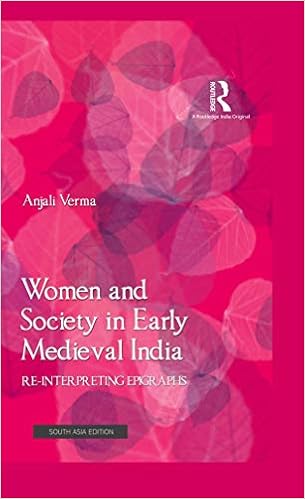
Book on medieval India out


The book, written by Anjali Verma, titled as ‘Women and Society in Early Medieval India - Re-interpreting Epigraphs’ has been released during the Indian History Congress Session in Bhopal by a galaxy of eminent historians like R Mahalaxmi, BP Sahu, Irfan Habib, Ishrat Alam and Sucheta Mahajan.

The book is an extensive pan-India study on women and society of the early medieval period (600-1200AC) through more than 650 epigraphs. Anjali Verma is working as assistant professor, department of history, Himachal Pradesh University, Shimla. She specialises in ancient Indian history, culture and archaeology.


Sunday, May 13, 2018

The fabulous women writers of Indian SF

From FactorDaily:

One does not really need a reason to celebrate the fabulous and fantastic women writers of India who’ve enriched science fiction – taking it in new directions with each tale they tell. Their stories are reason enough. The past few years have truly seen a global renaissance of fresh and original SF, and leading from the front have been the women writers, and the same holds true for India as well. Not surprising, when you consider the fact that it was an Indian lady who, over a century ago, wrote what is amongst the first pieces of feminist science fiction: Begum Rokeya Shakawat Hossain who in 1905 wrote Sultana’s Dream, with its portrayal of the feminist utopia of Ladyland, a full decade before Charlotte Gilman’s Herland.

And just as it was then, so it is now, with Indian women writers pushing the possibilities of the genre with their stories, which – while being rooted in our culture – have transcended borders, winning the hearts and minds of readers across the world with their universal appeal. There are so many writers one could list, not least given the fact that the markers of what constitutes speculative fiction is ever-expanding. So here then, are just some works from Indian women writers whose SF you should definitely be reading – if you haven’t already that is!

read more here @ FactorDaily

Saturday, June 24, 2017

The Ministry Of Utmost Happiness by Arundhati Roy

Indian author Arundhati Roy catapulted to literary stardom in 1997, when her debut novel, The God Of Small Things (IndiaInk), was released to widespread acclaim. It went on to win the prestigious Man Booker Prize that same year and has been translated into more than 40 languages.


But instead of becoming a literary star by riding on the wave of her spectacular debut, Roy immersed herself in the political struggles of her time: the Kashmir independence effort; Adivasi, or tribal Indian, land rights; and anti-nuclear protests. She argues against US imperialism and the far-right machinations of the Indian security state. Now, 20 years after her debut, Roy has returned with her second novel, The Ministry Of Utmost Happiness.


read more here @ Star2


Saturday, April 1, 2017

India's Rani Of Jhansi Regiment

This is a riveting and meticulously researched account of the Indian National Army’s Rani of Jhansi regiment, the first in recorded military history that comprised only women.

It is not often that a forgotten and glorious chapter of a country’s history is resurrected and presented to its people and the rest of the world, and that too by a foreigner. This is what India now sees with the publication of a riveting and meticulously researched account of the INA’s Rani Jhansi Regiment (RJR) authored by Danish historian Vera Hildebrand.

As the author says, this unit was the first in recorded military history that comprised only women. Admittedly, the Soviet Union’s Red Air Force in World War II had a few squadrons of women pilots, but the support staff included men. In any case, these squadrons were not formally designated as “women’s regiments”. The RJR’s status as the world’s only all-women ground forces fighting contingent remains uncontested.

Read more here at Swarajya Magazine Online and at the Hindustan Times
Read an excerpt here at Kitaab


Friday, March 3, 2017

Heroines : Powerful Indian Women of Myth and History

The book makes a case for revising notions of courage and heroism through the portraits of eight powerful women from mythology and history.With the purpose of keeping patriarchy intact; mythologies and histories are popularized and retold via state controlled media at the mass entertainment level and reflections of women characters are generally more negative than positive. 

Women of history and mythology are depicted as weak, emotive, obedient, submissive while qualities like courage, endurance, wisdom and physical strength has been associated with masculinity. The book challenges these stereotypes and makes a case for women heroism through the narratives of Draupadi, Radha, Ambapali, Raziya Sultan, Meerabai, Jahanara, Laxmibai and Hazrat Mahal.

The book is an inspiring read for anyone interested in women histories. It not only details the lives of the legendary women, but also describes its relevance in contemporary context through an analysis of its reception and circulation in cultural and political narratives today. 

Read review by Biraj Mehta Rathi here @ The Free Press Journal