Showing posts with label indian history. Show all posts

Sunday, September 8, 2019

Spying for the Raj: The Pundits and the Mapping of the Himalayas by Jules Stewart


One of the greatest projects of 19th century geography was the Great Trigonometric Survey of India. The British also wanted geographical information on the lands further north. However, in some regions these surveys seemed impossible. Some of the Indian border countries, in particular Tibet, would not allow westerners to enter their country, let alone a British surveying team.


In the 1860s, Captain Thomas Montgomerie trained natives to be surveyors, and had them explore the region covertly. These men, known as pundits, were disguised as lamas (holy men). 

This book talks about these servants of the Raj who managed to map the Himalayas and Tibet, helping the British to consolidate their rule in the Indian sub-continent.

see also: Trespassers on the Roof of the World: The Secret Exploration of Tibet by Peter Hopkirk

Monday, July 22, 2019

Royal Misses: Lost and Found

From Hindustan Times

It’s widely agreed that the French queen, Marie Antoinette, died early because she had too many frocks at a time of social unrest . History places her the way she was: her contribution to France was in lace and ruffles. In India, on the other hand, many women who made significant history, have just been projected as domestic goddesses; their exercise of political power considered overreach, or been simply sidelined.

Nur Jahan,Mughal harem,Mughal princesses
Authors, policy influencers, patrons of artists, wedding planners, in other words, alliance makers, city builders among Timurid women have, for instance, been lumped under ‘Mughal women’ in our textbooks after ‘Mughal art and architecture’ have got their due. That is, 214 years of varied achievements by women, overwritten by blocks of marble.

Women writers have recently been looking at the past with new glasses. They are examining the role women have played in the power structures of the day and are questioning the grand narrative of empire building as being the only story worth telling. In non-fiction, Ruby Lal’s Empress: The Astonishing Reign of Nur Jahan, Ira Mukhoty’s The Daughters of the Sun, Archana Garodia Gupta’s The Women Who Ruled India: Leaders, Warriors, Icons, Parvati Sharma’s Jahangir, Deepa Agarwal and Tahmina Aziz Ayub’s book, The Begum, on Ra’ana Liaquat Ali Khan, Pakistan’s first First Lady who was born Indian, all fall in this category..

In fiction, two upcoming titles, Subhadra Sen Gupta’s Mahal, and Amita Kanekar’s Pride of Lions, have prominent women figures with the Mughal era as backdrop. The latter is a thrilling story of an unlikely revolt. A group of peasants led by women fight the might of Aurangzeb’s rule. Who would not want to be drawn into that world?

read more here @ Hindustan Times


Sunday, March 31, 2019

Book on medieval India out


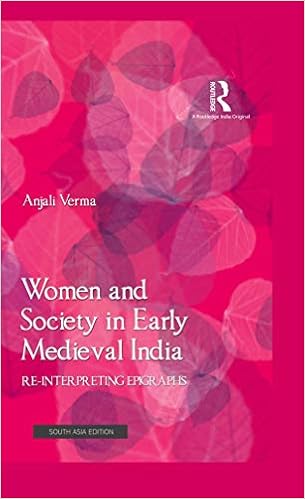
The book, written by Anjali Verma, titled as ‘Women and Society in Early Medieval India - Re-interpreting Epigraphs’ has been released during the Indian History Congress Session in Bhopal by a galaxy of eminent historians like R Mahalaxmi, BP Sahu, Irfan Habib, Ishrat Alam and Sucheta Mahajan.

The book is an extensive pan-India study on women and society of the early medieval period (600-1200AC) through more than 650 epigraphs. Anjali Verma is working as assistant professor, department of history, Himachal Pradesh University, Shimla. She specialises in ancient Indian history, culture and archaeology.


Tuesday, December 25, 2018

Sir Jadunath Sarkar’s "Fall of the Mughal Empire"

From The Hindu:

The four volumes of Fall of the Mughal Empire are the most impressive work of Indian history that I have read. They should be required reading in all of our schools for students aged 16, by when we are old enough to be able to look at the world around us through our own eyes. A lot of what we see around us in the India of 2018, we will be able to understand on reading this work. It is in that sense a shattering book, and one cannot think of too many that have such influence on the reader and have such ability to transform the way readers think.

Sir Jadunath Sarkar’s magisterial work spans only about seven decades of Indian history, from after the sack of Delhi by Nadir Shah, till the end of the Maratha power in the first few years of the 19th century. His model in writing this in some ways was a British administrator named William Irvine, who died around 1911, and had written a work called Later Mughals.


read more here @ The Hindu

Sunday, December 2, 2018

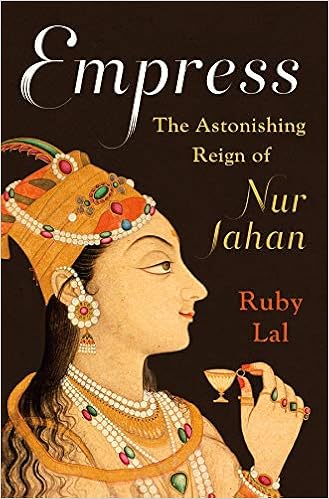
Review: Empress - The Astonishing Reign of Nur Jahan by Ruby Lal

"... finding her entails peering around the towering figures of men ..."


Nur Jahan was one of the most powerful and influential women in Indian history. Born amid a caravan traveling from Teheran to India, she became the last (eighteenth or twentieth) wife of the Mughal emperor Jahangir. When he succumbed to the effects of alcohol and drugs, she effectively took control of the government (1611-1627). Her reign is said to have marked the highpoint of the Mughal empire, during the course of which she made great contributions to the arts, religion, and the nascent trade with Europe. Her rise was swift - her downfall swifter, and she was effectively written out of Mughal history by Shah Jahan.

Ruby Lal's book is one of two biographies on this woman - the other being Ellison Banks Findly's Nur Jahan - Empress of Mughal India (which I haven't read, though a comparison between the two would be interesting). Lal says she is a feminist historian who is determined to "... tell the stories of women and girls, which are largely missing from the precolonial and colonial history of South Asia ..." - and this biography is written from a feminist viewpoint (more on that later). Her background in the study of Mughal history and culture serves her well, for the prose is very descriptive, so much so, you get a sense of actually being there.

We learn of a young girl (Mehrunissa) who meets Prince Salim (Jahangir) and they fall in love. Circumstance see her married to another, and it is only when Salim rebels against his father that they are brought together - her husband Ali Gurli was one of Salim's supporters. Upon his accession Saiem, now Jahangir, rewards her family where they take up positions within the new court. Mehrunsissa learns a lot during this period as her husband is often absent for a great portion of her marriage. When Jahangir's son rebels (1606 - 1607), Mehrusinssa's family falls under suspicion as does her husband, who later dies. Both she and her daughter are brought before the Emperor.

The trouble is, like most women whose voices are dimmed, sometimes there is just not a lot to write about and so we tend to hear more about them from the context of the males in their lives. For instance, we still don't really know how she rose to become the favoured wife - one out of many harem women. Nor the circumstances that led to her marriage to Jahangir in 1611.

We are told that she used her influence though patronage and family connections - her family had been firmly placed at the court of Jahangir's father Akbar and of Jahangir himself; her daughter from her first marriage, Ladl Begum, was married to Shahryar (d.1628) one of Jahnagir's sons (though not his successor). 

Following the deaths of both her parents Nur Jahan was left without a support network when another of Jahangir's sons - Khurram (Shah Jahan) - rebelled amid fears of being displaced in the line of succession (1622). Here, she is blamed for inciting sedition which resulted in the execution of Shahryar and a number of other princes. When Jahangir himself is captured (1626), it is Nur Jahan who engineers his rescue. However, her triumph was short-lived as Jahangir was dead the following year (1627) and Shah Jahan ascended the throne (1628). It is now that, despite her building works, that Nur Jahan fades from the pages of history (very similar situation to that of Hatshepsut of Egypt).


Lal is up front by claiming her biography of Nur Jahan is being written from a feminist viewpoint which essentially refers to the re-reading of history from a female perspective though sometimes interchangeable with feminist historiography, the restructuring of the history from the perspective of women. Why not just write a balanced (or as balanced as is possible) biography or history?  Why the need for terms and labels?

This biography however, is observational rather than factual. And it comes down to the sources used, which Lal claims, have been neglected and ignored by others - specifically Jahangir's own memoirs (wherein Nur Jahan is mentioned over 30 times) and the memoirs of Gulbadan Begum, whose descriptions of court life were extrapolated into / onto the life of Nur Jahan. Lal says she also made use later court histories and of the writing of those who visited the court: artists, tradesmen, diplomats, visitors and curious observers who were often ".. observing and assessing though his own cultural lens ..". Though how they had access to the imperial harem is a questioned I would love answered!

With nothing written in her own hand or by another expressing her own words, we know very little about this woman, except through the eyes of others. And Nur Jahan is not alone in this; there are many authors today, trying to piece together the fragmentary lives of notable women, to retell their stories from, I guess, a more retrospective and understanding voice. Some succeeded - others haven't.

There was still so much I wanted to learn about Nur Jahan that wasn't really covered here as the information was just not there. What Lal's book does do is gives us a fairly decent introduction into this woman. Lal says "... I didn't undo the legends. But I distilled them..." (CS Monitor 27th June 2018) - and sometimes, that is all we can do.

I will be looking forward to new forthcoming book on Gulbadan Begum, daughter of Mughal Emperor Babur (d.1556).  I am straying away from predominantly Euro-centric histories and seeking out more variety further afield.  Funny thing is - the stories are similar just different settings.  It really is a small world afterall.


Further reading:
Daughters of the Sun: Empresses, Queens and Begums of the Mughal Empire by Ira Mukhoty
Nur Jahan - Empress of Mughal India by Ellison Banks Findly
Private Life Of The Mughals Of India (1526-1803 A.D.) by R. Nath
Attendant Lords: Bairam Khan and Abdur Rahim, Courtiers and Poets in Mughal India by T.C.A. Raghavan
Baburnama by Zahiru’din Muhammad Babur Padshah Ghazi and trans. by Annette Susannah Beveridge
Akbar and The Rise of The Mughal Empire by GB Malleson
Light of the World”: The Life and Legacy of Nur Jahan (1577−1645) by Maggie Schuster

Nur Jahan (wikipedia)


Novels:
The Twentieth Wife by Indu Sundaresan (also: Feast of Roses and Shadow Princess)
Nur Jahan's Daughter by Tanushree Podder
Queen & Emperor: A Novel of the Mughal Empire by Tony Raosto

Saturday, November 3, 2018

Empire of Enchantment: The Story of Indian Magic by John Zubrzycki

Review by Kapil Komireddi for The National:

“Ask the average man for what India is most celebrated, and the chances are ten to one that he ..... will unhesitatingly reply in one word, ‘jugglers’,” the Strand Magazine wrote in its December 1899 issue. “India’s jugglers”, the magazine went on to explain, “have been the wonder of India”. There was scarcely anyone in England who was not aware of the jugglers’ “‘Jadoo’, or magic working”. India’s reputation as a land of the occult wasn’t, as John Zubrzycki reminds us in his delightful and charming new book Empire of Enchantment: The Story of Indian Magic, just confined to Britain.


By the medieval era, magic became so inextricably linked with India – where tricks merged with, and enlivened, religious ritual – that Indian magic manuals, translated into Arabic, were being hawked on the streets of Baghdad by the city’s fabled booksellers during the Abbasid caliphate. After India fell to the British, it became an object of fascination and condescension and a source of fear for Europeans. Countless conjurers travelled to India, convinced that it was the place to find and master pure magic.

read more @ Scribe Publications  and @ The National


Sunday, September 16, 2018

Ranjeeta Dutta reviews Rebel Sultans: The Deccan from Khilji to Shivaji by Manu S. Pillai

From The Hindu:

Rebel Sultans: The Deccan from Khilji to Shivaji review: Melting pot of ideasA history of the Deccan introduces us to a cosmopolitan world with fluid identities, cross-cultural interactions and political strategies

As a teacher of history, one is often confronted with students asking why the curriculum based on rigorous research has always remained confined to the precincts of university classrooms. Manu Pillai’s Rebel Sultans provides the much-needed bridge between the isolated world of academia and wider public audience. The book tells us a story of the fascinating world of Deccan, full of splendour, exciting political intrigues, glorious rulers, magnificent cities and fabulous treasures.


read more here @ The Hindu

Saturday, June 9, 2018

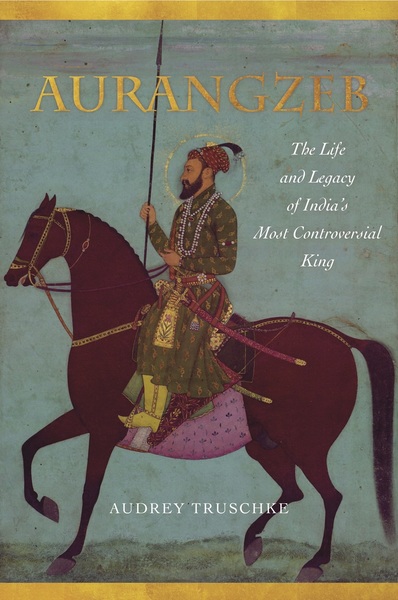
Aurangzeb: The Life and Legacy of India's Most Controversial King


The Mughal emperor Aurangzeb Alamgir is one of the most hated men in Indian history. Widely reviled as a religious fanatic who sought to violently oppress Hindus, he is even blamed by some for setting into motion conflicts that would result in the creation of a separate Muslim state in South Asia. In her lively overview of his life and influence, Audrey Truschke offers a clear-eyed perspective on the public debate over Aurangzeb and makes the case for why his often-maligned legacy deserves to be reassessed.

Aurangzeb was arguably the most powerful and wealthiest ruler of his day. His nearly 50-year reign (1658–1707) had a profound influence on the political landscape of early modern India, and his legacy—real and imagined—continues to loom large in India and Pakistan today. Truschke evaluates Aurangzeb not by modern standards but according to the traditions and values of his own time, painting a picture of Aurangzeb as a complex figure whose relationship to Islam was dynamic, strategic, and sometimes contradictory. This book invites students of South Asian history and religion into the world of the Mughal Empire, framing the contemporary debate on Aurangzeb's impact and legacy in accessible and engaging terms.


read review here @ Daily Times by Ayesha Rafiq
The book enacts a fascinating reassessment of Aurangzeb, by recognizing him as a product of his age, as opposed to previous research that makes the elementary mistake of judging Aurangzeb by modern sensibilities. Aurangzeb’s actions do begin to make sense, when he is placed within the context of Indian codes of conduct and values rather than within the context of twenty first century codes and values. 

Sunday, June 3, 2018

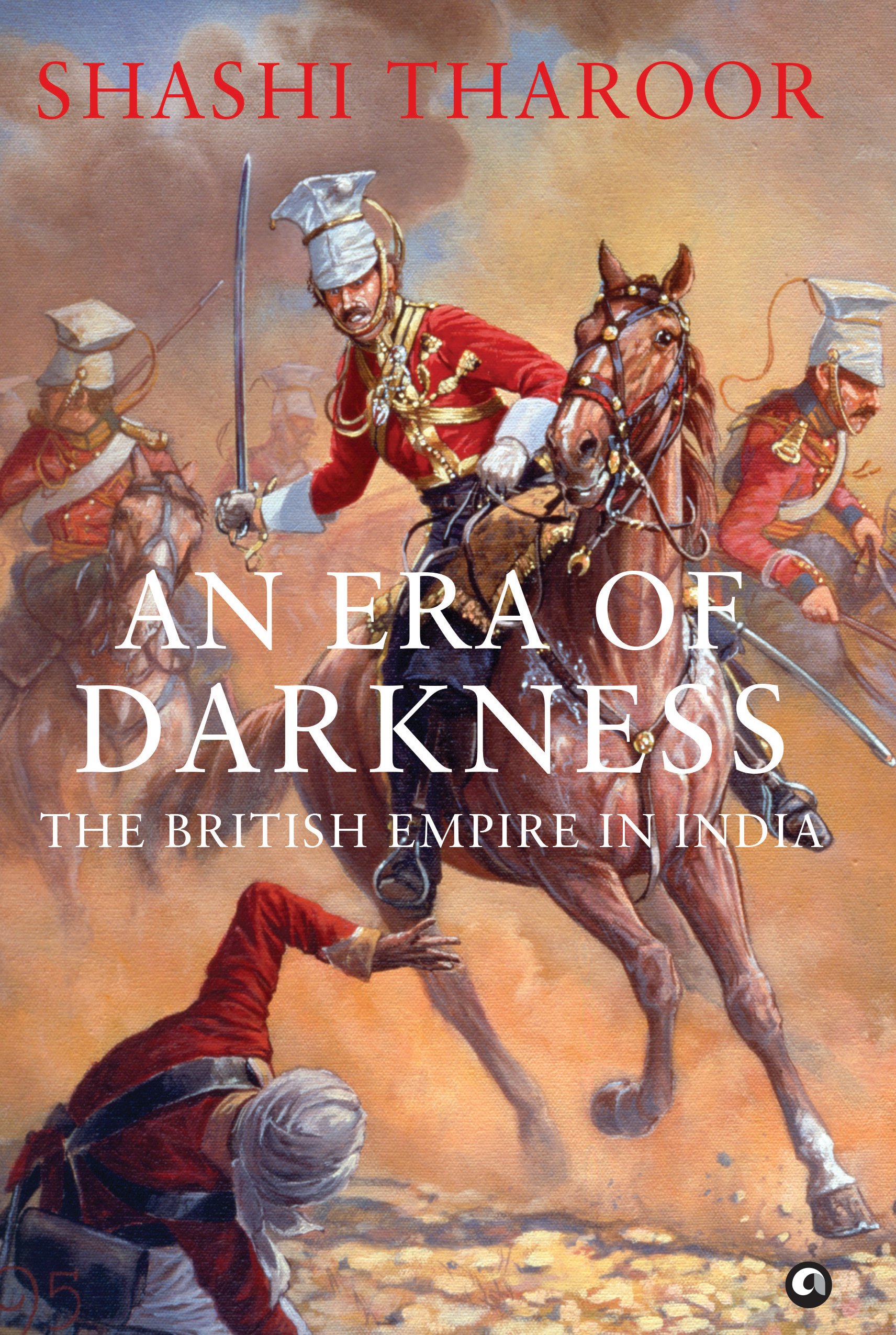
An Era of Darkness by Shashi Tharoor


Image result for an era of darknessIn May 2015, Indian author and politician Shashi Tharoor spoke at the Oxford Union debate for the motion: British owe reparations to her former colonies. In his 15 minute speech, Tharoor eloquently outlined how the British destroyed the Indian economy, amassed huge wealth, and when they departed, left India worst off.

In An Era of Darkness, Tharoor expands his Oxford union speech by collating selected accounts and sources and working them into a forceful, paced narrative. In cogently written eight chapters, he builds an impressive case against the British depredations and misgovernment that British Indian subjects suffered during 200 years of colonial rule of the South Asian sub-continent.

While there is no denying of the fact that many British laws were enacted to repress India’s independence struggle, but post-colonial India has acted much more brutally in occupied regions like Kashmir and Nagaland, where, enjoying impunity under the post-British laws like Armed Forces Special Powers Act, Indian armed forces have massacred, raped, tortured, and disappeared thousands of people.

All this criticism against Tharoor is in no way intended to discount or undermine his valid arguments against the British rule over South Asian sub-continent. He has an impressive case against colonialism. But, not all his opinions and arguments are genuine, some are just too simplistic.

For example, he does not mention how Dalits and marginalised groups view the British rule with respect to their empowerment—about which Dalit intellectuals like Ambedkar have written. If a reader wants to know all the bad things that British did in her South Asian colony, then this book is an apt catalogue for that. It is a well-crafted, racy narrative, with sprinkles of wry humour here and there. But, for a more balanced, complex, account on the colonial history refer to ‘academic’ works.

read entire review @ Free Press Kashmir

Sunday, May 6, 2018

Kashmir: Exposing the Myth Behind the Narrative by Khalid Bashir | books | reviews | Hindustan Times

It is highly recommended that readers begin with the epilogue of Kashmir: Exposing the Myth Behind the Narrative, one of the more important books to have come out of Kashmir in recent years. The reader would then be better prepared for the sharpness of the chapters entitled ‘malice’, ‘power’, ‘blood’, ‘agitation’ and ‘media’ that precede it.

The central premise of the book is contained in a Persian couplet: Khisht-i-awwal chu nehad memaar kaj, Taa surayya mee rawad dewaar kaj (If a mason puts the first brick askew, the wall, even if raised up to the Pleiad, is bound to come up slanted). Bashir argues that the edifice of Kashmir’s history has been erected on one such crooked foundation, a book called Rajtarangini, which translates as The River of Kings, but was by design or carelessness or the prevalent tradition fashioned into the ‘History of Kings’ over the years. This book and its derivatives became, with unsavoury consequences, the History of Kashmir over time.

Sunday, March 11, 2018

The Sun and Two Seas by Vikramajit Ram

This magical tale woven around historical events during the construction of Kalinga’s Konark sun temple in the mid-13th century, is Vikramajit Ram’s fourth book. 

At first, readers might believe this is a revenge tale but the real turn in the action occurs when the lovers in the story are separated. Their love story will take you by surprise and warm your heart. It will then crush it, quite like your very first love did, in a sudden and cold manner.

Despite weaving a fine tangle of plots and characters, the story progresses neatly. By the end, it is hard to settle upon one character as the protagonist for all the characters are temptingly meaty. But if one had to choose a protagonist, it would be the story. The best kind of books manage that.


Sunday, January 14, 2018

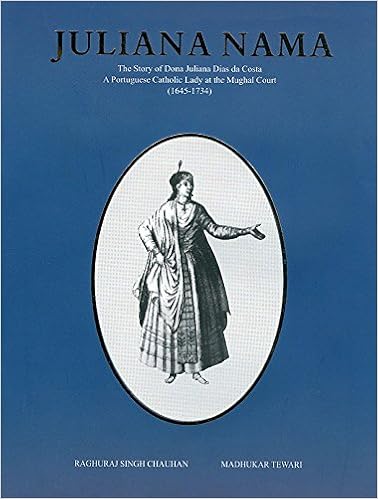
Juliana: The Mughal ‘Princess’ from Portugal


Medieval Indian history has stories and anecdotes of illustrious women such as Razia Sultana, Noor Jahan, Mumtaz Mahal and Jahan Ara, some of whom have also been featured stunningly so on celluloid. However, very little is known about Juliana, a Portuguese lady who played a sensational stellar role in the Mughal Court and witnessed from close quarters the unfolding of history, as well as history being made on account of the mystifying sway she had over this era.

Juliana Nama is a book that narrates the fascinating story akin to a fairy-tale of the alluring and charismatic Dona Juliana Dias da Costa—the favoured and beloved companion of Shah Alam, also known as Bahadur Shah-I—who succeeded his father, the controversial Monarch, Aurungzeb to the Peacock Throne. She not only left an enduring and unfading stamp on that period but perhaps, emphatically so, refashioned and altered the course of events to an exceptional degree.


Sunday, November 19, 2017

Diary Lost in Translation

Raja Todar Mal's diary, considered one of the rarest among the 5 crore documents stored at the Bihar State Archives, rests unread because no current generation scholar can translate it.

"This diary of Todar Mal is actually on land records and settlement of Bhagalpur during the Mughal times. It was found lying in the record room of Bhagalpur and was transferred to us. It is in old Urdu and Persian and we have been unable to get it translated as we don't have any scholar of these languages with us," said archives director Vijay Kumar.


Vijay revealed that he had contacted a few scholars "to get the diary translated. They agreed to do so, but did not turn up. I showed it to a Muslim scholar in Patna City and he said that the diary was invaluable as it contained the names of localities of Bhagalpur over 400 years ago and information about landholdings".

read more here @ Telegraph India


Saturday, June 24, 2017

Koh-i-Noor: The History of the World’s Most Infamous Diamond

Size, as we know, is not everything. You might only be the 90th largest, but you can still emerge with a sizable reputation. This is one of several lessons to be learned from the story of the Koh-i-Noor diamond, way down the list in terms of size but, as this new book’s subtitle suggests, looming large in the imagination. It is probably also the world’s most dangerous diamond, described here as being “like a living, dangerous bird of prey” because so many have lost their lives over it.


The origins of the Koh-i-Noor, the “mountain of light”, are unknown, beyond the reach even of this book’s two accomplished authors, but it seems safe to assume that it emerged out of alluvial deposit somewhere in India. It may have been known in antiquity and it may have been referred to in many a romantic tale, but its first verifiable appearance isn’t until the 18th century, where it decorated the Mughal emperor’s Peacock Throne in Delhi and where it stimulated envy and greed in the emperor’s rivals. Over the following 100 years, it brought torment and tragedy to a range of people in Delhi, Kabul and Lahore.

read more here @ The Guardian


Monday, June 5, 2017

Aurangzeb: The Man and the Myth

If history must be rewritten, the task is best left to a professional historian. In her little monograph on Aurangzeb, Audrey Truschke tries to rescue the most poorly-understood Mughal monarch from the soap opera scriptwriters of contemporary politics, who cast him as the greatest bigot in Indian history. Hindu-Muslim polarisation, she reminds the reader, is a modern game, with modern trophies and payouts which medieval India did not anticipate.

In Truschke’s words, Aurangzeb was man of his time. To single him out as a despot label him a bigot is a gross misrepresentation. We can only do justice to his life if things are viewed in context.

Truschke attributes the caricature of the bigoted Aurangzeb to later colonial history, which constructed the “eastern potentate” as a malevolent clown, with the political objective of showing British rule as enlightened by contrast. It follows, quite ironically, that the currently popular nativist readings of Muslim rule are effectively reviving a long-dead colonial project.

read more here @ Indian Express and @ Hindustan Times


Saturday, April 8, 2017

The Battle for Rama: Case of the Temple at Ayodhya

The sanctity of Ayodhya as the birthplace of Lord Rama, which has been questioned repeatedly by leftist historians, has been vouched for by not just "Hindu religious scriptures" but observers of diverse stripes across time.


From Persian works of the Medieval era to sanads issued by Mughals in the eighteenth century, ‘Muslim’ sources that acknowledge the disputed territory as Ram Janmabhoomi, for instance, have seldom been cited in mainstream discourse.

Meenakshi Jain’s The Battle for Rama includes an account of various such sources in history, shining a new light on the city, and also counters popular arguments.

read more here @ Swarajya


Saturday, April 1, 2017

India's Rani Of Jhansi Regiment

This is a riveting and meticulously researched account of the Indian National Army’s Rani of Jhansi regiment, the first in recorded military history that comprised only women.

It is not often that a forgotten and glorious chapter of a country’s history is resurrected and presented to its people and the rest of the world, and that too by a foreigner. This is what India now sees with the publication of a riveting and meticulously researched account of the INA’s Rani Jhansi Regiment (RJR) authored by Danish historian Vera Hildebrand.

As the author says, this unit was the first in recorded military history that comprised only women. Admittedly, the Soviet Union’s Red Air Force in World War II had a few squadrons of women pilots, but the support staff included men. In any case, these squadrons were not formally designated as “women’s regiments”. The RJR’s status as the world’s only all-women ground forces fighting contingent remains uncontested.

Read more here at Swarajya Magazine Online and at the Hindustan Times
Read an excerpt here at Kitaab


Friday, March 3, 2017

Heroines : Powerful Indian Women of Myth and History

The book makes a case for revising notions of courage and heroism through the portraits of eight powerful women from mythology and history.With the purpose of keeping patriarchy intact; mythologies and histories are popularized and retold via state controlled media at the mass entertainment level and reflections of women characters are generally more negative than positive. 

Women of history and mythology are depicted as weak, emotive, obedient, submissive while qualities like courage, endurance, wisdom and physical strength has been associated with masculinity. The book challenges these stereotypes and makes a case for women heroism through the narratives of Draupadi, Radha, Ambapali, Raziya Sultan, Meerabai, Jahanara, Laxmibai and Hazrat Mahal.

The book is an inspiring read for anyone interested in women histories. It not only details the lives of the legendary women, but also describes its relevance in contemporary context through an analysis of its reception and circulation in cultural and political narratives today. 

Read review by Biraj Mehta Rathi here @ The Free Press Journal