Showing posts with label conspiracy. Show all posts

Sunday, April 13, 2025

Review: Something Wicked by John F Myslinski

Synopsis: Something Wicked plunges readers into a labyrinth of corruption, organized crime, and religious intrigue at the heart of the Catholic Church. When Father Dan Lanaham - newly elected Superior General of the Jesuits - stumbles upon a series of bombings, murdered nuns, and unsettling ties to the Vatican Bank, he realizes the danger lurking beneath Rome's hallowed corridors is far more sinister than anyone dares admit.

Determined to uncover who ordered the Jerusalem bombing and why, Dan teams up with unlikely allies ranging from Mossad agents to secretive hackers-even a terrorist whose motives are murkier than they seem. At every turn, he battles shadowy Mafia connections, extremist plots, and twisted ambitions vying for control of the papacy. As the ailing Pope struggles to bring Dan into the Church's innermost council, a shocking global conspiracy unravels, threatening both faith and the lives of those closest to Dan.

Brimming with moral complexity, high-stakes subterfuge, and characters torn between devotion and ambition, Something Wicked will keep you on the edge of your seat. In a world where evil wears a saint's robes and redemption hinges on secrets best left buried, Father Dan's quest for the truth may cost him everything-including his soul.

~ ~ ~

This type of book was certainly down my alley - yet this was not.

I am not sure if it was how the narrative was delivered, the over abundant cast of characters, the multitude and complexity of themes, I just could not get into this - despite my most ardent desire to immerse myself in this tome, I found myself flagging with every chapter.

Quite possibly I need to re-revisit this in a physical format.

Wednesday, December 1, 2021

Alex Connor's Art Mystery Novels

Alex (Alexandra) Connor was born and educated in England. She has had a variety of careers including photographic model, personal assistant to a world famous heart surgeon, and working in a Bond Street art gallery.Having always had an intense interest in the history of art, Alex – who has previously written historical novels and non fiction – is now concentrating on writing conspiracy thrillers set in the art world.


The Rembrandt Secret (aka The Other Rembrandt)
History's biggest conspiracy is about to be revealed. But not if a brutal murderer has anything to do with it . . .

Marshall Ziegler's father runs a gallery in London, which Marshall has always ignored. But when his father is beaten to a pulp, disembowelled and left to die, Marshall suddenly needs to know every last detail of his life.

He discovers that his father knew a dark secret at the heart of Rembrandt's life, one that has the potential to bring down one of the worlds most lucrative industries. But a sadistic murderer is on the case, killing in increasingly brutal ways to keep it hidden.

Will Marshall beat the killer to the truth? Who can he trust? Will he stay alive long enough to reveal the greatest secret never told?


The Caravaggio Conspiracy
1608. Michelangelo Merisi da Caravaggio, the greatest Italian painter of his day, is expelled from the Order of the Knights of Malta. Subject to a clandestine hearing, his crime remains a closely guarded secret.

2014. Two bodies are found in a London art gallery – stripped naked, necks bound with wire and legs obscenely contorted. They are twin brothers – successful art dealers – their brutal murder linked to the mysterious disappearance of two paintings by the master Caravaggio.

Investigators are confounded, and it falls to art expert Gil Eckhart to identify the killer before he slays again. But as the search for clues takes him from the glamorous skyline of New York to the fetid catacombs of Palermo, Eckhart finds that in the high-stakes world of art, good and evil are often tarred with the same, blood-soaked, brush.


The Bosch Deception
A Truth Concealed: Brabant, 1473. 
A clandestine brotherhood hides a secret that could bring down the Catholic Church. Their chosen hiding place - the art of Hieronymus Bosch.

A Terrible Conspiracy: London, 2014. 
An excommunicated priest approaches both the Church and the art world, claiming to possess an artefact that will destroy their reputations.

A Ticking Clock: This man, Nicholas Laverne, is poised to end over 500 years of silence and injustice. Yet, unknown to Nicholas, he has just summoned a killer intent on silencing him.


I read the above three books over the course of a couple of weeks, interspersed with my other reading - its is amazing how quickly you can get through a physical book compared to an e-book.

I started with Caravaggio then Bosch and finished with Rembrandt. Of the three, only the enigmatic Caravaggio held any real interest for me - I just happened upon the other two at the same time as I came across the Caravaggio tome - and thought, why not?  All three had been sitting on the shelves of my own personal library for a number of years before I finally picked them off the shelf.  I had in the meantime read Connor's The Wolves of Venice, which I really didn't like, and figured - as I was in the midst of a book culling - to finally read a number of tomes that had been gathering dust, especially those that appeared to be a part of a series - or in this instance, similarly themed.  

Despite the different cast of characters, artist and mystery, the narrative formula is essentially the same. Past events surrounding a famous artist insinuate themselves into the 20th / 21st Century, requiring the solving / revealing of the said mystery with ensuing high body count.

Whilst I did enjoy these three for what they were - an not too dull adventure in the art world with a healthy dose of conspiracy theory - they really are not something I would go back to read again.  And so these three tomes will be donated / consigned to the little neighbourhood street library with a number of others.


More historical art mysteries:
> Reader's Digest: 13 Strangest Unsolved Mysteries of the Art World
> Culture Trip: 11 Biggest Unsolved Art Mysteries of All Time

Saturday, April 25, 2020

Review: Framed In Monte Carlo by Ted Maher

Framed in Monte Carlo: Why I Spent Eight Years in Prison for a Murder I Did Not CommitSynopsis: When billionaire banker Edmond Safra died in the ashes of Monaco’s La Belle Époque on December 3, 1999, the event made international headlines—for many reasons. One, of course, was the sheer wealth of the Lebanese mogul and his formidable presence in the international banking world. But the more seductive reason for the worldwide attention was the strange and intriguing way Safra died—ensconced within the armored walls of his vigilantly secured residence in the “safest city in the world.”

At 4:45 in the morning, a firestorm gutted Safra’s opulent Monte Carlo penthouse, trapping—and killing—Safra and one of his nurses, Vivian Torrente. The fire was ruled arson. Safra’s death, the result. The person responsible: ex–Green Beret Ted Maher, another of Safra’s nurses. Or so he stood accused.

The true details concerning the bizarre circumstances that led to Safra’s death and the subsequent conviction and imprisonment of Ted Maher are contained within the pages which features a play-by-play of the night Edmond Safra died, as well as Maher's sham of a trial and his subsequent imprisonment for seven years and eight months. 

After Maher had already served over ninety-five percent of his sentence, Ted was freed and his name was cleared—at least officially. But his business is unfinished. Now, for the first time ever, hear the facts straight from the source, including never-before-released details. The biggest question remains: who did kill Edmond Safra? With names like Vladimir Putin being legitimately put forth, the authors' conclusions will shock you.


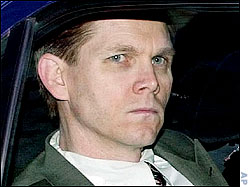
Theodore Maher | Photos | Murderpedia, the encyclopedia of murderers
There is really no need to add much more to the above synopsis. It is a powerful story of a man wronged by the legal system of another country for a crime he is being held to account. Ted Maher begins with his family, career, and married life prior to going into the events that led him to Monte Carlo in the first place. They we are taken through a blow-by-blow account of his time there before those tragic events of Safra's death. Ted then details his time in prison awaiting trial, the trail and subsequent sentencing, hunger strikes and his escape and then his final release.

But there is also a second tragedy that is Ted's own life - his poor choices in women and his failed marriages, including the betrayal of his wife at the time; the failure and betrayal of the legal system of Monaco as applied to foreign nationals; the sense that although finally freed, no-one has been held to account. 

Ted's story is easy to follow - and is heavily footnoted.  Unfortunately for Ted he comes across as a bit of a tosser - a man full of hubris - he is focused primarily on himself and his own self-promotion; he is not just a jack of all trades but an expert in all things; money and the making of it seems to always underlie his choices; and his need to control situations and those around him was misogynistic and grating. For someone bragging about is "green beret" skills and instincts, Ted truly made some dubious choices, and whilst the trial itself suggests sham, Ted is his own worst enemy.

I was seriously struggling to find some connection - some empathy - for this man, even though he was set up as a scapegoat for the sake of legal expediency, and even though he lost it all and was never truly compensated. There are some serious credibility issues here which should have been addressed prior to publication if Ted was hoping to elicit sympathy from his audience. The Foreward by Michael Griffith hints at a high-level conspiracy yet what we get is something quite different.

The presentation was a bit mish-mashed: I think it was supposed to be presented as a "tell-all" memoir peppered with news reports and trial details, but there was a lot of jargon and "tough guy" talk that one begins to wonder how much is fact and how much is fiction; what actually did take place and what has been possibly exaggerated to give the story more of a dramatic flair. There were times when I was thinking what a load of bullshit - this sounds more like the plot of a novel.  

As is befitting a memoir, most of the story is from Ted's perspective.  I would like to have heard a bit more from the Safra side; however, as Ted does feel hard done by the family, it is not surprising but it left me questioning his narrative.

I was rather surprised that the "final reveal" was literally left to the final chapter and the connections Ted was trying to make were that obvious - at least to me - and were probably deserving of a bit more page time as there was a lot purporting to be going on behind the scenes that the average reader would not necessarily have been privy to. Not having read anything on this case or Ted prior to this, I could not confirm if there were indeed any new "never-before-released details" or not contained within.


Framed In Monte Carlo is a proverbial car crash - you cannot look away.  Ted himself refers to this whole saga as a "glorified game of Clue". I was interested to read more and decided to follow up afterwards on my own as certain aspects in this seemed just too fantastical to be real.  Like Ted himself, much has been said and yet there is much left unsaid. And in the end, the truth is never revealled, merely speculated.


further reading:
A Privileged Witness: The Truth About Billionaire Edmond Safra's Death by Ted Maher
Gilded Lily: Lily Safra: The Making of One of the World's Wealthiest Widows BY Isabel Vincent (read online HERE)
Vanity Fair - Death in Monaco 


I have also doctored up some of my own footnotes summarising events and theories which have been taken from a plethora of media accounts and interviews that followed.