Sunday, March 8, 2020

Cities of Strangers by Miri Rubin

Cities of Strangers illuminates life in European towns and cities as it was for the settled, and for the 'strangers' or newcomers who joined them between 1000 and 1500. 

Cities of StrangersSome city-states enjoyed considerable autonomy which allowed them to legislate on how newcomers might settle and become citizens in support of a common good. Such communities invited bankers, merchants, physicians, notaries and judges to settle and help produce good urban living. Dynastic rulers also shaped immigration, often inviting groups from afar to settle and help their cities flourish. All cities accommodated a great deal of difference - of language, religion, occupation - in shared spaces, regulated by law. But when, from around 1350, plague began regularly to occur within European cities, this benign cycle began to break down. High mortality rates led eventually to demographic crises and, as a result, less tolerant and more authoritarian attitudes emerged, resulting in violent expulsions of even long-settled groups. 

Tracing the development of urban institutions and using a wide range of sources from across Europe, Miri Rubin recreates a complex picture of urban life for settled and migrant communities over the course of five centuries and offers an innovative vantage point on Europe's past with insights for its present.

Sunday, March 1, 2020

Review: Hollywood's Dark History by Matt MacNabb

Hollywood's Dark History: Silver Screen ScandalsSynopsis: The early days of Hollywood were full of glamour and a newfound decadence. The stars in these films were instantly catapulted to fame and fortune and the spotlight of the public eye. The real people behind the glamour were far different than the characters that audiences grew to know and love and much like Hollywood today, the lives of the stars were often full of scandal and debauchery.

This book examines the forgotten scandals of yesterday, featuring silent and silver screen stars like Jean Harlow, Mae West, Mary Pickford, Charlie Chaplin and Errol Flynn. Don't let the romanticized black and white world of yesterday fool you, their stories are rife with sex, drugs and murder.


Not quite in the salacious and gossipy tone of Hollywood Babylon, these thirteen vignettes take us back to the early days of Hollywood and to a few of the earliest scandals. From failed marriages and numerous liaisons, drug and alcohol addiction, abusive childhoods and relationships, murder, blackmail, gangsters, sex tapes and everything else in between, this makes for remarkable reading.

Many of the names may already be familiar to those who harken back to the era of vaudeville, silent films, and the "talkies" - Chaplin, Arbuckle, Normand, Taylor, Flynn, Crawford, Turner & West. All are presented with a look to their earlier life, career, personal life, and legacy. Not all received their star on Hollywood's Walk of Fame - and one wonders if of those who did, whether they actually deserved them.

An afternoon's escapism.

Review: Murder Will Out by Tony Piazza

36266037. sy475 Synopsis: 1930s Hollywood wasn’t just moving picture stars and backlots. It was also a petri dish crawling with crime. Power breeding corruption, wealth motivating robbery, and revenge leading to murder. In these three tales, Private Investigator, Tom Logan uses his brains, fists, and caustic wit, to first, take on a mysterious organization called ‘The Syndicate,’ which is usurping territory from other mobs and has placed a target on him, and the female witness he’s protecting. In a second story, Tom rescues a fair maiden from the clutches of a racketeer running a gambling boat. She becomes the ‘marker’ Logan has to prevent him from cashing in. And finally, Tom discovers that revenge is anything but sweet. A repeat (serial) murderer – labeled ‘The Full Moon Killer’ by the press, is stalking The City of Angels. Unfortunately, Logan’s name is on this character’s list.


Not the first book with this title, nor the first to be set in this era. But I was intrigued. The theme of old Hollywood, detectives (or PIs), a mystery, an author with a connection - who could not be hooked.

The fact this that is a prequel - and that I had not read any in the preceding series - was a good omen. It meant that I was starting at the beginning, I hadn't missed anything, and I had something more to look forward to. And I will be seeking out this series.now that I have read these three "cases". I also enjoyed the first person narrative - which reminded me of two of the genre's other great detectives - Spade, Marlowe. 

I am returning to my roots - so to speak - of detective fiction, and have read extensively over the last few years, some old favourites and some new works. This is one I would happily add to my own collection - and the rest in the series. 

Review: The Rivals of Sherlock Holmes

The Rivals of Sherlock Holmes: A Collection of Victorian-Era Detective StoriesSynopsis: Enthralled by the adventures of Sherlock Holmes, Victorian readers around the world developed a fascination with eccentric detectives and bizarre crimes. 

Featuring an international array of authors and characters, this compilation of 16 short stories showcases the best of the mysteries inspired by the Baker Street sleuth. Their heroes range from famous figures like G. K. Chesterton's Father Brown and Maurice Leblanc's Arsene Lupin to lesser-known but equally captivating characters. "The Problem of the Stolen Rubens," by Jacques Futrelle, centers on Professor Van Dusen, also known as The Thinking Machine, whose superior mental powers and dispassionate approach resemble Holmes'. Robert Barr's "The Absent Minded Coterie" presents French detective Eugène Valmont, a cultured and elegant gentleman . . . but a rather poor investigator. "The Murder at Troyte's Hill," by Catherine L. Pirkis, "The Ninescore Mystery," by The Scarlet Pimpernel author Baroness Orczy, and "Cinderella's Slipper," by Hugh C. Weir, feature a Victorian novelty—a detective heroine. Holmesians and other lovers of old-time mysteries will thrill to these tales of dark deeds and their discovery. 


I liked this foray into detective fiction set contemporaneously with that of Conan Doyle's "Sherlock Holmes". It is hard for some to image that there were no other writers writing detective fiction at this time, and this small tome will introduce many to possibly new authors and protagonists. For those who are more widely read on the subject, it may be a more familiar - though still welcome - well-trodden path.


Review: The Great Matter Monologues by Thomas Crocket

46047317Synopsis: England, 1527, King Henry seeks a divorce from his first wife, Katherine, who can't give him the male heir he desires. He sets his eyes on the younger, more daring Anne Boleyn, triggering a complex, triangular exchange of personal narratives from the protagonists, who remain entwined for the ensuing nine years. Each struggle in their pursuits of power, control and survival, ending in 1536 with Katherine's death and Anne's final miscarriage, sealing her fate and giving King Henry cause to seek yet another wife...


This is a different attempt at re-telling the events of Henry VIII's divorce from Katherine of Aragon.

Its is - as the author mentions upfront - based upon a style favoured for the stage - the character, standing alone before his / her audience, recounting their experiences, almost conversationally. In this instance, I can picture the three of them - Katherine, Henry and Anne - standing together, yet apart, with the spotlight moving from one to the other and then the next one, in alternating narrative.

A different perspective on a major event in Tudor history - for those who enjoy reading about the Tudors.

For those seeking to get an idea of what the author is attempting - link to the monologue from A Streetcar Named Desire

Review: Anne & Louis - Rulers & Lovers by Rozsa Gaston

49093636. sy475 Synopsis: In 1501, Anne of Brittany devises the perfect match for her only child by Louis XII, King of France. Their daughter will become the most powerful woman in Europe if she marries the future Holy Roman Emperor. But Louis balks. Instead, he wishes her to marry his successor. How else to keep his own bloodline on the throne?

Anne is incensed. Why should her daughter not rule Brittany one day as her successor? Better to be a decision maker as ruler of Brittany, where women are not forbidden to rule, than only to sit next to France’s future king as queen-consort, bereft of political power.

Anne wants Louis to stay out of Italy, but Louis is determined to gain a foothold there for France. Joining Ferdinand of Spain in a secret pact to partition southern Italy, Louis soon discovers, with devastating results, the age of chivalry is over.

As lovers, Anne and Louis are in accord. As rulers, their aims differ. Who will prevail?

Book Three of the Anne of Brittany Series, of which Anne and Charles is Book One, and Anne and Louis is Book Two.


Unfortunately, this was not for me.

I gave it two stars for tackling someone other than Eleanor of Aquitaine, Elizabeth I, or whoever is the current flavour of the month with historical fiction authors.  I am familiar with this period and the style of narrative just did not drawn me in and the characters left me flat. I could easily have left this unfinished but decided to persevere to the end.  For continuity purposes, I suggest reading the first two and the prequel, especially if new to this period and the characters. 

The Accursed Tower: The Fall of Acre and the End of the Crusades

From New York Times-bestselling author Roger Crowley comes this stirring account of the siege of Acre in 1291, when the last Christian stronghold fell to the Muslim army

The 1291 siege of Acre was the Alamo of the Christian Crusades -- the final bloody battle for the Holy Land. After a desperate six weeks, the beleaguered citadel surrendered to the Mamluks, bringing an end to Christendom's two-hundred year adventure in the Middle East.

In The Accursed Tower, Roger Crowley delivers a lively narrative of the lead-up to the siege and a vivid, blow-by-blow account of the climactic battle. Drawing on extant Arabic sources as well as untranslated Latin documents, he argues that Acre is notable for technical advances in military planning and siege warfare, and extraordinary for its individual heroism and savage slaughter. A gripping depiction of the crusader era told through its dramatic last moments, The Accursed Tower offers an essential new view on a crucial turning point in world history.

Byzantines, Latins, and Turks in the Eastern Mediterranean World after 1150

The late medieval eastern Mediterranean, before its incorporation into the Ottoman Empire in the sixteenth century, presents a complex and fragmented picture. The Ayyubid and Mamluk sultanates held sway over Egypt and Syria, Asia Minor was divided between a number of Turkish emirates, the Aegean between a host of small Latin states, and the Byzantine Empire was only a fragment of its former size.

This collection of thirteen original articles, by both established and younger scholars (and edited by Jonathan Harris, Catherine Holmes, and Eugenia Russell), seeks to find common themes that unite this disparate world. Focusing on religious identity, cultural exchange, commercial networks, and the construction of political legitimacy among Christians and Muslims in the late Medieval eastern Mediterranean, they discuss and analyse the interaction between these religious cultures and trace processes of change and development within the individual societies. 

A detailed introduction provides a broad geopolitical context to the contributions and discusses at length the broad themes which unite the articles and which transcend traditional interpretations of the eastern Mediterranean in the later medieval period.

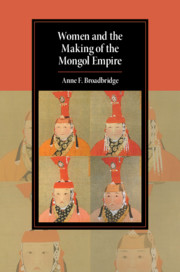
Women and the Making of the Mongol Empire

Women and the Making of the Mongol EmpireHow did women contribute to the rise of the Mongol Empire while Mongol men were conquering Eurasia? 

This book positions women in their rightful place in the otherwise well-known story of Chinggis Khan (commonly known as Genghis Khan) and his conquests and empire. Examining the best known women of Mongol society, such as Chinggis Khan's mother, Hö'elün, and senior wife, Börte, as well as those who were less famous but equally influential, including his daughters and his conquered wives, we see the systematic and essential participation of women in empire, politics and war. 

Anne F. Broadbridge also proposes a new vision of Chinggis Khan's well-known atomized army by situating his daughters and their husbands at the heart of his army reforms, looks at women's key roles in Mongol politics and succession, and charts the ways the descendants of Chinggis Khan's daughters dominated the Khanates that emerged after the breakup of the Empire in the 1260s.