Showing posts with label 9th century. Show all posts

Tuesday, November 4, 2025

Review: The Last Days by Lindsay Jacob

Synopsis: It is the year 833, and in the land of the East Angles, the rains have failed. The poor pray and starve. Then foreign hermits enter the north of the kingdom. They preach that God’s wrath has fallen upon the people because the king and the head of the Church are heralds of the Antichrist and have allowed sin to flourish. In the fevered atmosphere, lives are taken.

In the kingdom’s south, a boy with royal connections commits an inexplicable crime. The situation spirals out of control, and murder follows. The body of one of the victims is rumoured to have caused a miracle, drawing starving folk to surround the abbey where the body lies. In desperation, the ealdorman calls on Father Eadred—a simple priest with an ability to solve murders— to investigate the crimes.

Eadred throws himself into the task, risking his sanity and life to discover the truth. He uncovers a vile plot, where Christians and pagans are entangled in a volatile web. Eadred rushes from one end of the kingdom to the other, in an attempt to prevent the final crime.

But has someone beaten him?

~ ~ ~

I have read the first in the series but missed the second - this one is the third mystery.

One of the key themes in this mystery is the concept of "the last days". The concept of the "last days" varies across religions, but generally refers to a final period before an end-time event, often involving a final judgment. In Christianity, this period includes signs like moral decline, false prophets, and a coming tribulation before a final judgment and Christ's return.

"... it is a time of false prophets and deceivers ..."

All of these elements are present - church corruption, religious turmoil, vice, crop failure, drought, war, famine. As a sign of religious favour, the people and the church look to miracles as a sign that all will be well. It also means that the site of the miracle may become a place of pilgrimage, drawing in more income (and prestige) for the religious establishment.

However, murder has been committed against a royal personage and Eadred is sent forth to investigate. He comes up against a community shrouded in superstition and a regression to pagan ways, itinerant heretics preaching the end of the world, and suddenly - a miracle amid the bloodshed.

Once Eadred looks like he may have a firm grasp on events, things take a turn as egos vie for dominance, and church and state vie for the power of the people. Will Eadred solve the mysteries at hand or become one of the victims himself .... only time will tell.

This is a well constructed mystery that often takes one step forward and two steps back as the various cases Eadred must solve overlap, and his thoroughness in investigating often has him going hither and thither. The 9th century is depicted well with the ongoing battle of church and state for the souls of those under its protection and as detailed within, when all else fails, the people resort to the "old" religion of the ancestors. Despite Christianity's spread, there were still pockets resistance and a resurgence was on the horizon!

Jacob engages and immerses his readers without appearing to be providing a history lesson. A good little mystery series.

Sunday, April 2, 2023

New Viking Age Historical Fiction

New Viking Age historical fiction from a new author, Megan Formanek, who provides the reader with a powerful new series rich in historical detail and compelling characters, exploring the lives of people who lived during the early years of the Rurikid Dynasty.


Oath Undo Me
An oath made is a debt that must be paid.

Sweden 880: Astrid is free, widowed after two years in an unwanted marriage. She wants to reclaim her life and become the warrior she always wanted to be, just like her father. Horrified by her best friend’s unwelcome proposal, she flees everything she has ever known for a chance at life across the Baltic Sea, assuming a new identity in a land unknown.


Aldeigjuborg, in the land of the Rus’, is far different to her native homeland but, with the support of her new mentor, she is given the opportunity to create a life within the walls of a town she would have previously dreamed of raiding. Being a Viking is more than adventure and travel. Riches can be found in trade, through the learning of new languages and cultures.

Soon, Astrid realises everything has a price, and a promise made can have unintended consequences.


No-One's Viking
Raised on tales of glory, bound to question it all

882. Aldeigjuborg, Gardarike: Astrid has worked hard to become the well-respected textile merchant known as Signe. She wants to expand her business, support her daughter, and take full advantage of her new life. Her husband is long overdue from his trade mission and, with no word from him; Astrid turns to the gods for answers. As mysterious gifts begin appearing at her door, she questions if these are signs to guide her or a threat more sinister.

When someone Astrid swore to be free of forever reappears, dark omens plague her. Soon, Astrid finds herself tangled in the Norn’s weavings with agonising consequences.

In Aldeigjuborg, cultures clash and religion sparks trouble for the newly established empire of the Rus’. Word spreads of Grand Prince Oleg’s conquest of Kyiv and his capture of his brother’s heir. Rebellion threatens Astrid’s stable town, and the war horn calls her to embrace the Viking way.

But, as she prepares to defend her home, Astrid realises that in battle, all men are made monsters.

Saturday, July 24, 2021

Review: Murder at Elmstow Minster by Lindsay Jacob

Synopsis: It is the 830s; a time of warring Anglo-Saxon kingdoms, declining monastic standards and outbursts of fear of divine retribution. 

Elmstow Minster – a community of nuns in the Kingdom of the East Angles – has been recently established to atone for the execution of a young prince. The minster is torn between two camps – pious nuns and those who have no intention of giving up their worldly ways. These ungodly women are supported by powerful, degenerate donors, who treat Elmstow as an aristocratic whoring nest. The abbess of Elmstow has been humiliated by the influence wielded over her minster by these rich patrons and plots revenge. Two naked bodies are discovered, hanged together.


A young, introspective priest, Father Eadred, is sent to Elmstow to spy on the declining standards and against his wishes becomes entangled in the task of uncovering the guilty. He challenges the traditional approach of using an ordeal of hot iron to identify the culprits. Instead, he has the novel idea of exploring the evidence. He faces significant opposition, including an attempt on his life. Eadred is befriended by a hermit monk who becomes the only person with whom he can talk about his detection.

Further murders will take place. As Eadred moves closer to the truth the situation is thrown into further disarray when the minster is attacked by the neighbouring kingdom. Can they be saved and the final culprit revealed?


Rather good start from what promises to be the first among many, one hopes.

I have read a great deal of historical fiction, with characters from the fictional to the historical, putting on their deerstalkers and turning detective. Jacob's Father Eadred is one of many religieuse sleuths - Ellis Peters' "Brother Cadfael" series will be the foremost on many readers' minds - but he is joining the ranks of Rabbi David Small, Father Brown, Sister Fidelma, Hildegard and over 300 clerical detectives.

A number of murders and just as many motives and suspects - but not at all wrapped in a few pages - the denoument is drawn out to an interesting conclusion.  I am looking forward to reading more from this author.


note: 
those who like their crime fiction to be bubblegum wholesome would do well to avoid

further reading:

Sunday, March 29, 2020

Books: Medieval and Renaissance France

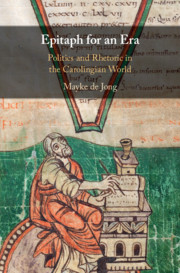
Epitaph for an Era: Politics and Rhetoric in the Carolingian World by Mayke de Jong
Epitaph for an Era
Wala, abbot of Corbie, played a major role in the rebellions against Emperor Louis the Pious, especially in 830, for which he was exiled. Radbert defended his beloved abbot, known to his monks as Arsenius, against accusations of infidelity in an 'epitaph' (funeral oration), composed as a two-book conversation between himself and other monks of Corbie. Whereas the restrained first book of Radbert's Epitaphium Arsenii was written not long after Wala's death in 836, the polemical second book was added some twenty years later. This outspoken sequel covers the early 830s, yet it mostly addresses the political issues of the 850s, as well as Radbert's personal predicament. In Epitaph for an Era, an absorbing study of this fascinating text, Mayke de Jong examines the context of the Epitaphium's two books, the use of hindsight as a rhetorical strategy, and the articulation of notions of the public good in the mid-ninth century.


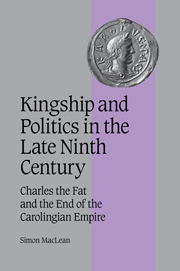
Kingship and Politics in the Late Ninth Century: Charles the Fat and the End of the Carolingian Empire by Simon MacLean
Kingship and Politics in the Late Ninth CenturyThis is a major study of the collapse of the pan-European Carolingian empire and the reign of its last ruler, Charles III 'the Fat' (876–888). The later decades of the empire are conventionally seen as a dismal period of decline and fall, scarred by internal feuding, unfettered aristocratic ambition and Viking onslaught. This book offers an alternative interpretation, arguing that previous generations of historians misunderstood the nature and causes of the end of the empire, and neglected many of the relatively numerous sources for this period. Topics covered include the significance of aristocratic power; political structures; the possibilities and limits of kingship; developments in royal ideology; the struggle with the Vikings and the nature of regional political identities. In proposing these explanations for the empire's disintegration, the book has broader implications for our understanding of this formative period of European history more generally.


The French Renaissance Court by Robert J. Knecht
"The French Renaissance Court" by Robert J.              KnechtThe definitive account of the French court, 1483-1589.  The court of France in the sixteenth century has often been seen merely as a focus of political intrigue and conflict, but it was also a cultural center in which the visual arts, music, literature, and sport flourished. This book traces for the first time in English the court’s evolution from a nomadic institution to a more sedentary one over the course of a century that began gloriously for France and ended in the horrors of civil war.

Robert Knecht, a renowned expert on Renaissance France, explores the political and cultural importance of the French court through seven reigns from Charles VIII to Henry III, including the tumultuous regency of Catherine de' Medici. Against a sharp precis of political events, he details the structure, daily activities, and festivals of the court. Sumptuously illustrated throughout, this is an enthralling account of an opulent and dynamic institution in which image and representation were key.


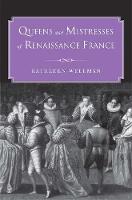
Queens and Mistresses of Renaissance France by Kathleen Wellman
"Queens and Mistresses of Renaissance France" by Kathleen WellmanThis book tells the history of the French Renaissance through the lives of its most prominent queens and mistresses, beginning with Agnès Sorel, the first officially recognized royal mistress in 1444; including Anne of Brittany, Catherine de Medici, Anne Pisseleu, Diane de Poitiers, and Marguerite de Valois, among others; and concluding with Gabrielle d’Estrées, Henry IV’s powerful mistress during the 1590s.

Wellman shows that women in both roles—queen and mistress—enjoyed great influence over French politics and culture, not to mention over the powerful men with whom they were involved. The book also addresses the enduring mythology surrounding these women, relating captivating tales that uncover much about Renaissance modes of argument, symbols, and values, as well as our own modern preoccupations.


Louis: The French Prince Who Invaded England by Catherine Hanley
"Louis" by Catherine HanleyIn 1215 a group of English barons, dissatisfied with the weak and despicable King John, decided that they needed a new monarch. They wanted a strong, experienced man, of royal blood, and they found him on the other side of the Channel: astonishingly, the most attractive candidate for the crown of England was Louis, eldest son and heir of the king of France.

In this fascinating biography of England’s least-known “king”—and the first to be written in English—Catherine Hanley explores the life and times of “Louis the Lion” before, during, and beyond his quest for the English throne. She illuminates the national and international context of his 1216 invasion, and explains why and how after sixteen fruitless months he failed to make himself King Louis I of England. Hanley also explores Louis’s subsequent reign over France until his untimely death on the Albigensian Crusade. Published eight centuries after the creation of Magna Carta and on the 800th anniversary of Louis’s proclamation as king, this fascinating story is a colorful tale of national culture, power, and politics that brings a long-forgotten life out of the shadows of history.


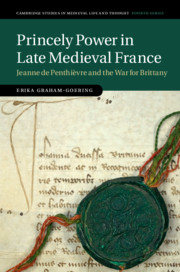
Princely Power in Late Medieval France: Jeanne de Penthièvre and the War for Brittany by Erika Graham-Goering
Princely Power in Late Medieval FranceJeanne de Penthièvre (c.1326–1384), duchess of Brittany, was an active and determined ruler who maintained her claim to the duchy throughout a war of succession and even after her eventual defeat. This in-depth study examines Jeanne's administrative and legal records to explore her co-rule with her husband, the social implications of ducal authority, and her strategies of legitimization in the face of conflict. While studies of medieval political authority often privilege royal, male, and exclusive models of power, Erika Graham-Goering reveals how there were multiple coexisting standards of princely action, and it was the navigation of these expectations that was more important to the successful exercise of power than adhering to any single approach. Cutting across categories of hierarchy, gender, and collaborative rule, this perspective sheds light on women's rulership as a crucial component in the power structures of the early Hundred Years' War, and demonstrates that lordship retained salience as a political category even in a period of growing monarchical authority.


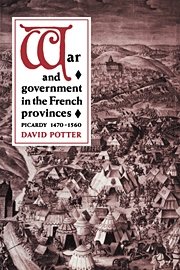
War and Government in the French Provinces by David Potter
War and Government in the French ProvincesFew studies of the history of provincial France have hitherto spanned the conventional medieval/early-modern divide, and David Potter's detailed examination of war and government in Picardy, a region of France hitherto neglected by historians, has much to say about the development of French absolutism. Picardy emerged as a province after the campaigns of 1470–1477, and its experience of the first period of absolutism provides an enlightening contrast with that of other, more outlying provinces: the Picard nobility was notable for the extent of its participation in the army, the court and the government of France. David Potter provides a detailed analysis of the organisation of French military power in the province, and its impact during the period of the Habsburg-Valois wars. The work concludes with Picardy about to enter a difficult period of civil war.


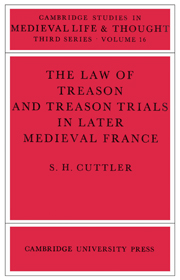
The Law of Treason and Treason Trials in Later Medieval France by S. H. Cuttler
The Law of Treason and Treason Trials in Later Medieval FranceThis book presents a balanced account not only of the theoretical framework and legal complexities of the law of treason in later medieval France, but also of the extent and political context of that law's enforcement. By shedding some light on a larger issue - the interplay of law and politics, authority and power - the book contributes to our understanding of the French monarchy's efforts in the crucial fourteenth and fifteenth centuries to protect, extend and enforce its authority. The crown needed virtually all its judicial resources to cope with treason. Summary judgement and judgement by notoriety had largely given way by the fifteenth century to institutionalized procedures; special mention is made of trial by commission and the trial of peers. In the last five chapters the prosecution of treason is treated narratively to illuminate the policies of individual kings. Throughout the book comparisons are made with the English law.

Saturday, October 5, 2019

‘King and Emperor’ Review: Charles the Great


Over 12 centuries ago, Charles the Great, Charlemagne, united, by force and diplomacy, those regions that make up today the core of the European Union, and created a state apparatus to govern the area. The empire lasted only a few decades beyond his death, but the institutions and cultural processes he promoted have marked Western Europe until today. He remains Europe’s most successful leader.

“King and Emperor: A New Life of Charlemagne” is not simply a biography: Ms. Nelson simultaneously presents the evidence from which she reconstructs the man and his times, guiding the reader through the complexities of medieval source criticism, offering lessons on how to read Carolingian poetry and showing her hand at every crucial moment of judgment. Doing history is always more engaging than reading history, and by involving the reader in the process, “King and Emperor” takes on the compelling suspense of good detective work as well as good history.

read complete review here @ Wall Street Journal

Friday, October 4, 2019

Heresy and Dissent in the Carolingian Empire by Matthew Bryan Gillis

Cover for 

Heresy and Dissent in the Carolingian Empire
Heresy and Dissent in the Carolingian Empire recounts the history of an exceptional ninth-century religious outlaw, Gottschalk of Orbais. Frankish Christianity required obedience to ecclesiastical superiors, voluntary participation in reform, and the belief that salvation was possible for all baptized believers. Yet Gottschalk-a mere priest-developed a controversial, Augustinian-based theology of predestination, claiming that only divine election through grace enabled eternal life. Gottschalk preached to Christians within the Frankish empire-including bishops-and non-Christians beyond its borders, scandalously demanding they confess his doctrine or be revealed as wicked reprobates. Even after his condemnations for heresy in the late 840s, Gottschalk continued his activities from prison thanks to monks who smuggled his pamphlets to a subterranean community of supporters. 

This study reconstructs the career of the Carolingian Empire's foremost religious dissenter in order to imagine that empire from the perspective of someone who worked to subvert its most fundamental beliefs. Examining the surviving evidence (including his own writings), Matthew Gillis analyzes Gottschalk's literary and spiritual self-representations, his modes of argument, his prophetic claims to martyrdom and miraculous powers, and his shocking defiance to bishops as strategies for influencing contemporaries in changing political circumstances. In the larger history of medieval heresy and dissent, Gottschalk's case reveals how the Carolingian Empire preserved order within the church through coercive reform. The hierarchy compelled Christians to accept correction of perceived sins and errors, while punishing as sources of spiritual corruption those rare dissenters who resisted its authority.

Wednesday, September 25, 2019

Edward the Elder and the Making of England by Harriet Harvey Wood

Edward the Elder and the Making of England by [Harvey Wood, Harriet]
Three men have been credited with being the first king of England – Alfred the Great, his son Edward the Elder and Edward’s son and Alfred’s grandson, Athelstan. It is an undoubted fact that, were it not for the work of Alfred, there might never have been the possibility of an English kingdom in the sense that we now understand it.


It is also true that Athelstan was the first explicitly to rule over an English kingdom in roughly its present shape and extent. What, then, was the contribution of Edward to the evolution of what his son was to inherit? As a child, he saw his father at the lowest point of his fortunes; as a boy, he grew up under the constant threat of further Danish invasion.

Edward came to adulthood in the knowledge that it was his responsibility to safeguard his country. By his death, he was undoubtedly the most powerful and respected ruler, not only in England but in western Europe, and he achieved this through both martial and legislative prowess. Edward built on his father’s work but he immeasurably expanded it, and the chroniclers who wrote in the centuries which immediately followed his death remembered him as ‘greatly excelling his father in extent of power’.

Edward the Elder succeeded Alfred as king of the Anglo-Saxons; he died as king of the English. And yet virtually nothing has been written about him. Until now.  While biographies of Alfred and studies of the achievements of Athelstan pour from the press, Edward is forgotten. Yet he was the first ruler to leave behind him the possibility of a united England, a country in which men thought of themselves as English, speaking a language which all would have described as English, which had never existed in quite this form before.

Anyone looking to fully understand and appreciate the making of medieval England must look to understand and appreciate Edward the Elder and his reign.

Sunday, July 14, 2019

The Formation of the English Kingdom in the Tenth Century by George Molyneaux

Cover for 

The Formation of the English Kingdom in the Tenth Century


The central argument of The Formation of the English Kingdom in the Tenth Century is that the English kingdom which existed at the time of the Norman Conquest was defined by the geographical parameters of a set of administrative reforms implemented in the mid- to late tenth century, and not by a vision of English unity going back to Alfred the Great (871-899).


In the first half of the tenth century, successive members of the Cerdicing dynasty established a loose domination over the other great potentates in Britain. They were celebrated as kings of the whole island, but even in their Wessex heartlands they probably had few means to regulate routinely the conduct of the general populace. 

Detailed analysis of coins, shires, hundreds, and wapentakes suggests that it was only around the time of Edgar (957/9-975) that the Cerdicing kings developed the relatively standardised administrative apparatus of the so-called 'Anglo-Saxon state'. This substantially increased their ability to impinge upon the lives of ordinary people living between the Channel and the Tees, and served to mark that area off from the rest of the island. The resultant cleft undermined the idea of a pan-British realm, and demarcated the early English kingdom as a distinct and coherent political unit.

In this volume, George Molyneaux places the formation of the English kingdom in a European perspective, and challenges the notion that its development was exceptional: the Cerdicings were only one of several ruling dynasties around the fringes of the former Carolingian Empire for which the late ninth, tenth, and eleventh centuries were a time of territorial expansion and consolidation.


Saturday, December 15, 2018

Penn library will return 9th-century documents found to have been stolen from Italian archive

From The Inquirer:

The University of Pennsylvania has voluntarily agreed to return two ancient parchment documents to an Italian archive from which they had been stolen, apparently in the 1990s, according to a formal stipulation filed in federal court in Philadelphia last month.

The heist was the work of an unknown thief and happened years before the papers surfaced at Penn.

The documents, which record land transactions in the 820s in southern Italy, were acquired in the late 1990s by the late collector Lawrence J. Schoenberg, who bestowed his collection of manuscripts and books on the university in 2011.

The Schoenberg Collection at the University of Pennsylvania Libraries, consisting of about 300 separate items, is particularly rich in medieval and Renaissance books and manuscripts.


read more @ The Inquirer

Saturday, August 18, 2018

Review: The Vikings - From Odin to Christ by Martyn and Hannah Whittock

Synopsis: The popular image of the Vikings is of tall red-headed men, raping and pillaging their way around the coast of Europe, stopping only to ransack monasteries and burn longships. But the violent Vikings of the 8th century became the pious Christians of the 11th century, who gave gold crosses to Christian churches and in whose areas of rule pagan idols were destroyed and churches were built.

So how did this radical transformation happen, and why? What difference did it make to the Vikings, and to those around them, and what is their legacy today? This book takes a "global" look at this key period in Viking history, exploring all the major areas of Viking settlement. Written to be an accessible and engaging overview for the general reader.


For me, this was a highly informative journey into the transformation of the "pagan" Viking into the acceptable "christian" that is well annotated and referenced, and makes use of the voices of the Vikings themselves, through their sagas, to provide context. The authors explore the conversion of the Viking peoples and how and why this religious transformation took place.  What is interesting is the differing views on what constituted conversion, where the roots of conversion eminated from, and the how each conversion event was unique. 

The authors make clever use of their chapters to sort out and compartmentalise the history of the conversion of each group or nation, making it more accessible to the reader.  We take a look at who were the Vikings of the pre-christian world, and compare that with our modern perception of them. We look at how different forms of Christianity were the driving forces behind the conversions - German, Irish, British and Greek missionaries each had their sphere of influence and success.

First up is the raids on Anglo Saxon England, Ireland, Frisia and the Frankish Empire.  Were these raids a serious threat to the already established Christian religions - for following these attacks was a serious collapse in pastoral care throughout into which the pagan religions filled the vacuum.

To the subject at hand - we now get down to the chapters that are the most interesting, and I will give a brief summary of each, starting with Chapter 4 -"The Cross and the Hammer" - the Vikings in northern England, the dominance of pagan rule, and of co-existance and assimilation.

Chapter 5 find us in 8th Century Ireland, with the inability of local leaders to unite and form a cohesive front against the Viking attacks and the establishment of permanent bases - at least not until the Battle of Clontarf.  The foundation of Normandy is covered in Chapter 6, with the transition of conversion taking a mere century, and the development of Church reform under these newly christianised leaders gained prominance.

Now we get to the main Viking nations: Chapter 7 covers the conversion process in 10th Century Denmark under the leadership of of Harold Bluetooth, despite earlier missions two centuries prior; and also clarifies some of the misnomers of the reign of both Svein Forkbeard and Cnut.  Chapter 8 takes us to Norway, whose missionary kings - the Olafs - lead the fight against pagan resistance.  The use of burials as an indicator of the level of the reaches of conversion, and the connection between conversion and the expansion of royal power is also discussed. 

Sweden and the arrival of the German missionaries in the 9th Century is covered in Chapter 9.  This conversion took much longer as this area was not so politically unified as its neighbours.  Unity and royal power increased at the same rate as the conversion, and was more or less complete with the incorporation of Finland by 13th Century.

Chapter 10 deals with the spread of the Vikings in the east, namely through the Byzantine Empire, the Baltic, the establishment of the kingdom of Rus, the reach of trade as far as Baghdad, and of course, the hero Harald Hardrada.  The colonisation and conversion of the North Atlantic Viking outposts of Iceland, Greenland, and the Faroe Islands in Chapter 11 quite naturally leads into the the voyages of the Greenlanders to Vinland in the 11th Century, and the first American Christians.

Back we head to Anglo Saxon England, and the reign of the first Viking Kings, Svein of Denmark and his son Cnut the Great, under who, as a loyal son the the Chruch, actively suppressed paganism.  The obliteration of Pictish culture under the Vikings in the islands to the north and the west (Hebrides, Orkneys, Shetland, et el), and the missions from Germany and Ireland, forms one of our final chapters.  It is assimilation, expansion, trade, spread of ideas, and the unity of political power in the mid 12th century that finally ended the "Viking Age".

This is truly a remarkable journey of the Christianisation of the Scandinavian world that really kicked off in the late 9th century and lasted for a period of three hundred years.

Monday, March 12, 2018

Review: Raven Saga by Giles Kristian

Preceeding all the hooplah of the series, "Vikings", was this trilogy by Giles Kristian. The story of a young man, taken as plunder when Norsemen attack his village, to metamorphysis into the warrior Raven. This is a period of history that holds great interest to me - I love the Viking Sagas, the journey of King Harald, of Egil, of Leif, and not to mention the heroic women. The historical re-creation of a time when the coastlines of what is now Ireland, Scotland and England, were subjected to the raiding of the Norse and the emergence of some larger than life characters is fascinating. And this is primary what drew me to book one, and the two subsequent tomes.


Book One - Raven - Blood Eye:
For two years Osric has lived a simple life, apprentice to the mute old carpenter who took him in when others would have him cast out. But when Norsemen from across the sea burn his village they also destroy his new life, and Osric finds himself a prisoner of these warriors. 

Immersed in the Norsemen's world and driven by their lust for adventure, Osric proves a natural warrior and forges a blood bond with Sigurd, who renames him Raven. When the Fellowship faces annihilation from Ealdorman Ealdred of Wessex, Raven chooses a bloody and dangerous path, accepting the mission of raiding deep into hostile lands to steal a holy book from Coenwolf, King of Mercia. There he will find much more than the Holy Gospels of St Jerome. And he will find betrayal at the hands of cruel men, some of whom he regarded as friends...

So, what did I think? I don't mind the first person narrative as we are immediately drawn to the character of Osric / Raven. The promises a tale of adventure, of battles, of plunder, of brotherhood, of betrayal - standard go-to plotline - young man captured, finds fidelity among the warriors, enter one bad guy hell bent on destroying the Fellowship, hero finds love and betrayal. But I found it a little flat - maybe it was just not the right time when I initially read this tale (2012), but looking back at my notes, I don't think so. Others have raved that Kristian is surely the heir-apparent to Bernard Cornwall - this really has no bearing on my review as I am not such a fan of Cornwall.


Book Two - Raven - Sons of Thunder:
Raven and his Wolfpack of Norsemen have been double crossed. The traitor Ealdred seeks to sell a holy book to the Emperor Charlemagne which will ensure riches beyond his wildest dreams. Greed drives him forward, but a band of fearsome warriors is in pursuit across the sea to Charlemagne's Frankish empire -- with the bloodiest of revenge on their minds.

Slaughter is certain as the Fellowship trap Ealdred and his men at the mouth of the river Sicauna in Frankia. Sigurd the Lucky challenges Ealdred's bodyguard Mauger in an ancient duel called the holmgang, and only one will walk away with his life. 

The continuing saga of the Viking Raven and his band of warrior brothers with the Fellowship on the trail of the evil Ealdred and pursue him to the lands of Charlemagne. This builds on book one, and I was pleased to say that the action and adventure picks up, and my reading interest was suitably maintained. The characters are finally developing, and the descriptive narrative of the journey is engaging. A much stronger outing with this book as Kristian has managed to capture the times (the good, the bad, the ugly) well. 


Book Three - Raven - Odin's Wolves:
Plunging through the living hell of Pope Leo’s shattered, perverted Rome, the dragon-faced ships of Sigurd the Lucky are manned by a strange and fearsome crew: among the Norsemen is Raven, a young man of uncertain parentage ...robbed of the woman he loves, destined to play a cunning role in the boldest of attacks. For the Vikings are on their way to glimmering Constantinople to put a deposed emperor back on his rightful throne—and claim the most magnificent prize of all. 

Travelling through Rome, the Fellowship is on its way to Constantinople. And here again I found the story a little bland, until the last when the action finally kicks in. I found the journey wasn't as fluid as in book two.

On another note, it is rather strange that after reading this series I found out that these stories fall in the latter stages in the life of Sigurd Haraldarson, and that there is a set of books dealing with his earlier story. I am pleased, in a strange way to hear this, as I felt more empathy with Sigurd than Raven. I might even revisit the Raven series after tackling Sigurd.


For more on Sigurd see:
  • God of Vengeance
  • Winters Fire
  • Wings of the Storm


Thursday, October 27, 2016

1066 and all that: a Hong Kong novelist’s alternative history

Author Justin Hill recounts his quest to reimagine the events of 1066 and retrace the life of a legendary warrior who could have become England’s king instead of William the Conqueror.
Harald Hardrada was one of the most fabulous adventurers of medieval times. His career has served as a template for fantasy char­acters such as Conan the Barbarian and even for the tumultuous turns of George R.R. Martin’s Game of Thrones. Harald was a child exile, like Arya Stark; as clever as Tyrion Lannister; as accomplished a warrior as Jaime Lannister; and travelled into the exotic east, like Daenerys Targaryen. His story is the archetype of the barbarian who rose to the heights of power and made himself king.
Shieldwall (2011), the first of a series of books examining the narratives and context of the 1066 Battle of Hastings, was a Sunday Times book of the year. Viking Fire is the second in this series and follows the adventures of Norwegian king Harald Hardrada.
Continue reading article here at Post Magazine

Sunday, October 23, 2016

Bernicia Chronicles: The Northern Queen


This month in the "What I Learnt..." series, Matthew Harffy talks to author Kelly Evans about her new novel "The Northern Queen" and researching for her novels.

Born in Canada of Scottish extraction, Kelly graduated in History and English from McMaster University in Ontario, Canada. After graduating Kelly moved to the UK where she continued her studies in history, focusing on Medieval England and the Icelandic Sagas (with a smattering of Old Norse and Old English). Her first novel, The Northern Queen, was released in 2015 and she is currently working on the second book in her Anglo-Saxon series, set in the years prior to the Norman invasion.


Read rest of the blog article here at Matthew Harffy's Bernicia Chronicles

Monday, July 4, 2016

Fez's Al Qarawiyyin University and Library

Fez's Al Qarawiyyin University and library, founded and restored by women — Quartz
Founded by a Muslim woman, the University of Al Qarawiyyin in Fez, Morroco, opened its doors in 859. Its library has been restored during the last three years by another woman, Canadian-Moroccan architect Aziza Chaouni. A wing will be open to the general public later this year.
The library houses a collection of 4,000 rare books and ancient arabic manuscripts written by renowned scholars of the region. According to the AP, the manuscripts include a 9th century version of the Quran and a manuscript on Islamic jurisprudence written by philosopher Averroes.

Read More here at QUARTZ