Showing posts with label notable men. Show all posts

Monday, October 6, 2025

Review: Cromwell's Spy by Dennis Sewell

Synopsis: A vivid biography of the elusive George Downing, a Puritan from colonial Massachusetts who became Oliver Cromwell's chief spy and a key figure in the Restoration.Downing Street is synonymous with political power, perhaps only second to Pennsylvania Avenue. But for the builder behind one of the world's most famous streets—George Downing—it was a mere retirement project.

Throughout his storied life, Downing would be a soldier, a politician, a diplomat, and a spy. He came of age as a pioneer in colonial Massachusetts, graduated from Harvard, crossed the Atlantic to sign up for the English Civil War and fast became Oliver Cromwell’s chief of military intelligence. He was one of a close group of now-forgotten Americans in Cromwell’s circle who exerted enormous influence upon English political life during their Civil War.

Throughout his life, Downing was always at the center of events, engaging with the most illustrious men and women of his times. His uncle was the governor of Massachusetts; his cousin the governor of Connecticut. In England, his patrons were Oliver Cromwell and King Charles II. The famous diarist, Samuel Pepys, was his clerk; the great poet, John Milton, prepared his letters and dispatches. William of Orange was godfather to his son; his next-door neighbor was Queen Elizabeth of Bohemia; and when Downing finally built his street, his surveyor was Sir Christopher Wren, architect of St Paul’s Cathedral.

He would leave his mark on American soil as well. He played a key role in the founding of New York by helping to wrest Manhattan and Long Island from the Dutch. Yet he remains one of the most elusive figures of his age. In Dennis Sewell's rich and vivid Cromwell's Spymaster, Downing emerges as the extraordinary, enigmatic, and endlessly fascinating anti-hero of his own life story.

~ ~ ~

After finishing this biography by Dennis Sewell, I still felt as if Downing was as elusive as ever, and I fear much of his "intelligence" work has gone and will continue to go undiscovered. It is his reputation - as a spy, a diplomat, a turncoat, a raconteur, an double agent - that has  foreshadowed all else.  But I feel that I have learned more about this man than I previously had, and have come to an understanding of his character and career.

George Downing was a man who was socially and politically connected to people - on both sides of the Atlantic - who mattered. He was politically active, initially as a preacher, before learning the art of deception and ambiguity from Oliver Cromwell himself. Downing was no fool - he was adroit, astute, with his own network of spies and agents, and was often referred to as both "an intelligencer and seducer" (c.1650).

His early political career was in Scotland however he took no part in the trial or execution of King Charles I of England, despite being on Cromwell's staff. He became increasingly concerned with foreign affairs and national security, finding himself as Ambassador in the Netherlands, where he was said to be "... burgling, bribing and blackmailing his way across the Low Countries..." which were a hot-bed of Royalist activity and home to a number of significant members of the royal house of Stuart.

His reputation was far from clean - he was an active participant in the trafficking of war prisoners to the Americas and nor was he above a little appropriation of the property of Royalists for himself. In the political vacuum that followed the death of Cromwell, Downing used his connections to intercede with the new King, Charles II. He was forgiven his misdemeanors, rewarded and even took on the role of hunter of the regicides.

Downing did well for himself in the US colonies - mercantilism became his new religion; and whilst he may have lost royal support due to abandoning his post during war, he was an active (and wealthy) parliamentarian.

As mentioned, it would be Downing's reputation - as a morally heinous, hypocritical scoundrel and turncoat - that would outlive his achievements. However, it should be remembered that Downing really was no better nor worse than his contemporaries and his actions should be judged only in light of the events and mores of his time - not ours!

Having finding myself reading more about the Interregnum under Cromwell and the hunt for the regicides of Charles I, this biography by Sewell landed at a most appropriate time. 

I would highly recommend indulging in this biography of an elusive and contradictory character, which does much to restore some of the dignity and acknowledge the sheer strength of political survivalism of this intriguing man.

Tuesday, September 7, 2021

The Making of Crusading Heroes and Villains by Mike Horswell & Kristin Skottki

Engaging the Crusades is a series of volumes which offer windows into a newly emerging field of historical study: the memory and legacy of the crusades. Together these volumes examine the reasons behind the enduring resonance of the crusades and present the memory of crusading in the modern period as a productive, exciting, and much needed area of investigation.

This new volume explores the ways in which significant crusading figures have been employed as heroes and villains, and by whom. Each chapter analyses a case study relating to a key historical figure including the First Crusader Tancred; ‘villains’ Reynald of Châtillon and Conrad of Montferrat; the oft-overlooked Queen Melisende of Jerusalem; the entangled memories of Richard ‘the Lionheart’ and Saladin; and the appropriation of St Louis IX by the British. Through fresh approaches, such as a new translation of the inscriptions on the wreath laid on Saladin’s tomb by Kaiser Wilhelm II, this book represents a significant cutting-edge intervention in thinking about memory, crusader medievalism, and the processes of making heroes and villains.

The Making of Crusading Heroes and Villains is the perfect tool for scholars and students of the crusades, and for historians concerned with the development of reputations and memory.


Sunday, August 11, 2019

Review: The Life & Legend of Sultan Saladin by Jonathan Phillips

44796194. sy475
Synopsis: When Saladin recaptured Jerusalem from the Crusaders in 1187, returning the Holy City to Islamic rule for the first time in almost ninety years, he sent shockwaves throughout Christian Europe and the Muslim Near East that reverberate today.


It was the culmination of a supremely exciting life, fraught with challenges and contradictions but blessed occasionally with marvellous good fortune. Born into a significant Kurdish family in northern Iraq, Saladin shot to power in faraway Egypt thanks to the tutelage of his uncle. Over two decades, this warrior and diplomat fought under the banner of jihad, but at the same time worked tirelessly to build an immense dynastic empire that stretched from North Africa to Western Iraq. Gathering together a turbulent and diverse coalition he was able to capture Jerusalem, only to trigger the Third Crusade and face his greatest adversary, King Richard the Lionheart.

Drawing on a rich blend of Arabic and European sources, this is a comprehensive account of both the man and the legend to which he gave birth, describing vividly the relentless action of his life and then tracing its aftermath through culture and politics all the way to the present day. It reveals the personal qualities that explain his enduring reputation as a man of faith, generosity, mercy and justice, even while showing him to be capable of mistakes, self-interest and cruelty. After Saladin’s death, it goes on to explain how in the West this Sunni Muslim became famed for his charm and chivalric virtue, while across much of the Islamic world he stands as one of history’s greatest heroes, an inspiration to be admired and emulated.


To be perfectly blunt, I could not have cared less whether the chapters on how Saladin's image has been used now were included or not. It is pretty obvious that it is used for the sole purpose of furthering the political agenda of the day of whatever political group has hijacked it. In short, his image is defined by the needs of the multitudes, and bears no resemblance to historical records.  As professor Nicholas Saunders remarked (on an unrelated issue): "The dead can always be weaponized politically ...."


I actually enjoyed the book more for being a detailed biography on the man himself. Medieval politics is a bit of a minefield to negotiate for the uninitiated - and Phillips does a sound job in explaining the political landscape that Saladin was born into and operated within.

Phillips' book is quite lengthy - it covers all the aspects of Saladin's personal life; his military career, especially that in Egypt; court life under both Zengi and Nur al-Din; political and religious histories of the then Muslim world. It is not solely focused on the Crusades, thought this period did indeed dominate his political and military career. Then, of course, are the chapters on his legacy, and the depictions of Saladin in both the West and the East.

A lot of research has gone into this book, with a plethora of sources worthy of exploring further. In fact, there were quite a few instances where little snippets of information piqued my interest which will result in my own further research.


Review: Emperor: A New Life of Charles V by Geoffrey Parker


45455839. sy475 I haven't read any single biographies on Charles V - this was my first. Much of what I had read was contained within other books - more of a secondary character or part of the supporting cast. So whether it stacks up against other known biographies, I cannot comment.

For me, this was an eye-opener into the intricacies of Charles' life and reign. I knew the basics and many of the names that cropped up but not at all in such depth as presented here. Many familiar events were tied together and put into perspective. Each of the "parts" of the book consisted of a series of manageable chapters highlighting his life, his reign, including an assessment of both the man and his political achievements. I was particularly intrigued by the view that Charles' later actions closely reflected the goals and values of his grandfather, Maximillian, ".. whom he imitated and saw as a role model, for better or worse.." - not really knowing much about Maximillian, it left me wondering how true this assessment was - and now leads me down another path of exploration. Other issues have been relegated to the appendices for addressing, allowing the author to explore and elaborate on views and theories, whilst still presenting a fairly unbiased biography.

As a whole, it is quite lengthy at 570 pages- containing biography; chronology; appendices; notes and sources, and bibliography; attesting to that fact that an extensive amount of research went into this tome. This is something I would definitely come back to re-read, and most likely find a place for on the shelves of my own personal library.

"History can never be reduced to a single entry in a ledger .." - and this book certainly proves that.

further reading:
  • The Reign of Charles V by William S. Maltby (2002)
  • The History of Charles V by William Robertson (1828)
  • The Emperor Charles V by Martyn Rady (2014)
  • Correspondence of the Emperor Charles V. and His Ambassadors at the Courts of England and France edited by William Bradford (1850)
  • The Golden Age: The Spanish Empire of Charles V by Hugh Thomas (2011)
  • Emperor Charles V by Willem Pieter Blockmans (2002)
  • Charles V: Duty and Dynasty: The Emperor and His Changing World 1500-1558 by Richard Heath (2018)
  • Charles V: The World Emperor by Harald Kleinshcmidt (2011)

Sunday, July 14, 2019

Author - Christopher Nicole

Author Christopher Nicole has a plethora of titles out encompassing various stages in history (210 books if you can believe it). If you look for him on Amazon, there are eleven pages worth of books to select from. However, here are a few that caught my eye, mainly due to my interest in history and notable women in history:


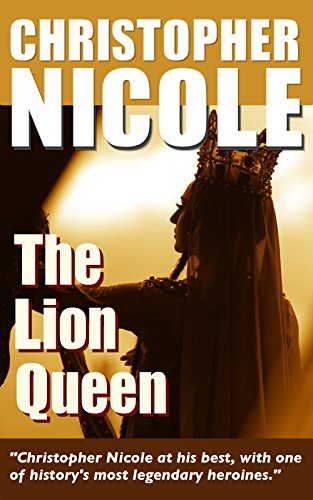
The Lion Queen
Image result for lion queen christopher nicoleWho: Queen Tamar / Tamara / Thamar of Georgia (Queen of Georgia from 1184 to 1213, presiding over the apex of the Georgian Golden Age. A member of the Bagrationi dynasty, her position as the first woman to rule Georgia in her own right was emphasized by the title mepe, afforded to Tamar in the medieval Georgian sources)

Synopsis: Today Georgia is a small country existing in the shadow of Russia, but only 900 years ago the Georgians controlled an empire that stretched from the Black Sea to the Persian Gulf, the Mediterranean to the Caspian. This was the work of Queen Tamara, who, inheriting the throne at the age of twenty-five as King of the Georgians – there was no word for queen in the Georgian language – led her armies sword in hand. Accurately depicting a savage age, when life was cheap virtue non-existent, this is not for the faint-hearted, but it is also the tale of a remarkable relationship, and an undying love.


Lord of the Golden Fan
Who: Will Adams (an English navigator who, in 1600, was the first of his nation to reach Japan during a five-ship expedition for the Dutch East India Company. As a key advisor to the shōgun Tokugawa Ieyasu, he has been recognised as one of the most influential foreigners in Japan during this period)

Synopsis: Leaving Elizabethan Kent in search of adventure, Will Adams took a voyage through Indonesia. Sailing as pilot of five small trading ships on a twenty-one months' voyage to the fabled Spice Islands of Java and Sumatra, Will survived disaster to reach seventeenth-century Japan. Not only was he the first Englishman to set foot in Japan, but he also became the lifelong protégé and friend of the reigning Shogun, Iyeyasu.  By his prowess and wise counsel, Will also opened the way to Japan's first contacts with the learning and culture of the West. 


Ottoman
Image result for book cover ottoman christopher nicoleWho: Sir John Hawkwood (not to be confused with the enigmatic English soldier and condottiero - mercenary - of the same name who was prominent in England, France and Italy a half century earlier)

Synopsis: English master-gunner John Hawkwood uproots his family from their native land and journeys to this fabled city. With the city under threat by the Ottoman Turks, the Byzantine emperor is in desperate need of men like Hawkwood and the knowledge of cannon and gunpowder he brings.  For a time, the Hawkwoods enjoy status and privilege in return for John’s superior abilities as an artillerist. 

But all good things must come to an end. When tragedy strikes, even the close relationship John shares with the emperor cannot absolve the family of their sins, and with little more than the clothes on their backs, the Hawkwoods flee Constantinople. 

Captured by the savage Turks, John Hawkwood swiftly changes his allegiance, and once more applies his considerable skills…this time serving the conquerors in their victorious surge across eastern Europe and Mediterranean shores.  No man lives forever, but the Hawkwood line never dies. 

Over a span of nearly one hundred and fifty years, the Hawkwoods must employ every ounce of political cunning they possess to survive the swirling intrigues and bloody massacres that dominate the world in which they live.  Beyond the gleaming wealth and the veneer of power lie grim spectres of betrayal and sudden death, the threat of ravishment and torture lurking behind the gilded pillars of their palaces and harems.  And when the time comes to choose between Ottoman and Hawkwood, no one can say what the future might bring…


Queen of Destiny
Who: Adelaide of Burgundy (Holy Roman Empress by marriage to Otto the Great; she was regent of the Holy Roman Empire as the guardian of her grandson in 991-995)

Synopsis: Adelaide, Queen of Burgundy and Empress of the Holy Roman Empire, was one of the most beautiful and courageous women in history. She is renowned as the most prominent European woman of the 10th century and Christopher Nicole brings you the amazing story of her life, her struggles and her conquests.


Queen of Lions
Who: Margaret of Anjou (Queen of England by marriage to King Henry VI from 1445 to 1461 and again from 1470 to 1471 - this was the period in history known as The Wars of the Roses).

Synopsis: When the beautiful Margaret of Anjou marries King Henry VI of England, she is a virgin who longs for love, power, wealth, and a son.  After arriving in England she learns that her deeply religious and delicate husband is unwilling to satisfy her desires and there seems to be no hope of producing an heir.  He is not the powerful man she had imagined and she is shocked to learn he does not hunt, is not properly trained in the art of battle and has no interest in entertaining guests. Though her husband cannot quench her desires, there are others at court who can … 

Under her banner of the dangerous, passionate red rose, Margaret draws men to her, to fight and die for her, never losing her fierce ambition, never satisfied with less than all.  And as the Wars of the Roses looms, she rides among her troops, rallying her ‘lions’ to the glorious cause.


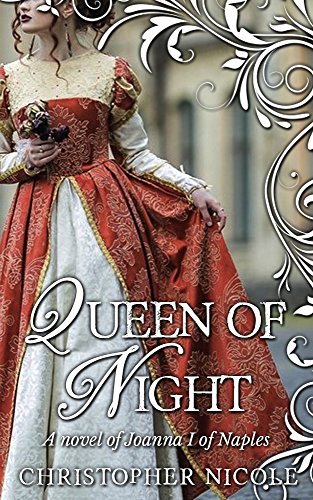
Queen of the Night
Who: Joanna I, Queen of Naples (countess of Provence and queen of Naples (1343–82) she defended her claim as well as that of the house of Anjou to the throne of Naples, only to lose it to Charles of Durazzo (Charles III of Naples). Beautiful and intelligent, she was also a patron of the poets and scholars of her time)

Image result for queen of the night christopher nicoleSynopsis: The year is 1338,11yo Richilde’s family is brutally murdered by pirates whilst her life is spared, she is subjected to unimaginable terror. The young English girl is sold, educated and groomed for the purposes of becoming a playmate and servant to the Duchess of Calabria, Joanna, the heir to the throne of Naples.  

Joanna is betrothed to Prince Andrew of Hungary, younger brother to the future King but unbeknown to both girls, Joanna’s foster mother, Donna, begins to hatch a manipulative plan.  In a bid to capture the kingdom for herself, Donna conspires against Joanna and aware of her desires, exposes the future queen to passions that would live on forever…

Stripping Joanna’s innocence under the pretence of educating her, Donna initiates a stream of sadistic events which will lead to the young Queen’s downfall.  In their struggle for survival, both Joanna and Richilde endure countless attempts on their lives … but, amidst it all, their strength to survive rallies on … as does their friendship …


Eleanor of Aquitaine and The Queen of Love
Who: Eleanor of Aquitaine (Duchess of Aquitaine, Queen of France, Queen of England, mother of Kings of England)

Sysnopsis: Book one deals with Eleanor's earlier life as a young woman and her first marriage to Louis VII of France, whilst the second deals with her marriage to Henry II and the remainder of her tumultuous life.


Dawn of a legend and Twilight of a Goddess
Who: Jane Digby, Lady Ellenborough (an English aristocrat, famed for her remarkable love life and lifestyle. She had four husbands and many lovers, and died in Damascus, Syria, as the wife of Arab Sheikh Medjuel el Mezrab, who was 20 years her junior.)

Synopsis Book 1: Jane Elizabeth Digby was born into one of the wealthiest families in nineteenth century England. By the age of seventeen, she became known as Aurora, the Light of Dawn, such was her beauty, and received the attentions of many a rich bachelor.  Her eventual marriage to Lord Ellenborough promised much but proved something of a disappointment when he turned out to be a prude in the bedroom. And so, Jane began to seek her pleasure elsewhere, conducting a string of scandalous affairs that would send shock waves through society.

Synopsis Book 2: It is 1835, and Jane Elizabeth Digby finds herself living in Bavaria having remarried the Baron von Venningen following an affair. But this is a marriage of convenience, for she has become the principal mistress of the German King. However, Jane, now approaching thirty, is becoming bored with her situation, and when she meets a glamorous Greek Count, she abandons everything to elope with him.

This is the beginning of a tumultuous career of love and adventure. Armed with her pistols, natural grace and wit, not to mention a body that turns heads, she jumps from one steamy affair to another, travelling from Athens into the bandit-ridden mountains of Albania, and the deserts of Syria, where, after a lifelong quest for love, she will become a living legend.


Queen of Glory
Image result for book covers christopher nicoleWho: Lakshmi Bai, Rani of Jhansi (Queen of the princely state of Jhansi in North India, she was one of the leading figures of the Indian Rebellion of 1857 and became a symbol of resistance to the British Raj for Indian nationalists.)

Synopsis: As the Indian Mutiny takes hold, one woman will establish her place in history for ever . . . ""India"," 1857." Aged just twenty-one, Lakshmi Bai, otherwise known as Manu, the widowed and recently deposed Rani of Jhansi, finds herself embroiled in the developing Indian Mutiny. Torn between leading Jhansi into battle or following the advice of her close friend and confidante, Emma Hammond, a tragic succession of events is triggered as the Mutiny comes to a head and Manu faces her destiny: one which will see her crowned as India s queen of glory. 


Full bibliography here @ Wikipedia


Saturday, April 6, 2019

Hernando Colon - The man who tried to read all the books in the world


129,864,880. That’s the number of books in the world, according to an estimate by Google Books, which since its launch in 2005 has been trying to scan them all, convert them to searchable text using optical character recognition and then make them publicly available online. Although Google Books’ hopes have been slowed by wrangles over copyright and fair use, if it succeeds it could become the largest online body of human knowledge ever available.

Half a millennium earlier in Seville, Spain, Hernando Colón (1488–1539) had the same ambitious aim: to create a library that would be universal in a way never before imagined because it would contain everything. And Colón really did try to collect everything: from precious manuscripts to books by unknown authors, from flimsy pamphlets to tavern posters, from weighty tomes to throwaway ephemera.

Colón’s bibliomania took him back and forth across Europe for three decades. According to Dr Edward Wilson-Lee, from Cambridge's Sidney Sussex College and the Faculty of English, he bought 700 books in Nuremburg over Christmas in 1521, before passing on to Mainz where he bought a thousand more in the course of a month. In a single year in 1530, he visited Rome, Bologna, Modena, Parma, Turin, Milan, Venice, Padua, Innsbruck, Augsburg, Constance, Basle, Fribourg, Cologne, Maastricht, Antwerp, Paris, Poitiers and Burgos, voraciously buying all he could lay his hands on.

Today, just over 3,000 books of Colón’s library remain. Until now, the life of this extraordinary man has largely escaped notice; it’s taken another revolution to grasp how visionary he was in recognising the power of tools to order the world of information.


read more from University of Cambridge

Simon V of Montfort and Baronial Government, 1195-1218 - G.E.M. Lippiatt

CoverDissenter from the Fourth Crusade, disseised earl of Leicester, leader of the Albigensian Crusade, prince of southern France: Simon of Montfort led a remarkable career of ascent from mid-level French baron to semi-independent count before his violent death before the walls of Toulouse in 1218. Through the vehicle of the crusade, Simon cultivated autonomous power in the liminal space between competing royal lordships in southern France in order to build his own principality. 

This first English biographical study of his life examines the ways in which Simon succeeded and failed in developing this independence in France, England, the Midi, and on campaign to Jerusalem. Simon's familial, social, and intellectual connexions shaped his conceptions of political order, which he then implemented in his conquests. By analysing contemporary narrative, scholastic, and documentary evidence-including a wealth of archival material-this volume argues that Simon's career demonstrates the vitality of baronial independence in the High Middle Ages, despite the emergence of centralised royal bureaucracies. More importantly, Simon's experience shows that barons themselves adopted methods of government that reflected a concern for accountability, public order, and contemporary reform ideals. 

This study therefore marks an important entry in the debate about baronial responsibility in medieval political development, as well as providing the most complete modern account of the life of this important but oft-overlooked crusader.

Saturday, September 23, 2017

More September Additions

With the latest round of additions to the Library, anyone would think I might have an addiction - to books that is.  I make no secret of the fact that I might have a "small" foible when it comes to books - I do tend to collect them on not such a small scale.  But to each their own!

Adding to my collection of George RR Martin's Game of Thrones series:
  • A Dance With Dragons: Part 1 Dreams and Dust
  • A Dance With Dragons: Part 2 After the Feast
  • A Knight of the Seven Kingdoms
As for the rest:
  • A History of Wales by John Davies
  • Daughter of Venice - Caterina Corner, Queen of Cyprus and Woman of the Renaissance by Holly Hurlburt
  • The Rival Queens - Catherine de' Medici, Her Daughter Marguerite de Valois, and the Betrayal That Ignited a Kingdom by Nancy Goldstone
  • Bess of Hardwick - First Lady of Chatsworth by Mary Lovell
  • Harold - Tha Last Anglo Saxon King by Ian Walker
  • Red Roses - Blanche of Gaunt to Margaret Beaufort by Amy Licence
  • Bosworth - The Birth of the Tudors by Chris Skidmore
  • The Life and Afterlife of Isabeau of Bavaria by Tracy Adams
  • Margaret, Queen of Sicily by Jacqueline Alio
  • Kingdom of Sicily 1130-1860 by Louis Mendola
  • Kingmakers - How Power in England Was Won and Lost on the Welsh Frontier by Timothy Venning
  • The Family of Richard III by Michael Hicks
  • The Warrior Queen - The Life and Legend of Aethelflaed, Daughter of Alfred the Greatby Joanna Arman
  • King John - England, Magna Carta and the Making of a Tyrantby Stephen Church