Showing posts with label 7th century. Show all posts

Monday, October 27, 2025

Review: Ravenna by Judith Herrin

Synopsis: In 402 AD, after invading tribes broke through the Alpine frontiers of Italy and threatened the imperial government in Milan, the young Emperor Honorius made the momentous decision to move his capital to a small, easy defendable city in the Po estuary - Ravenna. From then until 751 AD, Ravenna was first the capital of the Western Roman Empire, then that of the immense kingdom of Theoderic the Goth and finally the centre of Byzantine power in Italy.


In this engrossing account Judith Herrin explains how scholars, lawyers, doctors, craftsmen, cosmologists and religious luminaries were drawn to Ravenna where they created a cultural and political capital that dominated northern Italy and the Adriatic. As she traces the lives of Ravenna's rulers, chroniclers and inhabitants, Herrin shows how the city became the meeting place of Greek, Latin, Christian and barbarian cultures and the pivot between East and West. The book offers a fresh account of the waning of Rome, the Gothic and Lombard invasions, the rise of Islam and the devastating divisions within Christianity. It argues that the fifth to eighth centuries should not be perceived as a time of decline from antiquity but rather, thanks to Byzantium, as one of great creativity - the period of 'Early Christendom'. These were the formative centuries of Europe.

While Ravenna's palaces have crumbled, its churches have survived. In them, Catholic Romans and Arian Goths competed to produce an unrivalled concentration of spectacular mosaics, many of which still astonish visitors today. Beautifully illustrated with specially commissioned photographs, and drawing on the latest archaeological and documentary discoveries, Ravenna: Capital of Empire, Crucible of Europe brings the early Middle Ages to life through the history of this dazzling city.

~ ~ ~

I picked this one as: (1) I have Herrin's "Byzantium" which I enjoyed; and (2) for the inclusion of Galla Placidia and the Visigoth Kingdom, and the succeeding Ostrogoth and Lombard Kingdoms.

The period covered off was one of turmoil - political and religious, of conspiracy and machinations, internal and external power struggles, creation and destruction of empires. It was a period I was familiar with - and Herrin's tome is more on the academic side of things rather than a travel guide for the uninitiated. The city prospered after the fall of Rome, and this is evident in the church building program undertaken in the early 6th century and the city's position as a key power base for the Byzantine Empire.

For me, Herrin's book provided me with what I was specifically looking for - for others, a more general history may be in order.


Note: read in 2020 / review posted 2025

Saturday, October 24, 2020

The Woman Who Discovered Printing by T.H. Barrett

This beguiling book asks a set of unusual and fascinating questions—why is early Chinese printing so little acknowledged, despite anticipating Gutenberg by centuries? Why are the religious elements of all early printing overlooked? And why did printing in China not have the immediate obvious impact it did in Europe?


T. H. Barrett, a leading scholar of medieval China, brings us the answers through the intriguing story of Empress Wu (AD 625–705) and the revolution in printing that occurred during her rule. Linking Asian and European history with substantial new research into Chinese sources, Barrett identifies methods of transmitting texts before printing and explains the historical context of seventh-century China. He explores the dynastic reasons behind Empress Wu’s specific interest in printing and the motivating role of her private religious beliefs. He also deduces from eighth- and ninth-century Chinese records an explanation for the lesser impact of the introduction of printing in China than in Europe. 

As Renaissance Europe was later astonished to learn of China’s achievement, so today’s reader will be fascinated by this engaging perspective on the history of printing and the technological superiority of Empress Wu’s China.

Saturday, September 21, 2019

Review: Angles or Angels? by David Stokes

Angles or Angels?: To unite a kingdom, a family will be divided forever by [Stokes, David]Synopsis: Regional kingdoms are engaged in a ruthless struggle for supremacy. To the south, Saxon kings predominate but, in the north, British leaders are combining in a final effort to overthrow their two Angle rivals in Deira and Bernicia. To survive, the Angle warlords must put aside their ancient rivalry. Acha, daughter of one king is chosen to act as ‘peace-weaver’ by marrying the rival leader. But when her intended husband kills her father and disinherits her young brother, she has to choose between her lover, her family and her duty to the wider kin. Against a backdrop of military campaigns that decide the shape of northern Britain, this story follows the personal tragedies that force siblings into rival camps. The outcome may be a united kingdom but families will be divided forever.


Move over Vikings, the Anglo-Saxons are coming!
It is so nice to see another author tackling the so called Dark Ages - in this instance it is 7th Century Britain - Bernicia and Deria - which will unite to form Northumbria - but that is still a few years away yet.

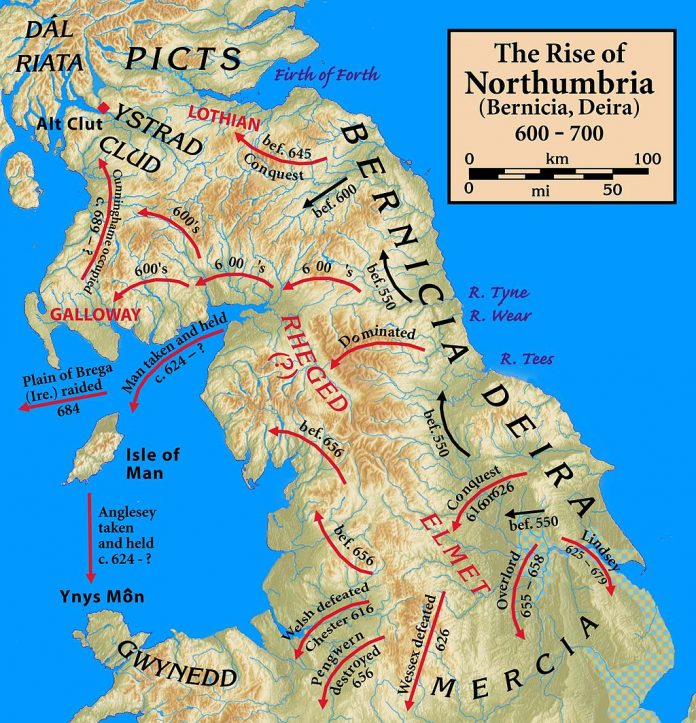
A little background to kick things off: Ida was the first king of Bernicia; and it many have been Ida who initiated the conflict with Deira by expanding his kingdom toward the south. Aethelfrith, grandson of Ida, expanded his kingdom through military conquest and repopulating formerly British regions with citizens from Bernicia. In c.600 he defeated the Britons decisively at the Battle of Catraeth (a tragic defeat for the British forces commemorated in the 13th century CE Welsh poem Y Gododdin) and by 604 had control of Deira and united it with Bernicia.

When Aethelfrith united Bernicia and Deira, he disinherited the ruling house of Deira, notably Prince Edwin (r. 616-633 CE) the son of King Aelle of Deira (r. 560 CE). Aethelfrith encouraged unity of the two kingdoms by marrying Edwin’s sister Acha but Edwin posed a recognisable threat to Aethelfrith’s reign and wisely fled Northumbria. Aethelfrith did, in fact, want Edwin killed but the prince was given sanctuary in the kingdoms of East Anglia, of the Welsh, and Mercia.

Image result for map northumbria 7th centuryWhen Aethelfrith died, Edwin returned from exile and claimed the throne, ruling from Deira. He capitalized on the gains made by Aethelfrith and expanded the kingdom further, prompting responses from Mercia and Wessex.

But our story is still in its infancy - In the last years of Aelle of Deira, plans are made for his daughter Acha to marry Aethelfrith (aka the Destroyer) and bring peace between the two kingdoms in the face of the encroaching southern kingdoms. We are witness to Aethelfrith's rise and take over of Deira following the death of Aelle, and the reverberations of his actions - which, no doubt will be expanded upon in the ensuing tomes.

The extreme and varying fortunes of the main kingdoms in seventh-century England illustrate the instability and fragility of political authority during this period. There is a plethora of great characters and events from which a narrative can be created for the reading pleasure of those with an interest in this particular period of history.


further reading:
Edoardo Albert (Northumbrian Thrones):
Edwin, High King of Britain; Oswald: Return of the King; Oswui: King of Kings

Matthew Harffy (Bernicia Chronicles):
The Serpent Sword; The Cross and the Curse; Blood and Blade; Killer of Kings; Warrior of Woden; Storm of Steel; Fortress of Fury; Kin of Cain


Sunday, June 2, 2019

Review: Cuthbert of Farne by Katharine Tiernan

Northumbria - 7th Century: The Anglo-Saxon kingdom of Northumbria was originally two kingdoms: Bernicia in the north and Deira in the south. These two countries were often in conflict before their eventual semi-permanent unification in 654. While violent conflicts between Bernicia and Deira played a significant part in determining which line ultimately gained supremacy in Northumbria, marriage alliances also helped bind these two territories together. During his reign, King Oswiu presided over the Synod of Whitby, a religious meeting designed to reconcile religious differences between Roman (new) and Celtic (old) Catholicism, in which he eventually backed the Roman beliefs, thereby bringing Northumbria in line with Southern England and Western Europe. It must be remembered that this kingdom had only converted to christianity in 627 - a mere 37 years prior to Whitby!

43911047
Cuthbert grew up in or around Old Melrose Abbey, a daughter-house of Lindisfarne. He had decided to become a monk after seeing a vision on the night in 651 that St Aidan, the founder of Lindisfarne, died, but he seems to have seen some military service first. He was quickly made guest-master at the new monastery at Ripon, soon after 655, but had to return with Eata of Hexham to Melrose when Wilfrid was given the monastery instead. About 662 he was made prior at Melrose, went on a mission to Pictland (663), was appointed prior to Lindisfarne (665) before retiring to become a hermit (676). Following Wilfred's downfall in 684 he was made bishop of Lindisfarne, but by late 686 he resigned and again returned to his hermitage (on Inner Farne) as he felt he was about to die, although he was probably only in his early 50s (c.687). 


Tiernan's novel follows the story of Cuthbert fairly closely and is interspersed with stories of the Northumbrian royal family as well as Cuthbert's rival, Wilfred, and of the holy abbess and royal virgin Elfleda, the daughter of Oswiu of Northumbria, who succeeded St Hilda as abbess of Whitby (680). For those readers unfamiliar with Anglo-Saxon history, this may be a challenge - it was a period of intense political and religious turmoil. I myself found it a bit confusing as the author decided to change the names of the main historical characters, which I personally felt was unnecessary.

Overall, this is still a good introductory novel for those with a fledgling interest in Anglo-Saxon religion and politics, as well as one on one of the most important religious figure of northern England, whose life spanned the transitional period from paganism to Christianity and whose cult is still active today. For as Bede himself says: "but even when the servant of Christ was dead and buried, the miracles which he worked whilst alive did not cease."

Note: 
An early anonymous Life of Cuthbert was written about 700, but the discovery of Cuthbert's uncorrupted body gave a new impetus to the cult, and Bede used the earlier Life to write his own verse Life, around 716, and a longer, prose Life around 721. 

Katharine on Cuthbert
Beshara Magazine - The Red Sail
Beshara Magazine - St Cuthbert of Farne
Place of Repose: A Tale of St Cuthbert’s Last Journey 


Read more on Cuthbert
St. Cuthbert, His Cult and His Community to AD 1200 edited by Gerald Bonner, David W. Rollason, & Clare Stancliffe
St. Cuthbert: His Life and Cult in Medieval Durham by Dominic Marner
Two Lives of St. Cuthbert edited by Bertram Colgrave
Life and Miracles of St. Cuthbert by Venerable Bede


Saturday, April 13, 2019

John Broughton's Dark Age Novels

Saints & Sinners:

Saints and Sinners (Mixed Blessings Book 1) by [Broughton, John]Saxon times are not called the Dark Ages for nothing. It is a violent, unrecognisable world of kill or be killed …  In seventh century England, tribes and so-called kings vie for power and blood flows freely throughout the land.  Aethelred, ruler of Mercia, is being pressed from all sides – north, south, east and west. And his wife, Osthryth, daughter of a rival Northumbrian king, is murdered in unknown circumstances.  Osthryth’s ring falls into the hands of warrior noble Aethelbald who is accused of her murder and forced to leave Mercia by his conniving cousin Coeolred who has eyes on the throne. 


Mixed Blessings:
Mierce, the English Midlands, 8th Century A.D.   Æthelbald, King of Mierce, is a man of ambition. Having created much-needed stability within his domain, he now aspires to the taking of surrounding kingdoms to expand and fortify his own. With stealth and cunning, Æthelbald manipulates other men of power, like chess pieces, to achieve his goals.

As Æthelbald’s reign grows and strengthens, so too does the authority of the church, whose leverage over monarchical matters becomes increasingly overbearing. The church does not approve of King Æthelbald’s exploits with innocent women and seeks to bring him into line with the threat of eternal damnation.  This, the sequel to Saints and Sinners, chronicles the life of an English king in the days where the boundaries of kingdoms and social propriety were undergoing rapid change.


Perfecta Saxonia:
King Alfred never achieved his dream of uniting the disparate Anglo-Saxon kingdoms into one Perfecta Saxonia.  The man destined to fulfill Alfred's dream is his grandson, Athelstan, as the spark of unity begins in the Saxon kingdom of Wessex. Abandoned by his father and raised by his uncle, young Athelstan faces numerous adversities on his way to becoming a mighty warrior and diplomat.  But can he overcome the odds to transform England from an insignificant island off the Western European mainland, into the leading centre of tenth-century diplomacy and learning?


Wyrd of the Wolf:
In seventh century England, political and religious upheaval mean that nobody is safe.   As the old gods are eroded by the new church, and tribes and ambitious men vie for power, property and precedence, blood is shed throughout the land.  In the south, ealdorman Aelfhere believes that for his only child, sixteen-year-old daughter Cynethryth, marriage to a Saxon king is the way to security. And so, somewhat against her own wishes, Cynethryth is betrothed. Yet as battle rages around her, and with her betrothed away to fight, Cynethryth too becomes a victim of war. 


In the Name of the Mother:
It is 689 AD, and Cynethryth is returning from Rome, carrying her dead husband's child.  She soon gives birth to a son, Aethelheard, whose parentage alone places him in danger. His mother has a tough choice to make and travels to Dorset, where the king is a cousin of her late husband.  After the king adopts the boy, he grows up in the dangerous company of rebellious princes, all who wish to overthrow the mighty Ine, king of Wessex.


The Purple Thread:
It is 733 AD in Anglo-Saxon Britain – a time and a world of warriors, wars and religious extremes.  Begiloc, a young freedman from Wimborne with a wife and son, is most definitely a man of action. But his world is turned upside down when the young Briton and best friend Meryn are ordered away to protect English missionaries in Germany.  For a man accustomed to brutality, Begiloc has a soft spot for the purple-tinged mountains, waterfalls, lakes, animals, trees and flowers – beginning to muse whether they, rather than Man, do not better embody the essence of God.  However, mission follows mission across the continent and Begiloc is driven ever further from his loved ones at home.


Die for a Dove:
Invasion, 674 AD and Werburgh, great-niece of the Abbess of Ely travels by night to bury and save the abbey treasure under a wayside cross in the kingdom of Lindsey.  Werburgh has crafted a magnificent gold and garnet jewel in the form of a dove. A cryptic inscription on the back indicates the location of the treasure. The dove becomes a family heirloom and only resurfaces in the English Civil War.  The reappearance of a cryptic clue to the whereabouts of the forgotten dove leads to a hunt across two continents and a trail of deaths.

Ulf's Tale by [Broughton, John]Ulf's Tale:
A Swedish nobleman. A kidnapped child. The choice between power and morality.  At the start of the slaughter-marred eleventh-century, nine-year-old Ulf is taken hostage by King Aethelred.  It’s the beginning of a life of luxury and opportunity for Ulf. But treachery and plotting throughout the country threaten uneasy alliances, while ambitious rivals attempt to seize power for themselves.  His own life threatened, Ulf embarks on a quest for unity to bring peace to the Baltic states. Will his own moral convictions be enough to overcome divided loyalties, religious clashes and ambitious kings?