Showing posts with label childrens books. Show all posts

Wednesday, August 15, 2018

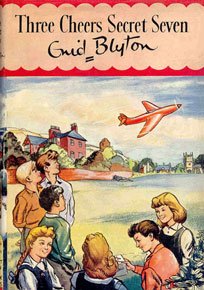
Enid Blyton's Secret Seven are making a comeback ...

Image result for secret seven

"Nostalgia is a brilliant marketing tool," observes Levis. "The great thing about those books is that they really highlight the good points of the original books and remind adults why they might have been so lovely to read as a kid. That can only be a good thing."

It's probably been a while since you've read about swotters, jolly japes, peculiar fellows, Housemistresses and lashings of ginger beer. Yet a new book looks set to breathe life into a decades-old series.

Those of a certain age will no doubt recall Enid Blyton's fictional group of child detectives, The Secret Seven. The first book was originally printed back in 1949 and the 15th title was released in 1963.

Yet the franchise has been revived by award-winning writer Pamela Butchart with a new novel, The Secret Seven Mystery of the Skull. Here, and in time-honoured tradition, the seven friends set off on an investigation without adult supervision.

read more here 


Saturday, December 16, 2017

Earliest-known children’s adaptation of Japanese literary classic discovered in British Library | University of Cambridge


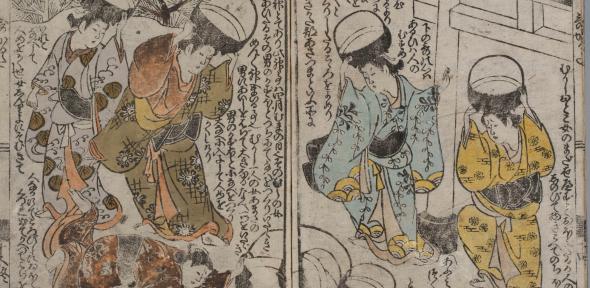
A chance discovery in the British Library has led to the discovery and reproduction of the earliest-known children’s adaptation of one of Japan’s greatest works of literature.

Dr Laura Moretti, from the Faculty of Asian and Middle Eastern Studies at Cambridge, came across an unknown children’s picture-book, dating from 1766, under the title of Ise fūryū: Utagaruta no hajimari (The Fashionable Ise: The Origins of Utagaruta) while on a study trip with her students.

The Tales of Ise has since been adapted and reinterpreted continually down the centuries as part of the canon of Japanese literature. 

Dr Moretti’s new book, Recasting the Past (Brill, 2016), presents a full-colour reproduction of the 18th century edition, alongside a transcription in modern Japanese, an English translation, and textual analysis. The publication of the 1766 adaptation of the Tales of Ise fills a gap in scholars’ understanding of the work’s history. Although much scholarship has taken place on the reception of Tales of Ise and its target audiences in different epochs, no one has previously explored the age of its readership.


read more here @ University of Cambridge

Sunday, November 19, 2017

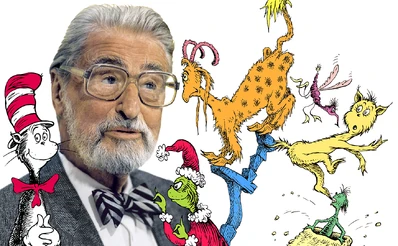
Why are children’s authors eccentric?


Image resultAs new parents and anyone who’s ever gone rummaging through their old childhood libraries quickly realises, much of the best literature for kids is bonkers. It all makes divine sense when you’re four or five or 10, but return as an adult to Alice’s Adventures in Wonderland or The Cat in the Hat, and what’s striking is that so much sublime whimsy and exuberant creativity could have been conjured up by our fellow grownups.

Then again, there’s a theory that children’s authors – the best of them, at any rate – never really grow up. Lewis Carroll famously – notoriously from today’s perspective – preferred playing games with children to adult conversation. Kenneth Grahame amassed a vast collection of toys – in his 20s. And Dodie Smith, a fascinating writer best known today for her children’s novel The Hundred and One Dalmatians, used to say she never felt quite grown up. (At under five feet tall and with a high-pitched, perpetually girlish voice, she perhaps had more excuse than most.)

read more here @ BBC - Culture
  • Kay Thompson, Eloise
  • Theodor Geisel, aka Dr Seuss,
  • EB White, Stuart Little and Charlotte’s Web
  • Kenneth Grahame, The Wind in the Willows
  • Margaret Wise Brown, The Runaway Bunny and Goodnight Moon
  • Dodie Smith, The Hundred & One Dalmatians


Sunday, May 14, 2017

Once upon a time: a brief history of children's literature

Shockheaded Peter c.1917
Adults have been writing for children (a broad definition of what we might call children’s literature) in many forms for centuries. Little of it looks much fun to us now. Works aimed at children were primarily concerned with their moral and spiritual progress. Medieval children were taught to read on parchment-covered wooden tablets containing the alphabet and a basic prayer, usually the Pater Noster. Later versions are known as “hornbooks”, because they were covered by a protective sheet of transparent horn.

Children’s books still contain moral lessons – they continue to acculturate the next generation to society’s beliefs and values. That’s not to say that we want our children to be wizards, but we do want them to be brave, to stand up for each other and to develop a particular set of values.

We tend to see children’s literature as providing imaginative spaces for children, but are often short-sighted about the long and didactic history of the genre. And as historians, we continue to seek out more about the autonomy and agency of pre-modern children in order to understand how they might also have found spaces in which to exercise their imagination beyond books that taught them how to pray.

read entire article here @ the Conversation