Showing posts with label hundred years war. Show all posts

Tuesday, October 20, 2020

Review: Murder During The Hundred Years War by Melissa Julian-Jones

Murder During the Hundred Year War: The Curious Case of Sir William Cantilupe

Synopsis: In 1375, Sir William Cantilupe was found murdered in a field outside of a village in Lincolnshire. As the case progressed, fifteen members of his household were indicted for murder, and his armor-bearer and butler were convicted. Through the lens of this murder and its context, this book will explore violence, social norms and deviance, and crime and punishment 'at home' during the Hundred Years War.

The case of William Cantilupe has been of interest to historians for many years, ever since Rosamund Sillem brought it to light in her work on the Lincolnshire Peace Rolls in the 1930s, but this is the first time it has received a book-length treatment, taking relationships between the lords and their servants into account. The verdict - guilty of petty treason - makes this one of the first cases where such a verdict was given, and this reveals the deep insecurities of England at this time, where the violent rebellion of servants against their masters (and wives against their husbands) was a serious concern, enough to warrant death by hanging (for men) and death by burning (for women). The reader is invited to consider the historical interpretations of the evidence, as the motives for the murder were never recorded. The relationships between Sir William and his householders, and indeed with his own wife and, and whether the jury were right to convict him and his alleged accomplice in the first place.


This is a fascinating look at a controversial murder that took place in the period known as The Hundred Years War.

Sir William de Cantilupe, a nobleman with a lineage dating back to the Conquest, was murdered, his body left in a ditch. His entire household, including his wife, was suspect; however, both at the time and today, there are difficulties in piecing together events and provide a suitable outcome.

The investigation of crime in the 14th century was much different that today. Finding a body, Julian-Jones says, was a series matter for the village, who were considered to be collectively responsible for it and could be fined if it was found that they had concealed this fact from the authorities, who in essence were the local Sheriff and the Coroner. The role of Sheriff and Coroner were separate; the coroner represented the Crown's financial interests in court cases, and neither role technically sat in judgement - for "holding the pleas" was the jurisdiction of judges. However, the coroner - with or without a jury - could hold an inquest - an investigation to hear evidence from live witnesses who attend at court and also may be read witness statements from witnesses who are not present. Records of the crime, the victim and accused, and the verdict were documented - witness testimony was not.

In this instance, there were no surviving records of the trials of the various suspects and it is here that Julian-Jones brings to light similar criminal cases to illustrate each point she raises, whilst giving the reader a sense of proceedings. 

Medieval justice and criminal investigations is nothing like what we are used to today - social connections, social and financial position, and a person or family's good name counted for much. It is likely that juries were pulled firstly from the local gentry and then those on the next social rung under them. Thus, many of those being accused would be known - and human nature being what it is, it is hardly surprising that a person's social standing or reputation put them in a better light than some unknown person or itinerant traveller. It could also work in the reverse where one of suspect character would automatically be cast as the villain. Julian-Jones talks about "social cohesion and closing ranks" with the greater community lending its support to those within their own community.

But the question still remains - "cui bono" - who benefits? And that is possibly something that we will never really know for sure.


Using contemporary documents and accounts and past scholarship, Melissa Julian-Jones presents the reader with various hypotheses, whilst examining in detail both the members of the household (including the wife) and the extended family connections "... to consider likely scenarios ..". As such, it is necessary to gather as much background information as possible to contextualise possible narratives. In this day and age, family and familial connections were very important and it is necessary to delve into the background of all associated with this case in order to eliminate possible suspects and motives.

This is an excellent and well researched investigation of a cold case. Those with an interest in the medieval period and obscure criminal cases will enjoy this very much. 


read more here: 
Going Medieval with Melissa Julian-Jones

Sunday, March 29, 2020

Books: Hundred Years War

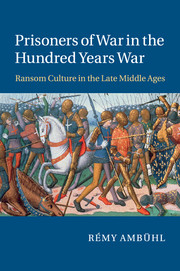
Prisoners of War in the Hundred Years War: Ransom Culture in the Late Middle Ages by Rémy Ambühl
Prisoners of War in the Hundred Years WarThe status of prisoners of war was firmly rooted in the practice of ransoming in the Middle Ages. By the opening stages of the Hundred Years War, ransoming had become widespread among the knightly community, and the crown had already begun to exercise tighter control over the practice of war. This led to tensions between public and private interests over ransoms and prisoners of war. Historians have long emphasised the significance of the French and English crowns' interference in the issue of prisoners of war, but this original and stimulating study questions whether they have been too influenced by the state-centred nature of most surviving sources. Based on extensive archival research, this book tests customs, laws and theory against the individual experiences of captors and prisoners during the Hundred Years War, to evoke their world in all its complexity.


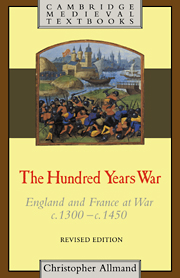
The Hundred Years War: England and France at War c.1300–c.1450 by Christopher Allmand
The Hundred Years WarThis is a comparative study of how the societies of late-medieval England and France reacted to the long period of conflict between them commonly known as the Hundred Years War. Beginning with an analysis of contemporary views regarding the war. Two chapters follow which describe the military aim of the protagonists, military and naval organisation, recruitment, and the raising of taxes. 

The remainder of the book describes and analyses some of the main social and economic effects of war upon society, the growth of a sense of national consciousness in time of conflict, and the social criticism which came from those who reacted to changes and development brought about by war. Although intended primarily as a textbook for students, Dr Allmand's study is much more than that. It makes an important general contribution to the history of war in medieval times, and opens up new and original perspectives on a familiar topic.


The Hundred Years War: The English in France, 1337-1453 by Desmond Seward
Front CoverFrom 1337 to 1453 England repeatedly invaded France on the pretext that her kings had a right to the French throne. Though it was a small, poor country, England for most of those "hundred years" won the battles, sacked the towns and castles, and dominated the war. The protagonists of the Hundred Years War are among the most colorful in European history: Edward III, the Black Prince; Henry V, who was later immortalized by Shakespeare; the splendid but inept John II, who died a prisoner in London; Charles V, who very nearly overcame England; and the enigmatic Charles VII, who at last drove the English out. Desmond Seward's critically-acclaimed account of the Hundred Years War brings to life all of the intrigue, beauty, and royal to-the-death-fighting of that legendary century-long conflict.


The Hundred Years War by Anne Curry
Front CoverAlthough the term 'Hundred Years War' was not coined until the 1860s, the Anglo-French conflicts of the later Middle Ages have long been of interest to historians. A fundamental question remains - was this a feudal war fought over ancient English rights in Gascony, or was it a dynastic war in which English kings battled for the crown of France itself?

This book, now fully revised and updated to take account of the latest scholarship, examines the origins and phases of the war and explores the trends in historical opinion from the fourteenth century to the present day. Anne Curry provides a straightforward narrative of English involvement in France, placing the well known military events in their diplomatic context. By focusing on the treaties of 1259, 1360 and 1420, Curry argues that there was not one 'hundred year war' but rather three separate yet linked conflicts, all with significant implications for the European scene as a whole, and for Anglo-French relations in the centuries to come.


The Age of the Hundred Years War by Clifford J. Rogers, Kelly DeVries, John France
Front CoverThis seventh volume of the Journal of Medieval Military History has a particular focus on western Europe in the late middle ages, and specifically the Hundred Years War; however, the breadth and diversity of approaches found in the modern study of medieval military history remains evident. Some essays focus on specific texts and documents, including Jean de Bueil's famous military treatise-cum-novel, Le Jouvencel; other studies in the volume deal with particular campaigns, from naval operations to chevauchées of the mid-fourteenth century. There are also examinations of English military leaders of the Hundred Years War, approaching them from prosopographical and biographical angles. The volume also includes a seminal piece, newly translated from the Dutch, by J.F. Verbruggen, in which he employs the financial records of Ghent and Bruges to illuminate the arms of urban militiamen at the end of the middle ages, and analyzes their significance for the art of war.


Seats of Power in Europe During the Hundred Years War: An Architectural Study from 1330 to 1480 by Anthony Emery
The Hundred Years' War between England and France is a story of an epic conflict between two nations whose destinies became inextricably entwined throughout the later Middle Ages. During that time the balance of architectural power moved from religious to secular domination, the Gothic form continued to grow and the palace-fortress was in the ascendancy. Seats of Power in Europe is a major new study of the residences of the crowned heads and the royal ducal families of the countries involved in the Hundred Years' War. Though they were the leading protagonists and therefore responsible for the course of the war, do their residences reflect an entirely defensive purpose, a social function, or the personality of their builders? As well as the castles of England and France it also looks at rulers residences in other European countries who supported one of the protagonists. They include Scotland, Castile, Aragon, Navarre, Portugal, the Low Countries, the imperial territories of Bohemia, and the papacy in Avignon and then Rome.

The study concentrates on sixty properties extending from the castles at Windsor and Denilworth to those at Saumur and Rambures, and from the palaces at Avignon and Seville to the manor-houses at Germolles and Launay. A number of subsidiary or associated properties are also considered in more broad-based sections. Each region and its residences are prefaced by supporting historical and architectural surveys to help position the properties against the contemporary military, financial, and aesthetic backgrounds.


Knights and Peasants: The Hundred Years War in the French Countryside by Nicholas Wright
This study of the soldier-peasant relationship in the context of the Hundred Years War (1337-1453) aims to bring out the realities of the situation. It seeks an understanding of different attitudes: how aristocratic soldiers reconciled the ideals of chivalry with exploitation of non-combatants, and how French peasants reacted to the soldiery, drawing on the late-medieval literature of chivalry and political commentary in England and (especially) in France. Employing additional documentary material, including the largely unpublished records of the French royal chancery, the book also describes the ways in which individual peasants and village communities were exploited by soldiers, and how, in order to survive, they adjusted to and reacted against their treatment.


Siege Warfare During the Hundred Years War by Peter Hoskins
Histories of the Hundred Years War have been written, and accounts of the famous battles, but until now no book has concentrated on the sieges that played a decisive role in the protracted struggle between England and France. Edward III's capture of Calais in 1347 was of crucial importance for the English, and the failure of the English siege of Orléans in 1429 was a turning point for the French after the disaster of Agincourt. Throughout the war, sieges were a major weapon in the strategic armories of both sides, and Peter Hoskins's perceptive and graphic study is a fascinating analysis of them.

He describes the difficulties faced by besieger and besieged, examines the logistics and resource implications of sieges, and provides a comparative assessment of siege warfare alongside set-piece battles and the English strategy of chevauchées. Key sieges are reconstructed in vivid detail, other sieges are summarized, and the book is fully illustrated with photographs and plans.