Showing posts with label ottoman empire. Show all posts

Monday, October 6, 2025

Review: Murder in Constantinople by AE Goldin

Synopsis: A gripping, immersive historical murder mystery in which a wayward boy from London's East End is pulled into the hunt for a serial killer on the eve of the Crimean War.

London, 1854. Twenty-one-year-old Ben Canaan attracts trouble wherever he goes. His father wants him to be a good Jewish son, working for the family business on Whitechapel Road, but Ben and his friends, the 'Good-for-Nothings', just want adventure.

Then the discovery of an enigmatic letter and a photograph of a beautiful woman offer an escapade more dangerous than anything he'd imagined. Suddenly Ben is thrown into a mystery that takes him all the way to Constantinople, the jewel of an empire and the centre of a world on the brink of war.

His only clue is three 'The White Death'. Now he must find what links a string of grisly murders, following a trail through kingmaking and conspiracy, poison and high politics, bloodshed and betrayal. In a city of deadly secrets, no one is safe - and one wrong step could cost Ben his life.

~ ~ ~

"Murder in Constantinople" reads like a boys-own-adventure. There are political machinations, espionage, murder, secret societies, travel, war, criminal detection, and a naive hero blundering into situations beyond his abilities.

And if you suspend belief and accept it as such, you will find an enjoyable romp through 19th century Constantinople at the time of the Crimean War - where politics and high society meld, where "everyone from high to low has secrets, all tied together in an invisible web", where conspiracies abound, and a serial killer is on the loose. Can our young runaway find his feet whilst avoid being the target of a secret group of assassins .... only time will tell.!


The first in a new series, the scene setting begins here and once it gets going, the action follows.

Thursday, April 2, 2020

Review: The Drowning Guard by Linda Lafferty

The Drowning Guard: A Novel of the Ottoman Empire by [Lafferty, Linda]Synopsis: Each morning in the hour before dawn, a silent boat launches on the Bosphorous, moving swiftly into the deepest part of the waters halfway between Europe and Asia, where a man will die...

The Drowning Guard is the tale of the Ottoman princess, Esma Sultan - one of the most powerful women in Ottoman history and unlike any other woman in the Islamic world. In a gender reversal of Scheherazade in 1001 Arabian Nights, Esma seduces a different Christian lover each night, only to have him drowned in the morning. The Sultaness's true passion burns only for the Christian-born soldier charged with carrying out the brutal nightly death sentence: her drowning guard, Ivan Postivich.

The Drowning Guard explores the riddle of Esma - who is at once a murderer and a champion and liberator of women - and the man who loves her in spite of her horrifying crimes. This textured historical novel, set in the opulence and squalor of Istanbul in 1826, is woven with the complexity and consequences of love.


There are a lot of themes running through this novel, so firstly, some background which will cover off the main characters and also a little bit about the setting - Istanbul and the Ottoman Empire:

Ivan Postivih - aka Ahmed Kadir - a fictional character who was a Serb captured by the Ottomans as a child and conscripted into the elite Janissary cavalry. The Janissaries where themselves always Christian conscripts converted to Islam, trained and educated solely for military service. As an essentially non-Muslim group, they owed no allegiance except to the Sultan. In the novel, Ivan has been demoted (due to inciting envy and jealousy from the Sultan) and sent to the Sultan's sister Esma as a guard. Esma assigns to him the role of her "drowning guard" wherein he is tasked with the clandestine executions of Esma’s discarded Christian lovers.


Esma Sultan
Esma Sultan was the daughter of Sineperver Sultan and the Sultan, Abdulhamid I (d.1789). Her mother was one of nine wives/ consorts of Adbulhamid. Esma was sister to Mustafa IV ruled for one year as Sultan (1080) succeeding his cousin before being executed by Mahmud II (their half-brother). 

When she was 11 years old, her father died. Since Mustafa was only 10 years old at the time of his father’s death. Selim III ascended to the throne as the eldest male member of the Ottoman Empire. She followed her mother to the old palace. When she was 14 her cousin Selim III married her to Küçük Huseyn Pasha, Chief Admiral of the Navy. Her husband died in 1803 when she was 25 years old. She never married again. 

In 1807, the Janissaries revolted again, dethroned, imprisoned, and later murdered Selim III. They placed his cousin Mustafa, brother of Esma Sultan, on the throne. Mustafa IV reigned briefly in an era of Janissary riots. Esma Sultan played a major role in Kabakçı revolt with her mother Sineperver Sultan in bringing her half-brother Mahmud to throne, at the expense of her brother Mustafa, who was duly executed.

Due to her husband's position at court, and the influence over and the esteem in which she was held by both her brothers, Esma became prominent herself and acquired a great deal of property, land, buildings and revenues which enabled her to enjoy her life to the fullest. She had a large retinue, traveled freely and extensively, and was an accomplished poet and musician.

At the time of the events in the novel, Esma is 48 years old and quite possibly residing at one of her waterfront palaces, such as at Kuruçeşme or Ortaköy.
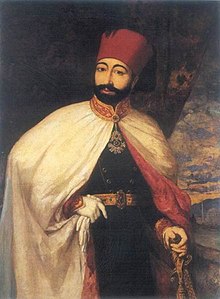

MahmutII.jpgMahmud II was the half-brother of Esma Sultna, his mother Nakşidil Sultan, being one of the wives / consorts of Abdulhamid I. As we have seen above, Mahmud came to the throne aged 23 after a revolt by the Janissaries and the deposition and execution of his brother Mustafa IV (1808).

His reign was dominated by external events: the war against the Saudi state, the independence of Greece and other Balkan nations, war with Persia, conquest of Ottoman Algeria by the French, and naval defeat at the hands of a combined force of English, Russian and French navies. In addition, the Ottoman Empire's trade policies and deindustrialisation led to economic downturn - decline had set in.

There is, however, one event that concerns us the reader as it was  more or less contemporary with events in the novel, which themselves may be posited as a mitigating factor, and once again involve the Janissaries. 

Ottoman military reform efforts begin with Selim III (1789–1807) who made the first major attempts to modernize the army along European lines. These efforts, however, were hampered by reactionary movements primarily from the Janissary corps, who had become anarchic and ineffectual. Jealous of their privileges and firmly opposed to change, they created a Janissary revolt (1807). Selim's efforts cost him his throne and his life, but were resolved in spectacular and bloody fashion by his successor, the dynamic Mahmud II. Most of the 135,000 Janissaries revolted against Mahmud II, and after the rebellion was suppressed, its leaders were killed, and many of its members exiled or imprisoned. The Janissary corp was effectively eliminated on 15 June 1826. Opening events in the novel take place less than one month prior (ie: May 1926). This revolt became known as the Auspicious Incident.


I was intrigued by the premise - imperial lovers being drowned in the Bosphorus after a night of pleasure.  Whilst the author states there was no such proofs for "drowning guards" this is in fact possibly incorrect, as events nearly 200 years previous may attest.

Istanbul: The City of Water

When Sultan Ibrahim (1616- 1648) came to the throne, his mental state was rather disturbed - hence he was referred to as "the Mad".  He had been imprisoned in a cage within the Topkapi Palace known as "kafes".  This was the fate of potential male heirs and rivals - previously they had all been executed regardless of age or mental state.  To distract him, his advisors suggested Ibrahim should pleasure himself with girls from the harem. This extravagant pastime pleased him greatly and left others alone to rule his empire as they wished, in particular his mother Kosem Sultan and Grand Vizier Kemankeş Kara Mustafa Pasha. Ibrahim favoured many of his concubines but unfortunately paranoia ruled his life, and his lasting legacy was to drown 280 concubines in the Bosphorus because he suspected they were plotting against him. 

Now to my final thoughts. Having persevered through average narrative, and characters and events that should have held my attention for far longer than they did, I was left slightly dissatisfied with the ending. The subject matter at hand could have made for a much stronger storyline. Possibly those unfamiliar with this period of history may find it more to their liking. Kudos for taking on a rather lesser-known female character and period of history; however, sometimes fiction just does not do actual history any justice.


Sunday, May 26, 2019

Beyond the harem: ways to be a woman during the Ottoman Empire


Ottoman women shopped. They didn’t just shop; they also ran businesses, owned property and, on occasion, stormed buildings to stage protest meetings. Not only did they flirt and dance – and infuriate their husbands with demands for the latest fashions – but they exerted genuine political and economic power. And they did all this much more visibly than is often assumed.

A new volume of essays looks afresh at women’s lives during the 600 years of the Ottoman empire. The book challenges the stereotypes of female lives confined to the harem and hamam – and reveals how women were surprisingly visible in public spaces.

In Ottoman Women in Public Space, a group of scholars of the Middle East and the Islamic world turn their attention to a neglected topic: what life was actually like for women at the height of an empire that lasted for 600 years (right up until the turn of the 20th century) and, at its most powerful, stretched eastwards from present-day Hungary, southwards to the religious centre of Mecca, and westwards around the southern Mediterranean to the bustling port of Algiers. 

Using a wealth of primary sources and covering the entire Ottoman period, Ottoman Women in Public Space challenges the traditional view that sees Ottoman women as a largely silent element of society, restricted to the home and not seen beyond the walls of the house or the public bath. Instead, taking women in a variety of roles, as economic and political actors, prostitutes, flirts and slaves, the book argues that women were active participants in the public space, visible, present and an essential element in the everyday, public life of the empire. 

Ottoman Women in Public Space thus offers a vibrant and dynamic understanding of Ottoman history.


read more here @ University of Cambridge