Showing posts with label medieval women. Show all posts

Monday, April 28, 2025

The Queens and Royal Women of Sweden c. 970–1330

Synopsis: This is the first major piece of scholarship to provide an overview of the lives of Sweden’s earliest documented queens, together with some of their most influential female relatives, who lived between 970 and 1330.

Spanning a period over 350 years, approximately 40 biographies are included from the semi-legendary Viking queen Sigrid StorrĂ¥da to Duchess Ingeborg of Norway, the first female de jure and de facto ruler of Sweden. 

Rather than merely summarising previous research, this study offers new perspectives on the evolution of queenship in medieval Sweden. It tracks the different religious, political, and socio-economic trends which defined and shaped the office of queen and identifies three main phases of development which led to royal women’s economic and political emancipation by the mid-fourteenth century. 

The study’s main strength lies in its close reading and novel interpretation of the surviving primary sources, enabling readers to understand the importance of these women and wider themes such as state formation, Christianisation, and international politics.

The Queens and Royal Women of Sweden, c. 970–1330 is of interest to scholars of queenship and gender studies, medieval historians in general, those with an interest in ecclesiastical history, and anyone studying medieval Scandinavia.


Monday, April 22, 2024

Review: The Sisters of Richard III by Sarah J Hodder

Synopsis: This book is the narrative of three women of York, sisters to not one, but two kings of England. Anne, Elizabeth and Margaret Plantagenet were the daughters of Richard, Duke of York and his wife, Cecily Neville, and therefore sisters to Edward IV and Richard III. These women watched from the sidelines as their father challenged England’s anointed king and lost his life, as their brothers fought together for the throne of England and then amongst themselves and as the Plantagenet dynasty fell, making way for the reign of the Tudors.

But they were not just bystanders; they had their own stories to tell. Anne of York was married to the Lancastrian Duke of Exeter who sided against her father and brother, before finding later happiness, albeit briefly, with her second husband. Elizabeth of York married John de la Pole, Duke of Suffolk and became the mother of eleven children who would become thorns in the side of the Tudor kings and Margaret of York became Duchess of Burgundy, a hugely influential woman in her adopted kingdom although she never stopped supporting her family back in England. Between them, they witnessed and contributed to one of the most turbulent times in English history yet they have naturally been overshadowed by their more famous brothers. This is their story.

~ ~ ~

The story of the three Yorkists sisters - Anne, Elizabeth and Margaret - as told against the backdrop of the Wars of the Roses. And the story of the sisters is one full of persistence in keeping both the Yorkist cause and that of their family name, alive. With their mother Cecily, these three women were the great survivors of this tumultuous period in history.

Hodder provides the reader with a well-researched tome that covers off the events of the Wars of the Roses, whilst linking the lives of these women to both their family and the events.

That there may have been a perception that they had gone unremarked is only due to the fact that two of their brothers - Edward IV and Richard III - outshone them. However, they did not go completely unobserved - a careful historian or student of history will find all three women,scattered across the pages of numerous tomes. What Hodder does is bring this all under one book cover and puts their lives into context with events as their not only occurred but also how they impacted this particular family.

The keen reader of the Wars of the Roses history will enjoy this as will someone who is coming new into this period. There were many extraordinary women at this point in history - this is the story of three of them (four if you also count in their mother, Cecily).

Saturday, July 1, 2023

Review: King John's Right Hand Lady by Sharon Bennett Connolly

Synopsis: In a time when men fought and women stayed home, Nicholaa de la Haye held Lincoln Castle against all-comers. Not once, but three times, earning herself the ironic praise that she acted ‘manfully’.Nicholaa gained prominence in the First Baron’s War, the civil war that followed the sealing of Magna Carta in 1215. Although recently widowed, and in her 60s, in 1217 Nicholaa endured a siege that lasted over three months, resisting the English rebel barons and their French allies. The siege ended in the battle known as the Lincoln Fair, when 70-year-old William Marshal, the Greatest Knight in Christendom, spurred on by the chivalrous need to rescue a lady in distress, came to Nicholaa’s aid.

Nicholaa de la Haye was a staunch supporter of King John, remaining loyal to the very end, even after most of his knights and barons had deserted him.

A truly remarkable lady, Nicholaa was the first woman to be appointed sheriff in her own right. Her strength and tenacity saved England at one of the lowest points in its history. Nicholaa de la Haye is one woman in English history whose story needs to be told…

~ ~ ~

My initial problem is with the title: King John's Right Hand Lady.

Whilst the historical Nicholaa / Nicola / Nichola was a loyal supporter of King John, to say that she was his "right hand" - his "Sir Hiss" or his "Sheriff of Nottingham" to use more populist references - would be highly incongruous. Roger of Wendover's "abbetors of iniquity" list does not mention Nicholaa, and at Runnymeade it is Archibishop Langton, William Marshall and Hubert de Burgh who are acknowledged as his advisors. So I am at a loss as to where Nicholaa sits in all of this - even more so when the author claims both Nicholaa and John "worked in harmony".  We need to remember that hers was a "deathbed appointment" by a King eager to shore up support for his infant son and heir at a time when said monarch found a distinct lack of support from all the usual suspects.

That she was a remarkable woman in her right, there is no doubt.  However, its all well and good to bring forth a tome on a notable person, but to ascribe to them more than their due is being disingenuous to the reader and playing fast, loose and false with the subject at hand.

Now for the rest: the tome contains lots of events not directly linked to Nicholaa; lots of repetition of information; and lots of information of family and familial connections. If you have read any of Bennett Connolly's other books on the period you will notice that they all cross over into each other, containing the same information, on the same people, over the same period. "But this her area afterall" I hear you say. Sure - that's fine, but each tome doesn't need to feel like it needs to include the previous ones as part of it. The chapter on the "legacy" was superfluous and was most likely taken from her previous tome on the de Warennes.

The extent of research is evident ... literally! But there is just not enough on Nicholaa to cover the 180 odd ages of relevant text. History is littered with many similar such stories if you go searching for them - this is just one.

Sunday, December 25, 2022

Review: The Woodville Women by Sarah Hodder

Synopsis: Elizabeth Woodville, queen to Edward IV and mother of the Princes in the Tower.

Elizabeth of York, daughter of Elizabeth Woodville and the first Tudor queen of England.

Elizabeth Grey, granddaughter of Elizabeth Woodville and Countess of Kildare, whose life both in England and across the Irish sea was closely entwined with the Tudor Court.

This is the tale of three generations of women, linked by their name, Elizabeth, and by their family relationship. The story begins in the reign of the great Plantagenet Kings with the life of Elizabeth Woodville and ends in the reign of perhaps England’s most famous dynasty, that of the Tudor kings and queens. Through the life of Elizabeth of York, the first Tudor queen and Elizabeth Grey, cousin to Henry VIII and Mary Tudor, we explore the Tudor court and its dealings with the Earls of Kildare.

From the birth of our first Elizabeth to the death of our last, these three women lived through wars and coronations, births and deaths, celebration and tragedy and between them they experienced some of the most exciting and troubled times in English history. Mother, daughter and granddaughter: individually they each have their own fascinating story to tell; together their combined stories take us on a journey through a century of English life.


Okay - so what did I think. Well, what I had hoped for was a bit more about the Woodville Women - not just three Elizabeths. Whilst it is fairly obvious that there was a lot of research involved, the application could have done with some finessing. It is a very pro-Tudor piece, covering the usual myths, rumours and tropes, interspersed with assumption and supposition.

The first part deals some background including that of the period in which these women lived; Elizabeth Woodville's mother, Jacquetta of Luxembourg; the potential (and I stress potential) household dynamics, with a whole of lot of myth (including the legend of Melusine) and repeated referencing the works of Christine de Pizan. Whilst there is some merit to this introductory chapter, there is much that should have been left out.

The second part looks at mother and daughter - Elizabeth Woodville and Elizabeth Plantagenet - both queens of England, before the final part deals with Elizabeth Grey - though interesting in her own right, a rather curious choice.

Whilst we began with Jacquetta, and followed this with her daughter, granddaughter, and great granddaughter, as I mentioned, I was looking for a few more female family members. The inclusion of Elizabeth Woodville's sisters and nieces would have fleshed this out to present a more rounded overview of this particular familial branch of women. It is clear, however, that these three main women - four if we include, as we should - Jacquetta - managed to navigate the male dominated political world of their own times, to ensure that their place in it would not go unnoticed nor unremarked.

I would suggest that before diving head first into this tome, a little preemptive research of your own would be recommended.

Saturday, April 16, 2022

Review: Women in the Medieval Court by Rebecca Holdorph

Synopsis: While the courts of medieval Europe ate up tales of knights in shining armor and damsels in distress, the reality for the elite women who inhabited those courts could be very different. Medieval society might expect the noblewomen who decorated its courts to play the role of Queen Guinevere, but many of these women had very different ideas.

In a society dominated by men, women who stood out from the crowd could experience great success - and greater failure. Great queens, who sometimes ruled in their own right, fought wars and forged empires. Noblewomen acted behind the scenes to change the course of politics. Far from cloistered off from the world, powerful abbesses played the role of kingmaker. And concubines had a role to play as well, both as political actors and as mothers of children who might change a country's destiny. They experienced tremendous success and dramatic downfalls.

Meet women from across medieval Europe, from a Danish queen who waged political war to form a Scandinavian empire, to a Tuscan countess who joined her troops on the battlefield. Whether they wielded power in battle, from a convent or throne room, or even in the bedchamber, these women were far from damsels in distress.


Holdorph's book is divided into four sections - noblewomen, consorts, reigning queens and concubines - and she peppers her narrative with the biographical details of a number of historical women.

In Section One - Noblewomen - Holdorph undertakes a chronological look at the lives of these women from childhood to motherhood, widowhood, remarriage and political life. The details for the section are lifted from the lives of Matilda of Tuscany, Anna Comnena, Marie de France, Alice de Lacy and Cecily Neville.

Section Two - Consorts - looks at queenship from the process of selecting a suitable candidate, potential alliances, the role of king's wife and mother of the heir, to the role of queen on both the domestic and international political field. In this instance, Holdorph looks at Anne and Eupraxia of Kiev, Eleanor of Castile, Maria de Luna, Isabeau of Bavaria and Margaret of Anjou.

Reigning Queens are covered in Section Three, where the importance of behaviour and reputation are explored, in addition to the problems of marriage and the right to rule. Historical subjects used as the examples for this section include Urraca and Berenguela of Castile, Joanna of Naples, Margaret of Denmark, Caterina Cornaro, with a few others dotted throughout.

Finally we reach Section Four - Concubines. Here Holdorph discusses the definitions of marriage for context, whilst looking at the role and status of the mistress. This section also explores the "good" and "bad" mistress, and the ultimate price that many had to pay - the author notes that the death rate for mistresses was unnaturally high! Some of featured ladies include Agnes Sorel, Katherine Swynford, Alice Perrers, and Ines de Castro.

Holdorph finally concludes that regardless of status and social position, men still had the upper hand when it came to control over women and their lives, that marriage was an important part of a woman's life, and that there is very limited information on medieval women with which to craft a truly detailed narrative.

What I did conclude from reading this work was there was nothing new for me personally - I didn't take away anything from this. All examples were already well known to me, as I have studied the lives of many of these women and have read extensively in this area.  There were many times I wanted to give up on this book, however, the hope that I might find some nugget worthy of my time kept me going.  There was no pot of gold at the end of the rainbow.

Secondly and most notably, the cast of characters is very Eurocentric - there were no examples from the history annals of Asia, Africa, or Eurasia - and the women selected were decidedly Christian in religion, with no Hindu, Muslim, Shinto or other religion being included.

Another thing that annoyed me the most was the use of names or rather a strange variant of name - if you are going to introduce your reading public to lesser known historical figures, then stick with the common usage of their names, or you will lose your reader that much more sooner.

I will say this, however, Holdorph's book could be considered more of a primer for someone just cutting their teeth on this subject - however, there are many other worthy tomes out there that have covered this subject matter of much more effectively and efficiently.


Saturday, August 21, 2021

W H Allen lands Ramirez's 'vivid and evocative' look at medieval women

W H Allen has landed the "remarkable" Femina: A New History of the Middle Ages by Oxford University lecturer and BBC historian Janina Ramirez.

Out in March 2022 and based on 10 years of research, Femina will bring "remarkable medieval women to the fore and offer the first comprehensive look at why they were written out of history". Ramirez will create a "vivid and evocative" picture of the lives of the women who influenced medieval society, including Aethelflaed, Margery Kempe and King Jadwiga, as well as individuals discovered more recently, like the Loftus Princess and the Cathar spies. It promises to ultimately reveal "how and why these remarkable people were removed from our collective memories, and highlight the misconceptions that have underpinned our historical narratives".

Lucy Oates, commissioning editor, acquired UK and Commonwealth rights from Rosemary Scoular at United Agents. She said: "The Middle Ages are seen as a bloodthirsty time of Vikings, saints and kings: a patriarchal society that oppressed and excluded women. But by digging a little deeper into the truth, drawing on evidence from all disciplines, we can see that the ‘dark’ ages were anything but. Janina has such an enthusiasm for her subject, and as a visual historian brings the past to life with creativity and passion. I’m absolutely delighted to be publishing her at W H Allen."

Ramirez added: "This book is not simply about introducing you to women from history who are inspiring. It's about seeing the past and our relationship with it differently. It's about understanding how our access to history has been curated and manipulated, and how our perceptions can change going forward.

read more here from The Bookseller


Thursday, September 3, 2020

Review: Joan, Lady of Wales: Power and Politics of King John's Daughter by Danna R Messer

Joan, Lady of Wales: Power and Politics of King John's Daughter
Synopsis: The history of women in medieval Wales before the English conquest of 1282 is one largely shrouded in mystery. For the Age of Princes, an era defined by ever-increased threats of foreign hegemony, internal dynastic strife and constant warfare, the comings and goings of women are little noted in sources. This misfortune touches even the most well-known royal woman of the time, Joan of England (d. 1237), the wife of Llywelyn the Great of Gwynedd, illegitimate daughter of King John and half-sister to Henry III. With evidence of her hand in thwarting a full scale English invasion of Wales to a notorious scandal that ended with the public execution of her supposed lover by her husband and her own imprisonment, Joan's is a known, but little-told or understood story defined by family turmoil, divided loyalties and political intrigue.

From the time her hand was promised in marriage as the result of the first Welsh-English alliance in 1201 to the end of her life, Joan's place in the political wranglings between England and the Welsh kingdom of Gwynedd was a fundamental one. As the first woman to be designated Lady of Wales, her role as one a political diplomat in early thirteenth-century Anglo-Welsh relations was instrumental. This first-ever account of Siwan, as she was known to the Welsh, interweaves the details of her life and relationships with a gendered re-assessment of Anglo-Welsh politics by highlighting her involvement in affairs, discussing events in which she may well have been involved but have gone unrecorded and her overall deployment of royal female agency. 


This was a difficult review for me not due to the content but how to formulate my many and varied thoughts on this book as they are at odds with each other.

On the one hand, this is a detailed study on the role of royal / noble women of the Welsh ruling houses (the titles are interchangeable) during the late 12th and early 13th centuries. To illustrate her points, the author's chosen subject is Joan, daughter of John of England, one of the predominant women at this time. Messer provides us with a well researched and thought out argument for her choice of Joan's mother, which she utilises throughout the narrative.

A number of chapters cross over with each other as certain themes are discussed, and at times we jump forward and backwards in the timeline so that there is no strict chronological order to things. A number of other notable women are also used to provide examples of their influence in the areas of hospitality, patronage, marriage, and some times, in the changing of prevailing attitudes and customs - most of these women have some connection of Joan.

What I am at odds with is the documentation used to support the theory that Joan played a dominant political role in Wales at this period. Messer acknowledges that ".. invisibility in sources doesn't naturally preclude invisibility in life ..". It also doesn't preclude an active political role. There is quite a bit of "it is likely" and "it is possible"and to conclude that Joan may have been one of the "unnamed" persons who may or may not have been awarded safe conduct to attend meetings without factual evidence does not make it fact. Alternatively, to assume that the granting of land and property to Joan and Llwellyn is payment for Joan's role as political negotiator or "peace weaver" would be to make fact out of supposition and assumptions, and to insert her into the narrative that may not be hers to own, and ponder the possibilities.

I have no doubt that Joan may have played an important political role as wife of the reigning prince, however, I would like to have seen some more supporting documentation from the multiple sources used - an image of a document, a translation of a text, a pipe role entry. To tell us that "... simply because details are non-existent does not mean .. Joan did not parley behind the scenes as she was so wont to do on many occasions ..". That is a rather bland and empty statement to put forth as a solidly researched argument.

In fact, as Messer admits, there is only one case that we actually know that Joan had a hand in it - the rest remains a matter of "contextualisation". And so Joan, like many women of her era are left to ".. languish in the shadows of the feats, tragedies and majesties of the powerful men .." in their lives, and that Joan's life has and will remain a mystery.

Look, this is a decent work on the role of women in Wales - maybe that should have been the focus, using what is known of Joan and the many other notable women, to provide a discussion on the different areas where women did have a documented involvement in society and politics.

Sunday, January 12, 2020

Review: To Crown A King by Raedene Jeannette Melin

48733390. sy475 Synopsis: Scotland, 1295. The kingdom is on the verge of rebellion. John Balliol wears the crown, but even his powerful Comyn kin cannot break King Edward of England’s insatiable desire to conquer the northern realm.


For Christina Bruce, neither man is worthy of being called King of Scots. Born into the influential Bruce family, the only noble house to rival the Comyns, she is expected to obey her father and side with England. But when a chance meeting with an outlaw named William Wallace brings her into the conflict, she risks everything to get what she wants most – freedom.

To Crown A King is the empowering tale of Christina Bruce and her struggle between family loyalty and Scottish freedom. Discover her untold story and follow along as she takes her destined place in history.


Firstly, I would suggest having some sort of pre-knowledge of the period in order to keep track of the characters in this fictional account of Cristina de Brus at the time of the Scottish Wars of Independence in the 13th century.

Late 13th century Scotland was a period of increased turmoil both politically and economically. The Scottish throne was left vacant with the death of the young Margaret, Maid of Norway. In the ensuing scramble to secure a successor to the Scottish throne, there was, at one stage, no few than 14 potential "competitors" or "claimants" - the most notably being from the families of de Brus (Bruce), Comyn, Balliol. This is where things get a bit tricky - Kind Edward I of England was approached as a kind of referee in the matter - he willingly accepted on the grounds that he should be regent or suzerain during this period, and then put forth his own candidate! Homage was paid, oaths were sworn and retracted, alliances made and unmade, all of this leading to what is now known as the First Scottish War of Independence.

The book, for me, was a quick read - there was very little by way of political, personal or geographical detail. Whilst attracted to the premise of focusing on a rarely explored period in Scottish history and bringing to the fore one of the less-known Bruce women, I really felt no connection with the character of Cristina. 

The story, such as it was, was bland and all together devoid of anything that could really identify this period - and apart from some later mentions of William Wallace - this could have been written about anywhere and nowhere, or quite simply have been made up completely. The tale ends shortly after Wallace's execution - and I could not decide if this is a single story or was to be part of something more. And likewise could not determine if it's target audience was adults or young adults.

For me, author Nigel Tranter covers this period in much better detail and narrative.

Sunday, May 26, 2019

Beyond the harem: ways to be a woman during the Ottoman Empire


Ottoman women shopped. They didn’t just shop; they also ran businesses, owned property and, on occasion, stormed buildings to stage protest meetings. Not only did they flirt and dance – and infuriate their husbands with demands for the latest fashions – but they exerted genuine political and economic power. And they did all this much more visibly than is often assumed.

A new volume of essays looks afresh at women’s lives during the 600 years of the Ottoman empire. The book challenges the stereotypes of female lives confined to the harem and hamam – and reveals how women were surprisingly visible in public spaces.

In Ottoman Women in Public Space, a group of scholars of the Middle East and the Islamic world turn their attention to a neglected topic: what life was actually like for women at the height of an empire that lasted for 600 years (right up until the turn of the 20th century) and, at its most powerful, stretched eastwards from present-day Hungary, southwards to the religious centre of Mecca, and westwards around the southern Mediterranean to the bustling port of Algiers. 

Using a wealth of primary sources and covering the entire Ottoman period, Ottoman Women in Public Space challenges the traditional view that sees Ottoman women as a largely silent element of society, restricted to the home and not seen beyond the walls of the house or the public bath. Instead, taking women in a variety of roles, as economic and political actors, prostitutes, flirts and slaves, the book argues that women were active participants in the public space, visible, present and an essential element in the everyday, public life of the empire. 

Ottoman Women in Public Space thus offers a vibrant and dynamic understanding of Ottoman history.


read more here @ University of Cambridge

Sunday, March 31, 2019

Book on medieval India out


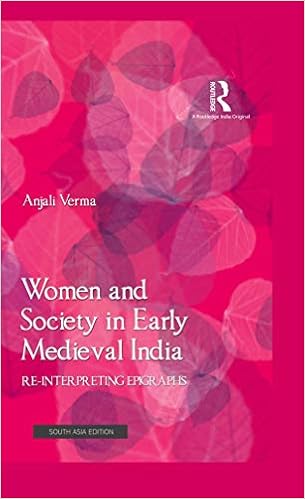
The book, written by Anjali Verma, titled as ‘Women and Society in Early Medieval India - Re-interpreting Epigraphs’ has been released during the Indian History Congress Session in Bhopal by a galaxy of eminent historians like R Mahalaxmi, BP Sahu, Irfan Habib, Ishrat Alam and Sucheta Mahajan.

The book is an extensive pan-India study on women and society of the early medieval period (600-1200AC) through more than 650 epigraphs. Anjali Verma is working as assistant professor, department of history, Himachal Pradesh University, Shimla. She specialises in ancient Indian history, culture and archaeology.


Sunday, September 30, 2018

Women in the Military Orders of the Crusades by Myra Miranda Bom

This study of the female members of the Order or Hospital of Saint John of Jerusalem in the High Middle Ages analyses their presence in the context of female monasticism and compares their position to the position of women in other religious military orders. Introducing questions of gender into the history of the military orders.


read also 


Sunday, November 5, 2017

The Queen's Hand

Review of Janna Bianchini's "The Queen’s Hand; Power and Authority in the Reign of Berenguela of Castile" by Elena Woodacre.
Berenguela of Castile (1180–1246) is a figure who is often overshadowed by her famous relatives, including her grandmother Eleanor of Aquitaine, her sister Blanche of Castile and her son Fernando III of Castile and LeĂ³n. However, there is no doubt that during her lifetime, she exercised considerable political power as a part of the ‘plural monarchy’ in both Castile and LeĂ³n in a range of roles.
The book moves chronologically through Berenguela’s life and political career and is divided into chapters which focus on particular periods of her life: as heiress, as queen consort of LĂ©on, after the annulment of her marriage, during the regency for her brother Enrique, as queen of Castile with her son, Berenguela’s role in the Leonese succession crisis of 1230 and finally her years of co-rule in both Castile and LeĂ³n with her son, Fernando III.

read complete review here @ Reviews in History

Saturday, September 30, 2017

Beyond the harem: ways to be a woman during the Ottoman Empire

A new volume of essays looks afresh at women’s lives during the 600 years of the Ottoman empire. The book challenges the stereotypes of female lives confined to the harem and hamam – and reveals how women were surprisingly visible in public spaces.

In Ottoman Women in Public Space, a group of scholars of the Middle East and the Islamic world turn their attention to a neglected topic: what life was actually like for women at the height of an empire that lasted for 600 years (right up until the turn of the 20th century) and, at its most powerful, stretched eastwards from present-day Hungary, southwards to the religious centre of Mecca, and westwards around the southern Mediterranean to the bustling port of Algiers.

With this new volume, Kate Fleet and Ebru Boyar and their contributors lift the lid on many thousands of lives previously marginalised by academic histories.


Saturday, September 23, 2017

Epistolae: Medieval Women's Letters

One of the most remarkable resources for those studying women in medieval times, is this vast collection of letters written by them and to them - available online at Epistolae: Medieval Women's Letters.
Epistoalae is a collection of letters to and from women in the Middle Ages, from the 4th to the 13th century. The letters, written in Latin, are linked to the names of the women involved, with English translations and, where available, biographical sketches of the women and some description of the subject matter or the historic context of the letter. The letters were originally collected and translated by Professor Joan Ferrante of Columbia University, mainly from printed sources.