Showing posts with label medieval scotland. Show all posts

Monday, October 6, 2025

Review: Desolation by Keith Moray

Synopsis: The Black Rood of Scotland, stolen. A coroner of York, murdered. An evil worse than plague itself, at large…

1361, York. As the country recovers from the war with France, and whispers that the pestilence has returned to England grow louder, fear is in the heart of every nobleman and commoner alike. Sir Ralph de Mandeville, ex-solider and newly appointed Justice of the Peace is sent to Langbarugh, just outside York, to investigate the murder of Coroner Sir Boderick de Whitby.

More deaths quickly follow, and while these are swiftly dealt with as plague victims, Sir Ralph and his two assistants Merek and Peter soon uncover something altogether more horrifying… A greater evil is at large in the northern wapentakes.

As panic escalates and the lines between plague and murder blur, Sir Ralph is thrust into a desperate race against time. Every shadow hides a potential killer, every cough could be a death knell. Can he unmask a murderer lurking in the terrifying shadow of the Black Death before they’re all consumed by a terror more sinister than any plague?

~ ~ ~

This series is set during the reign of King Edward III of England when the country was at war with France - the Hundred Years War.  The Black Death - or Plague - made its return - it would claim at least 20% of the population.  The Justices of the Peace Act was introduced, which created a new national role for justices of the peace (JPs) who were responsible for enforcing labor laws enacted in response to the economic changes caused by the Black Death.

The first in a new series wherein a number of local deaths is set firmly at the door of the plague - afterall, who in their right mind would look too closely at the putrefying corpse of a plague victim. However, it is the murder of a coroner and the theft of one of Scotland's most revered relics, that sets Ralph de Mandeville and his assistants on the trail of something more sinister.

There are many themes tackled in this tome - law and order, religion and superstition, necromancy and alchemy, doomsday preachers, murder, spite, and local jealousies and history.

Moray writes in an engaging manner, which slowly draws the reader in, setting the scene before our trio arrive to begin their investigations. A gentle history lesson to ensure the reader has a grasp of events and social customs of the period, is woven into the narrative - it is a subject not unknown to this author.  

Looking forward to the next installment in this new series.

Friday, September 10, 2021

Review: Lions of the Grail by Tim Hodkinson

Synopsis: First in an adventure-filled historical series following Irish Knight Templar, Richard Savage, as he is forced to spy on his homeland for the King of England.

1315 AD. Ireland and England are ravaged by bitter war. Rotting in an English prison, condemned as a heretic, Irish Knight Templar Richard Savage is given one chance of reprieve. But there is a catch. He must return to Ireland as a traitor, and work as a spy there for the King of England.

Savage returns to his homeland, but even here he can trust no one. He soon discovers the Scots intend to invade and someone in Ireland is helping them. The King of Scotland also claims to possess a mysterious holy treasure, and many are flocking to his cause. And what's more, Savage discovers he left more than just memories behind in Ireland...

Amid feasts, tournaments, invasion and war, can Savage decide whose side he is really on, discover whether this holy relic is real and, above all, stay alive?


As an avid reader of Hodkinson's Whale Road Chronicles, and having some fore-knowledge of the period in history, I was interested to see how the Scottish invasion of Ireland under the Bruces would pan out under Hodkinson's skillful narration.

This is the first in the series. So for those unfamiliar with the era, Edward Bruce fought alongside his brother Robert throughout his struggle for the Scottish throne, which culminated in the battle of Bannockburn, in which the Scots were victorious (1315). Continuing their war against England, especially after the Isle of Man fell under Scots loyal to England, Robert Bruce decided to open a second front in Ulster. As there had been no High King in Ireland for some time, Bruce figured that in making Edward King of Ireland, concessions could be made in return for localised support.  The Annals of Ulster record the event as follows:
U1314.2
Robert Bruce, king of Scotland, came to Ireland along with many gallowglasses in aid of Edward, his brother, to expel the Foreigners from Ireland.
This is where our story opens, in the events leading up to the invasion of Ireland by the Scots. Our protagonist, Richard Savage, is a Templar of Irish descent, imprisoned in England after the decimation of the Order by Philip of France in 1314. When the King of England, Edward II, needs to get a feel for what is happening in Ireland, he drags Savage out of his imprisonment and sends him across to Ulster to gauge the loyalty of those there and to scupper any plans for "a grand Gaelic alliance against England". As Savage is trusted by neither side, there is plenty of action, battles, captures, escapes, rescues, disguises, secret codes, assassins, an old enemy AND a holy relic.  There is enough to keep the reader entertained, much being centered around the town and castle of Carrickfergus, and ais is duly noted in the narrative "... one thing was sure - there would be more fighting ...".

Now, there has been plenty of speculation as to the relationship between the Knights Templars and Scotland. Treasure hunters claim that in the 14th century, the Knights Templar fled to Scotland with a trove of valuables because they received support and protection from King Robert the Bruce. Templar scholar and medieval historian Helen Nicholson said that any remaining Knights Templar were more likely to be found in Cyprus. One of the first to link the Templar fleet to Scotland was George Frederick Johnson, a Scottish exile in Germany in the mid-18th Century, who said that the Templars had sailed to Scotland. However, Johnson's claims proved to be as fraudulent as he himself was later discovered to be.

A number of actual historical figures make their appearance throughout, including the likes of Roger Mortimer, Richard de Burgh, Thomas de Mandeville, John de Bermingham and the Bruces - Robert and Edward. There is, of course, Edward II - though based upon the description of him in this instance, I find myself imagining him as Claude Rains in his role as Prince John in the 1938 adaption of Robin Hood. Similarly, I picture Lancaster as Basil Rathbone in his role from the same film.

Claude Rains and Basil Rathbone

The female character - to be honest - I could take or leave. Sometimes they are not necessary to the narrative - the cast of characters does not - in my opinion - always need to be "inclusive" or "politically correct" to tell a good story. There does not always have to be some "love interest" to lure in the female reader - sometimes their inclusion feels forced and detracts from the storyline. However, as one continues reading, the female character does have some sort of role.

What I find rather poignant about this whole episode can be summed up in this quote:
"   it's sad that a country that has struggled so long to gain it's own freedom should so soon seek to visit war and oppression on another ... "

I am looking forward to seeing how the rest of the series progresses.


Sunday, June 13, 2021

The Brus Family in England and Scotland 1100-1295 by Ruth Blakely

Robert de Brus, the "conquisitor of Cleveland, Hartness and Annandale", who came into England among the followers of Henry I, was also a close companion and mentor of David I, king of Scots. The lands he acquired from bothkings were divided between his sons, from whom two lines descended: the lords of Skelton, influential Northerners who played an active part during the baronial troubles in the reigns of John and Henry III, and the prominent cross-Border lords of Annandale, co-heirs of the substantial Chester and Huntingdon estates and progenitors of King Robert Bruce.

This study takes a fresh approach to the Brus family by assessing the achievements of the two lines in parallel while examining the extent of their power and the development of their lordships; it highlights the inter-relations between the barons of England and Scotland during two hundred years of comparative peace between the kingdoms. Of additional interest is the appendix of an extensive handlist of charters of the Brus family of both lines. It will be a welcome addition to the existing body of works on English baronial families and on Anglo-Scottish cross-Border lords of the twelfth and thirteenth centuries.

Saturday, December 12, 2020

Fife professor's project to write first history of medieval Scots literature a 'dream come true'

A university professor from Fife is to write the first full-length history of medieval Scots literature as it developed in the then-independent kingdom of Scotland more than 600 years ago.

Professor Rhiannon Purdie, of the School of English at St Andrews University, has described the opportunity as “the dream come true” after being one of three academics to receive major research fellowships totalling almost £320,000 from the Leverhulme Trust.


The two-year appointment allow the professor to write the first concise history on the subject.

It will also involve her teaming up with Scottish Qualifications Authority (SQA) to reintroduce Older Scots poetry to the Higher and Advanced Higher English curriculum, in a project informally dubbed ‘Older Scots for Modern Scots’.

read more here @ The Courier

Saturday, October 17, 2020

Review: The Highland Battles by Chris Peers

The Highland Battles: Warfare on Scotland's Northern Frontier in the Early Middle Ages
Synopsis: The wars fought in Scotland's northern and western highlands between the ninth and fourteenth centuries were a key stage in the military history of the region, yet they have rarely been studied in-depth before. Out of this confused and turbulent period came the more settled and familiar history of the region. The Highlands and islands were controlled by the kings of Norway or by Norse or Norse-Celtic warlords, who not only resisted Scottish royal authority but on occasion seemed likely to overthrow it.

Chris Peers explores the international background to many of these conflicts which had consequences for Scotland's relations with England, Ireland and continental Europe. At the same time he considers to what extent the fighting methods of the time survived into the post-medieval period. 


I think this book will send me off to become even further immersed in Scottish history. And whilst I considered myself sufficiently well read on this particular topic, there was still plenty to be learned. 

The battles themselves were detailed and included the events leading up to each particular battle, the engagement itself, and the aftermath. Not all were fought on land, some were on the water - which is not something that I feel many readers would be familiar with nor would the use of what is termed "guerilla warfare" which was one of the key components leading up to the battle known as the Field of Mam Garvia. Not all battles had an obvious outcome - oft times the victor did not live long enough to enjoy the spoils of war. Indeed, with regards to Tankerness, Peers comments that "... few of the participants were destined to die peacefully ...".

The structure of the armies, weapons and equipment is covered off fairly early on - to save repetition - as there is a lot of detail here. Use of archaeological evidence contemporary chronicles and the sagas add colour to the naval and land battles detailed within. It was rather an eye-opener to discover that the battle of Clairdon c.1198 was considered to be the " ... last full scale Viking battle fought on British soil ..." Peers also provides details at the end of each chapter for visiting the each of the battle sites or alludes to a probable site when the location is not as clear cut as we would like it to be.

As the synopsis states: "... The Highlands and islands were controlled by the kings of Norway or by Norse or Norse-Celtic warlords, who not only resisted Scottish royal authority but on occasion seemed likely to overthrow it ...". The participants belonged to the dynasties of Orkney, Man, Scotland and Norway and their offshoots. It was interesting to discover just how close those familial ties were amongst this group of protagonists, and often the feud carried on for a number of generations on both sides, especially between the Earls of Orkney and the Kings of Scotland, and the Kings of Norway and the Earls of Orkney.

The names of many of the protagonists were known to me: Thorfinn, Sigurd, Macbeth, Somerled, Alexander, Malcolm, Haakon. I myself have a number of biographies on the notable characters but Peers book ties them all in to the locations where they were dominant and shows the interaction and interpersonal relationships between them all. 

I was pleasantly surprised at the role of women with regards to the battle of Tankerness (c.1136). "Hell hath no fury like a woman scorned" comes readily to mind. Though in the Sagas we often read about women taking on the role of avenger or ensuring that any slight is revenged, so their role should not be discounted.

The reader will appreciate the map of battle sites, the appendices which list the kings of Scotland, Norway, the Isles and Man, and the Earls of Orkney. Each chapter also included the name of the battle, date and location, and the protagonists involved - and the outcome (though how it leads there is not so clear cut).

The Highland Battles is a well presented, well researched book, featuring seven lesser known military events in Scottish history from the 9th to 13th century which the reader will find rewarding. Definitely one for the Scottish history shelf of my library! 


Monday, May 11, 2020

Books: Notable Women

Servilia and Her Family by Susan Treggiari

Cover for 

Servilia and her Family


Servilia is often cited as one of the most influential women of the late Roman Republic. Though she was a high-born patrician, her grandfather died disgraced and her controversial father was killed before he could stand for the consulship; she herself married twice, but both husbands were mediocre. Nevertheless, her position in the ruling class still afforded her significant social and political power, and it is likely that she masterminded the distinguished marriages of her one son, Brutus, and her three daughters. During her second marriage she began an affair with Iulius Caesar, which probably lasted for the rest of his life and is further indicative of the force of her charm and her exceptional intelligence.

The patchiness of the sources means that a full biography is impossible, though in suggesting connections between the available evidence and the speculative possibilities open to women of Servilia's status this volume aims to offer an insightful reconstruction of her life and position both as a member of the senatorial nobility and within her extended and nuclear family. The best attested period of Servilia's life, for which the chief source is Cicero's letters, follows the murder of Caesar by her son and her son-in-law, Cassius, who were leaders among the crowd of conspirators in the Senate House on the Ides of March in 44 BC. We find her energetically working to protect the assassins' interests, also defending her grandchildren by the Caesarian Lepidus when he was declared a public enemy and his property threatened with confiscation. Exploring the role she played during these turbulent years of the late Republic reveals much about the ways in which Romans of both sexes exerted influence and sought to control outcomes, as well as about the place of women in high society, allowing us to conclude that Servilia wielded her social and political power effectively, though with discretion and within conventional limits.


Spartan Women by Susan Pomeroy
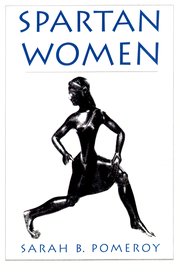
Cover for 

Spartan Women


Sparta, which existed from 800 B.C. until A.D. 200, was renowned in the ancient world as a stoic and martial city-state, and most of what we know about Sparta concerns its military history and male-dominated social structure. Yet Spartan women were in many ways among the most liberated of the ancient world, receiving formal instruction in poetry, music, dance, and physical education. And the most famous of mythic Greek women, Helen of Troy, was originally a Spartan. Written by one of the leading authorities on women in antiquity, Spartan Women seeks to reconstruct the lives and the world of Sparta's women, including how their legal status changed over time and how they held on to their surprising autonomy.

In this book, Sarah Pomeroy covers over a thousand years in the lives of Sparta's women from both the elite and lower classes. This is the first book-length examination of Spartan women, and Pomeroy comprehensively analyses ancient texts and archaeological evidence to construct the history of these elusive though much noticed women. Spartan Women is an authoritative and fresh account that will appeal to all readers interested in ancient history and women's studies.


Elizabeth of York and Her Six Daughters-in-Law: Fashioning Tudor Queenship, 1485–1547 by Retha Warnick
coverThis study of early modern queenship compares the reign of Henry VII’s queen, Elizabeth of York, and those of her daughters-in-law, the six queens of Henry VIII. It defines the traditional expectations for effective Tudor queens—particularly the queen’s critical function of producing an heir—and evaluates them within that framework, before moving to consider their other contributions to the well-being of the court. This fresh comparative approach emphasizes spheres of influence rather than chronology, finding surprising juxtapositions between the various queens’ experiences as mothers, diplomats, participants in secular and religious rituals, domestic managers, and more. More than a series of biographies of individual queens, Elizabeth of York and Her Six Daughters-in-Law is a careful, illuminating examination of the nature of Tudor queenship. 


coverThree Medieval Queens: Queenship and the Crown in Fourteenth-Century England by Lisa Benz St John
This book is an innovative study offering the first examination of how three fourteenth-century English queens, Margaret of France, Isabella of France, and Philippa of Hainault, exercised power and authority. It frames its analysis around four major themes: gender; status; the concept of the crown; and power and authority.


Berenguela of Castile (1180-1246) and Political Women in the High Middle Ages by Miriam Shadis
coverThe women in the family which ruled thirteenth-century Castile used maternity, familial and political strategy, and religious and cultural patronage to secure their personal power as well as to promote their lineage. Leonor of England, and her daughters Blanche of Castile (queen of France), Urraca (queen of Portugal), Costanza (a Cistercian nun of Las Huelgas) and Leonor, (queen of Aragon) provide the context for a study focusing on Berenguela of Castile, queen of Leon through marriage and of Castile by right of inheritance, whose most significant accomplishment was to enable the successful rule of her son Fernando.


"Trying Neaira" by Debra HamelTrying Neaira: The True Story of a Courtesan’s Scandalous Life in Ancient Greece by Debra Hamel
Neaira grew up in a Corinthian brothel in the fourth century B.C., became a high-priced courtesan and a sex slave, then settled into a thirty-year relationship with Stephanos of Athens. But next she found herself in court, charged with transgressing Athens’s marriage laws. This book reconstructs the amazing facts of Neaira’s life and trial, illuminating the social, legal, and cultural worlds of ancient Greece.


Women of Byzantium by Carolyn L. Connor
"Women of Byzantium" by Carolyn L.              ConnorWomen played key roles in Byzantine society: some ruled or co-ruled the empire, and others commissioned art and buildings, went on pilgrimages, and wrote. This engrossing book draws on evidence ranging from pictorial mosaics and inscriptions on the walls of churches to women’s poetry and histories, examining for the first time the lives, occupations, beliefs, and social roles of Byzantine women.

In each chapter Carolyn L. Connor introduces us to a single woman—from the elite to the ordinary—and uses her as a springboard to discuss Byzantine society. Frequently quoting from contemporary accounts, Connor reveals what these women thought of themselves and their lives and how they remembered the lives of women who had lived earlier.
Informative, sympathetic, and engagingly written, this book is a window into Byzantine culture and women’s history that has never before been opened.


Eleanor of Aquitaine: Lord and Lady edited by Bonnie Wheeler and John Carmi Parsons
coverEleanor's patrilineal descent, from a lineage already prestigious enough to have produced an empress in the eleventh century, gave her the lordship of Aquitaine. But marriage re-emphasized her sex which, in the medieval scheme of gender-power relations relegated her to the position of Lady in relation to her Lordly husbands. In this collection, essays provide a context for Eleanor's life and further an evolving understanding of Eleanor's multifaceted career. A valuable collection on the greatest heiress of the medieval period.


Matilda of Scotland: A Study in Medieval Queenship by Lois L. Huneycutt
Matilda of ScotlandA study of Matilda of Scotland (wife to Henry I) and the political acumen and personal skills she brought to the role of queen.Matilda of Scotland was the daughter of Malcolm II of Scotland and his Anglo-Saxon queen Margaret. Her marriage to Henry I of England in 1100 thus brought to Henry, descendant of the conquering Normans, a direct and politically desirable link to Matilda's ancestor Alfred the Great.

Her life makes clear that Matilda had outstanding talents. She was educated in the exclusive convents of Romsey and Wilton, a grounding which enabled her to further the literate court culture of the twelfth century, and under her control was a substantial demesne that allowed her to exercise both lay and ecclesiastical patronage. In the matter of ruling, she was an active partner in administering Henry's cross-channel realm, served as a member of his curia regis, and on occasion acted with what amounted to vice-regal authority in England while Henry was in Normandy.

Chroniclers of the twelfth and thirteenth centuries often refer to her as Mathilda bona regina, or Matildis beatae memoriae, and for a time she was popularly regarded as a saint. Huneycutt's study shows how Matilda achieved such acclaim, both because the political structures of her day allowed her the opportunity to do so and because she herself was skilled at manipulating those structures.

This study will be valuable to those interested in not only English political history, but also to historians of women, the medieval church, and medieval culture.


Elizabeth de Burgh, Lady of Clare (1295-1360): Household and Other Records edited by Jennifer Ward
Elizabeth de Burgh, Lady of Clare (1295-1360): Household and Other Records
Noble widows were powerful figures in the later Middle Ages, running their own estates and exercising considerable influence. Elizabeth de Burgh (1295-1360), daughter of one of the most powerful earls in England and cousin of Edward II, lost her third husband at the age of twenty-six, and spent the rest of her life as a widow. In 1317, having inherited one-third of the lands of her brother, Gilbert de Clare, earl of Gloucester and Hertford, who had been killed at Bannockburn three years earlier, she established herself at Clare, which became her main administrative centre for her estates in East Anglia, Dorset and South Wales. She enjoyed a noble lifestyle, was lavish in her hospitality to family and friends, entertaining Edward III in 1340, and she displayed her piety through her patronage of religious houses and her foundation of Clare College in Cambridge.

Her life and activities are portrayed in vivid detail in her household accounts and her will, selected extracts from which are provided in this volume. Altogether, 102 accounts of various types survive from the years of her widowhood, and the records here have been chosen to illustrate the great range of information provided, throwing light on Clare castle itself and its furnishings, daily life and religious practice, visitors, food and drink, livery and retainers, travel, and business. They paint of a vivid picture of the life and work of a noble family in the fourteenth century.


Sunday, January 12, 2020

Review: To Crown A King by Raedene Jeannette Melin

48733390. sy475 Synopsis: Scotland, 1295. The kingdom is on the verge of rebellion. John Balliol wears the crown, but even his powerful Comyn kin cannot break King Edward of England’s insatiable desire to conquer the northern realm.


For Christina Bruce, neither man is worthy of being called King of Scots. Born into the influential Bruce family, the only noble house to rival the Comyns, she is expected to obey her father and side with England. But when a chance meeting with an outlaw named William Wallace brings her into the conflict, she risks everything to get what she wants most – freedom.

To Crown A King is the empowering tale of Christina Bruce and her struggle between family loyalty and Scottish freedom. Discover her untold story and follow along as she takes her destined place in history.


Firstly, I would suggest having some sort of pre-knowledge of the period in order to keep track of the characters in this fictional account of Cristina de Brus at the time of the Scottish Wars of Independence in the 13th century.

Late 13th century Scotland was a period of increased turmoil both politically and economically. The Scottish throne was left vacant with the death of the young Margaret, Maid of Norway. In the ensuing scramble to secure a successor to the Scottish throne, there was, at one stage, no few than 14 potential "competitors" or "claimants" - the most notably being from the families of de Brus (Bruce), Comyn, Balliol. This is where things get a bit tricky - Kind Edward I of England was approached as a kind of referee in the matter - he willingly accepted on the grounds that he should be regent or suzerain during this period, and then put forth his own candidate! Homage was paid, oaths were sworn and retracted, alliances made and unmade, all of this leading to what is now known as the First Scottish War of Independence.

The book, for me, was a quick read - there was very little by way of political, personal or geographical detail. Whilst attracted to the premise of focusing on a rarely explored period in Scottish history and bringing to the fore one of the less-known Bruce women, I really felt no connection with the character of Cristina

The story, such as it was, was bland and all together devoid of anything that could really identify this period - and apart from some later mentions of William Wallace - this could have been written about anywhere and nowhere, or quite simply have been made up completely. The tale ends shortly after Wallace's execution - and I could not decide if this is a single story or was to be part of something more. And likewise could not determine if it's target audience was adults or young adults.

For me, author Nigel Tranter covers this period in much better detail and narrative.

Saturday, September 17, 2016

The Ancient Book of Deer

The Ancient Book of Deer, Oldest Known Gaelic Text in Existence | Ancient Origins
Currently housed at the University of Cambridge Library, the historic Book of Deer is said to have been discovered by the University's librarian, Henry Bradshaw, around 1860. It is said to be the only pre-Norman manuscript revealing tenth century northeastern Scottish culture's society and religious traditions, and is the earliest known Gaelic document in existence.
Although fascinating to historians for multiple reasons, the greatest intrigue for those drawn to this ancient text lies within the handwritten notations made in its margins and other blank areas, and not necessarily within the text itself. The notations, also referred to as 'notitiae', are written in the type of Gaelic typically spoken by the upper classes in the early twelfth century region of Buchan at a time later than the original text, indicated land grants or 'charters' and represented the legal rights to land believed to have belonged to the original Deer monastery of Aberdeenshire in Scotland, thus presenting a clear connection to the Deer region.
Read more of article at Ancient Origins