Showing posts with label byzantium. Show all posts

Sunday, April 17, 2022

Review: The Normans by Judith Green

Synopsis: A bold new history of the rise and expansion of the Norman Dynasty across Europe from Byzantium to England.

In the eleventh century the climate was improving, population was growing, and people were on the move. The Norman dynasty ranged across Europe, led by men who achieved lasting fame like William the Conqueror and Robert Guiscard. These figures cultivated an image of unstoppable Norman success and their victories make for a great story, but how much of it is true?

In this insightful history, Judith Green challenges old certainties and explores the reality of Norman life across the continent. There were many soldiers of fortune, but their successes were down to timing, good luck, and ruthless leadership. Green shows the Normans’ profound impact, from drastic change in England to laying the foundations for unification in Sicily, to their contribution to the First Crusade. Going beyond the familiar, she looks at personal dynastic relationships and the important part women played in what at first sight seems a resolutely masculine world.


I will preface this review by saying - reader beware.! This is not a casual and cursory look at the Normans that will appeal to the general masses; it is a more focused narrative that assumes that you - the reader - have done your due diligence and a sufficient enough grasp of the topic at hand to absorb the information contained therein.

The focus of Green's book is the Normans and their activities as related to a specific time period - the 11th Century - and is narrowed down to particular theatres of war - England, Normandy, Byzantium, Sicily & Southern Italy, Antioch & the Holy Land. It is also a look at how contemporary writers and chroniclers viewed them as well as their own perceptions of self.

Green begins with a look at the various contemporary writers and chroniclers in England (Malmesbury, Worcester, Huntingdon, Monmouth), Normandy (Dudo William of Jumieges, Vitalis, Wace), Southern Italy & Sicily (Malatera, William of Apulia, Amatus of Montecassin), and of course the Crusades (Ralph of Caen). This list is by no means complete as there are a number of others included as well. In this chapter Green also explores the relationships between subject matter and author, the issues of patronage, potential audience and the accessibility of sources.

We next move to Normandy for a look at the structure of Norman society, its emergence, the outward persona of warrior class, and the internal struggles within for dominance. This leads into the next chapter "swords for hire" and a look at the role of Normans as mercenaries throughout Europe and the Baltic. Here Green notes that 11th Century Europe was swarming with armed men who for for wealth, land and prestige. So what made this particular group that much more successful than others - this is what is explored. Green includes a number of prominent families in her narrative, as well as some much lesser ones (which are the ones I am always on the look out for).

Moving south, we explore the activities and personalities of the Normans in Southern Italy and Sicily from their earliest arrival as armed pilgrims to the arrival of Robert Guiscard and the legitimisation of the new kingdom and its conquests. A brief side visit to Byzantium is also covered off for this will have an impact of future relationships.  This is one of my favourite periods of Norman History (and dominates my personal library).

Doubling back, Green takes us to one of the more well know of the Norman conquests - England in 1066. This was no gentle take-over but one that would see years of resistance and rebellion, and the invasions of neighbouring nations of Scotland, Wales and Ireland. This period would also see the creation of the Domesday Book - a survey every shire in England, and some parts of Wales, to list all holdings and calculate the dues owed to William.

And then to our final field of activity - The Crusades and the establishment of the Norman Principality of Antioch. Green provides an assessment of the various Norman leaders (Bohemond, Tancred, Robert of Normandy), their motives for embarking on this great military and religious endeavour, their successes and their failures.


The remaining chapters encompasses a more rounded view of the Normans, covering such topics as government and power, settlement and conquest, church and state, culture and construction. And it is this lasting legacy that Green concludes with, wherein she notes that they were - in essence - "... ruthless opportunists [who] were able to change the political history of Europe ...". But this is merely one one part of who the Normans were - for they were also exceptional strategists, inventive, progressive, militaristic, pious, opportunistic, ruthless - and utterly compelling and unforgettable.

This is definitely one for my own library shelves, and my own personal collection of Norman literature.

Saturday, August 21, 2021

The Suda - The Byzantine Encyclopedia Written in the Year 1100

The Suda, the massive tome written by a Byzantine scholar around the year 1100, was one of the world’s first encyclopedias and lexicons.

Created as both a syllabary of the Greek language and an overview of events in the known world up until that time, it is a benchmark in scholarship of the Medieval period.

The Suda, or Souda (Σοῦδα,) was formerly attributed to an author called Soudas or Souidas.

It is an encyclopedic lexicon, written in Greek, with a staggering 30,000 entries, many drawing from ancient sources that have since been lost, and often derived from medieval Christian compilers. The derivation of the word “Suda” is from the Byzantine Greek word souda, meaning “fortress” or “stronghold,” with the alternate name, Suidas, stemming from an error made by Eustathius, who mistook the title for the author’s name.

read more here @ the Greek Reporter

Saturday, June 27, 2020

Review: Anna Komnene and the Alexiad by Loulia Kolovou

Anna Komnene and the Alexiad: The Byzantine Princess and the First CrusadeSynopsis: Anna Komnene is one of the most curious figures in the history of an intriguing empire. A woman of extraordinary education and intellect, she was the only Byzantine female historian and one of the first and foremost historians in medieval Europe. Yet few people know of her and her extraordinary story. Subsequent historians and scholars have skewed the picture of Anna as an intellectual princess and powerful author. She has been largely viewed as an angry, bitter old woman, who greedily wanted a throne that did not belong to her. Accusations of conspiracy and attempted murder were hurled at her and as punishment for her 'transgressions' she was to live the last days of her life in exile. It was during her time in a convent, where she was not a nun, that she composed the Alexiad, the history of the First Crusade and the Byzantine Emperor, Alexios I Komnenos (1081-1118), her father.

This book aims to present Anna Komnene - the fascinating woman, pioneer intellectual, and charismaticc author - to the general public. Drawing on the latest academic research to reconstruct Anna's life, personality and work, it moves away from the myth of Anna the conspirator and 'power-hungry woman' which has been unfairly built around her over centuries of misrepresentation. It places Anna Komnene in the context of her own time: the ancient Greek colony and medieval Eastern Roman empire, known as Byzantium, with the magnificent city of Constantinople at its heart. At the forefront of an epic clash between East and West, this was a world renowned for its dazzling wealth, mystery and power games. It was also known for a vigorous intellectual renaissance centuries before its western counterpart. This was a world with Anna Komnene directly at the centre. 


Whilst a little prior knowledge would be suggested, it is not necessary. Anyone with an interest in Byzantium, female historians, notable women, will find this to be a welcome addition to their own libraries.

Kolovou discusses Anna's family (important in the scheme of things), her birth, childhood, education, marriage - all though in the context of her father's reign as Emperor. Throughout, Kovolou uses many sources (including Anna's own words), not just those previously favoured by Western writers, to give a more rounded picture of Anna. Kovolou also addresses ambiguous passages or prior critiques of The Alexiad, and sets them up in the context that they were not only originally written but also according to Anna's own education and scholastic reading. Yes there were times when the author mentioned "more of that later" - only to indicate that the current discussion would not be derailed by going off topic midway through to pick up on something that would be presented in more detail - and in context - later on the book.

Most readers of The Alexiad will pick up this tome for Anna's detail on the First Crusade - and as has been mentioned, it is the only Greek source available. I myself was tempted on more than one occasion to pick up my copy of The Alexiad and read it in conjunction with Kovolou's work - indeed, the author says at the end that it is her hope that the reader will do just that!

With a glossary of terms, maps, family trees a timeline for Anna herself, and an easy narrative, the reader will have no trouble following the story of this remarkable woman and her creation - The Alexiad.


Monday, May 11, 2020

Books: Notable Women

Servilia and Her Family by Susan Treggiari

Cover for 

Servilia and her Family


Servilia is often cited as one of the most influential women of the late Roman Republic. Though she was a high-born patrician, her grandfather died disgraced and her controversial father was killed before he could stand for the consulship; she herself married twice, but both husbands were mediocre. Nevertheless, her position in the ruling class still afforded her significant social and political power, and it is likely that she masterminded the distinguished marriages of her one son, Brutus, and her three daughters. During her second marriage she began an affair with Iulius Caesar, which probably lasted for the rest of his life and is further indicative of the force of her charm and her exceptional intelligence.

The patchiness of the sources means that a full biography is impossible, though in suggesting connections between the available evidence and the speculative possibilities open to women of Servilia's status this volume aims to offer an insightful reconstruction of her life and position both as a member of the senatorial nobility and within her extended and nuclear family. The best attested period of Servilia's life, for which the chief source is Cicero's letters, follows the murder of Caesar by her son and her son-in-law, Cassius, who were leaders among the crowd of conspirators in the Senate House on the Ides of March in 44 BC. We find her energetically working to protect the assassins' interests, also defending her grandchildren by the Caesarian Lepidus when he was declared a public enemy and his property threatened with confiscation. Exploring the role she played during these turbulent years of the late Republic reveals much about the ways in which Romans of both sexes exerted influence and sought to control outcomes, as well as about the place of women in high society, allowing us to conclude that Servilia wielded her social and political power effectively, though with discretion and within conventional limits.


Spartan Women by Susan Pomeroy
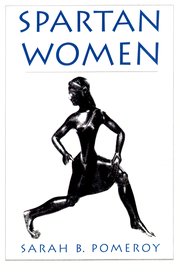
Cover for 

Spartan Women


Sparta, which existed from 800 B.C. until A.D. 200, was renowned in the ancient world as a stoic and martial city-state, and most of what we know about Sparta concerns its military history and male-dominated social structure. Yet Spartan women were in many ways among the most liberated of the ancient world, receiving formal instruction in poetry, music, dance, and physical education. And the most famous of mythic Greek women, Helen of Troy, was originally a Spartan. Written by one of the leading authorities on women in antiquity, Spartan Women seeks to reconstruct the lives and the world of Sparta's women, including how their legal status changed over time and how they held on to their surprising autonomy.

In this book, Sarah Pomeroy covers over a thousand years in the lives of Sparta's women from both the elite and lower classes. This is the first book-length examination of Spartan women, and Pomeroy comprehensively analyses ancient texts and archaeological evidence to construct the history of these elusive though much noticed women. Spartan Women is an authoritative and fresh account that will appeal to all readers interested in ancient history and women's studies.


Elizabeth of York and Her Six Daughters-in-Law: Fashioning Tudor Queenship, 1485–1547 by Retha Warnick
coverThis study of early modern queenship compares the reign of Henry VII’s queen, Elizabeth of York, and those of her daughters-in-law, the six queens of Henry VIII. It defines the traditional expectations for effective Tudor queens—particularly the queen’s critical function of producing an heir—and evaluates them within that framework, before moving to consider their other contributions to the well-being of the court. This fresh comparative approach emphasizes spheres of influence rather than chronology, finding surprising juxtapositions between the various queens’ experiences as mothers, diplomats, participants in secular and religious rituals, domestic managers, and more. More than a series of biographies of individual queens, Elizabeth of York and Her Six Daughters-in-Law is a careful, illuminating examination of the nature of Tudor queenship. 


coverThree Medieval Queens: Queenship and the Crown in Fourteenth-Century England by Lisa Benz St John
This book is an innovative study offering the first examination of how three fourteenth-century English queens, Margaret of France, Isabella of France, and Philippa of Hainault, exercised power and authority. It frames its analysis around four major themes: gender; status; the concept of the crown; and power and authority.


Berenguela of Castile (1180-1246) and Political Women in the High Middle Ages by Miriam Shadis
coverThe women in the family which ruled thirteenth-century Castile used maternity, familial and political strategy, and religious and cultural patronage to secure their personal power as well as to promote their lineage. Leonor of England, and her daughters Blanche of Castile (queen of France), Urraca (queen of Portugal), Costanza (a Cistercian nun of Las Huelgas) and Leonor, (queen of Aragon) provide the context for a study focusing on Berenguela of Castile, queen of Leon through marriage and of Castile by right of inheritance, whose most significant accomplishment was to enable the successful rule of her son Fernando.


"Trying Neaira" by Debra HamelTrying Neaira: The True Story of a Courtesan’s Scandalous Life in Ancient Greece by Debra Hamel
Neaira grew up in a Corinthian brothel in the fourth century B.C., became a high-priced courtesan and a sex slave, then settled into a thirty-year relationship with Stephanos of Athens. But next she found herself in court, charged with transgressing Athens’s marriage laws. This book reconstructs the amazing facts of Neaira’s life and trial, illuminating the social, legal, and cultural worlds of ancient Greece.


Women of Byzantium by Carolyn L. Connor
"Women of Byzantium" by Carolyn L.              ConnorWomen played key roles in Byzantine society: some ruled or co-ruled the empire, and others commissioned art and buildings, went on pilgrimages, and wrote. This engrossing book draws on evidence ranging from pictorial mosaics and inscriptions on the walls of churches to women’s poetry and histories, examining for the first time the lives, occupations, beliefs, and social roles of Byzantine women.

In each chapter Carolyn L. Connor introduces us to a single woman—from the elite to the ordinary—and uses her as a springboard to discuss Byzantine society. Frequently quoting from contemporary accounts, Connor reveals what these women thought of themselves and their lives and how they remembered the lives of women who had lived earlier.
Informative, sympathetic, and engagingly written, this book is a window into Byzantine culture and women’s history that has never before been opened.


Eleanor of Aquitaine: Lord and Lady edited by Bonnie Wheeler and John Carmi Parsons
coverEleanor's patrilineal descent, from a lineage already prestigious enough to have produced an empress in the eleventh century, gave her the lordship of Aquitaine. But marriage re-emphasized her sex which, in the medieval scheme of gender-power relations relegated her to the position of Lady in relation to her Lordly husbands. In this collection, essays provide a context for Eleanor's life and further an evolving understanding of Eleanor's multifaceted career. A valuable collection on the greatest heiress of the medieval period.


Matilda of Scotland: A Study in Medieval Queenship by Lois L. Huneycutt
Matilda of ScotlandA study of Matilda of Scotland (wife to Henry I) and the political acumen and personal skills she brought to the role of queen.Matilda of Scotland was the daughter of Malcolm II of Scotland and his Anglo-Saxon queen Margaret. Her marriage to Henry I of England in 1100 thus brought to Henry, descendant of the conquering Normans, a direct and politically desirable link to Matilda's ancestor Alfred the Great.

Her life makes clear that Matilda had outstanding talents. She was educated in the exclusive convents of Romsey and Wilton, a grounding which enabled her to further the literate court culture of the twelfth century, and under her control was a substantial demesne that allowed her to exercise both lay and ecclesiastical patronage. In the matter of ruling, she was an active partner in administering Henry's cross-channel realm, served as a member of his curia regis, and on occasion acted with what amounted to vice-regal authority in England while Henry was in Normandy.

Chroniclers of the twelfth and thirteenth centuries often refer to her as Mathilda bona regina, or Matildis beatae memoriae, and for a time she was popularly regarded as a saint. Huneycutt's study shows how Matilda achieved such acclaim, both because the political structures of her day allowed her the opportunity to do so and because she herself was skilled at manipulating those structures.

This study will be valuable to those interested in not only English political history, but also to historians of women, the medieval church, and medieval culture.


Elizabeth de Burgh, Lady of Clare (1295-1360): Household and Other Records edited by Jennifer Ward
Elizabeth de Burgh, Lady of Clare (1295-1360): Household and Other Records
Noble widows were powerful figures in the later Middle Ages, running their own estates and exercising considerable influence. Elizabeth de Burgh (1295-1360), daughter of one of the most powerful earls in England and cousin of Edward II, lost her third husband at the age of twenty-six, and spent the rest of her life as a widow. In 1317, having inherited one-third of the lands of her brother, Gilbert de Clare, earl of Gloucester and Hertford, who had been killed at Bannockburn three years earlier, she established herself at Clare, which became her main administrative centre for her estates in East Anglia, Dorset and South Wales. She enjoyed a noble lifestyle, was lavish in her hospitality to family and friends, entertaining Edward III in 1340, and she displayed her piety through her patronage of religious houses and her foundation of Clare College in Cambridge.

Her life and activities are portrayed in vivid detail in her household accounts and her will, selected extracts from which are provided in this volume. Altogether, 102 accounts of various types survive from the years of her widowhood, and the records here have been chosen to illustrate the great range of information provided, throwing light on Clare castle itself and its furnishings, daily life and religious practice, visitors, food and drink, livery and retainers, travel, and business. They paint of a vivid picture of the life and work of a noble family in the fourteenth century.


Saturday, April 11, 2020

Review: Blood Royal by Robert Bartlett

Synopsis: Throughout medieval Europe, for hundreds of years, monarchy was the way that politics worked in most countries. This meant power was in the hands of a family - a dynasty; that politics was family politics; and political life was shaped by the births, marriages and deaths of the ruling family.


How did the dynastic system cope with female rule, or pretenders to the throne? How did dynasties use names, the numbering of rulers and the visual display of heraldry to express their identity? And why did some royal families survive and thrive, while others did not?

Drawing on a rich and memorable body of sources, this engaging and original history of dynastic power in Latin Christendom and Byzantium explores the role played by family dynamics and family consciousness in the politics of the royal and imperial dynasties of Europe.

From royal marriages and the birth of sons, to female sovereigns, mistresses and wicked uncles, Robert Bartlett makes enthralling sense of the complex web of internal rivalries and loyalties of the ruling dynasties and casts fresh light on an essential feature of the medieval world.


This is really an analysis of family politics of royal and imperial dynasties throughout Latin Christendom and Byzantium 500 - 1500.

10 Surprising facts about Medieval Marriage and Divorce
We begin with the life cycle: however, before an heir can be born, the choice of bride must considered.  Bartlett discusses the intricacies associated with the marriage contract, pregnancy and childbirth, the potential for a childless marriage or bachelor king, or the repudiation of a bride and annulment of the marriage.

All things proceeding as planned, the bride gives birth to the much awaited offspring, what then?  For "what happens in bed had political consequences". Acknowledgement of a designated heir and or coronation secures the succession to a point but then we can run into problems such as a minority and interregnum or worse, adult sons - kings-in-waiting - circling and waiting for their chance. But what if the marriage produces only females - we then have now the succession of a queen and the associated issues of finding a potential husband, or the possible exclusion from rule altogether for the female heir.

Whilst considering the legitimate succession of son or daughter, we must also look to those illegitimate heirs and their rights to the succession for in many instances the "father's blood was enough to transmit eligibility to the throne" and sometimes preference was given to an illegitimate male over a legitimate female.

" ... ruling dynasties were not biological units but political ones.  Collateral branches might be excluded or pruned ... governed by biological uncertainty ..."

Still looking at the life cycle of a dynasty, Bartlett takes us through changes both within and without that can affect the success of a dynasty - hereditary or elective, too few heirs / too many heirs or rivals, provision of a patrimony for younger brothers especially as it may involve subdivision of dynastic lands. And if the heir is young and there is a minority, what of the "wicked" uncle or stepmother. It is not only the traditional forms of succession that are discussed but also how the dynasty worked within the Church, a Republic or City State to secure longevity.  Bartlett finishes his look at the life cycle with death, whether through illness, accident, warfare, assassination, disfigurement, or the figurative death of the dynasty through extinction.

Beginning of genealogy of King William I (1066-87)in the centre ...The second part of this work looks at the "sense of dynasty" - a bit more of an academic detour looking at the terminology and naming of dynasties, and of associating periods in time through the dynasty - ie: Tudor, Plantagenet, Capetian.  We also look at names, naming patterns, name changes and of course, the numbering of successive monarchs.  Diverging a little more, Bartlett considers how astrology, prophets, even sorcery and magic can have an impact in the face of dynastic uncertainty. He also takes a look at how monarchs themselves perceive their dynasty - the foundation legends, their public image and the medieval PR that goes into maintaining it.

One of my favourite chapters concerns pretenders and "returners" - the latter being a phrase I had not fully considered. We are treated to all manner of imposters, pretenders, substitution, deposition and imprisonment, and the "resurrection" of monarchs long thought dead.

Bartlett tells us that ".. ancient royalty is simply conquest that has endured ..".


This work will make a must have resource / reference for those with a penchant for medieval history. It is extremely well researched - so all the hard work is done for you - and is extensively noted with a comprehensive bibliography. There are many unique examples peppered throughout to support the information - so not just the standard, more familiar dynasties - which is easy to both read and understand.

Definitely one for my own personal library.

Sunday, November 24, 2019

Review: Far Away Bird by Douglas A Burton

48381373Synopsis: Inspired by true events, Far Away Bird delves into the complex mind of Byzantine Empress Theodora. This intimate account deftly follows her rise from actress-prostitute in Constantinople's red-light district to the throne of the Byzantine Empire. Her salacious past has left historians blushing and uncomfortable. Tales of her shamelessness have survived for centuries, and yet her accomplishments as an empress are unparalleled. Before there was a legendary empress, there was a conflicted young woman from the lower classes. And her name was Theodora


Burton seduces the reader as Theodora seduces all around her. This is a powerful, evocative narrative, that draws you into the human rather than mythical aspect of the "notorious" Theodora from her early childhood to her return to Constantinople. It is as though Burton is channeling his subject as her life dances across the pages before you, the reader. You are drawn into her life as if walking side by side, her contemporary, her ethereal other self - her far away bird.


More on Theodora

Friday, September 27, 2019

The Komnene Dynasty: Byzantium's Struggle for Survival 1057-1185 by John Carr

The 128-year dynasty of the Komneni (1057 to 1185) was the last great epoch of Byzantium, when the empire had to fend off Turkish and Norman foes simultaneously. Starting with the extremely able Alexios I, and unable now to count on help from the West, the Komneni played their strategic cards very well. Though the dynasty ended in cruelty and incompetence under Andronikos I (the Terrible), it fought a valiant rear-guard action in keeping eastern Christendom alive. 

The Komnene dynasty saw several changes in Byzantine military practice, such as the adoption of heavy cavalry on the western model, the extensive use of foreign mercenaries and the neglect of the navy (both of which were to prove a huge and possibly fatal disadvantage). A chapter is devoted to the famous Varangian Guard, which included many Saxons in exile following the Norman conquest of England. The terrible defeat at Myriokephalon in 1176 sealed the doom of the dynasty, preparing the way for the conquest of Constantinople by the Fourth Crusaders.

Sunday, September 8, 2019

Women in Antiquity - Oxford University Press

Oxford University Press has released a number of interesting books in the Women of Antiquity series. Here are a few that interested me personally:


Cover for 9780195379129Galla Placidia: The Last Roman Empress by Hagith Sivan
This new biography of Galla (c.390 - 450) is organized according to her changing roles as bride, widow, bereaved mother, queen and empress. It examines her relations with men in power, her achievements as a politician, her skills at establishing power bases and political alliances, and her efficiency at accomplishing her desired goals. (side note: I have this one myself!)

Theodora: Actress, Empress, Saint by David Potter
Potter penetrates the highly biased accounts of Theodora found in the writings of her contemporaries and takes advantage of the latest research on early Byzantium to craft a modern, well-rounded, and engaging narrative of Theodora's life. 

Zenobia: Shooting Star of Palmyra by Nathanael Andrade
This book situates Zenobia in the social, economic, cultural, and material context of her Palmyra. By doing so, it aims to shed greater light on the experiences of Zenobia and Palmyrene women like her at various stages of their lives. Not limiting itself to the political aspects of her governance, it contemplates what inscriptions and material culture at Palmyra enable us to know about women and the practice of gender there, and thus the world that Zenobia navigated

Boudicca: Warrior Woman of Roman Britain by Caitlin C. Gillespie
Introduces readers to the life and literary importance of Boudica through juxtaposing her different literary characterizations with those of other women and rebel leaders. This study focuses on our earliest literary evidence, the accounts of Tacitus and Cassius Dio, and investigates their narratives alongside material evidence of late Iron Age and early Roman Britain.

Cover for 9780195365528Arsinoe of Egypt & Macedon by Elizabeth Donnelly Carney
First ever biography (in english) of Arsinoë II (c. 316-c.270 BCE), daughter of the founder of the Ptolemaic dynasty. Although Arsinoë was the pivotal figure in the eventual evolution of regnal power for Ptolemaic women --and despite a considerable body of recent scholarship across many fields relevant to her life-- there has been no up-to-date biography in English of her life.

Berenice II and the Golden Age of Ptolemaic Egypt by Dee L. Clayman
First ever biography (in english) of Berenice II (c. 264-221 BCE), daughter of King Magas of Cyrene and wife of Ptolemy III Euergetes. which offers a portrait of a woman who had access to the cultural riches of both Greece and Egypt and who navigated her way carefully through the opportunities and dangers they presented, ultimately using them to accrue unprecedented honors that were all but equal to those of the king.

Cleopatra by Duane W Roller
First comprehensive biography of Cleopatra VII, queen of Egypt to draw solely from the source material from the Greco-Roman period: literary sources, Egyptian documents (Cleopatra's own writings), and representations in art and coinage produced while she was alive.

Cleaoptra's Daughter and Other Royal Women of the Augustan Era by Duane W Roller
The first detailed study of a number of royal women who were major players in the world of the latter first century BC and the early part of the following century. In addition to Cleopatra Selene (daughter of Cleoptra VII), other women of note included in this book are Pythodoris of Pontos, Salome of Judaea, Glaphyra of Cappadocia, Dynamis of Bosporos, Abe of Olbe, and Mousa of Parthia.

Clodia Metelli: The Tribune's Sister by Marilyn B. Skinner
First full-length biography of Clodia Metelli widow of the consul Metellus Celer in any language. As the eldest sister of the populist demagogue P. Clodius Pulcher, she used her wealth and position to advance her brother's political goals. For that she was brutally reviled by Clodius' enemy, the orator M. Tullius Cicero.

Faustina I and II: Imperial Women of the Golden Age by Barbara M. Levick
Cover for 9780195379419Provides an learned introduction to the lives of these two important classical women of the Roman Empire - Faustina the Elder (c. 97-140) and her daughter Faustina II (c. 130-175).  The book traces Faustina I's formation of her family's heritage amid a new empire through to Faustina II's enhancement of that legacy, focusing especially on the younger Faustina's deep involvement in palace politics and her possible role in the revolt of Avidius Cassius in 175.

Sabina Augusta: An Imperial Journey by T Corey Brennan
Sabina Augusta (ca. 85-ca. 137), wife of the emperor Hadrian (reigned 117-38), accumulated more public honors in Rome and the provinces than any imperial woman had enjoyed since the first empress, Augustus' wife Livia. Indeed, Sabina is the first woman whose image features on a regular and continuous series of coins minted at Rome. She was the most travelled and visible empress to date. Hadrian also deified his wife upon her death.

Turia: A Roman Woman's Civil War by Josiah Osgood
In this book, Josiah Osgood reconstructs the life of Turia, more fully than it has been before by bringing in alongside the eulogy stories of other Roman women who also contributed to their families' survival while working to end civil war. He shows how the wife's story sheds rare light on the more hidden problems of everyday life for Romans, including a high number of childless marriages. This unique narrative is more than a biography of one woman: it is a portrait of a vivid period in Roman history and a tribute to married love 

Eurydice and the Birth of Macedonian Power by Elizabeth Donnelly Carney
Examines Eurydice - the wife of Amyntas III, the mother of Philip II, and two other short-lived kings of Macedonia, and grandmother of Alexander the Great. This study examines the nature of her public role as well as the factors that contributed to its expansion and to the expanding power of Macedonia.

Cover for 9780190210038Hypatia The Life and Legend of an Ancient Philosopher by Edward J. Watts
First full English-language scholarly treatment of Hypatia in over 25 years which takes advantage of new techniques for reading ancient letter collections and philosophical and mathematical commentaries.  Watts uncovers a number of previously unnoticed early modern sources and uses them to speak at length about Hypatia's modern legacy. 

Perpetua:  Athlete of God by Barbara K. Gold
Perpetua was an early Christian martyr who died in Roman Carthage in 203 CE. This book will investigate and try to make sense of all aspects of Perpetua's life, death, and circumstances: her family and life in Carthage, Christians and Romans in Carthage and in the Roman empire in this period, the comparisons of martyrs to athletes, the influence of these martyr tales upon the Acts of the Apostles and the Greek novel, the reactions of later church fathers like Augustine to her story and her popularity, and the gendering of this text.

Monica: An Ordinary Saint by Gillian Clark
This tome seeks to illuminate Monica (mother of St Augustine) in the context of the societal expectations and burdens that shaped her and all ordinary women. Weighing Augustine's discussion of his mother against other evidence of women's lives in late antiquity, Clark achieves portraits both of Monica individually, and of the many women like her.

Sunday, May 26, 2019

The Restoration of Rome by Peter Heather

Cover for 

The Restoration of Rome


In 476 AD, the last of Rome's emperors, known as "Augustulus," was deposed by a barbarian general, the son of one of Attila the Hun's henchmen. With the imperial vestments dispatched to Constantinople, the curtain fell on the Roman empire in Western Europe, its territories divided among successor kingdoms constructed around barbarian military manpower. 


But, if the Roman Empire was dead, Romans across much of the old empire still lived, holding on to their lands, their values, and their institutions. The conquering barbarians, responding to Rome's continuing psychological dominance and the practical value of many of its institutions, were ready to reignite the imperial flame and enjoy the benefits. 

As Peter Heather shows in dazzling biographical portraits, each of the three greatest immediate contenders for imperial power--Theoderic, Justinian, and Charlemagne--operated with a different power base but was astonishingly successful in his own way. Though each in turn managed to put back together enough of the old Roman West to stake a plausible claim to the Western imperial title, none of their empires long outlived their founders' deaths. Not until the reinvention of the papacy in the eleventh century would Europe's barbarians find the means to establish a new kind of Roman Empire, one that has lasted a thousand years.

A sequel to the bestselling Fall of the Roman Empire, The Restoration of Rome offers a captivating narrative of the death of an era and the birth of the Catholic Church.


Sunday, June 11, 2017

The First Crusade: The Call from the East by Peter Frankopan

A book that sits proudly on my Crusades shelf in the Library, reviewed here by Andrew Holt, Ph.D:
I have long thought that Oxford historian Peter Frankopan’s The First Crusade: The Call from the East (Cambridge, Mass.: Belknap Press of Harvard University Press, 2012) is one of the more interesting and important recent books for understanding the circumstances leading up to the calling of the First Crusade in 1095. His emphasis on Byzantine efforts to win western Christian military support in their conflict with Muslim forces in the East provides an up to date and robust consideration of the issue that is lacking in many other works that consider the era of the First Crusade.  Frankopan’s work, particularly chapter six, gives a good sense of why western Christians believed this based on his analysis of extensive Byzantine efforts to cultivate and win such military support. 
read entire review here @ Andrew Holt's blog

Monday, March 13, 2017

Death and the Afterlife in Byzantium

This interdisciplinary study provides an in-depth analysis and synthesis of hagiography, theological treatises, apocryphal texts and liturgical services, as well as images of the fate of the soul in manuscript and monumental decoration. It also places the imagery of the afterlife, both literary and artistic, within the context of Byzantine culture, spirituality, and soteriology. The book intends to be the definitive study on concepts of the afterlife in Byzantium.

Read more here @ Yale News

Triple Biography of Byzantium

Historian Bettany Hughes is a fine storyteller and the triple biography of Byzantium, Constantinople and Istanbul is world history enmeshed in one desirable location. From the Greeks at Byzantium about 600BC to the Romans at Constantinople in AD300 to the Muslim city of the 1500s onwards and the Istanbul of modern Turkey, the layers of history are excavated in fine detail.

Along the way dozens of intruders found their way to this spot, which guards the entrance to the Black Sea. Persians, Vandals, Goths and the Crusaders all made their mark at various times and the modern city bears traces of them all. The author digs deep to find what they left behind and explain where the signs of the city's centuries of invasion can be found.

Read rest of review by Jim Sullivan here @ Otago Daily News

Wednesday, March 1, 2017

Barbara Newman reviews ‘Anna Komnene’ by Leonora Neville

Byzantium also produced a female historian, Anna Komnene (1083-c.1155). Her Alexiad, with its deliberately epic title, is considered an invaluable source for the reign of her father, Emperor Alexios Komnenos. Like most Byzantine histories, it is a tale of wars, conspiracies and heresies. Anna could describe a battle as vividly or refute a heretic as scornfully as any of her male peers. Western historians prize her account of the First Crusade, the only eyewitness view from Byzantium, in which she portrays the Norman adventurer Robert Guiscard and his son Bohemond with horrified fascination. In a period that witnessed the gradual loss of Asia Minor to the Turks, the emergence of Venice and Pisa as maritime powers and the formulation of holy war ideologies in western Christendom and Islam, our knowledge of the Byzantine response to these changes comes largely from the Alexiad. Like all histories, it has its gaps and silences, but also its odd inclusions, such as an excursus on Aristotelian philosophers in the capital. Anna herself would commission the first commentaries on the Nicomachean Ethics.

Continue Reading More Here:

See Also:
Anna & the First Crusade @ De Re Militari


Monday, October 12, 2015

Octobers Additions to the Library

Just a few additions (so far) to the Library for October 2015:

The Book of Melusine of Lusignan in History, Legend and Romance by Gareth Knight.
This book provides a collection of material from various sources to give an all round picture of the remarkable faery, her town, her church, her immediate family, and the great Lusignan dynasty she founded. An established authority on Melusine, Gareth Knight collects together all the best source material, which he translates from the French, and presents his own researches into the Lusignan family of the 12th century, whose dynasty included kings of Cyprus and Jerusalem, examining the possibility of a familiar spirit guiding the family in its destiny.

Anna Comnena by G. Buckler
This book discusses Anna’s character, attitudes, biases, theological opinions, and writing style (all of which are useful and interesting), but of more immediate interest to the genealogist is her chronicling of military affairs, foreign relations with the Crusaders (especially the "Franks"), and political marriages with Balkan rulers. 

The Man Who Believed He Was King of France by Tommaso Di Carpegna Falconieri
ith the skill of a crime scene detective, Tommaso di Carpegna Falconieri digs up evidence in the historical record to follow the story of a life so incredible that it was long considered a literary invention of the Italian Renaissance. From Italy to Hungary, then through Germany and France, the would-be king's unique combination of guile and earnestness commands the aid of lords and soldiers, the indulgence of innkeepers and merchants, and the collusion of priests and rogues along the way. (Still awaiting delivery of this one - have read it a numbers of times - on loan from local library - so now is the time to add it to my own personal library).

Magna Carta by David Carpenter
With a new commentary by David Carpenter "No free man shall be seized or imprisoned, or stripped of his rights or possessions, or outlawed or exiled, or deprived of his standing in any other way, nor will we proceed with force against him, or send others to do so, except by the lawful judgement of his equals or by the law of the land." Magna Carta, forced on King John in 1215 by rebellion, is one of the most famous documents in world history. It asserts a fundamental principle: that the ruler is subject to the law. Alongside a new text and translation of the Charter, David Carpenter's commentary draws on new discoveries to give an entirely fresh account of Magna Carta's text, origins, survival and enforcement, showing how it quickly gained a central place in English political life.

Templar Families by Jochen Schenk
This detailed study explores the close relationship between the Order of the Temple and the landowning families it relied upon for support. Focusing on the regions of Burgundy, Champagne and Languedoc, Jochen Schenk investigates the religious expectations that guided noble and knightly families to found and support Templar communities in the European provinces, and examines the social dynamics and mechanisms that tied these families to each other. 


Tuesday, September 29, 2015

September Additions - Part 3

And, finally, Part 3 of September's additions to the Library:

Byzantium and the Rise of Russia: A Study of Byzantino-Russian Relations in the Fourteenth Century by John Meyendorff - This book describes the role of Byzantine (predominantly ecclesiastical) diplomacy in the emergence of Moscow as the capital of Russia in the fourteenth century, and the cultural, religious and political ties which connected the Northern periphery of the Byzantine Orthodox 'Commonwealth' with its centre in Constantinople. 

Colonial Ireland, 1169-1369 by Robin Frame - This book examines the processes of conquest and colonization, against the background of economic expansion and seigneurial enterprise apparent elsewhere in Britain and Europe. It also explores the nature and extent of colonial retreat, and the political and cultural adjustments that were evident amid the less favorable conditions of the 14th century.

The Kingdom of the Isles: Scotland's Western Seaboard C.1100-C.1336 by Andrew McDonald - Exploring the history of Scotland's western seaboard during the central Middle Ages, this study discusses three interrelated themes: the existence of the Isles and coastal mainland as a kingdom; the monarchs of the region, from Somerled to his descendant John MacDonald, the first Lord of the Isles; and the complex relations among the Isles, Scotland, Norway, and England. 

Thomas Becket : Warrior, Priest, Rebel, Victim: a 900-year-old Story Retold by John Guy - The story of "Thomas Becket" is the story of an enigma, as well as of one of the most tumultuous periods in English history. Drawing on a vast array of contemporary records, personal letters and first-hand accounts, John Guy has reconstructed a psychologically compelling, stunningly nuanced and utterly convincing account of this most remarkable man, the dramatic times in which he lived and the pivotal role he played in his nation's history.

The Royal Stuarts : A History of the Family That Shaped Britain by Allan Massie - Exploring the family's lineage from the first Stuart king to the last, The Royal Stuarts is a panoramic history of the family that acted as a major player in the Scottish Wars of Independence, the Union of the Crowns, the English Civil War, the Restoration, and more. Drawing on the accounts of historians past and present, novels, and plays, this is the complete story of the Stuart family, documenting their path from the salt marshes of Brittany to the thrones of Scotland and England and eventually to exile. 

The Audacious Crimes of Colonel Blood : The Spy Who Stole the Crown Jewels and Became the King's Secret Agent by Robert Hutchinson - Bestselling historian Robert Hutchinson paints a vivid portrait of a double agent bent on ambiguous political and personal motivation, and provides an extraordinary account of the perils and conspiracies that abounded in Restoration England.

Saturday, October 12, 2013

October Additions

As the last of the September additions arrived in the post a couple of days ago, October's list has been sent off. Here are the tomes for October:


Elfrida by Elizabeth Norton
Contrary to popular belief, Anglo- Saxon England had queens, with the tenth-century Elfrida being the most powerful and notorious of them all. She was the first woman to be crowned Queen of England, sharing her husband King Edgar's imperial coronation at Bath in 973. 

Cnut: England's Viking King 1016-35 by M.K. Lawson
King Cnut ruled England from 1017 to 1035 and left behind him a legacy of peace, law and order. However, the beginnings of his kingship were less auspicious. He was a cruel and vicious warrior, who invaded England with his father Swegen Forkbeard, perhaps at a tender age.

The Military Leadership of Matilda of Canossa, 1046-1115 by David J. Hay
This is the first account in English of the entire, forty year military career of one of the most powerful women of the Middle Ages. Challenging the boundaries between military and gender history, it explains how one famous noblewoman rose to the defense of the reforming papacy, defeated the Holy Roman Emperor and turned the tide of the first great war between Church and State.

Jack the Ripper's Secret Confession by David Monaghan
While Jack the Ripper spread fear throughout the East End of London in 1888, another man stalked the streets hunting flesh. He called himself Walter. Walter printed up his memoir of sex under the title "My Secret Life". This book shows how this notorious work of Victorian pornography reveals that its author had the means to be Jack the Ripper. (Yes, I am an avid Ripperologist)

The Byzantine Lady by Donald M. Nicol
A lively collection of ten biographies of aristocratic women of the Byzantine empire in its final years.

Women Who Run with Wolves by Clarissa Pinkola Estes
Within every woman there is a wild and natural creature, a powerful force, filled with good instincts, passionate creativity, and ageless knowing. Her name is Wild Woman, but she is an endangered species. Though the gifts of wildish nature come to us at birth, society's attempt to "civilize" us into rigid roles has plundered this treasure, and muffled the deep, life-giving messages of our own souls. Without Wild Woman, we become over-domesticated, fearful, uncreative, trapped. 

The Anarchy of Stephen and Matilda by Stephen M. Taylor
Join Matilda Plantagenet in her violent struggle to overcome sexism in medieval England. Share her aspirations as she attempts to balance love and motherhood with the ultimate political career. Experience her frustrations as she battles sins of the flesh, dogmas of the Church and her archnemsis, the beguiling Stephen of Blois. (I am seriously hoping that this is not a novel but  non-fictional account of this period).


Tuesday, August 13, 2013

August Additions

Yes, as the July additions are slowly making their way to the Library, August's list has just been sent off - here they are:

Anglo-Saxon England by F.M. Stenton
Covers the emergence of the earliest English kingdoms to the establishment of the Anglo-Norman monarchy in 1087. Professor Stenton examines the development of English society, from the growth of royal power to the establishment of feudalism after the Norman Conquest.

Fourteen Byzantine Rulers by Michael Psellus
Chronicles the Byzantine Empire, beginning in 1025. This title shows an understanding of the power politics that characterized the empire and led to its decline.

The Other Tudors by Philippa Jones
Everybody thinks they know the tale of King Henry VIII's wives: divorced, beheaded died; divorced, beheaded, survived. But behind this familiar story, lies a far more complex truth. This book brings together the 'other women' of King Henry VIII. It examines the tales of the women who Henry loved but never married.

Richard III the Young King To Be by Josephine Wilkinson
This new biography concentrates on the much neglected early part of Richard's life - from his birth in 1452 as a cadet of the House of York to his marriage to the beautiful Anne Neville - and shows how his experiences as the son of an ambitious duke, a prisoner of war, an exile, his knightly training and awe of his elder brother, King Edward IV, shaped the character of England's most controversial monarch. 

The Rulers of the South - Sicily, Calabria, Malta - Vol II by Francis Marion Crawford
This early works is a comprehensive and informative look at the subject and is extensively illustrated throughout. Contents include; The Goths and the Byzantines, The Saracens, The Normans, In Later Times, and, The Mafia..... 

Joan of Arc by Kelly DeVries
Why did the soldiers of France follow a woman into battle when no troops of the Hundred Years War had done so before, and how was she able to win? This book is essential reading for anyone interested in the Middle Ages and the phenomenon of the girl warrior.

The Maid and the Queen by Nancy Goldstone
How did an illiterate seventeen-year-old peasant girl manage to become one of histories most salient females? It is almost 600 years since Joan of Arc heard the voices of angels that would change her life forever: in a breathtaking story her quest saved France from English domination and restored France's hereditary monarchy. 

The Kings & Queens of Wales by Timothy Venning
A considered attempt to set out what we can know about the rulers of what is now Wales in the early medieval period, Timothy Venning's new book does not shy away from problems of dating and interpretation in the use of the meagre source material.

The Kings & Queens of Anglo-Saxon England by Timothy Venning
In The Kings & Queens of Anglo-Saxon England, Venning examines the rulers of Anglo-Saxon England, beginning with the legendary leaders of the Anglo-Saxon invasion as Hengest and Horsa or Cerdic and Cynric and moving on through such figures as Aethelbert of Kent, the first king to be converted to Christianity and his daughter Aethelburh, whose marriage began the conversion of Northumbria, to Alfred of Wessex and his dynasty, the Viking invasions, and the last of the Anglo-Saxon kings, Harold Godwineson.