Showing posts with label ireland. Show all posts

Friday, February 7, 2025

Review: The Long Game - Inside Sinn Fein by Aoife Moore

Synopsis: Inside the rise of the political party, once subordinate to the IRA, that is on the brink of taking power in Ireland.

Sinn Féin, long widely-regarded as the political wing of the Provisional IRA, is the most popular political party in both Northern Ireland and the Republic. A movement once synonymous with a paramilitary campaign is on the brink of taking real power through purely democratic means. But if Sinn Féin has mastered the art of electoral politics, it remains strangely opaque. Who really runs the party? How is it funded? And what can we expect of it as a party of government?


Aoife Moore, Irish Journalist of the Year 2021. explores these and other burning questions in The Long Game. Drawing on exclusive interviews with current and former members of Sinn Féin, she builds up a picture of a party undergoing a profound, and still incomplete, transformation. She looks at the key individuals and moments that put the party on its present course, and she explores tensions within the party and the wider republican movement.
~ ~ ~

Moore's books is intended to provide a fair and accurate account of the rise of the Irish political party, Sinn Fein. And to be fair, Moore does this, documenting the legitimisation of Sinn Fein in 1974 through to its current incarnation today. Along the way, the narrative looks deeply into the culture and history and personalities of those within and those pulling the strings of the party.

What the reader will find when picking up this tome are the following, summarised in dot points below, and in no particular order:
  • the efforts of the party leadership to change the party's image were undercut by forces within the movement;
  • the party was and is in a state of perpetual flux;
  • the party is still tied and subservient to its historical paramilitary and political baggage;
  • there is a deep seeded culture of bullying, cover-ups, political disfunction, paranoia and suspicion, scandal, chaos, malfeasance;
  • it has a top down structure and hierarchy that is not driven by grass roots culture;
  • the party leadership worked to control its members and centralise power and no deviation from the party line is tolerated;
  • the party narrative was and is driven, controlled and censured by dominant personalities who didn't care for change until the politics became popularly unpalatable;
From available sources, historical documents, and anonymous interviews, Moore has managed to put together a history of the party. The narrative, however, goes back and forth with the introduction of each new character and key events to give perspective and context to the overall story (Irish storytelling is never linear). 

I personally, would also have preferred two things:
  1. that the actions of the Sinn Fein were viewed also in context of the actions of its political and paramilitary opponents, though understand that this would have increased what is already a decent lengthy tome;
  2. that the detail on the hierarchical structure of the party had been documented earlier in the book to aid the reader is grasping where each organisation was placed.

I have previously read a great deal about Irish history and politics leading up to the early 2000s, so I was keenly interested in what Moore (who implies that the reader has a certain level of knowledge already) had to say and what she could add to what had previously been written. There were some snippets I found of interest whilst there was much that confirmed and substantiated what I knew and suspected from my own readings and research.

Overall, from an outsiders' perspective, Moore achieves her intent. A worthwhile read for those for whom this subject matter is of interest.

Monday, July 3, 2023

Vikings of the Irish Sea by David Griffiths

"Vikings of the Irish Sea: Conflict and Assimilation Ad 790-1050" looks at the activities of the Vikings in the Irish Sea, a band of water that has been important since prehistoric times in the history of maritime cultural exchange between Britain and Ireland as well as the Scandinavian countries. The Vikings fully exploited their naval dominance to exert their influence across this area and David Griffiths presents a unique overview of the results of this dominance. 

The book will look, in detail at the activities of the Vikings in Wales, North West England, the Isle of Man, Scotland and Ireland. The archaeological evidence such as silver hoards and burials, along with the evidence of place-names, settlement and sculpture provide a fascinating insight into the mechanisms of Viking power in these areas.

Sunday, March 27, 2022

Review: Aedan of the Gaels by Keith Coleman

Synopsis: This is the first full-length work devoted to Aedan mac Gabrain, 6th century king of Dal Riata in Scotland. An associate of the famous St. Columba, he was the first recorded king to be ordained in the British Isles and was the most powerful ruler in his generation. His astonishing military reach took him from Orkney, Pictland, Ireland, Northumbria and the Isle of Man. 

This book details his dominant career, which came to a shattering end after decades of warfare at the Battle of Degsaston in AD 603. Beyond the record of warfare, there is a unique and tantalising accumulation of legend concerning Aedan, from stories about his birth, to tales of him in battle with Irish heroes. English sources mention him and he is one of the few Gaelic kings to feature prominently in Welsh tradition, where he is remembered as a uniquely powerful player in the north of Britain. Modern writers highlight Aedan as the father of a prince named Arthur, which has led to his place in Arthurian studies. Aedan's prominence in his era qualifies him as a fascinating figure, whose life and legend are accessibly explored in this exciting account of this unique ruler.


Aedan macGabrain (r. 574–608) was a 6th century Irish warlord of the Dal Riata (Riada) - an area which encompassed the western seaboard of Scotland and the north-eastern corner of Ireland, on each side of the North Channel. At its height in the 6th and 7th centuries - the period under Aedan and his successors - it covered what is now Argyll in Scotland and part of County Antrim in Northern Ireland. After a period of expansion, Dál Riata eventually became associated with the Gaelic Kingdom of Alba.

The sources for Áedán's life include Bede's Historia ecclesiastica gentis Anglorum; the Annals of Ulster and the Annals of Tigernach; and Adomnán's Life of Saint Columba. The Senchus fer n-Alban, a census and genealogy of Dál Riata, purports to record his ancestry and that of his immediate descendants. However, - not one of these sources are contemporary, which makes a re-telling of his life rather difficult. And thus with few concrete fact about him, any considerations are based upon supposition and guesswork, and many points are thus open to dispute.

Much of the earlier history of both Ireland and Pictland is shrouded in a mist that hovers between reality and legend and mythology, and this earlier period is often view through a much later lens.

Coleman does his best to utilise the historic sources, archaeological evidence, and myths and legends, to shed some light onto this period and its ruler. He uses comparative examples to "fill out" a proposed timeline and biography. The early histories were mainly oral except when documented by clerics usually in the form of a Vitae of their patron, and always from a distance and with an agenda or moral in mind. Much of what is covered is - as mentioned - open to interpretation and this itself is explored and placed in context.

Having said that, I enjoyed reconnecting with one of the larger than life, mysterious, yet real characters of history. And like today, the lines of reality are sometimes blurred with those of myth.


Further Reading:

Saturday, April 10, 2021

The Irish Detective Series by Scott Hunter

From the author's website:
Moran is a loner ... with a taste for Italian wine and quality scotch whisky; he is an appalling gardener and (like the author himself), the owner of hyperactive cocker spaniel named Archie.

Born and raised initially near Cork and later in Co. Kerry after his parents moved away during his teens, Moran was left in the care of the Hannigan family where he met and fell in love with Janice, the Hannigans’ eldest daughter.

They were engaged to be married, but Janice was tragically killed in a car bomb incident in the late 1970’s. The bomb had been meant for Moran ... he has never forgiven himself for Janice’ death, nor has he been able to settle into a relationship since.

Moving to England in the early nineteen-eighties, he joined the Thames Valley Police and rose through the ranks on merit. He has experienced various setbacks in his career .... he was almost killed in a car accident .... and also injured during the course of an investigation ....  also has an acute knack of being able to figure people out.


Black December
DCI Brendan Moran, world-weary veteran of 1970s Ireland, is recuperating from a near fatal car crash when a murder is reported at Charnford Abbey.

The abbot and his monks are strangely uncooperative, but when a visitor from the Vatican arrives and an ancient relic goes missing the truth behind Charnford's pact of silence threatens to expose not only the abbey's haunted secrets but also the spirits of Moran's own troubled past  . . .


Creatures of Dust
An unusual crime requires an unusual detective ... An undercover officer goes missing and the body of a young man is found mutilated in a shop doorway. Is there a connection? Returning to work after a short convalescence, DCI Brendan Moran's suspicions are aroused when a senior officer insists on freezing Moran out and handling the investigation himself.

A second murder convinces Moran that a serial killer is on the loose but with only a few days to prove his point the disgruntled DCI can't afford to waste time.

As temperatures hit the high twenties, tempers fray, and the investigation founders Moran finds himself coming back to the same question again and again: can he still trust his own judgement, or is he leading his team up a blind alley?


Death Walks Behind You
DCI Brendan Moran's last minute break in the West Country proves anything but restful as he becomes embroiled in the mysterious disappearance of an American tourist.

Does the village harbour some dark and dreadful secret? The brooding presence of the old manor house and the dysfunctional de Courcy family may hold the answer but Moran soon finds that the residents of Cernham have a rather unorthodox approach to the problem of dealing with outsiders.

As Moran is drawn deeper into Cernham's mysterious past a cold-blooded execution in Berkshire plunges deputising DI Charlie Pepper into a maelstrom of murder, double cross and treachery ...


A Crime for all Seasons
From the midwinter snowdrifts of an ancient Roman villa to a summer stakeout at an exclusive art gallery, join DCI Brendan Moran and his team for the first volume of criminally cunning short stories in which the world-weary yet engaging Irish detective reaffirms that there is indeed a crime for all seasons . . .


Silent as the Dead
A call from an old friend whose wife has vanished from their home in Co.Kerry prompts DCI Brendan Moran to return to his Irish roots. The Gardai have drawn a blank; can Moran succeed where they have failed?

Moran's investigation leads him to a loner known locally as the Islander, who reveals that the woman's disappearance is connected to a diehard paramilitary with plans to hit a high profile target in the UK.

Time is running out. Can Moran enlist the Islander's help, or does he have to face his deadliest foe alone?


Gone Too Soon
Moran is called to a burial in a local cemetery. But this is no ordinary interment; the body of a young woman, Michelle LaCroix, a rising star in the music world, is still warm, the grave unmarked. A recording reveals the reason for her suicide. Or does it?

Why would a young, successful singer take her own life? To unlock the answer, Moran must steer a course through his darkest investigation yet, as the clues lead to one shocking discovery after another . . .


The Enemy Inside
Whoever said 'Keep your friends close and your enemies closer' was right. But maybe not this close ...

DCI Brendan Moran's morning is interrupted when a suicidal ex-soldier threatens to jump from a multi-storey car park ...

Moran soon regrets getting involved when an unexpected visitor turns up on his doorstep to confront him with what appears to be damning evidence of past misconduct.

Can the Irish Detective clear his name, or must he come clean and face the consequences? One thing seems certain: by the time the night is over, his reputation may not be the only casualty ...


When Stars Grow Dark
A fatal road traffic collision uncovers a bizarre murder when it transpires that an elderly passenger in one of the vehicles was dead before the accident. All indications point to the work of a serial killer - but with little forensic evidence, how can DCI Brendan Moran and his team run the killer to ground?

To add to Moran's problems, an unexpected discovery prompts the Irish Detective to undertake a dangerous and unscheduled journey to Rotterdam where he believes his former friend and MI5 agent, Samantha Grant, is being held. Can Moran succeed in his rescue mission whilst juggling the heavy demands of his most perplexing murder investigation to date? 


Wednesday, February 17, 2021

Warriors of the Pale: An Irish Saga by Raymond Reagan Butler

In 1185, King Henry II of England sent a messenger to Rome, requesting that his youngest son, Prince John, should be recognised as King of Ireland. With the request granted, John went to Ireland to fight for his dominion and with him went Theobald Walter, the first of the warriors of the Pale - that part of Ireland completely under English rule in the Medieval period. The Butlers would produce an unbroken succession of male heirs right down to 1515.

For the first two centuries the military struggle between the native Irish and the Normans was a bloody stalemate; then in 1399 Richard II attempted to quell the Irish chieftains once and for all, but was pushed back to the Pale - and in the process lost the English throne to Henry IV. Raymond Butler follows the fascinating and not always well documented military struggle in Ireland, focussing upon the extraordinary Butler dynasty, who supported the English kings and were duly rewarded, the eighth earl being made Chief Governor of Ireland by Henry VIII.

The last of the great warriors of The Pale, the 'Black Earl', was Lieutenant-General of Ireland at his death in 1614, still loyal to the English King James I: though the Butlers had not always been loyal, not when their vast lands and wealth had been threatened. This is a 400-year-long story of pitched battles, shifting loyalties, political confusion, assimilation, treachery and military prowess that sheds new light on the entwined histories of England and Ireland.

Saturday, December 12, 2020

New book tells the story of a hardworking people in West Offaly

From the Offaly Express:
Veteran writer and local historian Brendan Ryan has just received the copies of his 12th book from the printers.  The book is called "On Gallen Green - The Story of a West Offaly Townland".

Brendan says the book had a modest beginning but then ballooned. "I started by writing an article on a townland that straddles both Ferbane and Cloghan parishes, for Offaly Heritage, but it grew legs and ended as a more than 200 page book." 

Brendan has written several very popular local history books over the last 35 years.  His first book was "The Green Fields - A History of Ferbane GAA", which was massively popular. His next book, printed in 1991, shone a light on the life and poetry of local man John M Doyle. The book was called "Where the Brosna Flows". In 1994 he published "A Land by the River of God - A History of Ferbane Parish". Last year he co-authored a book about Shannonbridge.

"On Gallen Green" is the story of a small townland (Gallen) in West Offaly, a townland that straddles two parishes, Cloghan and Ferbane. For the past three hundred years its economy was based on a thriving brickmaking industry, a labour-intensive enterprise, probably brought to the area by Cromwellian soldiers. The Grand Canal forms a focal point in the social life of the community.  "It is the story of a hard-working people," says Brendan, "a people who also know how to enjoy their recreations of football, dancing, music, singing and games."

Gallen has a Community School and the artifacts of a Celtic monastery and of a medieval Augustinian Priory. The book tells many interesting stories including how the Lord Lieutenant in Dublin Castle happened to send a silver snuff box to the parish priest of Ferbane in 1831; how two successive clerks of the Petty Sessions for King's County happened to live in Gallen View; and the times when the travelling theatres put on their shows in two local Gallen halls.

Brendan grew up in Dublin's north inner city. After graduating from UCG he taught for many years in Ferbane parish. Brendan is married to Cecilia MacNerney from Dromard, Longford and they have seven children.

A limited number of signed hardback copies of 'On Gallen Green' will be available, priced €20, in O’Callaghan’s Centra, Ferbane; Ferbane Post Office; Spar, Ferbane; Spar Express, Cloghan; and Offaly History Shop, Bury Quay, Tullamore. 

Copies of the book can also be ordered from the author at brendanryan@yahoo.com.

Monday, July 20, 2020

Review: Starving Men by Siobhan Finkielman

Starving Men: A psychiatrist. A killer. An unthinkable revenge for history.Synopsis: Dublin, 2019: Michael Gleeson is a well-respected psychiatrist – a quiet man, a good friend, and a useless cook. He also spends part of his professional life secretly counseling former members of the disbanded IRA. Michael always thought this would be enough to satisfy his Republican heritage, but when the highly skilled yet deeply disturbed Turlough O’Sullivan enters his office, Michael sees an opportunity that he just can't overlook.


Haunted by childhood tales of the gruesome history of the Irish people under British rule, Michael enlists his new patient's help in tracking down and killing the living descendants of the worst men in Ireland's past, figures whose names still send a shiver down the spine.

But Michael's plan for a bloody revenge doesn't run smoothly: Not only must he learn the brutal truth about the role models who formed him as a child, but on his trail is a young Irish detective temporarily assigned to Scotland Yard, an officer who becomes obsessed with stopping the unknown serial killer who is out for an historical revenge that she can't understand.


How many of us have asked ourselves "would that I could right an historical wrong" - and how many of us, had we the opportunity to do so, would?

This is the premise of Finkielman's psychological thriller set in Ireland wherein Michael Gleeson, noted psychiatrist and Irish Republican sympathiser, does just that. From the stories religiously instilled in him as a young and malleable child of The Troubles by his relatives, Michael Gleeson becomes fixated on events dating back to County Mayo during the Irish Famine, but has done nothing to assuage this unrequited need for revenge until the day when the instrument of his vengeance walks through the door.

A group of 600 Irish starving during the Great Hunger set out to Doolough to find food. Most of did not survive.The Great Famine and its effects have been felt keenly by many down the ages by the Irish diaspora. This was a tragic period of mass starvation and disease from 1845 to 1849, with the most severely affected areas in the west and south of Ireland. In the period between 1841 and 1851, the population of County Mayo declined by 29 per cent from 388,887 to 247,830. Deaths and emigration accounted for the loss of 114,057 of Mayo's population - a stark figure when compared to the county's population of 130,507 (2016 Census).

It is said that " ... the Irish aren't a people for forgetting about the past ... " and it is a cry from the past that ignites Gleeson's obsession with events linked to the Famine and finally propels him to move forward and seek retribution of the victims ... "... let it be some man down the years who will take the sharpest hands ..." .

This is an engrossing tale - and I was drawn to it due to this being a part of my own family history. It did, however, start out a little patchy in places, but I put this down to the storyline - and the characters - finding its feet, so to speak. The story is related through various mediums - we have the first person narrative of Michael Gleeson - who is both likeable and detestable - in the present as well as taking us back to his childhood; we have the historical narrative in the form of letters from Honoria O'Gliasain, reliving her experiences in Mayo at the time of the Famine; we have the narrative of police officer Maggie Foster, seconded to Scotland Yard, who finally puts the pieces of the puzzle together; and we have the instrument of death. There are various smaller contributing narratives, each added another layer and perspective, and linking in the various themes in order to bring the overall narrative together.

The Troubles - Irish CultureThe history and politics of Ireland is never clear cut, especially to an outsider. Like the country itself, this tale is a contradiction wherein villains are heroes and heroes are villains, and the truth is shrouded in a fog layered over the ages, obscuring, obfuscating, complex and dense; and where one man is held captive by his own obsessive compulsion to right a historical wrong.

A very suspenseful and engaging first novel.


Useful Links:


Monday, April 13, 2020

Say Nothing by Patrick Radden Keefe

Say Nothing (Patrick Radden Keefe).pngThis meticulously reported book begins with a longstanding mystery: Who abducted Jean McConville, and why? In December 1972, a group of masked men and women dragged McConville, a 38-year-old mother of 10 who had recently been widowed, from her Belfast home. “Say Nothing” investigates what happened to McConville, while also telling the broader story of the Troubles.

“This sensitive and judicious book raises some troubling, and perhaps unanswerable, questions” about how to move forward from an anguished past, our critic Jennifer Szalai writes. “Keefe’s narrative is an architectural feat, expertly constructed out of complex and contentious material, arranged and balanced just so.”


Jean McConville was a protestant woman who married a catholic British soldier and lived in the heartland of separatist Belfast.  A mother of ten children, she was widowed in early 1972 - by the end of the year she would be dead.

Ex-soldiers face new inquiry into deaths during Troubles | News ...
The Troubles in Ireland were primarily political and nationalistic, fueled by historical events, with an ethnic or sectarian dimension, although it was not a religious conflict. Following the "Bloody Sunday" shootings in Derry in January 1972, the Provisional IRA ramped up their own armed campaign in reaction to the ongoing violence. This culminated in a ferocious bombing campaign in July 1972. The IRA (as well as other Irish republican and loyalist paramilitary groups) had a policy of killing informers within its own ranks; however, from the start of the conflict the term informer was also used for civilians who were suspected of providing information on paramilitary organisations to the security forces. 

Murder of Jean McConville - Alchetron, the free social encyclopedia
Jean McConville
One night, in December 1972, Jean was kidnapped and murdered by the Provisional Irish Republican Army (IRA) and illicitly buried in County Louth in the Republic of Ireland in 1972 after being accused by the IRA of passing information to British forces (of which there was no actual proof). The Royal Ulster Constabulary (RUC) did not begin to investigate the disappearance properly until 1995, and her body was only discovered by chance in 2003. A formal investigation was launched in 2006 with arrests following in 2014, though suspects would be released due to insufficient evidence.

This crime is notorious due to the fact the Jean was a widowed mother of ten, her body was hidden when the bodies of informers were usually left in public as a warning, and due to the lack of any immediate follow up with regards to finding her.

Keefe said he began researching and writing the book after reading the obituary for Dolours Price in 2013. Dolours was an active member of the Provisional Irish Republican Army (IRA), and in a series of interviews conducted by Boston College (and for a forthcoming film "I, Dolours), she confessed to her participation in the murder and disappearance of Jean McConville.


Sunday, April 12, 2020

Author: Adrian McKinty

Sean Duffy, a detective sergeant in 1980s Northern Ireland, during the Troubles. He is a Catholic detective in the ranks of the Royal Ulster Constabulary. He has a degree in psychology from Queen's University Belfast, a taste for good literature and music, and lives in the heart of protestant Carrickfergus.  He has very dangerous enemies (including paramilitary commander Bobby Cameron who lives a few doors away) and quite influential friends (hence his secondment by MI5). 

"The beauty of the books is the way McKinty makes use of real events and characters in the scarred history of Northern Ireland as a skeleton for the structure of the books." (source: Sydney Morning Herald)


The Cold Cold Ground
The Cold Cold Ground (Detective Sean Duffy, #1)Northern Ireland, spring 1981. Hunger strikes, riots, power cuts, a homophobic serial killer with a penchant for opera, and a young woman's suicide that may yet turn out to be murder: on the surface, the events are unconnected, but then things--and people--aren't always what they seem. Detective Sergeant Duffy is the man tasked with trying to get to the bottom of it all. It's no easy job--especially when it turns out that one of the victims was involved in the IRA but was last seen discussing business with someone from the loyalist Ulster Volunteer Force. Add to this the fact that, as a Catholic policeman, it doesn't matter which side he's on, because nobody trusts him, and Sergeant Duffy really is in a no-win situation. Fast-paced, evocative, and brutal, The Cold Cold Ground is a brilliant depiction of Belfast at the height of the Troubles--and of a cop treading a thin, thin line.


I Hear The Sirens In The Street
I Hear the Sirens in the Street (Detective Sean Duffy #2)Sean Duffy knows there's no such thing as a perfect crime. But a torso in a suitcase is pretty close. Still, one tiny clue is all it takes, and there it is. A tattoo. So Duffy, fully fit and back at work after the severe trauma of his last case, is ready to follow the trail of blood-however faint-that always, always connects a body to its killer. A legendarily stubborn man, Duffy becomes obsessed with this mystery as a distraction from the ruins of his love life, and to push down the seed of self-doubt that he seems to have traded for his youthful arrogance. So from country lanes to city streets, Duffy works every angle. And wherever he goes, he smells a rat..


In the Morning I'll Be Gone
In the Morning I'll be Gone (Sean Duffy #3)A spectacular escape and a man-hunt that could change the future of a nation - and lay one man's past to rest. Sean Duffy's got nothing. And when you've got nothing to lose, you have everything to gain. So when MI5 come knocking, Sean knows exactly what they want, and what he'll want in return, but he hasn't got the first idea how to get it. Of course he's heard about the spectacular escape of IRA man Dermot McCann from Her Majesty's Maze prison. And he knew, with chilly certainty, that their paths would cross. But finding Dermot leads Sean to an old locked room mystery, and into the kind of danger where you can lose as easily as winning. From old betrayals and ancient history to 1984's most infamous crime, Sean tries not to fall behind in the race to annihilation. Can he outrun the most skilled terrorist the IRA ever created? And will the past catch him first?


Gun Street Girl
Gun Street Girl (Detective Sean Duffy, #4)Belfast, 1985, amidst the “Troubles”: Detective Sean Duffy, a Catholic cop in the Protestant RUC (Royal Ulster Constabulary), struggles with burn-out as he investigates a brutal double murder and suicide. Did Michael Kelly really shoot his parents at point blank and then jump off a nearby cliff? A suicide note points to this conclusion, but Duffy suspects even more sinister circumstances. He soon discovers that Kelly was present at a decadent Oxford party where a cabinet minister’s daughter died of a heroin overdose. This may or may not have something to do with Kelly’s subsequent death. New evidence leads elsewhere: gun runners, arms dealers, the British government, and a rogue American agent with a fake identity. Duffy thinks he’s getting somewhere when agents from MI5 show up at his doorstep and try to recruit him, thus taking him off the investigation. Duffy is in it up to his neck, doggedly pursuing a case that may finally prove his undoing.


Rain Dogs
Rain Dogs (Detective Sean Duffy, #5)It's just the same things over and again for Sean Duffy: riot duty, heartbreak, cases he can solve but never get to court. But what detective gets two locked-room mysteries in one career? When journalist Lily Bigelow is found dead in the courtyard of Carrickfergus Castle, it looks like a suicide. Yet there are a few things that bother Duffy just enough to keep the case file open, which is how he finds out that Bigelow was working on a devastating investigation of corruption and abuse at the highest levels of power in the UK and beyond.And so Duffy has two impossible problems on his desk: Who killed Lily Bigelow? And what were they trying to hide?


Police At The Station And They Don't Look Friendly
Police at the Station and They Don't Look Friendly (Detective Sean Duffy #6)Belfast 1988: A man is found dead, killed with a bolt from a crossbow in front of his house. This is no hunting accident. But uncovering who is responsible for the murder will take Detective Sean Duffy down his most dangerous road yet, a road that leads to a lonely clearing on a high bog where three masked gunmen will force Duffy to dig his own grave. Hunted by forces unknown, threatened by Internal Affairs, and with his relationship on the rocks, Duffy will need all his wits to get out of this investigation in one piece

Sunday, September 8, 2019

Battles for the Three Kingdoms - Ireland

Battles for the Three Kingdoms: The Campaigns for England, Scotland and Ireland - 1689-92 by John Barratt

The Battle of the Boyne in 1690 was the culmination of the ferocious struggle between two kings, James II and William III. This book makes use of research and sources, including eyewitness accounts, to analyse the opposing forces, their strategy, tactics and conduct of the war and the reasons for its eventual outcome.


The Siege of Derry 1689 by Richard Doherty
James II's army laid siege to the city of Derry for 105 days, during which half the city's population died. This is a military study of one of the most iconic episodes in Irish history, based on contemporary accounts, official records of the day, and published works on the siege. With an understanding of seventeenth-century warfare, especially siegecraft, the author probes many of the myths that have grown up around the siege and sets it in its proper context. Its ramifications for the consequent history of Ireland cannot be over emphasised.


The Battle of Aughrim 1691 by Michael McNally
With over 60,000 combatants, the Battle of the Boyne, which took place on 1 July 1690 was the largest battle ever fought on Irish soil, and has long been regarded as the pivotal event of the Williamite War. But despite the Boyne's celebrated place in Irish protestant folklore, the critical engagement of the campaign was to take place the following year outside the village of Aughrim, in County Galway. Here the outnumbered and outgunned Jacobites, their backs to the wall, faced the Williamite army in a battle that was to decide the course of Irish, and indeed European history. In the first major history of the battle in forty years, Michael McNally brings vividly to life the personalities and events of the bloodiest day in Irish history. Placing the battle firmly in the context of the wider campaign, and of early modern European power politics, he uses evocative eyewitness testimony to reconstruct the events of that fateful encounter, and reveal just how close to defeat the Williamites came.

Possessed By the Devil: The Real History Of The Islandmagee Witches And Ireland's Only Mass Witchcraft Trial by Andrew Sneddon

In 1711, in County Antrim, eight women were put on trial accused of orchestrating the demonic possession of young Mary Dunbar, and the haunting and supernatural murder of a local clergyman's wife. Mary Dunbar was the star witness in this trial, and the women were, by the standards of the time, believable witches - they smoked, they drank, they just did not look right. 

With echoes of Arthur Miller's 'The Crucible', and in fact Mary Dunbar repeated many of the reports from the Salem Witch-trials word for word in court, this is a story of murder, of hysteria, and of how the 'witch craze' that claimed over 400,000 lives in Europe played out on Irish shores.

Books: Irish - Australian History

Some titles from The History Press focusing on the transportation of the Irish to Australia in the 18th & 19th Centuries.


Mutiny or Murder?: The Bloodsoaked Voyage of the Chapman Convict Ship by Conor Reidy
On 15 March 1817 the convict ship the Chapman departed from Cork with 200 male prisoners on board. When it dropped anchor off Sydney Cove four months later, its prison doors opened to reveal 160 gaunt and brutalised men. Twelve were dead and twenty-eight lay wounded in the hospital below deck.
As officials pieced together the horrors of the voyage many questions arose. Why did Michael Collins claim that his fellow convicts conspired to take the ship? Why was Captain Drake unable to rein in the violent and sadistic Third Mate Baxter? Was there really an attempted mutiny on the Chapman? Or was this cold-blooded murder?

Using daily journals from the crew, detailed testimony from several convicts and official colonial government correspondence, this book unravels what happened during those four months at sea. Tarnished by intrigue, suspicion and mutual hatred, this is the story of one of the darkest episodes in the history of penal transportation between Ireland and Australia.


Van Diemen's Women: A History Of Transportation To Tasmania by Joan Kavanagh & Dianne Snowden 
On 2 September 1845, the convict ship Tasmania left Kingstown Harbour for Van Diemen’s Land with 138 female convicts and their 35 children. On 3 December, the ship arrived into Hobart Town. While this book looks at the lives of all the women aboard, it focuses on two women in particular: Eliza Davis, who was transported from Wicklow Gaol for life for infanticide, having had her sentence commuted from death, and Margaret Butler, sentenced to seven years’ transportation for stealing potatoes in Carlow.

Using original records, this study reveals the reality of transportation, together with the legacy left by these women in Tasmania and beyond, and shows that perhaps, for some, this Draconian punishment was, in fact, a life-saving measure.


Undaunted by John Wright
Undaunted is a collection of true stories about Irish men and women who travelled to Australia in search of a better life and battled against the odds in a remote and harsh world. From 1788 when the first convict ships landed to the mid-20th century, these true stories about settlers, convicts and their descendants highlight the best and worst of human behaviour in the kinds of dilemma that faced newcomers. This book tells the story of the Irish contribution to this struggle.

Sunday, June 30, 2019

Dublin Murder Squad by Tana French

The Synopsis:
Set in the heart of Dublin is the Murder Squad; an elite unit working within the police-force to solve the cities most toughest crimes. Dark and moody, Tana French has created a gritty world filled with realistic stakes and consequences. Each novel operates as an intricate character study of those on the force, individually revolving around a different member of Dublin’s prestigious Murder Squad. Taking on different cases they must deal with their own feelings to their given investigations over the course of the novel. Whilst each book deals with a separate case, it allows the central investigator to offer their own unique take on the proceedings. What this then enables French to do is to tackle the Dublin crime scene from a variety of different angles. Given her background in acting as well, this allows her to go even further into the motivations and mindsets of her protagonists, providing this well-rounded and well-received series of novels.


Book 1: Into The Woods
One night a young twelve year-old named Adam wanders into the woods with his two closest friends after a day out playing, but only Adam returns alone. Despite a search from the entire local community, they are never to be found again as they discover Adam by himself shivering from the cold. There are signs of a struggle nearby and it appears Adam has been in some sort of fight, but he’s too distraught to relate any of the events that took place, them having been wiped from his memory.

Moving forwards twenty years, Adam now goes by his middle name Rob, as he finds himself a detective on the infamous Dublin Murder Squad. Rob and his partner, Cassie Maddox, have been given the case of a murdered twelve year-old girl, Katy Devlin, which they have to solve. The difference with this case though, is the similarities it bares to Rob’s own traumatic past. Cassie knows this, as the two of them are extremely close yet not romantically involved, although many others believe they are.

At first it appears that Katy’s death is linked to the motorway protests that her father participated in, along with the possibility that there might have been a case of abuse happening within her family. It also soon transpires that there could be a physical link to Rob’s previous event in the form of a hair-clip found at the crime scene. The clip belonged to one of his friends.

It is then that Rob must try to remember what happened that night when he was lost in the woods. He undertakes a series of measures in which he tries to jog his memory, but it quickly starts to take its toll as he begins to suffer from nightmares and flashbacks. Meanwhile his relationship with Cassie begins to feel the strain as the two of them find difficulty maintaining their bond. Can they reform their broken bonds? Will a romance happen? What of the murder and Rob’s own traumatic past? Will they be able to solve the case whilst Rob manages to retain his sanity in the face of everything?

Book 2: The Likeness
Focusing this time on the protagonist Cassie Maddox and her case, this novel takes place six months after the previous one in the fallout of the events and a new investigation. Whilst she hopes to break away she’s pulled back in when the Detective Sam O’ Neill calls her back to investigate a murdered woman. The thing is, this case happens to be different due the victims appearance being similar to that of Cassie's. That’s not the only thing though, as her ID tag found goes by the same name that Cassie used to use when she was operating undercover.

This provides Cassie with the perfect chance to go undercover in her place once again with the story that the killing never took place as the stab wounds weren’t found to be fatal. Cassie maybe reluctant to this idea initially, but it’s her boss Frank Mackey who eagerly pushes it all forwards. The appeal of going back undercover once more proves to be too strong though, as Cassie can potentially take up the role of the murdered graduate student. Over time this proves to be fraught with danger, as the role she undertakes is shrouded in secrets and lies, as she immerses herself into the world of one Lexie.

The house where the students reside has a feud that’s been going on for generations and, to add to that, Cassie is getting an emotional attachment to the case that might prove to be problematic. Frank notices this and starts to become concerned for her well-being as he realizes she could potentially jeopardize the entire case. Will they find out her true identity? Can she solve the case whilst keeping out of harm’s way? Just what is the truth behind this mysterious turn of events underway?

Image result for dublin murder squadBook 3: Faithful Place
The course of Frank Mackey's life was set by one defining moment when he was nineteen. The moment his girlfriend, Rosie Daly, failed to turn up for their rendezvous in Faithful Place, failed to run away with him to London as they had planned. Frank never heard from her again. Twenty years on, Frank is still in Dublin, working as an undercover cop. He's cut all ties with his dysfunctional family. Until his sister calls to say that Rosie's suitcase has been found. Frank embarks on a journey into his past that demands he reevaluate everything he believes to be true.

Book 4: Broken Harbour
In a ghostly estate outside Dublin - half-built, half-inhabited, half-abandoned - two children and their father are dead. The mother is on her way to intensive care. Scorcher Kennedy is given the case because he is the Murder Squad's star detective. At first he and his rookie partner, Richie, think this is a simple one: Pat Spain was a casualty of the recession, so he killed his children, tried to kill his wife Jenny, and finished off with himself. But there are too many inexplicable details and the evidence is pointing in two directions at once.

Scorcher's personal life is tugging for his attention. Seeing the case on the news has sent his sister Dina off the rails again, and she's resurrecting something that Scorcher thought he had tightly under control: what happened to their family, one summer at Broken Harbour, back when they were children. The neat compartments of his life are breaking down, and the sudden tangle of work and family is putting both at risk . . 

Book 5: The Secret Place
Detective Stephen Moran hasn't seen Holly Mackey since she was a nine-year-old witness to the events of Faithful Place. Now she's sixteen and she's shown up outside his squad room, with a photograph and a story.

Even in her exclusive boarding school, in the graceful golden world that Stephen has always longed for, bad things happen and people have secrets. The previous year, Christopher Harper, from the neighbouring boys' school, was found murdered on the grounds. And today, in the Secret Place - the school noticeboard where girls can pin up their secrets anonymously - Holly found the card.

Solving this case could take Stephen onto the Murder squad. But to get it solved, he will have to work with Detective Antoinette Conway - tough, prickly, an outsider, everything Stephen doesn't want in a partner. And he will have to find a way into the strange, charged, mysterious world that Holly and her three closest friends inhabit and disentangle the truth from their knot of secrets, even as he starts to suspect that the truth might be something he doesn't want to hear.

Image result for dublin murder squadBook 6: The Trespasser
Being on the Murder Squad is nothing like Detective Antoinette Conway dreamed it would be. Her partner, Stephen Moran, is the only person who seems glad she’s there. The rest of her working life is a stream of thankless cases, vicious pranks, and harassment. Antoinette is savagely tough, but she’s getting close to the breaking point. 

Their new case looks like yet another by-the-numbers lovers’ quarrel gone bad. Aislinn Murray is blond, pretty, groomed-to-a-shine, and dead in her catalog-perfect living room, next to a table set for a romantic dinner. There’s nothing unusual about her—except that Antoinette’s seen her somewhere before.

And that her death won’t stay in its neat by-numbers box. Other detectives are trying to push Antoinette and Steve into arresting Aislinn’s boyfriend, fast. There’s a shadowy figure at the end of Antoinetteʼs road. Aislinnʼs friend is hinting that she knew Aislinn was in danger. And everything they find out about Aislinn takes her further from the glossy, passive doll she seemed to be.

Antoinette knows the harassment has turned her paranoid, but she can’t tell just how far gone she is. Is this case another step in the campaign to force her off the squad, or are there darker currents flowing beneath its polished surface?


The Dublin Murder Squad Series - The Adapation
The eight-part television series entitled Dublin Murders is being adapted by American premium cable channel Starz, Irish broadcaster RTE, and UK broadcaster BBC One.

In French’s book series, each of the eight books is led by a different detective from within the same murder investigation team. The television adaptation is said to be a blending of French’s first two books in the series, In the Woods and Likeness.

Killian Scott, who shot to fame for his portrayal in RTE’s drama Love/Hate, is playing the lead Rob Reilly. Sarah Greene, who starred in Rosie and Penny Dreadful, also stars as detective Cassie Maddox.

“This series, set during the height of the Celtic Tiger financial boom of the millennium, will focus on two murder investigations led by ambitious and charismatic Detectives Rob Reilly and Cassie Maddox.”

“The victims - a young talented ballerina who is found dead on an ancient stone altar; and a vivacious free-spirited woman, who is found stabbed in a roofless famine cottage - are seemingly unrelated, but as we will discover, are actually knitted together by powerful shared themes - the macabre ‘red in tooth and claw’ elements of both stories, and their heart-thumping psychological thriller qualities.”

Starz president and CEO Chris Albrecht said: "This series is brilliantly adapted by Sarah Phelps, who in blending the first two novels has constructed a complex and enigmatic world for this suspense-filled drama.”

read more here @ The New Yorker

Thursday, April 25, 2019

Review: The Judge's Wife by Ann O'Loughlin

29768256A spellbinding, haunting, heart-wrenching tale told in three narratives - Grace, Emma, and Vikram.

Wicklow 1954: a woman is sent away to an asylum days after giving birth.
Dublin 1984: a woman goes in search of her lost mother.
India 1984: a man looks back on a love lost.


This is a tale of conspiracy, hypocrisy, and passion with a deadly secret binding all together. But it is more than that. It is also a social history of the times, when a man, in this instance a Judge, could put away his wife not for being insane but for a social indiscretion.

In Ireland, the asylums reflected broader society. They were not the creation of doctors or asylum managers. They served a very real social purpose at a time of great change in Ireland, especially in the 1950s which were marked by economic stagnation, world wars, trade wars, religious change, declining population and emigration. The change to the family structure with the growing industrialisation of the country as a whole saw fewer families living off the land, where in the past an individual with a disability, or possibly a mental illness, might find a role. 

But in Ireland, asylums also became a convenient solution for many difficult societal problems, wherein communities and families used mental hospitals in complex and often subtle ways, according to their needs. You only have to look at the fallout from the Magdalene Laundries scandal today, which, for more than two centuries, saw women in Ireland sent to institutions as a punishment for having sex outside of marriage. Unwed mothers, flirtatious women and others deemed unfit for society were forced to labor under the strict supervision of nuns for months or years, sometimes even for life.

By the 1950s, the asylum system had expanded to such an extent that Ireland had the world highest rate of asylum residency per 100,000 population with over 21,000 residents or 0.7% of population (WHO, 1958.) This alarming increase happened within a society who had got used to locking away the undesirables, the non-conformists, the disabled, the perceived immoral. This then is the tragic backdrop to the story of The Judge's Wife.


Mental Treatment Act of 1945 - Brendan O'Kelly

Saturday, March 30, 2019

Review: Odin's Game by Tim Hodkinson

Orkney, 931: A young woman flees her home to secure a life for her unborn child. Eighteen years later, a witch foretells that she must lose him once more. The subject of a Viking prophecy, it is Einar's destiny to leave Iceland and fight his father – of whom only only one will survive. As the clouds of war gather, he will fight unimaginable foes, forge new friendships, and discover what it truly means to be a warrior. Not everyone will survive, but who will conquer all?

Image result for thorfinn skull splitterI was immediately drawn to the first two words - Orkney 931. Finally some new historical fiction set in the 10th century, and littered with actual historical characters that were, themselves, larger than life. In the Scandinavian world, this was a period rife with political turmoil, with, at times, murderous power struggles between nations and families; it was an age of exploration and settlement as the Scandinavian world spreads out over northern Europe - to Greenland, Iceland, Scotland, Kiev; it was an age where old Gods were being replaced by one God, though in some instances it was hardly a smooth and voluntary process.

Into this we are introduced to Unn Kjartinsdottir, a woman who fled her home and now must send her only son, Einar, out into the Viking world to face his fate. This tale is styled in the manner of your typical hero's quest - a young man come of age must go out in the world, seek his true identity, battle with heroes against villains, or with villains against others, and return home. However, in this instance, this is also a saga steeped in fact and history, that takes us on a journey that is far from straight forward - the Viking world was as combative as it was poetic.

The story begins in Iceland - a land settled by those fleeing persecution or tyranny in the Norse Kingdom. As a fledgling nation populated mainly by farmers, the land is "ruled by The Law not Kings" with the Icelandic Free State coming into being in 930 with the establishment of the Althing (parliament). Its is about this time that Icelandic historians began to document the nation's history in books commonly referred to as the Sagas of Icelanders. Another topic discussed in detail is religion. The Norse Gods were still powerful influences in everyday life, whilst Christianity was still in its infancy. It wasn't until many decades after our story does the nation - as a whole - convert to Christianity (through an act of parliament). In fact new research has suggested that the eruption of the volcano Eldgjá in 939, may have been viewed as an apocalytic omen, signalling the end of the old Gods and the arrival of a new God as laid out in the "Vǫluspá" . 

Among the cast of wonderfully crafted dramatis personae, we are, as I mentioned, introduced to such real life extraordinary characters as Thorfinn "skull-splitter" Jarl of Orkney, Eric "blood-axe"; Gurthfrith, King of Dublin, each worthy of a tome of their own: 

Thorfinn "skull-splitter": the Heimskringla of Icelandic historian Snorri Sturluson, and the anonymous compiler of the Orkneyinga Saga, write that Thorfinn was the most powerful of all the earls of Orkney. He is said to have been earl for seventy-five years and ruler of nine earldoms in Scotland, of the Hebrides, and of part of Ireland. A sizable part of the account in the Orkneyinga Saga concerns his wars with a "King of Scots" named Karl Hundason whose identity is very uncertain.

Eric "blood-axe": Eric was the son of Norwegian King Harald Fairhair. According to the colourful Icelandic sagas he began his Viking career aged 12. On one expedition he met and married a witch called Gunnhild, the daughter of the king of Denmark. The sagas paint Bloodaxe – a name they gave to Eric – as a barbarian, a murderous tyrant whose savagery was shocking even by Viking standards. Contemporary evidence, mainly from the Anglo-Saxon chronicles, is less vivid.

Image result for vikings in icelandGuthfrith of Dublin: a Viking leader who ruled Dublin and briefly Viking Northumbria in the early 10th century. How he came to rule Dublin is often a matter of debate. He may initially have been a de facto ruler in his kinsman's stead, before heading to Northumbria to take control there. Six months later, after being ejected from Northumbria, he returns to Dublin, where he reigns and continues his wars against the Vikings of Limerick until his death a few years later.

This was a world I was familiar with, having read many of the Scandinavian Sagas - a must if you are looking to delve deeper into this era. The tale that Hodkinson weaves in the Skaldic tradition is a page-turner - a gripping action adventure like the sagas of old; and once finished, you just want to go back and read it all over again.  In fact the scene is set for more adventures.


read more here

Saturday, November 3, 2018

Informers in 20th Century Ireland by Angela Duffy

The following article was one on a series in this months Crime Writers Association e-newsletter.  The book had sounded like a fascinating read and was firmly placed on my TBR list some time again.  However, I could not help reproducing the article here for those interested in the author's perspective on writing the book.


I didn’t set out to write a book

Angela Duffy
I didn’t set out to write a book. Even the thesis on which Informers in 20th Century Ireland is based was only an excuse to go on being a hyper-mature student, but then I started a whole series of obsessions – all of which are in the book. I bored other postgraduates with stories (but hey! I had to listen to theirs too), which concept is utterly forbidden to the historian, so I called them case studies instead; my writing style, after many years of writing fiction, wasn’t academic; my research methods were unconventional and consisted mostly of talking to people (many of whom are now old and tried friends); and I’m still not sure why Diane, my supervisor, is still speaking to me. Though after each holiday-cum-research trip to Ireland there was always a summoning email so that she could hear about Sean in Ennis who would laugh when he saw me and say “You’re going to get shot, you know!” or the time I was kidnapped, or my exit from the archives in Dublin for a fire drill completely forgetting that I had a large wodge of precious documents under my arm. In addition I wrote the thesis (and therefore the book) backwards.
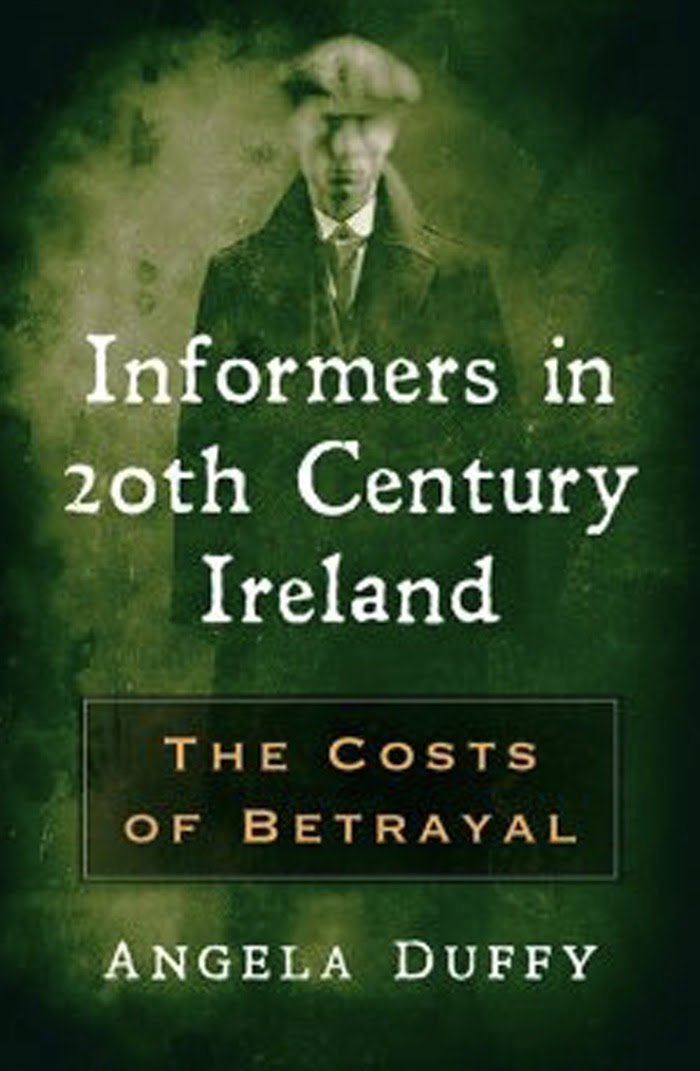
As for my case studies: they’re full of skulduggery, secrets and mayhem, all of which I like, and there is a more serious side to the book, as there should be. This is history, it really happened, and a great deal of the collusion and torture I have depicted went on in our name – yours and mine. And its effect on me has been to give me a love of research which just won’t go away – I always think of it as panning for gold: sometimes nothing, sometimes just little bits (never to be despised because one of those little bits consisted of two seemingly identical telegrams providing proof positive of one man’s guilt) and the occasional nugget when you want to dance around the archives shouting “Zoweee!”
And Diane’s final verdict: “If I can survive Angela I can survive anything!”