Showing posts with label biographies. Show all posts

Friday, July 18, 2025

Review: Women in the Scottish Wars of Independence by Beth Reid

Synopsis: The Scottish Wars of Independence are often celebrated for the heroic deeds of men, but behind the scenes, noblewomen played an equally pivotal role in shaping the nation’s fate. In Women in the Scottish Wars of Independence, Beth Reid brings to life the stories of these remarkable women, from royalty to influential landowners, whose contributions to Scotland’s turbulent history have long been overlooked.

From noblewomen like Isabella MacDuff, Agnes Randolph, and Agnes Comyn—who made kings, defended castles, and led conspiracies—to royal women who influenced key decisions and defined dynasties, this book paints a vivid picture of resilience, strategy, and courage. Through chronicles, royal charters, and material culture, Reid uncovers how these women navigated war and politics, revealing their critical yet underappreciated roles in shaping the outcomes of the Wars of Independence.

Focusing on noblewomen rather than ordinary lives, this book offers a fresh perspective on a male-dominated narrative, shedding light on the influential partnerships and actions of women who stood at the heart of Scotland's history. With meticulous research and compelling storytelling, Women in the Scottish Wars of Independence is essential reading for history enthusiasts eager to explore the often-untold contributions of Scotland’s noblewomen during one of its most formative periods.

~ ~ ~

On the one hand, Reid's book is a very detailed history of the period commonly known as the Scottish Wars of Independence - the era dominating the political landscape of Scotland from the death of the little Maid of Norway to the Treaty of Berwick which formally ended the wars and secured the release of King David II of Scotland from English captivity.

On the other hand, it is an attempt to give to a small cohort of women a more visual role on the political chessboard than they may have previously been given.

To the first, Reid provides an ample study of the succession, sovereignty and overlordship of Scotland during this period. The internal political factionalism, dynastic ambitions and prevalent warfare was dominated by men. Reid states her intent to provide a renewed focus on experience and perceptions of real people, particularly women; and this this tome will provide an accessible "correction to the wider understanding of 13th and 14th century Scottish women in warfare". However, the evidence is sparse and Reid relies on a wider context and a fair bit of speculation as to what may or may not have occurred.

Reid then collates her chosen subjects into three categories: politics, warfare and captivity. Under "politics" the focus in on the rise of the Bruce women; under "warfare" the focus is on the likes of Agnes Randolph and her ilk, who defended their castles against enemy armies; whilst "captivity" focuses on the humiliating and isolating fate of primarily the Bruce women after the defeat of Robert (kudos for exploring and and expanding on this in particular).

My issue, as with many other tomes of this style, is when an author attempts to ascribe to their given subject much more than is their due, particularly when "evidence" is lacking. 

To summarise: the women featured have not been overlooked - there is ample documentation both on the internet and in print - and what his been provided herein can easily be found via both if that is what you are looking for - I could put my hand on a number of books in my own library to support this. Secondly, I would question whether all these women had "critical roles in shaping the outcomes" - one or two or three perhaps, or is Reid possibly referring to this "critical role" in the context of dynastic political marriages. Thirdly, and unfortunately, I - personally - found no "fresh perspective on a male dominated narrative" - because that is essentially what it was - a period dominated by men and their actions on both the political and military fields. Yes, there were a number of women who stood out for their deeds and actions - however, we can find many examples among their historical counterparts both on the Continent and on home soil, both before and after their own times.  These are not singularly exceptional or unique only to the Scottish Wars. Again, these actions must be put in context to both the politics of the period and of personae dramatis in whose orbits they circled.

To give the author, Beth Reid, their dues, the book is well researched, providing a good background and context of the politics of the day; it accessible (conversational even) to the lay reader, thus not a dry, academic tome; and provides a good launching pad for further research. A well-read historical researcher will not find anything new.

Monday, April 28, 2025

The Queens and Royal Women of Sweden c. 970–1330

Synopsis: This is the first major piece of scholarship to provide an overview of the lives of Sweden’s earliest documented queens, together with some of their most influential female relatives, who lived between 970 and 1330.

Spanning a period over 350 years, approximately 40 biographies are included from the semi-legendary Viking queen Sigrid StorrĂ¥da to Duchess Ingeborg of Norway, the first female de jure and de facto ruler of Sweden. 

Rather than merely summarising previous research, this study offers new perspectives on the evolution of queenship in medieval Sweden. It tracks the different religious, political, and socio-economic trends which defined and shaped the office of queen and identifies three main phases of development which led to royal women’s economic and political emancipation by the mid-fourteenth century. 

The study’s main strength lies in its close reading and novel interpretation of the surviving primary sources, enabling readers to understand the importance of these women and wider themes such as state formation, Christianisation, and international politics.

The Queens and Royal Women of Sweden, c. 970–1330 is of interest to scholars of queenship and gender studies, medieval historians in general, those with an interest in ecclesiastical history, and anyone studying medieval Scandinavia.


Friday, February 7, 2025

Review: The Concentration Camp Brothel by Robert Sommer

Synopsis: In his seminal work, The Concentration Camp Brothel, Robert Sommer reveals the hidden horrors of sexual forced labor within the SS camp system, a subject long overshadowed and seldom acknowledged in the discourse on the Holocaust.

Through his rigorous examination of over 70 archives and poignant interviews with more than 30 survivors, including former visitors of camp brothels, Sommer paints a vivid and harrowing picture of the atrocities committed. This book is the first to offer a comprehensive exploration of the establishment, operation, and profound impact of brothels in Nazi concentration camps.

Sommer's research meticulously details the brothels' integration into the concentration camp system, their role in the Nazi exploitation of bodies for control and profit, and the complex reactions of the prisoner society to these establishments. He explores the desperate survival strategies employed by the women forced into sexual labor, and the chilling motivations of their exploiters.

The book also places the tragedy of camp brothels in the broader context of sexual violence under Nazi rule, making a critical connection between these acts of exploitation and the overall history of the Holocaust. This updated English edition incorporates new findings and perspectives since the original German publication in 2009, providing a more comprehensive understanding of the subject. The foreword by Annette F. Timm adds further context and contemporary analysis, enhancing the book's relevance and depth.

~ ~ ~

A confronting lost and ignored piece of Holocaust history. A forgotten voice given a hearing; its victims left physically and emotionally scarred, viewed as collaborators despite their own incarceration; so despised by their own that many refused to openly acknowledge this part of their lives. 

Using memoirs of those who would talk and other historical documents, this is a meticulous account of the brothels that were set up and operated, albeit for a short period of time, in Nazi concentration camps. These brothels were for the use of prisoners, not the guards or officers; mainly Ayran women were "employed" - women who had already been incarcerated for what was termed "anti-social behaviours"; the brothels were used as an "incentive" to increase the productivity of the imprisoned, forced labourers.

The stats at the end of the book are eye-opening - the youngest woman was seventeen, the oldest thirty-five.

It should be remembered that since the recognition of sex slavery in International Law (c. 2002), these victims are still ignored, uncompensated (as this was considered "voluntary"), outcast.

This is a well researched and confronting piece of history that - like its victims - deserves more recognition.


Monday, January 27, 2025

Review: Stuart Spouses by Heather R Darsie

Synopsis: Stuart Spouses looks at the oft-overshadowed consorts of the Stuart monarchs, from 1406 to 1714. By focusing on these people and detailing their rises to matrimony, the trials and tribulations of their courtships, and the impact their unions and dissolutions had on the kingdoms of Scotland, England, Ireland, and Wales, one learns not only the history of these kingdoms but the true, sometimes soft, power behind the throne.


~ ~ ~

Personally, much of what is contained in this tome is not new to me. I would consider this to be more of an introductory tome for those new to Stuart history and its personalities. It also includes the interregnum period in which Cromwell and his son ruled - I am presuming for chronological purposes, and finishes with the installation of the House of Hanover. Finally, there is the inclusion of poems, written wither by or for the spouses. Though must say, glad to see the inclusion of the male consorts!

Recommended purely as an introductory tome for this period in both English and Scottish history.

Wednesday, January 1, 2025

Review: The Most Maligned Women In History by Samantha Morris

Synopsis: Examines the lives and legacies of historically vilified women, questioning the truth behind accusations of witchcraft, treason, and murder.

Throughout history women, from the lowliest of the working classes to the highest echelons of society have been accused of crimes ranging from witchcraft and vampirism to treason and mass murder. Such accusations stuck particularly when it came to women who held power – the names that we most associate with maligned women today include those that we will all have heard of. The infamy of women such as Lucrezia Borgia and Elizabeth Bathory have come down to us throughout the centuries and even in the modern world, many women are needlessly and falsely vilified. 

But just how true were these accusations? The Most Maligned Women in History takes a look at the lives of a number of women whose crimes have been seen as some of the most heinous, just how true the rumours were and whether their reputations are deserved.

~ ~ ~

Morris' book revisits the myth of the wickedness of the eleven (11) women featured and this is then put into context with both the time and the original authors (ie: those with an axe to grind).

For me personally, it was a pretty basic tome with no real arguments - the "usual suspects" are covered off (ie: Lucrezia Borgia, Elizabeth Bathory, Empress Wu, Anne Boleyn, etc) - there was no-one new for me here. At times, the "vindication" consisted of a mere paragraph or two, which I found disappointing - this would have been the perfect opportunity for a more in-depth exploration of the "tarring and feathering" of our ladies.

I would suggest this would be a "starter" tome for someone interested in furthering their study / knowledge of historical women; however, much can already be found quite readily on the internet without too much effort.


Saturday, December 23, 2023

The King's Revenge by Don Jordan

When Charles I was executed, his son made it his role to seek out retribution, producing the biggest manhunt Britain had ever seen, one that would span Europe and America and would last for thirty years. When he ascended to the throne in 1660 as Charles II, his search for revenge intensified, with show trials in London and assassination squads scouring foreign countries. Many of the most senior figures in England were hanged, drawn and quartered; imprisoned for life; or consigned to a self-imposed exile, in constant fear of the assassin's bullet.

History has painted the regicides and their supporters as fanatics, but among them were exceptional men, including John Milton, poetic genius and political propagandist; Oliver Cromwell's steely son-in-law, Henry Ireton; and the errant son of an earl, Algernon Sidney, whose writings helped inspire the founders of the American Revolution. Cromwell himself was subjected to the most bizarre symbolic revenge when—though long-dead—his body was disinterred and beheaded.

Set in an age of intrigue and betrayal, The King's Revenge brings these remarkable figures vividly to life in an engrossing tale of ambition, double agents, and espionage.

Sunday, December 25, 2022

Review: Medieval Royal Mistresses by Julia Hickey

Synopsis: Marriage for Medieval kings was about politics, power and the provision of legitimate heirs. Mistresses were about love, lust and possession. It was a world that included kidnap, poison, murder, violation, public shaming and accusations of witchcraft. Ambition and quick wits as well as beauty were essential attributes for any royal mistress. Infamy, assassination and imprisonment awaited some royal mistresses who tumbled from favour whilst others disappeared into obscurity or respectable lives as married women and were quickly forgotten.

Meet Nest of Wales, born in turbulent times, whose abduction started a war; Alice Perrers and Jane Shore labelled ‘whores’ and ‘wantons’; Katherine Swynford who turned the medieval world upside down with a royal happy-ever-after and Rosamund Clifford who left history and stepped into legend.

Discover how serial royal womanisers married off their discarded mistresses to bind their allies close. Explore the semi-official roles of some mistresses; the illegitimate children who became kings; secret marriage ceremonies; Edith Forne Sigulfson and Lady Eleanor Talbot who sought atonement through religion as well as the aristocratic women who became the victims of royal lust.

Most of the shameful women who shared the beds of medieval kings were silenced, besmirched or consigned to the footnotes of a patriarchal worldview but they negotiated paths between the private and public spheres of medieval court life - changing history as they went.


My views on this book are conflicting. On the one hand, kudos for seeking out some of the lesser known historical women and providing something despite there being very little to go on in some instances. But on the other hand, this really has provided nothing that a good google search could not turn up. On the one hand, there is an interesting selection of mistresses; yet on the other, they are tried and true selections with a number of inclusions I found myself questioning as to their inclusion at all.

I found the subtitle not only deceiving and infuriating but rather trite - "Mischievous Women who Slept with Kings and Princes" . Where were these vamps and ingenues, these Mata Haris who plied their wares before all manner of royalty, these saucy and salacious bawds who managed to seduce and satiate royal carnal desires all for gain. Cue Sid James and the Carry-On gang - disappointingly no. If the focus was to bring these women to the fore, calling them "shameful" from the very outset does nothing to further that aim.

Beginning in the late 10th century with Canute and finishing off with the last Plantagenet King Edward IV, we are treated to not only a history lesson but also a rather dry series of biographies. Hickey repeats all the usual rumours, innuendos and scandals, providing very little by way of anything new. The selections are narrowly focused on and in the British Isles - the side trip to France seemed out of place. As I mentioned before, there were a number of inclusions that really should not have been there at all as there were no sufficient proofs, and then there were the generalisations where names were unknown.

What I was looking for and yet found lacking was any real exploration of the role of the royal mistress. Many of these women had no choice in this - women were chattels - property of first their fathers then husbands, and ultimately of their direct lord; very few were able to assert the independence of thought and action that many of us can do today. It is a shame that through a lack of any detailed accounts of many, their lives are seen only as a mere footnote in the pages of the lives of the men with whom they were associated.

This tome is not overly long, however, the material contained therein was not sufficient to keep me fully engaged. Being extremely well read on much of the content already, I was looking for that little something more - that new take, some new theory or thoughts, even some small snippet of of the promise of something new. The phrase quality not quantity comes to mind in this instance - we know you have done your due diligence, but there is no need to cram it all into one space as it shows that you really don't know what to do with it all.

I am sure that there is a market for this and there will be many who will enjoy this immensely, unfortunately, I am not to be one of them.

Monday, June 13, 2022

Review: Warrior Women by Will Roberts

Synopsis: Warrior Women consists of fifteen short stories of women who led men into battle, fought alongside them, or resisted invasion of their homeland by foreign forces. Some are well known, others less known.

From ancient times, I chose Atalanta, who played a significant role in the Calydonian Boar Hunt, and according to some of the chroniclers, sailed with Jason on the Argo in search of the Golden Fleece. Another from this era, Artemisia, the Queen of Caria, fought for Xerxes against the Greeks in the Greco-Persian War, and Cynane, the little-known half-sister of Alexander the Great, herself a fine warrior who led her army into battle.

From the Roman era, this compilation would not be complete without Boudica of the Britons, and I have included two others who resisted the Romans who were determined to impose the ways of Rome on their culture: Zenobia, Queen of Palmyra, and Mavia, of the Tanūkhids, (Saracens), who led a similar revolt against the Romans one hundred years after Zenobia.

From Asia, I chose Nakano Takeko, who fought to uphold the shogun and the samurai traditions. She led a squad of women against the riflemen of the Imperial army of Emperor Meiji, armed with only her naginata, the traditional samurai pole weapon, in the Boshin War. Also, from this region, and my favourite, I have Ba Trieu, the Korean warrior who resisted the Chinese invasion in the third century. She must have looked magnificent as she rode into battle on her great war-elephant, with her yellow cloak billowing in the breeze.

Another who would resist the Chinese, though in a different age, was Ani Pachen, the young Tibetan warrior nun, who fought the Chinese after they invaded Tibet in the 1950s, and when captured, would spend more than twenty years in prison.

Closer to home, I have included Lagertha, the Viking shield maiden; Gwenllian, the Welsh warrior princess Maurice of Londres mercilessly beheaded, as with Boudica, it would be inexcusable not to include Joan of Arc.

From North America, I have included the Apache warrior, Lozen, another who rarely gets mentioned in history books but who fought alongside her brother, Victorio, against the United States and Mexican armies, who were determined to wipe out the Native American.

From South America, Juana Azurduy de Padilla fought in the Bolivian War of Independence against the Spanish. Achieving the rank of Lieutenant Colonel and was revered by the President, Simon Bolivar. She died penniless and forgotten.

In this collection, the continent of Africa representative is Yaa Asantewaa, of the Ashanti, who opposed the British colonisation of their home, now part of modern-day Ghana. She died in exile on the distant shores of the Seychelles Islands.


Simple storytelling narrative with a decent mix of nations and time periods - kudos for that!. The narrative is not overly taxing and it was - for me - a quick read. All of the ladies present were know to me - however, I am sure readers will enjoy learning about some that may not be so well know.  A decent enough read for an independently published tome.


Tuesday, August 31, 2021

Review: Usurpers: a New Look at Medieval Kings by Michele Morrical

Synopsis: In the Middle Ages, England had to contend with a string of usurpers who disrupted the British monarchy and ultimately changed the course of European history by deposing England's reigning kings and seizing power for themselves. Some of the most infamous usurper kings to come out of medieval England include William the Conqueror, Stephen of Blois, Henry Bolingbroke, Edward IV, Richard III, and Henry Tudor. Did these kings really deserve the title of usurper or were they unfairly vilified by royal propaganda and biased chroniclers?

In this book we examine the lives of these six medieval kings, the circumstances which brought each of them to power, and whether or not they deserve the title of usurper. Along the way readers will hear stories of some of the most fascinating people from medieval Europe, including Empress Matilda, the woman who nearly succeeded at becoming the first ruling Queen of England; Eleanor of Aquitaine, the queen of both France and England who stirred her own sons to rebel against their father, Henry II; the cruel and vengeful reign of Richard II which caused his own family to overthrow him; the epic struggle for power between Henry VI, Margaret of Anjou, Richard of York, and Edward IV during the Wars of the Roses; the notorious Richard III and his monstrous reputation as a child-killer; and Henry VII who rose from relative obscurity to establish the most famous royal family of all time: the Tudors.


Whilst I appreciate that this promises a rather unique look at the reigns of some notable kings and whether they were worthy of the title "usurper" that had been applied to them, this really did not ignite any spark.

If you are going to use the words "a new look" in the title, then there should be something new that has not been repeated elsewhere. If I have picked up your tome with the title "usurpers" in it - it means that I have read the usual tomes, have a working background knowledge, and don't need the details of each kings' reign ..... in detail, including a history of events of the previous rulers.

Even a cursory read of the synopsis will tell you that there is more being included than needs to be - in fact - where really does Eleanor of Aquitaine fit into the subjects being studied - Henry II is not being accused of being a usurper nor is Richard or John. Begs a number of questions ... 

If you plan to provide an analysis of the reign of kings considered as usurpers, then more than a one to two page assessment at the end of what I considered to be an information dump, is required. What I am after is a unique, unbiased, assessment of why each deserved or did not deserve the title of usurper - not just a throw-away "because he snuffed out the previous ruler" or "because of his father's political ambitions" or "because his stole it {the crown} away".  And the synopsis will also tell you - if you read between the lines - what the verdict already is!

The assessment, whatever the author's opinion is, needs to be weighted against the reign, the actions, and viewed in the context of the period in order to be able to formulate a cohesive analysis. Sure provide some background - but - after I finished and looked at the sources provided and noted that I had read them all - sometimes less is more - a short sharp summary of events. I know you've done the research - what I want to see is how you've applied it to the premise - did the book meet the brief. Well ... briefly.

I would put this in the category of more popularist history - certainly, from the tone of the narrative, the language, it is not an academic text - I was left wondering who the intended audience was. Even if the reader had read nothing about the history of England from the time of Alfred to Henry VIII, I would be hesitant is suggesting this as an initial text. I actually did not enjoy reading this at all.  I think this is more of a case of someone thought it was a good idea to cobble together a number of blog posts and present them in book form (and not for the first time from this publisher unfortunately).

Everyone is entitled to their own opinion - and this is mine (based upon many, many years of reading and studying history).


Sunday, May 3, 2020

Books: Medieval Spain

The Unconquered Knight: A Chronicle of the Deeds of Don Pero Niño, Count of Buelna by Gutierre Diaz de Gamez
The heroic exploits of the 15th-century Count of Buelna, including tournament glories, knightly romance and the bitter hardships of life on campaign.

Gutierre Diaz de Gamez entered the service of Pero Niño, count of Buelna, in 1402, when they were both about 23, and served as head of his military household for nearly fifty years. He began a chronicle of his master's deeds in about 1431, and it is this eyewitness account of the life of a knight, both in war and peace, which is translated here. 

It is written in praise of his master, but beneath the veneer of hero-worship a good deal of the reality of a knight's existence shows through: even in the prologue, Diaz de Gamez gives a bitter picture of the hardships of a military campaign: 'Knights who are at the wars eat their bread in sorrow; their ease in weariness and sweat... Mouldy bread or biscuit, meat cooked or uncooked, water from a pond or a butt, poor sleep with their armour still on their backs, the enemy an arrow-shot off...' On the other hand, he can evoke the glories of a tournament, in which his master excelled, and his triumphs as a military commander both by sea and land. It is a story full of colour, adventure and romance, and one which deserves its place in the chronicles of chivalry.


The Duke of Alba by Henry Kamen
"The Duke of Alba" by Henry KamenFerdinand Alvarez de Toledo, the third duke of Alba (1507–82), is known to history as “the butcher of Flanders.” The general who carried out Philip II’s repressive policies in the Netherlands, he was responsible for the massacre of thousands of men, women, and children, considering it better to lay waste an entire country than leave it in the hands of heretics. Alba came to represent for contemporaries as well as for future generations the unacceptable face of Spanish imperialism.

In this intriguing re-evaluation, Henry Kamen narrates the duke’s personal history, looking beyond the conventional image to reveal motives and to explain rather than simply to condemn. Kamen examines the early years of Alba’s life, his travels over the whole of Europe, and the complex military and political career that made him Spain’s leading general of the imperial age. Drawing on the duke’s rich and expressive surviving correspondence, Kamen explores Alba’s beliefs and considers his infamous actions within the contexts of his time and of the monarchs—Emperor Charles V and King Philip II of Spain—whom he served.


Phillip II by Henry Kamen
"Philip of Spain" by Henry KamenPhilip II of Spain—ruler of the most extensive empire the world had ever known—has been viewed in a harsh and negative light since his death in 1598. Identified with repression, bigotry, and fanaticism by his enemies, he has been judged more by the political events of his reign than by his person. This book, published four hundred years after Philip's death, is the first full-scale biography of the king. Placing him within the social, cultural, religious, and regional context of his times, it presents a startling new picture of his character and reign.

Drawing on Philip's unpublished correspondence and on many other archival sources, Henry Kamen reveals much about Philip the youth, the man, the husband, the father, the frequently troubled Christian, and the king. Kamen finds that Philip was a cosmopolitan prince whose extensive experience of northern Europe broadened his cultural imagination and tastes, whose staunchly conservative ideas were far from being illiberal and fanatical, whose religious attitudes led him to accept a practical coexistence with Protestants and Jews, and whose support for Las Casas and other defenders of the Indians in America helped determine government policy. Shedding completely new light on most aspects of Philip's private life and, in consequence, on his public actions, the book is the definitive portrayal of Philip II.


Commander of the Armada: The Seventh Duke of Medina Sidonia by Peter Pierson
"Commander of the Armada" by Peter PiersonThe seventh Duke of Medina Sidonia is best known as the man who led to defeat the Spanish Armada of 1588. This book by Peter Pierson is the first complete biography in any language of this important figure. Based on previously inaccessible documents from the Medina Sidonia archives, it offers fascinating material on sixteenth-century Spain and new and exciting details about the armada campaign.

Pierson begins by describing the Duke’s youth and his close ties to the court of Philip II. He discusses the Duke’s lifelong involvement with the shipping that navigated the treasure route from Spain to the Indies, his significant role in Philip’s successful quest for the Portuguese Crown, and his appointment as Captain General of the Ocean-Sea. Spain’s war with England dominates the central chapters of the book. Pierson relates how Medina Sidonia embargoed ships and recruited men for the armada, the largest fleet yet concentrated in early modern Europe, and he analyzes Philip’s choice of the Duke to command the armada. 

Pierson provides a radical reinterpretation of the armada campaign, and with the aid of ten superb maps and diagrams he reconstructs the positions of the two navies, the number and names of ships, and their movements from the fleet’s departure for England to the surviving vessel’s arrival home. Pierson continues with Medina Sidonia’s life after the armada campaign and discusses his second appearance on the world stage, as the unsuccessful defender of CĂ¡diz against a major Anglo-Dutch attack in 1596. 


"The Count-Duke of Olivares" by J. H. ElliottThe Count-Duke of Olivares: The Statesman in an Age of Decline by JH Elliott
A masterful biography of Don Gaspar de GuzmĂ¡n, Count Duke of Olivares—righthand advisor to Spain’s Philip IV, archrival of Cardinal Richelieu, and a central figure in seventeenth-century Europe. Written by the eminent historian J. H. Elliott and based on many original sources, this elegant book is a landmark in the study of a man and an age.


The Catalan Rule of the Templars: A Critical Edition and English Translation from Barcelona, Archivo de la Corona de AragĂ³n, `Cartas Reales', MS 3344 translated by J.M. Upton-Ward
The Catalan Rule of the Templars: A Critical Edition and English Translation from Barcelona, Archivo de la Corona de Arag�n, `cartas Reales', MS 3344The Knights Templar, part monastic order, part military force, lived by a firm code, or rule, which exists in differing versions. This Spanish version is a follow-up to J.M. Upton-Ward's highly successful edition of the French Rule. 

The introduction to this Catalan Rule, Barcelona Archivo de la Corona de AragĂ³n, Cartes Reales, MS 3344, discusses the content, language and dating of the manuscript. It also provides background information derived from the French Rule (which the reader may require for a fuller appreciation of the text - see author note below) on the circumstances of the Knights Templar.

There is a brief description of the provincial organisation of the Order with particular reference to the houses in Aragon, where it is most likely that the manuscript was used; a summary of clauses; and a concordance with de Curzon's 1886 edition of the French Rule. Compared to de Curzon's edition, the Barcelona text is incomplete, but it contains important clauses not found in other manuscripts. 

A partial transcription claiming to represent all the clauses without equivalents in de Curzon's edition was published in 1889, but it omitted several clauses now published here for the first time. 

Footnotes to the English translation elucidate the text; give biographical information on the named officers of the Order where possible; and indicate significant differences compared with the French Rule.


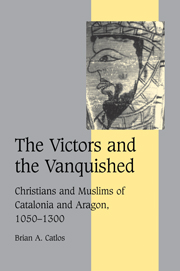
The Victors and the Vanquished: Christians and Muslims of Catalonia and Aragon, 1050–1300 by Brian A Catlos
The Victors and the VanquishedThis is a revisionary study of Muslims living under Christian rule during the Spanish 'reconquest'. It looks beyond the obvious religious distinctions and delves into the subtleties of identity in the thirteenth-century Crown of Aragon, uncovering a social dynamic in which sectarian differences comprise only one of the many factors in the causal complex of political, economic and cultural reactions. 

Beginning with the final stage of independent Muslim rule in the Ebro valley region, the book traces the transformation of Islamic society into mudéjar society under Christian domination. This was a case of social evolution in which Muslims, far from being passive victims of foreign colonisation, took an active part in shaping their institutions and experiences as subjects of the Infidel. Using a diverse range of methodological approaches, this book challenges widely held assumptions concerning Christian-Muslim relations in the Middle Ages, and minority-majority relations in general.