Showing posts with label chivalry. Show all posts

Sunday, May 3, 2020

Books: Marshal Boucicaut

The Chivalric Biography of Boucicaut, Jean II le Meingre translated by Craig Taylor & Jane H.M. Taylor
First English translation of the chivalric biography of one of France's leading figures of the middle ages.

Jean le Meingre, Maréchal Boucicaut (1364-1421), was the very flower of chivalry. From his earliest years at the royal court in Paris, he distinguished himself in knightly pursuits: sorties against seditious French nobles, ceremonial jousts against the English enemy, crusading in Tunisia and Prussia, the composition of courtly verses, and the establishment of a chivalric order for the defence of ladies, the Order of the Enterprise of the White Lady of the Green Shield. He was named Marshal of France at the age of only 27.

His chivalric biography, finished in 1409, is one of the most important accounts of the life of a knight from the Middle Ages. Whilst full of praise, it is also highly partisan and carefully selective; it glosses over the darker, much less successful, side of his career - in particular his participation in the catastrophic Nicopolis crusade (1396) and his governorship of Genoa, which came to an end shortly after the completion of the biography, when a rebellion forced him to leave the city, five years before his capture at the battle of Agincourt in 1415 and death in England in 1421.

This first English translation makes available to a wider audience a text that sheds light on the history of France, on crusading in Prussia and the Mediterranean, and on the complicated politics of Italy and the papacy during the Great Schism. It is a highly important contribution to our understanding of chivalric mentalities and attitudes in late-medieval France. It is presented with an introduction and notes.


A Virtuous Knight: Defending Marshal Boucicaut (Jean II Le Meingre, 1366-1421) by Craig Taylor
A radical re-interpretation of the chivalric biography of Boucicaut.

The Livre des fais du bon messire Jehan le Maingre (1409) is one of the most famous chivalric biographies of the Middle Ages. It presents Jean II Le Meingre, known as Boucicaut (1366-1421), as an ideal knight and role model, and has frequently been seen by modern scholars as a last-ditch effort to defend traditional chivalric values that were supposedly in decline. 

Here, however, Craig Taylor argues that the biography is a much more complex and interesting text, fusing traditional notions of chivalry with the most fashionable new ideas in circulation at the French court at the start of the fifteenth century. Rather than a nostalgic criticism of contemporary knighthood, it should be seen as a showcase of the latest ideas on chivalry, written to renew the enthusiasm of the great French princes for a man who was in grave danger of falling out of favour: its purpose was to celebrate and to defend a beleaguered Boucicaut against his critics at the royal court, and to explain his actions as governor of Genoa, his failed crusading enterprises in the Eastern Mediterranean and his unsuccessful efforts to broker a solution to the Papal Schism.

Books: Medieval Spain

The Unconquered Knight: A Chronicle of the Deeds of Don Pero Niño, Count of Buelna by Gutierre Diaz de Gamez
The heroic exploits of the 15th-century Count of Buelna, including tournament glories, knightly romance and the bitter hardships of life on campaign.

Gutierre Diaz de Gamez entered the service of Pero Niño, count of Buelna, in 1402, when they were both about 23, and served as head of his military household for nearly fifty years. He began a chronicle of his master's deeds in about 1431, and it is this eyewitness account of the life of a knight, both in war and peace, which is translated here. 

It is written in praise of his master, but beneath the veneer of hero-worship a good deal of the reality of a knight's existence shows through: even in the prologue, Diaz de Gamez gives a bitter picture of the hardships of a military campaign: 'Knights who are at the wars eat their bread in sorrow; their ease in weariness and sweat... Mouldy bread or biscuit, meat cooked or uncooked, water from a pond or a butt, poor sleep with their armour still on their backs, the enemy an arrow-shot off...' On the other hand, he can evoke the glories of a tournament, in which his master excelled, and his triumphs as a military commander both by sea and land. It is a story full of colour, adventure and romance, and one which deserves its place in the chronicles of chivalry.


The Duke of Alba by Henry Kamen
"The Duke of Alba" by Henry KamenFerdinand Alvarez de Toledo, the third duke of Alba (1507–82), is known to history as “the butcher of Flanders.” The general who carried out Philip II’s repressive policies in the Netherlands, he was responsible for the massacre of thousands of men, women, and children, considering it better to lay waste an entire country than leave it in the hands of heretics. Alba came to represent for contemporaries as well as for future generations the unacceptable face of Spanish imperialism.

In this intriguing re-evaluation, Henry Kamen narrates the duke’s personal history, looking beyond the conventional image to reveal motives and to explain rather than simply to condemn. Kamen examines the early years of Alba’s life, his travels over the whole of Europe, and the complex military and political career that made him Spain’s leading general of the imperial age. Drawing on the duke’s rich and expressive surviving correspondence, Kamen explores Alba’s beliefs and considers his infamous actions within the contexts of his time and of the monarchs—Emperor Charles V and King Philip II of Spain—whom he served.


Phillip II by Henry Kamen
"Philip of Spain" by Henry KamenPhilip II of Spain—ruler of the most extensive empire the world had ever known—has been viewed in a harsh and negative light since his death in 1598. Identified with repression, bigotry, and fanaticism by his enemies, he has been judged more by the political events of his reign than by his person. This book, published four hundred years after Philip's death, is the first full-scale biography of the king. Placing him within the social, cultural, religious, and regional context of his times, it presents a startling new picture of his character and reign.

Drawing on Philip's unpublished correspondence and on many other archival sources, Henry Kamen reveals much about Philip the youth, the man, the husband, the father, the frequently troubled Christian, and the king. Kamen finds that Philip was a cosmopolitan prince whose extensive experience of northern Europe broadened his cultural imagination and tastes, whose staunchly conservative ideas were far from being illiberal and fanatical, whose religious attitudes led him to accept a practical coexistence with Protestants and Jews, and whose support for Las Casas and other defenders of the Indians in America helped determine government policy. Shedding completely new light on most aspects of Philip's private life and, in consequence, on his public actions, the book is the definitive portrayal of Philip II.


Commander of the Armada: The Seventh Duke of Medina Sidonia by Peter Pierson
"Commander of the Armada" by Peter PiersonThe seventh Duke of Medina Sidonia is best known as the man who led to defeat the Spanish Armada of 1588. This book by Peter Pierson is the first complete biography in any language of this important figure. Based on previously inaccessible documents from the Medina Sidonia archives, it offers fascinating material on sixteenth-century Spain and new and exciting details about the armada campaign.

Pierson begins by describing the Duke’s youth and his close ties to the court of Philip II. He discusses the Duke’s lifelong involvement with the shipping that navigated the treasure route from Spain to the Indies, his significant role in Philip’s successful quest for the Portuguese Crown, and his appointment as Captain General of the Ocean-Sea. Spain’s war with England dominates the central chapters of the book. Pierson relates how Medina Sidonia embargoed ships and recruited men for the armada, the largest fleet yet concentrated in early modern Europe, and he analyzes Philip’s choice of the Duke to command the armada. 

Pierson provides a radical reinterpretation of the armada campaign, and with the aid of ten superb maps and diagrams he reconstructs the positions of the two navies, the number and names of ships, and their movements from the fleet’s departure for England to the surviving vessel’s arrival home. Pierson continues with Medina Sidonia’s life after the armada campaign and discusses his second appearance on the world stage, as the unsuccessful defender of Cádiz against a major Anglo-Dutch attack in 1596. 


"The Count-Duke of Olivares" by J. H. ElliottThe Count-Duke of Olivares: The Statesman in an Age of Decline by JH Elliott
A masterful biography of Don Gaspar de Guzmán, Count Duke of Olivares—righthand advisor to Spain’s Philip IV, archrival of Cardinal Richelieu, and a central figure in seventeenth-century Europe. Written by the eminent historian J. H. Elliott and based on many original sources, this elegant book is a landmark in the study of a man and an age.


The Catalan Rule of the Templars: A Critical Edition and English Translation from Barcelona, Archivo de la Corona de Aragón, `Cartas Reales', MS 3344 translated by J.M. Upton-Ward
The Catalan Rule of the Templars: A Critical Edition and English Translation from Barcelona, Archivo de la Corona de Arag�n, `cartas Reales', MS 3344The Knights Templar, part monastic order, part military force, lived by a firm code, or rule, which exists in differing versions. This Spanish version is a follow-up to J.M. Upton-Ward's highly successful edition of the French Rule. 

The introduction to this Catalan Rule, Barcelona Archivo de la Corona de Aragón, Cartes Reales, MS 3344, discusses the content, language and dating of the manuscript. It also provides background information derived from the French Rule (which the reader may require for a fuller appreciation of the text - see author note below) on the circumstances of the Knights Templar.

There is a brief description of the provincial organisation of the Order with particular reference to the houses in Aragon, where it is most likely that the manuscript was used; a summary of clauses; and a concordance with de Curzon's 1886 edition of the French Rule. Compared to de Curzon's edition, the Barcelona text is incomplete, but it contains important clauses not found in other manuscripts. 

A partial transcription claiming to represent all the clauses without equivalents in de Curzon's edition was published in 1889, but it omitted several clauses now published here for the first time. 

Footnotes to the English translation elucidate the text; give biographical information on the named officers of the Order where possible; and indicate significant differences compared with the French Rule.


The Victors and the Vanquished: Christians and Muslims of Catalonia and Aragon, 1050–1300 by Brian A Catlos
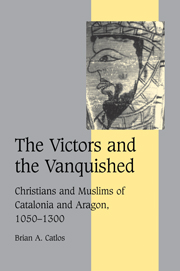
The Victors and the VanquishedThis is a revisionary study of Muslims living under Christian rule during the Spanish 'reconquest'. It looks beyond the obvious religious distinctions and delves into the subtleties of identity in the thirteenth-century Crown of Aragon, uncovering a social dynamic in which sectarian differences comprise only one of the many factors in the causal complex of political, economic and cultural reactions. 

Beginning with the final stage of independent Muslim rule in the Ebro valley region, the book traces the transformation of Islamic society into mudéjar society under Christian domination. This was a case of social evolution in which Muslims, far from being passive victims of foreign colonisation, took an active part in shaping their institutions and experiences as subjects of the Infidel. Using a diverse range of methodological approaches, this book challenges widely held assumptions concerning Christian-Muslim relations in the Middle Ages, and minority-majority relations in general.


Saturday, May 20, 2017

The Flower of Chivalry

Having just purchased a second book with this byline and contemplating a third title, my curiosity was piqued - how many other medieval warriors bore this title - who were these knights who were the epitome of the chivalric code.

William Marshal, 1st Earl of Pembroke (1146 or 1147 – 14 May 1219), also called William the Marshal, was an Anglo-Norman soldier and statesman. He served five English kings – Henry II, his sons The "Young King" Henry, Richard I, John, and John's son Henry III.

Further reading:
William Marshal, the Flower of Chivalry by Georges Duby
The Greatest Knight: The Remarkable Life of William Marshal, Power Behind Five English Thrones by Thomas Asbridge
William Marshal: Court, Career and Chivalry in the Angevin Empire 1147–1219 by David Crouch
William Marshal, Knight-Errant, Baron, and Regent of England by Sidney Painter

Bertrand du Guesclin (c. 1320 – 13 July 1380), nicknamed "The Eagle of Brittany" or "The Black Dog of Brocéliande", was a Breton knight and French military commander during the Hundred Years' War. He was Constable of France from 1370 to his death. Well known for his Fabian strategy, he took part in six pitched battles and won the four in which he held command.

Further reading:
The Flower of Chivalry: Bertrand Du Guesclin and the Hundred Years War by Richard Vernier 

Pierre Terrail, seigneur de Bayard (1473 – 30 April 1524) was a French soldier, generally known as the Chevalier de Bayard. Throughout the centuries since his death, he has been known as "the knight without fear and beyond reproach" (le chevalier sans peur et sans reproche). He himself however, preferred the name given him by his contemporaries for his gaiety and kindness, "le bon chevalier", or "the good knight". 

Further reading: 
The Chevalier Bayard by Samuel Shellabarger
The Story of the Chevalier Bayard by E Walford 

Sir William Douglas, Lord of Liddesdale (circa. 1300-k.1353) was also known as the Knight of Liddesdale and the Flower of Chivalry. He was a Scottish nobleman and soldier active during the Second War of Scottish Independence. 

Further reading: 
Border Fury: England and Scotland at War 1296-1568. by John Sadler 
The Black Douglases by Michael Brown 
Chronica Gentis Scotorum, by John of Fordun 

Sir Philip Sidney (30 November 1554 – 17 October 1586) was an English poet, courtier, scholar, and soldier, who is remembered as one of the most prominent figures of the Elizabethan age. 

Further reading
Life of the Renowned Sir Philip Sidney by Fulke Grevile
Sir Philip Sidney: Courtier Poet by Katherine Duncan-Jones

Henry V (9 August 1386 – 31 August 1422) was King of England from 1413 until his death at the age of 36 in 1422. He was the second English monarch who came from the House of Lancaster.

Further reading:
Henry V, Flower of Chivalry by Craig David Taylor
The Life and times of Henry V by P Earle
Agincourt: Henry V and the Battle That Made England by Juliet Barker

Edward of Woodstock KG (15 June 1330 – 8 June 1376), called the Black Prince, was the eldest son of King Edward III and Philippa of Hainault, and the father of King Richard II of England. He was the first Duke of Cornwall (from 1337), the Prince of Wales (from 1343) and the Prince of Aquitaine (1362–72). Edward has been referred to as the Flower of English Chivalry

Further reading:
Edward the Black Prince: Power in Medieval Europe. by David Green

Roland (died 15 August 778) was a Frankish military leader under Charlemagne who became one of the principal figures in the literary cycle known as the Matter of France. The historical Roland was military governor of the Breton March, responsible for defending Francia's frontier against the Bretons. 

Further reading:
Wikipedia - The Song of Roland
The Song of Roland by Dorothy Leigh Sayers

The story follows the adventures of a hidalgo named Mr. Alonso Quixano who reads so many chivalric romances that he loses his sanity and decides to set out to revive chivalry, undo wrongs, and bring justice to the world, under the name Don Quixote de la Mancha. 
Fearing he is dead, Sancho Panza laments Don Quixote: "Oh flower of chivalry, that with one blow of a stick hast ended the course of thy well-spent life! Oh pride of thy race, honour and glory of all La Mancha, nay, of all the world, that for want of thee will be full of evil-doers, no longer in fear of punishment for their misdeeds!

Further reading
Don Quixote by Miguel Cervantes


And finally we come to: 
Jean II Le Maingre, called Boucicaut (August 28, 1366 — June 21, 1421) was Marshal of France and a knight renowned for his military skill - the very flower of chivalry.  From his earliest years at the royal court in Paris, he distinguished himself in knightly pursuits: sorties against seditious French nobles, ceremonial jousts against the English enemy, crusading in Tunisia and Prussia, the composition of courtly verses, and the establishment of a chivalric order for the defence of ladies, the Order of the Enterprise of the White Lady of the Green Shield. 

Further reading
The Chivalric Biography of Boucicaut, Jean II Le Meingre by Craig David Taylor