Showing posts with label wars of the roses. Show all posts

Tuesday, December 31, 2024

Review: Yorkist Pretenders to the Tudor Throne by Kieran Molloy

Synopsis: For more than a decade after the Battle of Bosworth in 1485, Henry VII's fledgling dynasty was threatened by two Yorkist claimants. Lambert Simnel's rebellion, though short-lived, ended at the Battle of Stoke in 1487, a far bloodier affair than Bosworth two years earlier. The second rebellion, centred on Perkin Warbeck, ended in ignominious surrender but was the fulcrum of a power struggle involving the major European powers for most of the 1490s.

Who were these two men? Were they the imposters claimed by the King and generally accepted as such by most historians, or were they the nobles they claimed to be - Edward, Earl of Warwick and Richard, second son of Edward IV? What became of the other “Prince in the Tower”, Edward V? Were Edward IV's two sons really murdered by their uncle, Richard, Duke of Gloucester, or were both alive and involved in the two rebellions? Was there any link between the rebellions, or were they the last desperate and uncoordinated rolls of the dice by remnants of the House of York unwilling to accept the new Tudor regime? Do we really know what became of Simnel and Warbeck after their rebellions failed other than what Henry VII told us?

Part I of this book examines the evidence for the identity of Lambert Simnel while Part II recreates a courtroom trial for Perkin Warbeck allowing you, the reader, to act as jury.

~ ~ ~

The two stars are for the first part only - this was the study of Lambert Simnel, and whilst I was expecting something a bit more scholarly, this section was dealt with in an even-handed manner, providing a case for and against the various claimants.

HOWEVER, part two was a poorly executed shambles and had me asking WTF?. This smacks of laziness in an effort to reach a publication deadline and treats the reader with contempt.

Had this investigation into the Perkin Warbeck case continued in the same vein as part one, then this would be a three possibly four stars rated book.

This needs some serious re-thinking and re-editing before publication or your audience is lost.

Monday, April 22, 2024

Review: The Sisters of Richard III by Sarah J Hodder

Synopsis: This book is the narrative of three women of York, sisters to not one, but two kings of England. Anne, Elizabeth and Margaret Plantagenet were the daughters of Richard, Duke of York and his wife, Cecily Neville, and therefore sisters to Edward IV and Richard III. These women watched from the sidelines as their father challenged England’s anointed king and lost his life, as their brothers fought together for the throne of England and then amongst themselves and as the Plantagenet dynasty fell, making way for the reign of the Tudors.

But they were not just bystanders; they had their own stories to tell. Anne of York was married to the Lancastrian Duke of Exeter who sided against her father and brother, before finding later happiness, albeit briefly, with her second husband. Elizabeth of York married John de la Pole, Duke of Suffolk and became the mother of eleven children who would become thorns in the side of the Tudor kings and Margaret of York became Duchess of Burgundy, a hugely influential woman in her adopted kingdom although she never stopped supporting her family back in England. Between them, they witnessed and contributed to one of the most turbulent times in English history yet they have naturally been overshadowed by their more famous brothers. This is their story.

~ ~ ~

The story of the three Yorkists sisters - Anne, Elizabeth and Margaret - as told against the backdrop of the Wars of the Roses. And the story of the sisters is one full of persistence in keeping both the Yorkist cause and that of their family name, alive. With their mother Cecily, these three women were the great survivors of this tumultuous period in history.

Hodder provides the reader with a well-researched tome that covers off the events of the Wars of the Roses, whilst linking the lives of these women to both their family and the events.

That there may have been a perception that they had gone unremarked is only due to the fact that two of their brothers - Edward IV and Richard III - outshone them. However, they did not go completely unobserved - a careful historian or student of history will find all three women,scattered across the pages of numerous tomes. What Hodder does is bring this all under one book cover and puts their lives into context with events as their not only occurred but also how they impacted this particular family.

The keen reader of the Wars of the Roses history will enjoy this as will someone who is coming new into this period. There were many extraordinary women at this point in history - this is the story of three of them (four if you also count in their mother, Cecily).

Sunday, December 24, 2023

Review: The Kingmaker's Women by Julia Hickey

Synopsis: They were supposed to be pious, fruitful and submissive. The wealthiest women in the kingdom, Anne Beauchamp and her daughters were at the heart of bitter inheritance disputes. Well educated and extravagant, they lived in style and splendour but were forced to navigate their lives around the unpredictable clashes of the Cousins’ War. Were they pawns or did they exert an influence of their own?

The twists and turns of Fate as well as the dynastic ambitions of Richard Neville, Earl of Warwick saw Isabel married without royal permission to the Yorkist heir presumptive, George Duke of Clarence. Anne Neville was married to Edward of Lancaster, the only son of King Henry VI when her father turned his coat. One or the other was destined to become queen. Even so, the Countess of Warwick, heiress to one of the richest titles in England, could not avoid being declared legally dead so that her sons-in-law could take control of her titles and estates.

Tragic Isabel, beloved by her husband, would experience the dangers of childbirth and on her death, her midwife was accused of witchcraft and murder. Her children both faced a traitor’s death because of their Plantagenet blood. Anne Neville became the wife of Richard, Duke of Gloucester having survived a forced march, widowhood and the ambitions of Isabel’s husband. When Gloucester took the throne as Richard III, she would become Shakespeare’s tragic queen. The women behind the myth suffered misfortune and loss but fulfilled their domestic duties in the brutal world they inhabited and fought by the means available to them for what they believed to be rightfully their own.

The lives of Countess Anne and her daughters have much to say about marriage, childbirth and survival of aristocratic women in the fifteenth century.

~ ~ ~

Hickey makes the statement: "... identity and importance came from their role as daughters, and , later, as wives of the great and the good ...". Whilst true of the period, and of the periods both before and after, it is a rather disappointing one to make if you are writing a book that focuses on, brings to the fore, the women who were central in the events known as the Wars of the Roses.

However, as the blurb tells us from the beginning: "The lives of Countess Anne and her daughters have much to say about marriage, childbirth and survival of aristocratic women in the fifteenth century." Unfortunately it is the reverse - the author has much to say on marriage, childbirth and domesticity in the fifteenth century, but very little on her chosen subjects. 

We know there is no documentary trail for us to follow with regards to specifics for these women, and as such, Hickey provides generalities, assumptions and comparisons based on known contemporary sources.

Like many other authors, where the information is just not present, the focus turns to the more documented males and the usual genealogical information (who married who, who inherited what, etc).

The work is taken up to the period of the death of Anne Neville, and finishes up with a brief recap as to what was next for Anne Beauchamp and the fate of her grandchildren under the Tudors. And Hickey does provide the usual accompaniments - family tree, period timeline, a who's who, notes and pictures for those interested. 

Unfortunately, for me - personally - I found nothing new; nothing that I did not already know from my own extensive reading, and nothing that could not be found in even the most general history of the Wars of the Roses. For the newcomer, however, this book would make a good starting point - for the more well-read looking for specifics and more details, then less so.

Monday, January 2, 2023

Review: Hawker and the King's Jewel by Ethan Bale

Synopsis: Three outlaw knights. Three secrets. One last mission.

August 1485. The eve of the Battle of Bosworth. King Richard III summons his loyal and grizzled retainer, Sir John Hawker, and charges him with one final mission. After the battle, he must return a priceless ruby – one of the mysterious Tears of Byzantium – to its giver, the Doge of Venice. Richard believes the jewel has brought ill luck to his family, and wants rid of it before anything else can go wrong. Hawker is also sworn to protect Richard’s newly knighted bastard son, an arrogant youth unaware of his true parentage. But Richard’s commands are overheard by a Tudor spy.

When the king falls in battle, Hawker, his royal bastard, and another “lost” knight make common cause and flee the field with Tudor agents in hot pursuit of both the ruby and the potential Plantagenet heir. Not knowing who to trust and with England falling under the grip of Henry VII, Hawker and his small Yorkist band take the only course left open: Venice, with all its conspiracies – and the love Hawker left behind there...

~~~

Mercenary veteran Sir John Hawker escapes the bloody battlefield of Bosworth, charged by the late King Richard III, to return a jewel, previously held in possession of the Yorkists' kings, to the Doge of Venice. The pathway from Bosworth to Venice, unfortunately is never easy - the compass does not always point north. And along the way, the motley group of exiles and spies are beset by drama and betrayal. Their quest is hardly the secret they think it is, as enemies and allies alike want the jewel for themselves and their own purposes.

This first in a series gets off to a great start, as the main characters establish themselves across the pages. Bale provides plenty of historical detail that conveys the reader along on the journey. The reality of these perilous times is evident - Bale has done his due diligence.

I am looking forward to the next in this series.

Read in 2022


Sunday, December 25, 2022

Review: The Woodville Women by Sarah Hodder

Synopsis: Elizabeth Woodville, queen to Edward IV and mother of the Princes in the Tower.

Elizabeth of York, daughter of Elizabeth Woodville and the first Tudor queen of England.

Elizabeth Grey, granddaughter of Elizabeth Woodville and Countess of Kildare, whose life both in England and across the Irish sea was closely entwined with the Tudor Court.

This is the tale of three generations of women, linked by their name, Elizabeth, and by their family relationship. The story begins in the reign of the great Plantagenet Kings with the life of Elizabeth Woodville and ends in the reign of perhaps England’s most famous dynasty, that of the Tudor kings and queens. Through the life of Elizabeth of York, the first Tudor queen and Elizabeth Grey, cousin to Henry VIII and Mary Tudor, we explore the Tudor court and its dealings with the Earls of Kildare.

From the birth of our first Elizabeth to the death of our last, these three women lived through wars and coronations, births and deaths, celebration and tragedy and between them they experienced some of the most exciting and troubled times in English history. Mother, daughter and granddaughter: individually they each have their own fascinating story to tell; together their combined stories take us on a journey through a century of English life.


Okay - so what did I think. Well, what I had hoped for was a bit more about the Woodville Women - not just three Elizabeths. Whilst it is fairly obvious that there was a lot of research involved, the application could have done with some finessing. It is a very pro-Tudor piece, covering the usual myths, rumours and tropes, interspersed with assumption and supposition.

The first part deals some background including that of the period in which these women lived; Elizabeth Woodville's mother, Jacquetta of Luxembourg; the potential (and I stress potential) household dynamics, with a whole of lot of myth (including the legend of Melusine) and repeated referencing the works of Christine de Pizan. Whilst there is some merit to this introductory chapter, there is much that should have been left out.

The second part looks at mother and daughter - Elizabeth Woodville and Elizabeth Plantagenet - both queens of England, before the final part deals with Elizabeth Grey - though interesting in her own right, a rather curious choice.

Whilst we began with Jacquetta, and followed this with her daughter, granddaughter, and great granddaughter, as I mentioned, I was looking for a few more female family members. The inclusion of Elizabeth Woodville's sisters and nieces would have fleshed this out to present a more rounded overview of this particular familial branch of women. It is clear, however, that these three main women - four if we include, as we should - Jacquetta - managed to navigate the male dominated political world of their own times, to ensure that their place in it would not go unnoticed nor unremarked.

I would suggest that before diving head first into this tome, a little preemptive research of your own would be recommended.

Wednesday, May 18, 2022

Review: Soldier, Rebel, Traitor by Alexander Brondarbit

Synopsis: John Wenlock, first Lord Wenlock, was a leading diplomat, courtier and soldier during the Wars of the Roses whose remarkable career offers us a fascinating insight into one of the most turbulent periods in English medieval history. And yet he has hitherto been overshadowed by his more illustrious contemporaries. Alexander Brondarbit’s meticulously researched and perceptive biography is overdue. It establishes Wenlock as a major figure in his own right and records in vivid detail how this shrewd nobleman found his way through the brutal conflicts of his times.

Wenlock served in Henry V’s military campaigns in France in the 1420s before moving on to a career in the royal households of Henry VI, Margaret of Anjou and Edward IV. As a diplomat, he led multiple embassies to Burgundy and France and, in addition to the kings he served, he was closely connected with other notable figures of the age such as Richard Neville, earl of Warwick. But Wenlock’s speciality was on the battlefield – he took part in many raids, skirmishes and sieges and in three major battles including the Battle of Tewkesbury in 1471 where he lost his life.

Using primary sources as well as contemporary assessments in chronicles and letters, Alexander Brondarbit gives a nuanced description of the main episodes in Wenlock’s long career and throws new light on the motivation of a man who has been labelled a ‘Prince of Turncoats’ because of his frequent changes of allegiance.


I am always on the look out for books putting the spotlight onto some of the lesser know, though oft times more interesting, historical personages; so was rather keen to have a read of this book on John Wenlock.

Brondarbit says of Wenlock that his "... career was long, complex and colourful as he engaged in military venture and political intrigue ..." Brondarbit's book is "... meant to reassess one of the more maligned aristocrats ... and present a more nuanced picture of his life .. to understand rather than to rehabilitate ..."

There was much social and economic change in England at this time - the plague increased the standard of living for many people, and saw the demand for skilled labour. Warfare also saw its fair share of change, especially under the young Prince Hal - later Henry V - whose victories in France are still remembered to this day. However, it was not all clear sailing for the English in France - the tide was turning against them as France found inspiration in a peasant girl named Joan. On the political front, King Richard II had been deposed around the time of Wenlock's birth with the assumption of Henry IV onto the throne of England and thus the first of the Lancastrian line till his own death saw the succession of his son, Henry, who would himself be succeeded by his infant son, Henry VI. So you could say that by the time of his very early 20s, Wenlock had lived under four Kings of England! And it was this minority that gave rise to the future political turmoil that would lead into events colloquially known as The Wars of the Roses.

As a second son, Wenlock would be forced to seek advancement elsewhere. Like many young man of his age, he became a soldier in France in 1421 under Sir John Cornwall (himself a retainer of John of Gaunt, the King's grand uncle). This would be his first foray on the Lancastrian side as well as his first stakeholder in Lancastrian Normandy. Following the death of his brother tin 1429, Wenlock returned to England to assume his brother's estates before returning to France. From 1432, Wenlock makes regular appearances in government commissions and parliament; married; increased his land holdings; and in 1441, he entered into the King's household.

This period was the minority of Henry VI, which was considered to be remarkably successful! Fifteen years later not only was Henry still on the throne (he was crowned king of England in 1429, king of France in 1431), but his kingdom was not unduly lawless, the crown was solvent, and a substantial part of Henry V's conquests in France remained in Lancastrian hands.

Wenlock himself was back in France on behalf of the King. Brondarbit describes him as " ... apolitical pragmatist ..[who saw].. war as a means of establishing himself..." especially if it "... dovetailed with Wenlock's own personal aspirations ...". It would be around this time that Wenlock established a (political) relationship with one William de la Pole, Earl of Suffolk, and a favourite of King Henry VI. As an ambassador of the English Court, Wenlock was sent on a diplomatic mission - the marriage negotiations of Henry VI to Margaret of Anjou, which upon her arrival in England, saw Wenlock move into the Queen's household (c.1445) where he gained favour, was knighted (1448) and appointed as her Chamberlain. More diplomatic missions were undertaken over the next decade or so. All in all not bad for a second son whose prospects were considered not that promising.

It has been speculated that at some point on one of his embassies, Wenlock came into the orbit of Richard, Duke of York and his brother-in-law, Richard Neville, Earl of Warwick. There had been growing disenchantment with the current political scene - William de la Pole would bare the brunt of this opposition. He was seen as the man behind the scenes in the removal of powerful political figures (notably Humphrey of Gloucester, the King's uncle, and Cardinal Beaufort); for the growing losses in France (for which the Queen was also blamed); and for the growing mis-administration of government. Suffolk would be removed from power and exiled (though was murdered in the process). The government had huge debts as a result of the ongoing war in France, and as a result, it borrowed heavily from the nobility - often with the promise of repayment or rewards in lieu of payment, both of which was tardy in arriving. In this Wenlock was not alone - and like many others, Wenlock began to place his own survival and self interest ahead of his loyalty to the King.

Richard Plantagenet, 3rd Duke of York was - with some considerable military muscle - on the rise, By 1453 he was not only declared the heir of Henry VI but also protector of the realm. This was also the time the King suffered a catastrophic mental breakdown, rendering him incapable of governing. Suffice to say, that Wenlock drifted into the orbit of York, and became one of the most notable contributors to his cause, as was well-rewarded for his service. His actual reasons are far from clear - they were - like the man - complex, political, personal. He would suffer the ignominy of exile and attainder for his support, those rose again with the ascension of the Sunne in Splendour - Edward.

Wenlock always seemed to move within royal circles, beginning on the periphery and moving ever closer under the Yorkists. His rise naturally coincided with increased personal wealth and prestige. However, as we review his associations, we see that they were not necessarily on the side of the reigning monarch - for example he stood with York against Henry VI and Warwick against Edward IV. This close association with Warwick continued and saw him rebel against Edward IV (who fled into exile in Burgundy) and give his support to the Readeption of Henry VI (1470). Like many others Wenlock and Warwick believed that Edward had wronged those who gave him their initial support, and the influence of the "upstart" Woodvilles with their advantageous (if not at times unseemly) political marriages and insatiable greed.

Wenlock's final battle was at Tewkesbury in May 1471 - he was in the company of Queen Margaret of Anjou and the young Prince Edward. The Yorkists completely defeated their rivals, the Lancastrians. The Lancastrian heir to the throne, Edward, Prince of Wales, and many prominent Lancastrian nobles were killed during the battle or executed. Wenlock was one of them. Brondarbit writes that, in Wenlock's case - and maybe that of many others - ".... the accumulation of influence, wealth and status over the course of nearly five decades of public service was swiftly reversed by a single battle ..." Indeed, his Baronage died with him on the battlefield for there was no heir to follow him.


In "Soldier, Rebel, Traitor: John, Lord Wenlock and the Wars of the Roses", Brondarbit does his due diligence in bringing to the fore, the life of a man so remarkable, and yet unremarked. So unremarked he was that I could not find another single tome on the man - well, maybe one - "The Mystery of Lord Wenlock and His Glastonbury Treasure" by Adrian Fray (which I have not read). But no real biography with any substance.  Brondarbit's book amply and ably fills that vacuum, and is one I would gladly find space for on my "Wars of the Roses" shelves of my personal library.


Monday, October 5, 2020

Making of the Neville Family in England, 1166-1400 by Charles Young

A study of power in the middle ages: the Nevilles of Raby, who included among their members Warwick the Kingmaker, was one of the major baronial families in England.

The story of the Neville family is a fascinating one. From their inconspicuous beginnings in Lincolnshire after the Norman Conquest, by the fourteenth century the Nevilles of Raby were among the most influential groups in the north of England, virtually ruling the area by means of the royal offices they held, and their political power reached its zenith in the fifteenth century with Richard de Neville, earl of Warwick, the so-called Kingmaker. 

This new study aims to answer the question of how a family of knightly status but with no special prominence was able to rise to such heights, tracing its growth and development through a careful examination of surviving documents; it also illustrates how the governance of medieval England worked with the cooperation of baronial families in a pragmatic manner, quite apart from any abstract legal or constitutional principles.


see also:
- The Lordly Ones: A History of the Neville Family and Their Part in the Wars of the Roses by Geoffrey Richardson
- The Nevills of Middleham: England's Most Powerful Family in the Wars of the Roses by KL Clark
- Warwick the Kingmaker by Michael Hicks

Sunday, October 4, 2020

Review: Richard III and the North by MJ Trow

Richard III in the North
Synopsis: Richard III is England's most controversial king. Forever associated with the murder of his nephews, the Princes in the Tower, he divides the nation. As spectacular as his death at Bosworth in August 1485 - the last king of England to die in battle - the astonishing discovery of his bones under a Leicester car park five centuries later renewed interest in him and re-opened old debates. Is he the world's most wicked uncle; or is he (in the words of the man who most smeared him) 'a prince more sinned against than sinning'?

Richard was not born in the North; neither did he die there, but this detailed look at his life, tracing his steps over the thirty-three years that he lived, focuses on the area that he loved and made his own. As Lord of the North, he had castles at Middleham and Sheriff Hutton, Penrith and Sandal. He fought the Scots along the northern border and on their own territory. His son was born at Middleham and was invested as Prince of Wales at York Minster, where Richard planned to set up a college of 100 priests.

His white boar device can be found in obscure corners of churches and castles; his laws, framed in the single parliament of his short reign, gave rights to the people who served him and loved him north of the Trent. And when he felt threatened or outnumbered by his enemies during the turbulent years of the Wars of the Roses, it was to the men of the North that he turned for support and advice. They became his knights of the body; members of the Council of the North which outlived Richard by a 150 years. They died with him at Bosworth.

Although we cannot divorce Richard from the violent politics of the day or from events that happened far to the South, it was in the North that Richard's heart lay.  The North was his home. It was the place he loved.


I will admit to being a little biased - I have read a number of non-fiction (Vlad) and fiction (Marlowe) by MJ Trow. I find the writing style to be more conversational than academic, more so in this tome.

What we have here is a great (abridged) introduction to the Wars of the Roses and the family of Richard III. Trow uses the fortifications and castles associated with the Yorkist cause and with Richard himself as the anchor point from which to condense and recount Richard's thirty-three years.

As many would already know, following the accession of Edward IV, Richard received many honours and land, predominantly based in the north of England - t would be here that he would create long lasting ties with local landowners, religious and civil leaders - he was a popular figure.

However, not all the anchor points are linked with the north but with the family, and there is much discussion about these places not only associated with Richard, but also key points in the family history and with events being played out. 

Richard's links to the north were not only about his own time there, but also with how the northern barons - more often or not Lancastrians - impacted his childhood, adulthood, his political and personal perceptions. Trow tells us that Richard was often associated as a "northerner" due to his deliberate decision to base himself there - to live and to work - and muses that had things followed the anticipated successional course, Richard may have indeed spent much more time in the North. Regardless of how things finally played out, his legacy is and will always be associated with the North. And funnily enough, much of what Richard set about creating, the Tudors adopted themselves.

Trow also delves into the myths and perceptions of Richard himself, including the vexing question of the Princes in the Tower, finishing up with the discovery of Richard 's remains and his final internment.

Trow provides a "floor plan" for all the anchor buildings and possible plans for the major battles. All sources (of which a selected few are listed at the end) are considered and scrutinised, but here also Trow laments that lack of contemporary sources that shed light into the man himself that have not be "rewritten" or "formualted" with a specific target audience or patron in mind.

There are many books on the Wars of the Roses, Richard III and the Tudors, Trow's book will appeal to many - it is an accessible, uncomplicated history of the period and the man.


Friday, April 3, 2020

Review: The King's Dogge by Nigel Green

19200848Synopsis: Set in an England beset by power wrangling and warfare at the end of the 15th century, The King’s Dogge (the first of a two book series) tells of Francis Lovell’s meteoric rise from humble squire to closest ally of King Richard III.

Having courageously fought at Barnet for the great noble the Earl of Warwick, Lovell is introduced to Richard of Gloucester. Impressed by Lovell’s military acumen, Gloucester assigns him the unenviable task of fighting the Scots in the West March. His initiative wins him a knighthood and turns him into Gloucester’s most prized asset. In time, Lovell comes to respect Gloucester and a close friendship blossoms, each aware of one another’s weaknesses but together able to advance one another’s careers – military and political respectively. Lovell’s future is further shaped by Gloucester’s scheming wife Anne Neville, whose ambition exceeds that of her husband. 

But when their Machiavellian scheming leads to the cold-blooded murder of the princes in the tower, Lovell is forced to weigh his conscience against his sense of duty and ask himself what dark acts he is prepared to carry out in Gloucester’s name. 

The King’s Dogge is a fictional account of the rule of King Richard III as seen from the perspective of his closest adviser, Francis Lovell. It weaves a story around true events and throws the actions of the king into a new perspective when viewed against the ambition of his wife, Anne Neville. 


So, let's start with Francis Lovell. As a child, he was given over to the Earl of Warwick in who's household young Richard had spent some time. Whether they were under the same roof at the same time is uncertain. Married at a very early age, Francis was linked to Warwick, and gave his support to his father-in-law in his rebellion against Edward (1470). The following year, still a minor, he was given over into the guardianship of Edward's sister. He had, by age 18, inherited a considerable fortune.

Not only was Lovell linked by marriage to the Earl of Warwick, so too was he linked to Richard as their respective wives were cousins.

His political career lasted a mere ten years. He is said to have accompanied Richard to Scotland and was knighted (1481), coming into his service a year prior. His loyalty to Richard following the latter's accession to the throne (1483) was well rewarded. There is some conjecture as to whether he was at Bosworth (1485) with Richard or stationed somewhere else. What is certain is that he escaped soon after. As this is where we are left in Green's novel.

Now to the others mentioned in the famous poem:
“The Catte, the Ratte and Lovell our dogge
Rulyth all Englande under a hogge.”

Sir William Catesby: one of Richard's closest advisors and was well rewarded when Richard became king (1483). He fought at Bosworth, was captured and executed (1485).

Sir Richard Ratcliffe: a close companion of Richard whilst he was Duke of Gloucester. He too was well rewarded when Richard came to the throne (1483). He died at Bosworth with the king (1485).


So how does Green's novel stack up with what is known about both Lovell and Richard III? Richard was well liked in the North, and this fictional account based on Lovell's first-hand views are not very balanced. Richard is portrayed as something akin to Shakepseare's Macbeth wherein he is dominated by his scheming wife, with Lovell as the loyal Banquo as depicted by Holinshed in his Chronicles (from which Shakespeare borrowed copiously). As a high-profile Yorkist, the Lovell presented here is rather wishy-washy. 

This type of fiction may have been forgiven had this been written a century ago, but with access to today's research, the reader requires some degree of authenticity. Then again, as historical fiction, it is every author's right to interpret events their own way.

The first person narrative severely limits the scope of the story as we only see things as and when Lovell does and gain no perspective of how these events sit in a wider purview. As a novel depicting the relationship between Richard and Lovell, this does not fully meet the brief. As a novel about Lovell, well, this hits slightly closer to the mark. 


further reading:
Lovell Our Dogge by Michele Schindler
Francis, Viscount Lovel "Time Reveals All Things" by Joe Ann Ricca
Last Champion of York: Francis Lovell, Richard III's Truest Friend by Stephen David
The Secret Diary of Francis Lovell by Dawn Wheeler


Thursday, April 2, 2020

Review: A Dangerous Inheritance by Alison Weir

Synopsis: England's Tower of London was the terrifying last stop for generations of English political prisoners. A Dangerous Inheritance weaves together the lives and fates of four of its youngest and most blameless: Lady Katherine Grey, Lady Jane's younger sister; Kate Plantagenet, an English princess who lived nearly a century before her; and Edward and Richard, the boy princes imprisoned by their ruthless uncle, Richard III, never to be heard from again. Across the years, these four young royals shared the same small rooms in their dark prison, as all four shared the unfortunate role of being perceived as threats to the reigning monarch.


Again I will preface this by saying that I am not a huge fan of Weir, however, I was interested to see how this would play out with three of the main characters (the Plantagenets: Kate, Edward, Richard) having lived and died long before Katherine Grey came on the scene. There are essentially three stories: Katherine Grey, Kate Plantagenet, and the Princes in the Tower.

I will start with Kate Plantagenet, illegitimate daughter of Richard III, and of whom very little by way of fact is known, especially of her childhood. Could she have known John de la Pole, Earl of Lincoln, with whom she was said to have had a relationship with in the novel? It is possible that she knew him if she was living in the household of her uncle as following the death of Richard's own son Edward, first Edward of Warwick then John de la Pole became his nominated heir. As both Edward and John were nephews of Richard, would he have counternounced a relationship between his own daughter (illegitimate or not) and his nephew and heir?. 

After Richard succeeded to the throne Katherine was married to William Herbert, Earl of Huntingdon, (1455-1491) as his second wife. On 29th February, 1484 Herbert covenanted 'to take to wife Dame Katherine Plantagenet, daughter to the King, before Michaelmas of that year'. Richard paid for the wedding and granted the couple an annuity of 400 marks from the lordships of Newport, Brecknok, and Hay on March 3, 1484. They probably lived at Raglan Castle, the Herbert family seat in Monmouthshire.

When Henry Earl of Richmond landed in south Wales in 1485, it is likely that a Herbert sent word to Richard of Henry's landing. William Herbert. however is not recorded as having fought for his father-in-law at Bosworth, though de la Pole quite possibly did. At the coronation of Elizabeth of York in November 1487, William Herbert is referred to as a widower, the marriage is not thought to have produced any children. What happened to Katherine is speculation - though it is commonly thought that she had died prior (she is last mentioned in March 1485), possibly in childbirth.

Now to Katherine Grey - one of the famous Grey sisters, the others being Jane and Mary; all granddaughters of Henry VIII"s sister, Mary. Katherine was initially wed to Henry, Lord Herbert, the son of the Earl of Pembroke (1553) - however when the plot to put Jane on the throne failed, this marriage was annulled and she was returned to her family (1554). She and her sister Mary were, at one stage, considered as potential heirs to their cousin, Elizabeth I of England. However, Katherine incurred the wrath of Elizabeth by secretly marrying (1560) Edward Seymour, 1st Earl of Hertford (it was forbidden to marry without the Queen's consent - it was considered treason to do so). Arrested (c.1561) after the Queen was informed of their clandestine marriage, Katherine was confined to a life in captivity until her death (1568), having borne two sons in the Tower of London.

The only tenuous link between the two women is that both their husbands were, at one point, Earls of Pembroke and both were in close proximity to the throne.  


So my thoughts.  Unfortunately, I found it rather average.  What appeared to me to be two potentially separate stories were merged together with the mystery of the princes binding them together in some strange manner.    The different narratives - first person for Katherine, third for Kate - does not really work and was at times unclear in its direction.  The addition of the "supernatural" element (supposedly binding both women together through history) merely creates a fog over the narrative and lends itself to confusion.  Then Weir trots out her standard anti-Richard bias.

Did either of women embark on a search for the truth behind the "princes in the tower" mystery?  Highly unlikely as I think both would have been more focused on their own survival in what were periods of great uncertainty.  Her handling of the paranormal component was not done well - she could easily have left Kate Plantagenet out of it altogether, the story may have flowed a bit better. And I question whether Katherine Grey would have even considered that Richard was innocent of the crimes landed at his doorstep, if indeed she gave any  thought to this at all.

I did like Weir's portrayal of Elizabeth's nastier side - people tend to forget that she was a jealous and vindictive woman, only seeing her as Gloriana. That was a refreshing change and the one upside.

So for me, this was average novel from Weir.  Just because she has written much on the era does not make what she writes as the gospel truth or perfect, there is always a great deal of supposition and inference in her works. This was not her best work of fiction - and is really only one for the Tudor fans. 

Wednesday, April 1, 2020

Review: The Merry Mistress by Philip Lindsay


28247981. sy475 Synopsis: England, 1483: Unloved and publicly disgraced, an adulteress walks the streets of London to Ludgate prison. Her feet are bare; in her hands she carries a penitential candle. Her name is Jane Shore.

Philip Lindsay recounts Jane’s story – from her marriage as a child of fourteen to William Shore to her life at court as one of Edward IV’s lovers – with a masterful knowledge of this troubled period in history.

Through wars and betrayal, secrecy and discovery, he weaves a compelling tale of a child thrust into the life of a woman, pulling in the reader until they are entirely submerged in her tale of woe and wonder.

For Jane Shore was a woman like no other, unafraid of danger and cunning enough to work herself from the position of a simple mercer’s wife to one of the Queen’s most trusted ladies in waiting – and even into the heart of the King.


This re-telling of Jane Shore's story dates from the 1950s, and opens with Jane as she performs her "walk of shame" in her kirtle through the streets with a taper in her hand, and attracting a lot of male attention along the way. Following her penance, Jane is confined to Ludgate Prison where she reflects on her life and takes us back to where it all began. 

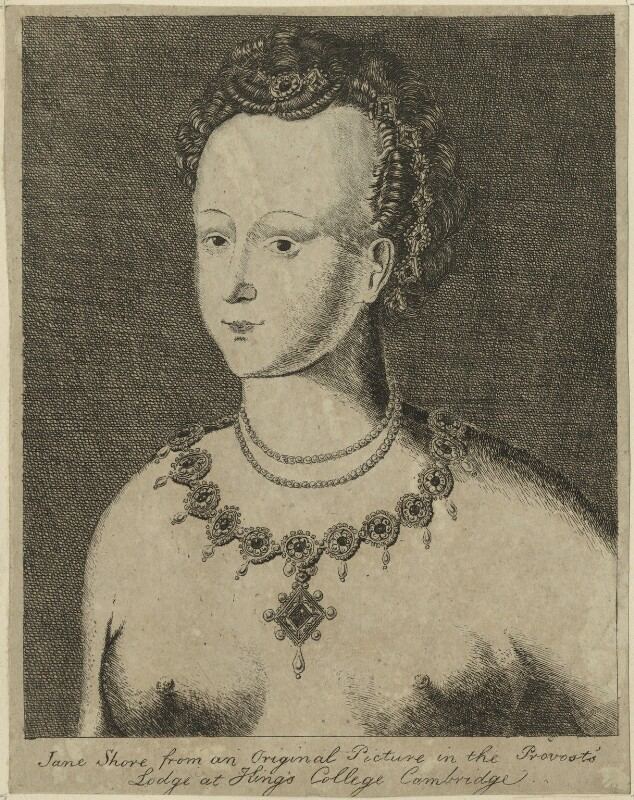
Jane Shore NPG D24096 Jane Shore Portrait National Portrait Gallery
From humble beginnings as Elizabeth Lambert, daughter of a prosperous merchant, her early association with William Hastings, her marriage to William Shore (often referred to as a goldsmith), and through to the annulment of her marriage, Jane narrates her own story.

Jane was one of the many mistresses of King Edward IV of England, and one of three whom he described as "the merriest, the wiliest, and the holiest harlots" in his realm. He was said devoted to her and did not discard her as he had done with so many others; however, she was also said not "showered with gifts" as other were. Jane, far from being solely devoted to Edward,was also the mistress of other noblemen, including Edward's stepson, Thomas Grey, 1st Marquess of Dorset, and William Hastings, 1st Baron Hastings, his close friend and adviser.

Jane Shore: The 15th Century Royal Mistress Forced to Walk ...
Following the death of Edward IV, Jane was said to have brokered an alliance between Hastings and the Woodvilles. However, upon the accession of Richard as King, she is accused conspiracy, required to do public penance and imprisoned. Whilst in prison, her gaoler John Russell become so enamoured, that he petitioned the King to marry her. She lived the rest of her life in comfortable anonymity.

Lindsay's novel contains much detail, focuses more on her relationships, is slightly dated by today's standards, though is still quite a readable tome on a woman at the periphery of the Wars of the Roses.


further reading:
A Merry Mistress by Judith Saxton
The Tragedy of Jane Shore by Nicholas Rowe
The Unfortunate Concubine, Or, History of Jane Shore, Mistress to Edward IV. King of England by S. King
The Witchery of Jane Shore, the Rose of London: the romance of a royal mistress by Charles John Samuel Thompson
The Life and Character of Jane shore by George Sewell
Re-Presenting 'Jane' Shore: Harlot and Heroine by Maria M Scott
The Intrigues of Jane Shore: A Tragedy, Or, the Fate of Unlawful Love by J. Read
The Mysterious Mistress: The Life and Legend of Jane Shore by Margaret Crosland
Royal Mistress: A Novel by Anne Easter Smith
The Fair Penitent and Jane Shore by Nicholas Rowe
The Life and Death of Jane Shore by E. Petch
Mistress to the Crown by Isolde Martyn
The Goldsmith's Wife by Jean Plaidy
Figures in Silk by Vanorra Bennett


Saturday, November 16, 2019

Review: The Brothers York by Thomas Penn

Synopsis: Thomas Penn's brilliant new telling of the wars of the roses takes us inside a conflict that fractured the nation for more than three decades. During this time, the house of York came to dominate England. At its heart were three charismatic brothers - Edward, George and Richard - who became the figureheads of a spectacular ruling dynasty. Together, they looked invincible. But with Edward's ascendancy the brothers began to turn on one another, unleashing a catastrophic chain of rebellion, vendetta, fratricide, usurpation and regicide. The brutal end came at Bosworth Field in 1485, with the death of the youngest, then Richard III, at the hands of a new usurper, Henry Tudor. The story of a warring family unable to sustain its influence and power, The Brothers York brings to life a dynasty that could have been as magnificent as the Tudors. Its tragedy was that, in the space of one generation, it destroyed itself.


The Wars of the Roses were a series of English civil wars for control of the throne of England fought between supporters of two rival cadet branches of the royal House of Plantagenet: the House of Lancaster and the House of York. Eventually, the wars eliminated the male lines of both families. Although the conflict lasted through many sporadic episodes between 1455 and 1487, there was related fighting before and after this period between the parties. 

Penn's narrative begins with the rise and Edward IV and his ascendancy over Henry VI in claiming the throne of England (1461), first sought by Edward's father Richard, Duke of York (1460). For those who are unfamiliar with this period, Penn's book provides a springboard from which to launch your own journey. All the major players and events are covered off in a detailed history that is neither dry nor sleep inducing. 

So as I read, I was being tempted with interesting passages describing the wars as "... a destructive chain of rebellion, deposition, vendetta, fratricide, usurpation and regicide ..... they dynasty's end was brutal .." and of the character of the brother York who ".. burned fiercely and died young .." as being ".. shaped [by] the way the saw the world and their place in it ..". Penn further tempts us with ".. the tragedy of the brother York was that they destroyed themselves ..." and Penn was going to enlighten us as to how and why.

What is abundantly clear is that Edward himself was the architect of the demise of the House of York. His blantant favouritism, initially of his brother George and then of his collective in-laws (the Rivers and Woodville clans) at the expense of his own family and loyal supporters, created an atmosphere of bitter and petty rivalry and jealousies, punctuated by backstabbing, paranoia, treachery and ultimately, betrayal and rebellion.

Prior to his brother's marriage, George Plantagenet found himself in the enviable and complicated position of heir presumptive. As the brother of the newly crowned Edward IV, whose succession was not hereditary, George's own position needed some serious elevation. Edward began to groom George as his successor - he was endowed with lands and titles whilst still a teen, creating a strong sense of entitlement in a young man ill-strained and ill-suited for such a role. For when Edward announced his marriage to Elizabeth Woodwville, George is more or less side-lined in favour of Elizabeth's extensive family, upon whom honours and lands are loaded, and advantageous marriages are arranged. George's position as heir presumptive is now uncertain, and as he is finding himself more and more on the outer, falling ever more under the sway of the Earl of Warwick (his uncle) who sees George as the perfect foil against Edward and possibly a new tool for his kingmaking pursuits. Warwick and George collaborate and make a plan to take the crown from Edward but after their attempts fail, they are declared traitors and driven out of England.

Richard figures very little in this story as he really doesn't come into his own until late into the second part of Edward's reign. He is not the heir presumptive and spends much of his time away from Court. He is the doting and loyal younger brother of the King, not involved in the machinations of brother George and the Earl of Warwick. His character is very different from that of his brothers - he had never really known a time when war was not prevalent and was said to have been unbending in his beliefs. However, as he reaches his teens and in the wake of George's rebellion, Richard is given more responsibility in the northern part of England - afterall, Edward is far too busy satiating is carnal pursuits, preferring to leave the government to others. 

I am in two minds with this book. On the one hand, it is a very well researched and engaging history of the Wars of the Roses, that was fascinating and dramatic. However, to me, it was more of a chronicle of the rise and fall of a prominent family, with a heavy focus of Edward, his court and courtiers, contemporary politics, peppered with quite a few side journeys into other areas which I found to be both distracting, unnecessary, and of no real interest to me. 

I came into this with an already sound knowledge of the Wars of the Roses, so what I was hoping for was more of an analytical approach to the three brothers and their inter-personal relationships; I felt that there should have been more focus on this aspect to explain why the dynasty imploded ".. within a generation.." I guess I wanted a more psycho-analytical approach to explain the family dynamic - Edward (the sunne in splendour), George (the petulant middle child), Richard (the broody dark horse) - these explorations were few and far between.  Edward's nepotism on a grand scale was hardly a secret and that this would have created bitterness and tension amongst his brothers and his supporters is not surprising but this is hardly unique as history is, quite frankly, full of similar stories.


I hugely enjoyed Penn's Winter King: The Dawn of Tudor England (bio on Henry Tudor) so was looking forward to this - but left feeling just a little disappointed in that it was not structured how I thought it would have been and really, for me personally, there was nothing that I had not already read in various other tomes.  

As I mentioned, nothing should be taken away from this book as it is a quite good re-telling of the Wars of the Roses.


Thursday, October 31, 2019

Review: Dark Queen Waiting by Paul Doherty

Dark Queen Waiting (Margaret Beaufort Mystery #2)Synopsis:  October, 1471. Edward IV sits on the English throne; the House of York reigns supreme. With her young son, Henry Tudor, in exile in France, Margaret Beaufort, Countess of Richmond, shelters deep in the shadows, secretly plotting for the day when Henry can be crowned the rightful king.  But as her supporters are picked off one by one, it becomes clear that a traitor lurks within Margaret’s household. Margaret orders her sharp-witted clerk, Christopher Urswicke, to find out who has betrayed her. If he is to protect Margaret’s remaining supporters from suffering a similar fate, Urswicke must solve a baffling mystery where nothing is as it first appears.


Historical mystery fiction set in the time of the wars of the Roses. This time, from the POV of Margaret Beaufort, mother of the future Henry VII - which makes a nice change. Usually we read only from the Yorkist side wherein the Lancastrians are often portrayed as the villains (being a bit of a Yorkist myself - and so they should!). 

At this particular point of history, Margaret is married to the ailing Sir Henry Stafford (her third husband), the battle of Tewkesbury (May 1471) witnessed the death of Prince Edward, son of Henry VI and many leading Lancastrian nobles (including Henry VI himself as a consequence), and cemented the position of the House of York upon the throne of England. Margaret's son Henry Tudor has fled abroad in exile, and Margaret is still viewed with great suspicion by the Yorkists despite outwardly giving no signs of rebellion or treason. But all the while, she sits quietly plotting the the triumphant return of her son and the shining hope of the Lancastrian cause.

However, this story was slow going and again characters pop in who you are never too sure are there simply to fill the page or are actually relevant to the story. Another annoying thing is the repetition of story-telling, first by one character and then another all in the space of a few pages.

I lost interest to be quite honest, and skipped through to the end - where I finally found something of interest - the character of Christopher Urswicke - or as Doherty calls him - "the founder of the British Secret Service". Now had that been at the start ....... 

I gave this two stars on Goodreads - the second star is because of this last remark which has sent me off on the trail of Urswicke. Obviously, Doherty plans many more in this series and intends to flesh out the character of Urwiske, but as I have no intention of continuing with the series, here's a little about the man himself - Urswicke that is ...


Who Was Christopher Urswicke?
Christopher Urswicke (1448 – 1522) was a priest and confessor of Margaret Beaufort. He was Rector of Puttenham, Hertfordshire, and later Dean of Windsor. Urswicke is thought to have acted as a go-between in the plotting to place her son Henry VII of England on the throne (c.1483 - 1485). This in itself is suggestive of a protagonist in medieval mystery.

There is very little known of the early activities of Christopher Urswicke. He often said to have been the son of Sir Thomas, Recorder of London and Chief baron of the Exchequer, who during the various battles of the wars of the roses ".. made himself conspicuous by his tact and cunning in aiding the cause of the Yorkist faction.." (and this is the path Doherty takes). However, from the looks of things, he was actually the son of one John Urswicke, a lay brother of Furness Abbey. He was educated at Cambridge and ordained (1468). Sometime following this, or even before, he came to the attention of Margaret Beaufort and her son Henry Tudor, most probably through the Stanleys. Even this introduction is shrouded in mystery as Margaret will not take Thomas Stanley as her fourth husband until 1472!

These are the events that have preceded and have taken us up to our current storyline.

I will go out on a limb here and suggest Urswicke's appointment as confessor to Margaret did not occur until after this time. There are references to his being in Rome in 1480 / 1481 and then coming to the attention of Margaret who became his patron for the remainder of her life; she presented him in 1482 to his first living - Puttenham, Huntingdonshire - and made him her chaplain and confessor. It has been suggested that the family had a long association with the Stanleys and / or that Dr Lewis Caerleon, Margaret's physician may have been responsible for the introduction. Because she sought to overthrow Richard III in favor of her exiled son, Margaret needed able and discreet servants; accordingly, she took Urswicke into her household as her confessor and secretary.

Margaret apparently involved Urswicke in the negotiations between herself and John Morton, then bishop of Ely, designed to lead to the marriage of her son, the future Henry VII to Elizabeth of York (1484). After helping save Henry's life, Having helped save the earl’s life, Urswicke became his confessor, advisor, and confidential agent. Urswicke remained with Henry, and was with him in Wales when Henry was gathering troops against Richard III.

Urswicke flourished under Hnery VII and was rewarded with the prebend of St Stephen's and later to the influential position of king's clerk and almoner. He was subsequently granted other benefices, offices, and prebends. Urswicke was also involved with Roderigo de Puebla in the negotiating the Treaty of Medina del Campo that was signed on 27th March 1489. It established a common policy towards France, reduced tariffs between the two countries and agreed a marriage contract between Prince Arthur and Catherine of Aragon and also established a dowry for Catherine of 200,000 crowns.

Urswicke represented Henry VII in Rome in 1493 and met with Emperor Maximilian I in 1496. Later that year he was appointed Dean of Windsor. Urswicke was with Henry when he was poor health in the early months of 1509. 

Urswicke began to slowly retire from life at court by the early 1500s and dedicated most of his time to independent projects, such as the rebuilding of St. Augustine's, where he would ultimately die. Amongst Urswicke's friends were the well-known humanists Thomas More and Erasmus, and he supplied valuable information on Richard III to More and Polydore Virgil, both of whom wrote about the former king. 

Christopher Urswicke was all but erased from the text of Vergil's Anglica historia sometime after 1513. Evidence of his part in the dissemination of literature that Henry VIII's court (and court historian) could have considered subversive may account for Urswicke's disappearance as well as illustrate some clerical reactions to early Tudor anticlerical sentiment.

All in all, Urswicke remained a loyal servant to both Henry VII and his son and successor, Henry VIII, until the day he died (21.03.1522).


Who was Reginald Bray..?
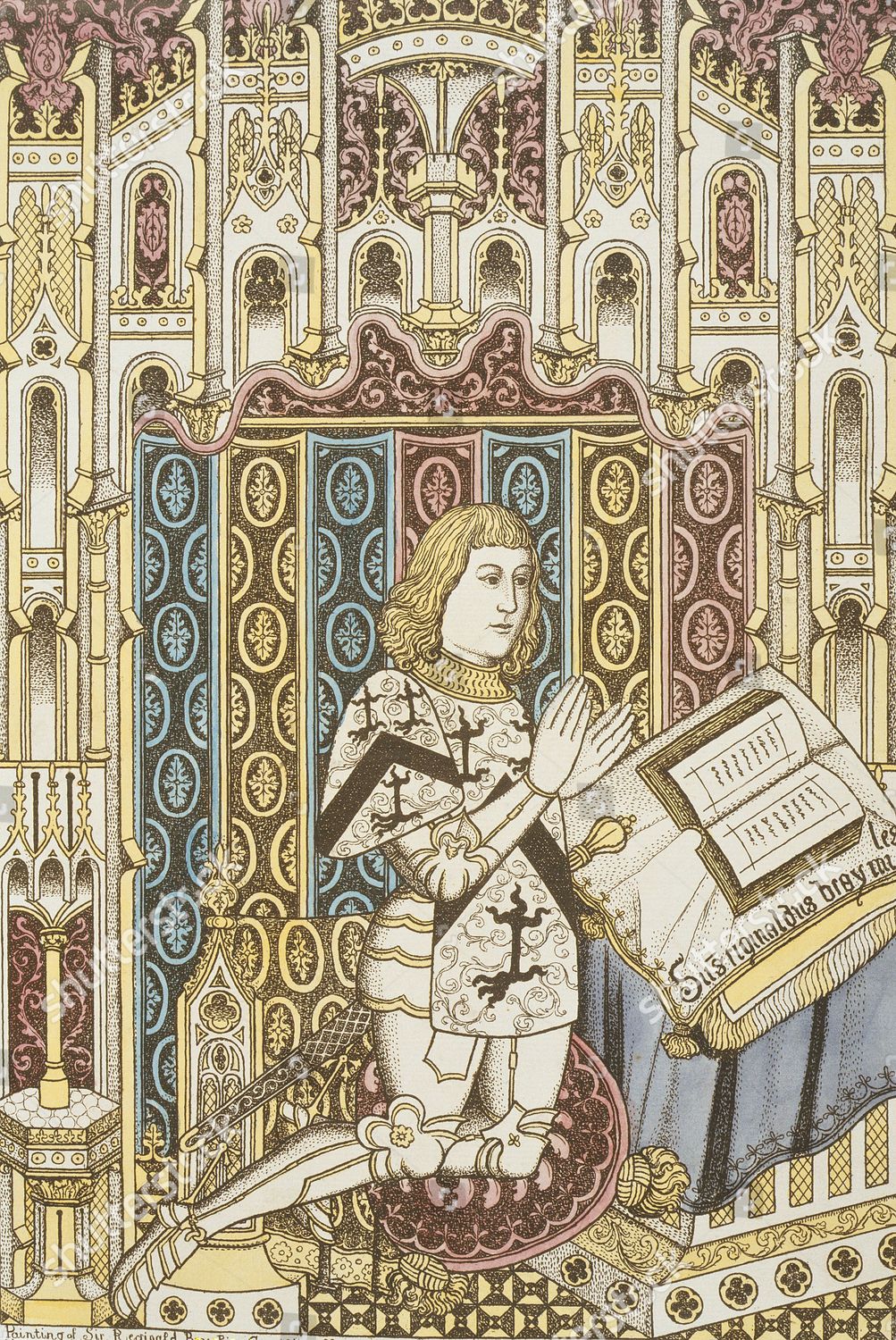
Reginald Bray (1440 - 1503), Urswicke's contemporary in Margaret Beaufort's household, played a vital role in organizing Buckingham's rebellion against Richard III during the last phase of the civil wars (1483–1487) and later became one of the most active and trusted ministers of Henry VII.

Image result for reginald brayBray began his career as receiver-general for Sir Henry Stafford, second husband of Margaret Beaufort, mother of the future Henry VII. After Stafford’s death in 1471, Bray continued to serve Lady Margaret as steward. In 1483, Bray acted as go-between for Margaret and John Morton, bishop of Ely, who was then engaged in drawing his jailer, Henry Stafford, duke of Buckingham, into the conspiracy being formed to dethrone Richard III in favor of Margaret’s son, Henry Tudor, earl of Richmond. Bray also raised much-needed funds for Richmond and won several key gentlemen to the earl’s cause, including Giles Daubeney and Richard Guildford.

After the failure of Buckingham’s Rebellion in October 1483, Bray was pardoned by Richard III, but continued to support Henry Tudorand may have gone into exile with him in France. Knighted after the Battle of Bosworth in 1485, Bray was quickly named chancellor of the Duchy of Lancaster and knight of the body. Appointed a member of the Council, Bray held various financial and administrative positions, sat in numerous Parliaments, and served on over 100 commissions. Bray’s record of loyal service to Margaret Beaufort made him a member of Henry VII’s inner circle of advisors, especially in matters of finance. Bray was responsible for the financial provisions that made possible construction of Henry VII’s chapel at Westminster and his renovations of St. George’s chapel at Windsor. He would be created a Knight of the Garter. Bray died in August 1503.


further reading: 
Urswicke also features in Robert Farrington's Henry Morane Series


Sunday, September 29, 2019

John Morton by Stuart Bradley

John Morton (c. 1420–1500) was one of the most important men in the land from the Wars of the Roses to the start of the Tudor dynasty. Yet he has been largely ignored in recent times.

He was a man of great character and influence over politics and the Church. He lived into his eighties, having served three kings as a councillor, Master of the Rolls, Lord Chancellor, bishop, Archbishop of Canterbury and Cardinal. He was a key figure in the early Tudor state. He had escaped from the Tower of London, lived in exile twice, and was a major adversary of Richard III. He funded the building of Hatfield Palace, the first drainage of the fens, and the central tower of Canterbury Cathedral. The Morton Missal contained the first printed music in England.

As S. B. Chrimes observed, ‘There can be little doubt that Morton was the key figure in Henry VII’s government, nothing approaching an adequate study of his life and role has yet been published.’ In fact, no detailed biography of Morton has been produced since Victorian times.

This book follows John Morton’s career through the reigns of Henry VI and Edward IV, and his central role in opposition to Richard III, before his fifteen years as Lord Chancellor to Henry VII, which were crucial to the establishment of the Tudor dynasty.

Sunday, August 18, 2019

Amberley Publishing - Interest History Titles

Amberley Publishing have some history titles out that have caught my eye - thought I would share:


La Reine Blanche by Sarah Bryson
This is the story of Mary Tudor, told through her own words via primary sources, state papers and letters, for the first time.


The Anarchy: the Darkest Days of Medieval England by Teresa Cole
The Anarchy blends contemporary, sometimes eyewitness accounts with modern analysis to describe a period of England’s history so dark and lawless that those who lived through it declared that ‘Christ and his saints slept.'


Edward the Elder: King of the Anglo-Saxons by Michael John Key
Edward the Elder succeeded his father Alfred the Great to the kingdom of Wessex ... and deserved to be recognised for his contribution to Anglo-Saxon history and a new assessment of his reign is overdue. He proved equal to the task of cementing and extending the advances made by his father, and paved the way for the eventual unification of the Anglo-Saxon kingdoms and the nation-state of England. The course of English medieval history after his death was a direct outcome of military successes during his reign.


Plantagenet Queens & Consorts: Family, Duty & Power by Dr Steven J. Corvi
Examination of the lives and influence of ten figures, comparing their different approaches to the maintenance of political power in what is always described as a man’s world. On the contrary, there is strong evidence to suggest that these women had more political impact than those who came later – with the exception of Elizabeth I – right up to the present day. Beginning with Eleanor of Provence, loyal spouse of Henry III, the author follows the thread of queenship: Philippa of Hainault, Joan of Navarre, Katherine Valois, Elizabeth Woodville, and others, to Henry VII’s Elizabeth of York. 


The House of Grey: Friends & Foes of Kings by Melita Thomas
The Grey family was one of medieval England’s most important dynasties, serving the kings of England as sheriffs, barons and military leaders from the reign of William the Conqueror. Family came to prominence in the period known as the Wars of the Roses and under the Tudor Monarchs.


Lovell Our Dogge: The Life of Viscount Lovell by Michèle Schindler
Francis Lovell was not only an ally of Richard III but his closest friend, and one of the wealthiest barons in England. Author Michèle Schindler returns to primary sources to reveal the man who was not only a boyhood friend of the king-to-be as a ward of Edward IV, but also linked to him by marriage: his wife, Anne FitzHugh, was first cousin to Richard’s wife, Anne Neville.


Ranulf de Blondeville: The First English Hero Iain Soden
The study of a nobleman whose exploits became the stuff of medieval romance, once recounted in the same breath as Robin Hood. Ranulf de Blondeville was fabulously rich and powerful. He served six kings, endured difficult regime-change, fought his way across half of France and back and more than once turned wrested victory from defeat. He never forgot that his roots were Norman although his efforts were for England, where he made his home.


Lawson Lies Still in the Thames: The Extraordinary Life of Vice-Admiral John Lawson by Gill Blanchard
This biography charts the tumultuous life and times of an ordinary seaman born in Scarborough who would come to play a major role in the English Civil War, the Restoration, the Anglo-Dutch Wars and the start of the transformation of England into a global political and economic power in the seventeenth century.